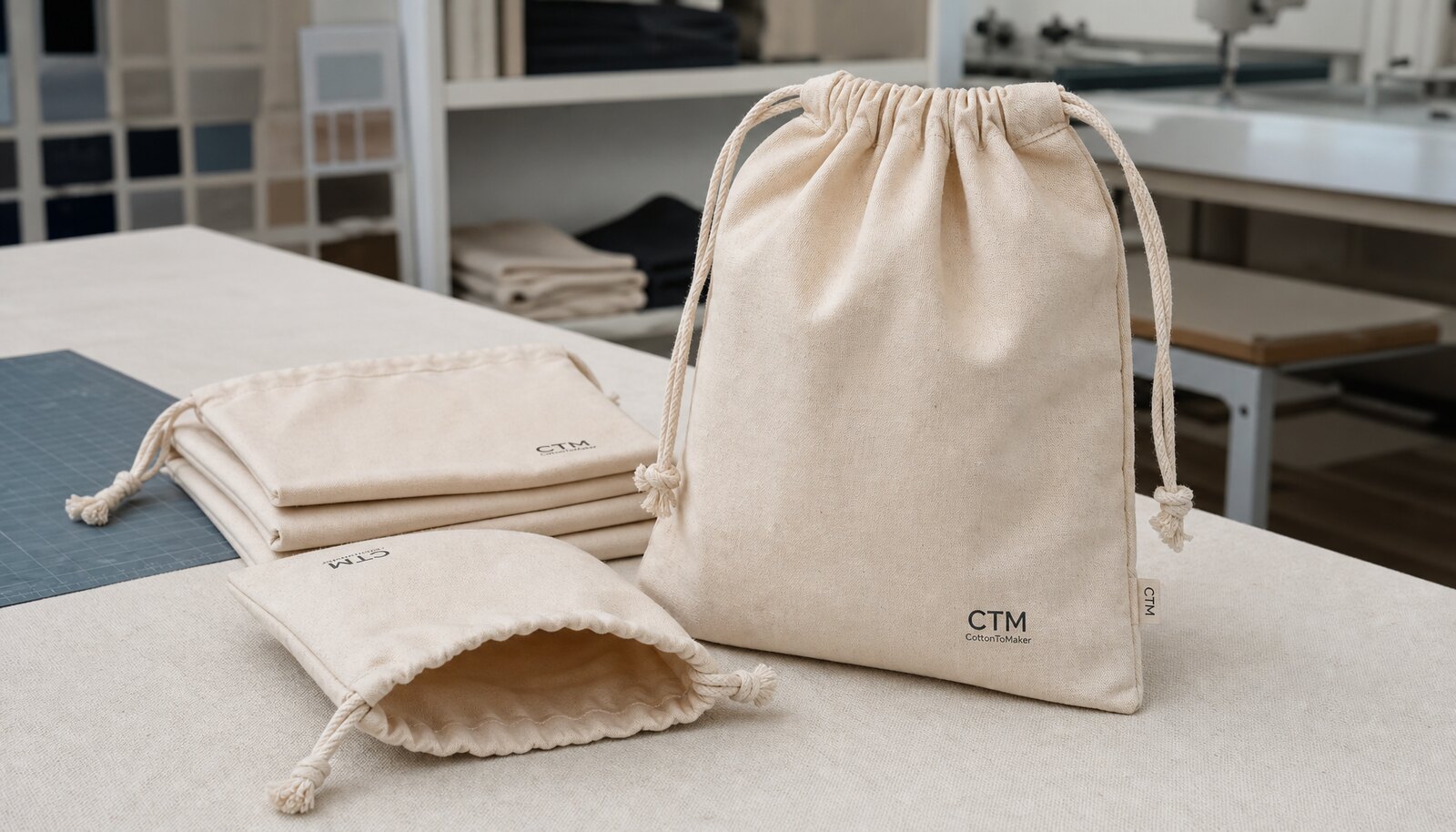
Why cosmetic drawstring pouches are a retail buying problem, not just a packaging item
Cosmetic drawstring pouches for retail look simple, but they sit in a tricky procurement zone. They are expected to hold product, protect the contents, support branding, and still contribute to a price point that makes sense for a gift set, promo pack, or standalone accessory. That combination means the lowest quote is rarely the best quote. A pouch that is a few grams too light, a few millimeters too narrow, or a little too soft can create problems at packing, merchandising, and customer use.
The retail buyer is not only buying fabric and stitching. You are buying repeatability. A pouch used in a beauty set often needs to be reordered in the same size, same color, same print position, and same packed format across seasons. If the first production run is approved loosely, the next order can drift in hand-feel, shape, or opening width. That is why this category needs a procurement mindset: detailed specification, sample control, and a quote that separates base cost from the many small extras that determine landed cost.
It also helps to think about the use environment. A pouch used inside a gift box has different requirements from one that hangs on a display hook or goes straight into e-commerce fulfillment. Shelf appearance, ease of opening, resistance to dust, and the ability to sit neatly inside secondary packaging all matter. If the pouch looks premium in a photo but collapses in a carton, the retail program still fails. Good sourcing starts by defining the pouch’s job in the product line, not by asking for a generic “cotton drawstring bag” price.
- Define whether the pouch is a retail accessory, a kit component, or a promotional insert.
- Tie the spec to the actual cosmetics or accessories it must hold.
- Use repeatability and packed condition as procurement criteria, not just first-sample appearance.
Start with the fill profile and finished size, not the artwork
A surprising number of pouch orders fail because the buyer starts with decoration before confirming what the pouch needs to carry. Cosmetics are awkward items from a packaging perspective. Compacts are flat but hard-edged, brushes are long and flexible, bottles vary in diameter, and gift sets can combine several shapes at once. The pouch size should be based on the biggest practical item plus room for hand entry and closure movement, not on a guessed flat dimension.
When writing the spec, distinguish between cut size and finished size. The manufacturer needs to know the final width, depth, and usable opening width after the seams and channel are sewn. If the pouch is meant to hold a set of products, list the actual fill contents or provide a packing mock-up. Even a small mismatch can make the pouch hard to close or visually too small once filled. For retail sets, buyers should also consider how the pouch sits in the box when folded, stacked, or tied off.
Another useful practice is to define the opening behavior. Some pouches need a wide mouth for quick packing on the production line, while others need a tighter opening so the bag looks neat on shelf. Those are not the same requirement. If your packers insert product by hand, or if a fulfillment team will pick and pack at speed, the opening width, cord pull force, and top channel height deserve explicit attention in the RFQ.
- Specify final size, usable opening, and depth separately.
- Base dimensions on the actual cosmetic items, not a generic pouch shape.
- State whether the pouch must pack quickly, sit neatly, or both.
Choose fabric weight, weave, and finish based on structure and print performance
Fabric choice drives the pouch’s appearance, stiffness, print quality, and perceived value. In this category, buyers often compare only GSM, but GSM alone is not enough. Two fabrics with the same weight can behave very differently if one is a loose plain weave and the other is a tighter canvas weave. A tighter weave usually gives better print clarity and a cleaner body shape, while a softer or looser weave can drape more naturally but show more texture and seam waviness. For many retail programs, 120–160 GSM cotton is a useful working range. If the pouch needs more body or a more premium shelf presence, 140–180 GSM canvas is often easier to merchandise.
Finish matters too. Washed or brushed fabric may feel softer, but it can change shrinkage and surface texture. That affects both the final size and how sharply the logo prints. If the customer-facing brand image is minimalist and premium, a cleaner surface and flatter weave are usually safer. If the product positioning is natural, artisanal, or eco-oriented, a slightly textured cotton can be acceptable, but the buyer should inspect how the material behaves after sewing and packing. Ask for the supplier’s fabric name, composition, finishing process, and any shrinkage treatment in writing. If the pouch is lined, confirm whether the outer and lining fabrics shrink at similar rates. Differential shrinkage is a common source of puckering at the top edge and around the channel.
For procurement, the right question is not “What is your cotton pouch price?” but “What exact fabric do you plan to sew, and how will it behave after printing, sewing, and carton storage?” That question usually separates a supplier with a real production standard from one who only has a generic quotation template.
- 120–160 GSM cotton: common balance of cost, softness, and printability.
- 140–180 GSM canvas: better structure and shelf presence for premium retail.
- Ask about weave density, surface finish, and shrinkage treatment, not GSM alone.
Closure design, seam allowance, and stitch control are where pouches win or fail
The drawstring itself is only one part of the closure system. A retail pouch needs a channel that is strong enough to handle repeated opening and closing, plus side seams that will not burst when the pouch is full. If the channel is too narrow, the cord can snag. If it is too wide, the top edge can look sloppy and the bag may not gather evenly. If the seam allowance is inconsistent, the finished opening can drift from sample to production even when the cut pattern is correct.
This is where procurement teams should get more specific than “good stitching.” Ask the supplier for the seam allowance they use, the stitch density on critical seams, and how the channel is constructed. A simple pouch may use a basic folded channel, while a better-built version may use reinforcement at the entry point or at the cord hole. Side seams and bottom corners deserve special attention because those points take the load when the pouch is packed and pulled. A pouch with weak corners can look fine empty and fail once filled with cosmetic items that have edges or weight at the base.
The closure cord also deserves a decision. Common options include cotton round cord, braided cord, flat tape cord, or polyester cord. Cotton often suits a natural retail look, while polyester can resist wear better and slide more smoothly through the channel. Braided cords may hold shape well and feel premium, but they can be slightly more expensive. If the pouch is wider, a double drawcord can make opening and closing easier and may improve the consumer experience. However, it can also add labor and cost. Ask for cord diameter or width, end finish, and whether the cord is color matched or stock standard. A neat pouch can be undermined by a cord that frays, twists, or looks out of place on the shelf.
- Request seam allowance, stitch density, and channel construction details in the quote.
- Check side seams and bottom corners for reinforcement and burst resistance.
- Choose cord type based on handling, look, and cost—not only appearance.
Decoration choices should match artwork complexity, retail position, and wash/rub exposure
For simple branding, one-color screen print remains the most practical option for many cosmetic pouch programs. It usually offers good opacity, straightforward cost control, and stable repeatability. But even screen print needs the right base fabric and the right expectations. On coarse canvas or highly textured cotton, fine text can lose sharpness. If the logo includes small type, thin lines, or tight spacing, the buyer should insist on a physical sample printed on the final fabric, not on a smooth substitute. Color density, edge sharpness, and placement accuracy are all more visible in retail than in a sample-room photo.
More detailed artwork may require heat transfer or digital print. These methods can handle gradients or multi-color images, but they bring different risks. Heat transfer can crack or lift if the adhesive and fabric interaction is poor, while digital print may show more variation in color depth depending on fabric texture and coating. Neither method is automatically better; the correct choice depends on the design, volume, and retail environment. If the pouch is likely to be handled often or reused by the consumer, ask how the decoration performs after rubbing, folding, and typical retail handling.
Premium brands sometimes prefer a woven label, side label, or embroidery instead of a large front graphic. That can work well when the overall brand language is restrained and the pouch should feel elevated rather than promotional. Embroidery is especially attractive on thicker canvas, but it can distort the panel if the stitch count is too heavy. A smart RFQ should ask not only which decoration method is available, but also what artwork size the supplier recommends, whether the logo will remain legible at shelf distance, and what durability test they use before shipment.
- Screen print is usually best for simple logos and repeat orders.
- Heat transfer and digital print need physical approval on final fabric.
- Woven labels and embroidery suit premium positioning, but both need control on size and placement.
MOQ, setup cost, and color splits should be read together
MOQ is often presented as if it were a single number, but for retail pouches the real minimum depends on several variables: size, color, fabric availability, decoration method, and packing format. A quote of 1,000 pieces may apply only to one size and one artwork version on standard stock fabric. If you ask for three colorways, a custom label, and individual polybags, the practical order economics can change fast. That is why buyers should ask whether the MOQ is per color, per size, per print version, or per combined order.
The most useful comparison is not just unit price; it is total order cost. Add sample fees, screen or plate fees, label setup, packing labor, and any surcharge for low-volume color splits. In some cases, a “lower MOQ” supplier becomes the more expensive option once setup charges are included. This is especially common when a launch order is small and the pouch needs a custom-dyed fabric or nonstandard cord. The quote should show whether the factory is using stock fabric or buying special material only for your order.
Buyers should also think about follow-on replenishment. A supplier that can make a first small run but cannot repeat the same shade or construction later may create continuity problems across retail seasons. It is worth asking whether the supplier can archive the approved fabric swatch, print file, and packing standard for reorder use. That question is not bureaucratic; it reduces future mismatch and shortens the next quotation cycle.
- Clarify MOQ by color, size, and artwork version.
- Compare setup fees, sample fees, and packing labor against unit price.
- Ask whether the supplier can repeat the same approved spec on reorder.
Separate competent factories from intermediaries before you commit
For procurement buyers, supplier route is not just a paperwork issue. A direct factory, a trading company, and a subcontracted arrangement can all send a usable quote, but they do not offer the same level of control. A competent factory should be able to explain the production flow from fabric receiving to cutting, sewing, printing, inspection, and carton packing. If the supplier speaks only in generalities and cannot name where the pouch is actually sewn or decorated, you may be dealing with a trading layer that has limited visibility into the process.
A strong quote should reveal real production knowledge. Ask about the sewing line, the print process, and the inspection stage. Ask who signs off on the first article, who checks size and color, and whether they can show you recent production photos that match your style. If a supplier cannot discuss seam allowance, channel construction, or the handling of defects in plain language, that is a signal to slow down. A middleman can still be acceptable, but only if they add useful coordination and clearly disclose the actual factory behind the order.
There is also a cost tradeoff. Traders may offer flexibility for mixed orders or smaller test programs, but the quote can be less transparent and may hide margin between you and the factory. Direct factories are usually better for repeat retail items where consistency matters, especially if the pouch will be re-ordered across different product launches. The key procurement question is not “Who is cheapest?” but “Who can prove control over the specs I care about?”
- Ask whether the supplier owns the sewing, printing, and packing steps or subcontracts them.
- Request evidence of actual production capability, not only sales-room samples.
- Choose the route that best matches repeatability, transparency, and reorder control.
Use a sourcing comparison that reflects cost, risk, and use case
The table below is designed for decision-making, not for spec browsing. It compares sourcing routes and pouch configurations on the questions that matter most in procurement: how much control you get, what cost tradeoffs are likely, and where the risks usually sit. Cosmetic pouches are small items, but the sourcing model can determine whether the project runs smoothly or creates repeated rework.
A useful way to read this table is to first identify your program type: promotional insert, launch SKU, premium retail accessory, or repeated replenishment item. Then choose the route or construction level that matches the volume, time pressure, and brand expectations.
- Use the table to choose a route before you finalize the RFQ.
- Match sourcing model to order frequency and spec sensitivity.
- Treat risk control as part of price, not as an afterthought.
Sampling and approval should test real use, not just visual appearance
A sample is only useful if it reflects the real production setup. That means the final fabric, final cord, final decoration method, and final packing format. A common mistake is approving a visually attractive sample made with a nicer cord or a cleaner fabric than the bulk order. The result is disappointment when production arrives because the closure feel, shape, or print appearance is not the same. For cosmetic pouches, that difference can be obvious even if the sample looked acceptable in photos.
The approval process should include practical checks. Put the actual cosmetic products or representative fillers into the pouch, then close it several times. Look at how the top edge gathers, whether the opening stays square, and whether the pouch still sits neatly inside the outer pack or display carton. If the pouch is part of a set, test the whole set together. This catches clearance issues that do not show up when the pouch is empty. Buyers should also capture the approved version in writing: fabric swatch, cord sample, print proof, size spec, packing method, and any agreed tolerance. That record becomes the reference if production deviates later.
If changes are needed, make them before the bulk run starts. It is much easier to adjust channel width, logo placement, or finished size during sample development than after material has been cut. A good supplier will welcome a clear approval trail because it reduces disputes later. A weak supplier will push for vague approval and then rely on the buyer accepting variation. That is usually a bad sign.
- Approve the exact production fabric, cord, print method, and packing method.
- Fill the pouch with real or representative products before sign-off.
- Keep a signed record of size, color, artwork, and packing details.
Packing, labeling, and carton controls change both retail appearance and landed cost
Packing is where a lot of “cheap” pouch quotes become expensive in practice. Individual polybagging protects the pouch from dust, warehouse handling, and staining, but it adds material, labor, and carton volume. Bulk packing saves money and is often fine for internal warehousing, but it can crease soft cotton or canvas if cartons are overfilled or stored too long. If the pouch will go through retail distribution or e-commerce fulfillment, the packaging standard should be written into the RFQ, not negotiated after the sample is approved.
Buyers should also define whether the pouches are folded, nested, tied, stacked, or set-packed. The packing method affects not only the cost but also the unboxing look and the degree of wrinkling at arrival. Retail sets often require barcode stickers, carton marks, or inner pack counts that align with warehouse scanning. If the supplier does not know your receiving requirements, you may pay for relabeling or repacking after arrival.
Carton information matters for freight planning. Ask for carton dimensions, gross weight, pack count, and whether the supplier can propose palletization. This is not just logistics detail; it affects the true landed cost and the amount of space your warehouse will need. If you are comparing suppliers, make sure each quote uses the same packing assumptions. Otherwise, one supplier may look cheaper only because their carton pack count is inflated or their packing standard is loose.
- Specify bulk pack versus individual polybagging based on the sales channel.
- Define barcode, carton mark, and inner pack requirements early.
- Request carton dimensions and gross weight before freight is booked.
Specification comparison for buyers
| Sourcing option | Best use case | Cost and MOQ tradeoff | Risks to manage | What to ask in the quote |
|---|---|---|---|---|
| Direct factory | Repeat retail SKUs, private-label programs, and custom specs that need tighter control | Usually better unit economics at scale, but may require higher setup discipline and clearer specifications | Can be hard to judge capability if the factory outsources stitching or printing; confirm actual production ownership | Do you cut and sew in-house, print in-house, and pack in-house? What is included in sample fees, screen/plate fees, and packaging? |
| Trading company | Multi-item bundles, lower-volume launches, or buyers needing one communication point for several product types | Often more flexible on small orders, but the unit price can be higher and the cost structure less transparent | Hidden margin, subcontracted production, and weaker control over fabric, stitching, and inspection standards | Which factory will make this, and can you name the sewing line, print method, and inspection step? |
| Regional converter | Shorter supply routes, local finishing, or programs that benefit from easier replenishment | Useful when freight time or import complexity matters, but material options and decoration capacity may be narrower | Fabric consistency, color matching, and trim availability can be less competitive for large retail programs | Where is the fabric sourced, what is converted locally, and what tolerance do you hold on size and shade? |
| Stock pouch with custom branding | Fast launches, promotions, seasonal retail packs, and budget-sensitive programs | Lowest setup burden, usually smaller MOQ, but limited in size, color, and structure choices | Brand fit may be weak; print placement, pouch size, or cord color may not fully match the line | What stock base sizes and colors are available, and what branding methods work without retooling? |
| Fully custom sewn pouch | Retail hero product, premium gift set, or brand-owned reusable pouch | Better fit and presentation, but higher development time, more sample rounds, and more specification control required | Design errors on seam allowance, closure channel, or finished opening can delay launch | Can you make a tech pack from our drawing, and what is your sample approval process before bulk? |
| Unlined cotton pouch | Accessory inserts, lower-cost kits, and products that do not need a structured finish | Usually lower cost and quicker to sew, but less rigid and more visible seam allowance inside | Can look flimsy if the GSM is too low or the seam finish is inconsistent | What GSM, weave, and seam allowance do you recommend for the target fill weight? |
| Lined pouch | Premium cosmetics, travel sets, or items with sharp edges that could show through unlined fabric | More material and sewing time, so higher cost and potentially longer lead time | Lining can shrink differently, distort size, or create bulk at the channel if not controlled | What lining material, seam finish, and tolerance do you use for the finished opening and depth? |
| Screen print | Simple logos, one or two colors, and repeatable retail orders | Strong cost efficiency at volume, but setup depends on color count and artwork size | Fine lines can fill in on textured fabric; print position and opacity need physical approval | How many colors are included, what mesh count do you use, and what is your rub-resistance check? |
| Woven label or side label | Minimalist branding, premium retail presentation, or subtle brand placement | Usually a modest add-on, but still requires size, placement, and attachment method control | Poor label stitching can pucker the pouch or detach after repeated opening | What label size, attachment stitch, and placement tolerance do you hold? |
Buyer checklist before sampling
- Confirm finished size, usable opening width, and usable depth; do not approve only the flat cut size.
- State the fabric by fiber type, weave, GSM, finish, and whether pre-shrinking or washing is allowed.
- Define the seam allowance, channel width, cord insertion method, and the minimum acceptable stitch density for key seams.
- Specify the closure cord type: cotton round cord, braided cord, polyester cord, flat tape, or double drawcord, and name the cord diameter or width.
- Set the logo location, print area, color count, and whether the artwork must survive retail rub handling.
- Require sample approval on the exact fabric, cord, decoration method, and packing format that will be used in bulk.
- State the packaging method: bulk pack, individual polybag, barcode sticker, set pack, or shelf-ready carton labeling.
- Ask for carton dimensions, pack count, gross weight, and pallet assumptions before confirming freight and warehouse intake.
- Define acceptable tolerances for size, color, print position, seam alignment, and cord length before the PO is issued.
- Request the supplier’s defect handling rule: what is minor, major, or critical, and how many replacements or rework units are included.
Factory quote questions to send
- Are you a direct factory, a trading company, or a subcontracted sewing office, and which steps do you control in-house?
- What is the exact material specification, including fabric fiber, GSM, weave, finish, and any shrinkage treatment?
- What seam allowance do you sew to, and what stitch density do you use on side seams, bottom seams, and the drawcord channel?
- What cord type, diameter, and end finish are included in the quote, and can the cord color be matched?
- Which decoration method is quoted, and how many colors, stitch passes, or setup files are included?
- What are the MOQ terms by size, color, and artwork version, and do stock fabrics or trims reduce the MOQ?
- Are screen fees, plate fees, label fees, sampling fees, and packing fees included or separate?
- What are the accepted tolerances for finished size, opening width, print position, and color variation?
- What inspection standard do you use, and can you state your AQL level for major and minor defects?
- What packing format is included, and can you share carton size, carton count, and gross weight estimate?
Quality-control points to confirm
- Measure finished width, height, and opening width against the approved spec sheet using the same measurement method every time; record the tool used and the tolerance limit.
- Inspect seam construction at the side seams, bottom corners, and drawcord channel; look for skipped stitches, loose needle holes, puckering, or seam burst risk.
- Define stitch density expectations in the tech pack for critical seams, and reject samples that show visibly sparse stitching or uneven stitch spacing compared with the approval sample.
- Check seam allowance consistency by opening one or more samples for destructive review; confirm the allowance is stable enough to keep the channel and side seams from drifting.
- Verify drawcord performance by opening and closing the pouch repeatedly; the cord should move without snagging, twisting, or creating uneven gathers.
- Test cord ends, knots, or metal/plastic tips where used; loose ends, fraying, or sharp hardware edges should be treated as defects.
- Review print quality under normal retail lighting for opacity, registration, edge sharpness, and placement; define what counts as a positional miss or color shift.
- Run a basic rub check on the print and high-contact areas; note any cracking, transfer, or visible color loss before shipment release.
- Check color consistency across cartons and lots using the approved reference, especially for natural cotton, dyed canvas, or lined styles where shade changes are visible.
- Inspect for cleanliness: oil marks, dust, loose threads, broken needles, lint, or storage stains should not be present on packed retail units.