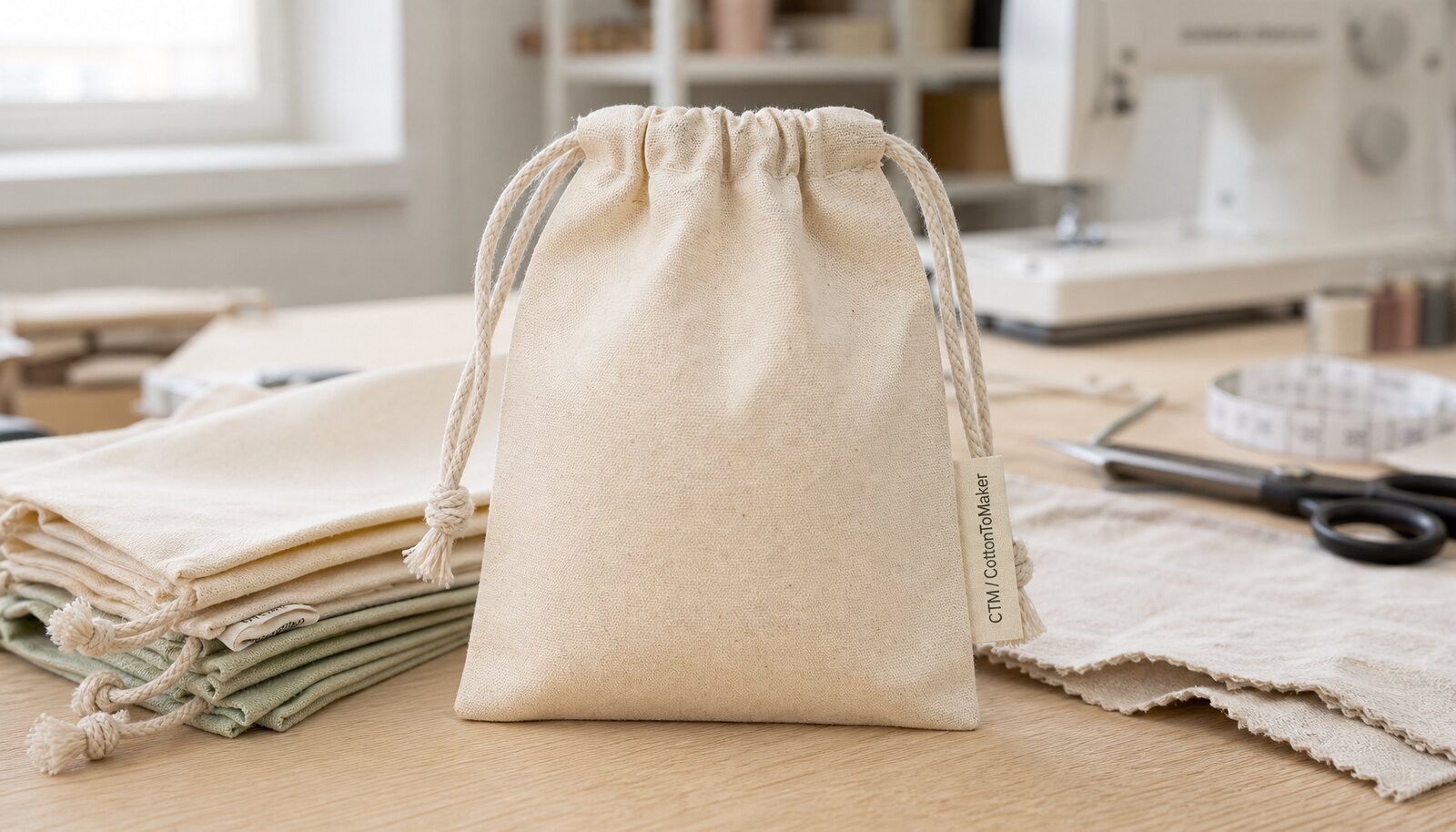
Define the event use case before you write the spec
Cosmetic drawstring pouches for events are small products with large downstream consequences. The same pouch can be a sample wrap, a beauty-kit carrier, a hotel amenity pack, or a premium PR insert, and each use case drives a different spec. A pouch that looks polished when empty can become a problem the moment a filled bottle pushes on the seam or a powder item rubs against a loose inner thread. Procurement teams get the best results when they write the brief around the actual contents, the event format, and the distribution method—not around a generic idea of a “nice pouch.”
For B2B buyers, the first decision is functional, not decorative. Ask whether the pouch must protect fragile cosmetics, hold multiple components, or simply present a branded giveaway at low cost. A pouch for one lipstick sample may only need a small flat format, while a multi-piece beauty kit may need gusset depth, stronger cord exits, and a cleaner inside finish. If the pouch will be reused after the event, then the fabric feel, print durability, and seam quality become part of the buyer’s brand risk. Those details should be specified before quotes go out so suppliers are comparing the same job.
- Single-item sample wrap: prioritize compact size, crisp print, and low cost per unit.
- Multi-piece beauty kit: prioritize gusset depth, seam strength, and easy closure.
- Premium PR mailer: prioritize presentation, label detail, and reuse value.
- Venue handout: prioritize count accuracy, fast packing, and dependable replenishment.
Choose fabric weight and weave for the real fill weight
Cotton is the most common starting point for cosmetic drawstring pouches for events because it prints cleanly, has a natural hand feel, and is easy to source across multiple quality tiers. The weight range should be set against the contents, not against a marketing assumption. Light fabrics around 100 to 120 GSM can be acceptable for sachets, simple sample sets, or pouches that will only carry very light items. Once the contents include several pieces or any rigid cosmetic container, the fabric usually needs more body. For most standard event programs, 120 to 150 GSM is a practical baseline because it balances cost, appearance, and printability.
Heavier options around 180 to 220 GSM are better when the pouch is intended to be reused or when the contents are dense, rigid, or expensive enough to justify a more substantial presentation. But GSM alone does not tell the whole story. Weave density, yarn quality, pre-washing, shrinkage allowance, and seam reinforcement all change the final result. A softer fabric may print well but distort around the drawstring channel. A heavier fabric may feel more premium but increase print cost or make tight closure harder. The procurement answer is to test the actual kit weight inside the approved pouch, then confirm the pouch still closes smoothly and holds shape after several open-close cycles.
- 100 to 120 GSM: light giveaway pouches for sachets or single samples.
- 120 to 150 GSM: the usual range for standard event cosmetic kits.
- 180 to 220 GSM: better for reusable premium pouches and heavier fills.
- Pre-shrunk or washed fabric: reduces surprise shrinkage after packing, storage, or transit.
Select the decoration method with durability in mind
Decoration is where a pouch starts to look branded—or starts to look temporary. Screen printing remains the most economical and common choice when the artwork is simple, the logo is bold, and the volume justifies a setup. It is especially strong for one-color or two-color designs on cotton, provided the ink is matched to the fabric and cured properly. For procurement teams, the key point is not whether screen print is cheap; it is whether the printed pouch can survive handling, folding, and shipping without the logo becoming patchy or weak.
More complex graphics may push buyers toward heat transfer or digital transfer, but those methods need more scrutiny. Fine details, gradients, and small text can look good in a sample and still fail after repeated handling if the film cracks or edges lift. If the pouch is intended to feel premium, woven labels, side labels, or embroidery can improve presentation. Woven labels generally offer a cleaner, lower-bulk premium cue than heavy embroidery, especially on lighter fabrics. Embroidery is attractive when the brand wants visible texture, but it can pucker thin cloth and is less forgiving if placement is even slightly off. Ask the supplier to show close-up samples of the decoration on the same fabric weight, not only on generic swatches.
- Screen print: best for simple logos, repeat volume, and controlled unit cost.
- Heat transfer: useful for short runs or multicolor art, but check for cracking and edge lift.
- Woven label: good for discreet branding and a cleaner premium finish.
- Embroidery: strong visual identity, but only if the fabric can support the stitch density cleanly.
Match pouch size and construction to the contents, not the artwork
A cosmetic pouch that is too small turns into a stress point; one that is too large can look wasteful and weakens the presentation. For small sample sets, compact flat formats often work in the 10 x 12 cm to 15 x 20 cm range. For mixed beauty items, 20 x 25 cm is a useful middle ground. Larger kits or amenity sets may need 25 x 30 cm and above, especially if bottles, boxes, or inserts must sit upright. The right size should be chosen from the fill list and the pack-out method, not from the logo layout. If the artwork forces the size decision, the pouch often ends up wrong for the product.
Construction details matter just as much as overall dimensions. A drawstring channel that is too tight can twist and pinch the cord; one that is too loose can look sloppy and reduce closing force. Cotton cord gives a natural look, while polyester cord can offer smoother pull and more consistent running. If the pouch will be opened and closed multiple times, the cord exits should be reinforced with bar tacks or extra stitching so the fabric does not tear at the stress point. For powder products or soft cosmetics, a cleaner inner trim and controlled thread trimming reduce lint complaints and give the pouch a more finished feel. Ask for a test pack with the real contents or an equivalent fill weight before final approval, because the inside behavior is what reveals the construction quality.
- 10 x 12 cm to 15 x 20 cm: small samples, sachets, and single-item gifts.
- 20 x 25 cm: versatile size for mixed beauty items and event handouts.
- 25 x 30 cm and above: better for multi-piece kits or fuller gift sets.
- Gusseted construction: better for rigid contents, layered packs, and nicer sitting shape.
Use a real sourcing comparison instead of comparing logo prices only
The quote you receive depends as much on the supplier route as on the pouch spec. A direct factory with in-house sewing and printing generally gives the tightest control over fabric, stitching, and decoration, which matters when you need repeatability or a guaranteed event date. A trading company can be useful when the project combines pouches with inserts, hangtags, and other components, but the buyer needs to know exactly where the production occurs and who carries responsibility if a component fails. A stock-pouch route can be the fastest option, but only if the base fabric, size, and color are acceptable for the campaign.
This is why procurement should compare suppliers on the same information, not on the same conversation. If one quote includes blank pouches only, another includes print and polybags, and a third includes cartons but not freight, the unit prices are not comparable. Ask every supplier to quote the same pouch size, same GSM, same artwork file, same packing method, and same shipping term. Then request a line-by-line view of what is and is not included. The cheapest headline number often becomes the most expensive order after add-ons, rework, or delayed freight are counted in.
- Direct factory: best for repeat volume and tighter process control.
- Trading company: useful when the order has several packaging components.
- Stock route: fastest for short deadlines if the blank pouch already fits the brief.
- Domestic decorator: practical for local turnaround or when blank inventory is already in hand.
Set MOQ, sampling, and approval steps before the supplier quotes
MOQ should move with complexity. A plain cotton pouch with a one-color print usually supports a lower order quantity than a custom-size pouch with lining, a gusset, or a woven label. Buyers often focus on the supplier’s headline MOQ, but the more useful question is where setup cost stops making sense. Once the spec requires additional sewing operations or extra decoration steps, the order typically needs more volume to hold the unit price in a practical range. If the event volume is uncertain, it can be smarter to pilot with a simpler spec and reserve the premium finish for a repeat run.
Sampling deserves a more structured process than many RFQs give it. A blank sample checks size, feel, weave, cord length, and basic construction, but it will not confirm logo placement or decoration quality. A printed strike-off or decorated sample checks print density, color, and positioning on the actual fabric. The pre-production sample is the final approval point before mass production; it should match the intended production method, not a hand-finished substitute. In your approval workflow, define who signs the sample, what photo evidence is acceptable, and whether any change after sign-off triggers a new sample. That small discipline helps avoid the classic dispute where the factory says the production matches the approved sample, while the buyer says the approved sample never reflected the real method.
- Blank sample: checks size, weave, cord length, and hand feel.
- Printed strike-off: checks logo placement, ink density, and color behavior.
- Pre-production sample: confirms the final production method before the full run.
- Approval rule: one named approver should sign off the master sample and artwork proof.
Build a quote package that prevents hidden costs
A useful RFQ reads like a production instruction. State the exact size, fabric, GSM, color, closure style, decoration method, artwork colors, packing method, destination, and target ship date. If the pouch needs to match other event materials, say so and include those items in the brief. Suppliers quote more accurately when the job is specific, and they are less likely to hide assumptions inside the unit price. Procurement teams that leave out details often end up with a lower quote up front and a change order later.
To make comparisons easier, ask for an all-in quote split into clear line items: product, decoration, packaging, sampling, tooling, and freight. If the supplier uses screens, plates, or labels, those should be shown separately. If inner polybags or master cartons are included, that should be visible too. The real goal is not to get the lowest number on paper; it is to understand the landed cost and the risk of scope creep. A slightly higher quote with clear inclusions, stable lead time, and a defined sample workflow is often better than a low quote that leaves procurement exposed to last-minute add-ons.
- Include exact size, fabric, GSM, color, and closure style in the RFQ.
- Attach vector artwork and state the number of print colors.
- Specify whether packing is bulk, polybagged, or set-packed.
- Request separate pricing for tooling, samples, packaging, and freight.
- Ask the supplier to identify every excluded line item in writing.
Use QC thresholds that catch real defects, not just obvious ones
QC for cosmetic drawstring pouches for events should focus on defects that buyers and end users actually notice. The common problems are uneven sizing, crooked or offset logos, rough seam trimming, weak cord exits, and dirty packing. A pouch may pass a casual visual check and still fail in use if the cord slips open, the print rubs off, or the stitching breaks under normal handling. The approved sample should become the master reference, and the inspection standard should be written around it. If the factory is left to interpret quality on its own, the accepted tolerance can end up looser than the receiving team expects.
A practical inspection plan should mention both defect severity and the acceptance standard. Many B2B buyers use an AQL-based inspection approach for shipment control, then classify issues by critical, major, and minor defects. For example, a critical defect would be a pouch that cannot close, has a broken drawstring channel, or contains contamination that makes it unusable. Major defects would include wrong dimensions beyond tolerance, severe print misplacement, open seams, or logo failure that damages the brand presentation. Minor defects would include light loose threads, small trim inconsistencies, or slight shade variation within the agreed range. Set the tolerance in the PO or QC appendix: no open seams, no broken cords, no odor, no visible stains, no print peeling, and no carton count discrepancy. If you use a third-party inspector, give them the master sample, artwork proof, carton packing map, and the defect list in advance so the report is based on your standard rather than a generic one.
- Critical defects: non-closable pouch, broken cord channel, contamination, or unusable construction.
- Major defects: wrong size outside tolerance, severe misprint, open seam, or weak print adhesion.
- Minor defects: loose thread tails, slight trim inconsistency, or small shade variation within tolerance.
- Inspection input: provide the master sample, artwork proof, and carton map before the audit.
Write an acceptance checklist for stitch, print, and packing failures
Procurement teams often say “good stitching” or “acceptable print,” but those phrases are too vague for a shipment dispute. It helps to write concrete failure examples. Stitch-related failures include skipped stitches, loose seams, broken bar tacks at the drawstring exit, twisted channel stitching, and seam fraying inside the pouch. Print-related failures include off-center logos, blurred edges, poor ink coverage, ghosting, transfer lift, cracking after folding, and color mismatch outside the approved sample range. Packing-related failures include short counts, mixed SKUs, incorrect labels, crushed cartons, and missing moisture protection when storage conditions require it. When those examples are written down, the factory knows exactly what is not acceptable and the inspector can report consistently.
The acceptance checklist should also explain what happens when a defect is found. If one carton shows print rubbing, does the buyer require 100% sorting, reprint, or replacement of only the affected carton? If a shipment is short by a small count, does the supplier reship or credit the shortfall? The answer depends on volume and event timing, but it should be pre-agreed. That is especially important for cosmetic drawstring pouches for events because the product often feeds a fixed-date program with no room for late surprises.
- Stitch failures: skipped stitches, broken bar tacks, seam fray, twisted channels.
- Print failures: off-center logos, blur, ghosting, lift, crack, or weak coverage.
- Packing failures: short counts, mixed SKUs, wrong labels, or crushed cartons.
- Disposition rule: define rework, replacement, or credit before shipment.
Manage packing and logistics so the event team can receive quickly
Packing is a commercial issue, not an afterthought. Event pouches usually need to arrive flat, clean, and easy to count, with the receiving team able to move them directly into kits or venue stock. If the pouch is part of a bundled program, set packing can reduce handling cost on the buyer side. If the pouch needs to stay pristine, individual polybags may be worth the extra cost. The best packing method depends on whether the receiving team is unpacking for assembly, direct distribution, or retail display. It also depends on the storage environment; humid storage or long transit can justify moisture protection, especially when natural fibers are used.
Ask the supplier how the pouch is folded, how many units go into an inner pack, what goes into the master carton, and what marks will appear on the carton exterior. For procurement, the carton spec should include count per carton, gross weight target, carton dimensions if freight planning matters, and whether the cartons are export-ready. If the pouches are being delivered to multiple event sites, ask for pallet logic or carton labeling by destination. A clear packing plan reduces receiving time and lowers the chance that a good product is miscounted as a bad delivery.
- Flat-packed cartons: efficient for count accuracy and venue distribution.
- Individual polybags: useful for premium kits or when cleanliness must be preserved.
- Set packing: best when each pouch belongs with a specific beauty kit component.
- Carton marks: show size, color, quantity, PO number, and destination if needed.
Specification comparison for buyers
| Sourcing route | Typical spec fit | Commercial strengths | Watchouts / decision points |
|---|---|---|---|
| Direct factory with in-house sewing and printing | Standard cotton pouch with one to two logo colors, repeat event programs, or large annual buys | Best control over fabric, stitching, print curing, and carton packing; easier to lock a stable repeat order; usually the cleanest path for landed-cost planning | Verify that printing, labeling, and packing are actually in-house; ask who signs off on the pre-production sample and what happens if color or placement drifts |
| Stock pouch + custom print | Fast-turn event giveaways using a common size and base fabric | Lower sampling burden, faster start, and simpler approval when size is already known; useful for simple branding at short notice | Stock shade and fabric lot can vary; confirm the exact blank before print approval and ask whether future reorders will match the same base stock |
| Fully custom size and construction | Beauty PR kits, hotel amenity sets, multi-piece bundles, or products that need a specific fit | Lets procurement design the pouch around the fill list, presentation standard, and reuse target; can improve the customer experience when the contents are rigid or layered | Tooling, pattern setup, and sampling add time and cost; ask how many sample rounds are included and whether the quoted MOQ changes with gusset, lining, or closure changes |
| Trading company bundling multiple items | Campaigns that combine pouches, inserts, cards, hangtags, or mixed promotional items | Single point of contact for multiple components; can reduce coordination work when several factories would otherwise need to be managed separately | Request a production map showing which factory makes what; clarify who owns QC, replacement liability, and packing sign-off if one component fails |
| Low-MOQ workshop | Pilot events, influencer mailers, regional launches, or test orders | Useful for validating size, feel, and branding before committing to scale; may accept smaller runs with more flexible artwork options | Unit cost is often higher and repeat consistency can be weaker; ask whether the same materials and sewing team will be used on future orders |
| Premium finishing route with woven label or embroidery | Higher-end beauty gifts, retail-ready event kits, or reusable keepsake pouches | Elevates perceived value and can help the pouch stay in use after the event; supports premium brand presentation without changing the base pouch shape | Decoration adds complexity and can create puckering, thread build-up, or registration issues; request close-up samples and a durability check before approval |
| Domestic decorator using blank inventory | Urgent rework, local events, or orders where blanks are already on hand | Short logistics chain and quick turnaround when the blank pouch is already approved; practical for last-mile event needs | The decorator did not control the base pouch, so print performance depends on the quality of the blank; verify ink adhesion and seam condition before decorating |
| High-volume repeat production line | Annual conferences, chain-wide promotions, or recurring beauty events | Best unit economics when the same size and decoration repeat across seasons; easier to standardize carton counts and PO language | Do not let a low unit price hide weak tolerance discipline; require the same approved sample, carton spec, and inspection criteria on every repeat run |
Buyer checklist before sampling
- Confirm the event use case: single-item giveaway, multi-piece beauty kit, amenity set, or retail resale pack.
- Build the pouch around the actual fill list, not around a guessed gift value or a marketing photo.
- Choose fabric weight by feel and durability: light, standard, or premium reuse.
- Specify the print method, print area, artwork colors, and whether branding goes on one side or both.
- State whether the pouch must be flat, gusseted, lined, reinforced, or labeled.
- Set acceptable size tolerance, print placement tolerance, and seam strength expectations before sampling.
- Ask for a sample hierarchy: blank sample first, then printed strike-off, then pre-production sample.
- Define the approval workflow: who signs the sample, who confirms color, and what becomes the master reference.
- Request an all-in quote that separates product, print, packing, tooling, and freight.
- Align the production schedule to the event date with buffer for revisions, inspection, and shipment delay.
Factory quote questions to send
- What exact fabric, weave, GSM, and finish are included in the quote?
- Is the logo printed, woven, embroidered, or attached as a side label, and how many colors are included?
- What is the MOQ for this spec, and how does it change if we adjust size, cord type, gusset, lining, or packaging?
- Which sample stage is quoted first: blank sample, printed strike-off, or pre-production sample?
- What is the size tolerance after sewing, and what print placement tolerance do you follow?
- What stitch standard do you use for seams, cord exits, and stress points, and how do you classify minor vs major defects?
- What is the packing method per polybag, inner pack, and master carton, and are cartons export-ready?
- What is the lead time after sample approval, and what is the earliest ship date by incoterm?
- Which line items are excluded from the quoted unit price, such as screens, plates, cartons, labels, sampling, or freight?
- If the pouch is part of a recurring program, can you hold the same fabric lot or clearly note any lot-to-lot variation?
Quality-control points to confirm
- Fabric weight and hand feel match the approved sample within the agreed tolerance.
- Pouch dimensions remain within the accepted size range after sewing and finishing.
- Drawstring channel is even, with no twisting, collapsed edges, or exposed raw seams.
- Cord pull is smooth, the stopper or closure holds properly, and the pouch does not spring open under normal handling.
- Stitch density is consistent, with no broken stitches, skipped stitches, or loose thread tails at stress points.
- Logo placement is centered or positioned exactly as approved on the reference sample.
- Print adhesion passes a rub test and does not crack, peel, ghost, or bleed onto the fabric.
- Color variation across the lot stays within the approved shade range for event distribution.
- Pouches are clean inside and out, with no odor, oil marks, lint contamination, snags, or stains.
- Cartons are packed to prevent crushing, with correct count, mark label, and moisture protection if needed.