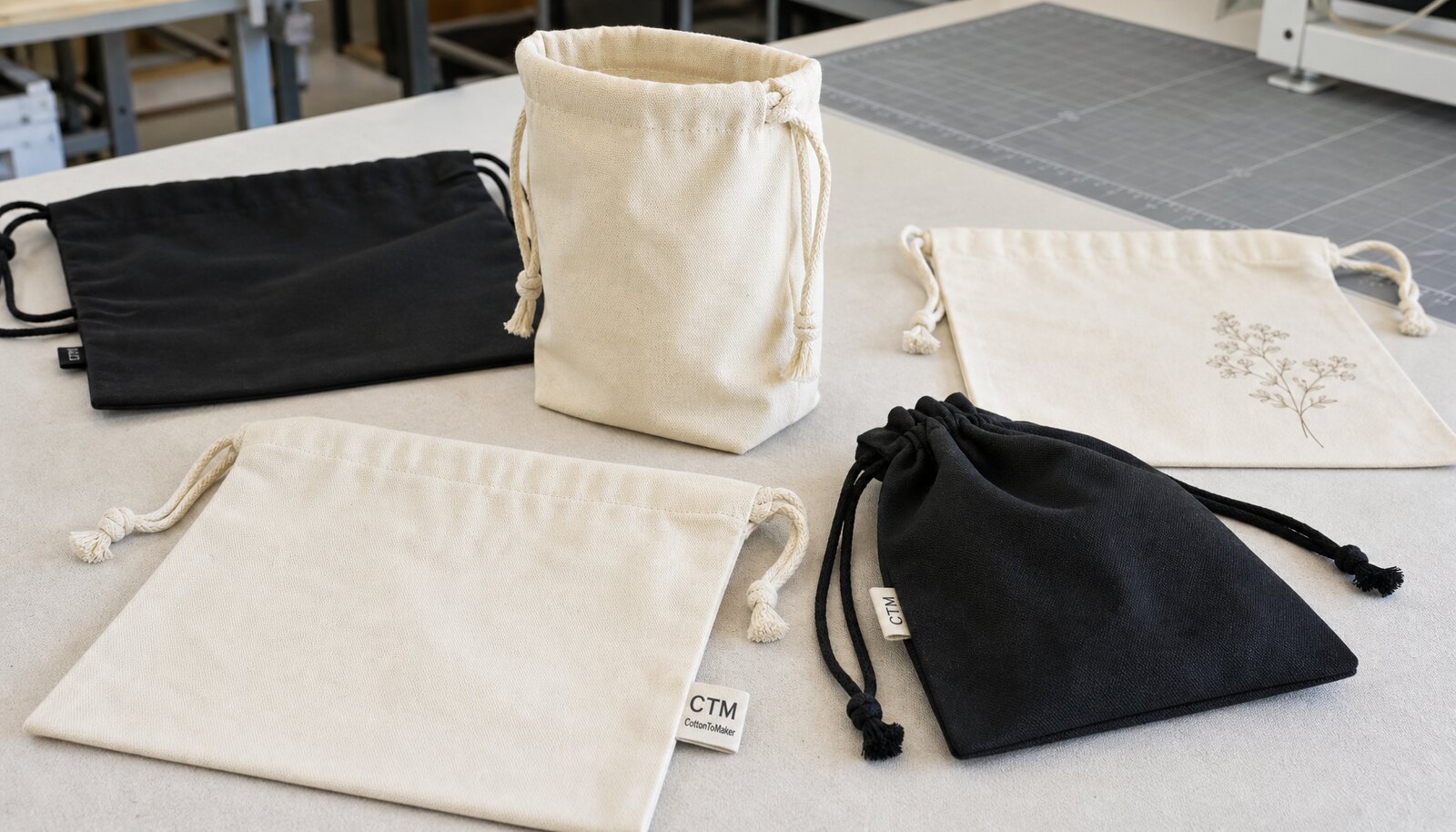
Why cosmetic drawstring pouches are a launch-critical SKU
For a brand launch, cosmetic drawstring pouches are rarely just packaging. They are often the first tactile item a customer opens, photographs, keeps, and reuses. That means the pouch has to do three jobs at once: protect the product, carry the brand mark clearly, and look consistent across the whole opening shipment. If one of those fails, the launch looks less controlled than the creative deck promised.
Procurement teams usually run into trouble when the pouch is treated as a low-value add-on. In practice, the differences between a 90 GSM cotton pouch and a 150 GSM canvas pouch can affect print quality, unit cost, carton volume, and even customer perception. The right buying decision depends on how the pouch will be used: retail accessory, PR mailer, gift-with-purchase, e-commerce insert, or internal kit component.
A useful way to think about the purchase is by risk, not only by price. If the pouch is visible at shelf or in unboxing content, the finish matters more. If it is hidden inside a kit, functional consistency matters more. If it is intended for reorders, repeatability matters most. Buyers who separate those priorities usually write a cleaner spec, get better quotes, and reduce the chance of rework.
- Use a cleaner, denser fabric when the pouch will sit beside premium skincare or makeup.
- Use simpler construction when the pouch is hidden inside a box and only needs to hold smaller items.
- Treat logo placement and finish as part of the product, not as a print-only exercise.
- Match the pouch style to the launch channel: retail shelf, PR send-out, subscription box, travel kit, or promo insert.
Choose the right fabric weight before you compare quotes
Most sourcing problems start with vague fabric language. A supplier can quote 'cotton pouch' and still mean a wide range of materials from thin muslin to compact canvas. For cosmetic drawstring pouches for brand launches, the practical range is usually 120–150 GSM cotton for a soft retail feel, or 140–180 GSM canvas when the pouch needs more structure, better opacity, and a stronger presentation.
Lightweight fabric lowers cost and packs smaller, but it can crease easily and show the outline of the contents. That matters if the pouch will hold shaped cosmetic products, boxes, or jars. Heavier fabric helps the bag stand up better and improves print sharpness, but it increases material cost and may need a stronger stitch spec around the channel and side seams. If the pouch is filled near capacity, heavier fabric often pays back through better appearance and fewer complaints about weak-hand feel.
The procurement mistake is to ask for 'nice cotton' and let the factory decide the build. That creates quote drift across suppliers because each factory silently chooses a different fabric, weave density, seam allowance, or wash finish. Instead, write the material spec like a buyer: fabric type, GSM target, acceptable tolerance, shrinkage expectation if applicable, and whether the cloth must be bleached, dyed, brushed, or raw. If the launch uses a specific brand palette, you should also ask whether the fabric is stock white, stock natural, or custom dyed, because the route changes MOQ and lead time.
- 120–130 GSM: good for samples, giveaway pouches, and light cosmetic inserts.
- 140–150 GSM: balanced choice for retail launch pouches with standard logo printing.
- 160–180 GSM: better for premium kits, heavier contents, or a more structured look.
- If the pouch will be reused, prioritize hand feel and seam strength over saving a few cents on fabric.
Size, closure, and construction choices that protect usability
The ideal size depends on what the pouch actually holds, not on a generic catalog dimension. A pouch for lip minis and sachets can stay compact, while a pouch carrying palettes, travel bottles, or a small cosmetics set needs more depth and a wider opening. Common launch sizes fall around 10x14 cm, 12x18 cm, 15x20 cm, and 18x25 cm, but the finished size should always be tied to the item dimensions plus allowance for easy opening and closing.
A strong spec includes the contents inside the pouch, not just the pouch dimensions. If you know the widest item and the tallest item, you can calculate whether the opening needs to be wider than the flat width suggests. For example, a pouch that looks fine on paper may be too narrow when the product has a rigid cap or boxed edge. Ask the supplier to confirm the usable opening width after the drawcord is pulled and the top hem is folded. That is the dimension the user feels.
For closure, a single drawcord is usually enough for cosmetic launches. The real issue is how the cord channel is built. A narrow or weak channel may look fine on a sample but fail after repeated opening. Look for a clean folded hem, even stitching, and enough room for the cord to move without catching. If the pouch will be handled by consumers in stores or in PR kits, the opening action needs to feel smooth and reliable.
Construction details that deserve line-item attention include top hem depth, side seam finish, whether the bottom is flat or gusseted, and whether internal raw edges are fully enclosed. A small pouch with clean seams can feel more premium than a larger pouch with sloppy finishing. If the logo sits near the top edge, check how it behaves after the hem is folded; many artwork placement problems happen because the printer and sewer worked from different assumptions.
- For small cosmetic items, avoid making the pouch so tight that the opening feels forced.
- For gift sets, leave enough width so the pouch can be closed without distorting the contents.
- If you need a more premium look, ask whether the factory can add a reinforced top hem or denser stitch density.
- Confirm usable opening width after closure, not just flat width on the spec sheet.
Print method decisions: what works on launch pouches and what does not
For cosmetic drawstring pouches, screen print is usually the most predictable option when the logo is simple and the order volume is meaningful. It gives clean edges, good opacity on cotton, and stable repeatability across lots. One- or two-color branding is generally easier to control than full-color imagery, especially on textured fabric. A woven label or sewn side label can also be a good solution when the branding needs a premium finish and the artwork is small.
Heat transfer and digital print can work in some cases, but they are not automatically better. Transfers can crack or sit too much on top of the fabric if the pouch will be folded, packed, or reused often. Digital print may be suitable for detailed artwork, but the buyer should confirm color consistency, hand feel, and rub durability if the pouch will face retail use. Embroidery is usually less common on small cosmetic pouches because it can stiffen the panel and distort fine logos. For launch programs, the safer choice is often the one that the factory already produces well rather than the one that sounds most flexible on paper.
The key procurement question is not 'What print can you do?' but 'What print can you repeat without variance across the whole order?' Ask the supplier which decoration process is standard on this material, what artwork limitations apply, and whether the same setup can be used for the reorder. A simple logo that prints cleanly at one location is often better than a more ambitious graphic that creates registration risk, extra proofing rounds, and higher reject rates.
- Best for simple branding: screen print with 1–2 colors.
- Best for premium small-logo branding: woven side label or sewn logo patch.
- Best for detailed artwork in low volume: digital print, but only after sample validation.
- If artwork is close to a seam, ask the factory to mark the no-print zone before approving placement.
Comparison table: supplier routes for cosmetic pouch launches
The cheapest quote is not always the safest route. For a brand launch, the question is whether the supplier can hold the same fabric, print position, and packing method across the full order. The comparison below helps buyers separate low-cost quoting from controlled execution.
Use the table to decide whether you need a direct factory, a packaging converter with cut-and-sew capability, or a trading route for a short-run test. The right choice changes with MOQ, artwork complexity, and how strict your retail launch date is. If your team is new to cut-and-sew sourcing, prioritize suppliers that can show real production photos, explain their process steps, and describe how they prevent fabric substitution or mix-ups between approved samples and bulk production.
- Write decisions in measurable language, not only descriptive wording.
- Ask for sample photos plus one physical approval sample for important orders.
- Keep quotation, sample approval, and inspection notes tied to the same spec version.
- Ask the supplier to confirm what they do in-house versus outsourced, because that changes control and accountability.
How to audit suppliers before placing a launch order
A polished quotation does not prove that a supplier can make a good pouch at scale. For cosmetic drawstring pouches, the supplier needs more than access to a sewing machine. They need cut-and-sew capability, consistent material handling, print control, and a documented way to keep bulk output aligned with the approved sample. Procurement teams should ask for more than a price sheet and a factory selfie.
Start with a simple capability audit. Ask whether the supplier cuts fabric in-house or outsources cutting, whether stitching and printing are done on the same site, and whether the line has made drawstring pouches or similar soft goods before. If they only trade the order to another workshop, you need to understand who really controls the fabric source, who owns the sample reference, and who will inspect the first production run. A trading-only route is not automatically wrong, but it raises the chance of spec drift unless the paperwork is tight.
Request evidence rather than broad claims. Useful proof includes production photos of the actual machine line, images of seam detail on similar goods, a list of the available fabrics with measured GSM, and a sample of a previous finished pouch with stitching, label placement, and closure detail. If possible, ask for a factory walkthrough video that shows the cutting table, stitching stations, print area, and final inspection zone. The goal is to confirm that the factory can repeat the work, not just talk about it.
To prevent material substitution, identify the approved material by more than one feature: fabric type, GSM, weave or knit description, color code or shade reference, and if needed a physical swatch. Then put that spec into the PO or confirmation sheet. If the supplier wants to change the material source, require written approval before production starts. This is especially important when the pouch is color-sensitive or when a lower-cost substitute could affect opacity, drape, or print sharpness.
- Ask who performs cutting, sewing, printing, and inspection, and whether all steps are in the same facility.
- Request a sample of a similar product with measurable details: stitching, cord type, and label position.
- Verify that the supplier can state fabric GSM, width, and tolerance without guessing.
- Require written approval for any fabric, cord, or packing substitution before production starts.
- If the supplier is a trading company, ask for the real production site address and the name of the responsible workshop.
Sample approval: what a good pre-production sample must prove
A photo approval alone is not enough for this product. The sample should prove size, hand feel, print scale, cord function, and stitching quality on the exact fabric and construction you intend to buy. Ask for a pre-production sample that uses the same GSM, the same print method, and the same cord spec as the bulk order. If the sample is made from a different fabric or with simplified stitching, it is a reference piece, not an approval basis.
Inspect the sample like a receiving supervisor would. Put the intended cosmetics inside the pouch, close it several times, and check whether the drawcord slides smoothly. Look at the opening edge after pulling the cord hard a few times. If the print sits too close to a seam or the logo bends awkwardly when the pouch is filled, the artwork position needs adjustment before production starts. For multi-SKU kits, test the pouch with the heaviest and widest item, not only a light sample filler.
A strong sample review also checks what happens when the pouch is handled like a real launch item. Fold it, open it, refold it, and see whether the logo cracks, the cord catches, or the channel twists. If the pouch includes a woven label, check label orientation, stitch firmness, and whether the label edge causes discomfort or snags. Record the approved condition with photos and written notes, because a verbal 'looks okay' is difficult to enforce later.
This is the best stage to solve issues with placement, tension, and pack format. If the sample already feels close to production-ready, the bulk order is less likely to turn into a change-order cycle. If it does not, do not approve just to keep the timeline moving; launch delays from rework are usually more expensive than one extra sample round.
- Confirm finished size against the actual product dimensions, not only the drawing.
- Approve the print placement after the pouch is filled, not only when it is flat.
- Record acceptable cord color, seam tension, and fabric shade in writing or on a signed sample.
- Test the sample with the heaviest intended contents so the seam and channel are not under-tested.
MOQ logic and quote structure: where cost really changes
The MOQ for cosmetic drawstring pouches is usually driven by fabric availability, print setup, and packing complexity. If the base fabric is stock and the branding is a simple single-color print, you can often keep MOQ lower than you would for a custom dyed or custom woven body. If you want a special color, metallic print, or retail-ready individual packing, the order minimum climbs because the factory has more setup and handling cost per unit.
A practical procurement view is to separate the order into cost layers. The base layers are fabric, cutting, sewing, and a standard drawcord. Then come decoration, labels, special packing, and quality control. If a supplier gives one single number, ask them to break it out. That makes it easier to compare routes and see where one quote is lower because it assumes no label, no carton marks, or a different fabric source.
For launch orders, a low MOQ can be useful if the brand wants to test market response or needs multiple colorways. But low MOQ only helps if the supplier can keep quality stable. A small order from a weak process is more expensive than a larger order from a reliable one. If you expect a reorder, ask the supplier to quote both the launch quantity and a replenishment price so you can see whether the first-order savings are real or temporary.
When comparing quotes, split the price into clear components: fabric, cutting and sewing, print setup, packing, cartonization, and freight terms. One supplier may look expensive on unit price but include better packing and more reliable QC. Another may quote a low unit price but add hidden charges for sampling, plates, labels, or carton marks. That is how launch budgets get distorted.
- Stock fabric plus simple print: best route for test launches and fast reorders.
- Custom color fabric: expect a higher MOQ and longer lead time.
- Individual retail packing: budget for extra labor, bags, inserts, and carton labor.
- Ask for both launch pricing and reorder pricing if you expect a second run within the season.
QC thresholds that matter before you release the shipment
Cosmetic pouches fail in boring ways: off-center prints, uneven top hems, weak drawcord stitching, and small size drift between lots. Those defects do not usually show up in the product photos, but they become obvious when the first cartons are opened at the warehouse. Define acceptance criteria before bulk production starts, not after the shipment lands.
For a launch item, the most useful QC points are measurable. Set an allowed tolerance for finished size, approve a sample for print placement, and specify how much color variance is acceptable. If the pouch is part of a retail kit, require carton labeling and pack counts to match the retailer's inbound rules. That reduces receiving delays and repacking costs. If your brand has strict presentation standards, ask for a tighter cosmetic standard on visible panels than on the inside seams.
A practical inspection plan should cover three stages: incoming material check, in-process inspection, and final shipment inspection. Incoming checks verify fabric shade, GSM, and cord type before cutting starts. In-process checks catch seam drift, wrong label placement, and print misregistration while there is still time to correct them. Final inspection confirms random sampling for appearance, function, and count before cartons are sealed. This structure is much more useful than a generic 'QC passed' statement.
For a launch order, consider AQL-style checks that cover both appearance and function. Ask the supplier or your inspector to verify dimensions, stitching, print quality, cord pull performance, label placement, and packing accuracy. Failure examples to look for include a logo that shifts into the seam allowance, a top hem that twists after cord threading, a fabric lot that is thinner than approved, and cartons packed with mixed sizes despite clear carton marks.
- Finished size tolerance: keep it tight enough that the pouch fits the intended product range.
- Print alignment: logo should not drift into seam allowance or sit too high under the top fold.
- Stitch quality: no skipped stitches, loose thread tails, or channel tearing at hand pull test.
- Use AQL-style sampling for launch orders when the pouch is visible to consumers or retail buyers.
- Reject mixed fabric shades in the same order unless the spec explicitly allows a heathered or natural variation.
Packing, cartonization, and landed-cost comparison
Packing choices can change landed cost almost as much as fabric choice. Bulk packing by size and color is the lowest-cost option and usually the easiest for warehouse teams to process. Individual polybag packing can be necessary for retail presentation or hygiene, but it adds labor, plastic, and carton volume. If the pouches are going into subscription boxes or launch kits, check whether inner packs should be counted by SKU or by set.
Cartonization matters because it affects both freight and receiving. A pouch that is light but bulky can create inefficient carton fill, especially if the supplier uses oversized cartons or adds unnecessary internal wrapping. Ask for net weight, gross weight, carton dimensions, and pack count together. That allows you to estimate palletization and compare freight impact across suppliers. If the quote is only based on unit price, you are not seeing the full landed cost.
To compare landed cost, include not just ex-factory unit price but also sample fees, print setup, packing, carton weight, and transport mode. A pouch that is a few cents cheaper in factory quote can become more expensive if the carton is heavier or the packing method is inefficient. For brands that reorder frequently, a stable, repeatable spec often matters more than shaving the first order by a small amount. A clean, efficient pack format also reduces the chance of warehouse errors when the launch team is dealing with multiple SKUs and a fixed go-live date.
- Bulk pack: lowest cost, best for distributors and warehouse rework flexibility.
- Individual polybag: better for retail-facing presentation, but higher labor and material cost.
- Carton labels: use clear size/color/SKU labels to reduce mis-picks at receiving.
- Ask suppliers to quote carton dimensions and gross weight, not only unit price.
Specification comparison for buyers
| Spec decision | Recommended option | Typical MOQ band | Lead-time impact | Buyer risk to check |
|---|---|---|---|---|
| Fabric route | 120–150 GSM cotton or 140–180 GSM canvas | 1,000–5,000 pcs for stock fabric; higher for custom dyed cloth | Stock fabric usually shortens lead time by 1–2 weeks versus custom dyeing | Too-light fabric can wrinkle, show fill shape, and weaken drawcord channels |
| Closure style | Single drawcord with reinforced hem channel | Usually no MOQ impact if channel construction is standard | Special cord tips, metal ends, or extra reinforcement can add 3–7 days | Thin channels can tear when consumers pull hard or when the bag is overfilled |
| Print method | 1–2 color screen print or woven side label | Low setup burden for simple prints; tighter MOQ if multiple colors or special inks are used | Artwork changes, extra colors, or registration-sensitive art slow approvals | Fine gradients, tiny text, or full-wrap art may blur or register poorly |
| Decoration placement | Front center or lower corner logo plus optional side label | No direct MOQ change, but complex placements often require more sampling | May require another sample round if artwork sits near seams or channel folds | Crowded artwork can interfere with seam allowances and drawcord openings |
| Bag size route | Small: 10x14 cm to 12x18 cm; medium: 15x20 cm to 18x25 cm | Small bags usually run at lower MOQ than large structured formats | Larger or gusseted bags often add cutting and sewing steps | Undersized bags force overfilling and increase seam stress |
| MOQ route | Standard fabric/color base with print variation instead of fully custom body fabric | Commonly 1,000–3,000 pcs for launch tests; 3,000–10,000+ pcs for custom fabric or packing | Custom dyeing, custom trims, and retail-ready packing can extend lead time materially | Custom requests raise the chance of substitution if spec language is vague |
| Packaging route | Bulk packed by size/color with carton label and inner poly only if needed | Lowest MOQ friction and often easiest for first-order launches | Retail-ready individual packing usually adds labor and can slow packing by several days | Individual packing adds cost, plastic, and receiving complexity |
| Sample approval route | Pre-production sample with print placement, seam, and pull test | One or more samples should be included in planning; urgent launches may need paid sample routing | A proper approval round can add time, but it usually prevents bigger delays later | Approving from artwork only often misses shrinkage, print scale, and cord length issues |
| Supplier route | Factory-direct with audited production photos and cut-sew capability | Direct factories often support mid-sized launch orders better than brokered routes | Direct routing can shorten communication loops once the spec is locked | Trading-only quotes can hide fabric substitutions and weaker process control |
Buyer checklist before sampling
- Confirm target use: cosmetic kit, gift-with-purchase, retail accessory, subscription insert, or PR mailer, because each use case has different size, presentation, and durability needs.
- Lock fabric weight in GSM and acceptable tolerance, not just 'cotton' or 'canvas'. Ask the supplier to state the measured GSM on the quote.
- Specify finished size, seam allowance assumptions, and whether the pouch needs a gusset, base depth, or flat profile.
- Define decoration method, artwork file format, print colors, and whether the logo may be moved slightly to avoid seams or drawcord channels.
- State cord type, cord diameter, channel reinforcement, and whether cord ends need knots, metal tips, aglets, or heat-sealed ends.
- Request photos and, where possible, physical samples of the exact fabric shade, print method, and closure style before approval.
- Set carton pack counts, inner packing requirements, and retail barcode or hangtag needs early so packing does not become a last-minute change order.
- Compare quotes on the same basis: material, decoration, packing, sample fee, tooling or plate charge, and freight terms.
- Ask for lead time from sample approval, not from PO date only, and separate production time from transit time.
- Require a QC plan for seam strength, print alignment, color consistency, and pull-opening performance, with acceptance criteria written into the PO or spec sheet.
Factory quote questions to send
- What fabric construction, GSM, and width will you use, and what tolerance do you allow on GSM and finished size? Ask for the actual measured specs, not only the catalog description.
- Is the quote based on stock fabric or custom woven/dyed fabric, and what changes the MOQ if we alter color, handle, or packing?
- Which print method is included, how many colors are priced, and what is the repeat setup, screen charge, or plate charge?
- What reinforcement is used at the drawcord channel and side seams, and can you share production photos of similar bags from the same line?
- How many samples are included, what is the sample lead time, and is the sample fee refundable or credited against the bulk order?
- What is the packing method, carton quantity, carton size, net and gross weight estimate, and whether cartons are export-ready or retail-ready?
- What is the production lead time after sample approval, and what events would extend it: fabric shortage, artwork revision, packing change, or inspection hold?
- Which QC checkpoints do you use for seam strength, print position, cord threading, size checks, and pre-shipment carton verification?
- Can you confirm that the bulk order will use the approved fabric lot and artwork version, and what is your policy if the material source changes mid-order?
- Can you provide the names or photos of the machines and processes used for cutting, stitching, printing, and final inspection on this product type?
Quality-control points to confirm
- Finished size should stay within the agreed tolerance. For small pouches, a common working range is ±0.5 cm; for larger pouches, ±1.0 cm may be acceptable if the contents and closing function are not affected.
- Fabric GSM should match the approved swatch or approved measurement window. A visibly thinner lot should be rejected even if the color is close, because it affects drape, opacity, and channel strength.
- Print registration should keep the logo placement within the approved artwork box, with no major skew, blotchiness, pinholes, ghosting, or broken lines on filled areas.
- Screen print should have even ink coverage and clean edges. Failure examples include over-saturation that bleeds into the weave, under-printing that looks faded, and off-center placement that crowds the seam.
- Drawcord channels must be stitched evenly, with no skipped stitches, broken top-stitch lines, loose thread tails, or tearing when the cord is pulled by hand under normal consumer force.
- Cord length on both sides should be balanced, and knots, aglets, or tips must not slip through the channel. Check for one side becoming significantly shorter after repeated opening and closing.
- Stitch density and seam allowance should be consistent across the batch, especially at side seams, top hems, and corners. Inconsistent seam allowance is a common cause of size drift and weak edges.
- Color variation between lots should be controlled by a signed shade band or approved production swatch. If the next lot is darker, yellower, or more mottled than approved, it should not be treated as equivalent.
- Carton labels, inner packs, and barcode placement must match retailer or warehouse receiving instructions exactly. Wrong carton data can trigger receiving delays even when the product itself is acceptable.
- AQL-style inspection should sample both appearance and function. For launch orders, buyers commonly ask for a tighter visual standard than for replenishment goods, especially on logo position, stitching cleanliness, and packing count.