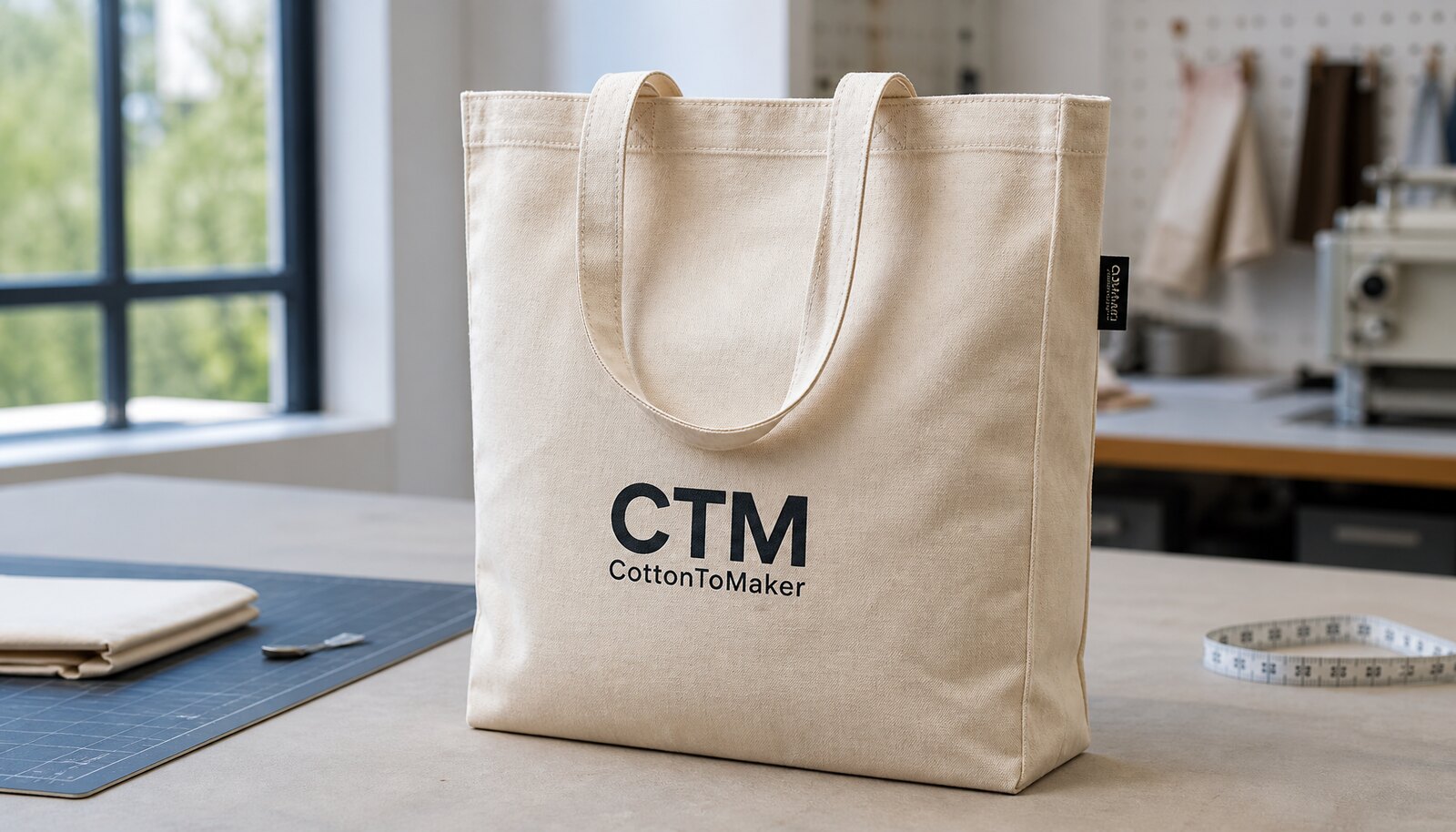
Start With the Use Case, Not the Logo File
Cloth shopping bags with logo are easy to underestimate because the artwork is simple and the product looks familiar. In procurement, that is exactly why problems happen. One buyer says "cotton tote" and the supplier prices a light giveaway bag. Another thinks of a structured retail shopper with reinforced handles and a gusset. Both can use the same artwork, but they are not the same product, and they should not be sourced from the same assumptions.
Start by writing the job the bag has to do. Is it a branded carry bag at checkout, a retail resale item, a trade-show giveaway, or an insert for a subscription box? The use case determines fabric weight, handle drop, print method, and packing. A retail bag needs shelf appeal and consistent fold quality. A grocery-use bag needs better seam strength and a base that will not collapse. A giveaway bag can be simpler, but it still needs to survive repeated folding, handling, and transportation without the logo cracking or the handle seam failing.
Procurement buyers get better pricing when they define the load and the presentation together. If the bag will carry books, bottles, or boxed goods, tell the supplier the approximate load and shape. If it needs to sit upright on a shelf, say so. If it must fold flat for distribution, write the folded dimensions. The more specifically you describe the use, the less likely the factory is to fill in the blanks with a generic tote specification.
A practical RFQ should answer three questions before it asks for a quote: what the bag is for, how the customer will use it, and how the bag will be judged on receipt. That is the quickest way to avoid getting ten prices for ten different products.
Short buyer note: if your brief can be summarized in one line only as "canvas bag with logo," it is not ready for sourcing yet.
- Write the primary use in one sentence: retail, grocery, event giveaway, or subscription insert.
- State the heaviest realistic load or the product type the bag must carry.
- Decide whether the bag must stand upright, fold flat, or present as shelf-ready packaging.
- Include whether the bag is for one-time promotional use or repeated carry over many cycles.
Choose Cloth Weight and Construction Around Real Load, Not Habit
For most procurement programs, 10-12 oz canvas is the safest starting point because it balances structure, logo visibility, and unit cost. Lighter cloth can work for low-load promotional use, but it tends to wrinkle more, show the weave more strongly, and lose shape faster at the handle. Heavier cloth gives a premium feel and better load handling, but freight, sewing time, and fabric cost rise quickly, and the product can become too expensive for a campaign bag that does not need to carry weight.
Construction matters just as much as cloth weight. A bag with a wider gusset can hold boxed goods better and looks more stable on a counter. Longer handles improve shoulder carry but also increase material use and the chance of variation if the factory does not control cut length carefully. Lined bags, inner pockets, zip closures, and piping can look attractive in a sample photo, yet each addition creates more sewing steps and more inspection points. In buyer terms, that means more cost and more rework risk.
Do not rely on the supplier’s standard size sheet if the bag has any functional requirement. Ask for finished measurements after sewing, not only cut panel dimensions. Cotton and canvas can shrink or relax depending on washing, finishing, humidity, and how the cloth was stored before cutting. If the bag needs a very clean shape, ask whether the fabric is pre-shrunk or whether the factory expects natural shrinkage to be absorbed in the sewing allowance. This is a small detail that often explains why a second run does not match the first.
A useful sizing discipline is to define width, height, gusset, handle length, and handle drop separately. That sounds basic, but it removes a lot of ambiguity. The handle drop, in particular, affects real usability more than many buyers expect. A short handle may look neat in product photography but be uncomfortable on the shoulder. A long handle may be practical, but if it is not controlled, the bag can look sloppy on the shelf.
If the order is intended for repeat purchase, build in a little margin for product aging. A tote that is only barely strong enough on day one usually becomes a service problem by the second or third reorder when fabric lots or stitch settings drift.
- Use 8-9 oz cloth for low-load promotional bags only when structure is not a selling point.
- Use 10-12 oz canvas for most retail, shopping, and brand-awareness programs.
- Use 12-16 oz canvas when the load is heavier or the brand wants a more premium hand feel.
- Require handle reinforcement for any bag that will regularly carry weight or be reused often.
- Specify finished dimensions after sewing, not just cut sizes.
- State whether fabric is pre-shrunk and whether shrinkage is allowed within the tolerance.
Match Artwork, Print Method, and Fabric Surface Before Pricing
The print method should be chosen with the artwork in mind, not by habit. Screen print is usually the best fit for a simple brand mark, one to three solid colors, and larger quantities because it keeps unit cost manageable and gives a predictable result. Heat transfer and digital transfer are easier for short runs or full-color art, but they introduce more sensitivity around peel resistance, edge lift, and how the print feels on textured canvas. Embroidery and woven labels can look premium, yet they are not automatically better; on lighter cloth they can distort the panel, create puckering, or make the front face too stiff for a shopping bag.
A procurement-grade artwork package should include more than a logo file. Send vector artwork, Pantone references, print size in millimeters, and exact placement from the top edge and side seam. If the logo includes small reversed text or thin lines, say so explicitly and ask the supplier to point out whether the artwork is safe for the selected process. On canvas, tiny detail is the first thing that disappears once the fabric texture, stitch lines, and folding stress are added to the equation.
A common mistake is approving a digital proof that only proves color and placement in theory. The real test is how the logo behaves when the bag is folded, flexed, and carried. A strong supplier will show a strike-off, explain where the print may soften on the weave, and flag any detail that is too fine for the cloth. A weak supplier will simply say "okay" and move on. That is a red flag in any quote review because it suggests the factory is chasing the order rather than managing the process.
If the bag will be sold as retail merchandise, ask how the ink or transfer will hold up under folding, rubbing, and handling. If it is a promotional giveaway, you may accept a lower decorative standard, but you should still insist that the mark does not shed, crack, or bleed under normal use. This is one of the fastest ways to separate a decorative sample from a production-ready item.
For repeat programs, keep the approved print strike-off together with the fabric swatch. That combination is usually more useful than an old catalog image when it comes time to reorder.
- Use screen printing for bold, flat logos and repeatable color control.
- Use transfer methods for short runs, multicolor art, or fast sample turnarounds.
- Use embroidery or woven labels only when the extra texture is worth the cost and possible distortion.
- Approve placement in millimeters, not only by visual reference.
- Ask the supplier to flag any artwork that is too fine for the cloth surface before sampling.
Compare Supplier Routes by Control, Not Just by Unit Price
The route you choose affects the real cost of the program as much as the product spec. A direct factory usually gives the strongest control over fabric purchase, cutting, sewing, printing, and packing. That is the route many procurement teams prefer for repeated programs because the factory can lock materials and process steps more cleanly. A trading company can be useful when the order involves several bag styles, custom packaging, or multiple delivery points, but the buyer needs to know which factory is actually producing the bags and how much control the trader really has over fabric and QC.
Domestic decorators and printers are often good for urgent orders and small quantities. They can be practical when the deadline is tight or when the buyer needs to test market response before committing to a larger run. The tradeoff is that their blank bag source may change from one order to the next. If the blank changes, the bag may feel different, print differently, or fold differently even when the artwork is the same. Marketplace resellers are the least controlled route and should be used carefully, mainly for test buys or one-off convenience purchases.
A useful way to compare routes is to ask three questions: who buys the cloth, who owns the sewing line, and who signs off the final carton? If one company is only relaying messages and another is actually controlling production, the quotes may look similar but the risk profile is not similar at all. This is where buyers get surprised by "the same spec" coming back with different seam quality or color depth.
For higher-value programs, ask each supplier route to explain its material traceability. A direct factory should be able to identify the cloth source, dye lot, and production batch. A trader should be able to identify the actual maker and the controls they use. If nobody can identify the source of the blank bag with confidence, reorder stability will be weak.
The best route is not always the cheapest at PO award. It is the route that can repeat the same product without creating a new approval cycle every time you reorder.
- Direct factory: best for repeatability, stable specs, and better visibility into fabric and sewing control.
- Trading company: best when coordination is the issue, but demand written confirmation of the actual maker and process ownership.
- Domestic printer: best for urgent small runs, with more attention needed on blank-bag consistency.
- Marketplace reseller: best avoided for long-term programs because source control is weak and reorder drift is common.
Read the Quote Like a Production Sheet
A good quote for cloth shopping bags with logo should read like a production summary, not a sales note. The supplier should separate the cost of the blank bag, printing, packing, and freight basis. If you cannot see those pieces separately, you cannot compare offers properly. A cheap headline price may hide a lower fabric weight, a shorter handle, fewer reinforcement stitches, or a less durable print process. The real comparison is always between equal specs, not between similar-looking photos.
When reviewing quotes, watch for omissions. Some suppliers include print setup in the piece price, while others add it later. Some include simple bulk folding but not retail inserts or barcode labels. Some quote EXW and leave the buyer to absorb local pickup, export handling, and freight. Others quote CIF but quietly use a different carton count or a looser folding standard. The quote is not just a price; it is the first version of the factory's interpretation of your spec.
The main cost drivers are fabric weight, bag size, gusset depth, handle length, reinforcement, print color count, and packing complexity. A wider gusset increases both cloth consumption and labor. Extra colors increase setup time and the chance of registration error. Lined bags, zippers, and special label work add labor and inspection burden. If two prices are far apart, look for these exact differences before assuming one supplier is expensive and the other is efficient.
Procurement buyers should also normalize the commercial terms. Compare the same incoterm across all suppliers, and write down whether the quote includes sampling, artwork adjustment, carton marks, or documentation. If one supplier is quoting FOB and another is quoting EXW, the apparent saving may disappear once local handling and export costs are added. The same is true for freight estimates: without the same carton dimensions and pack count, freight comparison is often misleading.
A practical rule: do not let the supplier revise the product while you are comparing the price. If you accept a lighter cloth, different print method, or altered packing just to make the price look better, you are no longer comparing the same bag.
- Separate blank bag, print, packing, and freight so each quote can be normalized.
- Use the same artwork file, same spec sheet, and same incoterm for every supplier.
- Treat carton count and carton dimensions as part of the landed cost, not an afterthought.
- If a quote is much cheaper, identify which spec item was reduced before you proceed.
Validate Supplier Claims Before PO Award
The biggest sourcing risk in this category is not the logo file; it is unverified supplier confidence. A polished quote can still come from a factory that does not actually run the process it claims to run, or from a trader relying on a subcontractor that changes by order. Before PO award, validate who is making the bag, who is printing it, and whether the supplier can repeat the same result on a reorder.
Start with basic identity checks. Ask for the legal company name, business license, factory address, and the name of the person responsible for production and QC. If the supplier claims to be a factory, ask for photos or a live video of the sewing line, printing area, warehouse, and carton packing zone. If they say they are a trader, ask which factory they will use and what written controls they have over that factory. A supplier should not hesitate to explain its own role in the process.
Then ask for evidence tied to similar work, not just marketing material. Useful evidence includes recent inspection reports, photos of packed lots with the same fabric type, sample swatches, print strike-offs, and line-level QC notes. If you receive only glossy catalog images, that does not tell you whether the supplier can hold a finished size tolerance or maintain print consistency across a lot.
For a stronger verification step, use a short supplier audit question set: What are your top three defects on cotton or canvas tote bags? How do you control cloth shade variation by lot? How do you verify handle reinforcement on the line? What happens if the print shifts after curing? Can you show one recent example of a rejected lot and how it was corrected? A supplier that can answer these questions clearly usually understands the product. A supplier that cannot answer them is likely quoting from a broker position.
Before you award the PO, ask who owns artwork, screens, dies, or digital files after approval. Reorder stability depends on whether those assets are held and retrievable. If the supplier outsources all tooling or artwork setup without a clear handoff record, the next order may start from scratch even when the design is unchanged.
A final practical check: confirm that the quoted production path matches the promised lead time. If the sample was made locally but the bulk will be made elsewhere, the sample is not a strong predictor of bulk quality unless the process, cloth, and workforce are the same.
- Verify the legal entity, factory location, and actual production responsibility before PO award.
- Ask for live factory evidence: sewing line, print area, warehouse, and carton packing zone.
- Request recent inspection reports or lot photos from similar bag work, not just marketing shots.
- Use audit questions focused on defects, cloth control, handle reinforcement, and print curing.
- Confirm who holds the print files, screens, or artwork records for reorders.
Build a Sample Approval Process That Catches Drift Early
Sample approval is where a lot of avoidable cost can be saved. If the buyer approves only a pretty sample, the bulk order can still drift in size, fabric, or print feel. A better approach is to use three sample stages when the order deserves control: a development sample, a pre-production sample, and a shipment sample. The development sample helps you finalize structure and artwork placement. The pre-production sample should be made with the same cloth lot, same printing process, same thread, and same packing method as the bulk order. The shipment sample is the record of what actually left the factory.
The approval criteria should be written in measurable language. Instead of saying the bag is acceptable if it looks good, define finished size, handle drop, print position, and reinforcement type. If the print sits 8 mm higher than agreed, that may be fine on a rough giveaway bag and unacceptable on a retail item. If the handle stitching is sloppy but hidden by a folded strap, that may still be a failure if the bag will be sold as a premium product. A good approval sheet reflects the channel, not just aesthetics.
When reviewing a sample, use simple physical tests that match real use. Flex the bag at the print area several times. Rub the logo lightly in both directions. Load the bag with typical items and check whether the handles settle or the side seams distort. Open the corners and inspect thread ends, stitch consistency, and fabric puckering. These are quick checks, but they reveal more than a one-minute visual approval on a desk.
Keep the approved sample sealed, labeled, and tied to the PO number. This matters for reorders. Without a retained master sample, buyers often rely on memory or a screenshot, and that is how the second order becomes a different product. For a canvas tote program, the master sample should include the bag, the print strike-off, the fabric swatch, and the carton mark reference.
If the supplier resists pre-production sampling or wants to go straight to bulk after an email approval, treat that as a risk signal rather than a convenience.
- Use a development sample to settle structure and artwork placement.
- Use a pre-production sample made from the same fabric lot and process as bulk.
- Keep a sealed shipment sample for receipt comparison and future reorders.
- Measure finished size after sewing and document the result on the approval sheet.
- Test the bag by flexing, rubbing, and loading it before sign-off.
Specify Packing and Retail Presentation Before Bulk Starts
Packing is easy to overlook because it feels like a logistics detail, but it affects unit cost, product appearance, and freight. For wholesale distribution, flat-folded tote bags in master cartons are usually the most efficient choice. The fold, however, must not create a hard crease across the logo or crush the front panel into a visible wrinkle. For retail or e-commerce, the bag may need individual polybags, hangtags, inserts, or barcodes. Each of those items adds labor and often changes the carton count and carton size.
This is where the quote can become misleading if the packing spec is not written in advance. One supplier may assume a basic bulk fold, while another assumes retail polybagging, desiccant, and barcode labels. The quotes will not be comparable unless the packing standard is fixed. Buyers should also pay attention to carton strength and moisture control. Canvas can absorb moisture, and a bag that leaves the factory clean and dry can still arrive with handling creases or staining if the cartons are weak or poorly sealed.
For retail presentation, decide where labels and marks belong. If the product needs a country-of-origin mark, fiber content label, or barcode, those should be agreed before print starts, not after the cartons are packed. It is much easier to adjust the artwork layout before production than to rework labels on the last day. If the bag is sold in a premium channel, ask how the factory protects the logo face during folding so the first customer does not receive a bag with a heavily marked crease line across the branding.
There is also a reorder issue here. Once one pack style is accepted, keep it stable. Switching from bulk fold to retail polybag, or from one carton count to another, can change freight, handling time, and store presentation. A reordering buyer should not have to re-approve the packing method every time unless there is a deliberate change in channel.
The most efficient pack is the one that arrives clean, flat, and consistent without creating unnecessary labor at receipt.
- Define whether the bag is folded flat, rolled, tissue-wrapped, or individually bagged.
- Lock carton count, carton dimensions, and carton markings before freight is booked.
- Approve barcode, origin marking, and any care or fiber labels before bulk production.
- Request a packed photo or short carton video before shipment if the order is sensitive.
Plan Lead Time Around the Real Bottlenecks
Lead time is usually controlled by fabric sourcing, artwork approval, print setup, and packing, not by sewing alone. A factory can stitch a simple tote quickly if the cloth is ready and the sample has already been approved. The delays usually happen when the buyer changes artwork, revises carton markings, or changes the packing style after the sample stage. Those changes create rework, and rework is what turns a normal lead time into a missed launch.
If the canvas is stock fabric, the process is often faster and simpler. If the cloth needs to be custom dyed, heavily finished, or matched to an exact shade, the schedule becomes more sensitive to approval timing and batch availability. Embroidery and multi-step decoration can also slow the schedule because they need more setup and more in-process checks. If the bag is part of a seasonal program, do not schedule it as if it were a standard replenishment item. Build time for sample sign-off, production, packing, and freight booking separately.
For repeat programs, the smartest move is to create a master spec and keep it unchanged between orders. That does not mean no improvement ever happens; it means the first spec becomes the reference, and deviations are intentionally approved rather than accidental. This lowers reorder risk because the supplier knows which fabric, stitch pattern, and print setup must be repeated. It also shortens quote turnaround because the buyer is no longer rebuilding the spec from scratch.
A practical lead-time control tool is a simple milestone list: artwork approved, sample approved, bulk material confirmed, cutting started, printing complete, sewing complete, packed, and ready for shipment. Ask the supplier to report against those milestones. It is much easier to catch slippage at the cutting stage than after the cartons are already sealed.
When a supplier promises a very fast turnaround, the buyer should ask what is already in stock and what is not. Fast delivery is often a function of available blank bags, not of magical production speed.
- Start the schedule from approved artwork and deposit, not from first inquiry.
- Add buffer for custom-dyed cloth, embroidery, or peak shipping periods.
- Keep a master spec and master sample for reorders.
- Ask the supplier to report progress by milestone rather than giving only one end date.
Use QC Methods That Match How the Bag Will Fail
For tote bags, the defects that matter are usually visible and functional, not subtle. Buyers should focus on crooked print, weak handles, uneven seams, size drift, shade variation, stains, and packing errors. A bag may look fine on a bench and still fail in the store or in the customer's hands if the handle stitches are too short, the logo cracks when folded, or the seam opens under normal load. That is why QC should be tied to use, not to a generic factory checklist.
A workable inspection plan starts with a written acceptance standard and a representative sample size. For a typical bulk order, buyers often use random inspection across cartons rather than checking only the top layer. The exact AQL can be chosen by the buyer's quality system, but the important point is to sample from multiple cartons and inspect both appearance and function. Larger orders deserve more disciplined sampling because small drifts can hide inside a few cartons if no one opens them.
The most useful physical checks are straightforward. Measure finished dimensions against the approved tolerance. Load the bag with typical contents and observe handle strain and seam behavior. Flex the print area to see whether the ink cracks or lifts. Rub the logo lightly to check for transfer. Open and flatten random bags to inspect corners, top hems, and reinforcement stitching. These are simple tests, but they are directly related to how the bag will be used in the real world.
Acceptable defect thresholds should be written before production, not argued after a shipment is already on the water. For example, if the order is a retail product, even a small visible print shift may be unacceptable. If it is a giveaway bag, minor cosmetic variation may be acceptable, but handle failure is not. The buyer should be clear about which defects are cosmetic and which are functional. That distinction helps suppliers focus their process control where it matters.
For higher-value programs, ask for a shipment sample and compare it to the approved sample before final release. If the factory changed thread, print ink, or packing method without notice, that is often where the drift shows up first. A good QC file keeps the approved sample, the swatch, the strike-off, and the carton mark together so a future reorder can be checked against the same reference set.
- Inspect multiple cartons, not only the first carton or the top layer.
- Use pull, flex, and rub checks because they expose real tote failures quickly.
- Write clear cosmetic versus functional defect rules before bulk production.
- Measure finished size and handle drop against the approved sample.
- Keep shipment samples and master references together for repeat orders.
Specification comparison for buyers
| Spec decision | Recommended option | Buyer tradeoff / fit | Sample lead time, price drivers, QC burden, and when to exclude |
|---|---|---|---|
| Supplier route | Direct canvas factory | Best for repeat programs where you need the same fabric, sewing method, and logo placement every time | Sample lead time is often 5-10 days for a basic development sample and 7-14 days for a pre-production sample if fabric is not already on hand; price is driven by cloth weight, stitch count, print colors, and packing; QC burden is lower if the factory controls fabric and sewing; exclude when you need only a very small rush run, a mixed-source program, or if the supplier cannot show the actual production line |
| Supplier route | Trading company | Useful when the program mixes bag styles, labels, inserts, or multiple destinations | Sample lead time is often 7-15 days because the trader may need to coordinate with a factory; price is driven by the underlying maker plus coordination margin, and freight terms can be less transparent; QC burden is moderate to high because responsibility is split; exclude when you need direct process control, stable reorder identity, or traceable lot records |
| Supplier route | Domestic decorator / printer | Good for short runs, urgent events, and buyers who need fast sample turnaround | Sample lead time is often 2-7 days if blank bags are in stock; price is driven more by blank-bag availability, print setup, and local labor than by fabric sourcing; QC burden is usually lower on transport but higher on blank consistency; exclude when you need custom fabric, tight repeatability, or a long replenishment program |
| Supplier route | Marketplace reseller | Suitable only for very small tests or spot buys where speed matters more than strict repeatability | Sample lead time is fast only if stock exists, often 1-5 days before dispatch, but source visibility is weak; price is driven by availability and mark-up rather than process control; QC burden is high because fabric, sewing, and print sources may change without notice; exclude for retail programs, controlled brand launches, and any reorder-sensitive item |
| Fabric weight | 8-9 oz canvas | Light promotional use, giveaway campaigns, or low-load retail carry | Lower cost and lower freight weight, but more sagging, weaker structure, and higher risk of handle distortion if the bag is overloaded or reused often; exclude if the bag must carry bottles, books, or boxed goods regularly |
| Fabric weight | 10-12 oz canvas | Mainstream retail shopping, grocery-top-up use, and most branded carry programs | Balanced cost and structure, but you need to control pre-shrink, finished size, and seam quality because the material is still light enough to distort if construction is weak; exclude only when the load is unusually heavy or the brand needs a premium, stiffer hand feel |
| Fabric weight | 12-16 oz canvas | Premium retail, heavier goods, or programs where the bag itself is part of the brand experience | Higher fabric and sewing cost, longer handle stress life, and better shape retention, but more freight weight; exclude if margin is tight and the bag is meant to be a low-cost giveaway rather than a long-life carrier |
| Logo method | 1-3 color screen print | Best for bold branding and larger runs with stable artwork | Low setup cost per color at scale, but fine type can fill in, print registration needs control, and QC must include rub and flex checks on the finished bag; exclude if artwork has tiny gradients, photo detail, or very thin reversed text |
| Logo method | Heat transfer / digital transfer | Best for short runs, full-color images, or artwork that cannot be separated cleanly for screens | Lower setup friction and fast sampling, but peel risk, hand feel, and heat-mark issues increase QC burden and reorder sensitivity; exclude when the bag will see heavy folding, frequent washing, or long retail shelf life |
Buyer checklist before sampling
- Define the end use: retail resale, checkout carry, event giveaway, or subscription insert.
- Lock finished size, gusset depth, and handle drop in the RFQ; do not rely on a vague tote description.
- Specify fabric composition, GSM or oz weight, weave type, color reference, and whether the cloth is pre-shrunk.
- State the exact print method, print size in millimeters, color count, placement from seams, and artwork file format.
- Separate bag cost, print setup, packing cost, and freight basis so every quotation is comparable.
- Confirm MOQ by size, fabric color, and logo version, not just one headline number.
- Require a pre-production sample made with the same fabric lot, print method, thread, and packing method as bulk.
- Write the acceptance tolerance for finished size, print position, stitch appearance, and color match.
- Define packing method, carton count, carton dimensions, master carton marks, and any retail labels or inserts.
- Hold a sealed approved sample, fabric swatch, and print strike-off against the PO for reorders.
Factory quote questions to send
- What is the exact finished bag size after sewing, including gusset depth and handle length?
- What fabric weight, weave, and finish are included in the quoted price, and is the cloth pre-shrunk?
- Which part of the quote covers blank bag, print setup, per-color charges, and packing labor?
- What is the MOQ per size, color, and artwork version?
- Can you make a pre-production sample using the same cloth lot and the same print method as the bulk order?
- What seam construction do you use at the handle attachment, and what reinforcement is standard?
- What are the carton pack count, carton dimensions, and gross weight, and do those figures change after printing or folding?
- Which incoterm is quoted, and which export documents and origin markings are included?
- What tolerance do you hold for finished dimensions, print placement, and color matching?
- If we reorder later, what material or process details will you lock so the bag stays identical?
Quality-control points to confirm
- Finished dimensions should match the approved sample within a practical tolerance, typically about ±1 cm on body size and tighter on handle drop and print placement.
- Use a simple AQL plan for visual inspection; for larger orders, inspect a representative sample from multiple cartons rather than relying on the top carton only.
- Handle attachment should be reinforced with box-X, bar tack, or an equivalent load-bearing stitch pattern, with no skipped stitches or loose thread nests.
- Perform a gentle pull test on handles and seam intersections; the bag should not show seam opening, thread breakage, or obvious deformation under normal hand force.
- Inspect print adhesion by flexing the logo area and rubbing it lightly in both directions; cracking, peeling, smudging, or color transfer should be treated as a defect.
- Check for fabric faults such as holes, slubs, contamination, oil marks, mildew odor, or obvious shade variation across the same lot.
- Verify that the top edge is straight, gusset corners are square, and the bag stands or folds as specified in the approved sample.
- Count cartons and inner packs against the packing list, and confirm barcode, carton mark, and country-of-origin placement before shipment.
- Review packed bag condition for moisture, compression damage, crushed handles, or creased logo faces that would affect retail presentation.
- For higher-value orders, keep a shipment sample and compare it against the approved sample before releasing final payment or reorder approval.