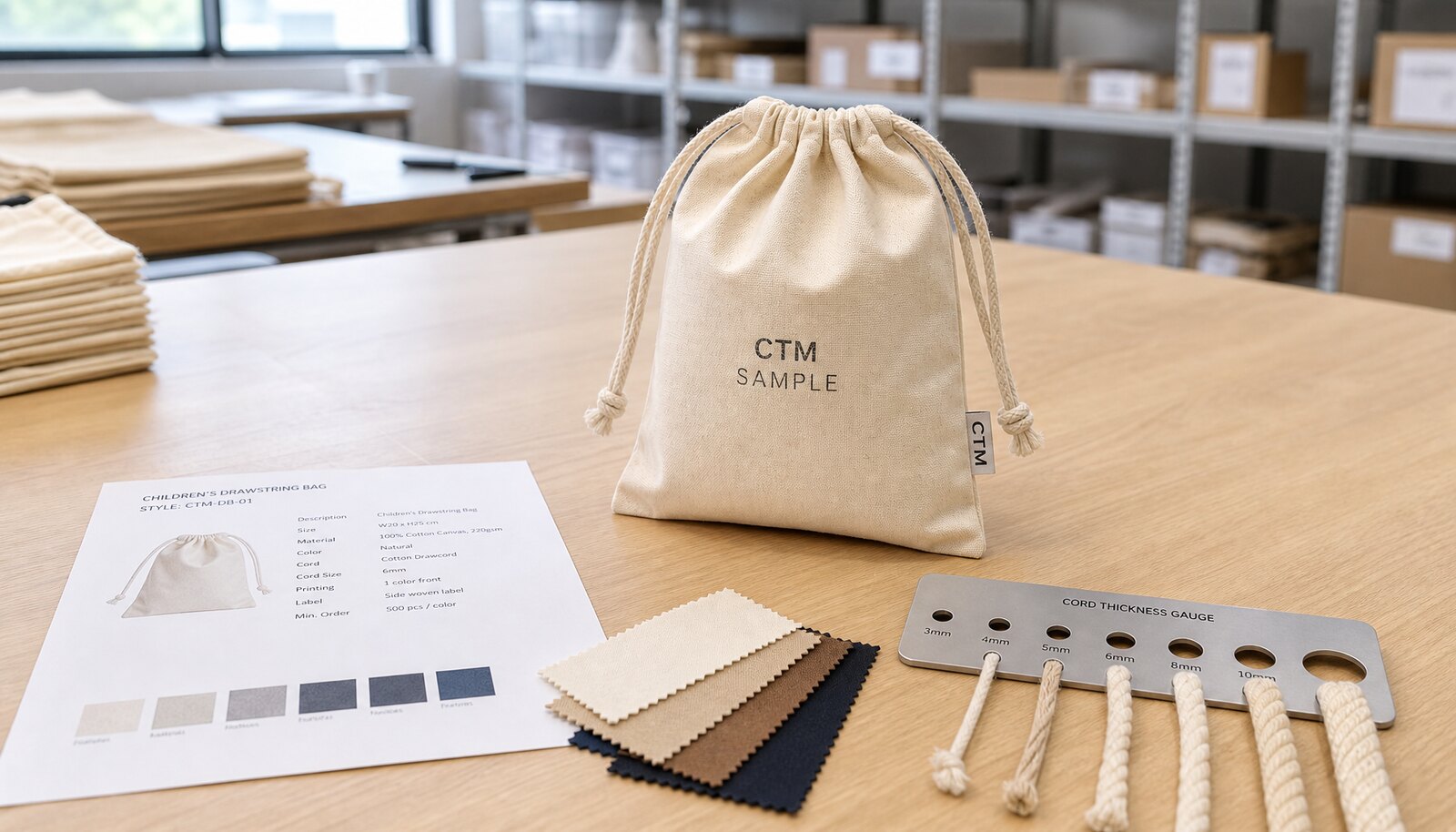
Start with the product use case before you price the logo
A childrens personalised drawstring bag is easy to under-spec because the branding looks simple. That is exactly why buyers get quote noise. The real product question is not only how the logo appears, but where the bag will be used, how often it will be handled, and what the carrier expects it to survive. A school supply bag, a retail gift bag, and a promotional handout may all look similar in a photo, yet they need different fabric weights, seam strength, cord control, and packaging discipline.
For procurement, the use case should drive the spec line by line. A bag for one-off event packs can stay light and economical. A bag that will be reused in a school setting needs a stronger body, cleaner stitching, and a print method that still looks acceptable after repeated folding. If the bag is being sold through retail, shelf appearance matters too: shape retention, print clarity, and a neat closure all influence perceived quality. Buyers who write the use case into the brief usually get quotes that are easier to compare and less likely to hide assumptions.
A practical way to start is to define the load, user age group, distribution channel, and expected lifespan. Then decide which attributes are mandatory and which are optional. That saves time later when suppliers try to upsell heavier fabric or extra trims that do not improve the business outcome. In this category, the best spec is usually the one that fits the use case without paying for features the channel will not value.
- School use: prioritize light weight, smooth cord action, and durable print placement.
- Retail use: prioritize shape retention, neat sewing, and a cleaner branded finish.
- Promo use: prioritize short lead time and a spec that keeps MOQ manageable.
- Export use: prioritize carton fit, labeling clarity, and repeatable size control.
Write a spec sheet the factory can actually price
A supplier can only quote what you define. If you send a photo and say “same as this,” the factory will fill in the gaps with its own defaults, and that is where hidden cost and mismatch start. A workable spec sheet should name the finished size, seam allowance, fabric type, fabric weight, cord material and diameter, print area, print colors, label placement, pack count, and destination market. If the order needs a compliance route, note that as part of the product definition rather than as a late-stage reminder.
Artwork control needs the same discipline. Submit vector artwork whenever possible, with fonts outlined and colors referenced by Pantone or a clearly equivalent standard. For any logo with small text, define the minimum text height and line thickness so the supplier can confirm whether the artwork is practical on the chosen print method. If the factory needs to redraw or resize the art, ask for a proof that shows print placement, stitch lines, and label position together. A mockup that ignores sewing lines is not a usable approval document for production.
If the project includes several variants, keep the base spec clean and list alternates separately. For example, one base construction and two print options is easier to quote than a single brief packed with optional trims and packaging choices. Procurement teams that separate base and alternate options usually get cleaner pricing and fewer arguments over what was included.
- Use finished dimensions in cm, not vague size language like small or medium.
- State whether the size is finished size or cut size after seam allowance.
- Attach one approved artwork file and avoid screenshots or low-resolution exports.
- Ask for a proof that shows print area, stitch lines, and label position together.
Fabric, seams, and cord details decide whether the bag feels cheap or reliable
Fabric weight is the first number buyers compare, but it is only one part of the quality picture. For a light promotional childrens personalised drawstring bag, 120-140 GSM cotton often keeps the product flexible, inexpensive, and easy to fold for distribution. If the bag needs more body, better shelf presence, or a more durable retail feel, 180-220 GSM cotton canvas is usually a safer base. The right choice depends on how the bag will be used and how much your channel will pay for a better hand feel.
Do not assume GSM alone tells the whole story. Weave density, finishing, shrinkage, and dye consistency all affect how the bag performs. A loose weave can let a logo look uneven or make the fabric feel weaker than expected. Pre-shrunk or better-finished cloth can reduce surprises after sewing and packing, especially when the bag is part of a coordinated set. Ask the supplier whether the fabric is raw, washed, calendared, or otherwise finished, because that can change both hand feel and dimensional stability.
The construction details are where children’s bags either hold up or fail. Look closely at the top hem, the cord channel, the exit points, and the bar-tacks. These are the high-stress areas when a child opens, closes, and pulls the bag repeatedly. A neat outer appearance is not enough if the channel is weak or the cord exits are poorly reinforced. Buyers should treat seam quality, trim clean-up, and edge finishing as decision points, not just inspection notes.
- 120-140 GSM: suitable for low-cost promo, event packs, and lighter school use.
- 180-220 GSM: better for retail resale, repeated use, and a firmer bag shape.
- Ask whether GSM is measured before or after washing and finishing.
- Request a physical swatch if the order is large enough to justify real approval.
Choose the print method based on artwork complexity and durability
The branding method should follow the artwork and the channel. Screen print remains the most practical option for one or two solid colors because it is repeatable, economical, and relatively easy to control once the setup is approved. DTF or heat transfer is more suitable for detailed artwork, gradients, or multicolor designs where a screen print would lose definition. Embroidery can create a premium look, but for lightweight bags it is usually a niche choice because it adds stiffness and can distort the panel if the stitch density is too high.
The main risk is not the logo file itself; it is the way the logo interacts with fabric and sewing. Small text may look fine on a flat mockup and then fill in or blur after printing. A design that looks centered in artwork can shift once the bag is cut, sewn, and folded. That is why buyers should define print placement in millimeters, not by eye. For a personalised product, the approved proof should show the exact placement relative to seams and the top edge, not only the art floating in space.
If you are comparing suppliers, ask what they will use for curing, color matching, and adhesion control. A supplier that cannot explain those steps may still be able to produce the bag, but the risk of inconsistent print quality is higher. For first orders, it is also worth asking for a simple rub or fold durability check on the printed area before bulk release. That test is not a substitute for a full lab program, but it helps catch weak settings early.
- Screen print: best for flat, repeatable logos and lower unit cost.
- DTF or heat transfer: better for detailed artwork, but test adhesion and folding durability.
- Embroidery: premium look, but avoid tiny type and dense fills on thin fabric.
- Set a print placement tolerance in writing so the factory knows the pass-fail line.
Child safety and destination-market compliance need to be written into the brief
If the bag is intended for children, the sourcing brief should include a safety review, not just a decoration spec. That does not mean every market needs the same certification path, but it does mean you should not treat child use as a generic pouch purchase. Look for loose cords, rough labels, sharp trims, small detachable parts, exposed hardware, and any feature that could create snag or irritation risk during normal use. The safest route is usually the simplest one: a clean sewn structure, secure cord exits, and no decorative parts that do not contribute to function.
For corded bags, the practical focus is on how the cord is anchored and finished. Braided polyester or cotton cord is common because it handles well and is easy for the factory to source, but the buyer still needs a clear view of how the cord is fixed inside the channel and whether the ends are sealed or secured. If the design uses a stopper, toggle, or decorative tip, ask whether it adds any small-part risk in the target market. If the bag will be sold into the UK, EU, US, or another regulated market, confirm the applicable label and safety requirements with your compliance team before bulk approval, not after production starts.
Because compliance routes vary by destination and use case, buyers should ask the supplier what documentation they can actually support. Some factories can provide material declarations, test coordination, or inspection records; others can only sell to a brief. That difference matters for landed risk, not just paperwork. The right question is not “is this compliant?” in the abstract, but “what evidence can you supply for the market I am selling into?”
Compare suppliers on route, capability, and hidden tradeoffs
A useful comparison table should help you choose between genuinely different supply options, not just sort quotes from cheapest to most expensive. For a childrens personalised drawstring bag, the main supplier routes are usually factory-direct, trading company, local print shop, or a mixed model where one party manages source control and another does the printing. Each route can work, but each shifts where the risk sits. Factory-direct usually gives the clearest view of sewing, print, and packing controls. A trading company can be helpful when you need several product types in one shipment. A local print shop may be the fastest way to get a small run, but textile consistency and carton discipline can be weaker.
Decision depth matters here. A cheap quote from a middle layer can look attractive if the program is one-off, but it may become expensive when you need a second order and the original material, print setting, or carton format cannot be repeated exactly. On the other hand, a higher unit price from a factory-direct supplier may be the better choice if it comes with tighter sampling, better defect control, and more reliable repeat production. Procurement teams should ask not only who is selling the bag, but who owns the actual sewing, who checks the print, and who seals the cartons before shipment.
- Factory-direct: strongest technical control and clearest accountability for repeats.
- Trading company: useful when sourcing several item types under one buying program.
- Local printer: faster for urgent small runs, but inspect textile quality and packing control closely.
- Ask who owns final inspection, because that answer reveals where the real risk sits.
Turn the quote into landed cost, not just unit price
For this product, the ex-works price is only one part of the decision. The real procurement number is landed cost, which includes sampling, setup, packing materials, carton efficiency, freight weight, and the likely cost of rework if the first batch misses spec. A quote that is a little higher per unit can still be the better buy if it uses a stronger cloth, avoids print failures, packs efficiently, and does not generate extra charges after sample approval. Buyers who only compare unit price often reward the supplier who leaves out the useful details.
To compare fairly, ask for separate line items for fabric, sewing, print, packing, sample fee, and any tooling or setup charge. That separation lets you see where the money is going and whether the supplier is genuinely competitive or simply presenting a convenient all-in number. It also makes it easier to compare suppliers who quote different construction levels. If one factory includes a stronger hem or a better packing format while another does not, the total landed cost may be closer than it first appears.
Freight efficiency also matters. Overly loose packing, oversized cartons, or inconsistent carton counts can add unnecessary cost even when the unit price looks good. If you are buying for retail or distribution, ask for carton dimensions, gross weight, and inner pack details in the quote. Those numbers are not just logistics data; they tell you whether the supplier understands how the product will move through your supply chain.
- Compare suppliers on the same size, same fabric GSM, same print method, and same pack count.
- Include sample fees and setup costs in first-order math, not as an afterthought.
- Watch freight efficiency if cartons are oversized or the bags are packed too loosely.
- Treat rework risk as a real cost because print mistakes and seam failures erase margin quickly.
Sampling should prove production methods, and QC should test how the bag really behaves
A sample is only useful if it reflects the bulk process. A hand-finished sample made with extra attention or non-standard cloth can hide the very problems that show up in production. The cleaner approach is a pre-production sample, followed by a sealed approval sample made with the same fabric, cord, print method, and packing approach that will be used in bulk. If the factory changes material, finish, cord, or print settings after approval, that should trigger a new sign-off. Small changes can matter more than they look on paper, especially in a product that relies on consistent folding, pulling, and opening.
Quality control should focus on the parts of the bag that take stress in use. Measure finished size, check print placement, inspect seam neatness, and repeatedly pull the cord to confirm smooth action and stable locking. Check the top hem and the cord exits for fraying or weak stitching. Do a simple rub, fold, or tape test appropriate to the print method to see whether the graphic cracks, lifts, or loses too much color. For the first order, ask the factory or inspector to classify defects clearly and use a defined AQL or your internal standard. The point is to make the pass-fail line visible before cartons are sealed.
For first-shipment acceptance, inspect more than just the top layer. Pull cartons from the top, middle, and bottom of the stack so a packing or compression issue does not stay hidden. If the order has multiple colors or sizes, make sure the separation is obvious and the packing list matches what is inside. It is much cheaper to catch a label or count issue in the warehouse than after the bags reach the end user.
- Check 5-10 pieces from the sample batch under good light before approval.
- Pull the cords repeatedly to confirm smooth action and stable knots.
- Fold the printed panel to see whether the graphic cracks, peels, or shifts.
- Reject any sample that looks good visually but fails at the opening, cord exit, or stitch line.
Packing, carton loads, and warehouse requirements can change the final economics
Packing is often treated as a closing detail, but for a childrens personalised drawstring bag it can change both cost and damage risk. Bulk packing may be fine for internal distribution, but it can create scuffs, creases, and count disputes if the bags are handled many times before delivery. If the bag is going to retail shelves, a distribution center, or a marketplace warehouse, the packing format should protect the print surface and make receiving simple. The key is consistency: one fixed pack count per SKU, one approved carton format, and one agreed marking standard.
The quote should state carton dimensions, gross weight, inner pack configuration, and carton marks. Those details help you estimate freight, storage fit, and handling risk. If barcodes, warning text, or hangtags are required, the exact placement and format should be listed in the brief so the supplier does not guess. A supplier that improvises label placement can create receiving delays and rework. The same applies to overfilled cartons: they may look efficient on paper, but they often become a damage problem in transit or a receiving problem in the warehouse.
For procurement teams managing repeat orders, packing consistency is part of supply continuity. If the first order ships in one carton count and the reorder changes without notice, warehouse planning becomes harder and receiving errors increase. Keep the pack format stable unless there is a deliberate reason to revise it, and update the spec sheet whenever you do. That discipline saves time on every future order.
- Choose one carton count per SKU and keep it stable across repeats.
- Use inner packs or polybags when print scuffing is a risk.
- State barcode, lot number, size, and color marking requirements in advance.
- Check whether the supplier does final packing in-house or at a separate facility.
Use a tight RFQ to get better answers, not more email
A good RFQ does not need to be long, but it does need to be complete. For this product, the minimum useful brief is one finished size, one fabric spec, one approved artwork file, one packing format, one target market, and one expected quantity. That is enough for a factory to quote without improvising. If there are optional features, list them as alternates instead of mixing them into the base request. A clean base line makes supplier comparison much easier and keeps the quote from drifting into a sales conversation instead of a costing exercise.
The quote questions should uncover manufacturing reality, not just price. Ask how the bag will be made, which steps are in-house, how the print will be controlled, and which part of the process is most likely to extend lead time. Those answers tell you whether the supplier understands the product or is only reselling a standard pouch under your logo. For a customised children’s bag, that technical clarity is worth more than a small headline price difference. It also helps you choose the supplier that can repeat the order later without re-learning the spec.
A practical way to keep the process efficient is to send one base spec and one comparison sheet. Then ask suppliers to quote on the same assumptions and highlight any deviation from those assumptions. If a supplier suggests an improvement, it should be listed as an alternate, not substituted into the main quote without notice. That keeps the pricing clean and makes the final approval easier for buyers, QA, and finance to review together.
- Keep the base spec simple and push optional features into separate alternates.
- Ask for pricing with and without print, labels, and retail packing.
- Request production photos or process evidence if the supplier claims repeat experience.
- Make the approval path explicit: sample, sign-off, production, final inspection, ship.
Specification comparison for buyers
| Decision area | Practical baseline | Cost impact | Compliance / QC risk | Lead-time or sample tradeoff |
|---|---|---|---|---|
| Fabric weight | 120-140 GSM cotton for light promo use; 180-220 GSM cotton canvas for a more structured retail feel | Lower GSM reduces material cost and freight weight; heavier cloth raises cost and can increase carton volume | Too-thin fabric can distort print, tear at seams, and look uneven; shrinkage and color variation should be controlled | Heavier cloth may need longer sourcing time, but it usually gives a more representative sample and fewer bulk surprises |
| Print method | Screen print for 1-2 spot colors; DTF or heat transfer for detailed or multicolor art; embroidery only for premium programs | Screen print is often the lowest unit cost at volume; transfer methods add setup and per-unit cost; embroidery is usually the most expensive route | Fine text can fill in, transfer films can crack, and embroidery can stiffen the panel or pull light fabric | Complex artwork often needs an extra proof or a production-method sample to confirm registration and durability |
| Cord and channel | 3-5 mm braided polyester or cotton cord with reinforced exits and secured ends | Cord cost is small, but poor cord choice can create rework, complaints, and returns | Weak channels, loose knots, rough cut ends, and sharp hardware are common child-use failure points | If cord color, tip finish, or stopper is custom, allow extra time for trim sourcing and approval |
| Supplier route | Factory-direct for custom construction; trading company only when you need mixed-category sourcing or consolidated logistics | Factory-direct usually gives better price transparency; trading routes may add margin and obscure the real factory cost | If the middle layer cannot show sewing, print, and packing controls, QC visibility drops | Factory-direct usually gives faster technical back-and-forth; trading routes can be slower on sample sign-off and corrective actions |
| Packing format | Bulk pack for internal distribution; individual polybag or retail-ready pack when the channel requires it | More packing steps increase labor and materials, but reduce scuffing, count disputes, and warehouse handling damage | Loose packing raises contamination, scuffing, and carton count errors; labels must be placed correctly | Retail packing usually adds approval steps for barcode, warning text, and pack count |
| Sample path | Pre-production sample plus sealed approval sample before bulk cutting | Sample fees are cheap compared with production rework, rejected stock, or delayed launch | A hand-made sample that does not match production methods creates false confidence | Plan for one correction round unless the artwork and construction have already been proven on the same line |
Buyer checklist before sampling
- Define the finished size, seam allowance, and intended use case before asking for pricing.
- Send artwork as vector PDF, AI, or EPS with outlined fonts, Pantone references, and a stated minimum text size.
- Lock fabric type, GSM, cord diameter, cord color, and any label or trim requirements.
- State the market and use case clearly: school supply, retail resale, event gift, or promotional pack.
- Confirm whether the supplier should quote sample fee, setup cost, print cost, packing cost, and freight separately.
- Specify pack count per carton, inner pack requirements, barcode position, and any hangtag or warning text.
- Request a pre-production sample, not just a digital mockup, and approve the sample against the production method.
- Ask for a clear lead-time breakdown covering material sourcing, sample approval, sewing, printing, packing, and dispatch.
Factory quote questions to send
- What is the finished size, and is the measurement taken after sewing and finishing or at cut size?
- What is the actual fabric GSM, and is it measured before washing, after washing, or after finishing?
- Which cord material and diameter will you use, and how are the cord ends secured?
- What print method will you use for this artwork, and what is your minimum line thickness and minimum text size?
- Can you confirm the artwork file format you need, and will you redraw or resize the logo internally?
- Which steps are in-house and which are outsourced, especially sewing, printing, labeling, and packing?
- How many sample rounds are included, and will the approved sample be a production-line sample?
- What inspection standard do you use, what counts as major or minor defects, and what AQL do you apply for final inspection?
- What is the carton count, gross weight, carton size, and packing method for each size or color run?
- What is the standard lead time after sample approval, and what events will extend it?
Quality-control points to confirm
- Finished size must match the approved spec with a clear tolerance band, typically around +/- 0.5 cm unless your program requires tighter control.
- Fabric should match the approved swatch for color, hand feel, weave density, and visible defects such as slubs, holes, or stains.
- Stitching should have no skipped stitches, loose thread tails, broken bar-tacks, or weak cord exits.
- Cord must pull smoothly, hold its knot or stopper correctly, and show no fraying, slippage, or sharp edges after repeated use.
- Printed areas should sit within the approved placement tolerance and stay clear of seams, cord channels, and top hems.
- Print durability should be checked with a simple rub, fold, or tape test appropriate to the print method; look for cracking, lifting, or heavy color loss.
- Child-safety review should confirm there are no detachable small parts, sharp trims, exposed needle points, or other accessible hazards.
- Any warning text, barcode, hangtag, or compliance label should appear in the approved location, language, and format for the destination market.
- Carton counts should reconcile with the packing list, and size or color separation should be obvious before cartons are sealed.
- For the first shipment, inspect cartons from the top, middle, and bottom of the stack so a packing issue does not hide in one layer.