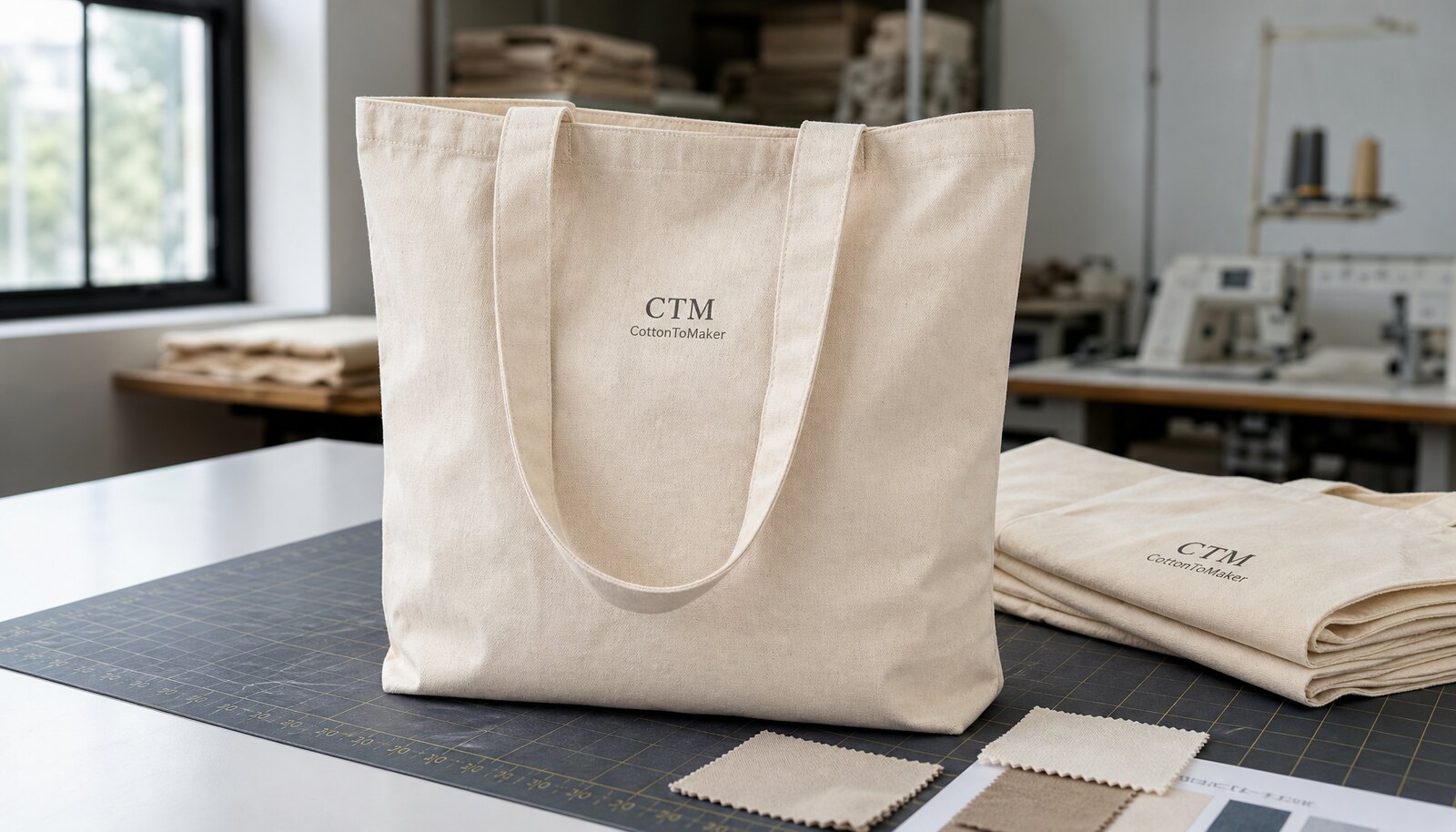
What Cheap Really Means for Printed Cotton Bags
For procurement, cheap printed cotton bags should mean low landed cost with acceptable failure risk, not the lowest factory quote on paper. A bag that looks good in the sample room but shrinks, prints poorly, or arrives with weak handles is expensive once you add replacements, chargebacks, and wasted freight. The right target is a simple bag spec that can be produced repeatably, packed efficiently, and shipped with minimal rework.
Most of the price sits in four places: cloth weight, print complexity, sewing time, and packing. A buyer who trims all four too aggressively usually gets a bag that feels flimsy and looks unfinished. A buyer who defines the right minimum for each item can still get a low price without creating a reject problem. That is the real buying problem behind cheap printed cotton bags.
- Treat the quote as a landed-cost decision, not only a unit-price decision.
- Use the bag for a real load scenario, not just a logo placement exercise.
- Low-cost bags fail most often at handles, print clarity, and carton packing.
Choose the Fabric Weight Before You Price
Fabric weight is the fastest way to change both the look and the cost of a cotton tote. For giveaway programs, 110-120gsm natural cotton is usually the practical floor because it keeps the bag soft, printable, and cheap enough for bulk use. For retail bags or bags that will carry catalogues, samples, or grocery items, 140-160gsm gives a better hand feel, less see-through, and more shape retention. Once you go much lower than that, the bag often starts to look like a promotional wrapper rather than a usable product.
The right fabric choice depends on load, print coverage, and where the buyer will sell or distribute the bag. A light cloth with a dense full-coverage print can still feel premium if the sewing is clean, but a heavy cloth with poor cutting and a sloppy hem still looks cheap. Ask the factory to quote the same size in two or three GSM options so you can see the cost curve before choosing a cloth that is too thin for the channel.
- 110-120gsm works for events, samples, and low-cost retail promotions.
- 140-160gsm is safer for shopping use, branded retail, and higher perceived value.
- If the bag must stand upright or carry weight, specify the seam and handle reinforcement with the GSM.
Pick the Print Method by Artwork and Quantity
For most cheap printed cotton bags, one-color screen print is still the best cost-to-quality option. It handles solid logos well, gives strong opacity on natural cotton, and spreads setup cost across the order. If the design uses gradients, small text, or multiple colors, a direct screen build can become expensive and brittle. In that case, a transfer method may be more economical for short runs, but the buyer should accept a different hand feel and check that the print survives folding and abrasion.
The artwork file matters as much as the print method. A factory can print a clean simple logo if the buyer supplies vector art, clear Pantone references, and a defined print size. Badly prepared art drives up quote variance because the supplier has to guess at line thickness, trap, and screen count. For low-cost buying, keep the design simple and force the quote to show each added color, screen, or setup charge separately.
- Use screen print for simple logos and repeat orders.
- Use transfer or digital methods only when artwork detail justifies the extra cost.
- Approve a strike-off on the actual fabric, not just a PDF proof.
Which Supplier Route Actually Lowers the Landed Cost
The cheapest supplier route is not always the factory with the lowest headline quote. A direct factory usually wins on repeat orders because the sewing line, printing area, and packing are under one roof, which reduces handling and hidden markup. A trading company can still make sense when the order mixes several SKUs or the buyer needs one contact to manage multiple factories, but the unit price usually includes another layer of margin. Local printers are useful for urgent small runs, yet they often lose on fabric cost and export packing efficiency.
For buyers comparing cheap printed cotton bags across suppliers, the key question is who actually controls production. If the printer outsources sewing, or the bag maker outsources print, you can end up with quality gaps that do not show up in the quote. Ask for factory photos, recent production images, and a clear explanation of which step is done in-house. The supplier route should match the order size, the timeline, and the level of control you need over fabric, print, and packing.
- Direct factory usually fits repeat orders and stable specs.
- Trading companies fit mixed programs and buyers who need one point of coordination.
- Local printers fit very small or rushed jobs, but freight efficiency and consistency are often weaker.
MOQ Logic and Quote Breakpoints
MOQ is not just a factory policy line; it is where setup cost stops dominating the unit price. For a simple cotton tote, 500 pieces may be possible, but the unit price will look high because the screens, cutting, sewing setup, and packing labor are spread over too few bags. At 1,000 to 3,000 pieces, the quote usually starts to make sense for a cheap printed program. At 5,000 pieces and above, the per-unit price often drops again because cutting efficiency, printing rhythm, and carton packing improve.
An illustrative FOB quote for a 38 x 42 cm natural cotton bag in 120gsm with one-color one-side screen print, self-fabric handles, and bulk packing might move from roughly 0.55-0.85 USD at 1,000 pieces to 0.28-0.45 USD at 10,000 pieces, depending on country, labor, and packing details. That range is only useful if the spec is identical. Add a second print color, heavier cloth, retail polybags, or a custom size, and the quote can move quickly. The buyer should compare tiered pricing, not just the first line price.
- Ask for price at multiple quantities, not a single MOQ number.
- Separate print setup from bag price when possible.
- Check whether the factory quotes ex-works, FOB, or CIF, because the comparison changes fast.
Samples, Color Control, and Acceptance Criteria
A useful sample process for cheap printed cotton bags has two parts: a printed strike-off and a sewn preproduction sample. The strike-off proves logo size, print density, and edge definition. The sewn sample proves fabric feel, seam finishing, handle strength, and the way the bag folds. If the supplier only sends a photo, the buyer is guessing about the two biggest production risks: print texture and sewing quality.
Set acceptance criteria before the bulk order starts. A practical approach is to hold dimensions within about 1 cm, handle length within about 1.5 cm, and print placement within a few millimeters of the approved sample. The exact tolerance should depend on the size of the bag and the channel, but the key is to write it down. Color should match the approved sample under the same light source, not just the digital artwork file, because natural cotton changes the appearance of ink.
- Approve both print appearance and sewing construction before mass production.
- Use the actual fabric shade for the sample, since natural cotton varies by lot.
- Keep one sealed approval sample as the reference for final inspection.
Packing and Carton Decisions That Affect Freight
Packing is where many cheap tote projects lose money without anyone noticing. Bulk folded carton packing is the lowest-cost option and usually best for importers who will distribute from a warehouse. Individual polybags, backing cards, barcode stickers, and retail inserts all add labor and volume. For a bag sold through retail, that extra packaging can be justified; for a promo campaign, it often turns a cheap bag into a freight-heavy product.
Carton size matters because it drives cube, not just carton count. A bag that is over-folded or stuffed into a small carton may look efficient on a packing list, but it can crease the print and make the outer cartons harder to handle. Request carton dimensions, gross weight, and pieces per carton early. If the bags are shipping by sea, keep cartons dry, well taped, and labeled clearly. If the bags are going by air, carton optimization is even more important because the freight bill is based on volume as much as weight.
- Bulk pack is usually cheapest for B2B distribution.
- Retail-ready pack adds cost, volume, and more packing labor.
- Carton spec should be part of the quote, not a last-minute detail.
Lead Time Planning Without Surprises
For standard custom cotton tote production, a realistic lead time is often 20-30 days after sample approval, with shipping time added on top. That window assumes the print method is simple, the fabric is available, and the buyer responds quickly on artwork and sample approval. If the order needs new screens, special labeling, or a revised sample round, the timeline expands. Buyers who build the ship date backward from the launch date usually avoid emergency air freight.
Schedule risk usually comes from three places: slow artwork approval, fabric or accessory delays, and peak season congestion. The safest move is to freeze the spec before the quote is finalized, then set the sample target early enough that the factory can start production without waiting on final decisions. If the order is tied to a campaign, give yourself a buffer for one sample revision and one freight delay. Cheap bags stop being cheap when the shipment misses the sales window.
- Plan around sample approval first, then production, then freight booking.
- Add buffer for print changes, seasonal congestion, and customs delay.
- Avoid changing the artwork after screens or plates are already prepared.
How to Compare Quotes Line by Line
A serious quote comparison starts with the same specification on every line. Ask each supplier to show fabric GSM, bag size, handle material, print colors, packing method, carton count, and shipping term. A lower unit price may hide a thinner cloth, fewer stitches, or a stripped-down pack-out. If one factory includes the sample fee, carton marks, and inner packing while another excludes them, the headline price is not meaningful.
The cleanest way to compare cheap printed cotton bags is to build a simple landed-cost sheet: unit price, print setup, sample cost, packing cost, inland cost, freight, duty, and any destination handling. Once those numbers sit side by side, the low quote is often not the best quote. The supplier with the slightly higher unit price may still win if they use less packaging, quote more honestly on carton size, or avoid rework and delays. That is the point of buyer control: you want the real cost, not the cheapest-looking number.
- Require the same spec across all suppliers before comparing prices.
- Separate one-time setup costs from recurring unit costs.
- Use landed cost, not factory price, as the final buying metric.
Specification comparison for buyers
| Spec decision | Recommended option | When it fits | Buyer risk to check |
|---|---|---|---|
| Sourcing route | Direct factory for repeat orders, trading company for mixed SKUs, local printer for very small runs | Use this when you care about unit cost, control of production, and whether one party owns print and sewing | Confirm who actually makes the bag, who prints it, and who carries rework if the artwork or sewing fails |
| Fabric weight | 110-120gsm for promo use; 140-160gsm for retail carry use | Choose lighter cloth when the bag is mainly a handout or packaging item, heavier cloth when it must hold weight and keep shape | Thin fabric goes translucent, shrinks the perceived value, and weakens the handle zone; ask for a swatch and seam sample |
| Print method | One-color screen print for the lowest repeatable cost; digital transfer for short runs or complex art | Screen print suits simple logos and larger lots, transfer helps with gradients, fine detail, and multiple colors | Artwork with tiny text or soft gradients can blur or crack; require a strike-off on the actual fabric |
| Bag size | Standard 38 x 42 cm or 35 x 40 cm with 60-70 cm handles | Standard sizes keep cutting waste low and fit mainstream retail or promo programs | Custom dimensions raise cutting waste and price; ask the factory to show fabric utilization before approving a special size |
| Handle construction | Cotton web handles for comfort; self-fabric handles for the cheapest build | Use webbing when the bag will carry catalogs, bottles, or heavier retail items | Weak handle stitching fails first; require reinforced stitch boxes or bar-tacks at both ends |
| Construction method | Straight side seams with overlock or lockstitch and reinforced stress points | Works when the buyer needs a simple, low-cost bag that still survives transit and basic use | Open seams, skipped stitches, and poor edge finishing create rejects and returns; define seam allowance and stitch density |
| Packing route | Bulk folded in export cartons; individual polybag only for retail-ready programs | Bulk packing is the lowest freight cost and best for distribution center repacking | Retail packaging adds labor and carton volume; confirm carton count, inner pack, and barcode placement before PO |
| Sample route | Printed strike-off plus sewn preproduction sample | Needed when color, logo placement, or fabric hand feel matter to the approval | Photo approval alone misses print texture, seam quality, and fabric shrink behavior |
| Lead time | 20-30 days after sample approval for a standard custom order | Use for normal procurement schedules with sea freight or planned launch dates | Peak season, screen changes, or slow approvals can extend production; build buffer before booking freight |
Buyer checklist before sampling
- Lock the bag size, fabric weight, and handle length before asking for price tiers.
- Specify the print method, number of colors, print side, and artwork file format.
- State the target quantity at each tier so suppliers quote the right setup cost.
- Decide whether you need bulk packing, retail polybags, inserts, or barcode labels.
- Request both a printed strike-off and a sewn preproduction sample.
- Define acceptable tolerances for dimensions, print placement, and color match.
- Ask for carton count, carton size, gross weight, and shipping terms in the quote.
- Set the ship window early and leave time for sample revisions before production starts.
Factory quote questions to send
- What fabric GSM, yarn count, and shrinkage allowance are you pricing?
- Which print method are you using, and what is the setup charge per color or screen?
- What is the MOQ, and how does the unit price change at 1,000, 3,000, and 5,000 pieces?
- Does the sample fee apply to production, and how many sample rounds are included?
- What packing is included in the quoted price, and what changes the carton count?
- What are your allowed tolerances for size, handle length, and print placement?
- What is the production lead time after sample approval and deposit?
- Can you send in-process photos and final inspection photos before shipment?
Quality-control points to confirm
- Fabric weight matches the approved swatch and the cloth does not feel limp or translucent for the intended use.
- Finished dimensions stay within the agreed tolerance, usually tight enough that the bag stacks and packs consistently.
- Handle stitching is reinforced at both ends and does not show skipped stitches, loose thread, or twisting.
- Print registration is clean, the logo is centered as approved, and the ink coverage is even without pinholes.
- Seams are straight, edges are finished, and the inside of the bag does not shed excessive loose fiber.
- The sample and the bulk order match on color tone, print size, and handle material rather than only on artwork.
- Carton packing matches the packing list, with the right piece count, carton marks, and no crushed corners.
- Outer cartons are dry, closed correctly, and suitable for the chosen freight method without moisture damage risk.