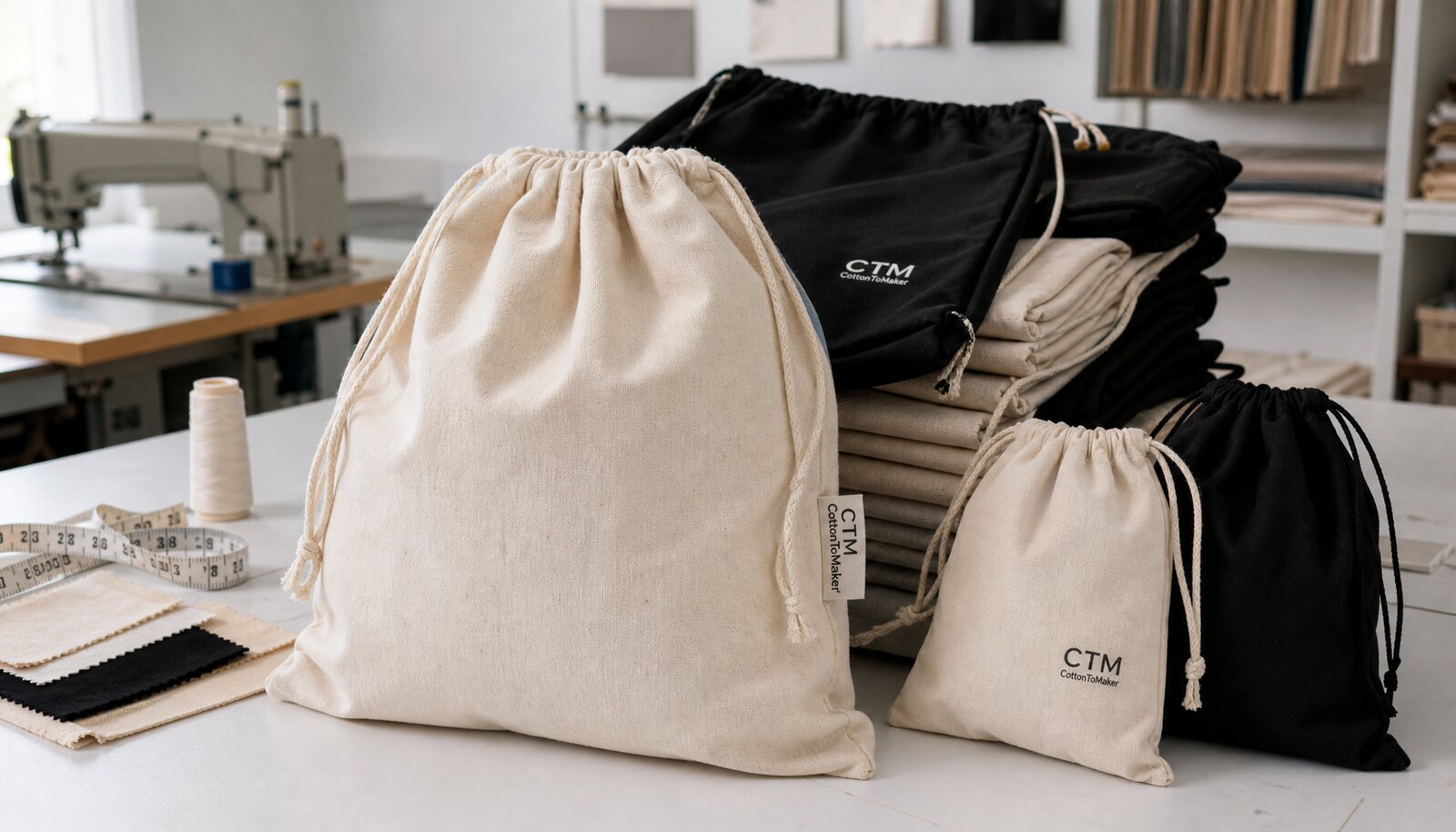
What buyers really mean by “cheap” and “no minimum”
For cheap custom drawstring bags no minimum, the first procurement mistake is assuming that the lowest unit price is automatically the best commercial result. In B2B buying, cheap should mean the bag meets the intended use case at the lowest acceptable total cost, including sample work, packing, reject risk, and freight. A low factory quote is only useful if it still gives you enough fabric weight, print clarity, stitch strength, and carton discipline to avoid downstream rework. When the order is small, hidden costs matter more because there is less volume to dilute mistakes.
The phrase no minimum also needs to be translated into practical sourcing language. Suppliers may mean no minimum per order but still require a minimum per design, per color, per print plate, or per fabric lot. Some can take one small order only if the buyer uses stock fabric and one-color print. Others can technically accept any quantity, but the quote becomes inefficient once the buyer asks for multiple colors, labels, or special folding. If the RFQ does not ask these questions directly, the supplier may answer in a way that sounds flexible but does not help the buyer control the actual order economics.
For procurement teams, the correct objective is not to find a supplier that says yes to everything. The objective is to find a supplier that states the real constraints clearly enough that the buyer can decide whether to simplify the spec, split the order, or wait for a larger run. On small drawstring bag programs, transparency is worth more than a vague promise of flexibility because it prevents price drift after artwork, sample, or packing changes.
In practice, cheap also depends on the product’s job. A bag used for one-time event handouts can justify lighter fabric and simpler finishing. A bag used for retail resale, customer welcome kits, or packaging of premium goods needs better consistency even if the order is still small. The buyer should define the use case first and then search for the cheapest version of that use case, not the cheapest bag in the market.
When you compare offers, ask which cost element is being optimized. Is the supplier cutting fabric cost, reducing labor by using standard packing, limiting print complexity, or shortening quality checks? A quote is only meaningful when you know what was simplified to get there.
If the bag is part of a channel program, also ask whether cheap means acceptable for your brand standards. Some buyers need a budget look. Others need a budget cost with a clean retail finish. Those are not the same decision.
- Treat “cheap” as lowest acceptable total cost, not only the lowest factory quote.
- Translate “no minimum” into per-design, per-color, per-print-plate, and per-lot questions.
- Use the intended application to decide how much quality margin you can reduce.
- Ask what the supplier simplified to reach the price.
Choose the right base material before you ask for a quote
Material selection is the main cost lever in short-run drawstring bag sourcing, and it should be fixed before the supplier prices the job. For low-cost custom bags, common options are light cotton, 210D polyester, and some non-woven alternatives when the buyer only needs a simple carry pouch or packaging sleeve. Cotton usually gives a softer, more natural feel and is often preferred for gift sets or brand programs that want a less synthetic appearance. Polyester usually prices more predictably because it is stable to sew, easy to pack, and less likely to distort in production. If the bag is mainly packaging rather than repeated carry use, a lighter build may be enough. If the bag will be reused, the buyer should avoid over-optimizing on price and end up with a thin shell that looks cheap in hand.
A more useful way to specify fabric is by use case and minimum acceptable performance. For example, 80–100 GSM cotton can work for samples, accessories, or event kits if the load is light and the buyer accepts a softer, less structured hand-feel. 100–120 GSM cotton is usually a safer choice when the buyer wants better opacity, a cleaner print surface, and stronger perceived value. 210D polyester is often the practical choice when the buyer wants a low-cost branded pouch with repeatable sewing, low freight weight, and fewer lot-to-lot surprises. If the buyer wants a more premium natural look but still needs low-MOQ flexibility, a cotton-poly blend or recycled-content option may work, but only if the factory can source it as a standard material rather than a special make.
Fabric should also be tied to the contents. A bag carrying brochures, cosmetics, apparel accessories, or light electronic accessories needs different seams and different opacity than a bag used only for event merch. If the contents are sharp-edged or heavy, the buyer should ask for seam reinforcement, a heavier body, or a larger channel allowance. This is where a low-price quote can be misleading: a bag that saves a few cents on cloth but fails when the cord is pulled several dozen times is not cheap in procurement terms.
When buyers request pricing, they should avoid broad instructions like “good quality” or “lowest price.” Better instructions are: finished dimensions, GSM target, contents, end use, and acceptable tradeoff. That gives the factory a chance to propose the cheapest material that still fits the job. It also reduces argument later if the buyer receives exactly the material they approved.
If the order may be repeated, ask whether the fabric is stock-supported. Reorders are easier to manage when the supplier can source the same lot or an equivalent color standard. If the fabric is custom dyed, the buyer should expect higher cost, longer lead time, and more shade risk on future replenishment.
- 80–100 GSM cotton: low-cost natural look for light promotional use.
- 100–120 GSM cotton: better opacity and a safer feel for retail-adjacent use.
- 210D polyester: cost-efficient, stable, and easy to quote on small orders.
- Match fabric weight to load, reuse expectation, and appearance standards.
- Ask whether the fabric is stock-supported or special sourced for the job.
Print methods: where small-order cost and risk usually sit
On low-MOQ drawstring bag orders, print method has a bigger impact on the final economics than many buyers expect. With small quantities, setup cost can matter as much as the print itself. One-color screen printing is usually the most economical choice for bold logos, text marks, and simple artwork because it is relatively fast to set up and easy to repeat. Heat transfer can help when the logo is more detailed or when the order is small enough that a full screen setup is not efficient, but the buyer should agree on finish, rub resistance, and whether the print is expected to feel soft or slightly raised. Embroidery looks strong on premium pouches, but it usually pushes the product away from the cheap category and is rarely the right route if the main buying constraint is budget.
The procurement rule is simple: simplify the artwork before you simplify the quality expectations. Fine lines, gradients, halftones, tiny reverse text, and low-contrast logos are the typical causes of print disappointment on budget bags. The buyer should specify the maximum print area and provide an artwork file that is already prepared for the chosen method. If the logo is too detailed for the budget print method, it is better to reduce it early than to approve a weak proof and then reject the bulk order later.
Placement matters as much as print method. On a drawstring bag, the seam map and cord channel create visual boundaries that can make a technically correct print look wrong if the artwork sits too close to a fold or seam. Buyers should ask the supplier to overlay the print area on a bag template before approval. That lets the team see whether the artwork will be cut off, skewed, or forced to sit too high because of the channel. A simple logo placed correctly often looks more professional than a complex graphic placed badly.
For B2B buyers, the best question is not “Can you print this?” but “What is the most reliable decoration method for this artwork at this quantity?” That wording gets a practical answer and often reveals tradeoffs the supplier would not mention voluntarily, such as setup fees, expected registration tolerance, or the likelihood of visible edge variation.
If the bag is going into resale, ask for a rub test reference and if possible a sample under real handling conditions. If the order is only for a one-time event, simple durability may be enough. Either way, the buyer should set the expectation before production, not after the first carton opens.
- Screen print is best for flat logos, bold text, and repeatable low-cost runs.
- Heat transfer can work for more detail, but confirm rub and handling expectations.
- Embroidery usually increases unit cost and is rarely the cheapest no-minimum option.
- Ask for a template showing print area versus seam and cord positions.
- Reduce artwork complexity before asking the supplier to price the job.
Understanding MOQ logic when a supplier says “no minimum”
A true zero-MOQ production model is uncommon because cutting, sewing, printing, and packing all create setup work. Most no minimum offers are really one of three models. The first is stock-base production, where the supplier uses existing fabric and standard cord and only changes the print. The second is semi-custom production, where the supplier accepts very small orders but only from a narrow menu of approved materials, trims, and packing methods. The third is a consolidation model, where the supplier groups several small requests into one production plan. Buyers need to know which model they are dealing with because each one changes cost, speed, and responsibility for defects.
Even when a supplier says there is no MOQ, there is often still a practical threshold hidden somewhere. Some factories have no minimum overall but do require a minimum per design or per print plate. Others can split colors only if the bag size stays fixed. Some will accept one-off orders only if the print is one color and the material comes from stock. These differences are not trivial. They determine whether a buyer can split an order by region, campaign, or customer segment without creating a price penalty.
The key sourcing question is not “Do you have MOQ?” It is “What is the operational penalty if we split this order?” A buyer may learn that 50 pieces are possible but not price-efficient, while 200 pieces unlock a better rate and better packing efficiency. That is helpful because it lets procurement decide whether to launch with a test quantity or consolidate into a more efficient batch. It is also how you avoid surprises when marketing asks for multiple colorways or two logo versions under the same purchase order.
Another useful check is repeatability. If a supplier can accept a small first order, can it repeat the same spec later without moving the price too much? A low-MOQ supplier that cannot support reorder consistency may be fine for event merchandise but risky for ongoing retail replenishment. Reorders are where a procurement program proves whether the initial quote was structurally stable or merely a one-time offer.
When the supplier claims no minimum, ask for the minimum they still enforce by material, artwork, or packing. That question is more useful than arguing about the words no MOQ, because it exposes the real commercial boundaries of the job.
- No minimum overall may still mean minimums by design, color, or print plate.
- Split-size and split-color orders can change price more than buyers expect.
- Ask whether the order will run on stock inventory or a dedicated production slot.
- Clarify whether the price changes on reorder with the same artwork and same spec.
- Request the supplier’s minimum pricing logic in writing so budgeting stays accurate.
How to compare quotes without getting fooled by the headline price
A meaningful quote for cheap custom drawstring bags no minimum should break out the bag body, print, packing, sample fee, and shipping basis. If a supplier gives only one number, the buyer cannot compare it against another factory or trading-company offer on equal terms. A low headline unit price may hide a thinner fabric, a smaller print area, looser packing, a different carton count, or an assumption that the buyer will pay extra for sample revisions. On a small order, those hidden items matter because they decide whether the purchase is controllable or whether it starts accumulating scope creep.
The best comparison method is a simple quote matrix. Use one row for each cost driver and one column for each supplier: fabric GSM, finished size, print method, print area, packing count, sample fee, EXW or FOB terms, carton dimensions, and lead time. Then compare the landed cost, not only the factory price. For drawstring bags, carton cube and packing efficiency can matter nearly as much as unit price, especially if the order ships by air or if storage space is expensive. A slightly higher factory price with a smaller carton or a flatter fold can land cheaper than a lower quote with inefficient packing.
Buyers should also ask what changes trigger a re-quote. Does a small artwork change cause a new setup fee? Does a color change require a new fabric lot? Does adding a woven label or barcode sticker change the packing line? On small orders, re-quoting is a frequent source of budget erosion because one extra revision can consume the savings from the original low price. Procurement teams should know the revision rules before approving the sample.
If possible, request a line-item comparison showing what is included and excluded. A factory that is transparent about exclusions is often easier to work with than a supplier that advertises a low unit price but leaves sample, packing, or label costs to be discovered later. Low-MOQ buying is already a compromise; the quote should make the compromise visible.
It is also wise to compare the quote against the product use case. A budget giveaway bag may not need the same finish as a retail pouch. But if the bag is meant to support a premium brand, the cheapest quote may damage the brand more than it saves. The right procurement decision balances cost with how the bag will be judged by the end user.
- Compare at least EXW and FOB so you can see where costs sit.
- Request carton size and pack quantity so freight volume can be estimated.
- Check whether the quote includes printing, labels, folding, and any insert cards.
- Build a landed-cost sheet before placing the PO, especially for small orders.
- Ask what changes trigger a re-quote so there are no surprises after approval.
What to lock before sampling so the sample is actually useful
Sampling should confirm production reality, not reopen the design conversation. Before asking for a sample, the buyer should lock the finished size, fabric GSM, cord type, print artwork, print location, and expected packed format. If any of those items are still open, the sample is not a production approval sample; it is a concept sample. That can be useful early in development, but it should not be used as the final sign-off if the buyer needs consistent bulk production. For cheap custom drawstring bags no minimum, an unfrozen spec is especially risky because small revisions can multiply quickly and delay the order more than the buyer expects.
A good sample request should read like a production note. The bag dimensions should be written as finished size, not approximate size. Cord style should be specified, including whether it is round, flat, braided, tape-like, or a tube cord. If the buyer cares about retail presentation, the note should also define whether the bag will be folded in a standard way, whether the logo must face outward, and whether the bag will include a woven label, care label, or size tag. Those details affect labor, packing, and inspection, so they belong in the RFQ and sample approval stage rather than in a later email chain.
A common failure mode is approving a sample on appearance alone. The bag can look clean in a photo yet still fail in use because the cord snags, the channel puckers, or the logo sits too close to the seam. Those issues are easy to overlook on a desktop proof and harder to correct after the supplier has already cut and printed the bulk order. Buyers should test the sample by opening and closing it several times, checking the print under light rubbing, and folding it into the intended warehouse or retail format.
If the order is intended for repeat use, the sample should also be checked with a real load. Even a simple weight test can reveal whether the seam holds properly and whether the drawcord remains comfortable to pull. If the bag is only for packaging or one-time use, the sample test can be lighter, but the buyer should still confirm that the cord action and stitch line are not visibly weak.
The approval note should state exactly what was accepted: fabric, color, print method, cord style, packed format, and any minor deviations that are allowed. That makes the sample useful as a reference if a later bulk shipment needs review.
- Freeze size, fabric, cord, print area, and label position before sampling.
- Request the sample in the actual fabric and actual print method, not a visual mockup.
- Define folded size and retail presentation if the bag is going directly to shelves.
- Test the sample by opening, closing, rubbing, and lightly loading it.
- Write the approval status clearly: approved, approved with notes, or revise and resubmit.
Sample approval checklist: what to inspect in hand, not just on screen
A pre-production sample should be treated as a release gate. Inspect the bag in hand, under normal light, and with the actual items it is intended to carry if possible. Start with the stitch line at the top channel and the seam where the cord enters the bag. These are common failure points because they take the most strain when the bag is opened, closed, and lifted. If the bag is meant for retail resale or premium giveaways, examine the surface for print alignment, color balance, edge sharpness, and visible thread tails. A cheap bag can still look professional if the sample is clean and consistent.
Quality control for small orders should be practical and measurable. Buyers do not need an oversized spec book to avoid problems, but they do need a few clear thresholds. Decide what is acceptable for stitch density, print placement, bag width and height, cord length, and color shade. If the supplier offers a sample photo first, use it only as an early checkpoint. Final approval should be on the physical sample, and the approval note should say exactly what was accepted. That protects both sides if a later claim needs to be reviewed.
The best sample approval process includes a simple use test. Open and close the bag several times. Pull the cord to check whether the channel remains smooth. Rub the print lightly to see whether the ink lifts or cracks. Fold the bag to the planned packed format and see whether the logo remains visible and undamaged. If the bag is supposed to survive light retail handling, try a short cycle of repeated use and check whether the seams loosen or whether the cord ends start to fray. These checks take only minutes, but they often reveal issues that a visual review would miss.
For procurement records, note the defect categories you checked and whether the sample passed on first pass or required a resubmission. That record is helpful if the bulk lot later shows a similar issue. It also helps procurement teams standardize approvals across multiple suppliers.
If the sample fails, be specific. Saying “not good” is not enough. Say whether the fail was stitch unevenness, print misalignment, bag size drift, cord snagging, or poor packing presentation. Clear failure language makes the correction faster and prevents the next sample from repeating the same issue.
- Check seam strength at the top channel and cord entry points.
- Rub the print lightly to judge scuff resistance.
- Open and close the bag repeatedly to test cord flow and snagging.
- Measure length and width on the sample, not just the artwork placement.
- Write the approval status clearly and name the defect if the sample is rejected.
Packing and carton setup for warehouse-friendly small orders
Packing is one of the most overlooked parts of sourcing cheap custom drawstring bags no minimum because buyers focus on the bag itself. Yet for importers, distributors, and e-commerce operators, packing can change both cost and receiving speed. A simple bag should usually be flat-packed or neatly folded in a way that minimizes carton cube while protecting the print surface. If the bags are destined for shelf display, inner polybags or barcode stickers may be needed, but those items should be quoted separately so the buyer can decide whether the extra handling cost is justified. Bundled in the quote, they can hide the real labor cost.
For low-volume procurement, carton discipline matters more than decorative presentation. The supplier should state carton dimensions, pack quantity, gross weight, and whether cartons are mixed by color or separated by SKU. Mixed cartons may seem convenient, but they can slow warehouse intake and create counting problems. Clear carton labels should include the PO number, size, color, and pack count. If the bags are going to fulfillment, the buyer should also ask whether the packed bag size fits the mailer or outer shipping carton used downstream. A product that is cheap at factory level can become expensive if it forces a warehouse re-pack.
Because drawstring bags compress well, a smart buyer should use that advantage. Small changes in folding or stacking can improve freight efficiency without changing the bag spec itself. If freight is expensive, ask the supplier whether the packing format can be optimized before changing fabric or print choices. In many cases, the right fold method saves more than a switch to a lower-grade material would.
The buyer should also define over/under shipment tolerance before packing begins. Small orders can be especially sensitive to count errors because there is not much quantity to absorb a discrepancy. If the supplier packs 3 percent extra to offset process loss, that should be written into the order. If exact count is required, the buyer should say so and ask for final carton count verification before dispatch.
For retailers, presentation matters as much as protection. If the bags will be sold individually, ask whether the supplier can fold them consistently so the logo faces the same direction in every carton. That small detail makes receiving easier and improves shelf readiness.
- Define carton count, packing method, and acceptable over/under quantities.
- Use clear carton marks for size, color, SKU, and PO number.
- If barcode labels are required, verify placement and scan readability before mass packing.
- Ask whether the bags will be folded, stacked, tied, or bagged individually.
- Check that carton compression does not wrinkle or scuff the printed area.
Lead time, approvals, and the hidden delay points in small orders
Small custom bag orders can move quickly when the supplier uses stock fabric, a single print color, and standard packing. The weak point is not always sewing capacity; it is the sequence of approvals and material availability. If the supplier must wait for artwork confirmation, fabric reservation, label artwork, carton mark sign-off, or packing approval, the order can lose its speed advantage. Buyers should treat lead time as a chain: quote, sample, approval, material booking, production, QC, and packing. A supplier that gives only one total lead time without naming the checkpoints is not giving a procurement-grade schedule.
The most common reason for delay is scope change after the order is already moving. The brand team wants a darker shade. The sales team wants a larger logo. The warehouse wants a different carton mark. Each change can create a new approval loop. On no-minimum orders, that can be expensive because small jobs have less room to absorb revisions. For this reason, the best practice is to finalize all production-critical details before deposit and to ask the supplier exactly when the clock starts. Some factories count from deposit receipt; others count from sample approval and artwork confirmation. Buyers should not assume those are the same.
If the order is tied to an event or launch date, the buyer should build in time for correction. A small order that is supposed to be fast can still fail if the first sample needs revision or if the print file is not ready. Fast sourcing is only fast when the brief is complete.
A useful timing question is whether the supplier books material only after approval or whether the material is reserved earlier. For low-volume orders, early booking can reduce the risk of stock loss, especially if the fabric or cord color is common across many jobs. However, it can also create waste if the buyer is still undecided on artwork. The buyer should choose the booking strategy based on how final the spec really is.
If you need a delivery date that matters to a launch or event, ask for a milestone schedule with dates for sample approval, cutting, print, sewing, final inspection, and dispatch. That is better than a single promise like fast delivery because it shows where the risk sits.
- Stock-base simple print orders are usually faster than custom fabric or custom trim orders.
- Artwork delay is one of the most common reasons a low-MOQ order misses ship date.
- Confirm whether production starts after sample approval, deposit receipt, or both.
- Ask the supplier to show a milestone schedule, not just a single lead-time number.
- Leave correction time if the bags are connected to a launch, exhibition, or holiday deadline.
Supplier verification: what B2B buyers should check before awarding the order
For cheap custom drawstring bags no minimum, supplier verification matters because low-MOQ work is often handled differently from large runs. Some suppliers are factories with direct sewing and printing control; others are trading companies that coordinate multiple workshops. Either model can work, but the buyer should know which one is actually responsible for fabric quality, artwork placement, and final packing. If the order touches more than one workshop, ask who owns the defect claim if the print is correct but the seams are weak, or if the seams are acceptable but the carton count is wrong. Without that clarity, a low-price quote can become a dispute the moment the first issue appears.
B2B buyers should ask for practical proof of capability. Not every supplier needs a long certification list, but a supplier that regularly handles export work should be able to show business registration, workshop or factory information, and any audit or compliance records that align with the buyer’s sourcing policy. If the bag will be sold into a channel that requires social compliance, material traceability, or restricted-substance controls, request those records before sample approval rather than after production. A supplier that can explain its material source, QC process, and claim handling in clear terms is usually easier to work with than one that only promises a low price.
A useful verification step is to ask for production ownership details: who cuts the fabric, who prints the logo, who checks the carton count, and who signs the final inspection. If the supplier cannot describe these steps clearly, the buyer may not know where quality responsibility begins and ends. That matters most on small orders, where one error can consume a large share of the budget.
It also helps to ask for current factory capability artifacts rather than marketing claims. These can include a capability sheet, inspection summary, sample library photos, machine list, or a summary of the last batch control process. Buyers do not need every internal document, but they do need enough evidence to judge whether the supplier can actually execute the requested construction and packing format.
If the supplier is a trading company, ask how it monitors the subcontractor. If it is a factory, ask how it handles overflow jobs or special trim requests. In either case, the buyer should know what happens when capacity, print, or sewing are split between locations.
- Confirm whether the supplier is factory-direct, a trading company, or a hybrid sourcing route.
- Ask who owns cutting, printing, sewing, inspection, and final packing.
- Request business registration, workshop information, and audit or compliance documents as needed for your sourcing file.
- Check whether the supplier can explain its claim window and defect handling process clearly.
- Ask for capability artifacts such as machine list, sample photos, or recent inspection evidence before award.
Specification comparison for buyers
| Spec decision | Recommended option | When it fits | Buyer risk to check |
|---|---|---|---|
| Base fabric | 80–120 GSM cotton or 210D polyester for entry price control | Promotional packs, event giveaways, light retail packaging, and orders where the buyer needs a low starting price | Too-light fabric can show weave, distort print, or fail after repeated cord pulls; ask for a cut-edge check and measure actual GSM on a sample, not only the quote sheet |
| MOQ route | Stock fabric + simple print + standard packing | Short-run launches, seasonal campaigns, and buyers testing a design before larger replenishment | Stock lots can vary in shade and hand-feel; confirm whether lot-to-lot shade variation is acceptable and whether the supplier can reserve matching fabric for repeat orders |
| Print method | 1-color screen print or simple heat transfer | Bold logos, text marks, short deadlines, and low-cost sampling | Fine lines, gradients, small reverse text, and thin strokes may blur, break, or fill in; require a print proof at actual size and ask for rub-test expectations |
| Closure style | Single drawcord with reinforced channel, heat-sealed cord end, or tied cord finish | Budget bags for events, uniforms, accessory packaging, or light retail use | Loose cord ends, weak knotting, or poor stitch reinforcement can shorten bag life; inspect the cord exit points and the bartack or reinforcement stitch at the top channel |
| Bag size | Common sizes such as 25x30 cm, 30x40 cm, or a buyer-defined finished size within a standard cutting template | General-purpose giveaway and accessory programs | Oversized artwork can cross seams or crowd the cord channel; ask for a layout drawing showing the print area versus seam and cord positions |
| Supplier route | Factory-direct or trading company with clear production responsibility | Buyers who need lower cost and direct control over material and artwork decisions | If sewing and printing are split across workshops, defect ownership becomes unclear; request a named final inspector and written ownership of nonconforming goods |
| Packing method | Bulk packed by size and color with clear carton labeling | Importers and distributors who need fast warehouse intake and low pack cost | Mixed packing without a count sheet can create shortages and receiving disputes; ask for carton count, pack method, and over/under tolerance |
| Sample stage | Pre-production sample after artwork, fabric, and packing confirmation | Any order with logo placement, exact shade, or retail presentation requirements | Approving only a photo sample can miss cord length, stitch density, and hand-feel issues; require the physical sample when the bag is customer-facing |
| Lead time model | 7–15 days for stock-base simple print, longer for custom fabric or custom labels | Urgent campaigns or replenishment orders with flexible design scope | Short lead times often exclude special Pantone matching, extra labeling, or special folding; ask when the clock starts and which approvals are prerequisites |
Buyer checklist before sampling
- Lock the bag size, fabric GSM, cord type, print area, and finished color before requesting a quote.
- State whether the order is promotional, retail, subscription, or packaging use, because acceptable fabric weight, stitch density, and packing differ by channel.
- Ask the supplier to separate bag price, print cost, sample fee, tooling if any, packing charge, and freight terms.
- Request both a sample photo and a physical pre-production sample for logo size, seam quality, cord function, and fold presentation.
- Confirm whether the supplier is using stock fabric, custom-dyed fabric, or a blended sourcing route, and ask for the lot reference if stock is used.
- Set acceptable tolerances for size, stitch density, print position, and color shade before mass production starts; write those tolerances on the PO or approved spec sheet.
- Ask who owns final QC if sewing, printing, and packing happen in different workshops, and who signs the release for shipment.
- Confirm carton count, inner packing method, folded size, and whether bags ship flat, stacked, or tied; ask for gross weight and carton dimensions.
- Ask for the supplier’s defect handling process: rework, replacement, credit note, or refund trigger, and the time window for claims.
- Verify whether the quoted MOQ is per design, per color, per size, per print plate, or per carton allocation, even if the supplier says there is no minimum overall.
Factory quote questions to send
- What fabric options can you offer for cheap custom drawstring bags no minimum, and what is the actual GSM of each option measured on production cloth?
- Is the quoted price based on stock fabric or custom woven/dyed material, and can you identify the lot or color standard if stock fabric is used?
- Is there a practical MOQ by design, color, size, print plate, or carton, even if you accept no minimum overall?
- Which print method is included in the quote, what is the maximum logo size that method can handle cleanly, and what line thickness do you recommend to avoid fill-in or breakage?
- Can you provide a separate sample fee, and is it refundable against production order quantity or only against a larger repeat order?
- What is the standard packing method, carton size, pack quantity per carton, and gross weight, and can you change the packing if the buyer needs retail-ready or warehouse-friendly units?
- What lead time applies to sample approval, production, and export booking, and when does the lead-time clock start?
- What defects will you reject before packing, and what AQL or internal QC standard do you use for seam defects, print placement, and count accuracy?
- If we split sizes or colors, how does that change price, lead time, packing efficiency, and MOQ?
- Can you quote both EXW and FOB so we can compare landed cost accurately, and can you also estimate cartonized freight volume?
Quality-control points to confirm
- Fabric weight matches the agreed quote within a defined tolerance; reject any bag that is visibly thinner, more transparent, or softer than the approved sample if the spec was set for structure.
- The drawcord slides smoothly, does not fray at the cut end, and exits the channel without snagging; check both sides of the channel, not just one corner.
- Stitching at the top channel is even, secure, and free from skipped stitches, loose thread tails, seam puckering, or broken bartacks at stress points.
- Logo print is centered within the approved artwork window, aligned to the seam map, and remains readable after light rubbing and a simple tape pull.
- Bag opening and finished size match the approved spec with tolerances agreed before production; measure width, height, and usable opening rather than relying on a vendor photo.
- Color consistency is acceptable across cartons; investigate shade drift if stock fabric comes from different lots or if different dye baths were used.
- Packing count per carton matches the packing list, with clear size and color labeling; reject cartons that show mixed SKUs unless mixed packing was approved in writing.
- Sample approval is signed off on actual materials, not only on a digital mockup or one-off photo, and the approval note names the exact fabric, print method, and packing method.
- Cord length, knotting, and end finish are uniform across the sample set, not just on a single approved piece; compare at least three to five samples from the same batch.
- Cartons are strong enough for transit, and inner packing keeps bags flat enough to avoid print scuffing; inspect carton corners, tape closure, and any compression marks before shipment.