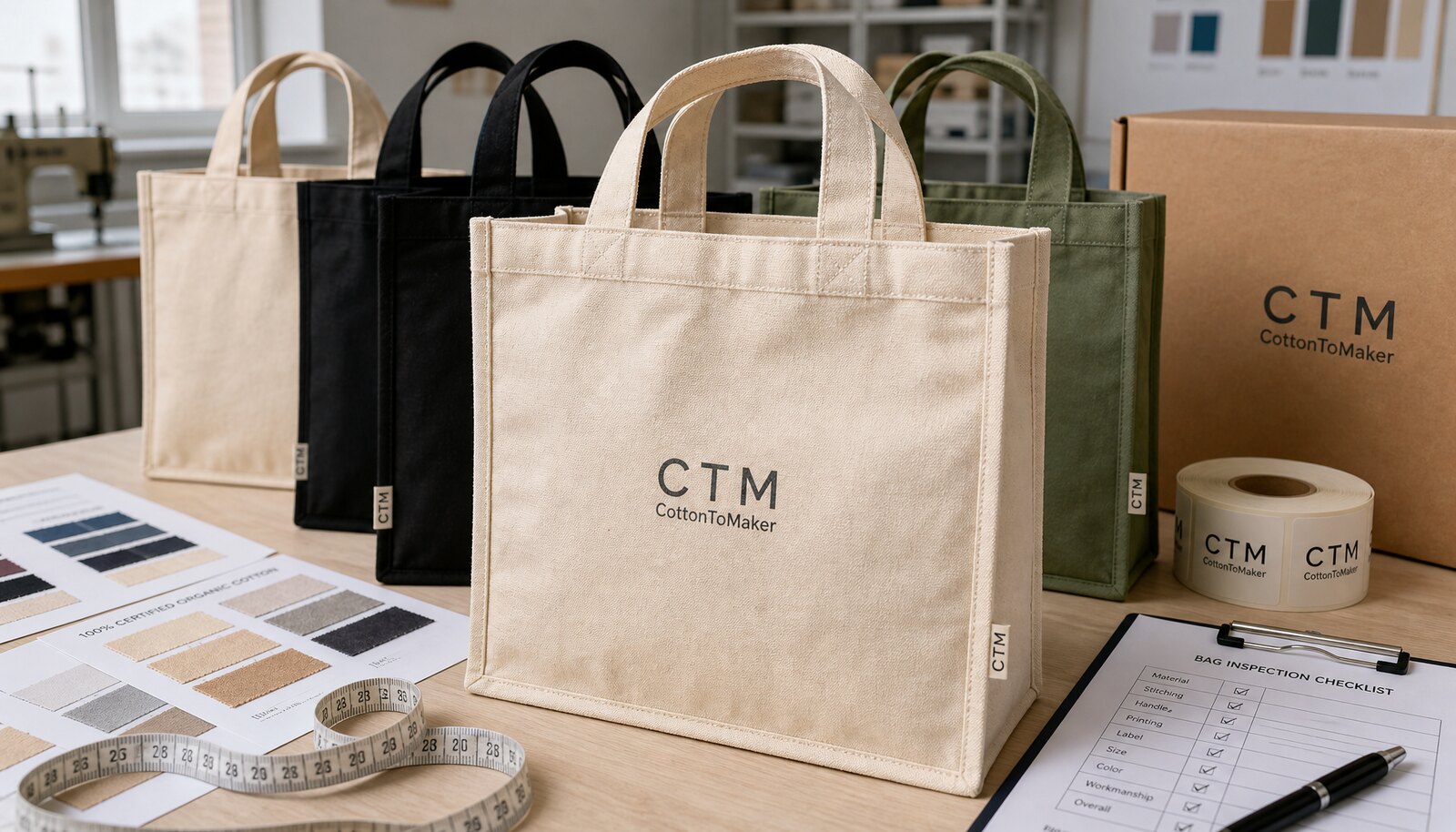
1. Start the audit with the retail claim, not the bag size
For a certified cotton shopping bag, the first procurement question is not whether a supplier can sew a tote. Many factories can cut two fabric panels, attach handles, print a logo, and pack cartons. The real buying risk is whether the cotton claim you plan to use in retail communication is supported by the supply chain behind the bag. A supplier audit should therefore begin with the claim, the document route, and the chain of custody before the team debates GSM or logo size.
Be precise in the RFQ. The phrase certified cotton shopping bag can mean several different things: organic cotton, cotton from a farm program, certified material processed by a certified mill, a factory that holds a general certificate, or simply a natural cotton bag sold with eco language. These are not equal for compliance. If your product page, hangtag, invoice, carton, or ESG report will mention certified cotton, ask what proof can be provided for your exact order and which organization will issue or apply for that proof.
A practical rule for retail buyers is simple: if the proof cannot be tied to the material used for your purchase order, do not approve the claim. A certificate on its own may show capability, not shipment coverage. The supplier must explain how certified cotton enters the system, how it remains identifiable, and how the finished bags can be connected to the certified input quantity. This is especially important when the same factory also produces conventional cotton bags.
- Write the exact claim you intend to make before requesting quotes: certified cotton, organic cotton, recycled blend, or natural cotton with no certification claim.
- Ask where the claim will appear: bag print, woven label, hangtag, polybag, carton, invoice, website, marketplace listing, or internal reporting file.
- Require the supplier to state whether the certificate covers the mill, fabric trader, printer, sewing factory, exporter, or only one company in the chain.
- Do not approve artwork containing certification wording until document scope and order-level documentation are confirmed.
- If the document route is weak, choose a non-claim design or source through a supplier that can support the claim properly.
2. Verify certification scope and reject weak proof in practice
Certification review should not be a box-ticking exercise. Retail buyers should check certificate validity, scope, material category, process coverage, and whether the certificate holder is actually involved in the order. A supplier may send a certificate that is expired, belongs to another company, covers a different facility, or covers a product category that does not match cotton fabric bags. These situations are not minor paperwork issues; they can make your retail claim unsubstantiated.
Ask for the certificate page that shows the company name, address, license or certificate number, expiry date, product categories, process categories, and material scope. Where the standard provides an online database or official verification method, use that route rather than relying only on a PDF. If the supplier says the certificate is confidential, ask them to mask pricing-sensitive information only, not the details needed to verify scope. A logo file, marketing brochure, or screenshot should never be treated as proof of certified cotton for a specific order.
Also separate company capability from transaction coverage. A factory may be certified to handle certain products, but your order may still require a transaction certificate or equivalent shipment-level document depending on the standard and claim. If the seller cannot explain who applies for the transaction document, when it is issued, which quantity it covers, and what information will appear on it, the buyer should pause the order or remove the certified claim. This avoids the common problem of receiving good-looking bags with no usable compliance file after shipment.
- Check certificate holder name against the quoting company, invoice company, factory name, and exporter name.
- Confirm certificate expiry date covers the expected production and shipment period, not only the RFQ date.
- Review scope boundaries: material, product category, processing step, subcontractors, trader/exporter role, and logo-use permissions.
- Reject vague statements such as our cotton is certified, we use an organic supplier, or certificate can be provided later if no scope proof is shown.
- Ask for the order-level document process before deposit: who applies, what quantity is covered, what lead time is needed, and what fee applies.
- Escalate if the supplier offers a certified claim at one price but refuses traceability records after you request documentation.
3. Map the chain of custody from fabric roll to packed carton
A certified cotton shopping bag supplier may not control every step. Fabric may come from a mill, dyeing unit, warehouse, or trader. Printing may be done in a separate workshop. Sewing and packing may happen in the main factory. Your supplier audit should map this complete path because certified material can lose integrity when roll identity, subcontracting, or leftover handling is uncontrolled.
During a factory review, follow the physical material flow. Where do certified fabric rolls arrive? Are they labeled with roll number, batch number, width, and quantity? Are certified rolls stored separately or at least clearly identified? How are cutting tickets created? Does the cutting room record which roll numbers were used for your PO? If there is leftover fabric, is it returned to controlled storage, scrapped, or mixed into another order? These questions reveal whether the factory has a real chain-of-custody habit or only a sales-level claim.
Subcontracting is another common audit gap. If screen printing or embroidery is outsourced, ask whether the subcontractor is permitted under the certification scope or controlled by the certified supplier’s system. Even if certification rules differ by standard, retail buyers should know where the goods go, who handles them, and how certified and conventional goods are separated. A beautiful sewing line does not compensate for unknown material movement.
- Request a simple process map covering fabric receiving, storage, cutting, printing, sewing, finishing, inspection, packing, and dispatch.
- Check roll labels, internal lot numbers, fabric issue records, cutting tickets, production batch numbers, and packed-carton references.
- Ask whether certified and conventional cotton are processed on the same tables, machines, or lines and how cleaning or segregation is handled.
- Confirm whether printing, embroidery, washing, dyeing, or packing is subcontracted and how those steps are controlled.
- Ask how the factory reconciles input fabric quantity with cut panels, production loss, rejected pieces, leftovers, and shipped quantity.
- If roll-to-order traceability cannot be demonstrated, treat certification support as high risk even if the sample quality is acceptable.
4. Specify fabric by use case, finished GSM, and tolerance
Fabric weight is one of the biggest reasons certified cotton shopping bag quotations vary. A 180 GSM plain-weave bag and a 280 GSM canvas bag may have the same finished dimensions in a product photo, but they will not perform, fold, ship, or cost the same. Lighter fabric can reduce unit price and freight weight. Heavier fabric can improve structure, premium feel, and load performance, but it increases material cost, sewing difficulty, carton weight, and sometimes minimum order quantity.
Retail buyers should choose GSM according to intended use, not only target price. For apparel, cosmetics, books, and general retail checkout bags, 180-220 GSM certified cotton is often a practical starting range. For premium reusable bags, gift-with-purchase programs, grocery-style use, or heavier products, 250-300 GSM canvas may be more suitable. Very heavy canvas can look substantial, but it can also create bulky seams, higher needle stress, and expensive cartons. Ask for a sample in the intended GSM rather than approving a lighter showroom sample.
The quote should state whether GSM is measured before or after finishing. Greige fabric weight, washed fabric weight, dyed fabric weight, and finished bag feel can differ. If the supplier quotes only thick cotton or 12 oz style without a clear metric conversion or tolerance, comparison becomes unreliable. Define the finished GSM target and tolerance in the purchase order, and allow a practical inspection method for checking it.
- 140-160 GSM: light promotional or event bag; lower cost but higher risk of transparency and lower load expectation.
- 180-220 GSM: common retail range for apparel, cosmetics, bookstores, lifestyle stores, and moderate reusable shopping use.
- 250-300 GSM: stronger canvas feel for premium programs, heavier goods, gift packaging, and longer service-life positioning.
- 320 GSM and above: heavy-duty appearance, but audit seam bulk, needle marks, folding size, carton weight, and freight impact.
- Always compare price, durability, and logistics together; the lowest unit price may be expensive if failures or airfreight occur.
5. Audit construction details that decide in-store performance
For shopping bags, sewing details are not cosmetic. Handle width, handle drop, reinforcement method, seam allowance, thread quality, stitch density, and bottom-corner construction decide whether the bag survives normal retail use. Many buyer complaints happen because the approved sample looked clean from the front, while the handle attachment or seam construction was not specified strongly enough for bulk production.
Handle design should match the carrying scenario. A shoulder bag generally needs a longer handle drop than a hand-carry checkout bag. Narrow handles can lower cost, but they cut into the hand when the bag is loaded. For many retail bags, 2.5-3.5 cm self-fabric handles are a practical range, but large bags or heavy goods may require wider handles or more robust reinforcement. A simple single stitch may be acceptable for a very light bag, but box-x stitching, cross-stitching, or bar tacking is safer where load risk is higher.
Ask the factory to show its construction standard, not only a finished sample. The audit should check how operators know seam allowance, stitch density, handle placement, and trimming requirements. If the supplier cannot document or photograph these points, the bulk line may drift from the sample. Include construction drawings or annotated photos in the PO so inspectors have an objective reference.
- Handle width: specify finished width and tolerance; avoid reducing handle width after sample approval to save cost.
- Handle drop: define whether the bag is intended for shoulder carry, hand carry, stroller hook use, or light promotional use.
- Reinforcement: specify box-x, cross-stitch, bar tack, or other method and require the same construction in the pre-production sample.
- Seam allowance: define minimum allowance and finishing method so fabric does not fray under load.
- Stitch density: agree a practical range per inch or centimeter and check for skipped stitches, broken stitches, and loose backstitching.
- Load test: set a practical test weight and duration based on intended retail use; record handle and seam condition after loading.
6. Match printing, labels, and certification wording to the artwork risk
Most certified cotton shopping bags use one-color or two-color branding, and water-based screen printing is often a strong fit for simple solid artwork. It can provide a softer hand feel on cotton than some heavy plastisol or transfer options. However, water-based print is not automatically correct for every design. Fine lines, tiny text, large solid panels, gradients, and dark fabric grounds all require careful sampling and curing control.
The printing method should be selected after reviewing final artwork. Screen printing, digital printing, heat transfer, embroidery, and woven labels have different risks. Screen print may lose small details if the artwork is too fine. Heat transfer can hold detail but may crack, lift, or feel plastic-like if not tested. Digital print can help with multicolor designs but may have different rub and cost profiles. Embroidery can look premium but may pucker lighter cotton fabric. A woven side label can be a subtle retail branding option, but placement and sewing must be controlled.
Certification wording adds a separate compliance risk. Do not let the design team print organic cotton, certified cotton, or standard logos until the document scope and logo-use rules are confirmed. The same caution applies to hangtags, barcode labels, cartons, and e-commerce copy. If the supplier cannot support the claim at shipment level, changing one phrase after bulk printing may require rework, relabeling, or scrapping.
- Provide final vector artwork, print size, print position, number of colors, Pantone or color target, and artwork version number.
- Ask the printer to confirm ink type, screen setup, curing method, expected hand feel, and color tolerance on natural cotton.
- Test print rubbing, adhesion, edge sharpness, registration, show-through, ink migration, and cracking where relevant.
- Proofread all certification wording, fiber composition, care instruction, country of origin, barcode, SKU, and retailer-required label text before bulk production.
- For woven labels, specify label size, fold type, material, artwork, sewing side, distance from seam, and whether the label itself carries any claim.
- Hold bulk printing until the approved printed pre-production sample and compliance wording are signed off.
7. Build the RFQ so supplier quotes are truly comparable
Two supplier prices are only comparable when the quoted assumptions are the same. A low price may exclude certification documentation, use non-certified stock fabric, reduce GSM, narrow the handles, simplify reinforcement, use cheaper packing, or quote FOB when another quote includes DDP support. Retail buyers should force clarity before negotiating, otherwise the supplier with the most incomplete quote may look like the best option.
A strong RFQ for a certified cotton shopping bag should read like a production control document. It should define bag size, finished GSM, fabric color, construction, printing, labels, packing, certification proof, inspection requirement, Incoterm, sample process, and document timing. If you want to compare 180 GSM and 280 GSM options, ask each supplier to quote both. If you may need a pilot run and a full rollout, ask for price breaks and explain whether the pilot must carry the same certification claim.
Separate cost lines when they affect decisions. For example, ask for unit price, screen or setup cost, sample cost, certification document cost if any, hangtag cost, barcode application cost, special packing cost, and freight-related carton data. This helps procurement see which cost is structural and which cost is optional. It also prevents late surprises after the PO is issued.
- Bag specification: finished width, height, gusset, shape, tolerance, fabric GSM, weave, color, handle size, and construction drawing.
- Branding specification: print method, colors, print positions, print size, artwork file name, label details, hangtag, and approval route.
- Certification specification: required claim, certificate scope, transaction documentation expectation, logo-use rules, and timing of document delivery.
- Packing specification: folding method, pieces per carton, inner packing, carton mark, barcode, store allocation, plastic-free requirement, pallet option, and moisture control.
- Commercial comparison: MOQ, price breaks, sample charges, setup charges, lead time, payment terms, Incoterm, quotation validity, and inspection access.
- Reject quotes that provide only a unit price and product photo; treat them as estimates, not sourcing decisions.
8. Understand MOQ, sampling, and approval as audit controls
MOQ for certified cotton shopping bags is not just a sales preference. It can be driven by fabric roll availability, certified material booking, custom dyeing, printing setup, cutting efficiency, packing labor, and documentation. A supplier offering a very low MOQ may be using existing fabric, while a supplier requiring a higher MOQ may be booking fresh certified fabric from a mill. Neither is automatically better, but the buyer must know what is behind the number.
Ask the factory to explain MOQ by component. Natural undyed fabric may have a lower MOQ than custom dyed certified cotton. A one-color print may be easy to set up at small volume, while multicolor prints or multiple store versions increase waste and labor. Store allocation, individual barcode labeling, paper bands, hangtags, or plastic-free packing can also raise practical minimums. If you are testing a retail program, ask for a pilot option and a reorder option based on the same approved specification and document requirement.
Sampling should be used as an audit control, not just a sales demonstration. A showroom sample made from conventional cotton may be useful for size and stitching review, but it should be clearly marked construction sample only. The pre-production sample should use the nominated fabric or an approved equivalent, the final handle construction, the intended print method, and the final label and packing approach where possible. Version control matters: every approved sample should have a date, file reference, and comments so the factory, merchandising team, and compliance team are approving the same product.
- Ask what drives MOQ: certified fabric, dyeing, print setup, cutting loss, special packing, document cost, or factory scheduling.
- Separate pilot-order quote, production-order quote, and reorder quote so procurement understands the cost path.
- Approve samples in stages: fabric swatch, blank construction sample, printed pre-production sample, and packing sample.
- Mark non-certified or substitute-fabric samples clearly so they are not mistaken for compliance-approved samples.
- Create a golden sample record with dimensions, GSM, handle details, print file, label wording, packing instruction, approval date, and approver name.
- If the sample changes after approval, issue a revised version rather than relying on email comments scattered across teams.
9. Set end-to-end quality control before cutting starts
Quality control for certified cotton shopping bags should begin before fabric is cut. Waiting until cartons are sealed leaves little time to correct wrong material, weak handle construction, print errors, or label mistakes. Retail buyers should agree the inspection plan, defect classification, sampling approach, and corrective-action process before bulk production begins. This is especially important when the order includes certification wording, barcodes, store allocation, or a launch deadline.
Start with incoming fabric control. The factory should check roll identity, GSM, width, shade, odor, stains, moisture, mildew, weaving defects, and roll count against the PO. For certified cotton, roll labels and batch records are part of quality control because they support material traceability. If incoming fabric fails GSM, shade, or contamination checks, the factory should hold it and notify the buyer before cutting. Cutting defective or unverified fabric transfers the problem into thousands of finished bags.
Next comes first article approval. After the first few pieces are cut, printed, and sewn, the factory should confirm dimensions, handle position, reinforcement, print color, print placement, label position, and workmanship against the approved sample. This is the best time to catch a wrong screen position, handle drop mismatch, or seam allowance issue. Inline inspection should then monitor sewing consistency, thread trimming, broken needles, print defects, and quantity flow. Final inspection should verify finished goods and packing before shipment release.
Defect classification should reflect retail risk. Critical defects include wrong material, unauthorized certification claim, contamination, unsafe sharp objects, incorrect logo, missing mandatory label, or mixed SKU/carton contents. Major defects include weak handle attachment, open seams, heavy stains, print misregistration, wrong dimensions beyond tolerance, severe odor, or incorrect carton marks. Minor defects may include a small loose thread, slight natural slub within approved limits, or minor shade variation that does not affect retail presentation. Define these levels before inspection so pass, hold, rework, or reject decisions are not negotiated under shipping pressure.
- Incoming fabric check: roll label, batch number, GSM, width, shade, odor, stains, moisture, mildew, and certified-versus-conventional segregation.
- First article check: compare the first finished pieces with the golden sample before bulk sewing and packing continue.
- Inline check: monitor cutting accuracy, print curing, stitch density, handle reinforcement, seam alignment, trimming, and rejected-piece segregation.
- Final inspection: verify dimensions, workmanship, print, labels, barcode, carton count, carton marks, packing method, gross weight, and document readiness.
- Critical defects: wrong certified claim, wrong material, contamination, unsafe foreign object, wrong logo, missing required label, or mixed SKU.
- Major defects: broken seam, weak handle, severe stain, wrong size beyond tolerance, heavy print defect, strong odor, or wrong carton label.
- Minor defects: small loose thread, slight natural cotton slub, or minor shade variation within the approved visual range.
- Require inspection photos, measurement records, defect summary, corrective actions, and a clear release decision before balance payment or shipment.
10. Control packing, lead time, shipment release, and audit decisions
Packing can change cost, freight, inspection time, warehouse receiving, and customer experience. A certified cotton shopping bag may be flat packed, folded, individually packed, paper-banded, hangtagged, barcode-labeled, or sorted by store allocation. Each option adds labor and possible error. If the retailer restricts plastic packaging, specify paper bands, master polybag limits, carton liners, or other acceptable alternatives early rather than after bulk packing has started.
Carton data should be confirmed before freight booking. Ask for pieces per carton, carton dimensions, gross weight, net weight if needed, carton material, carton mark layout, pallet configuration, and moisture-control method. Cotton fabric can absorb moisture, so sea freight and humid warehouses require practical protection. If desiccants or carton liners are specified, verify they are actually used and do not conflict with retailer packaging rules. For distribution centers, carton mark accuracy can be as important as bag workmanship because receiving errors create chargebacks, delays, or manual relabeling.
Lead time should be broken into stages: certification verification, fabric booking, sample making, sample approval, transaction document planning, cutting, printing, sewing, inline inspection, final inspection, packing, shipment booking, and document delivery. A supplier promise such as 30 days is incomplete unless you know when the clock starts. Does it start after deposit, after artwork approval, after fabric arrival, or after pre-production sample sign-off? For certified cotton, document processing and fabric availability can be real schedule drivers, so include them in the production calendar.
Finally, make audit outcomes actionable. A supplier can pass commercially but fail on certification scope. Another supplier may have strong documents but weak sewing. Your decision should state the consequence: approve, approve with corrective action, use for non-certified claim only, require third-party inspection, reduce order quantity, or reject. Procurement buyers protect the launch by tying each audit finding to a sourcing decision, not by filing a checklist without follow-up.
- Packing approval: confirm folding method, inner packing, plastic-free requirement, barcode position, hangtag, carton count, and carton mark before bulk packing.
- Carton control: verify dimensions, gross weight, carton strength, quantity per carton, SKU accuracy, destination, country of origin, and pallet plan.
- Moisture control: consider carton liners, desiccants, humidity storage rules, and dry-container practices where appropriate for the route.
- Lead-time control: build the schedule from sample approval and fabric readiness, not only from deposit date.
- Shipment release: require final inspection pass, packing photos, carton list, document status, and corrective-action closure before release.
- Audit decision: approve fully, approve with conditions, downgrade claim, require re-sampling, hold shipment, or change supplier based on evidence.
Specification comparison for buyers
| Audit area | What strong proof looks like | Weak proof to reject or escalate | Buyer decision consequence |
|---|---|---|---|
| Certification scope | Valid certificate or license covering the relevant organization, process, and certified cotton material category, plus a clear route for order-level transaction documentation where applicable | A generic factory certificate, expired PDF, cropped screenshot, logo use claim, or certificate that covers apparel but not fabric/bags/material handling | Do not approve certification wording on artwork or packaging until scope and order coverage are confirmed |
| Material traceability | Fabric roll labels, mill invoice or packing list, batch or lot records, cutting ticket, and segregation records connecting certified fabric to the PO | Supplier says fabric is certified but cannot identify roll numbers, source mill, lot quantity, or how leftovers are controlled | Treat the bag as unverified cotton; decide whether to change the claim, change material, or change supplier |
| Fabric specification | Finished GSM range, weave, color, shrinkage expectation, fabric width, finishing method, and tolerance stated in the quote and PO | Only a product photo or vague terms such as thick cotton, eco cotton, natural cotton, or organic style | Quotes are not comparable; require a revised specification before price approval |
| Construction strength | Handle width and drop, seam allowance, stitch density, thread type, reinforcement method, and load-test requirement defined before sampling | Single-line handle stitch on a large bag, no stated seam allowance, no stitch standard, or sample differs from quoted construction | High risk of in-store failure; require a stronger sample or limit use case |
| Printing and branding | Final artwork file, print method, ink type, color target, print size, position tolerance, curing check, rub test, and proofread label/certification wording | Supplier chooses print method without artwork review, cannot explain curing, or prints certification phrases before document approval | Hold bulk printing until artwork, compliance wording, and print test are approved |
| Packing and retail readiness | Pieces per carton, carton dimensions, gross weight, folding method, barcode or hangtag position, carton mark, moisture control, and pallet option confirmed | Packing is described only as standard export carton, with no carton data or receiving-label review | Freight quotes, DC receiving, and final inspection may fail; require packing sample or packing instruction |
| Final inspection | AQL level or agreed sampling plan, defect classification, measurement tolerance, load/rub checks, document check, and sealed-carton release process | Inspection limited to factory photos of finished bags, no defect definitions, no carton count check, no corrective-action time | Do not release balance payment or shipment until inspection evidence matches the PO |
Buyer checklist before sampling
- Write the exact retail claim first: certified cotton, organic cotton, cotton in conversion, recycled cotton blend, or conventional natural cotton. Do not let suppliers quote against a vague eco bag description.
- Verify certificate status, certificate holder, product category, process scope, material scope, expiry date, and whether the certificate connects to the fabric supplier, bag factory, printer, and shipment documentation route.
- Ask what order-level proof can be issued for your PO, such as a transaction certificate or equivalent shipment-level record where the standard requires it. Reject proof that cannot be tied to the ordered material and quantity.
- Map the chain of custody from certified cotton fabric receiving through roll storage, cutting, printing, sewing, inspection, packing, leftover control, and dispatch.
- Require fabric details in the quote: finished GSM, tolerance, weave, color, yarn count if available, fabric width, finishing, shrinkage expectation, and whether the material is in stock or must be booked from a mill.
- Define finished bag dimensions, gusset, handle width, handle drop, seam allowance, stitch density, reinforcement type, thread color, and load-use expectation before sample approval.
- Match the print method to the final artwork, not to a generic quote. Confirm ink type, number of colors, print size, Pantone or lab dip target, position tolerance, curing, rub resistance, and hand feel.
- Approve samples by function: material swatch, construction sample, printed pre-production sample, and packing sample. Clearly mark any non-certified sample as construction sample only.
- Compare suppliers using the same size, GSM, fabric source status, certification document requirement, handle construction, print coverage, packing method, Incoterm, and inspection requirement.
- Set acceptance criteria for dimensions, GSM, shade variation, fabric defects, odor, stains, print placement, print fastness, seam strength, broken stitches, labels, barcode, carton marks, and carton count.
Factory quote questions to send
- Which certified cotton standard, material category, and product scope can you support for this shopping bag, and can our PO receive a transaction certificate or equivalent shipment-level document if required?
- Who is the certificate holder for each stage: fabric mill, dyeing or finishing unit, printing unit, sewing factory, trader, or exporter? Which operations are inside your scope and which are subcontracted?
- Can you provide certificate numbers, expiry dates, scope pages, and the official verification route instead of only a logo file or screenshot?
- Is the quoted fabric in stock, reserved from a certified fabric supplier, woven after order confirmation, or substituted from a conventional stock fabric? What quantity and color are available now?
- What is the exact finished GSM, weave type, fabric width, color, shrinkage expectation, and tolerance? Is the GSM measured before or after washing, dyeing, or finishing?
- Can you quote the same bag in 180 GSM, 220 GSM, and 280 GSM certified cotton so we can compare unit cost, strength, carton weight, and freight impact?
- What handle width, handle drop, seam allowance, stitch density, thread type, and reinforcement stitching are included in the quoted unit price?
- What practical load test do you recommend for this use case, and can you perform and document it on the pre-production sample and final inspection samples?
- Which print method do you recommend for our artwork, and what are the setup charges, color limits, print-size limits, curing process, and rub-test expectations?
- If certification wording or an organic cotton statement appears on the bag, hangtag, carton, or invoice, who checks the wording against the document scope before printing?
Quality-control points to confirm
- Verify certificate and document status before production: certificate validity, scope category, order-level documentation route, and approval of any certification wording used on product, label, carton, invoice, or website content.
- At incoming fabric inspection, check roll labels, batch numbers, color, width, length, visible contamination, moisture, odor, mildew, oil marks, and whether certified fabric is physically separated from conventional rolls.
- Measure fabric GSM using a calibrated GSM cutter or agreed practical method where possible. Record the result and compare with the quoted finished GSM tolerance, not only the greige fabric claim.
- Check finished bag dimensions: width, height, gusset, handle width, handle length, handle drop, seam allowance, and print position against the approved sample and PO tolerance.
- Inspect fabric appearance for unacceptable slubs, holes, broken yarns, weaving bars, stains, shade panels, crease marks, dirt, mildew, and strong chemical or storage odor.
- Review cutting accuracy: fabric grain direction, panel alignment, consistent handle length, clean cut edges, correct quantity, and separate control of certified fabric remnants.
- Check sewing workmanship: stitch density, backstitching, thread trimming, skipped stitches, broken stitches, seam waviness, puckering, open seams, needle damage, and bottom corner strength.
- Test handle attachment using an agreed practical load based on the retail use case. Observe seam distortion, thread breakage, fabric tearing, and reinforcement failure after loading.
- Confirm print quality: color target, size, placement, registration, edge sharpness, ink coverage, hand feel, curing quality, dry and wet rubbing where required, transfer cracking, or ink migration.
- Check all labels and wording: woven labels, care labels, country of origin, hangtags, barcode stickers, SKU labels, carton marks, and any certified cotton or organic cotton statement.