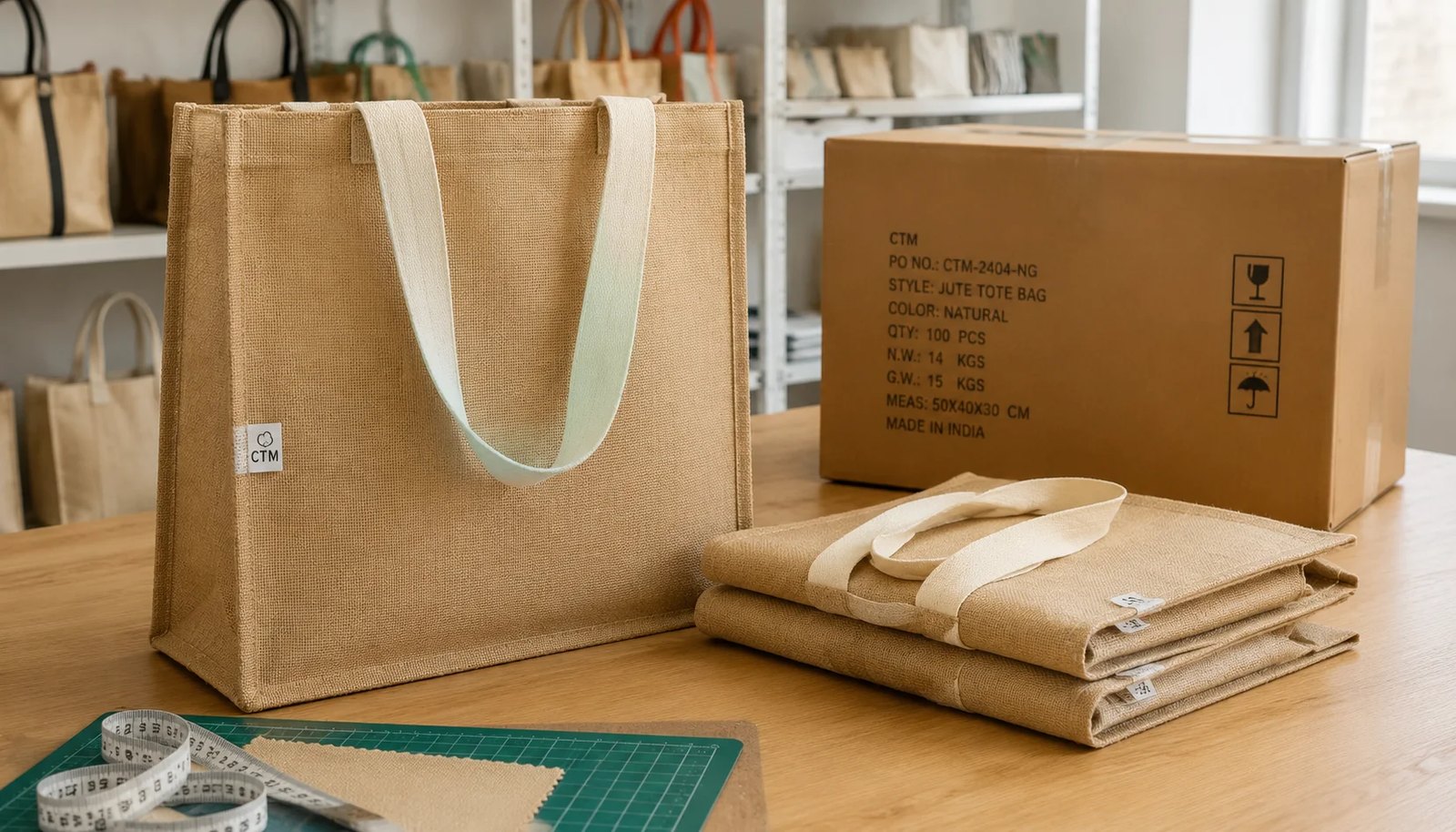
Why carton planning matters more than the bag price on jute grocery programs
On wholesale jute tote bags for natural grocers, procurement teams often negotiate hard on unit price and leave carton planning until the supplier is ready to ship. That usually creates avoidable cost. Jute is bulky, gusseted, and often laminated, so the carton plan changes loading efficiency much more than it does on light cotton pouches. A bag that looks only a few cents cheaper ex-factory can end up costing more per delivered unit if the fold method, case count, or carton strength is wrong.
Natural grocers also have practical downstream needs that many factories do not understand unless they are written into the RFQ: store-level replenishment by case count, warehouse handling limits, and clean presentation when cartons are opened. If the bags arrive over-compressed, the gussets can stay creased, handles can twist, and printed faces look tired on shelf. A useful carton plan is not just about fitting more pieces into a container. It must balance freight cube, carton damage risk, receiving efficiency, and first-use appearance.
- Main cost levers: carton cube, pieces per carton, pallet height, and gross weight per case
- Main quality levers: fold method, lamination crack resistance, handle distortion, and carton board strength
- Main operations levers: DC receiving speed, store allocation by carton count, and relabeling avoidance
Start with the finished bag spec before discussing pack count
A realistic packing plan starts with the actual finished bag. For natural grocery use, a common jute tote range is about 35 x 38 x 18 cm or 14 x 15 x 7 inches, with laminated interior and cotton webbing handles. Fabric in the 260-310 GSM laminated range gives enough body for grocery loads without becoming unnecessarily thick. If you move to very soft, light jute, the bag compresses better in carton count terms, but complaints about shape retention and print appearance increase.
Print method also affects packing thickness. A 1-2 color screen print on flat panels is still the most commercial choice for bold grocery branding. Heavy ink coverage across large areas can create tackiness before full cure and add blocking risk when bags are stacked tightly. If buyers want a cleaner natural look, a smaller front-panel print with unprinted gussets generally packs better and lowers reject risk compared with full-wrap artwork.
- Typical grocery-ready jute body: 260-310 GSM laminated
- Handle preference: cotton webbing 2.5-3.2 cm wide for comfort under heavier loads
- Commercial print choice: 1-2 color screen print before assembly
- Spec detail worth adding to RFQ: finished size tolerance, handle drop tolerance, and print placement tolerance
How MOQ logic changes when you want an efficient packing plan
MOQ on jute bags is not only a material issue. It is tied to print screens, fabric color, handle color, and carton efficiency. A factory may quote a low MOQ for a basic body with one print, but the effective MOQ rises if you split artwork into several regional versions or require separate carton assortments for different distribution centers. Buyers should look at MOQ by SKU and by packed case configuration, not just total order quantity.
This matters because many importers try to place one mixed order to hit factory MOQ while still requesting small carton splits by store group. The result can be extra handling, manual assortment, and weaker case packing consistency. In some programs, it is cheaper overall to standardize one bag body and one print across a larger run, then manage downstream allocation domestically, instead of paying the factory to create too many low-volume carton variants.
- Low-complexity MOQ: natural jute body, 1 print, standard handle color
- Higher effective MOQ triggers: multiple logos, mixed case packs, custom retail inserts, barcode labels by SKU
- Useful quote method: request price breaks at one MOQ, one mid-volume, and one full-container planning quantity
Choose a carton count based on handling limits, not only container math
For wholesale jute tote bags, 50-piece and 100-piece master cartons are the most practical starting points. A 100-piece carton can reduce carton count and labor at origin, but it is only efficient if gross weight and carton dimensions remain acceptable for your warehouse. Jute with lamination and webbing handles adds weight quickly. If the master carton becomes too heavy, cartons get dragged, corners split, and receiving teams cut them open on the floor instead of shelving them properly.
A 50-piece carton often costs a little more in material and loading labor, yet it can be the better commercial option when natural grocers or distributors break cases by location. Smaller cartons also reduce compression force on the bottom layers. If you are comparing quotes, ask each supplier to model both options using your actual bag specification. The right answer is often different for domestic truck distribution than for direct container-to-DC import programs.
- Typical handling preference for many warehouses: stay around 15-18 kg gross per carton unless buyer approves more
- Compare both case-count options using packed cube, gross weight, and pieces per container
- Do not approve case count without the actual packed carton dimensions
Fold method is a quality issue, not just a packing detail
Jute totes do not recover from rough folding as easily as lightweight cotton bags. If the factory folds the bag body too tightly to chase a higher carton count, the gusset edges take a set, lamination can whiten or crack at fold lines, and the front panel can show print pressure marks. A better method is to tuck the gusset inward, lay the handles flat inside the body line, and avoid hard reverse folds across the printed area.
Buyers should request photos of the approved fold method before full packing starts. This is especially important when bags are being used in retail displays or promotional launches where first appearance matters. A proper packed sample tells you more than a flat pre-production sample because it reveals how the bag behaves under compression, whether handles snag, and whether the case count is realistic without distorting the product.
- Preferred fold sequence: flatten side gussets, align base, tuck handles inside, stack evenly by panel grain
- Warning signs: sharp white fold lines in lamination, twisted handles, stacked bags with uneven height, ink offset
- Sample to request: one sealed master carton plus unpacked photos from top, middle, and bottom layers
Carton construction and shipping marks affect damage rates and receiving speed
Many buyers accept a generic export carton description, but that leaves too much room for variation. Jute bags are denser than they look, and laminated surfaces make stacks less forgiving. For standard sea freight, a 5-ply master carton may be acceptable if case count is moderate and inland transfer is short. For long drayage, pallet stacking, or multi-stop distribution, a 7-ply carton or stronger board spec can pay back quickly in lower carton failure and better stack stability.
Shipping marks should also be treated as an operations tool rather than artwork afterthought. Clear marks on two long sides and one short side save time in receiving and reduce relabeling. Include PO, style, color, case pack, gross and net weight, dimensions, country of origin, and carton number range if the shipment is split. If the buyer uses warehouse scans, the outer label format should be approved before printing to avoid hand-applied labels after arrival.
- Quote carton board explicitly: ply, flute type if available, and any burst or ECT benchmark the supplier can provide
- Marking minimum: SKU/style, PO, quantity, origin, carton dimensions, gross/net weight
- If palletizing, define pallet footprint, max height, and whether slip sheets are acceptable instead of full pallets
Sample approval should include one packed-carton trial, not only the bag
Most sourcing teams approve color, size, and print on a pre-production sample and assume the packing will be fine. That misses one of the biggest variables in jute programs. A packed-carton trial exposes whether the selected case count causes panel curl, whether the handle stack creates carton bulging, and whether the board spec is sufficient once the carton sits under stack load for several days.
The most useful approval path is staged. Start with a stock or material reference sample to confirm fabric and handle feel. Then review a pre-production sample for print and construction. After that, require either a physical packed carton or at minimum detailed packing photos and measurements using production-intent cartons. This last step catches problems while correction is still cheap.
- Sample stage 1: material/shape reference sample
- Sample stage 2: pre-production sample with actual print and handle attachment
- Sample stage 3: packed-carton validation with dimensions, gross weight, and unpacked appearance review
- Useful acceptance notes: no severe gusset set, no lamination peel, no print transfer, carton remains square after stack
Lead time risk usually sits in printing, packing materials, and booking windows
Jute bag lead times are often quoted as one simple number, but procurement planning works better when the supplier breaks the timeline into material booking, printing, sewing, packing, and handover. For natural grocery programs with seasonal promotions or store resets, the weak point is often not sewing capacity. It is the coordination between printed panels, custom cartons, and vessel booking. If one part slips, finished bags may sit waiting while the shipping window narrows.
Requesting carton changes late in production is a common source of delay. A buyer may approve the bag and then decide to reduce carton weight or add extra marks after the cartons are already printed. That can force repacking or replacement board. If the shipment is moving in a tight retail calendar, lock the carton plan before bulk printing begins and align the ex-factory date with freight cut-off, not merely with sewing completion.
- Ask for milestone dates, not one total lead-time figure
- Custom outer cartons and compliance labels can become the last-minute bottleneck
- Packed goods ready date is more useful than sewing finish date for logistics planning
Compare quotes using delivered packing economics, not ex-factory bag price alone
Two suppliers can quote nearly identical jute bags and still produce very different landed cost outcomes because of carton efficiency. One may quote a lower unit price but pack loosely, leading to fewer pieces per container and higher freight cost per bag. Another may use a smarter fold pattern and better carton sizing that reduces freight spend enough to offset a higher ex-factory price. This is why packed dimensions and carton weight belong in the first round of quote comparison, not after nomination.
A practical way to compare is to calculate cost per delivered piece using at least three buckets: ex-factory product cost, packing cost if separated, and estimated freight per packed cubic meter or per container utilization. Even rough examples can expose differences. If Supplier A is $0.05 cheaper per bag but ships 12 percent fewer pieces per container, the apparent saving may disappear once ocean and inland freight are allocated.
- Quote sheet should include: unit price, sample cost, carton size, carton weight, pieces per carton, pieces per container estimate
- Ask whether carton cost is included or listed separately
- Useful internal comparison metric: landed cost per usable delivered piece, not just ordered piece
QC thresholds for natural grocer programs should reflect real use and warehouse handling
Quality control on jute totes should focus on the points that create downstream cost: weak handle attachment, rough cutting, odor from poor lamination, misaligned prints, and damaged cartons. Cosmetic irregularity is part of the natural-fiber character, but there still needs to be a tolerance line. A buyer who does not define that line often receives arguments at inspection because the supplier treats visible slubs and shade variation as acceptable while the retailer sees them as defects on a branded bag.
For carton packing, the acceptance criteria should include both product and package condition. A bag may technically pass sewing inspection but fail your program if the packed case arrives crushed or if lower-layer bags show pressure marks. Linking the QC standard to the approved packed-carton sample gives inspectors a practical reference and reduces subjective disputes at final random inspection.
- Construction focus: handle reinforcement, side seam integrity, base seam security, trimmed threads
- Appearance focus: print clarity, panel alignment, visible stains, odor, excessive shade variation beyond approved standard
- Packing focus: correct count per carton, carton squareness, clean shipping marks, no moisture exposure signs
Specification comparison for buyers
| Spec decision | Recommended option | When it fits | Buyer risk to check |
|---|---|---|---|
| Fabric weight | 14 oz equivalent jute or about 260-310 GSM laminated jute with stable body | Best for grocery totes carrying jars, produce, and boxed items without collapsing | Below this range the bag may wrinkle heavily, print registration may shift, and the side gusset can distort after filling |
| Lamination choice | Inner PP lamination with matte finish | Useful when natural grocers want wipe-clean interiors and better resistance to moisture from chilled produce | Lamination quality varies; weak bonding can bubble, crack at fold lines, or create strong odor in hot containers |
| Bag size | Approx. 14 x 15 x 7 in or 35 x 38 x 18 cm | Good all-around size for checkout reuse, pantry items, and store-branded promotions | Large formats raise carton cube quickly and can push freight up more than unit price savings suggest |
| Handle material | Cotton webbing 1 to 1.25 in wide, cross stitched into top hem | Preferred when comfort matters and buyers want fewer complaints from heavier basket loads | Short insertion depth or weak reinforcement can fail before the jute body does |
| Print method | 1-2 color screen print on flat panels before assembly | Best value for bold grocery branding, ingredient-style copy, and simple logos | Fine lines and large solid coverage can bleed on coarse jute; confirm artwork minimum line thickness and print placement tolerance |
| Fold and pack method | Flat folded with gusset tucked in, handle laid inside, 25 pcs per inner poly or paper band, then master carton | Efficient for warehouse counting, cleaner unpacking, and lower deformation risk | Over-compression to fit more pieces per carton leaves edge creasing and can crack laminated interiors |
| Master carton count | 50 or 100 pcs depending on bag thickness and warehouse handling limit | Works when buyers need practical case counts for DC receiving and store allocation | Very high counts reduce carton count but may exceed 15-18 kg handling preference and increase carton burst risk |
| Carton board spec | 5-ply export carton for standard sea freight; 7-ply if high stack or long inland transfer | Useful for mixed supply chains with port drayage, cross-dock moves, and pallet racking | Thin board fails at bottom seam under laminated jute weight; ask for burst strength or edge crush data |
| Palletization | Cartons aligned by count and orientation, stretch wrapped on fumigation-compliant pallets only if destination requires pallets | Best when importer receives into pallet racking or wants faster unloading | Some buyers pay for pallets they do not need; pallet height can reduce container efficiency if not modeled before booking |
Buyer checklist before sampling
- Define target bag size, gusset depth, and finished handle drop based on real grocery basket use, not only old artwork dimensions.
- State whether the bag must be laminated inside, unlaminated, or biodegradable-coated; do not leave lining material open to interpretation.
- Specify jute weight range in GSM and whether tolerance applies to finished laminated fabric or base cloth before lamination.
- Set maximum packed carton weight acceptable for your warehouse, distributor, or retail receiving team.
- Require the factory to provide packed carton dimensions for at least two pack-count options so freight can be modeled before PO.
- Note the fold method required inside each carton to avoid crushed gussets and twisted handles at store level.
- Define print colors, print sides, artwork line thickness, and whether registration on gusset panels matters.
- Request pre-production sample photos showing body fabric, handle attachment, inside lamination, and actual folded packing thickness.
- Approve shipping marks layout including SKU, color, PO, carton count, country of origin, and carton dimensions.
- Confirm whether polybags are allowed, restricted, vented, recycled-content, or replaced by paper bands to match retailer policy.
Factory quote questions to send
- What jute GSM do you quote, and is that measured on finished laminated fabric or base fabric before lamination?
- Can you quote the same bag in both 50-piece and 100-piece master cartons with full packed dimensions and gross weight per carton?
- What fold method will you use inside the carton, and how many folds are applied to the gusset and handle area?
- What is the estimated pieces per 20 ft and 40 ft container under your recommended carton plan?
- What carton board construction do you include in the price: flute type, ply count, and any burst or edge crush benchmark?
- Does your quote include inner polybags, paper bands, or no inner pack, and what are the material and thickness details?
- For screen printing on jute, what minimum line thickness and maximum solid coverage do you recommend to avoid ink spread?
- What is your MOQ by bag size and print color count, and how does MOQ change if we split one order into multiple logo versions?
- What sample stages are available: stock sample, digital layout, pre-production sample, and packed carton sample?
- What is the normal lead time for material booking, printing, sewing, packing, and vessel handover after artwork approval?
Quality-control points to confirm
- Fabric weight should stay within the agreed tolerance band; if laminated, inspect both cloth stability and lamination adhesion after folding.
- Body size, gusset, and handle drop should be measured on a representative sample after sewing, not only on cut panels.
- Handle pull strength should match intended grocery use; reinforcement stitch pattern and insertion depth need visual and practical load testing.
- Print should be legible on jute texture, with no severe fill-in, ghosting, offset smudge, or obvious panel misplacement beyond agreed tolerance.
- Inner lamination should not peel at corners or crack sharply along fold lines after standard carton packing compression.
- Carton dimensions and gross weight should match the approved packing list because freight invoices are often based on packed cube, not quoted estimate.
- Cartons should remain square after stacking; crushed corners, weak bottom seams, or water-softened board are warning signs before loading.
- Shipping marks must match PO, destination, SKU, and country-of-origin requirements to avoid relabeling cost at the warehouse.