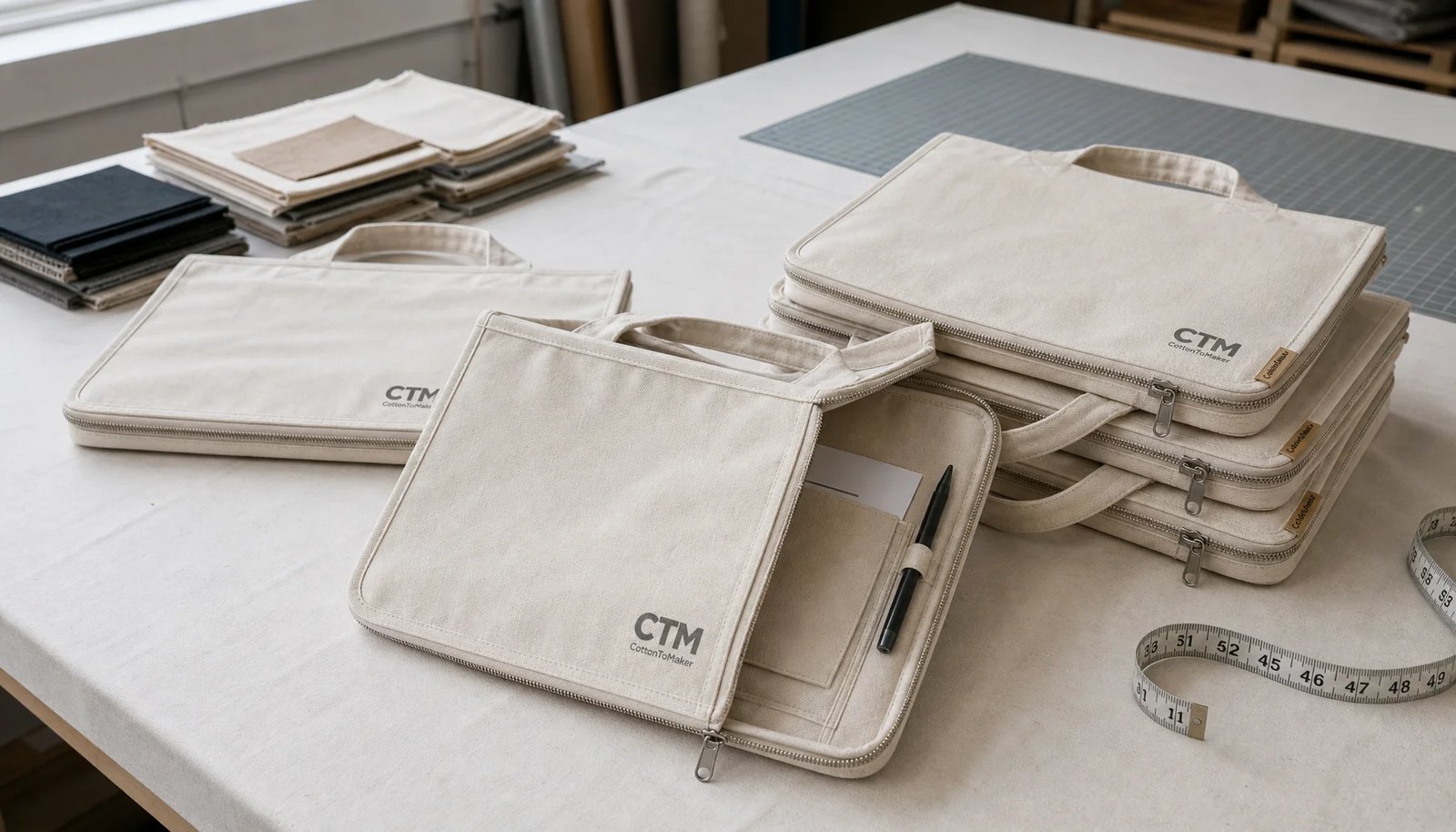
Start With The Event Use Case
A canvas zipper portfolio for trade show exhibitors is not the same product as a casual pouch or a retail stationery case. It has to handle brochures, contracts, business cards, pens, product sheets, and sometimes a tablet while still looking orderly on a booth counter. That means the first sourcing decision is not color or decoration. It is the actual job the portfolio must do during the show.
Procurement teams should write the RFQ around that workflow. Will staff carry the portfolio all day, or will it be handed to visitors as a premium giveaway? Will it hold thin flyers, a full sales kit, or sample swatches? A giveaway version can be lighter and simpler. A staff-use version needs better zipper movement, stronger internal organization, and more attention to repeated opening and closing.
- For visitor giveaways, prioritize clean logo print, flat packing, and controlled unit cost.
- For booth staff, prioritize zipper durability, internal pocket access, and comfortable handling.
- For distributor resale, prioritize consistent retail appearance, label placement, and carton presentation.
- For sales kits with catalogs, test the actual insert thickness before approving the finished size.
Define Size Around Real Inserts
Portfolio size should be based on usable internal space, not just outside dimensions. A buyer can request an A4 zipper portfolio and receive a product that measures close to A4 on the outside but is too tight inside after seams, zipper tape, lining, and corner radius are included. For US buyers, the difference between A4 and letter-size paper also matters. A sample that fits one format may scuff or bend the corners of the other.
A stronger specification gives both the finished outside size and the largest insert size the product must hold. It should also state whether inserts need to slide in easily when the portfolio is lying flat on a booth table. If catalogs, sample sheets, or order forms are included, send the supplier the real stack thickness. A 5 mm stack and a 15 mm stack require different gusset, zipper, and pocket decisions.
- State the target insert format: A4, US letter, legal, tablet size, or custom catalog dimension.
- Allow clearance for seams, lining, zipper tape, and corner curvature.
- Use a small gusset if the portfolio must hold several brochures or swatch cards.
- Avoid sharp zipper corners when thick inserts must pass through the opening.
Choose Canvas Weight And Finish Together
The most common mistake in sourcing canvas zipper portfolios is treating fabric weight as a simple upgrade ladder. Heavier is not automatically better. A 10 oz cotton canvas may be enough for a soft document case, but it can look loose if the front panel is large and unsupported. A 16 oz canvas gives a stronger hand feel, but seams and zipper corners can become bulky, especially when the zipper runs around three sides.
For most trade show portfolios, 12 oz canvas, roughly 380-420 GSM before washing, is a practical starting point. It has enough body for a professional look and still accepts screen printing well. If the product needs a more structured feel, adding interlining is usually better than jumping to a much heavier canvas. Interlining helps the panel stay flat, protects printed areas, and keeps the zipper path more stable. Finish matters too: raw natural canvas, washed canvas, and lightly treated canvas can all look different under the same print.
- 8-10 oz canvas: suitable for light giveaway folders, but check wrinkling and print show-through.
- 12 oz canvas: balanced option for most wholesale exhibitor portfolios.
- 14-16 oz canvas: stronger hand feel, but higher sewing difficulty and carton weight.
- Interlining: useful when the buyer wants panel stiffness without excessive seam bulk.
Specify The Zipper Build, Not Just The Zipper Color
The zipper is the part exhibitors will blame first if the portfolio feels cheap. For canvas zipper portfolios, a No.5 nylon coil zipper is usually more forgiving than a metal zipper because it bends around corners more smoothly and keeps cost under control. Metal pullers can still be used to improve hand feel. If the buyer wants a premium look, upgrading the puller and slider is often smarter than choosing an unnecessarily heavy zipper tape.
The zipper path needs equal attention. A zipper along one side is cheaper but gives limited access. A two-side or three-side zipper makes the portfolio easier to open flat, but it adds sewing difficulty and can create weak points at corners. The sample should be opened and closed repeatedly with actual inserts inside. If the slider catches lining or fabric bulk, mass production will not fix that by itself.
- No.5 nylon zipper is a practical default for A4 and letter-size canvas portfolios.
- Metal pullers improve appearance, but confirm plating color and corrosion resistance.
- Rounder corners usually improve zipper movement and reduce stress.
- Thread ends near the zipper must be trimmed cleanly to prevent slider catching.
Plan The Interior Layout For Real Exhibit Use
Internal layout should support the way a trade show team actually works. Most exhibitors do not need a complex office organizer. They need quick access to a document sleeve, a card pocket, a pen loop, and perhaps one slim tablet slip pocket. The more the interior tries to do, the harder the portfolio is to sew, inspect, and use under event pressure. Every extra pocket adds another opportunity for misalignment or seam blockage.
If the portfolio is meant to hold sales notes, sample cards, or contract pages, think through the order of use. Which items should sit nearest the opening? Which pocket needs to be visible without turning the product upside down? Buyers should provide a reference pack of the actual papers, cards, and device dimensions. That is better than describing the interior as office style or premium layout, because those phrases leave too much room for interpretation.
- Keep the base layout simple unless the use case proves a stronger need.
- Measure the exact thickness of cards, forms, or tablets that will go inside.
- Check that seams do not block pocket openings or narrow the usable insert width.
- Avoid decorative internal features that add cost but do not improve booth use.
Match Decoration Method To Artwork And Canvas Surface
Trade show portfolios usually carry a sponsor logo, exhibitor logo, campaign mark, or distributor brand. The print method should be chosen from the artwork, not from habit. Screen print is cost-effective for solid logos with one to three colors. It works well on canvas, but fine lines can break or thicken because the fabric surface is textured. Heat transfer can handle gradients and small details, but the buyer has to accept the film edge and the hand feel.
For a more retail-style finish, a woven label, cotton label, PU patch, or debossed patch can be added. These details increase perceived value, but they also add production steps and placement tolerances. If the portfolio will be used as a high-visibility exhibitor kit, the safest approval process is to check the decoration on final fabric before full sample sewing. Paper Pantone approval is not enough because natural canvas shifts the visual result.
- Use screen print for bold logos, text, and simple campaign artwork.
- Use heat transfer when gradients, photos, or small full-color details are required.
- Use woven labels or patches when the buyer wants a quieter retail finish.
- Define logo placement by distance from edge and zipper, not by a marked photo only.
Quote The Full Cost Picture Before Comparing Suppliers
Factories quote canvas zipper portfolios on more than fabric and printing. Cutting yield, zipper length, lining, interlining, number of pockets, sewing time, logo versions, packing method, and inspection requirements all affect cost. A portfolio with one document sleeve and one pen loop may be efficient. A design with five internal pockets, elastic straps, mesh, card slots, and custom zipper pullers can take much longer to sew and inspect.
A useful RFQ separates must-have features from nice-to-have features. That allows the supplier to quote a base version and optional add-ons. Buyers comparing quotes should be careful when one supplier is much cheaper. The low quote may exclude interlining, use lighter canvas, assume a smaller print size, pack in bulk, or price only one logo version while the buyer actually needs several exhibitor sponsor versions.
- Base cost drivers: canvas GSM, zipper length, lining, interlining, and sewing complexity.
- Decoration cost drivers: print size, number of colors, screens, labels, patches, and logo versions.
- Packing cost drivers: individual bags, cartons, inserts, barcodes, carton marks, and pallet requirements.
- Administrative cost drivers: samples, revisions, split shipments, inspection, and documentation.
Understand MOQ Logic Before You Split Versions
MOQ for canvas zipper portfolios is not only about the total quantity. It depends on fabric availability, dyeing, zipper color, print setup, cutting efficiency, and how many versions the buyer needs. A factory may accept 500 pieces if the order uses stock natural canvas, stock black zipper, and one logo. The same factory may require a higher MOQ for custom-dyed canvas, special zipper tape, or five separate logo versions.
For trade show exhibitors, split versions are common. One distributor may need the same portfolio for several regional events or sponsor logos. Buyers should not hide that plan until after the first quote. It is better to present the version plan clearly and request pricing by scenario. The factory can then show whether the most economical route is one shared body color with different prints, or separate production lots with different material sourcing.
- Lowest MOQ usually comes from stock natural canvas and standard zipper colors.
- Custom fabric dyeing may require fabric mill MOQ before bag production starts.
- Each logo version may need separate screen setup, print proofing, and packing control.
- Small color splits can create leftover fabric and higher unit prices.
Approve Samples With Measurable Criteria
A good sample approval process prevents expensive arguments after bulk production. The pre-production sample should use final canvas, final zipper, final interlining, final print method, and final internal layout. A sample made with substitute fabric can help confirm shape, but it should not be treated as production approval. Canvas weight, stiffness, and color all affect print result and zipper behavior.
The buyer should record sample measurements and acceptance comments in writing. That includes finished size, pocket size, zipper opening, logo placement, print color, seam quality, and packing. If revisions are required, mark them clearly on sample photos and update the specification sheet. The factory should not have to interpret vague comments such as make it stronger or improve the print. If the event date is fixed, lock the sample fast and avoid open-ended revision loops.
- Measure outside size, usable inside size, and pocket opening size.
- Test zipper movement with the actual documents or sample kit inside.
- Review print color under normal office light and daylight if possible.
- Keep an approved sealed sample or signed photo record for final inspection.
Set Inspection Rules For Production And Packing
Quality control should focus on the failure points buyers actually notice during use. On canvas zipper portfolios, the most visible issues are poor zipper movement, crooked logo placement, loose threads, stains, uneven stitching, and distorted packing. A product can pass a quick photo check and still feel wrong in the hand if the seam allowances are inconsistent or the zipper corner is too tight.
Inspection standards should cover both appearance and function. Stitch density should stay uniform, print adhesion should survive rubbing, and the portfolio should accept the intended insert without forcing the zipper open. Cartons also matter. A carton that is too heavy, too soft, or too tightly packed can deform the product before the order reaches the booth. For time-sensitive events, one clean inspection standard is better than a loose standard and several arguments after shipping.
- Check zipper cycling with inserts inside, not only on an empty sample.
- Verify print cure, tape resistance, and edge wear on folded areas.
- Confirm that pockets fit the actual cards or documents without curling them.
- Inspect carton marks, carton strength, and gross weight before release.
- Treat stains, major zipper failure, major print errors, and wrong size as non-negotiable defects.
Specification comparison for buyers
| Spec decision | Recommended option | When it fits | Buyer risk to check |
|---|---|---|---|
| Outer canvas weight | 12 oz cotton canvas, around 380-420 GSM before washing | Balanced choice for trade show document folders that need structure without excessive freight weight | Very light 8-10 oz canvas can collapse and wrinkle; very heavy 14-16 oz canvas can make seams bulky and raise carton cost |
| Fabric finish | Raw natural, dyed, washed, or lightly treated surface depending on brand look | Choose based on print style, hand feel, and whether the portfolio must look premium or utility-focused | Color shift after washing or finishing can change print appearance and delay approval |
| Interlining or backing | Medium non-woven or cotton interlining laminated or sewn inside the panel | Useful when brochures, catalogs, or tablets need protection and the front panel must stay flat | No interlining can create a wavy print surface; overly stiff backing can crack at folds and corners |
| Zipper specification | No.5 nylon zipper with metal puller, color matched or contrast finished | Reliable for A4 or letter-size portfolios used repeatedly during a multi-day event | Cheap coil zippers may snag at corners; request zipper cycling testing and corner-radius review |
| Logo decoration | Screen print for 1-3 solid colors; heat transfer for gradients; woven label for a subtle retail finish | Screen print is usually efficient for exhibitor giveaways with clear brand marks and controlled cost | Fine lines can fill in on textured canvas; approve on actual fabric, not on paper only |
| Internal layout | One document sleeve, one business card pocket, one pen loop, and optional tablet slip pocket | Fits most exhibitor kits without turning the portfolio into an expensive office organizer | Too many internal pockets raise sewing time, inspection points, and reject risk |
| MOQ logic | Start from 500-1000 pcs for standard canvas, existing zipper colors, and one print version | Suitable for event teams and distributors that need one logo version with reasonable unit cost | Split orders by color or logo version may price as separate MOQs because setup and cutting change |
| Packing method | Individual polybag or glassine bag, 20-40 pcs per export carton depending on size and weight | Protects printed panels from rubbing and keeps event kits clean at the venue | Loose bulk packing can mark prints; overpacked cartons can deform zipper corners and increase damage |
| Sample approval | Pre-production sample using final fabric, zipper, lining, print size, and packing | Best control point before mass cutting, especially for fixed event delivery dates | A sample made from substitute fabric or random zipper stock does not prove production quality |
Buyer checklist before sampling
- Define the finished size by document format and real use, not by a vague reference photo; state A4, US letter, legal, catalog size, tablet size, and the minimum internal clearance needed for easy insertion.
- Specify canvas weight in oz and approximate GSM, plus the fabric state: raw, dyed, washed, lightly coated, laminated, or softened. The finish changes both print appearance and zipper bulk.
- Confirm whether the portfolio needs interlining, padding, or a structured board to prevent brochure corners from bending and to keep the front panel flat after print curing.
- Name the zipper type, zipper size, zipper tape material, slider material, puller shape, puller finish, and whether the zipper must run around one, two, or three sides.
- Provide artwork in vector format and state print method, print size, placement from fixed edges, Pantone targets, and the acceptable color tolerance on natural canvas.
- List all internal components separately: document sleeve, business card pocket, pen loop, tablet pocket, elastic strap, mesh pocket, label, or divider. Small additions change sewing time and cost.
- Clarify MOQ by color, logo version, size, and packing version so the supplier quote does not hide split-order charges or assume a single production run.
- Require a pre-production sample made with final fabric, final zipper, final print, final sewing method, and proposed packing, then approve it in writing before bulk cutting.
- Set inspection points for fabric weight, finished dimensions, zipper function, stitch density, print adhesion, logo placement, odor, thread trimming, and carton strength.
- Request carton size, gross weight, net weight, pieces per carton, carton marks, HS code suggestion, and loading quantity so freight quotes can be compared on the same basis.
Factory quote questions to send
- What canvas weight and GSM are included in the price, and is the fabric greige, dyed, washed, or finished after printing?
- Is the quotation based on stock canvas and stock zipper colors, or does it require custom dyeing with a separate MOQ and lead time?
- What zipper size, zipper tape material, slider type, and puller material are included in the quoted spec?
- Does the price include interlining, padding, reinforcement board, or only a single outer canvas layer?
- Which print method is included, what is the maximum print size, and how many colors are covered before extra charges apply?
- How many logo versions, body colors, or inner layouts are included in the MOQ shown in the quote?
- What sample fee, sample lead time, and revision policy apply before bulk production starts?
- What is the estimated bulk lead time after sample approval and deposit, and where are the schedule bottlenecks?
- What packing method, carton quantity, carton dimensions, and gross weight are included in the offer?
- Which quality standard will be used for final inspection, and what defects are considered major for zippers, printing, stains, loose stitching, and dimension variance?
Quality-control points to confirm
- Fabric GSM should be checked by cutting and weighing a measured fabric piece, with tolerance agreed before production.
- Finished size tolerance should normally be controlled within plus or minus 5 mm for the main portfolio dimensions unless the design is padded or structured.
- Zipper must open and close smoothly across corners for repeated cycles without catching lining, thread ends, or fabric bulk.
- Stitch density should be consistent, commonly around 7-9 stitches per inch for canvas portfolio seams, with reinforced stress points.
- Logo placement should be measured from fixed edges, not judged by eye, especially when several logo versions are produced.
- Screen print adhesion should pass a simple tape test and rubbing check after full curing, with no cracking on folded areas.
- Interior pockets should hold the intended document or card size without tight insertion, curling, or seam blockage.
- Cartons should pass practical handling review: correct ply strength, no over-compression, clear marks, and stable weight per carton.
- Random inspection should include zipper function, stains, loose threads, skipped stitches, print color, odor, and packing accuracy.
- If the order uses a custom zipper puller, check plating consistency, sharp edges, and puller attachment strength before shipment.