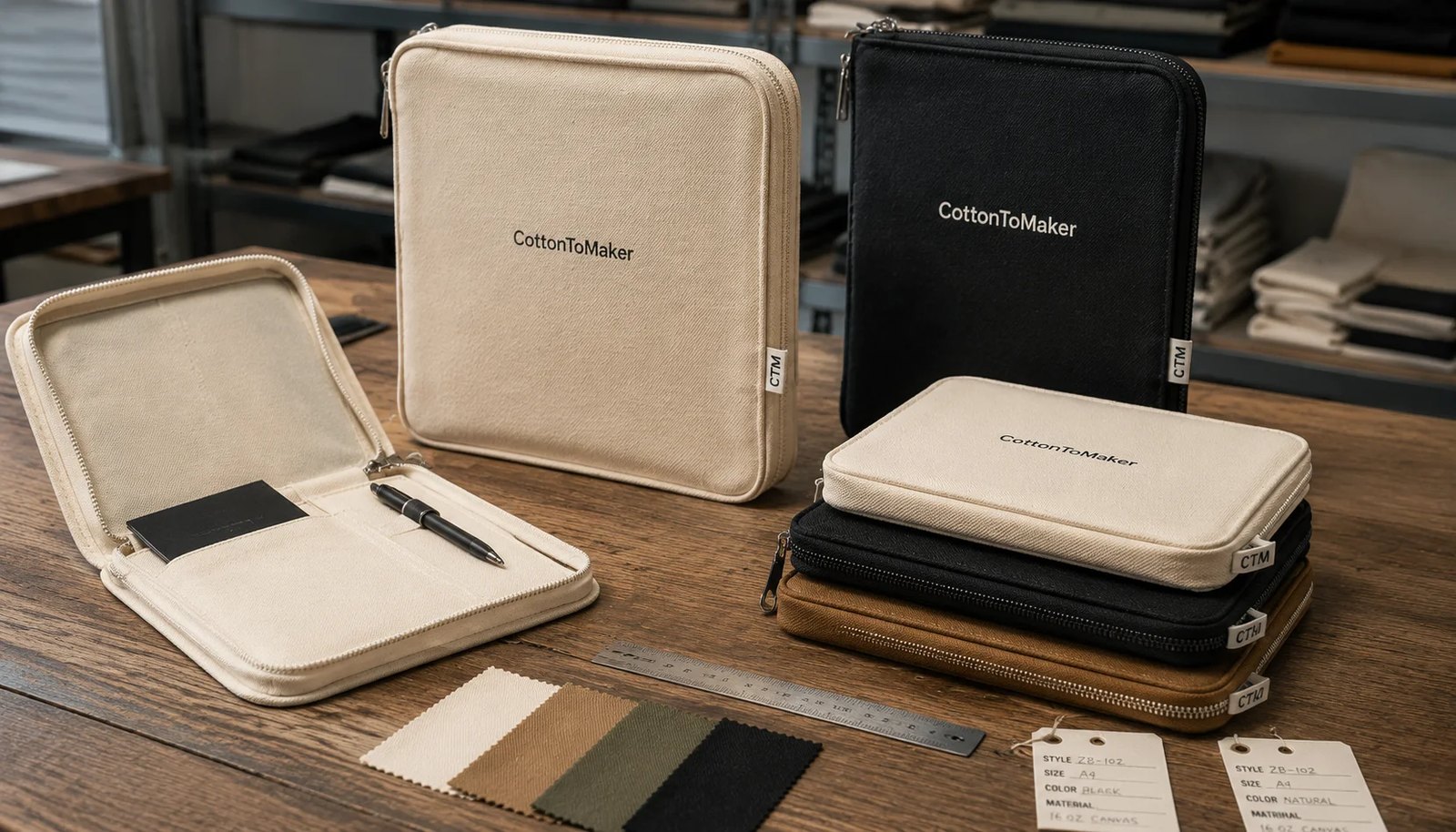
Why liquor retailers buy canvas zipper portfolios differently from standard promo bags
A canvas zipper portfolio sits in a different buying category than a giveaway tote. Liquor retailers usually use it for distributor presentations, wine club welcome packs, premium document kits, tasting event materials, menu or pricing folders, or account-opening packs for trade partners. That means the buyer is not just sourcing a bag-shaped item. They are sourcing a presentation tool that has to protect contents, reinforce brand quality, and survive repeated handling by sales teams or retail managers.
This difference changes the spec priorities. For a tote, small shape changes or slightly softer fabric may be acceptable. For a portfolio, a weak zipper, a floppy front panel, shallow inside pocket, or warped corners immediately makes the product feel cheap. When procurement compares quotes, the biggest mistake is treating all canvas folios as equivalent once the outer size looks similar. Construction detail drives the usable life and the perceived value.
- A portfolio usually needs better shape retention than a tote bag
- Zipper quality matters more because failure makes the whole item unusable
- Interior layout must fit real inserts such as menus, brochures, tasting sheets, or branded notepads
- Premium feel often comes from clean sewing and material balance, not from adding too many features
Start with the end use before writing the RFQ
The cleanest RFQs start with the actual use environment. A portfolio for regional sales reps visiting bars and restaurants needs different construction from one used as a gift accessory in a holiday bottle promotion. The field-use version should prioritize abrasion resistance, a stronger zipper path, reinforced stress points, and simpler branding that holds up under friction. The gift-set version may lean toward better presentation, neater interior organization, and more premium trim if the item is opened only occasionally.
If your team writes an RFQ around visuals only, suppliers fill in the blanks differently. One factory quotes a soft 10 oz body with no reinforcement. Another assumes 16 oz canvas with lining and foam. Unit prices may look wildly different, but the product is not comparable. Build the RFQ around what the portfolio must hold, how often it will be used, and whether the buyer cares more about cost, durability, or premium presentation.
- State target contents: A4 documents, tasting cards, membership folder, notepad, sales forms, POS inserts
- State use frequency: one-time presentation, seasonal campaign, or daily rep carry
- State display expectation: shelf-ready gift item, back-office organizer, or field presentation tool
- State whether mixed materials are allowed, such as PU patch, lining, elastic loops, or metal zipper pull
Fabric and structure choices that keep the portfolio from feeling cheap
For most liquor retail programs, 12 oz to 16 oz canvas, roughly 340 to 450 GSM, is the practical starting range. At this weight, the folio can hold shape better, carry print more cleanly, and resist looking limp after repeated opening and closing. Below that range, the portfolio can still work, but only if the construction includes lining, interfacing, or a simplified layout. Otherwise the body tends to collapse, the zipper line can ripple, and the product loses the premium feel buyers usually want.
Structure matters as much as fabric weight. A plain single-layer shell may be enough for low-cost event folders, but a retailer-grade portfolio often benefits from light lining, seam reinforcement, and in some cases a thin foam or board layer to improve hand feel. Buyers should be careful here because factories may use terms like reinforced or padded loosely. If shape retention is important, ask what actual internal layer is used and where it is placed.
- 10 oz canvas, about 280 GSM: budget use only, better for simple event document sleeves than long-life portfolios
- 12 oz canvas, about 340 GSM: balanced choice for many wholesale programs
- 14-16 oz canvas, about 400-450 GSM: stronger premium feel, better for larger folios or heavier inserts
- Lining options: no lining, cotton lining, polyester lining, or nonwoven support layer
- Reinforcement options: interlining, foam sheet, board insert, or extra panel under zipper seam
Zipper construction is the main failure point, so quote it separately
The zipper is often where cost pressure creates the most complaints. A portfolio with a weak or poorly installed zipper will look acceptable at carton opening but fail after a short period of use. For standard document folios, a No. 5 nylon zipper is usually sufficient. For oversized formats, portfolios carrying heavier inserts, or designs with a handle, a No. 8 zipper gives better support. Metal zippers can look premium, but they increase weight, cost, and risk of scratching adjacent surfaces if used carelessly.
What buyers should control is not only zipper size, but the whole zipper path. Corners need smooth sewing, proper tape tension, secure end stops, and enough seam allowance so the slider does not snag fabric. A common sourcing mistake is approving a nice-looking top view without opening and closing the sample repeatedly. If the zipper waves around the corner or bites the lining, that is not a minor issue; it becomes a return or complaint problem later.
- Specify zipper size: No. 5 or No. 8 are the usual commercial ranges
- Specify zipper material: nylon coil is the practical default for canvas folios
- Specify slider and puller finish if brand presentation matters
- Request zipper tape color to match or intentionally contrast the body fabric
- Test sample by opening and closing through the full perimeter at least 20 cycles before approval
Interior layout should match real inserts, not just a pretty sample
Many portfolio samples look organized until a buyer tries to fit actual documents inside. A document sleeve that is too shallow, a pen loop that is too tight, or card slots stitched too close together create a product that photographs well but does not work in the field. For liquor retailers, practical insert use is often simple: forms, product sheets, event notes, distributor information, or a branded notepad. That means the best value usually comes from a restrained layout with the right dimensions, not a crowded premium-style interior with too many pockets.
Every extra interior feature adds sewing time, alignment risk, and more opportunities for bulk defects. If buyers need a premium look, use one well-made document pocket, one pen loop, and one card or note pocket with clean edge finishing. If the portfolio is part of a gift box or membership kit, add only the features that support the actual insert set. Overbuilding the interior increases unit cost without improving usefulness.
- Document sleeve depth should be based on the actual paper or booklet size plus insertion clearance
- Pen loop width should match the intended pen barrel, not a generic slim sample pen
- Card pockets need practical opening width and enough seam allowance to avoid curling
- Notepad slot dimensions should match actual pad backing thickness
- If bottles, minis, or accessories are involved, use a different product concept instead of forcing them into a folio layout
Branding method changes cost, appearance, and defect risk
For canvas zipper portfolios, the most practical logo routes are screen print, woven label, embroidery, and PU patch. Screen print is usually the most cost-efficient for medium and large runs, especially for simple one- or two-color artwork. It gives clear logo visibility and works well when the portfolio doubles as a branded presentation item. Woven labels suit more understated retail programs where buyers want a cleaner front panel. PU patches can elevate the look, but they change material composition and may not fit every natural-brand positioning strategy.
The main buying issue is that artwork method affects both unit cost and defect pattern. Large screen prints can crack if placed across fold lines or distorted by padding underneath. Embroidery can pull lighter canvas panels and make zipper areas pucker if placed too close to the edge. Patches require accurate stitching and can expose unevenness on thinner fabrics. Choose the branding method after reviewing the panel area, expected wear, and your brand style, not just the cheapest setup charge.
- Screen print: best for bold visibility and scalable cost on larger runs
- Woven label: low-profile branding, often cleaner on premium or minimalist programs
- Embroidery: durable look but can distort light canvas if backing is weak
- PU patch: premium visual effect but introduces mixed material and added sewing step
- Keep logos away from zipper corners, heavy fold points, and deep seam lines
MOQ logic: when stock patterns beat full custom development
A lot of quote confusion comes from buyers expecting fully custom development at near-stock MOQ levels. For canvas zipper portfolios, there are usually two sourcing routes. The first is a stock body pattern with customized fabric color, logo application, zipper tape, or puller. This route can sometimes work around 300 to 500 pieces depending on material availability and print method. The second is a fully custom pattern with bespoke dimensions, custom interior layout, and special trim, which often starts closer to 800 to 1,500 pieces depending on complexity.
If the program is seasonal, regional, or a first test run, the stock-pattern route often gives the best commercial result. It reduces sampling time, tooling uncertainty, and fit issues. If the program is a national chain rollout or a long-term private label item, full custom may be justified because the pattern and internal layout can be tuned around your exact inserts and merchandising plan. The key is not to compare these two routes as if they should share the same unit economics.
- Lower MOQ is usually possible when using existing body pattern and stock fabric base
- Custom zipper pull, custom lining print, or new internal compartments can push MOQ upward
- MOQ may apply by colorway, not only by total order quantity
- Sample cost is usually higher for full custom because of pattern work and material preparation
- Mixed designs in one PO can create hidden packing and production complexity even if total pieces look sufficient
Sample approval should focus on function, not just artwork placement
The pre-production sample is where many avoidable bulk issues should be caught. Buyers often spend most of the approval cycle on print size and logo color while under-reviewing the construction points that actually affect returns and warehouse claims. For a zipper portfolio, the sample needs to be opened, filled, zipped, stacked, and packed in a way that simulates actual use. If the folio is intended for notepads or distributor documents, insert the real materials during review rather than relying on empty photography.
A useful approval process has at least one function-focused review sheet. Note whether the zipper runs cleanly at corners, whether the front panel stays flat, whether the item closes properly when loaded, and whether the inside pockets accept inserts without distorting the outer shape. If the sample is made with substitute hardware or temporary fabric, it is not ready for full signoff. Buyers should seal only a sample that represents real bulk construction.
- Approve against real inserts, not empty compartments
- Measure closed and open dimensions against your target spec
- Review print or label position after the portfolio is fully assembled, not as a flat panel only
- Check odor, stray threads, panel warping, and seam puckering under normal room light
- Retain one sealed reference sample for final inspection comparison
Packing and landed cost: the cheapest unit quote can lose on freight
Portfolios are more rigid than flat totes, so packing method has a direct effect on freight efficiency and damage rates. If packed too tightly, corners crush and zippers warp. If packed too loosely with unnecessary inner boxes or excess filler, shipment cube rises and landed cost worsens. For most wholesale liquor retail programs, a practical approach is individual polybag only when channel rules require it, plus shape support such as a simple insert sheet if the folio tends to collapse. Then use export cartons sized to protect shape without trapping too much empty air.
Buyers comparing supplier quotes should always request carton count, carton dimensions, and gross weight per carton. A unit price difference of a few cents can disappear if one supplier packs 20 pieces per carton efficiently while another uses oversized cartons that consume more cubic volume. For importers and distributors, this matters even more when the item ships with inserts or as a kit. Landed cost is not just ex-factory price plus ocean rate; it is unit cost multiplied by carton logic, damage risk, and handling complexity.
- Request pieces per carton, carton size, and gross weight on every quote
- Use support insert sheets if needed to preserve front panel shape
- Avoid unnecessary gift boxing unless retail presentation requires it
- If kitting with notepad or printed materials, approve the packed sample, not only the empty portfolio
- Review whether barcode labeling, inner pack sorting, or store-set bundling adds labor cost
Lead time risk and the quote details that expose weak supplier planning
Canvas zipper portfolios are not the most technically difficult product, but they do involve several schedule-sensitive components: fabric sourcing, zipper color matching, logo application, labels or patches, interior assembly, and packing. Buyers often receive optimistic lead times that assume all materials are ready and no sample revision is needed. In reality, the schedule risk usually sits in custom-dyed fabric, special zipper tape colors, branded zipper pullers, or revised interior layout after sample comments.
The better way to compare suppliers is to break lead time into stages rather than accepting one total number. Ask for sample time, material booking time, production time, and packing time separately. A supplier that clearly states these stages usually understands where delay happens. Also look for warning signs: vague answers on fabric availability, no distinction between stock and custom trims, or unwillingness to commit to packed carton data. Those issues often matter more than a slightly lower ex-factory quote.
- Sample stage often takes longer when the portfolio uses a new pattern or custom interior
- Custom fabric dye lots can add time and shade-approval risk
- Special pullers, woven labels, or patches may sit on separate trim timelines
- Production plans tighten quickly before holiday promotion windows, especially for liquor retail seasonal programs
- A quote with stage-by-stage timing is usually more reliable than a single blanket promise
Specification comparison for buyers
| Spec decision | Recommended option | When it fits | Buyer risk to check |
|---|---|---|---|
| Outer canvas weight | 12 oz to 16 oz canvas, about 340-450 GSM | Best for liquor retailer gift programs, supplier folders, tasting event kits, and reusable premium packaging where shape retention matters | Some factories quote lower GSM canvas with heavy coating to imitate thickness; request actual fabric GSM tolerance and finished weight basis |
| Canvas type | Combed cotton canvas or cotton-poly canvas with clear composition disclosure | Choose pure cotton when brand positioning favors natural material; choose blend when crease resistance and cost stability matter more | Composition substitutions change print feel, shrinkage, and customs declarations; require fabric content on quote and bulk lab dip or swatch |
| Zipper grade | No. 5 nylon zipper for standard portfolios; No. 8 for oversized or heavy insert sets | No. 5 works for A4 document sets, wine club materials, menus, and POS inserts; No. 8 suits portfolios carrying samples, swatches, or multiple accessories | Zipper failure is a common complaint point; define slider finish, tape color, cycle test expectation, and top-stop security |
| Closure and carry format | Full zip folio with 3-side opening and optional short handle | Useful when liquor retailers want a secure presentation case for trade reps, distributor meetings, account openings, or premium gift-with-purchase sets | Handle attachment points can tear on light canvas or weak bartacks; review reinforcement panel and handle load test if included |
| Branding method | Screen print for simple logos, woven label for understated branding, debossed PU patch for premium look | Screen print fits larger program runs and bold branding; woven labels fit minimalist private label presentation; PU patch fits premium merch if mixed material is acceptable | Large dark prints can crack on heavily folded areas; label placement may interfere with zipper path; patch stitching can distort lighter canvas |
| Interior organization | One document sleeve, one card pocket, one pen loop, optional notepad slot | Best for buyers who need practical business use rather than decorative packaging; keeps costing disciplined while giving retail teams a clear use case | Too many stitched compartments raise defect risk and sewing time; confirm actual insert dimensions, not just visual mockup layout |
| MOQ route | Stock body pattern with custom logo and zipper pull for 300-500 pcs; fully custom construction from 800-1,500 pcs depending on fabric and hardware | Stock pattern route fits seasonal liquor promotions, distributor onboarding kits, and regional campaigns; full custom suits national chain or long-term brand programs | Low MOQ quotes often hide limited color choice, generic lining, or mixed production dates; confirm what is truly custom versus selected from stock |
| Packing method | Individual polybag only if required by channel, then 20-40 pcs per export carton with shape support sheet | Works when portfolios ship direct to DCs or importers and need clean arrival without crushed corners | Over-packing drives cube cost; under-packing causes zipper warping and edge creasing; define carton drop and stacking expectations |
Buyer checklist before sampling
- Define the use case first: sales presentation folder, wine club document holder, premium gift set, or reusable retail accessory
- Specify finished size in closed and open format, for example A4, letter size, or custom bottle certificate dimensions
- State outer fabric weight in GSM or oz and whether tolerance is allowed, such as 12 oz canvas at about 340 GSM plus or minus 5 percent
- Lock the zipper type, size, tape color, slider finish, and whether the zipper runs on three sides or full perimeter
- List all interior features with dimensions: document sleeve depth, card slot count, pen loop width, notepad slot, lining, and any foam backing
- Choose branding method based on actual artwork: screen print, woven label, embroidery, or PU patch, and note maximum print area
- Clarify if the portfolio must stand up to repeated field use or only serve as premium packaging for a campaign
- Request a pre-production sample with the real zipper, real fabric, and final artwork position rather than a digital layout only
- Set quality thresholds for stitching density, seam alignment, zipper operation, print registration, color variance, and odor
- Confirm MOQ by construction route: stock shape with customization versus fully custom pattern and tooling
Factory quote questions to send
- What is the exact fabric composition and finished fabric weight in GSM for the quoted canvas body and any lining material?
- Is the quote based on stock fabric and stock pattern, or a fully custom pattern with new sampling and cutting setup?
- What zipper specification is included: size, material, brand level if any, slider type, tape color, and puller finish?
- How many stitched interior components are included in the quoted price, and what are their dimensions and materials?
- Does the quoted branding include screen setup, color count, woven label weaving charge, patch mold charge, or embroidery digitizing?
- What is the MOQ by colorway and by logo artwork, and can mixed body colors run under one order quantity?
- What sample stages are available: blank sample, logo sample, pre-production sample, and sealed shipping sample?
- What packing method is included in the quote, including individual bagging, tissue, insert board, carton count, carton size, and gross weight?
- What is the production lead time measured from artwork approval, sample approval, and deposit receipt, and what materials drive schedule risk?
- What in-line and final inspection points do you normally perform on zipper portfolios, and can you work to AQL if required?
Quality-control points to confirm
- Fabric weight and hand feel should match approved sample within agreed tolerance; lighter substitute fabric is a common hidden downgrade
- Color shade of canvas, zipper tape, labels, and print should be reviewed under consistent light against the approved standard
- Zipper should open and close smoothly through all corners with no wave, bite, missing teeth, or loose top stops
- Stitch density should be consistent on stress areas such as zipper ends, handle bases, pen loops, and pocket openings
- Finished dimensions should remain within agreed tolerance after sewing, especially on portfolios sized for A4 or letter documents
- Interior pocket depth and opening width must accept the intended inserts, cards, and notepad without buckling the exterior
- Printed logos should meet approved position, color, and adhesion standard with no pinholes, ghosting, or misregistration
- Woven labels or patches should be centered, cleanly sewn, and not distort the canvas panel or interfere with the zipper path
- Edge binding or turned seams should be even with no raw edge exposure, skipped stitches, or puckering around corners
- Packing should preserve shape: no crushed corners, bent zipper tracks, excessive moisture, or mixed color counts in the wrong carton