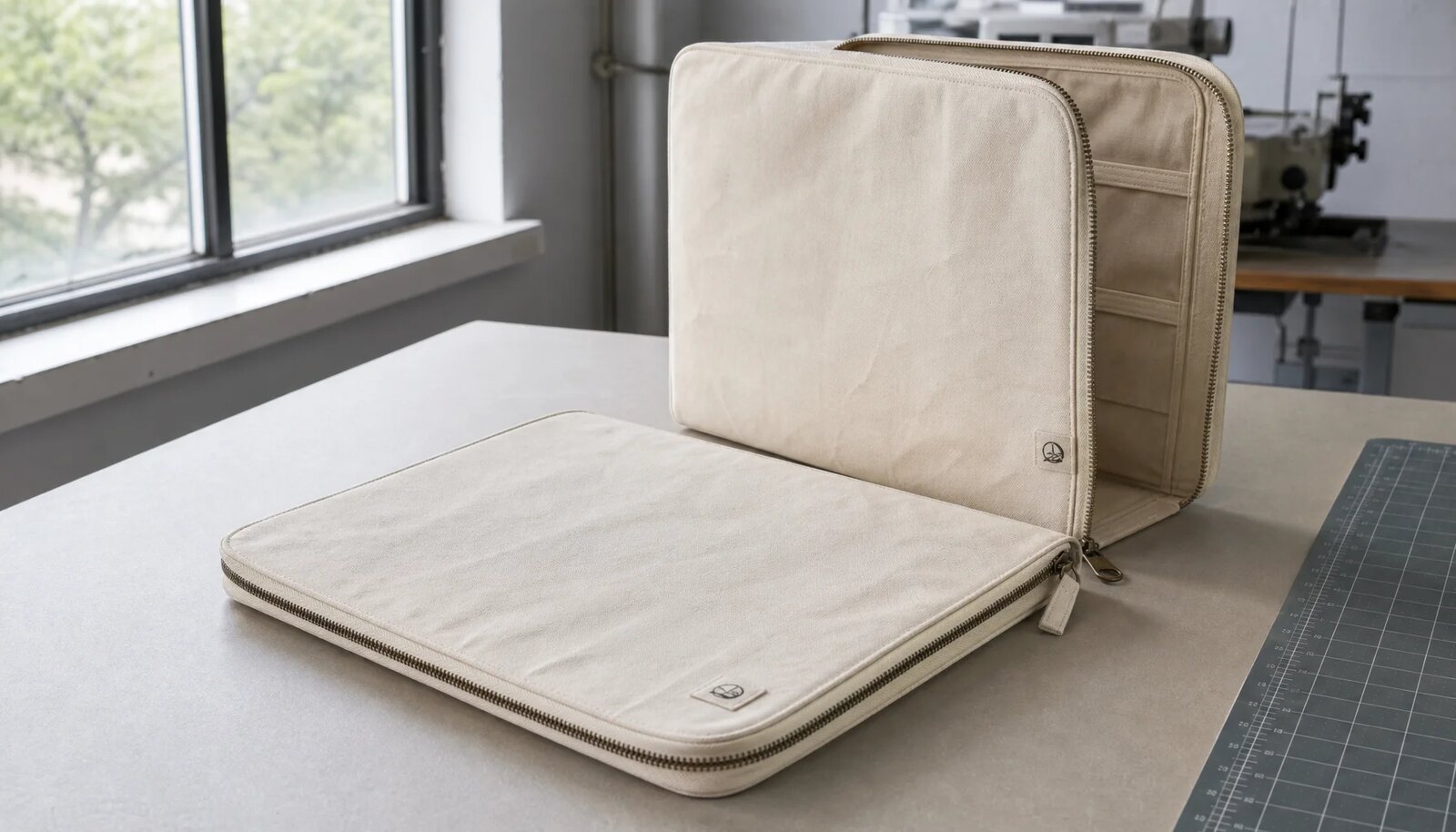
Start With the Job the Portfolio Must Do
A canvas zipper portfolio looks simple on a line sheet, but the buying decision is doing more work than the product suggests. A flat A4 document carrier, a letter-size conference portfolio, a tablet sleeve, a retail stationery case, and an employee onboarding kit do not share the same pattern logic. They do not need the same zipper curve, body stiffness, lining, corner treatment, or packing method. If the RFQ starts with only natural canvas, zipper closure, logo, and target price, the factory will fill in the gaps with its own assumptions. That is how buyers end up with quotes that look close on paper but are not actually the same product.
The first sourcing decision is the use case. A document portfolio needs enough clearance for papers and a notebook without making the opening feel cramped. A tablet portfolio needs more controlled internal space and a zipper path that will not press into corners or scratch contents. A retail accessory may need cleaner interiors, tighter brand presentation, and better shape retention. A one-off event kit may care more about cost, delivery speed, and carton efficiency than premium finishing. Each use case changes the cost stack in a different way.
Write down the actual contents instead of relying on an outside dimension alone. Include paper size, notebook thickness, tablet model, charger, pen, sample cards, or inserts. Then define the finished size and the usable internal size separately. Seam allowance, zipper tape, corner radius, and canvas thickness reduce internal space, and the effect is noticeable on flat products. If the portfolio will carry a tablet or a boxed insert, test the pattern against equivalent contents before pre-production approval.
- Classify the product as a document portfolio, gusseted portfolio, tablet sleeve, retail stationery case, event kit, or branded internal gift.
- List the contents by height, width, thickness, and weight so the factory understands the load, not just the look.
- Define finished outside size and usable internal size separately.
- Decide whether the item should stay flat, hold a light gusset, protect electronics, or act as a presentation case.
- Test the zipper path with real or equivalent contents before bulk approval, especially for thicker notebooks or devices.
Turn the Concept Into a Spec Sheet a Factory Can Quote
A factory-ready spec sheet is what turns a design idea into a comparable quote. Without it, every supplier will interpret the product differently. One quote may assume 14 oz canvas, bound seams, a #5 zipper, individual polybagging, and barcode labels. Another may assume 10 oz canvas, an unlined build, a stock zipper, and bulk packing. Those prices are not comparable until the assumptions are aligned. Procurement should not let a low quote hide an incomplete scope.
The spec sheet should include finished dimensions, usable internal dimensions, tolerance, canvas weight, fabric composition, color, finish, lining, zipper system, thread color, stitch type, seam allowance, reinforcement points, decoration method, label type, and packing method. Photos are useful, but they are not a substitute for measurements. Factories price based on material, labor, waste, and inspection burden. If a detail changes one of those inputs, it needs to be written down. The best RFQs make it difficult for a supplier to answer with a vague maybe.
Separate mandatory requirements from preferences. If organic cotton is required because the brand will make an organic claim, that belongs in the spec. If recycled packaging is required by a retailer, it belongs in the spec. If a recycled polyester lining is only preferred but not mandatory, state that clearly. This helps suppliers propose practical alternates without quietly downgrading the product. It also makes internal approvals easier when cost, claim language, and lead time compete.
- Include finished size, usable internal size, opening width, and any gusset depth with tolerance.
- Specify canvas weight in oz per square yard and GSM, plus whether the weight is greige, dyed, washed, coated, or finished.
- Name the zipper specification in full: size, coil or metal type, tape material, tape color, slider, puller, and end treatment.
- List the interior build: unlined, lined, bound seams, turned seams, divider, slip pocket, pen loop, or padded panel.
- Attach artwork with print size, placement from fixed points, color references, and allowed placement tolerance.
- Call out thread color, stitch density target, and whether contrast stitching is intentional.
- Flag mandatory compliance items separately from nice-to-have features.
Choose Canvas Weight and Finish With the End Use in Mind
Canvas weight is one of the easiest places for a quote to become misleading. In most textile sourcing contexts, ounces mean ounces per square yard. A practical conversion is that 1 oz per square yard is roughly 33.9 GSM, so 12 oz canvas is about 407 GSM, 14 oz is about 475 GSM, and 16 oz is about 542 GSM. That conversion is useful for comparison, but it is not enough by itself. The buyer still needs to know how the supplier measures the cloth and what happened to it after weaving. Dyeing, washing, coating, and softening can change weight, shrinkage, and hand feel.
Heavier canvas is not automatically better. A 16 oz portfolio may feel premium, but it can make corners bulky, stitch lines visible, and the zipper harder to run cleanly around bends. It also increases carton weight and freight cost. A 10 oz to 12 oz build is often enough for event kits, document carriers, and lightweight branded inserts. A 12 oz to 14 oz range is usually the most practical starting point for wholesale programs because it balances body, sewing reliability, and shipping efficiency. Move higher only when the design really needs the structure.
Finish matters as much as the weight. Undyed natural canvas can fit an eco-leaning brand story, but it shows shade variation, slubs, and handling marks more easily. Dyed canvas needs shade control and colorfastness review. Washed canvas may feel better, but it can distort if the pattern is not designed for shrinkage. Coated canvas can add structure or light water resistance, but it may complicate print adhesion and claim language. Buyers should request swatches from the same finishing route intended for bulk, not a convenient substitute from the supplier's shelf.
- Use 10 oz to 12 oz canvas for lighter document portfolios, event kits, and cost-sensitive programs.
- Use 12 oz to 14 oz canvas for the most balanced wholesale spec in this category.
- Use 14 oz to 16 oz canvas only when the design needs a firmer body and the pattern can absorb the extra bulk.
- Ask whether weight is quoted before or after dyeing, washing, coating, calendaring, or softening.
- Set shade tolerance by approved swatch, lab dip, or pre-production sample.
- Confirm shrinkage expectations if the canvas is washed, dyed, or heavily printed before cutting.
- Reject substitutions that reduce GSM, change weave, or mix fabric lots without written approval.
Treat Sustainability Claims Like Procurement Data
Eco apparel brands usually have a tighter claim environment than general promotional buyers. Their customers, wholesale accounts, and compliance teams want specific material language, not broad marketing words. A canvas zipper portfolio may sit inside an apparel assortment, an employee gift program, or a retail accessory line, so any claim on the hangtag, product page, or line sheet should be supportable. Terms like eco-friendly, sustainable, natural, green, or conscious are too vague unless they are tied to a specific material, process, or document.
Procurement should define which claims are real requirements and which are just design preferences. Organic cotton, recycled cotton, recycled polyester lining, recycled paper packaging, undyed canvas, plastic-reduced packing, and low-impact dyeing are all different claims with different evidence needs. A supplier may be able to provide certificates, transaction records, mill declarations, dyehouse statements, or packaging specifications. The buyer should ask for that paperwork before award, not after bulk goods are already packed. Late paperwork creates delay and often creates pressure to accept weaker substitutes.
The zipper and trims matter here as well. Even if the body fabric is cotton canvas, zipper tape is usually polyester, pullers may be metal or plastic, labels are often polyester, and packaging may include polybags. That does not automatically make the product a bad fit for an eco brand. It does mean the claim language has to be precise. If the goal is a lower-plastic or mono-material story, the conversation needs to happen early because it can affect performance, MOQ, and cost.
- Define the approved claim language before labels, hangtags, web copy, and wholesale line sheets are written.
- Request documentation for organic cotton, recycled fiber, recycled packaging, dyeing claims, and retailer compliance requirements.
- Clarify whether trims such as zipper tape, pullers, labels, thread, and packaging are included in the claim.
- Do not accept broad eco terms unless they point to a specific material, process, or document.
- Keep supplier declarations, certificates, trim specifications, and approved wording in the PO file.
- State clearly when no certification is required so the supplier does not price paperwork that is not needed.
Specify the Zipper as a Complete System
The zipper is the most-used mechanical part of the portfolio, yet many RFQs reduce it to one phrase: zipper closure. That is not enough for a controlled wholesale buy. The factory still has to choose zipper size, coil or teeth type, tape material, slider quality, puller style, color, end stops, and installation method. Those decisions affect how the portfolio feels in use and whether it stays reliable after repeated opening and closing. A clean-looking canvas body can still fail the customer experience if the zipper waves, catches on the corner, or separates under light pressure.
For most canvas zipper portfolios, a #5 nylon coil zipper is the practical default. It is flexible, moderate in weight, and generally smoother around curves than many metal options. A #3 zipper can feel too light on a heavier build, while a #8 zipper can add bulk that does not help a flat portfolio. Metal zippers and custom metal pullers can work for premium or heritage styling, but they should be priced separately. They often bring higher trim MOQ, more lead time, and a higher risk of scuffing adjacent units in packing or transit.
The zipper should be tested on the finished pattern, not as a loose sample. Corner radius, seam bulk, lining position, and zipper tape tension all affect performance. Load the portfolio with the intended contents and open and close it repeatedly. Check whether the slider runs cleanly, whether the lining creeps into the zipper path, whether the end stops are strong, and whether the puller holds under normal use. If any of those points are unstable in sample stage, the bulk order will not improve on its own.
- Specify zipper size, type, tape material, tape color, slider finish, puller shape, puller size, end stops, and zipper length.
- Use #5 nylon coil as the default benchmark for most daily-use canvas zipper portfolios.
- Quote metal teeth or custom metal pullers separately, with MOQ, tooling, and lead time clearly stated.
- Confirm how zipper ends are finished: tucked, tabbed, bartacked, bound, or otherwise reinforced.
- Test zipper movement around corners with the portfolio loaded, not empty.
- Check for waviness, slider sticking, tooth skipping, weak stops, puller detachment, and lining caught in the path.
- Keep a detailed zipper trim card or photo reference with the sealed gold sample.
Choose Decoration That Can Hold Up on Real Canvas
Canvas is brand-friendly, but it is not a smooth label stock. The weave, slubs, absorbency, and finish all affect how decoration lands on the surface. A bold one-color screen print on a flat front panel can look sharp and wear well. Fine reversed type, thin lines, gradients, and large heavy ink blocks are more likely to reveal the limits of the substrate. Procurement should review artwork on the actual canvas weight and finish before approving bulk. That is the easiest way to avoid a logo that looks good on screen and weak on the product.
Screen printing is usually the strongest option for repeat wholesale programs. It suits simple one- or two-color logos, consistent placement, and cost control. If the brand position leans eco, the buyer should still specify the ink expectation and confirm cure, rub resistance, opacity, and transfer behavior. Some suppliers will default to an ink system that is convenient for them, not necessarily aligned with the brand's claim language or performance expectation. The RFQ should not leave that open.
Woven labels, embroidery, and patch treatments can be good choices when the brand wants subtle decoration, a premium touch, or several logo versions on the same base item. They also reduce large areas of ink coverage. But each one introduces its own QC points: backing, edge finish, stitch density, attachment strength, and interior feel. A patch that looks refined on a table can still be a problem if it scratches documents, curls after packing, or pulls the panel out of shape.
- Use screen print for bold logos, repeat orders, and controlled wholesale cost.
- Specify ink type, number of colors, print size, placement, and cure requirements.
- Use woven labels when multiple brand versions or subtle branding matter more than large logo coverage.
- Use embroidery or patches only after testing panel distortion, edge finish, and interior comfort.
- Avoid tiny reversed text, thin outlines, gradients, and stiff ink blocks unless the supplier proves them on production canvas.
- Measure placement from fixed points such as the top edge, zipper edge, side seam, or center line.
- Rub, fold, and stack the decorated area to test cure, transfer, cracking, and bleed.
Compare Supplier Routes Before You Compare Price
A low unit price is only useful when the supplier is quoting the same product and can control the same risks. Direct factories, trading companies, sourcing agents, and print-first vendors all have a role, but they do not offer the same control model. A direct factory with in-house cutting and sewing usually gives stronger visibility into pattern execution, seam allowance, zipper installation, in-line inspection, and reorders. When something goes wrong, the conversation is closer to the production floor.
A trading company or sourcing agent can work well when the canvas zipper portfolio is one item in a larger apparel and accessory program. The buyer gets one commercial point of contact, which can save time. The tradeoff is that factory-level detail can become less visible unless the buyer asks for it explicitly. Procurement should confirm the named factory, who owns the pattern, who keeps the gold sample, who approves rework, and who is responsible if trims are substituted. If those points are vague, the quote is carrying hidden risk.
A print-first vendor can be acceptable when the product is basically a flat decorated pouch with simple sewing. It becomes less attractive when the item needs better shape, zipper reliability, or repeatable interior finish. Decoration capability does not automatically mean bag construction capability. For recurring wholesale programs, the safer choice is usually the supplier that can preserve approved samples, document the spec, and repeat the same trim stack without improvisation.
- Use a direct factory for repeat orders, tighter construction control, and clearer responsibility for sewing and final inspection.
- Use a trading company or sourcing agent when multi-category coordination matters, but require the named factory and written substitution rules.
- Use a print-first vendor only for simple flat portfolios after checking sewing capability and zipper quality.
- Ask which operations are in-house: fabric sourcing, cutting, sewing, printing, embroidery, label attachment, packing, and inspection.
- Confirm who holds the pattern, trim card, pre-production sample, and sealed gold sample after approval.
- Require suppliers to list alternates instead of quietly changing canvas weight, zipper grade, lining, or packaging to hit price.
Write the RFQ So Quotes Can Be Compared
A strong RFQ for canvas zipper portfolios is a technical buying document, not a short email. It should force suppliers to price the same product under the same assumptions so procurement can compare cost, lead time, and risk fairly. Include quantity, target delivery date, destination, incoterm, packaging expectation, sample path, inspection requirement, sustainability documentation, and the full product specification. If any of those pieces are missing, the factory will fill them in with its own defaults.
Line-item pricing helps expose where the cost is coming from. Even if the purchase order later uses one unit price, a detailed quote lets the buyer see whether differences are driven by fabric, zipper, sewing, lining, decoration, custom trim, packaging, or testing. That matters when a target price is missed. If the only response is the price is too low, the buyer has no way to know whether to remove a custom puller, simplify packing, change the ink system, or revise the canvas weight.
Break MOQ down by component. The body fabric may have one minimum, dyed colors another, zipper tape another, custom pullers another, woven labels another, and packaging another. A natural canvas portfolio with a stock zipper and one-color print is usually easier to source than a dyed canvas version with custom hardware and multiple logo versions. Ask for price breaks at the target quantity and at two higher tiers so the real cost steps become visible.
- Include product size, internal usable size, fabric, zipper, lining, pockets, reinforcement, decoration, labels, and packing in the RFQ.
- Attach artwork files with print size, placement measurements, color references, and logo tolerance.
- Ask for quotes at the target quantity plus two higher quantities so you can see cost breaks clearly.
- Separate MOQ by body color, zipper tape color, lining color, logo version, custom puller, label, and packaging version.
- Request line items for canvas, cutting, sewing, zipper, lining, label, decoration setup, custom trim, packing, samples, testing, inspection, and freight assumptions.
- State incoterm and destination so FOB, EXW, DDP, courier, air, and sea freight are not mixed.
- Ask each supplier to flag any deviation from the spec in a separate alternates section.
Use Sampling as a Production Audit
Sampling should test how the supplier reads the specification, not just whether the product looks attractive in a photo. The buyer should measure the sample, load it with intended contents, open and close the zipper, inspect seam construction, check logo placement, rub the decoration, review the interior, and look at the packing. A portfolio can be visually acceptable and still fail because the opening is too tight, the zipper catches at the corner, or the lining shifts into the slider path. Those are not minor defects once the product is in bulk.
A practical sample path includes a proto sample and a pre-production sample. The proto sample confirms pattern, size, general construction, and artwork direction. It may use available trims if that is accepted in writing. The pre-production sample should use bulk-equivalent canvas, zipper, lining, label, ink, thread, puller, and packing. If any component is still provisional, the supplier should say so clearly before approval. Bulk should not start until the buyer has either approved the pre-production sample or knowingly accepted the risk.
The sealed gold sample is the inspection reference. It should be labeled with style code, supplier, date, approved fabric, zipper, decoration, packing method, and revision notes. Bulk inspection then becomes a comparison task rather than a debate. Without a physical standard, defect decisions become subjective and slower to resolve. That is especially risky in a category where the whole product can look almost right while still failing on fit, function, or presentation.
- Measure outside size, internal usable size, opening width, gusset depth, and corner radius against the spec.
- Load the sample with real contents and confirm the zipper closes without forcing, bending, or catching.
- Open and close the zipper 10 to 20 times during sample review, with attention to corners and end stops.
- Check lining movement, pocket placement, seam allowance, exposed raw edges, and reinforcement at zipper ends.
- Rub and fold the print area to test cure, opacity, cracking, bleed, ghosting, transfer, and hand feel.
- Inspect the back side of labels, embroidery, and patches so rough backing does not damage contents.
- Approve packing at the pre-production stage when barcode, retail, or warehouse handling requirements matter.
- Record sample comments in a revision log with dates and decisions instead of relying only on chat messages.
Set QC Rules Inspectors Can Actually Use
Quality control needs measurable standards. Phrases like good sewing, nice print, and smooth zipper are too subjective for final inspection. The purchase order and inspection checklist should define defect types, tolerance, inspection method, and severity. For canvas zipper portfolios, the highest-risk areas are fabric weight and shade, finished size, zipper function, seam strength, decoration placement, print cure, interior finish, cleanliness, and packing accuracy. The more these are defined in advance, the less room there is for argument when the shipment is on the dock.
The quality threshold should match the product tier without excusing functional defects. A budget event portfolio can have a simpler interior finish, but it should not have a jammed zipper, open seam, dirty canvas, or logo printed too far off position. A premium retail accessory should have tighter decoration placement, cleaner seams, smoother zipper operation, and more consistent shade. Natural canvas character can be accepted if it is defined, but mildew odor, oil stains, holes, and obvious shade mixing should still be treated as defects.
Inspection timing matters. Incoming fabric and trim checks catch wrong canvas, wrong zipper tape, or incorrect labels before cutting. In-line inspection catches sewing and print problems before the entire lot is finished. Final inspection verifies finished goods, carton counts, carton markings, packing method, and random functional checks. If third-party inspection is required, the supplier should know the booking process, the acceptance standard, the shipment hold rule, and who pays for reinspection if the first pass fails.
- Inspect finished size against agreed tolerance and confirm the intended contents still fit after sewing and zipper installation.
- Inspect logo placement from fixed reference points, commonly using a 5 mm tolerance unless a tighter standard is approved.
- Reject skipped stitches, broken threads, thread nests, loose topstitching, open seams, and unapproved raw edges.
- Reject snagging, slider failure, tooth skipping, puller detachment, weak end stops, and excessive waviness.
- Reject stains, mildew odor, oil marks, holes, severe weave faults, wrong weight, and unapproved shade lots.
- Reject tacky ink, transfer, cracking, bleeding, ghosting, poor registration, pinholes, and unwanted color shift.
- Verify lining, pocket placement, and trim backing do not interfere with use.
- Verify unit count, carton count, SKU separation, barcode labels, PO number, style code, carton number, and carton condition.
Specification comparison for buyers
| Spec decision | Recommended option | When it fits | Buyer risk to check |
|---|---|---|---|
| Supplier route | Direct factory with in-house cutting, sewing, and final packing | Best for repeat wholesale programs, controlled specifications, and orders where fabric weight, zipper installation, seam allowance, and inspection standards must be repeated | Confirm whether cutting, sewing, printing, label attachment, and packing are in-house; require written approval before any fabric, zipper, lining, label, or packaging substitution |
| Supplier route | Trading company or sourcing agent with named factory and inspection ownership | Useful for multi-category apparel and accessory programs where one commercial contact coordinates multiple suppliers | Check who owns the pattern, who keeps the gold sample, who approves rework, and whether the buyer can review factory-level production photos and inspection reports |
| Supplier route | Print-first vendor using subcontracted sewing | Acceptable only for simple flat portfolios with loose construction requirements and one basic decoration position | Risk of weak zipper alignment, inconsistent seam allowance, poor corner control, and limited traceability for canvas, zipper, and sewing quality |
| Canvas weight | 10 oz to 12 oz canvas, approximately 339-407 GSM if measured as oz per square yard conversion | Cost-sensitive document carriers, event kits, lightweight inserts, and programs where foldability and lower carton weight matter | Confirm whether quoted weight is greige or finished; check shrinkage, shade variation, stiffness, and whether the portfolio still has enough body after sewing |
| Canvas weight | 12 oz to 14 oz canvas, approximately 407-475 GSM | Balanced wholesale choice for eco apparel brand accessories that need visible quality without excessive bulk | Check corner thickness, zipper smoothness, print surface quality, and carton weight before approving bulk |
| Canvas weight | 14 oz to 16 oz canvas, approximately 475-542 GSM | Premium retail portfolios, structured business bags, tech accessory positioning, or higher perceived durability | Heavier canvas can create bulky seams, needle marks, zipper stress, higher freight weight, and tighter usable internal space unless the pattern is adjusted |
| Zipper system | #5 nylon coil zipper with approved tape color, slider, puller, and end treatment | Most practical default for canvas zipper portfolios because nylon coil runs more smoothly around corners and keeps weight moderate | Inspect zipper waviness, corner catching, end-stop strength, slider smoothness, puller attachment, and tape color consistency by carton |
| Zipper system | Metal zipper or custom metal puller quoted as a separate trim option | Premium heritage or workwear styling on heavier canvas, especially where the zipper path is mostly straight | Metal teeth and heavy pullers can add weight, scratch adjacent units, raise trim MOQ, and feel rough on curved openings |
| Decoration | Screen print on flat front panel with specified ink type, artwork size, and placement tolerance | Best for bold one- or two-color logos, repeat wholesale runs, and economical brand visibility | Check ink cure, rub resistance, registration, pinholes, opacity, transfer during stacking, and whether water-based or plastisol ink is actually quoted |
Buyer checklist before sampling
- Define the product use case before price comparison: A4 or letter document carrier, laptop-style sleeve, tablet portfolio, conference kit, retail stationery case, employee onboarding gift, or wholesale accessory line item.
- List the actual contents with dimensions and thickness: paper size, notebook, tablet model, charger, pen, sample card, catalog, hangtag pack, or insert box. Add functional clearance instead of using only outside finished size.
- Specify finished size and usable internal size separately. For flat portfolios, allow for seam allowance, corner radius, canvas thickness, lining, and zipper installation reducing the usable opening.
- Lock fabric weight in both oz per square yard and GSM. State whether the number refers to greige fabric, dyed fabric, washed fabric, coated fabric, or final finished canvas.
- Define canvas composition and claim language: conventional cotton, organic cotton, recycled cotton blend, cotton-poly blend, undyed natural canvas, low-impact dyed canvas, or no sustainability claim required.
- Request documentation for any claim that will appear on hangtags, product pages, wholesale line sheets, or retailer compliance files. Do not let suppliers use broad terms such as eco canvas without defining the claim.
- Specify zipper type, size, tape material, tape color, slider finish, puller shape, end stops, and zipper length. A phrase like zipper closure is not enough for comparable quotes.
- State construction details that affect cost and QC: lining, binding, turned seams, seam allowance, reinforced zipper ends, bartacks, inner pocket, divider, pen loop, gusset depth, padding, or edge binding.
- Set tolerances in the RFQ: finished size, logo placement, label placement, zipper tape color match, seam allowance, stitch density, and carton count accuracy.
- Define decoration method, print colors, ink expectation, artwork size, exact placement from fixed reference points, label type, and whether color must match Pantone, fabric swatch, or approved sample.
Factory quote questions to send
- What canvas weight are you quoting in oz per square yard and GSM, and is that weight measured before or after dyeing, washing, coating, softening, or other finishing?
- What is the canvas composition, weave, yarn count if available, finishing route, expected shrinkage range, and shade tolerance for bulk fabric?
- Can you quote the same construction in 12 oz, 14 oz, and 16 oz canvas so we can compare unit cost, sewing feasibility, carton weight, and freight impact?
- Which zipper specification is included: size, coil or metal type, tape material, tape color, slider type, puller finish, puller dimensions, end stops, and zipper length?
- Do you source zipper tape, sliders, and pullers from an approved trim supplier, in-house stock, or market purchase, and how will you prevent substitution after sample approval?
- What is the MOQ by body fabric color, zipper tape color, lining color, logo version, woven label, custom puller, hangtag, and packaging version?
- Which decoration method is included, how many colors are priced, what ink or thread type is assumed, what curing or finishing process is used, and what is the setup charge for each extra artwork position or color?
- What construction details are included in your unit price: lining, bound seams, turned seams, inner pocket, divider, pen loop, reinforcement at zipper ends, bartacks, padded panel, branded puller, hangtag, or barcode label?
- What sustainability documentation can you provide for cotton, recycled fiber, dyeing, printing, labels, zipper tape, or packaging, and when can we review it before bulk production?
- Will the pre-production sample be made with the same bulk fabric lot, zipper type, lining, label, ink, puller, and packing method, or will any component still be provisional?
Quality-control points to confirm
- Fabric weight should match the approved range in both oz per square yard and GSM. Do not approve unverified lighter substitutes, mixed fabric weights, or unexplained hand-feel differences between cartons.
- Canvas composition and sustainability claims should match approved paperwork. Organic, recycled, undyed, recycled packaging, or low-impact dye claims should not appear on product materials unless documentation supports the buyer's compliance needs.
- Canvas shade should remain within the approved tolerance. Natural canvas can have controlled variation, but obvious shade lots should not be mixed in the same carton unless the buyer approved that treatment in writing.
- Fabric should be clean, dry, and free from oil marks, mildew odor, water stains, severe slubs beyond the approved standard, broken yarns, holes, heavy lint, and visible contamination.
- Finished outside dimensions and internal usable space should stay within the agreed tolerance. Confirm that the intended paper, notebook, tablet, or insert still fits after sewing and corner bulk are considered.
- Zipper must open and close smoothly through repeated cycles without snagging, tooth skipping, slider sticking, tape waviness, corner catching, broken stops, or puller detachment.
- Zipper tape color, slider finish, puller style, end treatment, and zipper length should match the approved pre-production sample and should not vary between cartons or production lots.
- Main seams should be even, with no skipped stitches, broken threads, thread nests, loose topstitching, open seams, exposed raw edges beyond the approved finish, or inconsistent seam allowance.
- Corners, zipper ends, pocket openings, tabs, and stress points should be reinforced exactly as approved. Bartacks or reinforcement stitching should be present, secure, and positioned consistently.
- Logo placement should stay within the agreed measurement tolerance, commonly within 5 mm for print or label placement unless the artwork or retail standard requires tighter control.