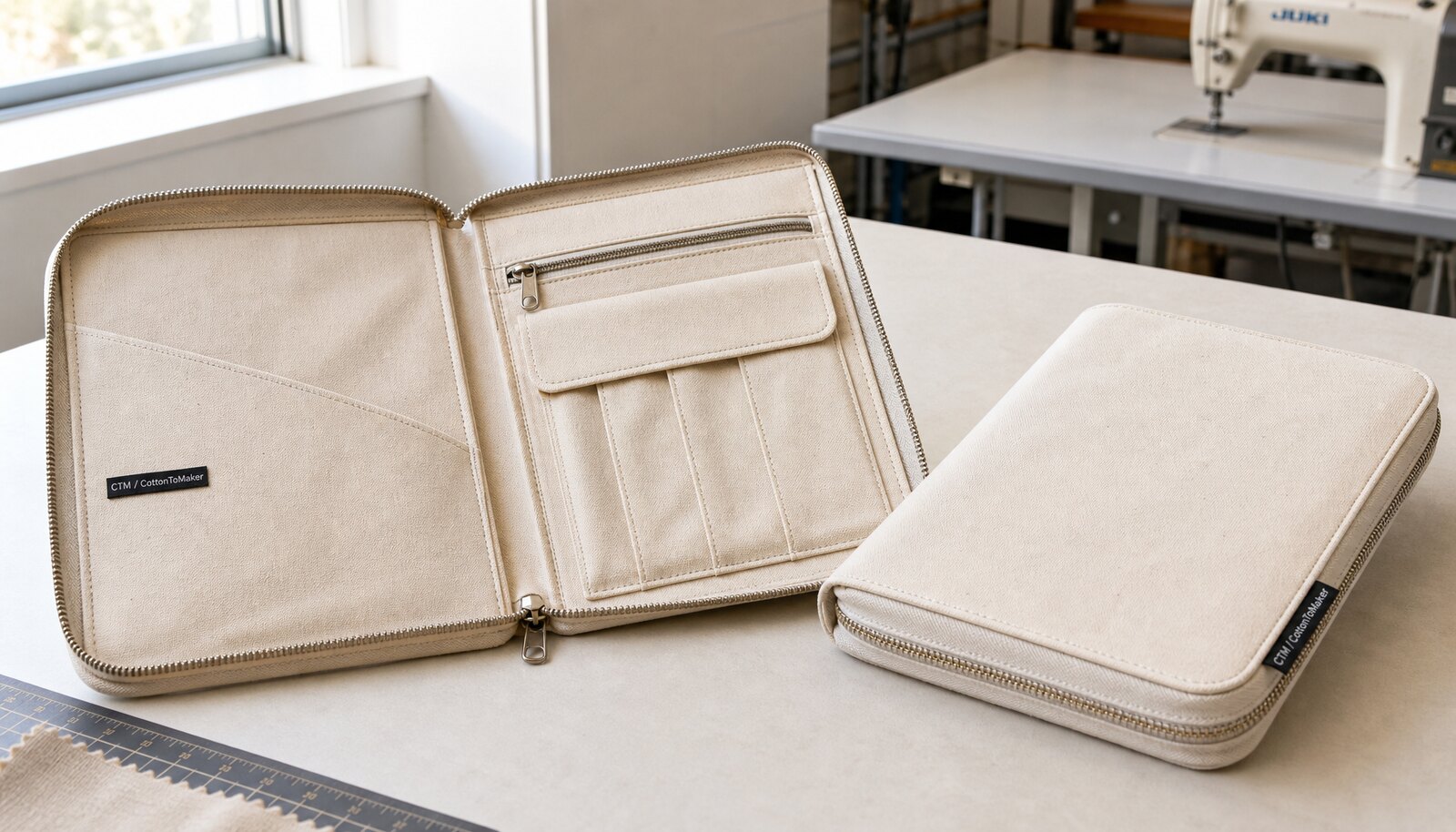
1. Start With the Use Case, Not the Product Name
For boutique wineries, a canvas zipper portfolio is rarely just a stationery item. It may hold tasting menus, price sheets, trade show notes, vineyard maps, sales packets, club documents, reservation forms, or staff handouts. In the tasting room, the piece is visible before it is touched, which means the buyer is sourcing both a functional carrier and a small brand surface. That is why a portfolio used for guest-facing materials has different requirements from one used only for back-office filing or distributor kits.
Before you ask for pricing, define the document set the portfolio must carry and how it will be used. A letter-size packet for front-of-house service might need a slim profile and a clean counter presentation. An event kit with heavier inserts may need a little more body, a stronger zipper, and a lining that keeps paper from snagging. If the item is also being sold at retail, the fold line, zipper pull, and print placement become part of the buyer experience. That should be written into the spec instead of left as a style preference.
The biggest mistake in this category is naming the product before defining the job. Buyers often send a quick request for a canvas zipper portfolio wholesale quote, then discover that the factory priced a generic document pouch while the winery needed a presentation piece with stronger structure and retail-ready packing. The more clearly you describe the use case, the fewer surprises you will have when the first sample arrives.
- Define the paper size first: A4, letter, legal, or a custom insert pack.
- Count the real load: number of sheets, menu cards, event inserts, or sample cards.
- State where the item will live: counter display, car transport, warehouse storage, or direct-to-store shipping.
- Separate presentation requirements from storage requirements; they usually drive different build choices.
2. Set the Fabric, Closure, and Build Spec Before You Compare Prices
For most wholesale orders, natural canvas in the 12 oz to 14 oz range is a practical starting point, but it should be treated as a starting point rather than a rule. A lighter canvas can keep the portfolio flat and easier to mail, while a heavier canvas adds body and hides the contents better when the portfolio is filled. The right choice depends on whether the item is meant to look crisp on a tasting room counter or withstand repeated packing, transport, and handling at events. If the buyer is asking for a premium hand, the fabric should support that decision instead of fighting it.
The zipper matters as much as the cloth. A #5 nylon coil zipper is a common fit for document portfolios because it runs smoothly and is less rigid than many metal alternatives. That matters when the panel is narrow and the portfolio needs to lie flat. A decorative metal zipper can make sense for a gift-oriented or retail-led line, but it can also add stiffness and edge stress. For that reason, a buyer should ask not only what zipper is being used, but also what the factory recommends based on the intended load, pull frequency, and finishing method.
Construction details often separate a clean sample from a frustrating bulk order. Ask whether the bag is lined, whether the zipper tape is visible inside, what seam allowance is used, and how the puller is finished. A small change in stitch density, tape color, or corner reinforcement can affect how the product reads on a counter and how it survives repeated use. The supplier should be able to explain why a build choice is being made, not only what price it produces. If the answer is simply ‘this is standard,’ push for a reason tied to function, not habit.
- Use lighter canvas when the portfolio must stay flat and ship efficiently; use heavier canvas when presentation feel and opacity matter more.
- Keep the zipper standard unless the use case truly needs a decorative or heavier closure.
- Match thread and zipper tape to the body fabric unless contrast is part of the design brief.
- Ask for a sample built with the exact fold direction and closure method you expect in bulk.
3. Choose the Right Supplier Type for Your Control Level
The sourcing route affects more than price. For a custom portfolio program, a direct factory is usually the best fit when you need control over fabric weight, zipper spec, print placement, and carton packing. That route is particularly useful for wineries that re-order the same item season after season, because it allows the buyer to keep the same spec while fine-tuning smaller details over time. A direct factory should also be able to show how the order moves from cutting to sewing to print to final packing without handoff confusion.
A trading company can still be a good option when the winery is buying several product types at once or wants one point of contact to manage multiple factories. The tradeoff is that the buyer must be more disciplined about documentation. If the quote arrives without the actual factory name, process details, or the material source, it becomes harder to compare supplier risk. A trading company can add value in communication and consolidation, but the buyer should pay for that value with clear records, not with vague promises.
Local decorators or small print shops are only sensible in narrow situations: short lead time, small quantity, or a very simple decoration. They may be fine for a limited winery event or an internal staff run, but they often have less control over fabric sourcing and sewing consistency. For procurement buyers, the key screening question is simple: who actually cuts, prints, sews, and packs the order? If the supplier cannot answer that cleanly, the quote may be too thin to manage risk properly.
- Request evidence from the production line, not just catalog photos.
- Confirm whether the supplier owns the sewing line or brokers the order.
- Ask who buys the canvas, zipper, lining, and labels.
- Look for sample-room feedback and in-process photos, not only a polished approval image.
4. Write an RFQ That Forces Comparable Quotes
A useful RFQ removes room for assumption. State the finished dimensions, canvas weight, color, zipper type, zipper tape color, lining status, pocket requirement, print method, logo placement, fold direction, packing method, carton mark details, destination, and target ship window. If the request only says ‘canvas zipper portfolio with logo,’ each supplier will fill in different blanks. Then the quotes will look comparable when they are not. For boutique wineries, where the item often supports guest experience and brand presentation, ambiguity tends to create expensive rework later.
A strong RFQ should also define the commercial terms the same way for every supplier. Use one incoterm, one artwork file version, one carton target, and one sample expectation. Ask for the quote to separate unit price from setup and support charges. The line items that matter include print setup, sampling, packaging, labels, insert cards, carton costs, and any special testing or export paperwork. If the supplier only gives a single price, the buyer cannot see whether the low number is a real advantage or just a stripped-down build.
Buyers comparing canvas zipper portfolios wholesale should also state what the quote must exclude. That sounds strict, but it protects the procurement process. Ask suppliers to identify anything outside the ex-factory number, including cartons, inland transfer, customs documents, testing, or extra packing. If you do not require this transparency, you will compare numbers that are not built on the same assumptions.
- Use one dimension set and one artwork file for all suppliers.
- State the same incoterm on every quote request, such as FOB or EXW.
- Ask for line items for sample fee, setup, packing, and carton cost.
- Specify whether the quote includes internal pockets, labels, insert cards, or special folding.
5. Compare Supplier Options, Not Just Spec Lines
A spec sheet is useful, but procurement buyers make better decisions when they compare supplier behavior, not just fabric weight. One factory may be strong on clean stitching but weak on packing discipline. Another may quote a sharp unit price but have limited tolerance control or slow sample turnaround. A third may be able to handle custom branding well but require a larger MOQ because it cuts and prints in batches. For boutique winery programs, the best supplier is often the one that matches the real decision shape of the order, not the one with the most attractive headline cost.
When you compare quotes, think in three layers. First, the product layer: fabric, zipper, print, and finish. Second, the production layer: sample process, lead time, batch consistency, and inspection readiness. Third, the commercial layer: MOQ, packing, incoterms, payment terms, and change control. A quote can look cheap at the product layer and still be expensive once the production and commercial layers are added. This is especially true when the winery needs branded packaging that must arrive on time for a release, an event, or a seasonal retail window.
If you are choosing between suppliers, ask each one to explain where they think the order is easiest to win and where it is risky. A good supplier answer sounds specific: for example, ‘we can hold the zipper spec but we need a revised logo size to avoid stitch interference’ or ‘we can keep the cotton canvas natural, but this particular print needs a one-color screen rather than a heat transfer.’ That kind of answer is more useful than a low quote with no technical context. It shows whether the supplier understands the product as a production task rather than a sales sample.
- Compare factories on sample speed, communication clarity, and tolerance control as well as price.
- Ask which part of the build is standard and which part is custom, since custom steps often drive MOQ.
- Look for a supplier that can explain constraints before you place the order.
- Treat a quote with no exceptions as a warning, not a strength.
6. Treat the Sample as a Functional Prototype, Not a Presentation Piece
The sample stage is where many buyers lose control of the spec. A clean-looking sample can still fail in use if the zipper catches, the pocket distorts the silhouette, or the canvas shows through too much when the portfolio is filled. For winery applications, the first sample should be tested with the actual document set, not just viewed empty on a table. Put in the tasting menu, price sheet, business cards, or training packet that the final user will carry. If it only works when empty, it is not yet approved.
Use the sample to confirm dimensions, fold behavior, seam alignment, logo placement, and opening feel. Measure the flat size and compare it to the drawing, not to memory. Check where the zipper ends sit relative to the top edge, whether the front panel bows under load, and whether the inside corners snag paper. If the product includes a pocket, check whether the pocket depth is practical or whether it steals usable width from the main compartment. This is the stage to catch those issues because corrections are still cheap.
A good approval note should read like a manufacturing instruction, not a compliment. For example: print centered within X mm of the approved mark, zipper slides smoothly when the portfolio contains the full paper set, seam tails trimmed flush, and no visible puckering at the corners. That kind of language gives the factory something measurable to build to and reduces the chance that a later dispute turns into a subjective conversation about what ‘looks close enough’ means.
- Check the sample with the actual paper load, not with an empty shell.
- Measure logo position against the approval sheet and note the allowable shift.
- Test the zipper several times while the portfolio is filled and again after flexing the seams.
- Look for corner snagging, seam twist, and pocket interference before you sign off.
7. Set Quality-Control Thresholds the Factory Can Actually Inspect
Quality control is strongest when it is written in observable terms. For a canvas zipper portfolio, the factory should inspect fabric shade, panel size, zipper line placement, seam strength, print registration, and packing consistency. The buyer should also say which side is the front panel, because natural canvas can look slightly different from side to side and the print must land on the intended face. If this is not clarified early, the factory may assume either side is acceptable and still consider the order compliant.
It is better to define tolerances than to use vague language such as ‘good quality’ or ‘premium finish.’ The buyer does not need to over-engineer a lab standard, but they do need enough detail to support a pre-shipment inspection. For example, define acceptable logo shift, acceptable variation in seam line straightness, and whether minor loose threads are re-trimmable or rejectable. Decide in advance how many pieces can be repaired on site and what defects require rejection. That makes inspection faster and reduces back-and-forth after production is complete.
In this category, the common defects are straightforward but easy to miss in a quick check: crooked print, zipper misalignment, puckered corners, uneven folding, loose thread tails, and inconsistent label placement. For winery buyers, the cost of a bad piece is not only replacement cost; it is the appearance of inconsistency across a branded set. A tasting room that hands out ten portfolios expects them to look like one program, not ten separate batches. QC should protect that consistency as much as it protects function.
- Define which panel is the front face and which is the back before printing starts.
- Set an acceptable logo shift range and a clear no-go zone near the zipper line.
- Specify how much loose thread is acceptable, if any, and what requires rework.
- State whether rework is allowed for packing defects, sewing defects, or neither.
8. Plan Packing, Cartons, and Warehouse Handling Around Real Wholesale Flow
Packing is not an afterthought in a wholesale program. A canvas zipper portfolio that looks fine in a sample photo can arrive creased, damp, or hard to unpack if the fold direction and carton fill were not planned carefully. For winery buyers, the usual choices are simple: flat fold, tissue or no tissue, individual polybag or no polybag, and whether an insert card is needed for retail presentation. The right answer depends on the destination. A distributor carton going to a warehouse has different needs from a retail-ready shipment going straight to a tasting room.
Carton planning should be based on dimensions and handling limits, not only on a piece count target. A portfolio with a zipper and a folded body often occupies more volume than buyers expect, and overstuffed cartons can deform the contents or increase handling damage. Ask the factory for carton dimensions, gross weight, and carton quantity per shipment unit before approval. Then compare those numbers with your receiving process, shelf space, and pallet rules. If a carton is too heavy for easy handling or too large for efficient warehousing, the supposedly low unit price can turn into higher labor cost.
For sea freight or humid routes, moisture protection deserves attention. A clean polybag and dry carton are usually enough, but if the route includes a long transit or an odor-sensitive retail environment, ask the supplier how they control moisture and odor during packing. You do not need decorative packaging if the item is a wholesale utility product. You do need a packing method that keeps the portfolio flat, presentable, and ready to use when it arrives.
- Use a consistent fold direction so all units open the same way on receipt.
- Ask whether an insert card or barcode label is required for the receiving workflow.
- Confirm carton marks, barcodes, and pallet pattern before bulk release.
- Check whether carton size and weight fit your warehouse handling limits.
9. Compare Landed Cost, Risk, and Rework Exposure
The headline unit price is only one part of the decision. A real comparison for canvas zipper portfolios should include setup charges, sample costs, packing materials, carton fees, inspection, inland transfer, freight, duty, and the likely cost of defects or rework. A supplier with a slightly higher unit price can still be the better commercial choice if the pack-out is efficient, the sample process is disciplined, and the factory closes quality issues before shipment. Conversely, a cheap quote can become expensive if the cartons are inefficient, the logos need rework, or the product arrives in a condition that requires repacking before use.
A useful landed-cost review asks a simpler question: how much do I pay per sellable unit received? That is a more honest measure than cost per unit produced. If one supplier gives a low ex-factory price but ships with weak QC, loose packing, or unclear carton data, the buyer may spend time and money fixing the order after it arrives. That hidden work is especially painful for boutique wineries because the product is often needed for a launch, event, or seasonal retail push where timing and presentation both matter.
Procurement teams should also consider risk concentration. If the same supplier is handling fabric, print, sewing, and packing, then quality issues can be corrected internally faster. If different parties handle each step, the buyer should expect more handoffs and more chance of confusion unless the documentation is unusually strong. The cheapest quote is not always the best one when the order has a fixed launch date and the reputation risk of a misprinted branded item is high.
- Compare every quote using the same incoterm, carton spec, and artwork version.
- Include defect allowance and rework risk in the cost model.
- Ask for carton data and packing method before comparing freight.
- Measure value by sellable units received, not by units shipped.
10. Build a Winery-Specific Approval Plan Before You Place the Order
Boutique wineries often buy these portfolios for a specific moment: a club mailer, a tasting room refresh, a harvest event, a trade show, or a sales team update. Because the calendar is tied to a launch date, the approval process should be simple and explicit. Before production begins, confirm who approves artwork, who approves the sample, who signs off on the inspection result, and who can accept a minor change if the factory finds a material shortage. Without that decision path, small delays multiply quickly.
A practical approval plan should include three checkpoints. First, artwork approval: size, placement, logo color, and any copy on the insert card. Second, pre-production sample approval: fabric, zipper, print, fold, and packing method. Third, final shipment approval: carton count, packing list, label format, and visual sample photos if the buyer requests them. If a step is skipped because ‘it looks fine,’ the order becomes vulnerable to misunderstanding later. The goal is not bureaucracy. The goal is to make sure the supplier and buyer are judging the same product at the same point in time.
For winery buyers, this is also the moment to think about replenishment. If the portfolio will be re-ordered across seasons, keep the spec file organized: approved dimensions, fabric reference, zipper details, print artwork, packing instruction sheet, and QC tolerance notes. The first order is always the one with the most discussion. The second order should be easier. Good documentation is what turns a one-off purchase into a stable sourcing program.
- Assign one internal owner for artwork approval and one for final purchase approval.
- Keep a version-controlled spec file with drawings, photos, and approved comments.
- Use three sign-offs: artwork, pre-production sample, and final shipment.
- Save approved photos so the next order can be compared against the same reference.
Specification comparison for buyers
| Buying decision | Best-fit option | Where it works best | Tradeoff or supplier check |
|---|---|---|---|
| Supplier type | Direct factory with sewing, print, and packing in-house | Best for repeat winery programs, tighter QC control, and spec changes between seasons | Confirm that the supplier is not outsourcing cutting, printing, or final packing; ask who signs off the pre-production sample |
| Supplier type | Trading company or sourcing agent with managed factory access | Useful when you need multiple bag types or one point of contact across product families | Ask for the actual factory name, audit trail, and photo/video evidence from the production line rather than only showroom images |
| Fabric weight | 12 oz canvas for a lighter presentation piece | Works for tasting room handouts, menus, and document-only use where a flat profile matters | Check whether the bag still feels opaque enough when filled; light canvas can reveal contents and ripple near the zipper |
| Fabric weight | 14 oz canvas for a more structured hand | Good for premium tasting-room use and sales kits that need a little more body | Heavier cloth can increase sewing difficulty and carton bulk; confirm finished size after folding |
| Closure option | #5 nylon coil zipper with auto-lock slider | A practical standard for document portfolios that need smooth opening and fewer metal stress points | Ask for zipper tape color, puller style, and corner behavior when the portfolio is filled |
| Closure option | Metal zipper or decorative puller | Can suit a gift-oriented presentation when the visual cue matters more than minimum weight | Check stiffness, edge stress, and whether the puller scratches adjacent printed surfaces or labels |
| Branding method | One-color screen print or woven side label | Best when logo readability, repeatability, and controlled cost matter more than detailed artwork | Confirm line thickness, small text legibility, and exact placement tolerance on the sample |
| Branding method | Multi-color print or complex graphic treatment | Only worth considering when the visual brief truly needs illustration or gradients | Ask the factory for proof that the chosen print method can hold the artwork cleanly on textured canvas |
| Packing level | Flat fold, tissue, polybag, master carton | Appropriate for wholesale replenishment, distributor drops, and warehouse receiving | Confirm fold direction, moisture protection, carton count, and barcode placement before bulk release |
Buyer checklist before sampling
- Define the end use first: tasting room counter display, staff document carry, retail sale, club mailer, or event kit.
- State the exact finished size against the documents it must hold, not just a generic portfolio name.
- Lock canvas weight, weave, finish, and color reference before approving any sample.
- Choose the zipper type, slider style, puller shape, and zipper tape color to match the intended use.
- Confirm whether the build needs a lining, pocket, gusset, or stiffener and say why.
- Send vector artwork plus a backup raster proof, and note logo size, placement, and color values.
- Ask for a pre-production sample that uses the exact materials, fold direction, and print method.
- Set packing rules: tissue or not, individual polybag or not, insert card or not, master carton count, and pallet pattern if needed.
- Compare supplier quotes on the same incoterm, same carton size, same packing spec, and same artwork version.
- Reserve time in the schedule for sample revision, inspection, transit, and any rework after receipt.
Factory quote questions to send
- What is the exact canvas weight, weave, and finish you will use for this order, and can you show a photo of the reference fabric?
- Is this quote from a direct factory line, and which steps, if any, are subcontracted?
- Which zipper grade, slider type, puller style, and zipper tape color are included in the quote?
- What print method do you recommend for this artwork, and what are the setup charges by color or location?
- What is the MOQ by color, by artwork version, and by fabric option?
- What sample stages do you offer before bulk production, and what does each sample cost?
- What packing is included in the unit price, and what is charged separately for polybags, insert cards, labels, or cartons?
- What measurement tolerance and defect standard do you use for bulk inspection, and how many pieces can be reworked?
- What is the lead time after sample approval and deposit receipt, and what is the production slot risk in your current schedule?
- What is excluded from the ex-factory quote, including cartons, inserts, inland transfer, testing, and export documentation if applicable?
Quality-control points to confirm
- Canvas matches the approved weight, weave, color reference, and finish across the production lot.
- Finished size stays within the agreed tolerance for width, height, and any gusset or pocket depth.
- The zipper closes smoothly through repeated open-close cycles and does not catch at the corners or distort the front panel.
- Logo placement is within the approved shift range and does not crowd the zipper line or seam allowance.
- Print edges are clean, with no smearing, pinholes, weak coverage, or obvious misregistration on the canvas texture.
- Stitching is straight, with no skipped stitches, broken threads, or loose tails longer than the buyer’s allowance.
- Seams at the zipper ends and other stress points do not pucker, gape, or open when the portfolio is filled with the intended paper set.
- Inside pockets, labels, and binding stay within the agreed dimensions and do not interfere with document insertion or removal.
- Polybagging, tissue, insert cards, and carton labels match the packing instruction sheet and purchase order.
- Carton count, gross weight, outer carton dimensions, and pallet pattern match the shipment plan and receiving limits.