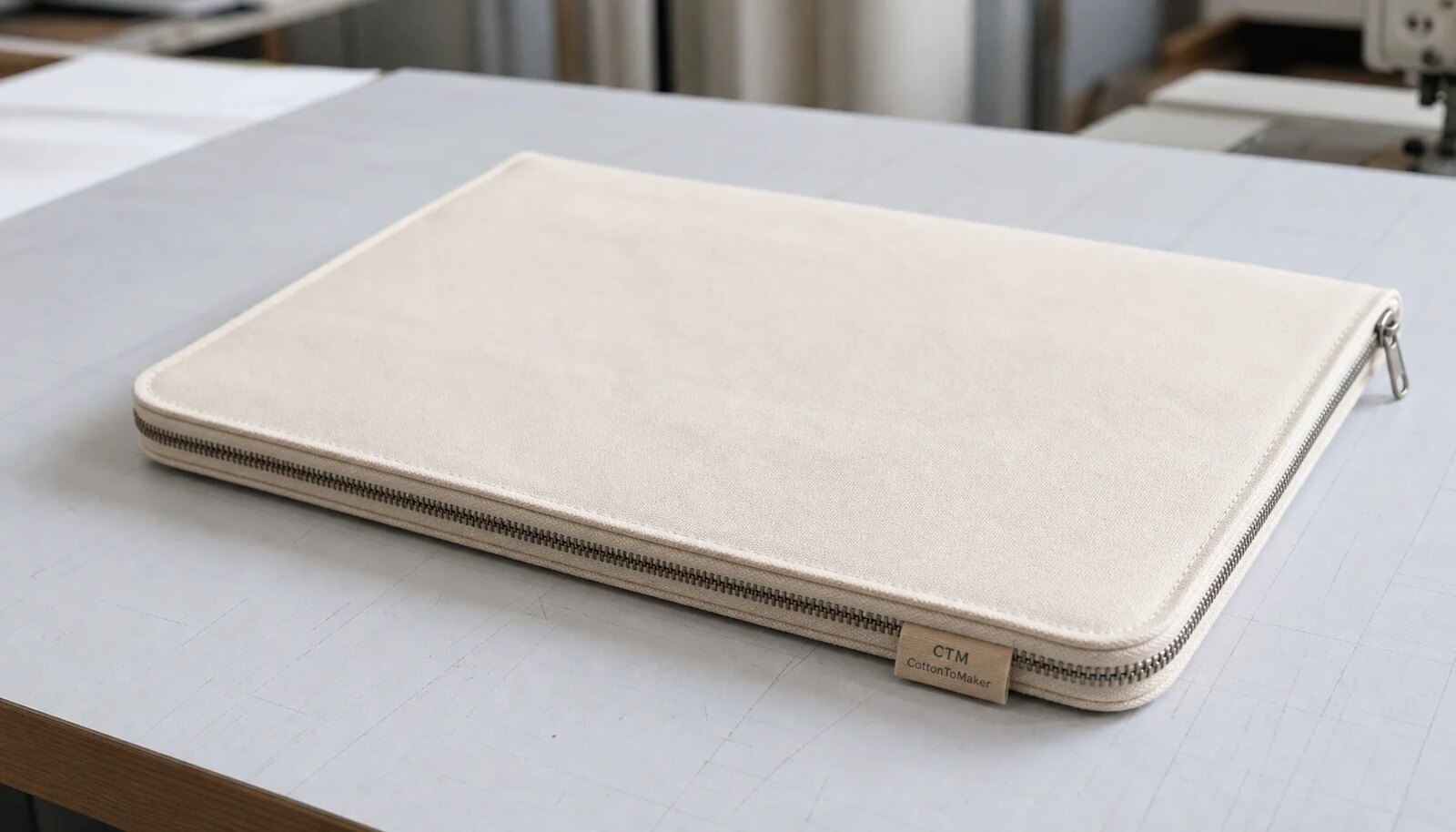
1. Buy the use case before you buy the pouch
A canvas zipper portfolio looks simple until it enters a wholesale program. One buyer may need a flat document folder for line sheets. Another may need a polished sales kit for showrooms. A third may want a practical press pouch that ships with a seasonal apparel drop. Those jobs are close enough to share a product name, but they do not share the same construction priorities.
For procurement teams, the first spec decision is not color or logo size. It is the job the portfolio must perform after it leaves the carton. A document folder can be light, flat, and efficient. A buyer-kit portfolio needs a stronger hand feel, cleaner zipper movement, and better presentation under showroom lighting. A retail accessory needs barcode readiness, surface protection, and tighter shade control because customers will compare pieces side by side.
Write the use case in the RFQ. This helps suppliers quote the correct build instead of guessing. It also makes later negotiations cleaner because the buyer can tell whether a lower price came from efficiency or from removing performance that mattered.
- Line-sheet folder: flat body, smooth zipper, minimal bulk, clean edge finishing.
- Sales kit or media pouch: stronger canvas, better logo execution, controlled shade, careful packing.
- Retail accessory: consistent dimensions, barcode plan, individual cleanliness, tighter final inspection.
- Event giveaway: cost-controlled materials, standard colors, simple decoration, predictable replenishment.
2. Specify canvas in measurable terms
For most canvas zipper portfolios, 10 oz to 12 oz canvas is the practical wholesale range. In metric terms, that is roughly 340 to 410 GSM, depending on weave and finish. Ten ounce canvas is usually enough for a folder-style portfolio that carries documents, swatches, or a light catalog. Twelve ounce canvas gives more structure and a more substantial feel, which may be worth the extra fabric cost and freight weight for a branded eco apparel program.
Avoid asking for 'heavy canvas' or 'premium cotton canvas' without numbers. Those phrases invite suppliers to quote different materials while appearing to answer the same request. A usable RFQ names composition, weave, weight, finish, and color route. For example: 100% cotton plain-weave canvas, 12 oz, natural undyed, pre-shrunk, suitable for screen print. If the fabric is a cotton-poly blend, recycled cotton blend, or organic cotton canvas, state the target composition and the documentation needed.
Natural canvas has a good eco-brand feel, but it is not automatically simpler. Undyed fabric can show seed flecks, slubs, shade variation, and handling marks more clearly than dyed fabric. Dyed black or dark olive canvas may hide marks but introduces color fastness and rub risk. Washed canvas feels softer and more casual, but dimensions can vary if shrinkage is not controlled.
- Ask for both oz and GSM when possible, because teams and suppliers may use different systems.
- Request a fabric swatch before sample approval, especially for natural, recycled, organic, or dyed canvas.
- Confirm whether weight is measured before or after washing, coating, or finishing.
- For document fit, test stiffness and flexibility with the actual papers, catalogs, or swatches the portfolio will carry.
3. Treat sustainability claims as controlled specs
Eco apparel brands often want the portfolio to support the brand’s material story. That is reasonable, but procurement should keep claim language disciplined. A natural cotton portfolio is not the same as organic cotton. Recycled cotton is not the same as post-consumer recycled cotton. Undyed canvas reduces dye processing, but it may still use conventional cotton and conventional finishing. A plastic-free packaging claim can fail if the item ships in a standard polybag.
Ask suppliers what they can document at the material-lot level. For recycled inputs, GRS or another recognized chain-of-custody document may be relevant. For organic cotton, OCS or GOTS documentation may be needed depending on the claim and the market. For chemical safety, buyers may request OEKO-TEX, a restricted substances declaration, or lab testing against the brand’s RSL. The right requirement depends on your sales channel and legal review, but the principle is consistent: the claim should match the evidence.
Packaging deserves the same attention. Recycled paper belly bands, FSC paper sleeves, paper tape cartons, compostable bags, and no-individual-bag packing all sound attractive, but each has tradeoffs. Natural canvas scuffs more easily without protection. Paper sleeves can abrade print. Compostable bags may need special storage and may not meet all retail requirements. The cleanest solution is the one that protects the item and can be truthfully described.
- Request lot-specific material certificates when making recycled or organic claims.
- Ask whether zipper tape, thread, labels, and lining match the sustainability goal or are conventional trims.
- Confirm restricted substances compliance for dyed canvas, prints, zipper tape, and labels.
- Decide whether the product needs individual protection, retail packaging, or bulk export packing only.
- Keep marketing terms such as recycled, organic, biodegradable, plastic-free, and low-impact out of the PO unless evidence supports them.
4. Construction details decide whether quotes are comparable
Two canvas zipper portfolios can share the same size and still be very different products. Seam allowance, lining, zipper insertion, corner shaping, inner pockets, edge finishing, and stitch density all change labor time and defect risk. A cheap quote may simply be a simpler build.
The RFQ should state finished dimensions, measurement method, zipper opening length, and whether the zipper stops at the corner or extends slightly beyond the body for easier access. If the portfolio must hold A4, letter-size documents, catalogs, or fabric swatches, measure the real contents and allow room for the zipper seam. A portfolio that fits paper only when empty will frustrate the sales team once samples and inserts are added.
Lining is another early decision. Unlined construction lowers cost and weight, but seam allowances may be visible inside. A light cotton or poly-cotton lining gives a cleaner interior and can protect documents, yet it adds material, sewing time, and another shade variable. If the item is for an eco-positioned brand, lining composition should be included in the sustainability review instead of added as an afterthought.
- Define flat, squared, rounded, or gusseted corners before sampling.
- Specify thread color, stitch density, seam allowance, and reinforcement at zipper ends.
- Name internal pockets, divider panels, pen loops, or label positions in the first RFQ.
- Require the portfolio to lie flat after packing if presentation is important.
- Include finished-size tolerance, commonly plus or minus 5 mm unless your insert size requires tighter control.
5. Zipper choice is a brand-feel and failure-risk decision
The zipper is the part buyers handle first and complain about fastest. For canvas zipper portfolios, a nylon coil zipper is usually the most practical option because it runs smoothly, works well on soft goods, and is easier to sew than many heavier zipper types. The buyer should still define coil size, tape color, slider finish, puller shape, and end-stop construction. 'Good zipper' is not a specification.
A metal zipper can look premium, but it adds weight and can scratch adjacent portfolios in bulk packing. A chunky plastic zipper can support a sportier look, though it may not suit a clean apparel buyer kit. Recycled-look pullers or natural-color tape may support the brand aesthetic, but they still need functional testing. The zipper tape should sit flat without waviness, and the slider should pass over the corner area without catching on seam bulk.
Procurement should ask for zipper testing that reflects the order value. For a basic B2B program, manual cycling during inspection may be enough. For a retail accessory, paid lab testing or higher sample cycling can be worthwhile. The pass-fail rule should be written before inspection, because zipper failures are difficult to negotiate after cartons are packed.
- Use nylon coil zippers for most soft canvas portfolio programs.
- Ask for at least 20 smooth open-close cycles during inspection sampling; consider 100-cycle checks for premium programs.
- Reject skipped teeth, slider separation, sharp pullers, crooked zipper insertion, and tape waviness that distorts closure.
- Check zipper color against canvas shade in daylight and warehouse lighting.
- Protect zipper heads in packing so they do not scratch neighboring pieces.
6. Decoration needs its own approval path
Canvas texture affects decoration more than a flat digital mockup suggests. Screen print is usually the best wholesale choice for simple logos and repeat orders because it scales well and keeps unit cost controlled after setup. Embroidery can look elevated, but it may pucker lighter canvas or distort small text. Heat transfer can reproduce fine detail, yet adhesion and edge lift must be tested on the actual fabric. Woven labels or side labels are often the quietest and most durable branding route for eco apparel buyers who prefer a restrained look.
Artwork should be approved on the real fabric color, not only on a PDF. Natural canvas changes perceived ink color. Recycled cotton can have more flecks and shade variation. Dark dyed canvas can reduce contrast or create rub issues. If the logo sits near the zipper or seam, leave enough distance so stitching does not distort the mark.
For quote normalization, decoration cost should be separated from the base product where possible. Ask suppliers to quote the same portfolio with screen print, embroidery, woven label, and heat transfer if you are still choosing the method. This exposes setup charges, unit labor, sample cost, and likely defect risk.
- Request a strike-off or decoration sample before pre-production approval.
- Set logo placement tolerance, commonly plus or minus 3 mm to 5 mm for small marks.
- For screen print, check pinholes, ink coverage, dry rub, and cracking at fabric folds.
- For embroidery, check puckering, thread trimming, backing removal, and small-letter legibility.
- For heat transfer, check edge lift, adhesion, shine level, and rub resistance on textured canvas.
7. MOQ, lead time, and incoterms belong in the same conversation
Custom canvas zipper portfolios usually make commercial sense around 500 to 1,000 pieces per color or style, though the right number depends on fabric availability, decoration method, and factory setup. Stock blank programs can go lower, but the buyer gives up control over size, zipper, fabric, and replenishment. Custom recycled or organic canvas can require higher MOQ because fabric mills and dye houses have their own minimums.
Lead time should be broken into stages. A realistic schedule includes swatch approval, decoration strike-off, pre-production sample, bulk material booking, cutting, sewing, decoration, finishing, inspection, packing, and export handover. If the canvas is custom dyed, if zipper tape must match a seasonal color, or if certifications are required, add time before bulk cutting. A calendar that ignores approvals is usually the calendar that fails.
Incoterms can make quotes look cheaper than they are. EXW may exclude local transport and export handling. FOB is often easier for experienced importers. CIF includes ocean freight but not destination charges. DDP may simplify landed pricing but should be checked carefully for tax, duty, and delivery assumptions. Procurement should compare total landed cost with the same packing volume, carton count, inspection plan, and document charges.
- Ask for price breaks at 300, 500, 1,000, and 2,000 pieces if your forecast is uncertain.
- Separate sample lead time from bulk lead time on the quote sheet.
- Confirm whether custom fabric, zipper color, labels, screens, and cartons affect MOQ.
- Compare quotes under the same incoterm, port, currency, and payment term.
- Add buffer for holiday periods, peak sewing capacity, vessel booking, and inspection rework.
8. Supplier evidence should be concrete
Procurement buyers do not need a dramatic supplier pitch. They need evidence that the supplier can make this product class consistently. Ask for business license details, export experience, production capacity, sample-room contact, and recent photos of similar canvas zipper bags or document pouches. If an audit is required by your company or retail partner, request the latest report early rather than after price approval.
The most useful production evidence is ordinary and specific: cutting table photos, zipper insertion close-ups, corner stitching, label placement, inspection records, packing photos, and material rolls with lot labels. These details show whether the supplier understands the defects that matter. A supplier that only sends polished catalog images may still be capable, but the buyer has less evidence for risk assessment.
For eco apparel brands, documentation should include both material and claim support. Ask whether certificates apply to the actual production batch. Confirm whether the factory buys certified fabric directly or through a converter. Request the chain of documents before deposit if the product claim will appear on packaging, a product page, or a brand sustainability report.
- Request business license, export record, and factory address before deposit.
- Ask for recent product-class photos, not only catalog renderings.
- Review material certificates, transaction certificates, RSL declarations, and audit reports where relevant.
- Confirm which processes are in-house and which are subcontracted, especially printing and embroidery.
- Ask for monthly capacity and the sewing line plan if the launch date is tight.
9. Sample approval should be handled like a small inspection
The pre-production sample is where problems are cheapest. Do not approve it after checking only the logo. Open and close the zipper repeatedly. Measure the height, width, and opening length. Put the intended documents inside. Check whether the portfolio lies flat. Look at the corners and zipper ends, because those are common stress points.
Approval should reference the exact material, zipper, thread, decoration, lining, label, and packing method. If the supplier sends a sample in substitute fabric or with a similar zipper, label it clearly as a construction sample only. The final pre-production sample should match the bulk order. For important orders, seal one golden sample and have the supplier keep a matching reference. This makes inspection language less subjective.
If the sample fails, document the defect and required change in writing. Avoid vague notes such as 'make it nicer' or 'improve zipper.' Use measurable changes: move logo 8 mm lower, increase zipper opening by 20 mm, change to 12 oz canvas, reduce stitch puckering, use matching thread, or add end reinforcement.
- Approve fabric swatch, decoration strike-off, pre-production sample, and golden sample as separate steps when risk is meaningful.
- Measure the sample against the spec sheet and record results.
- Check zipper cycles, corner symmetry, seam straightness, print rub, and interior finishing.
- Photograph the approved sample with a dated spec tag.
- Do not release bulk production until substitutions are either removed or approved in writing.
10. QC and packing close the loop before shipment
A useful QC plan turns brand expectations into inspection decisions. For canvas zipper portfolios, the main defect groups are fabric appearance, size, zipper function, seam strength, decoration quality, shade variation, and packing accuracy. AQL 2.5 for major defects and AQL 4.0 for minor defects is a common starting point for general consumer goods inspection, while critical compliance or safety defects should be zero tolerance. Buyers with stricter retail partners should apply their own standard.
Define test thresholds where practical. Fabric weight can be checked against the agreed GSM tolerance. Size can be measured flat with an agreed plus or minus tolerance. Zippers can be cycled during sampling and rejected for snagging, separation, or sharp pullers. Seams at zipper ends and corners can receive a short pull check, often in the 7 kg to 10 kg range for practical factory screening. Decoration can be dry-rubbed and visually checked for lift, cracking, pinholes, or staining. Dyed canvas and dark zipper tape may need wet rub or lab color fastness testing.
Packing should be inspected before final release. Master cartons need correct count, carton marks, gross weight, dimensions, and barcode placement. The pack-out should prevent zipper heads from marking other pieces and should keep natural canvas clean. Individual polybags may be useful for retail cleanliness, but bulk inner packs can reduce material and carton volume for B2B shipments. Choose the packing route intentionally and make it part of the PO.
- Use the sealed golden sample as the inspection reference for shade, hand feel, zipper, decoration, and packing.
- Reject critical defects at zero tolerance and apply agreed AQL levels for major and minor defects.
- Check carton strength, moisture exposure, carton count, and warehouse labeling before shipment release.
- Require rework, replacement, discount, or shipment hold language in the purchase terms if inspection fails.
- Keep the final inspection report, packing list, photos, and approved sample record together for replenishment orders.
Specification comparison for buyers
| Supplier route | Best fit | Documents and evidence to request | Commercial risk to check |
|---|---|---|---|
| Direct factory OEM | Repeat programs of 500 to 1,000 pcs per color or more, where the buyer wants stable specs, better cost control, and a sealed golden sample for replenishment | Business license, export license or export partner details, recent canvas bag or portfolio production photos, material purchase records, QC checklist, capacity by sewing line, and sample-room contact | Factory may be less flexible on low MOQ, mixed categories, or small art changes after approval; confirm who handles export paperwork and booking |
| Trading company or sourcing agent | Mixed-category orders, first-time market tests, or buyers who need one supplier to consolidate portfolios with apparel, hangtags, notebooks, or other kit items | Supplier profile, factory disclosure policy, inspection responsibility, material certificates passed through from the factory, packing photos, and written control plan for subcontracted work | Unit price may include hidden margin and factory origin may be unclear; require the final production site before deposit and inspection |
| Stock blank with logo decoration | Fast events, smaller runs, low-risk trials, or programs where standard size and color are acceptable | Blank inventory photos, actual stock dimensions, fabric weight confirmation, decoration sample, aging or storage condition check, and available quantity by color | Lower MOQ is useful, but color choice, zipper spec, and construction may be fixed; replenishment can be difficult if the blank changes |
| Cut-and-sew OEM with custom fabric | Eco apparel brands that need recycled cotton, organic cotton, undyed canvas, special lining, custom pockets, or a specific retail pack | Fabric composition certificate, GRS or organic transaction certificate where applicable, lab dip or strike-off, restricted substances declaration, zipper and thread specs, and pre-production sample | Lead time is longer and sample rounds matter; define acceptance criteria before bulk fabric is purchased |
| Domestic decorator using imported blanks | Small urgent orders where the brand wants local print control, faster approval, or lower international logistics complexity | Blank source, fabric and zipper spec, decoration test, packing method, inventory age, and proof that the decorator can handle canvas texture | Unit cost is usually higher and blank quality may vary lot to lot; compare landed cost against importing finished goods |
| Factory direct with compliance/audit requirement | Retail-facing programs, corporate gifting, or brand collaborations where documentation is as important as unit price | Social audit report if required, material certificates, chemical compliance statement, product safety declaration, carton drop or transport test plan, and inspection history | Audit-ready factories may quote higher; confirm whether certificates apply to the actual material lot, not only the supplier’s general brochure |
Buyer checklist before sampling
- Define the portfolio use case first: buyer kit, document folder, showroom line-sheet pouch, press mailing, employee onboarding item, or retail accessory. The use case decides stiffness, lining, zipper opening, and presentation level.
- Specify canvas by composition, weave, weight, and finish. For most wholesale canvas zipper portfolios, quote 10 oz to 12 oz canvas, roughly 340 to 410 GSM, with pre-shrunk or sanforized fabric if size stability matters.
- State whether the canvas should be conventional cotton, recycled cotton, organic cotton, cotton-poly blend, undyed natural canvas, dyed canvas, or washed canvas. Ask what documents support any sustainability claim.
- Give finished dimensions with tolerances, zipper opening length, seam allowance expectation, corner shape, and whether the portfolio must lie flat after packing.
- Define zipper construction: nylon coil size, zipper tape color, puller material, slider finish, puller shape, end stops, and whether the zipper should extend past the corner for easier access.
- Choose decoration by risk, not only appearance. Screen print suits simple artwork at volume; embroidery suits premium marks but needs puckering checks; woven labels reduce print defects; heat transfer needs adhesion and rub testing.
- Confirm MOQ by color, by logo method, and by material route. A 500 to 1,000 pc MOQ per color/style is common for custom factory production; stock blank routes may go lower with less control.
- Normalize quotes on the same basis: fabric GSM, zipper grade, decoration, lining, inner pocket, packing, inspection requirement, sample type, lead time, and incoterm. Compare landed cost, not only ex-factory unit price.
- Request a blank material swatch, decoration strike-off, pre-production sample, and sealed golden sample for bulk reference. Record the approved spec version on the sample tag.
- Set QC criteria before deposit: AQL level, size tolerance, zipper cycle count, seam strength check, rub or abrasion check, shade band, packing standard, and acceptance or rejection rules.
Factory quote questions to send
- What is the exact fabric composition, weave, yarn count if available, and weight in oz and GSM? Is the canvas pre-shrunk, washed, dyed, undyed, or finished after weaving?
- If the quote uses recycled cotton or organic cotton, which certificate supports it, and can you provide a transaction certificate or lot-level document for the production material?
- What zipper are you quoting: nylon coil size, tape material, slider material, puller style, end-stop type, tape color matching method, and brand or grade?
- Can you quote the same design using 10 oz canvas and 12 oz canvas so we can compare structure, price, carton weight, and freight volume?
- What is your MOQ per style, color, logo method, and custom material? What changes if the first order is 300, 500, 1,000, or 2,000 pieces?
- Which decoration options can you run in-house: screen print, embroidery, heat transfer, woven label, leather alternative patch, or side label? Which options are subcontracted?
- What are the finished dimensions, allowed tolerance, zipper opening length, seam allowance, stitch density, and thread specification you will use for production?
- Can you provide photos of recent canvas zipper bags, document pouches, or portfolios showing zipper insertion, corner stitching, label placement, and carton packing?
- What samples are included in the quote: blank sample, material swatch, lab dip, strike-off, pre-production sample, and sealed golden sample? Which ones are chargeable?
- What lead time applies separately to artwork approval, custom material sourcing, sample making, bulk cutting, sewing, decoration, packing, and shipment handover?
Quality-control points to confirm
- Fabric weight should match the approved spec within the agreed tolerance, often plus or minus 5% for bulk fabric unless a tighter tolerance is contracted. Reject thin spots, slubs that affect appearance, holes, oil marks, mildew smell, and major shade variation.
- Composition and eco claims must be supported by documents tied to the production lot. Recycled cotton, organic cotton, GRS, OCS, OEKO-TEX, or restricted substances claims should not be accepted from a generic brochure alone.
- Finished size should be measured flat after normal conditioning. A practical portfolio tolerance is often plus or minus 5 mm on width and height, or the buyer’s own stricter standard if it affects document fit.
- Zipper function should be checked through repeated open-close cycles during inspection. For a basic wholesale portfolio, require at least 20 smooth manual cycles on inspected samples; for premium or repeat programs, request 100-cycle sampling or a lab zipper endurance test.
- Zipper defects that should trigger rejection include slider separation, missing teeth, snagging at seam intersections, tape waviness that prevents flat closure, sharp puller edges, mismatched tape color beyond approved shade, and loose end stops.
- Seam strength should be checked at zipper ends, corners, and handle or tab points if used. A practical factory pull check is 7 kg to 10 kg for short duration on critical seams, with no seam opening, broken stitches, or fabric tearing unless the buyer sets another threshold.
- Stitch quality should match the approved sample: even stitch density, straight topstitching, backtack or bartack at stress points, no skipped stitches, loose thread tails over 5 mm, nesting, needle cuts, puckering, or exposed raw edges unless intentionally specified.
- Decoration must be inspected for placement, color, adhesion, and surface durability. Screen print and heat transfer should pass a dry rub check with no obvious transfer; darker prints or dyed fabric should also be checked for wet rub staining where feasible.
- Logo placement should stay within the approved tolerance, commonly plus or minus 3 mm to 5 mm for small marks and wider only if documented. Reject crooked labels, distorted embroidery, print pinholes, and artwork cropped by seams or zipper tape.
- Abrasion and surface checks should simulate real handling. Rub the portfolio face against another piece and against carton/interleaving material; reject obvious scuffing, print lift, zipper-head scratches, and visible dust transfer on natural canvas.