Start With the Portfolio Job
A canvas zipper portfolio for a wellness studio is rarely just a flat pouch. It may hold intake forms, new member agreements, retreat schedules, practitioner notes, treatment cards, class passes, certificates, guided journals, gift vouchers, product inserts, or retail welcome-kit materials. A yoga studio, spa group, pilates chain, wellness retreat, nutrition clinic, and distributor may all describe the same item in similar words. In production, they are not buying the same performance.
Start with the job of the portfolio before locking the fabric number. A 12 oz unlined document sleeve, a 12 oz lined organizer with a divider, and a 12 oz retail-packed portfolio with reinforced zipper ends are three different products. They vary in labor, seam bulk, usable capacity, packing volume, inspection risk, and landed cost. If an RFQ says only “12 oz canvas zipper portfolio,” suppliers will fill in the gaps themselves, and the quotes will be hard to compare.
A member welcome kit needs a clean front panel, smooth zipper action, and enough body to keep forms and a slim notebook neat. A retail resale item needs better inside finishing, consistent logo placement, and packaging that protects the item while still looking presentable. A retreat program needs date discipline because the event will not move. A distributor needs repeatable SKU control so the item can be reordered without starting from zero.
The stronger RFQ states the finished size, intended contents, target hand feel, fabric type, logo method, quantity by SKU, packing route, delivery market, and inspection standard. Fabric weight then becomes one controlled decision inside a complete zipper business bag specification, not a guess based on a photo.
- For welcome kits, choose a stable mid-weight canvas that holds forms, cards, and a slim journal without sagging.
- For retail resale, define lining, zipper pull, label details, barcode needs, and front-panel cleanliness.
- For retreats, prioritize confirmed lead time, carton sorting, destination labels, and consistent logo placement.
- For practitioner handouts, check that the portfolio opens easily and is not too heavy for daily handling.
- For distributor stock, limit custom features until the forecast supports MOQ, inventory splits, and reorder control.
Fabric Weight Ranges That Work
Most canvas zipper portfolios sit best in the 10 oz to 16 oz range, roughly 340 GSM to 540 GSM. The conversion is not exact. Yarn count, weave density, finishing, dyeing, washing, and moisture content all affect the final number. Treat oz and GSM as a practical sourcing range, then confirm the finished fabric weight and tolerance in writing.
An 8 oz canvas can work for small promotional sleeves, but it often feels too soft for a portfolio expected to protect documents or a wellness journal. At the other end, 20 oz canvas may look impressive in a swatch book, yet it can be stiff at zipper corners, slower to sew, and heavier to ship. Heavy fabric does not automatically make a better portfolio if the zipper path, corner construction, and internal capacity are not designed for it.
For many wellness studio programs, 12 oz canvas, about 400 GSM, is the safest starting point. It gives enough body for a flat front panel, accepts screen printing well, and avoids much of the zipper-corner bulk that can appear with heavier cloth. If the design has lining, a divider, or light interlining, the buyer may not need to increase the outer fabric weight. Structure can come from pattern engineering and reinforcement, not only from thicker canvas.
A 10 oz canvas, around 340 GSM, can suit cost-sensitive document sleeves or programs where freight weight matters. A 14 oz canvas, around 475 GSM, gives a stronger hand for retail resale, larger formats, or thicker journals. A 16 oz canvas, around 540 GSM, can feel premium, but the sample must be checked for corner bulk, zipper drag, visible needle holes, and carton gross weight.
Ask when the weight is measured: greige, dyed, washed, coated, or finished. Washed canvas may feel softer and thicker at the same nominal weight. Tightly woven canvas may feel more structured than a looser cloth with a similar GSM. The approval sample should be filled with the intended contents, zipped, held by one corner, and checked for front-panel distortion. If the front collapses, add structure. If the zipper corner fights the user, reduce bulk or improve the edge construction.
- 10 oz / about 340 GSM: lighter hand, lower bulk, suitable for simple document sleeves and lower-cost programs.
- 12 oz / about 400 GSM: balanced choice for branded wellness portfolios, member kits, and most custom orders.
- 14 oz / about 475 GSM: stronger body for retail resale, larger sizes, and heavier journals.
- 16 oz / about 540 GSM: premium feel, but requires zipper, corner, sewing, and carton-weight checks.
- Washed canvas: approve final dimensions and shrinkage after washing, not only raw fabric weight.
- Interlining: adds structure without automatically moving to very heavy outer canvas.
Choose the Canvas Finish Carefully
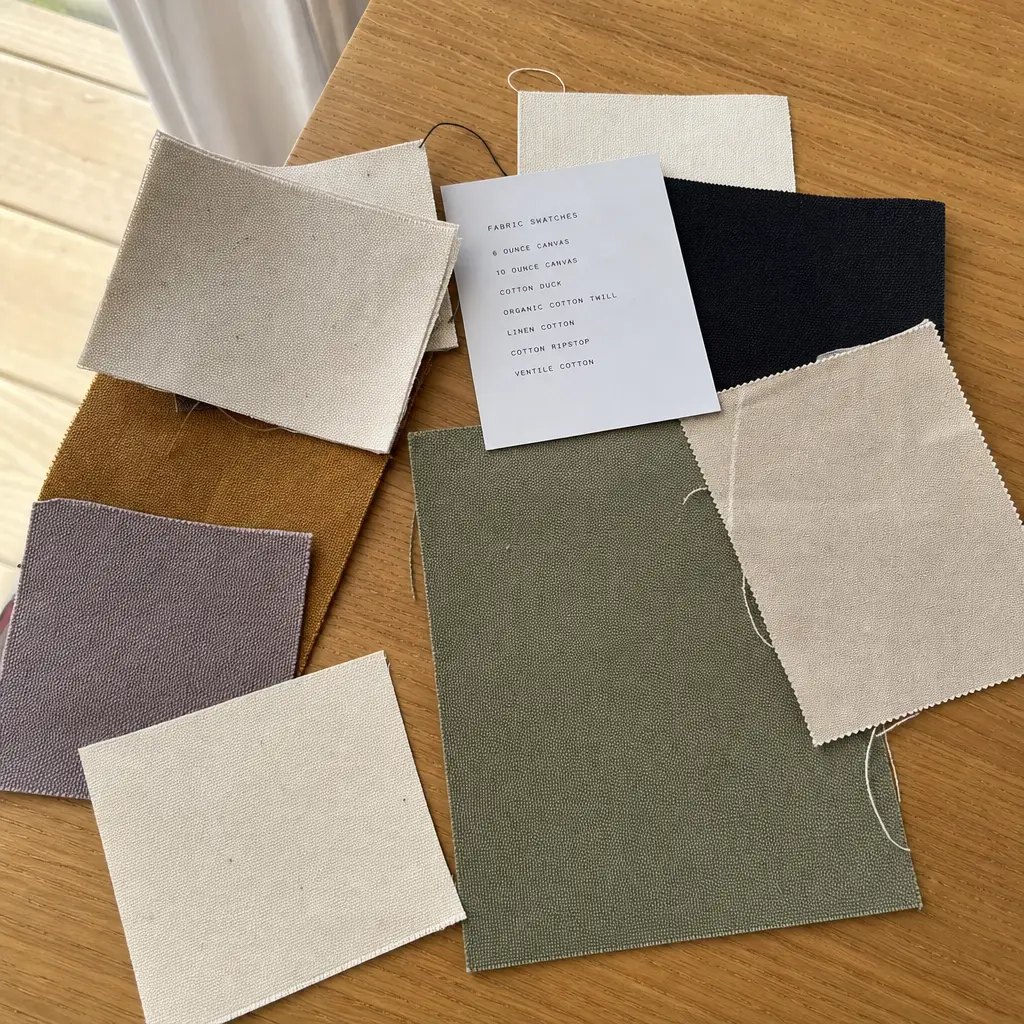
Natural canvas is popular for wellness studio portfolios because it works with calm palettes, minimalist logos, and retail programs that want an organic-looking material. It is often easier to source than custom dyed fabric and may support lower MOQ when stock cloth is available. The tradeoff is variation. Cotton seed specks, slubs, darker yarns, weaving bars, and small shade differences may be normal. Define them before production, or final QC may reject normal texture as defects.
Dyed canvas is the better route when the portfolio must match a studio brand palette, seasonal retail collection, or multi-location visual system. Common wellness colors include sage, warm beige, sand, terracotta, clay, charcoal, cream, muted lavender, soft olive, and dusty blue. Custom dyeing needs lab dip approval, bulk shade confirmation, and schedule allowance. Buyers should approve color under consistent lighting and state whether small shade variation is acceptable between lots or split deliveries.
Washed canvas gives a softer lifestyle finish, but it adds risk. Washing can shrink panels, soften corners, wrinkle the front, alter zipper tape behavior, and change how the logo panel sits. A washed zipper portfolio needs tighter sampling than a tote because it still has to fit documents and close smoothly. If it must hold A4 or US letter paper, test the washed sample with the actual contents, not only with a ruler.
Organic cotton, recycled cotton blends, and other certified materials can support a wellness brand story, but procurement should confirm documentation before any claim is used on packaging or sales pages. Ask what certification applies, whether the factory can provide relevant transaction or scope documents, and how material identity is separated through cutting and sewing. Do not assume standard cotton canvas supports a certification claim.
- Use natural canvas when brand guidelines accept flecks, slubs, and small shade variation.
- Use dyed canvas when the portfolio must match a brand palette, retail launch, or color-coded studio system.
- Use washed canvas only after checking shrinkage, zipper waviness, front-panel wrinkles, and final-size tolerance.
- Use certified or recycled materials only after confirming documents, MOQ, lead time, and approved claim language.
- Keep an approved swatch and sealed sample for final inspection comparison.
Control Construction Before Cost
A canvas zipper portfolio quote should identify more than outer fabric weight. Edge finish, lining, zipper gauge, pocket layout, reinforcement method, thread, seam allowance, label position, and packing all affect price and inspection risk. A plain flat sleeve with one zipper is not the same product as a lined organizer with a divider, pen loop, card pocket, elastic holder, and retail band. Missing details create mismatched quotes.
The highest-risk zone is often the zipper end and corner seam. Users overfill portfolios with forms, brochures, journals, cards, and gift inserts, then pull hard from the corner. When zipper ends are not reinforced, the seam can open even though the canvas is strong. Reinforcement may include bartacks, folded zipper stops, binding capture, extra topstitching, or a small fabric tab. The right method depends on whether the edge is bound, turned, or gusseted.
Bound and turned edges give different results. Bound edges help control thicker canvas and create a crisp frame, but binding width, stitch line, and color must stay consistent. Turned edges look softer and cleaner for minimalist wellness branding, yet they require accurate folding and pressing to avoid lumpy corners. Lining improves the interior, but it can reduce usable capacity if the pattern is not adjusted for seam bulk.
Internal organization should be designed around real contents. A divider that is too shallow will not hold forms. A pen loop that is too tight will annoy users. A card pocket placed too close to the zipper can catch during opening. Ask for an internal layout drawing with dimensions before sampling, then test the physical sample with the actual inserts. Small construction choices change sewing time, packing efficiency, defect rate, and customer complaints.
- No.5 nylon coil zipper is usually the most practical option for flexibility, smoothness, and sewing control.
- Metal zipper can look premium but adds weight and may scratch light canvas if packing is not controlled.
- Bound edges suit thicker or structured portfolios; turned edges suit softer minimalist designs.
- Inner pockets should be dimensioned around actual contents, not estimated from artwork or paper size alone.
- Reinforced zipper ends reduce failure risk more effectively than simply increasing canvas weight.
- Thread color, stitch length, and topstitch alignment should be approved because they are highly visible on plain canvas.
Match Logo Method to Fabric
Screen printing is often the most efficient logo method for canvas zipper portfolios when the artwork is a solid studio logo, retreat mark, short slogan, or simple line graphic. On 12 oz natural canvas, a one-color screen print can look clean, handle normal use, and stay cost-effective at bulk quantity. The RFQ should define ink type, print size, print position, color reference, artwork format, and placement tolerance. “Logo printing” is too vague.
Fabric texture changes logo results. A rough canvas can break up fine lines. Dark dyed canvas may need higher-opacity ink or an underbase. Large solid prints can change hand feel and may crack if the ink layer is not suitable for the fabric and repeated flexing. Before bulk printing, approve a strike-off on actual production fabric and check it under daylight and indoor light. Muted wellness palettes make small color differences more visible.
Embroidery, woven labels, cotton labels, patches, and heat transfers can work, but each has a specific risk. Embroidery may pucker a flat panel if the fabric is too light or stitch density is high. Woven labels suit small multi-color logos and subtle retail branding. A side seam label can add perceived value without covering the front panel. Heat transfer can hold fine artwork, but adhesion and edge lifting must be tested on textured canvas.
Logo placement should be measured from fixed reference points. “Centered” is not enough when zipper seams, gussets, rounded corners, or inner pockets affect the finished shape. State the distance from the left edge, bottom edge, or zipper edge, and allow a practical tolerance such as +/-3 mm for front-panel placement. If the portfolio has a front pocket or binding frame, approve logo balance on the sewn sample, not on a flat mockup alone.
- Use screen print for solid logos, retreat marks, event branding, and high-volume member kit programs.
- Use embroidery only after checking backing, stitch density, puckering, and distortion of thin logo lines.
- Use woven labels for subtle retail branding, small multi-color marks, and lower rub exposure.
- Use patches when a premium tactile detail is desired, but confirm attachment stitching and added stiffness.
- Use heat transfer only after adhesion, flexing, and edge-lift checks on production canvas.
- Set logo position by millimeter measurements from fixed edges, not only visual centering.
Plan MOQ and SKU Splits
MOQ is shaped by fabric availability, dye lot size, zipper color, logo setup, cutting efficiency, sewing-line setup, inspection, and packing. A factory may accept a lower quantity when the buyer uses stock natural canvas, standard zipper tape, one print color, and simple packing. The same factory may require a higher MOQ for custom dyed 14 oz canvas, matching zipper tape, woven labels, belly bands, barcode stickers, and multiple destination carton marks.
Tie MOQ to the exact specification. If a supplier says 300 pieces are possible, ask whether that quantity includes the requested fabric weight, color, zipper, logo method, lining, and packing. Low MOQ can be real when stock materials are used. It can also mean lighter canvas, available zipper colors, limited shade control, simplified packing, or a changed logo method. A low-MOQ quote and a fully custom quote should not be compared as if they are identical.
Distributors and multi-location wellness brands should disclose SKU splits at RFQ stage. A 1,000 piece order divided into four colors, two logo versions, and three shipping destinations is not one clean 1,000 piece run. Each split can require separate fabric allocation, cutting bundles, print setup, labels, packing lists, inspection sampling, and carton marks. Cost and lead time move with those details.
A practical buying strategy is to define one core specification and launch with the most reliable forecasted SKUs first. If the brand team wants seasonal colors, request tiered pricing by total order quantity and by quantity per color. Procurement can then decide whether to begin with one strong stock color or carry a broader retail assortment with higher MOQ and more inventory complexity.
- Lowest MOQ usually uses stock natural canvas, standard zipper, one logo color, and simple packing.
- Custom dyed canvas increases MOQ because lab dips, dyeing, and bulk shade control create a separate batch.
- Multiple logo versions may require separate screens, setup charges, strike-offs, and packing checks.
- Retail packaging can raise MOQ if hangtags, paper bands, inserts, barcode labels, or cartons are custom printed.
- Shipment splits should be priced before order confirmation, not after goods are packed.
- A reorder plan can justify better material control than chasing the smallest possible first batch.
Make Sample Approval Practical
The approved sample is the main reference for a canvas zipper portfolio order. Words such as premium, sturdy, soft, natural, minimalist, and clean are subjective until they become a physical sample and written specification. A production approval sample should include the actual fabric weight, zipper, thread color, logo technique, lining, edge construction, and intended packing. A rough size sample helps early decisions, but it should not release bulk cutting.
Separate sample stages when the order has custom details. A fabric swatch confirms shade, hand feel, and weight. A logo strike-off confirms artwork scale, ink color, opacity, and texture. A blank construction sample confirms finished size, pocket layout, zipper path, seam bulk, and edge finish. A pre-production sample confirms the full item before bulk. For a simple stock order, some stages can be combined, but the buyer should know exactly what has been approved.
Test the sample the way the final user will use it. Fill it with the intended forms, journal, certificates, cards, and inserts. Close the zipper. Open and close it repeatedly. Hold the item by the corners. Check whether the front panel distorts. Measure both outside dimensions and usable inside space. If the portfolio will be retail packed, review a packed sample too. Paper bands, hangtags, polybags, and zipper pulls can create pressure marks or hide defects.
Keep one sealed sample with the factory and one with the buyer or QA team. Label it with order number, date, fabric weight, color, logo method, approved changes, and written approval reference. If anything changes after sampling, update the sample record. Otherwise, bulk teams may follow old photos, outdated comments, or an earlier sample that no longer matches the order.
- Approve fabric swatch before sample making when color, certification, hand feel, or weight is critical.
- Approve logo strike-off before printing full panels or cutting printed production pieces.
- Measure the sample after filling it with intended contents, not only when empty and flat.
- Cycle the zipper at least 20 times on the sample, including corner movement and end stops.
- Check the sample after 24 hours packed to see whether zipper pulls, folds, or bands mark the front panel.
- Record every approved change in writing so bulk production follows the current specification.
Compare Quotes Line by Line
A canvas zipper portfolio has many cost layers: outer fabric, lining or interlining, zipper and puller, cutting loss, sewing labor, logo setup, logo application, trimming, inspection preparation, individual packing, export carton, carton marking, and inland handling. A quote that lists only a unit price is hard to trust. Two factories can use the same product name while quoting different fabric weights, zipper grades, seam finishes, and packing standards.
Fabric weight affects both factory cost and landed cost. Heavier canvas usually costs more per yard, creates more cutting waste by weight, sews more slowly, and increases carton gross weight. It may improve perceived value, but it can reduce pieces per carton or make air freight expensive for urgent campaigns. For sea freight, carton cube, moisture protection, and redistribution handling can matter as much as a small FOB difference.
Branding can also change the quote. Screen printing may include screen setup, color matching, strike-off approval, and extra handling time. Embroidery depends on stitch count, backing, and machine time. Woven labels and patches may have separate MOQs and lead times. Retail packaging can include hangtags, belly bands, barcode stickers, insert cards, tissue, recycled polybags, carton liners, or printed cartons. These elements should be itemized, not hidden inside a vague unit price.
Ask suppliers to confirm the specification line by line: fabric, zipper, lining, logo, packing, carton, sample fee, lead time, payment terms, and Incoterms. A better quote is not always the cheapest one. It is the quote that matches the approved specification and reduces surprise charges after the purchase order is placed.
- Fabric: weight, width, finishing, dyeing, shrinkage allowance, and cutting loss affect cost.
- Labor: lining, pockets, binding, turned corners, zipper reinforcement, and topstitching add sewing time.
- Branding: screen count, ink type, embroidery stitch count, label MOQ, patch cost, and setup fees matter.
- Packing: individual bags, paper bands, hangtags, barcode labels, carton liners, and export cartons add cost.
- Freight: fabric weight and carton efficiency change landed cost by channel.
- Administration: SKU splits, carton marks, inspection preparation, and multi-location dispatch add handling work.
Pack for Clean Arrival
Canvas products can arrive with dust marks, humidity spots, zipper pressure marks, uneven creasing, or carton abrasion when packing is treated as an afterthought. Wellness studio portfolios often use light natural or muted colors, so marks show quickly. Packing should protect the front logo panel, stop hardware from rubbing against neighboring pieces, and keep cartons stable through export handling and domestic redistribution.
Individual polybags provide strong protection, especially for light canvas shipped by sea, but they may conflict with sustainability preferences. Paper bands, paper sleeves, and recycled wraps improve presentation and reduce single-use plastic, but they offer less moisture protection. A practical compromise is a paper band for presentation plus a master carton liner, or an individual recycled polybag for light-colored canvas on long routes. Choose based on transit time, humidity, fabric color, retail needs, and damage tolerance.
Carton quantity should be set by shape retention and handling, not maximum compression. Overpacking can create zipper impressions and crushed corners. Underpacking allows movement and abrasion. If metal pulls are used, interleaving or controlled orientation may be needed so the pulls do not mark the front panel. If goods will be redistributed to studios, cartons should be strong enough for secondary handling, not only factory-to-port transport.
Carton marks should support receiving and inventory control. Include SKU, color, logo version, quantity, gross weight, net weight, carton number, destination, and purchase order reference where required. Confirm whether barcodes are applied to individual units, inner packs, cartons, or all three. Labeling errors can slow warehouse receiving even when the product itself is acceptable.
- Set pieces per carton by shape retention, zipper protection, carton strength, and final handling route.
- Use interleaving, puller wrapping, or controlled orientation if hardware can mark the front panel.
- Add desiccant, carton liner, or moisture barrier for humid routes, long sea transit, or light natural canvas.
- Mark cartons by SKU, color, logo version, quantity, gross weight, net weight, destination, and carton sequence.
- Confirm carton board quality if goods will be redistributed to multiple studio locations.
- Review one packed carton sample or photo set before shipment for retail-facing orders.
Release Shipments With QC Evidence
A realistic production schedule starts only after key inputs are approved: deposit, fabric confirmation, artwork, lab dip if needed, trims, and pre-production sample. Stock natural canvas with a simple screen print is usually faster than custom dyed fabric, washed finishing, special labels, matching zipper tape, or complex inner organization. Common delays include late artwork changes, lab dip rejection, zipper color matching, sample revisions, retail packaging changes, and unclear approval responsibility.
Wellness studio orders are often tied to retreats, new location openings, seasonal membership drives, practitioner training, or retail merchandising windows. If goods must arrive before a fixed date, state the required delivery window and final destination market in the RFQ. The supplier can then recommend whether to simplify construction, use stock fabric, reduce SKU splits, pre-approve packing, or plan a partial air shipment.
Freeze size, pocket layout, zipper color, logo placement, packing, and carton requirements before bulk cutting. If print size changes after panels are cut, parts may need rework or replacement. If packing changes after cartons are ordered, pieces per carton and carton dimensions may no longer work. A simple approval calendar with named owners prevents many avoidable delays.
Final inspection should be built into the timeline. Inspect after goods are packed but before shipment release, with enough time for sorting or correction if defects are found. AQL-style sampling is useful only when defect definitions are written. Critical defects may include unsafe hardware or severe contamination. Major defects may include wrong size, zipper failure, missing reinforcement, visible stains, wrong logo, or mixed SKUs. Minor defects may include small loose threads or slight cosmetic variation within the approved standard.
- Allow time for fabric approval before cutting, especially for dyed, washed, certified, or seasonal colors.
- Do not start bulk printing until logo strike-off, placement, ink color, and print size are approved.
- Freeze size, pocket layout, zipper specification, packing, and carton marks before the cutting marker is made.
- Schedule final inspection after packing but before shipment release and freight handover.
- For fixed events, consider partial shipment planning rather than rushing all units and accepting avoidable defects.
- Ask the factory which approval step is most likely to delay the order and assign a buyer-side owner.
Specification comparison for buyers
| Spec decision | Recommended option | When it fits | Buyer risk to check |
|---|---|---|---|
| Outer canvas weight | 12 oz / about 400 GSM cotton canvas, with finished-fabric tolerance agreed before cutting | Most wellness studio member kits, retreat folders, intake-form holders, journal sleeves, and branded onboarding packs | Below 10 oz may collapse with papers inside; above 16 oz can create bulky zipper corners, slower sewing, higher carton weight, and more needle marks |
| Finished size allowance | A4 or US letter content size plus 15-25 mm width and height allowance, measured on the finished empty item | Document portfolios carrying forms, class schedules, certificates, slim journals, vouchers, or practitioner handouts | Cutting to exact paper size leaves no allowance for seam bulk, zipper tape, lining, paper thickness, or slightly overfilled contents |
| Lining structure | Unlined for simple sleeves; 5 oz cotton lining or 75-100 GSM TC lining for a cleaner interior | Unlined works for lower-cost document sleeves; lining suits retail resale, gift packs, and visible inner compartments | Lining can reduce usable capacity, wrinkle at corners, or catch in the zipper if seam allowance and topstitching are not controlled |
| Zipper type | No.5 nylon coil zipper with matched tape, approved slider finish, and reinforced ends | Best balance of flexibility, smooth operation, weight, and sewing control around portfolio edges | Cheap zipper tape may wave after sewing; weak zipper ends often fail before the canvas does when users overfill the portfolio |
| Closure edge construction | Bound edge or turned edge with zipper end tabs or bartack reinforcement | Bound edge controls thicker canvas; turned edge supports softer minimalist wellness branding | Unreinforced corners, uneven binding width, and lumpy turned edges are common visible defects on flat portfolios |
| Logo method | Screen print for 1-3 color artwork; woven label, cotton label, embroidery, or patch for tactile branding | Screen print suits bulk studio programs; labels and patches suit premium retail or subtle brand placement | Dark dyed canvas may need opacity testing; embroidery may pucker; heat transfer needs adhesion and flex testing on textured canvas |
| MOQ planning | 500-1,000 pcs for custom size, fabric color, logo, and packing; lower only with stock materials | Importers, distributors, studio chains, retreat operators, and multi-location wellness brands consolidating demand | Very low MOQ quotes may assume stock canvas, substitute zipper colors, limited shade control, simplified packing, or different logo technique |
| Packing format | Individual recycled polybag, paper band plus carton liner, or retail sleeve based on route and sales channel | Polybag protects light canvas during long transit; paper band improves retail presentation and reduces single-use plastic | Unprotected canvas can pick up carton dust, humidity marks, zipper impressions, pressure creases, or hardware scratches |
| Inspection standard | AQL-style final inspection with written critical, major, and minor defect definitions | Useful for B2B buyers needing objective shipment release criteria across multiple SKUs or destinations | Without defect definitions, buyers and factories may disagree on slubs, shade variation, stains, zipper drag, print placement, or loose threads |
Buyer checklist before sampling
- Define the portfolio job clearly: retail resale, member welcome kit, retreat workbook holder, intake-form folder, practitioner handout, distributor SKU, or multi-location onboarding pack.
- Specify finished external size and required usable internal size, including whether it must fit A4, US letter, a specific journal, tablet sleeve, product insert, gift card, or boxed voucher.
- State outer canvas weight in oz and approximate GSM, and confirm whether the weight applies to greige fabric, dyed fabric, washed fabric, or finished fabric.
- Agree fabric tolerance before order placement; for many cotton canvas programs, a practical finished-weight tolerance is about +/-5% to +/-8%, depending on finishing and mill control.
- Confirm material type: natural cotton canvas, bleached canvas, dyed canvas, washed canvas, organic cotton, recycled cotton blend, conventional cotton, or coated/finished canvas.
- Define acceptable natural-canvas character, including cotton flecks, slubs, darker yarns, weaving bars, and shade variation, so QC does not reject normal texture as defects.
- Confirm construction: unlined, lined, interlined, bound edge, turned edge, gusseted, flat sleeve, document divider, card slot, pen loop, elastic holder, label tab, or internal pocket.
- Specify zipper gauge, zipper type, tape color, slider finish, puller material, zipper end reinforcement, and minimum open-close cycle check on approved samples.
- Choose logo method by artwork size, color count, fabric texture, rub exposure, hand feel, brand positioning, and whether the front panel must remain smooth and flat.
- Request physical approval samples using production fabric, production zipper, production thread, actual logo method, lining, edge construction, and packing method before bulk cutting.
Factory quote questions to send
- What exact canvas weight is quoted for the outer shell in oz and GSM, and is that measurement for greige, dyed, washed, or finished fabric?
- What finished fabric weight tolerance should we expect, and can you state it on the proforma invoice or technical sheet?
- Is the quoted fabric stock natural canvas, custom dyed canvas, bleached canvas, washed canvas, organic cotton, recycled cotton blend, or standard conventional cotton canvas?
- What fabric checks can you provide before cutting, such as finished GSM, width, shrinkage, shade continuity, colorfastness to rubbing, and obvious weaving defects?
- What is the proposed finished size, usable inside size, and dimensional tolerance for width, height, gusset, pocket depth, and zipper opening length?
- What zipper specification is included: No.5 or other gauge, nylon coil or metal, tape color, slider finish, puller type, zipper length, and reinforcement method at both ends?
- Does the price include lining, interlining, document divider, card pocket, pen loop, elastic holder, label, gusset, binding, or only a plain single-compartment sleeve?
- Which logo method is quoted, and what are the print size limit, color limit, setup charge, artwork format, strike-off process, placement tolerance, and approval timeline?
- What is the MOQ for this exact specification, and how does cost change if we split colors, split logos, use custom zipper tape, or change packing format?
- What sample types are available before production: fabric swatch, blank size sample, logo strike-off, pre-production sample, packed sample, and sealed approval sample?
Quality-control points to confirm
- Finished width and height should normally be controlled within +/-5 mm for flat A4 or US letter portfolios; heavier washed canvas, gussets, or padded structures may need a wider agreed tolerance.
- Usable internal size should be checked with the actual documents, journal, cards, inserts, or vouchers, not only by measuring the outside panel.
- Canvas finished weight should be checked against the approved specification and tolerance; record whether measurement is taken before or after washing, dyeing, or coating.
- Fabric shade should match the approved swatch under consistent light, especially for natural, cream, sand, sage, terracotta, clay, charcoal, lavender, and other muted wellness colors.
- Natural canvas should be inspected against an agreed standard for flecks, slubs, dark yarns, weaving bars, oil marks, stains, and foreign fibers.
- Zipper should open and close smoothly across the full length without catching on lining, dragging at corners, separating at the end, or showing wavy tape after sewing.
- Zipper end reinforcement should be checked by visual inspection and light pull handling; weak end stitching, missing bartacks, and unsecured tabs should be treated as major defects.
- Main seams should have even stitch density, no skipped stitches, broken thread, open seams, loose topstitching, exposed raw edges, or needle damage visible at normal viewing distance.
- Logo placement should match the approved sample with an agreed tolerance, commonly +/-3 mm for centered front-panel print or a stated distance from edge and zipper reference points.
- Printed logos should show no obvious cracking, peeling, ink bleeding, ghosting, pinholes, uneven opacity, or dry-rub transfer beyond the approved standard.