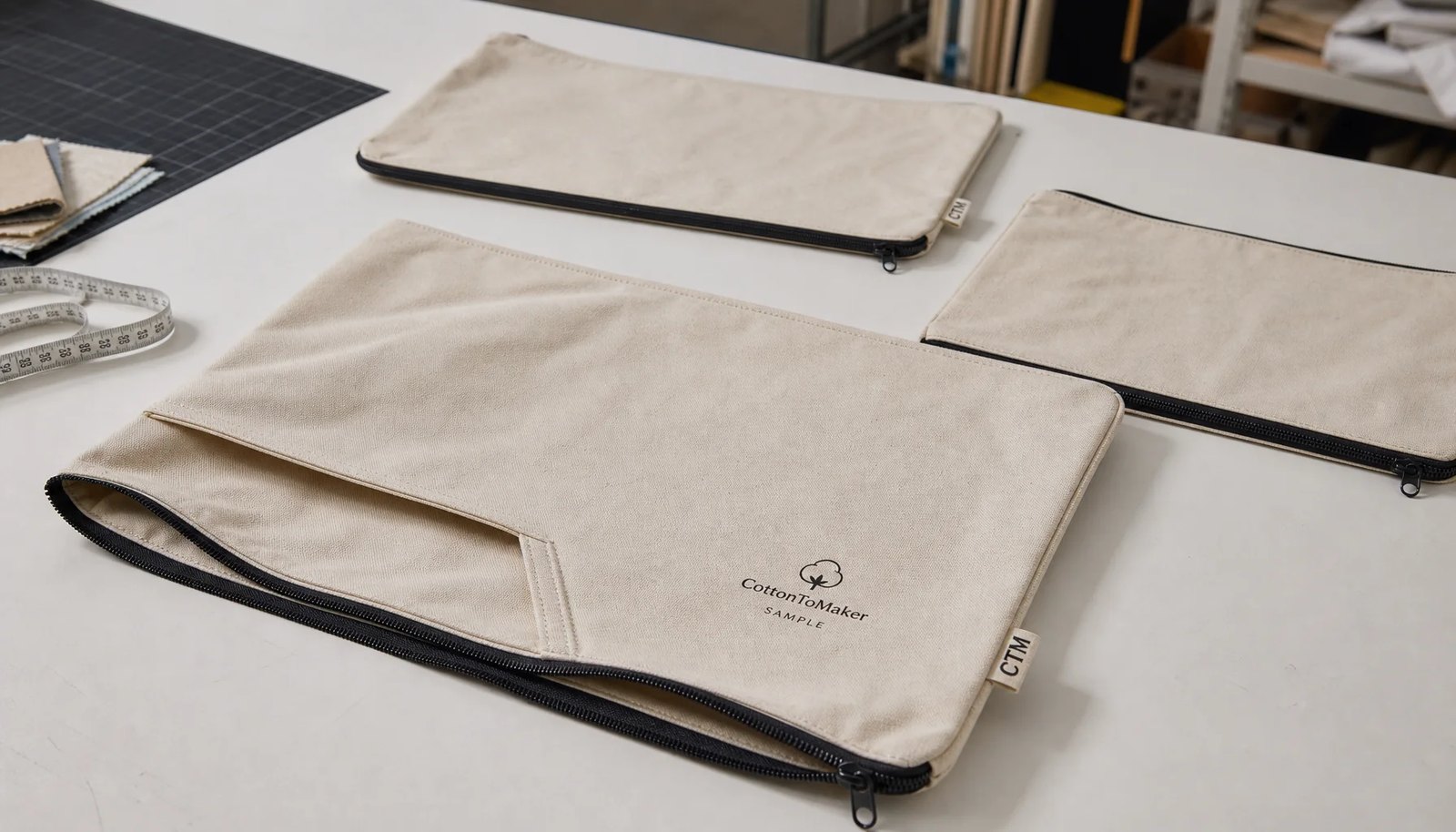
The buying problem: portfolios look simple but fail at the details
Canvas zipper portfolios for university bookstores sit between stationery, campus merchandise, and promotional packaging. They are not complicated bags, but they combine several failure points in one product: flat fabric panels, zipper alignment, logo decoration, interior organization, and retail packing. A quote that only says "canvas zipper portfolio with logo" is too thin for comparison because one supplier may price a soft unlined pouch while another prices a structured retail item with lining, pockets, and barcodes.
The best wholesale buying checklist starts with use case. A bookstore selling a portfolio next to notebooks needs a cleaner finish than an orientation department handing out document packs for one event. A campus brand owner may care about exact school colors and logo approval, while a distributor may care more about carton count and SKU separation. Before comparing unit prices, lock the functional level of the product.
- Retail resale version: better canvas, cleaner stitching, controlled logo color, individual barcode packing.
- Orientation kit version: practical size, reliable zipper, economical print, carton grouping by department.
- Gift or alumni version: heavier fabric, lining, premium puller or patch, stricter cosmetic inspection.
- Budget document pouch: unlined body, standard zipper, one-color print, simplified packing.
Size and layout should be built around the contents, not a catalog photo
A common sourcing mistake is choosing a portfolio size from a supplier photo without testing the actual contents. University bookstores often need the portfolio to hold letter-size documents, A4 paper for international programs, spiral notebooks, brochures, campus maps, or a bundled stationery set. The finished size is different from the cut fabric size because seam allowance, zipper tape, lining turn-in, and fabric shrinkage reduce usable space.
For U.S. bookstore programs, a finished size around 13 x 10 inches works for letter documents if the portfolio is not overfilled. If a spiral notebook, folder, or tablet sleeve is included, move closer to 14 x 10.5 inches or define the internal usable size. For zip-around portfolios, corner radius and zipper path matter; tight corners increase slider resistance and sewing defects.
- State finished external size and minimum internal usable size separately.
- Allow extra width for bound notebooks, not only loose paper.
- Decide whether the zipper opens on one long side, two sides, or three sides.
- For retail shelves, confirm whether the portfolio must fit existing display bins or peg hooks.
- If hangtags or belly bands are used, confirm that packing does not cover the logo.
Canvas weight, finish, and structure drive both price and customer perception
Canvas weight should be quoted in GSM as well as ounces. Many buyers hear 10 oz or 12 oz and assume all suppliers mean the same fabric. In practice, 10 oz canvas may sit around 300-340 GSM, while 12 oz may sit around 380-410 GSM depending on weave and finishing. A portfolio needs enough body to look flat on a shelf and protect documents, but too much stiffness can make zipper corners bulky and increase sewing rejects.
For most university bookstore wholesale orders, 12 oz cotton canvas is a strong default. It gives a better handfeel than lightweight cotton and still runs efficiently in sewing. Use 10 oz when the item is a budget orientation pouch or when shipping weight is tightly controlled. Use 14 oz or heavier only when the retail price supports it and the design has enough seam allowance, needle size, and zipper strength to handle the fabric.
- Natural canvas hides minor shade variation better than dark dyed canvas.
- Bleached canvas gives cleaner logo color but may show dirt faster in retail handling.
- Dyed canvas requires color approval under the buyer's light source, not only a phone photo.
- Washed canvas feels softer but can shrink and wrinkle, so size tolerance must be agreed.
- Coated canvas can improve stain resistance but may affect ink adhesion and sewing marks.
Zipper and sewing choices separate a reusable product from a one-season pouch
The zipper is usually the first functional complaint on a canvas portfolio. A No. 5 nylon coil zipper is normally enough for document portfolios and gives a smoother curve around corners than a chunky molded zipper. Oversized zippers can look rugged, but they add cost, weight, and stiffness. Metal zippers may look premium but are less forgiving on soft canvas panels and can scratch paper or devices if the inside construction is not controlled.
Sewing details need to match the zipper path. A zip-around portfolio should have balanced topstitching, reinforced zipper ends, and enough fabric clearance so the slider does not catch the seam allowance. If handles, wrist straps, or webbing loops are added, the reinforcement must be defined. A simple backstitch may be enough for a light wrist strap, but handles used for carrying notebooks should have bar-tack or box stitching.
- Recommended standard: No. 5 nylon coil zipper with matching tape and smooth metal or molded puller.
- Use No. 8 zipper only for oversized, padded, or heavy-duty versions.
- Define slider color, puller shape, and whether the puller can carry a small logo.
- Avoid sharp internal metal edges if the portfolio may hold tablets or calculators.
- Inspect zipper corner smoothness on a loaded sample, not only an empty sample.
Logo decoration must match campus brand rules and fabric behavior
University artwork is often stricter than normal promotional artwork. Bookstore teams may need approval from licensing, athletics, alumni, or department marketing before production. A supplier cannot control that process unless the RFQ includes vector artwork, Pantone references, print size, placement, and a clear rule for color tolerance. Do not let the first bulk sample become the first real logo test.
Screen printing is the standard decoration method for canvas zipper portfolios when the logo uses one to three solid colors. It is durable, cost-effective, and works well on natural or dyed cotton if the ink is matched to the fabric. Heat transfer can handle gradients, small details, and full-color graphics, but buyers should test edge lift and handfeel. Embroidery can look premium but may distort flat portfolio panels and can be expensive for large university marks.
- Use screen print for solid campus logos and larger quantities.
- Use heat transfer when gradients, photo details, or very tight artwork are required.
- Use woven labels or PU patches for premium collections with repeated orders.
- Define logo placement from top and side edge in millimeters or inches.
- Approve a print strike-off on the actual production fabric before bulk printing.
MOQ logic changes when one total order contains many bookstore SKUs
Wholesale MOQ is not only the total order quantity. It is affected by fabric color, logo version, print color, zipper color, packing type, and carton sorting. A buyer may say the order is 2,000 pieces, but if it is split across eight departments, four logo colors, and two packing methods, the factory sees small batches. That increases screen setup, line changeover, packing control, and inspection complexity.
A realistic RFQ should show the quantity matrix. If the bookstore wants 500 pieces for the main university logo, 300 for athletics, 200 for alumni, and smaller runs for departments, list each SKU. The factory can then advise whether to keep fabric and zipper common across all SKUs while changing only print artwork. This often protects MOQ and lead time better than customizing every element.
- Separate MOQ per fabric color from MOQ per print design.
- Keep zipper tape color common if the order has many department logos.
- Group small department runs by the same print ink colors where possible.
- Expect extra screen charges or setup fees for each logo version.
- For custom dyed canvas, plan higher MOQ and longer fabric lead time than stock natural canvas.
Sample approval should prove construction, print, and packing before bulk cutting
A photo approval is not enough for canvas zipper portfolios. The buyer needs to feel fabric body, test zipper travel, insert the intended contents, and review logo color under normal lighting. For a new program, the sample process should move from material swatch to proto sample, then print strike-off, then pre-production sample. The final approved sample becomes the reference for inspection and dispute resolution.
The sample record should include measurements, fabric weight, zipper type, thread color, print method, logo placement, interior layout, and packing. If the bookstore barcode or retail sticker is part of the order, include it at sample stage. Many packing mistakes happen because packaging is treated as an afterthought after product approval.
- Material swatch: confirms GSM, color, handfeel, and surface for printing.
- Proto sample: confirms size, zipper path, pockets, handles, and general structure.
- Print strike-off: confirms ink color, coverage, edge sharpness, and adhesion.
- Pre-production sample: confirms final construction, logo, packing, and carton plan.
- Sealed approval sample: kept by buyer, factory, and inspection team if possible.
Quality thresholds should be written before inspection, not during a claim
Because canvas is a natural woven fabric, some slubs and shade variation may be normal. The problem is not that variation exists; the problem is that buyers and factories often define it after goods arrive. For bookstore retail, cosmetic standards should be tighter than for free event giveaways. Visible oil marks, heavy wrinkles, broken stitches, crooked logos, and zipper failure should be classified as major defects.
Functional tests should be simple and repeatable. Load the sample with the expected paper or notebook bundle, zip and unzip several times, and inspect whether the corners distort. Measure a few pieces from the first production batch before the full run continues. If print durability matters, perform dry rub, light scratch, and bend tests on the decorated area. These checks do not replace formal inspection, but they prevent obvious bulk mistakes.
- Finished size tolerance: typically plus or minus 5 mm unless a wider range is agreed.
- Logo placement tolerance: set a maximum shift from approved sample, such as 3-5 mm.
- Zipper test: smooth opening and closing without splitting, catching, or slider detachment.
- Stitching: no skipped stitches, open seams, loose bar-tacks, or exposed raw edges.
- Print: no heavy pinholes, smearing, cracking, wrong color, or poor registration.
- Packing: correct barcode, SKU, carton mark, and quantity per carton.
Packing decisions affect bookstore receiving, not just export shipping
University bookstores often receive goods through systems that require SKU labels, barcode stickers, inner packs, or department separation. If the factory packs mixed logo versions in the same carton without a clear plan, the buyer may save a small amount on packing labor but lose time during receiving. For retail programs, packing is part of the product specification.
A typical export packing plan may use individual polybags and master cartons of 50 to 100 pieces depending on size and fabric stiffness. Overpacking can crease portfolios, bend zipper tracks, and make shelves look untidy. Underpacking increases carton count and freight cost. The right carton quantity should protect the product while staying within handling limits for the bookstore warehouse or distribution center.
- Use individual polybags when products need barcode labels or clean retail handling.
- Use belly bands or hangtags when the product must communicate features on shelf.
- Pack by SKU, logo, and color; avoid mixed cartons unless the buyer approves a clear assortment.
- Show carton marks with PO number, SKU, color, quantity, gross weight, net weight, and carton number.
- Confirm whether cartons must meet parcel shipment weight limits or palletizing requirements.
Lead time risk comes from approvals, materials, and SKU complexity
A factory lead time should begin after sample approval, deposit, and final artwork confirmation. Buyers sometimes count from the first quotation date, but production cannot start from an unapproved logo or incomplete SKU list. For canvas zipper portfolios, the schedule is usually affected by fabric availability, dyeing, zipper sourcing, print screens, sample revisions, and packing label approval.
Stock natural canvas with a one-color screen print is the fastest route. Custom dyed canvas, custom zipper pullers, multiple logo versions, lined interiors, or retail barcode packing add time. University approval cycles can be slower than factory sampling, so build the calendar around the campus decision process as well as sewing capacity. If the goods are needed for orientation, homecoming, graduation, or back-to-school retail, missed delivery windows can make the inventory much less valuable.
- Fastest route: stock canvas, standard zipper, one logo position, simple carton packing.
- Moderate route: lined version, multiple department prints, barcode labels, retail tags.
- Longer route: custom dyed fabric, custom puller mold, patches, complex interior organization.
- Schedule buffer should include artwork approval, sample shipping, buyer comments, and pre-shipment inspection.
- Do not approve bulk cutting until final size, logo, material, and packing are all locked.
Specification comparison for buyers
| Spec decision | Recommended option | When it fits | Buyer risk to check |
|---|---|---|---|
| Canvas body fabric | 12 oz cotton canvas around 380-410 GSM, pre-shrunk if heavy washing or dark print is planned | Best balance for bookstore retail shelves, orientation kits, alumni gifts, and campus department resale | Low GSM substitutions can collapse after packing; request actual GSM tolerance and finished panel handfeel, not only ounce wording |
| Lining construction | Unlined for budget orders; 210D polyester lining for premium portfolios with pen loops and internal pockets | Unlined works for simple document sleeves; lined version suits higher retail price points and gift programs | Lining adds labor and defect points; inspect seam catching, loose threads inside, and pocket depth consistency |
| Zipper type | No. 5 nylon coil zipper with metal or molded puller; No. 8 only for oversized or padded versions | No. 5 is sufficient for A4 or letter portfolios holding notebooks, brochures, and campus documents | Cheap coil zipper can wave or split at corners; test opening force and repeated pull cycles on samples |
| Portfolio size | Approximately 13 x 10 inches for letter documents, or 14 x 10.5 inches when a notebook plus inserts are required | Good for U.S. university bookstores selling notebooks, orientation packs, and department-branded stationery kits | Too-tight dimensions cause document corner damage; allow seam loss and fabric shrinkage in the finished size |
| Logo decoration | Screen print for one to three solid colors; heat transfer for gradients; woven or PU patch for premium retail version | Screen print is the standard bookstore choice when campus logo colors are controlled and order quantity is stable | Print cracking, dye migration, and off-register artwork are common if fabric finish, ink type, and PMS approval are skipped |
| Handle or carry option | No handle for slim portfolio; short webbing handle or wrist strap for gift kits and event resale | Handle version increases perceived value and helps students carry documents during campus tours or orientations | Handle reinforcement must be bar-tacked or box-stitched; weak attachment can fail before zipper or fabric |
| MOQ structure | 500-1000 pieces for standard fabric and print; higher MOQ when custom dyed canvas, custom zipper tape, or molded puller is used | Useful for seasonal campus orders where bookstores repeat colors and vary department logo artwork | Low MOQ quotes may hide higher unit price, fabric surcharge, or limited color control; separate stock material from custom material |
| Retail packing | Individual polybag with barcode sticker or belly band; master carton by color and logo version | Needed when bookstore receiving teams scan SKUs directly into retail inventory or distribute by department | Mixed cartons create receiving delays; carton marks, SKU labels, and inner quantity must match the purchase order |
Buyer checklist before sampling
- Define the finished portfolio size by what it must hold: letter paper, A4, spiral notebook, tablet sleeve, orientation brochure set, or bookstore stationery bundle.
- State canvas weight in both ounces and GSM, with an acceptable tolerance such as plus or minus 5 percent after finishing.
- Specify whether the portfolio is unlined, lined, padded, or fitted with internal pockets, pen loops, card slots, or document dividers.
- Choose zipper size, zipper color, puller style, and whether the zipper must run around two sides or three sides of the portfolio.
- Provide artwork as vector files and include print size, placement from edges, Pantone references, and whether the logo must survive retail handling without cracking.
- Separate samples into proto sample, print strike-off, pre-production sample, and sealed approval sample so the factory knows which stage controls bulk production.
- Give SKU structure by logo, color, department, and packing method instead of sending one total quantity that hides multiple small batches.
- State individual packing, barcode sticker location, carton quantity, carton mark format, and whether cartons must be suitable for bookstore distribution centers.
- Request quote lines for fabric, decoration, zipper/hardware, packing, sample cost, mold or screen charges, and freight terms.
- Build lead time from artwork approval and deposit date, not from first email inquiry, and add buffer for campus logo approval and bookstore receiving windows.
Factory quote questions to send
- What exact canvas weight will be used in GSM, and is the fabric greige, bleached, dyed, washed, or finished with any coating?
- What is the finished size tolerance after sewing, and how much seam allowance is included around the zipper?
- Which zipper brand, size, tape material, slider finish, and puller type are included in the quote?
- Is the quoted price based on screen printing, heat transfer, embroidery, patch application, or another decoration method?
- How many logo colors, print positions, and print sizes are included before extra charges apply?
- What is the MOQ per color, per logo, and per SKU if the order includes several departments or bookstore branches?
- Can you provide a material swatch, zipper sample, print strike-off, and full pre-production sample before bulk cutting?
- What packing method is included: individual polybag, barcode label, hangtag, belly band, master carton, or export carton only?
- What carton quantity and carton dimensions are planned, and can they be adjusted for bookstore receiving or parcel shipment limits?
- What production lead time applies after sample approval, and what risks could extend it, such as dyed fabric, custom puller molds, or holiday capacity?
Quality-control points to confirm
- Finished size tolerance should normally stay within plus or minus 5 mm for small portfolios unless a wider tolerance is approved.
- Canvas GSM should be verified by swatch or cutting-room sample, not only by supplier quotation wording.
- Zipper must open and close smoothly around corners without slider snagging, tooth separation, or tape distortion.
- Logo placement should follow an approved measurement from top edge and side edge, with tolerance noted on the approval sample.
- Screen print should pass a dry rub test and reasonable bend test without heavy cracking or flaking on the approved fabric.
- Seams at zipper ends, corners, handles, and pocket openings should have secure backstitching or bar-tack reinforcement where needed.
- Internal pockets and pen loops should be measured for usable width, not only visual appearance.
- Loose threads, needle holes, oil marks, fabric slubs, and uneven topstitching should be classified before inspection to avoid argument at shipment.
- Barcode labels and carton marks must match SKU, color, logo version, and purchase order line.
- Cartons should be drop-resistant enough for export handling and not overpacked to the point that portfolios crease permanently.