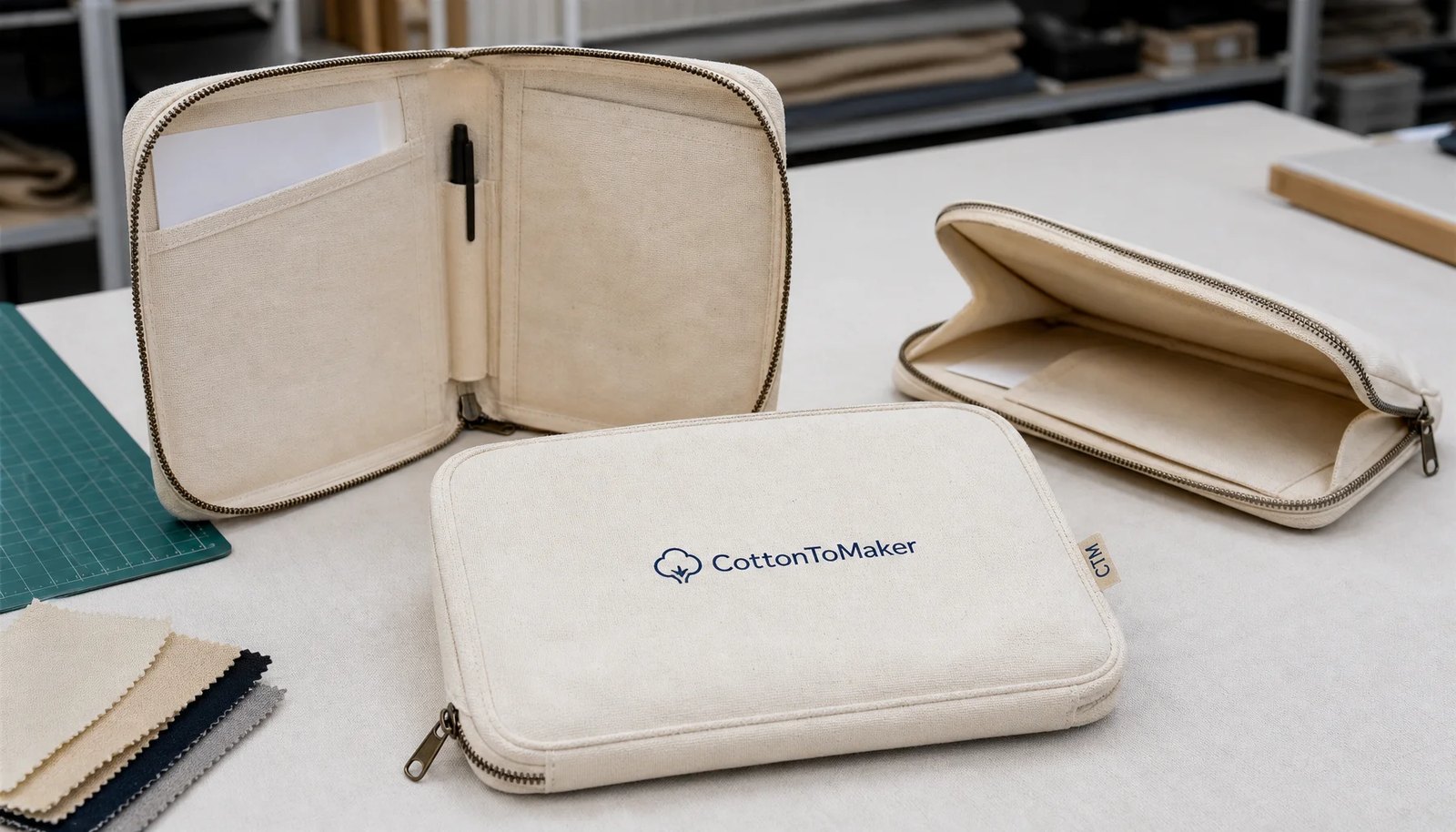
Why the RFQ must define the portfolio before asking for price
Canvas zipper portfolios look simple in photos, but they can be quoted in very different ways. One factory may price a flat unlined document pouch with a zipper. Another may quote a structured conference portfolio with inner sleeves, pen loops, lining, and reinforced corners. Both may call the item a canvas zipper portfolio, yet the fabric consumption, sewing time, trim cost, packing volume, and inspection risk are not the same.
For university bookstores, the buying problem is usually not only lowest unit price. The item must hold up on retail shelves, carry a licensed campus logo cleanly, fit common document sizes, and arrive in sellable condition before orientation, graduation, or back-to-school dates. A useful RFQ removes assumptions so suppliers quote the same product and procurement can compare numbers without guessing what was included.
- State whether the product is a flat zipper document case, padded tablet portfolio, binder-style portfolio, or retail accessory pouch.
- Define the intended channel: bookstore resale, event giveaway, course kit, alumni merchandise, or department procurement.
- Include target retail positioning, because a low-cost course kit item and a premium alumni item should not use the same construction.
- Tell the factory whether the quote should optimize for low unit cost, premium hand feel, plastic-free packing, or fast delivery.
Core specification choices that change the quote
The first specification to control is fabric. For most bookstore zipper portfolios, 10 oz cotton canvas is a cost-conscious option, while 12 oz canvas gives better body and retail feel. Heavier 14 oz or 16 oz canvas can look premium, but it may create bulky seams at zipper ends and increase carton weight. If the supplier quotes only in ounces, request GSM as well; 12 oz canvas is often around 380-400 GSM, but mills and finishing methods vary.
Color and finishing also affect price and risk. Natural canvas is usually easier and faster than custom dyed canvas. Dyed canvas requires shade approval and can show batch variation if fabric is replenished mid-order. Washed canvas has a softer hand feel but may shrink, distort pocket panels, or require adjusted cutting patterns. A buyer RFQ should state the target fabric hand feel, shrinkage tolerance, and whether minor natural slubs are acceptable.
- Common fabric range: 10 oz for economy, 12 oz for balanced retail use, 14 oz for premium structured feel.
- Request both oz and GSM so competing quotes are easier to compare.
- For natural canvas, define acceptable slubs and seed marks instead of treating all texture as defects.
- For dyed canvas, provide Pantone or lab dip target and require bulk shade approval before cutting.
- If padding is needed, define foam thickness and whether padding is on one side, both sides, or only the tablet pocket.
Construction details that prevent bookstore returns
A portfolio used by students, faculty, or alumni will be opened and closed repeatedly. The zipper should not be treated as a minor trim. A size 5 nylon coil zipper is a practical default because it is flexible, durable, and easier to sew around canvas corners than a heavy metal zipper. Metal zippers may look more premium, but they raise cost and can scratch notebooks, tablets, or the fabric surface if the puller is oversized.
Interior layout must be specified with real objects in mind. If the portfolio is sold for documents, confirm whether it must fit US letter paper, A4 paper, or both. If it is positioned for tablets, the RFQ must state the device size, divider padding, elastic security strap, and whether the zipper can close when the tablet and documents are inside. A sketch without dimensions often creates samples that look acceptable but fail in use.
- Use reinforced bartacks or secure backstitching at zipper start and end points.
- Specify stitch density, such as approximately 7-9 stitches per inch, if appearance consistency matters.
- Confirm whether corners are square, rounded, bound, or piped; each changes sewing difficulty.
- Define inner pocket height and width, not just pocket name.
- If a pen loop is included, give pen diameter range or use elastic that can handle common pen sizes.
Logo decoration for licensed university marks
University bookstore programs often involve licensed marks, mascot graphics, department logos, or alumni association branding. Decoration method should be chosen before price comparison. Screen print is usually the cleanest and most economical choice for one or two color logos on canvas. It works well on flat panels if the fabric is cut and printed before sewing. Large solid prints on coarse canvas may need heavier ink deposit and careful curing.
Embroidery gives a premium look but can distort thin canvas panels, especially near zipper seams or pocket edges. Woven labels are useful when the same portfolio body is sold to several campuses or departments because the label can be changed without printing large panels. Leather or faux leather patches can work for alumni merchandise, but they introduce extra stitching, tooling, and compliance questions. The RFQ should attach artwork and define placement from the edge, not just say front logo.
- For screen print, provide Pantone color, print size, print position, and whether the logo prints before or after sewing.
- For embroidery, state stitch count estimate if available and require backing to prevent puckering.
- For woven labels, specify label size, fold type, edge finish, and whether it is sewn into seam or top-stitched.
- For patches, define material, thickness, deboss or emboss depth, stitch color, and corner shape.
- Include licensing review time in the schedule; factories cannot control approval delay from a university rights holder.
MOQ logic: why one total quantity is not enough
MOQ for canvas zipper portfolios is driven by material purchasing, cutting efficiency, sewing line setup, logo setup, and packing configuration. A factory may accept 500 pieces if the fabric is natural canvas and the zipper is a standard color from stock. The same factory may require 1,000 pieces or more for custom dyed fabric, special zipper tape, multiple logo versions, or retail packaging with custom printing.
Procurement teams often send an RFQ saying 2,000 pieces total, assorted university logos. That is not enough for accurate pricing. A factory needs to know whether the order is 2,000 pieces of one logo, four logos of 500 each, or ten department logos of 200 each. Each split affects screen setup, line changeover, packing marks, inspection sorting, and overrun risk. The best RFQ separates MOQ by body color, logo design, packing SKU, and shipment destination.
- Lowest practical test order: often 500-1,000 pieces per logo when using stock natural canvas and standard trims.
- Custom dyed canvas: plan higher MOQ because fabric mills may have minimum dye lots.
- Multiple campus logos: expect separate screen charges and possible price increase for small runs.
- Assorted colors: treat each fabric color as a separate MOQ unless the supplier confirms fabric is stocked.
- Retail barcode packing: each SKU split should be listed because carton marking and packing labor increase.
How to compare supplier quotes without being misled
A low quote may be valid, but it may also be missing important cost elements. For zipper portfolios, the common omissions are lining, reinforced zipper ends, inner pockets, logo setup, individual packing, carton marking, and pre-production sample charges. Some quotes also use lighter canvas than requested or quote FOB without showing carton CBM, making freight comparison difficult.
Build the quote sheet so every supplier responds in the same format. The unit price should sit beside the specification, not separate from it. If one supplier quotes 10 oz unlined and another quotes 12 oz lined with pockets, the cheaper price is not a better offer; it is a different product. For importers and distributors, carton size and gross weight matter because a portfolio can be bulky even when the unit price looks attractive.
- Compare fabric weight, lining, zipper grade, logo method, and inner features line by line.
- Request unit price by Incoterm, such as EXW, FOB, or FCA, and state the port if FOB is needed.
- Record sample fee, screen charge, label tooling, packing cost, and inspection fee separately.
- Request carton quantity, carton dimensions, gross weight, net weight, and total CBM.
- Ask for quote validity because cotton, zipper, and freight-related costs can change before approval.
Sample approval should test construction, not just appearance
A photo sample is not enough for a canvas zipper portfolio. Buyers should approve a physical sample made with the intended canvas weight, zipper, lining, inner pocket layout, and logo process. If the first sample uses substitute fabric, it can still help confirm dimensions and layout, but it should not be treated as a production approval sample. The final pre-production sample must represent what the factory will cut and sew in bulk.
Sample feedback should be written with measurable corrections. Instead of saying the portfolio feels flimsy, state that the body should be changed from 10 oz to 12 oz canvas or add a lining/interlining layer. Instead of saying the print is too low, provide exact placement from top edge and side edge. A sealed sample kept at both buyer and factory sides is the strongest tool for avoiding disputes during final inspection.
- Check finished dimensions with documents inside, not only when the portfolio is empty.
- Open and close the zipper repeatedly to feel drag at corners and zipper ends.
- Insert a pen, cards, documents, and tablet if those functions are promised.
- Rub the printed logo with a dry white cloth to screen for obvious curing or ink adhesion problems.
- Review carton packing sample if corner shape and retail presentation are important.
Packing choices for retail shelf and import handling
Packing is part of the product specification for university bookstores. Individual polybags protect canvas from dust and moisture during export, but some campuses prefer reduced plastic. A paper belly band or kraft sleeve can look retail-friendly, yet it does not protect well against humidity unless combined with an inner carton liner or controlled storage. The RFQ should state the buyer's packaging policy instead of leaving the factory to choose the cheapest method.
Carton loading also matters. Canvas zipper portfolios are flat, but corners can deform if too many are compressed into one carton. For many sizes, 20-40 pieces per export carton is more realistic than forcing very high carton quantities. If each unit has a barcode, hangtag, or price label, the supplier needs placement instructions and SKU-level carton marking. Importers should request carton dimensions early to estimate freight and warehouse handling cost.
- Retail options: individual polybag, paper belly band, kraft sleeve, hangtag, barcode sticker, or master pack only.
- Export carton should be dry, strong enough for stacking, and not overloaded to the point of corner deformation.
- If plastic reduction is required, define whether biodegradable bags, paper bands, or no individual packaging are acceptable.
- Add desiccant or carton liner only when appropriate for routing and climate; do not assume it is included.
- Carton marks should include SKU, logo version, quantity, gross weight, net weight, carton number, and destination if needed.
Lead time planning around campus selling seasons
University bookstore orders are often tied to immovable dates: orientation, move-in week, alumni weekend, homecoming, graduation, and back-to-school promotions. A realistic schedule includes artwork approval, sample making, sample shipping, buyer review, material purchase, bulk cutting, printing, sewing, packing, inspection, and export booking. The production clock should not start until the pre-production sample, artwork, and material details are approved.
Lead time risk increases when the order uses custom dyed canvas, special zipper tape, multiple licensed logos, or plastic-free retail packaging that requires custom printing. Buyers should build a buffer for licensing review and sample courier time. If the order is urgent, simplify the spec: natural canvas, standard zipper, screen print, fewer SKU splits, and standard packing. A beautiful custom portfolio that misses orientation week becomes dead inventory.
- Typical sampling sequence: construction sample, logo sample, then pre-production sample when needed.
- Do not approve bulk cutting until fabric shade, GSM, shrinkage, and logo placement are approved.
- Multiple logos should be scheduled as separate print batches with clear sorting instructions.
- Inspection should be booked before goods are fully packed if rework may be needed.
- For sea freight, request final carton CBM early so the forwarder can estimate booking requirements.
QC thresholds and acceptance criteria for bulk production
Final inspection should cover function, dimensions, appearance, and packing. For this product category, zipper performance is as important as print appearance. A portfolio with a clean logo but a dragging zipper will create returns. Major defects include broken zipper teeth, detached pullers, open seams, wrong logo, severe stains, incorrect size that prevents document fit, and missing required inner pockets. Minor defects may include loose threads, small washable marks, or slight stitch irregularity within approved limits.
For importer-level control, AQL 2.5 for major defects and 4.0 for minor defects is a common starting point, but the buyer should define critical defects as zero tolerance. Critical issues include wrong licensed mark, unsafe sharp trim, mold, strong chemical odor, or packing that makes the goods unsellable. The approved pre-production sample should be used as the visual standard for fabric texture, logo color, zipper color, and overall hand feel.
- Dimension tolerance: generally +/- 5 mm for flat size unless otherwise agreed.
- Zipper test: at least three open-close cycles on inspected units, including corner stress points.
- Print test: visual color match to approved standard and dry rub check for obvious ink transfer.
- Seam check: no broken stitches, skipped seams, loose bartacks, or raw edge exposure where not approved.
- Packing check: correct quantity, SKU separation, barcode accuracy, carton mark, and carton strength.
Specification comparison for buyers
| Spec decision | Recommended option | When it fits | Buyer risk to check |
|---|---|---|---|
| Outer canvas weight | 12 oz cotton canvas, about 380-400 GSM, pre-shrunk or controlled shrinkage | Most bookstore retail programs where the portfolio must feel durable but not too bulky | Very light canvas may collapse in hand; very heavy canvas raises freight weight and makes zipper sewing harder at corners |
| Lining structure | 210D polyester lining or unlined bound seams depending on target price | Lined version fits premium alumni gifts and graduation displays; unlined version fits lower-cost course supply bundles | Unlined interiors expose seam allowances; lining can pucker if the pattern is not graded correctly |
| Zipper type | Nylon coil zipper size 5 with reinforced pull tab | Good balance for bookstore handling, display opening, and repeated student use | Cheap zippers may snag on fabric thickness; metal zippers look premium but add cost and may scratch notebooks |
| Logo decoration | 1-2 color screen print for campus marks; woven label for repeat neutral stock | Screen print fits bookstore-branded items; woven label works when designs change by season | Large prints on coarse canvas need artwork compensation; licensed marks require exact color and placement approval |
| Interior function | Document sleeve, business card pocket, elastic pen loop, and optional tablet divider | Useful for orientation kits, executive education, alumni events, and campus store retail | Too many pockets slow sewing and increase defect points; tablet divider needs padding spec, not just a sketch |
| MOQ approach | 500-1,000 pcs per color/logo when using common canvas and standard zipper stock | Practical for university bookstores testing one or two campus logo versions | Lower MOQ may use available fabric lots with shade variation; multiple logos split the production line and raise setup cost |
| Packing method | Individual polybag or paper belly band, 20-40 pcs per export carton depending on size | Polybag protects against shop-floor dust; belly band supports plastic-reduction retail policies | Over-tight cartons deform corners; paper band without moisture protection is risky for sea freight |
| Inspection standard | AQL 2.5 major / 4.0 minor with zipper pull test, seam strength, print rub, and size tolerance checks | Suitable for importers and bookstore distributors needing consistent sellable units | Visual-only inspection misses zipper drag, interior pocket distortion, and carton moisture issues |
Buyer checklist before sampling
- Define final use: retail shelf item, orientation kit, alumni gift, course supply bundle, or staff merchandise.
- Specify finished size, document size it must hold, zipper opening direction, and whether A4 or US letter fit is required.
- List outer fabric weight in oz and GSM, color standard, shrinkage tolerance, and whether canvas must be washed, raw, dyed, or natural.
- Confirm lining, binding, inner pockets, pen loop, gusset, padding, and zipper size before requesting price.
- Provide logo artwork with Pantone references, print size, placement, and licensing requirements for university marks.
- Separate MOQ by design, color, and shipment instead of only asking for one total order quantity.
- Request pre-production sample approval with actual fabric, zipper, lining, print method, and packing sample.
- State carton packing rules, barcode needs, retail hangtag or belly band requirements, and plastic-reduction policy.
- Include inspection criteria for size, seam strength, zipper operation, print fastness, fabric stains, and carton condition.
- Ask for quote data in a comparable format: unit price, sample cost, mold or screen charge, packing cost, carton size, gross weight, lead time, Incoterm, and validity.
Factory quote questions to send
- What canvas weight in oz and GSM are you quoting, and is it in stock or custom dyed for this order?
- Is the quoted portfolio lined or unlined, and what are the lining fabric, binding, and interior pocket materials?
- Which zipper size, zipper material, puller style, and zipper brand or grade are included in the price?
- What is the MOQ per logo, per fabric color, and per shipment, and what cost changes if we split the order across two campus marks?
- Which logo method is included: screen print, heat transfer, embroidery, woven label, leather patch, or embossing?
- What print setup charges, sample charges, artwork charges, or logo label tooling charges are separate from the unit price?
- What sample types will you provide: blank construction sample, printed sample, pre-production sample, and sealed production sample?
- What are the expected sample lead time and bulk lead time after artwork, material, and packing approval?
- What are the carton dimensions, pieces per carton, gross weight, and estimated CBM for the quoted specification?
- What inspection standards and product tests can be performed before shipment, and who pays for rework if the goods fail agreed criteria?
Quality-control points to confirm
- Finished size tolerance should normally be within +/- 5 mm for flat portfolio dimensions unless the design includes heavy padding or a gusset.
- Zipper must open and close smoothly for at least three full cycles during inspection with no skipped teeth, fabric catching, or puller detachment.
- Main seams and corner stitching should have even stitch density, no broken threads, no loose backstitching, and no exposed raw edges unless intentionally designed.
- Screen print should match approved placement within agreed tolerance, resist dry rubbing, and show no pinholes, heavy bleeding, or cracked ink on folded areas.
- Canvas should be checked for stains, weaving slubs beyond approved standard, shade variation between panels, and odor from dyeing or packing.
- Interior pockets must fit the stated items, such as US letter documents, pens, cards, or tablets, without blocking zipper closure.
- Cartons should be dry, export-grade, correctly marked, and not compressed enough to deform portfolio corners.
- A sealed pre-production sample should remain at the factory and with the buyer as the reference for bulk inspection.