Start With The Bookstore Use Case
Canvas zipper portfolios for university bookstores sit in a different buying lane from simple cotton totes or giveaway pouches. The item is handled, opened, zipped, stacked, scanned, and often sold as a campus-branded accessory. Logo placement is not only a branding decision; it affects perceived retail value, sewing feasibility, decoration cost, and defect rate.
Before discussing artwork, the buyer should define how the portfolio will be sold or distributed. A portfolio for freshman orientation can carry a larger institutional logo and simpler construction. A bookstore retail item usually needs a cleaner front panel, better zipper action, barcode-ready packing, and a logo position that looks intentional on shelf. A graduation or alumni program may justify heavier canvas, embroidery, or a woven patch.
- For bookstore retail, keep the front face clean and place the logo where it remains visible when stacked.
- For orientation kits, prioritize low defect risk, fast production, and clear school identification.
- For alumni or faculty gifts, consider heavier canvas, premium trim, and more restrained logo scale.
- For distributors, separate the base portfolio spec from the decoration options so quotes remain comparable.
Choose A Logo Zone Before Artwork Is Final
The common mistake is sending a full-color university mark and asking the factory to place it where it looks good. That leaves too much interpretation on the production side. A canvas zipper portfolio has limited flat printable zones because the zipper seam, edge binding, rounded corners, gusset folds, and inner pocket layers can interfere with print pressure and alignment.
For most university bookstore orders, the safest logo zones are the lower right front panel, centered upper third, or a sewn label near the lower side seam. The lower right position feels retail-friendly and avoids the zipper opening on many designs. Centered upper placement gives stronger visibility but requires careful distance from the zipper track. A side label is subtle and useful when the school mark is regulated or when the bookstore wants a more lifestyle product.
- Keep screen print at least 25-35 mm away from zipper tape, binding, and folded corners.
- Avoid printing across a seam, pocket step, or area with inner reinforcement underneath.
- For embroidery, allow more distance from edges because hooping needs flat material around the design.
- For sewn patches, define patch size, stitch color, patch edge finish, and exact placement tolerance.
Match Fabric Weight To Logo Method
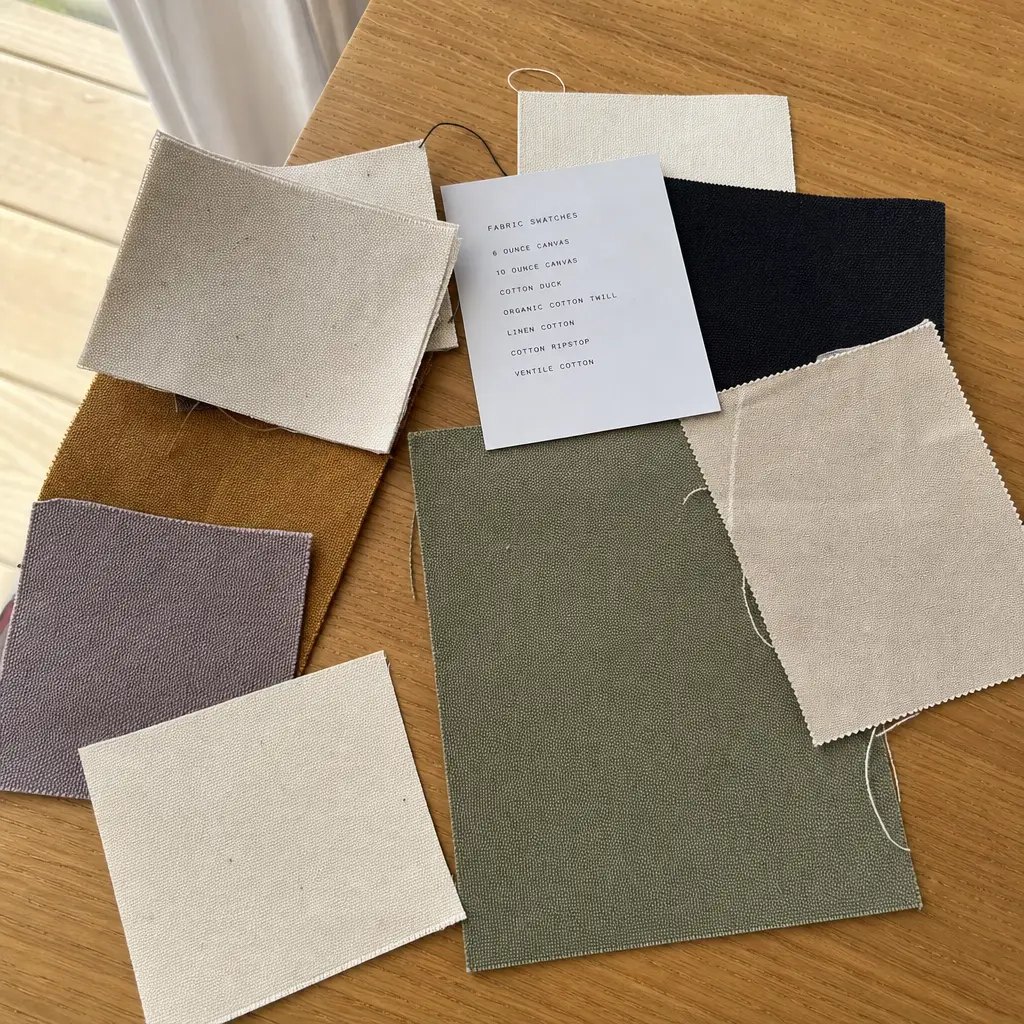
Canvas weight controls handfeel, structure, freight cost, and decoration performance. A 10 oz canvas can be suitable for cost-sensitive campus promotions, but it may feel soft for a zipper portfolio and can show interior pocket edges through the front panel. A 12 oz canvas is often the practical standard for bookstore retail because it gives better body without making corners too bulky. For premium programs, 14 oz or 16 oz canvas can work, but the factory must manage needle size, corner folding, zipper tape tension, and carton packing pressure.
In GSM terms, buyers often see canvas around 280-340 GSM for lighter construction, 340-407 GSM for 12 oz class goods, and 475 GSM or above for heavier canvas. Exact conversion varies by fabric structure and finishing, so the quote should state both the trade weight and measured GSM if possible. Natural cotton canvas may have shade variation and cotton seed flecks; this can look authentic, but it also affects print clarity on small logos.
- Screen print works well on 10-12 oz canvas when the fabric surface is tight and not too hairy.
- Embroidery needs enough fabric body to prevent puckering, especially on university seals or arched text.
- Heat transfer can reproduce detail, but buyers should test adhesion and handfeel on textured canvas.
- Woven patches hide fabric texture and give consistent logo detail, but add patch MOQ and sewing labor.
Set Practical Logo Size Rules
A logo that looks balanced on a tote bag may be too large on a zipper portfolio. The front panel is interrupted by zipper construction and the product is often viewed at desk distance, not from across a room. For a standard Letter or A4-sized portfolio, an 80-140 mm wide front logo is usually enough for campus recognition without turning the item into a giveaway piece.
University artwork often includes shields, fine lines, founding dates, small department names, or licensing marks. These details can close up in screen printing or embroidery. The buyer should provide vector artwork and request a factory comment on minimum line thickness, minimum letter height, and color separation before approving the production logo. If the logo has many colors, a single-color version may look cleaner on canvas and reduce print defects.
- Minimum small text height for screen print should usually be tested before bulk approval.
- Thin lines below the factory's stable print limit should be thickened or removed.
- Pantone references are better than RGB or web colors for quote and sample approval.
- Metallic inks and very opaque white ink may require additional passes or different costing.
Compare Decoration Methods By Risk
Screen printing is usually the best first option for canvas zipper portfolios because it is cost-efficient, durable enough for bookstore handling, and suitable for flat front panel decoration. It works especially well for one-color or two-color university logos. The buyer should still review print opacity, edge sharpness, and rubbing performance because canvas texture can break up fine artwork.
Embroidery, woven patches, and sewn labels can make the product feel more retail-grade, but they bring different production risks. Embroidery may pucker the panel if the canvas is too light or if the design is dense. Woven patches need separate development time and may have their own MOQ. Sewn labels look subtle, but they must be placed consistently and should not disappear into the side seam or look like a care label by mistake.
- Use screen print for clean marks, controlled budgets, and medium to large bookstore runs.
- Use embroidery when the buyer wants texture and the design has limited fine detail.
- Use woven patches for complex crests, multiple colors, and premium campus collections.
- Use side labels for minimalist retail positioning or when the front panel must stay plain.
Build The RFQ Around Real Cost Drivers
A useful RFQ does more than say canvas zipper portfolio with logo. The factory needs closed size, open size if relevant, canvas weight, lining or no lining, zipper type, internal pocket layout, logo method, number of colors, packing method, and target order quantity. Without these details, quotes may look attractive but hide differences in fabric weight, zipper quality, labor time, and packing.
MOQ logic also matters. A factory may accept 300 pieces for natural canvas with a one-color screen print because the fabric is available and setup is simple. Custom-dyed canvas, custom zipper pullers, printed lining, embroidery patches, or multiple SKU colors can push the practical MOQ to 500 or 1000 pieces. Buyers comparing quotes should separate the finished product MOQ from material and trim MOQs.
- List the order quantity by logo version, colorway, and delivery destination.
- State whether the quote should include sample cost, screen charge, patch mold, or artwork setup.
- Require the quote to show fabric weight, zipper type, decoration method, packing, and incoterm.
- Request carton size and gross weight early so air freight and warehouse costs are not guessed later.
Approve Samples With Measurable Criteria
The pre-production sample is where logo placement problems should be solved, not during final inspection. A buyer should review the sample as a production object: closed appearance, zipper path, print position, fabric stiffness, interior pocket usefulness, stitch quality, and packing recovery after folding. A sample that looks acceptable in a photo may still have a zipper that catches at the corner or a front logo that wrinkles when documents are inserted.
For logo placement, measure from fixed construction points such as the top edge, side edge, zipper seam, or bottom binding. Do not measure from a soft fold or from a corner that changes shape after packing. Record the approved measurement in millimeters and include tolerance. The approved sample should use the same canvas, decoration method, zipper, and internal structure as bulk production.
- Measure logo distance from two stable edges and photograph the ruler position.
- Open and close the zipper repeatedly, including around corners where resistance often appears.
- Insert the intended document or tablet size to test pocket fit and front panel distortion.
- Bend the printed area lightly to see whether ink cracks or loses coverage on canvas texture.
- Pack the sample as bulk will be packed, then check creasing across the logo after recovery.
Control Production Defects Before Inspection
Most defects on canvas zipper portfolios come from the same few areas: logo misalignment, uneven print opacity, zipper catching, loose thread, puckered corners, fabric shade variation, and crushed packing. A factory with experience in zipper business bags should be able to explain how it controls these issues during cutting, printing, sewing, and final packing.
Quality control should include both appearance and function. For bookstore buyers, the product must look good at retail and survive repeated handling before purchase. A portfolio with a beautiful logo but poor zipper action will create returns. A strong zipper with a crooked logo will not pass campus brand review. The acceptance criteria should be written into the purchase order or inspection instruction, not only discussed during sampling.
- Logo alignment: set tolerance before bulk, commonly plus or minus 3 mm for print and plus or minus 5 mm for patches.
- Print quality: reject visible smears, contamination, major pinholes, wrong color, ghosting, and poor curing.
- Sewing: reject skipped stitches, open seams, loose back-tacks, broken threads, and severe puckering.
- Zipper: test smooth opening, slider strength, end stop security, and corner resistance.
- Appearance: control canvas shade, stains, fold marks across the logo, and distorted panel shape.
Plan Packing For Bookstore Receiving
Packing is often treated as an afterthought, but it affects sellable condition and receiving efficiency. Canvas can absorb dust and moisture, and zipper portfolios can develop pressure marks if cartons are overfilled. For university bookstores and distributors, the packing plan should match how the goods will be received, counted, stored, and replenished.
Individual polybags protect the product but may conflict with sustainability preferences. A paper band, tissue wrap, or recycled polybag can be considered depending on the buyer's retail policy. If the goods need barcode labels, price stickers, hang tags, or SKU separation by logo version, those requirements should be in the RFQ. Carton labels should include PO number, SKU, item description, color, quantity, gross weight, net weight, carton number, and destination if needed.
- Avoid tight folding that creates a hard crease through the printed logo.
- Use moisture protection for sea freight, especially for natural cotton canvas.
- Limit carton weight to a practical handling range for bookstore warehouses.
- Separate mixed logo versions clearly so receiving teams do not open every carton to identify stock.
- Confirm whether retail hang tags, barcode labels, or inner carton labels are included in the unit price.
Protect The Schedule Around Artwork And Trim
Lead time for canvas zipper portfolios depends on material availability, logo approval, trim sourcing, sample revisions, and packing requirements. A straightforward natural canvas portfolio with one-color print can move faster than a custom-dyed, embroidered, patch-labeled version with special zipper pullers. Buyers should avoid treating all decoration methods as equal on schedule.
A realistic timeline separates artwork proofing, material confirmation, sample production, sample transit, buyer review, bulk material preparation, cutting, printing, sewing, inspection, and packing. The clock should start from the point the factory actually has approved artwork, approved sample, deposit, and confirmed materials. For bookstore launches tied to semester start, orientation week, or graduation, missed approval dates can be more damaging than a slightly higher unit cost.
- Build extra review time for university licensing or brand office approval.
- Freeze logo placement before bulk fabric is cut or front panels are printed.
- Treat custom dyed fabric, custom patches, and branded zipper pullers as schedule risk items.
- Approve carton marks and barcode data before packing materials are printed.
- Keep a written change log when artwork, placement, fabric, or packing changes after sampling.
Specification comparison for buyers
| Spec decision | Recommended option | When it fits | Buyer risk to check |
|---|---|---|---|
| Front panel logo position | Lower right or centered upper third, kept 25-35 mm away from zipper seam and edge binding | Best for university bookstore retail where the logo must be visible on shelf and during campus use | Logo may distort if placed too close to seams, curved corners, zipper tape, or folded construction lines |
| Fabric weight | 12 oz canvas for standard retail; 14-16 oz canvas for premium portfolios | 12 oz balances cost and shape; heavier canvas supports embroidery and a more structured handfeel | Very heavy canvas can increase sewing difficulty, freight weight, and corner bulk near the zipper |
| Decoration method | Screen print for 1-3 color logos; embroidery or woven patch for premium bookstore programs | Screen print fits most college marks and larger seasonal orders; patches suit heritage or alumni designs | Fine university seals, small text, and gradients may fail unless artwork is simplified before sampling |
| Logo size | 80-140 mm wide for front panel logos, adjusted to panel size and viewing distance | Works for bookstore shelves, orientation kits, and graduation gift sets without overpowering the product | Oversized logos can look promotional instead of retail-grade and may crack on folded or stressed areas |
| Zipper specification | Nylon coil zipper with smooth puller, color matched or contrast branded | Good for daily bookstore handling, lower noise, and easier sewing into canvas panels | Low-grade zipper sliders can snag on canvas dust or fail during repeated opening tests |
| Interior layout | Document sleeve plus pen loop, optional card pocket if budget allows | Useful for student orientation, faculty gifts, conference stores, and campus bookstore bundles | Too many internal pockets raise labor cost and create uneven print pressure on the front panel |
| MOQ logic | 300-500 pieces for simple screen print; 500-1000 pieces for dyed fabric, embroidery, or custom trims | Allows factory setup costs, logo screens, cutting markers, and trim purchasing to be spread properly | Very small orders may carry high setup charges or force the buyer into available stock fabric only |
| Retail packing | Individual polybag or paper band plus carton with moisture protection and barcode label option | Suitable for bookstore receiving, storage, and direct shelf replenishment | Overpacked portfolios waste carton space; underpacked canvas can absorb moisture or dust in transit |
Buyer checklist before sampling
- Define the final product use: bookstore retail, orientation kit, alumni gift, faculty conference, or graduation bundle.
- Confirm portfolio closed size, document capacity, gusset depth, zipper path, and whether it must hold A4, Letter, or tablet-sized inserts.
- Select canvas weight by handling expectation: 10 oz for cost-sensitive programs, 12 oz for standard retail, 14-16 oz for premium structured goods.
- Mark the logo placement on a flat technical drawing, not only on a lifestyle image.
- Keep front logo artwork away from zipper tape, rounded corners, binding, stitch lines, and folded pressure points.
- Specify logo method, Pantone colors, artwork file type, maximum print size, and approval standard for small text.
- Request a pre-production sample using actual canvas weight, actual zipper, actual logo method, and intended logo position.
- Review zipper smoothness, corner sewing, logo alignment, print opacity, stitch density, inner pocket dimensions, and edge binding tension.
- Require carton marks, barcode or SKU labels if needed, inner packing method, carton size, carton weight, and moisture-control plan in the quote.
- Compare supplier quotes using the same fabric weight, logo method, packing terms, incoterm, sample cost, tooling charge, and lead time assumptions.
Factory quote questions to send
- What canvas weight and composition are included in the quote, and is the weight stated in oz or GSM?
- Is the price based on natural canvas, dyed canvas, washed canvas, or laminated canvas?
- What is the maximum printable area on the front panel after seam allowance and zipper construction?
- Can the factory provide a placement drawing showing distance from top edge, side edge, zipper seam, and bottom binding?
- Which decoration method is included: screen print, heat transfer, embroidery, woven patch, leather patch, or sewn label?
- How many print colors are included, and what is the charge for each additional color or screen?
- What zipper brand or grade is quoted, and has it been tested on canvas portfolios of similar thickness?
- What MOQ applies to the finished product, and what separate MOQ applies to custom-dyed fabric, custom zipper pullers, patches, or printed lining?
- What sample stages are offered: artwork proof, material swatch, proto sample, salesman sample, and pre-production sample?
- What are the carton dimensions, gross weight, pieces per carton, and recommended loading quantity for sea or air shipment?
Quality-control points to confirm
- Logo placement tolerance should normally be within plus or minus 3 mm for screen print and plus or minus 5 mm for sewn patches unless the design needs tighter control.
- Front panel print should show even opacity with no pinholes, obvious smears, ghosting, color contamination, or cracking after light bending.
- Zipper must open and close smoothly for repeated cycles without catching at corners, separating at the end stop, or pulling loose from the seam.
- Stitching should be straight at visible edges, with no skipped stitches, broken thread, loose back-tacking, or puckering around zipper tape.
- Canvas shade should match the approved swatch within the agreed tolerance, especially for natural canvas where batch variation is common.
- Portfolio must lie acceptably flat after packing, with no crushed corners, severe creasing across the logo, or warped front panel.
- Interior pockets should match approved dimensions and hold intended documents without tight insertion, tearing, or excessive sagging.
- Carton labels should match PO, SKU, color, logo version, quantity, gross weight, net weight, and destination requirements.