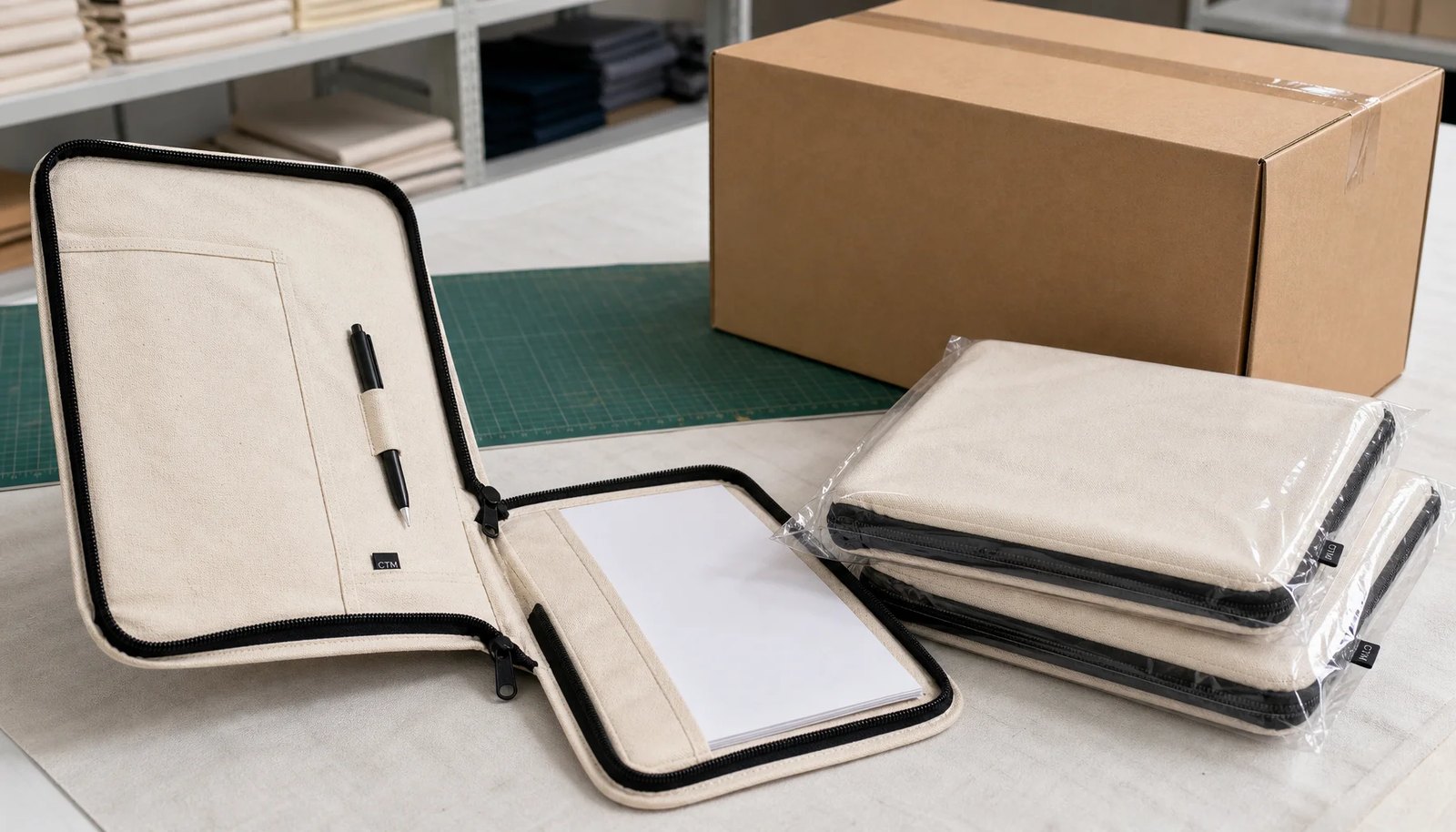
Buying Problem: The Portfolio Is Flat, But the Carton Risk Is Not
Wholesale canvas zipper portfolios for university bookstores look simple in a product photo, but carton planning can decide whether the shipment arrives saleable or becomes a receiving problem. A flat canvas product is easy to overpack because each piece feels light, yet a full carton of dense canvas, zipper pulls, and printed panels can become heavy enough to crush corners, mark prints, or fail warehouse handling rules.
For bookstore buyers, the practical issue is not only unit price. The order may arrive before orientation week, graduation events, homecoming, alumni campaigns, or department kit assembly. If cartons are too large, too heavy, poorly marked, or packed with the print face rubbing zipper pulls, the receiving team spends time sorting defects instead of putting merchandise on shelves.
- Use carton planning as part of the RFQ, not as a final packing detail after production.
- Compare quotes by CBM, gross weight, and pieces per carton, not only by unit price.
- Treat retail packing, barcode placement, and carton marks as production specs with tolerances.
- Require the supplier to quote from the approved packed structure, because changing carton quantity later changes freight and damage risk.
Portfolio Size Starts With the Contents, Not the Outer Dimension
The first specification mistake is giving only an outside size such as 13 x 10 inches or 34 x 25 cm. That number does not tell the factory whether the product must hold US letter paper, A4 documents, a spiral notebook, a tablet, admissions materials, or a bookstore gift set. A zipper portfolio loses usable space to seam allowance, zipper tape, corner sewing, and fabric thickness.
For university bookstore programs, the safest RFQ states both finished outer size and usable inner opening. If the product must hold US letter documents, allow clearance beyond 8.5 x 11 inches. If it must hold A4 papers, the pattern needs different proportions. If the buyer plans to insert a notebook or course packet before retail sale, the gusset, zipper curve, and carton height must be planned around the filled thickness.
- For flat document use, specify usable inner space, not only finished outer dimensions.
- For inserted kits, provide the thickness and weight of the inserted item before carton planning.
- For tablet-friendly portfolios, define device size plus protective clearance and zipper opening width.
- For retail shelf display, define whether the item hangs, stacks flat, or ships directly to campus departments.
Canvas Weight and Structure Affect Carton Cube
Canvas weight is usually quoted in ounces per square yard, but many factories also use GSM. A practical range for canvas zipper portfolios is often 10oz to 12oz, roughly 280-340 GSM depending on construction. This range gives the portfolio enough body for retail handling without making the seams too bulky at the zipper. A lighter 8oz canvas may reduce cost and carton weight, but it can feel weak for a bookstore product positioned as a reusable campus item.
A heavier 14oz or 16oz canvas can look premium, but it changes sewing behavior and packing density. Thick fabric at the corners can make the zipper wave, increase needle holes, and create pressure marks when stacked. If the product includes lining, foam padding, inner pockets, or binding tape, the carton count should be recalculated from a packed sample rather than estimated from the flat fabric area.
- 10oz canvas: useful for budget programs, large quantity giveaways, and lightweight freight targets.
- 12oz canvas: stronger retail feel and common for bookstore merchandise with screen print branding.
- 14oz or heavier canvas: better hand feel, but more seam bulk, higher freight cost, and slower sewing.
- Lined portfolios: cleaner interior and better structure, but increased unit thickness and carton CBM.
Zipper and Sewing Details That Influence Packing Damage
The zipper is a functional part and a packing risk. A #5 nylon coil zipper is usually a good standard for canvas business bags and portfolios because it is smooth, flexible, and less abrasive than large metal teeth. Metal zippers can be used for a more premium look, but they add weight and can mark the printed face of the next piece if the packing direction is wrong.
Sewing details around the zipper ends matter because this is where customers pull hardest and where stacked pressure concentrates. Fabric zipper tabs, reinforced bar tacks, and controlled corner radius help the item stay flat. If the zipper is too close to the edge, the seam may curl. If the zipper puller is oversized, cartons need more air space or protective separation to avoid dents and print marks.
- Specify zipper size, tape color, puller type, pull direction, and whether the puller can be logo engraved.
- Require zipper opening tests on filled samples if the portfolio will hold documents or kits.
- Use tissue, paper sleeve, or alternating pack direction when zipper pullers contact printed panels.
- Reject bulk samples where zipper ends twist, because this problem normally becomes worse after carton compression.
Print Method Selection for Campus Bookstore Graphics
Most university bookstore portfolios use screen printing because campus logos, department marks, and event graphics often have solid colors. Screen print works well on 10oz to 12oz canvas when the artwork is not too fine and the ink is properly cured. The buyer should provide Pantone references, print size, placement from edges, and whether the print sits on natural canvas, dyed canvas, or washed canvas.
Digital print can work for complex artwork or small design batches, but it may not match the hand feel or cost efficiency of screen print for large runs. Embroidery is possible, but on a flat zipper portfolio it can distort fabric unless backed correctly. Woven labels and sewn side tabs are often better for premium branding where the bookstore wants a subtle CTM-style or campus label rather than a large front print.
- Screen print: best for solid logos, repeat bookstore designs, and controlled unit cost.
- Heat transfer: useful for detailed graphics, but test adhesion and hand feel on canvas.
- Embroidery: premium effect, but confirm backing, puckering, and carton pressure on stitches.
- Woven label: good for small branding and avoids large ink areas that may rub in cartons.
- Print placement tolerance should be written, for example plus or minus 5 mm from approved position.
Carton Planning: Quantity, Weight, CBM, and Handling Rules
A common carton plan for flat canvas zipper portfolios is 25 to 50 pieces per master carton, but the right number depends on size, fabric weight, zipper puller, packing sleeve, and whether the pieces are inserted with retail materials. The target is a carton that stays square, does not exceed the buyer's warehouse weight limits, and does not crush product corners. For many retail import programs, keeping cartons manageable is more important than forcing the lowest possible CBM.
The RFQ should request carton dimensions, pieces per carton, net weight, gross weight, and total CBM for the order quantity. This data allows the buyer to compare landed cost across suppliers. A supplier with a slightly lower unit price may create a higher landed cost if their carton count, carton cube, or damage rate is poor. Carton board should also be specified; a 5-ply export carton is usually safer for sea freight and multi-touch warehouse routes than a weak carton designed only for local delivery.
- Set a maximum gross weight per carton that matches the receiving warehouse rule, often around 12-18 kg depending on the buyer.
- Avoid cartons that are very long and shallow if they bend during pallet handling.
- Use packed sample measurements to calculate CBM, not only CAD size or fabric consumption.
- Require carton marks with item number, purchase order, color, quantity, carton number, gross weight, net weight, and destination if needed.
- For mixed campus designs, separate cartons by SKU unless the buyer has approved mixed carton packing.
MOQ Logic and Cost Drivers Behind the Quote
MOQ for canvas zipper portfolios is controlled by fabric purchase, zipper color, print setup, cutting efficiency, and packing material. For standard natural canvas and common zipper colors, factories can often support lower quantities than custom dyed canvas. A realistic MOQ range may start around 500 to 1,000 pieces per color or print design, but the unit price changes quickly when artwork, zipper color, labels, or inner structures vary.
Buyers should not compare quotes unless the same cost drivers are included. One supplier may include individual polybags, UPC labels, 5-ply cartons, and print setup in the unit price. Another may quote only the sewn product and add packing, label application, and carton upgrades later. For bookstore orders, hidden packing costs matter because receiving accuracy and retail readiness are part of the product value.
- Fabric cost: affected by canvas weight, bleaching, dyeing, shrinkage control, and order quantity.
- Zipper cost: affected by coil size, metal puller, custom puller, color matching, and minimum zipper purchase.
- Print cost: affected by number of colors, print size, screen setup, curing time, and reject risk on dark fabric.
- Labor cost: affected by lining, pockets, binding, zipper curve, reinforced corners, and inspection requirements.
- Packing cost: affected by individual bags, paper sleeves, barcode stickers, carton grade, and mixed SKU sorting.
Sample Approval Should Include a Packed Unit
A loose approval sample can look fine on a desk but fail once packed 40 pieces per carton. The buyer should approve a pre-production sample that includes the final fabric, zipper, print, label, and unit packing. If the final order uses a paper belly band, barcode sticker, warning label, or printed insert card, those items should appear on the sample or at least be verified through a packing mockup before bulk production.
For university bookstore buyers, sample checks should be written as acceptance criteria rather than general comments. The sample either holds the required document size or it does not. The zipper either runs smoothly when filled or it catches. The print either matches the approved Pantone range and placement tolerance or it needs correction. This prevents subjective approvals that cause disputes during final inspection.
- Measure finished outer size and usable inner opening on the sample.
- Insert the intended document, notebook, or retail kit and test zipper movement.
- Rub the print with a dry white cloth to check obvious transfer before approving.
- Stack packed samples under weight for a short simulation to see whether zipper pulls mark the print.
- Photograph the approved packing layout so bulk packers follow the same direction and quantity.
Inspection Thresholds for Retail-Ready Bookstore Goods
AQL inspection for canvas zipper portfolios should combine textile appearance checks with functional and packing checks. Appearance defects include stains, oil marks, weaving defects, broken stitches, loose threads, print smears, and inconsistent color. Functional defects include zipper failure, blocked opening, weak zipper end, incorrect inner size, or sharp puller edges. Packing defects include wrong barcode, mixed SKU cartons, damaged cartons, incorrect quantity, or missing carton marks.
The buyer should define major and minor defects before production starts. A zipper that fails is a major defect because the item cannot be sold as intended. A small loose thread may be minor if it can be trimmed and does not affect appearance. A wrong university logo, wrong print color, or wrong barcode should be treated as a serious defect because it creates retail and licensing risk.
- Measurement tolerance: define by product size, often plus or minus 5 mm for common portfolio dimensions.
- Print placement: define distance from top and side edges, with tolerance written on the artwork sheet.
- Zipper test: open and close a sampled quantity multiple times and test with contents inserted.
- Stitching: require secure zipper ends, no skipped stitches at corners, and no loose seam openings.
- Carton inspection: verify carton count, carton strength, marks, labels, gross weight, and visible compression.
Lead Time and Schedule Risk for Campus Retail Calendars
University bookstore timelines are often fixed by academic calendars, not by factory convenience. Orientation, welcome week, commencement, alumni weekends, and department events do not move because a zipper delivery is late. A practical schedule includes artwork confirmation, sample making, sample shipping, sample approval, material booking, cutting, printing, sewing, final inspection, packing, export documentation, and shipping.
The highest schedule risks are late artwork approval, custom dyed canvas, zipper color matching, print correction, and carton label changes after packing has started. If the buyer needs multiple campus logos or department versions, the production plan should show whether those SKUs run together or separately. Separate SKU packing reduces receiving confusion but increases handling time, carton mark control, and inspection workload.
- Sample development commonly needs several working days after artwork and spec confirmation, plus transit time.
- Bulk production should not start until fabric, zipper, print method, label, and packing are approved together.
- Custom dyed canvas or custom zipper tape can add material lead time and shade approval risk.
- Final inspection should be scheduled before the vessel cutoff, not on the same day as cargo loading.
- Bookstore receiving labels should be finalized before packing, because relabeling cartons is slow and error-prone.
Specification comparison for buyers
| Spec decision | Recommended option | When it fits | Buyer risk to check |
|---|---|---|---|
| Canvas body weight | 10oz to 12oz cotton canvas, about 280-340 GSM | Good balance for bookstore retail: firm enough for notebooks, light enough for carton efficiency | Very heavy 16oz canvas raises freight cost and can create thick zipper seams unless the pattern is adjusted |
| Portfolio format | A4 or US letter document size with 20-30 mm tolerance around contents | Fits course packets, admissions folders, orientation documents, and branded stationery | If the buyer only gives outer size, the factory may not protect the usable inside opening after seam allowance |
| Closure system | Nylon coil zipper with metal or molded puller, #5 size for most portfolios | Smooth opening for retail customers and less carton snagging than oversized metal teeth | Cheap zipper tape may wave after sewing; test opening on filled samples, not empty samples only |
| Branding method | Screen print for solid campus graphics; woven label or side tab for premium small branding | Works for bookstore logo programs, alumni merchandise, and department bundles | Large ink areas on natural canvas can crack if the print is too thick or cured poorly |
| Packing style | Flat packed one piece per polybag or paper sleeve, 25-50 pieces per export carton | Best for shelf-ready receiving and stable carton cube planning | Overstuffed cartons bend corners and cause zipper pressure marks during sea freight |
| Carton board | 5-ply export carton for sea freight, 44-48 cm maximum loaded side where possible | Useful when portfolios are stacked flat and cartons are handled through multiple warehouses | Thin cartons may collapse because flat portfolios concentrate weight on corners and zipper pulls |
| MOQ structure | 500-1,000 pcs per color/print for standard canvas and standard zipper colors | Matches most university bookstore seasonal buys without forcing unnecessary inventory | Low MOQ quotes may hide higher unit packing cost or use available canvas lots with shade variation |
| Inspection focus | AQL inspection with functional zipper test, print rub test, measurement check, and carton drop observation | Appropriate for retail merchandise that must arrive saleable, not only technically sewn | A generic textile inspection misses carton compression, barcodes, carton marks, and retail packaging accuracy |
Buyer checklist before sampling
- Define whether the portfolio must hold A4, US letter, tablets, spiral notebooks, or course packets before approving the outer size.
- State canvas weight in oz and GSM, and require the supplier to declare whether fabric is greige, dyed, washed, or treated after printing.
- Confirm zipper size, zipper color, puller type, puller orientation, and whether zipper ends are reinforced with fabric tabs.
- Provide print artwork size, Pantone references, print placement tolerance, and whether print must pass dry rub and tape pull tests.
- Specify unit packing method, polybag or paper sleeve thickness, warning label needs, barcode placement, and master carton quantity.
- Request carton dimensions, gross weight, net weight, carton board grade, and CBM per carton before comparing supplier quotes.
- Approve a pre-production sample packed in the same way as bulk goods, not only a loose sample from the sewing line.
- Build the delivery plan backward from bookstore receiving windows, including artwork approval, material booking, production, inspection, and vessel cutoff.
Factory quote questions to send
- What canvas weight in oz and GSM is included in the quote, and is the fabric stock fabric or custom dyed fabric?
- What is the exact finished outer size, usable inner document size, seam allowance, and measurement tolerance?
- Which zipper specification is included: coil or metal, size number, tape color, puller material, and puller logo option?
- How many colors and how large is the print area included, and what print method is recommended for the artwork?
- What is the MOQ per color, per print design, and per zipper color, and what cost changes occur at 500, 1,000, 2,000, and 5,000 pcs?
- How will each piece be packed, how many pieces go into one master carton, and what are the estimated carton size, gross weight, and CBM?
- Can the supplier provide a packed sample or packing simulation with carton stack photos before bulk packing starts?
- What lead time applies for sample, material booking, bulk production, inspection, and shipping document preparation?
- Which quality checks are performed in-line and before shipment, and what acceptance standard is used for zipper function, print position, stains, and carton damage?
- Are carton marks, inner labels, UPC stickers, retail hangtags, or bookstore receiving labels included in the quoted unit price?
Quality-control points to confirm
- Canvas weight should match the approved swatch within a realistic mill tolerance, and fabric shade should be consistent across cut panels.
- Finished size should remain within the agreed tolerance after sewing, especially at zipper opening, corner radius, and document insertion depth.
- Zipper must open and close smoothly for repeated cycles without catching canvas seam bulk or twisting at the ends.
- Print must align to the approved placement guide and should not crack, smear, or transfer under normal dry rubbing.
- Corners should be square or consistently rounded, with reinforced stitching where the zipper starts and stops.
- Loose threads, oil marks, needle holes, puckering, and visible fabric defects should be classified clearly before inspection.
- Unit packing should protect print face and zipper pullers from abrasion during carton stacking.
- Master cartons should meet the approved dimensions and weight limits, with clear carton marks and scannable labels where required.