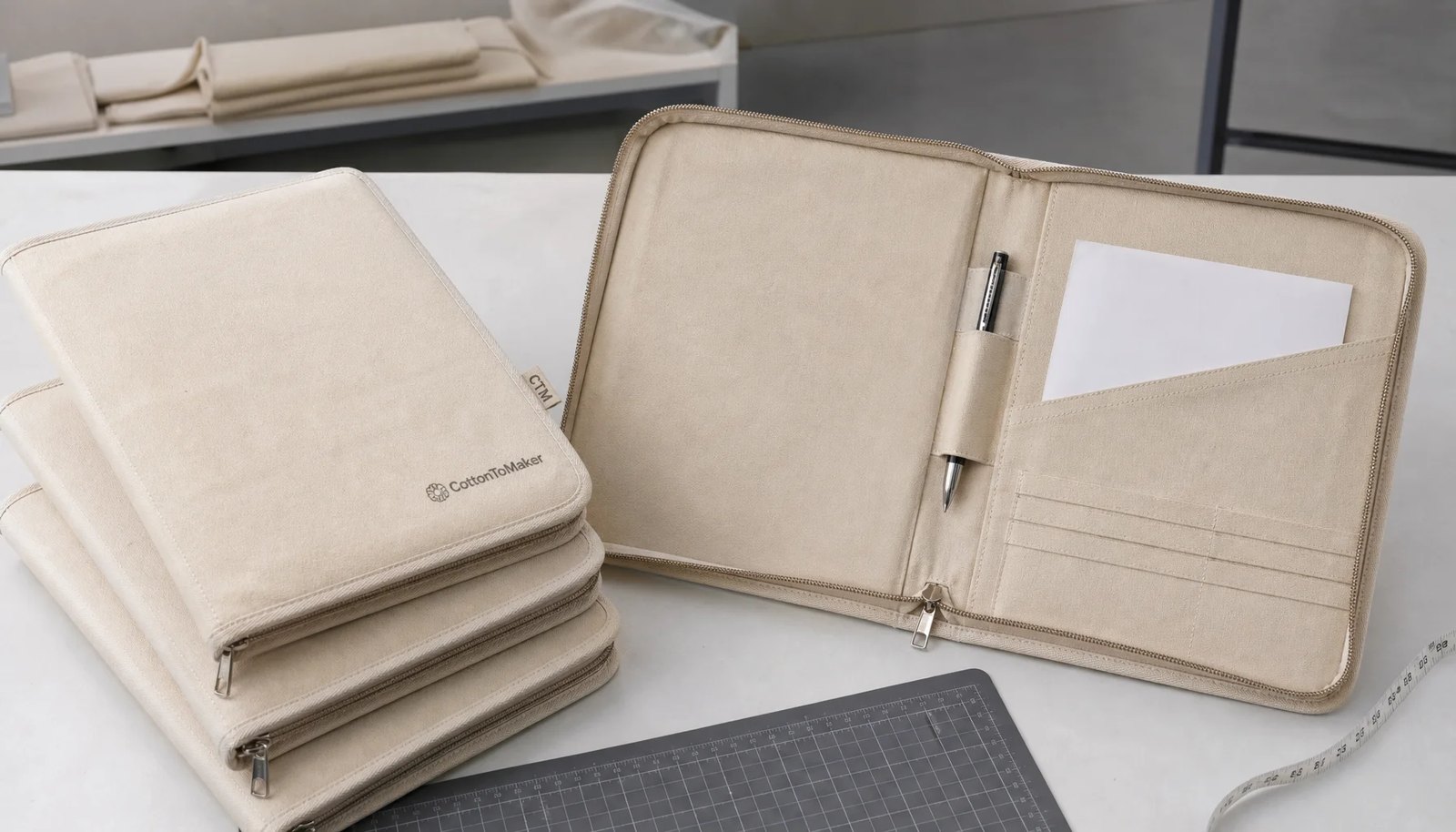
Start With the Campus Use Case
A useful canvas zipper portfolios for university bookstores bulk pricing plan starts with the job the product has to do. A portfolio sold on a bookstore shelf is judged differently from one handed out at orientation or packed into an admissions kit. Retail buyers care about shelf presentation, barcode accuracy, clean branding, and repeatable quality. Event teams may care more about delivery date, department sorting, and a construction that survives a busy week of use.
The phrase "canvas zipper portfolio" is too broad for a reliable quote. One factory may assume a lightweight canvas, top zipper, one-color print, and bulk packing. Another may include a heavier canvas, three-side zipper, hangtag, barcode label, and reinforced corners. Both can be honest quotes, but they are not comparable products. Procurement should remove that ambiguity before collecting prices.
University programs also run on fixed calendars. Orientation, semester launch, admissions mailings, alumni weekend, graduation, and department conferences rarely move because samples arrive late. Work backward from the required campus receiving date, then include time for artwork approval, swatches, pre-production samples, bulk production, inspection, freight, customs, and bookstore check-in.
If stakeholders are still debating budget and finish level, do not force one vague RFQ. Ask suppliers to quote economy, standard, and premium options as separate lines. That keeps trade-offs visible: lighter canvas versus heavier canvas, top zipper versus L-shaped zipper, screen print versus woven label, and bulk packing versus retail-ready packing.
- Define the channel first: resale, orientation kit, admissions packet, alumni gift, department merchandise, certificate folder, or internal giveaway.
- List the required campus receiving date and the earlier date needed for bookstore shelf setup or event packing.
- Use separate RFQ lines for economy, standard, and premium constructions instead of blending them into one request.
- Require every supplier to quote from the same master specification and call out any deviation in writing.
Translate Fit Into Dimensions
Size errors often begin with casual language. "Letter size" can mean the paper size, the finished outside size, or an existing factory pattern that only roughly fits letter paper. The same problem appears with A4, certificates, notebooks, and tablets. A procurement spec should state the finished outside dimensions and the usable document opening, not only the document name.
US letter paper measures 216 x 279 mm. A4 paper measures 210 x 297 mm. A portfolio needs clearance beyond those dimensions so documents slide in without curling and the zipper can close without pulling at the corners. Where the design allows easy insertion, 10-15 mm clearance is a practical starting point. If the portfolio must hold a notebook, tablet in a slim case, certificate folder, or course packet, send the actual maximum content size and thickness.
The zipper route has a direct cost and usability impact. A top zipper keeps the product simple and economical, which can fit giveaways or low-price bookstore items. An L-shaped or three-side zipper gives better access and feels more like a true portfolio, but it uses longer zipper tape and requires cleaner sewing around corners. A gusset increases capacity, yet it also adds material, bulk, carton volume, and more places for size variation.
Small pattern details matter. Corner radius, sleeve depth, seam allowance, zipper end placement, pocket position, and flat-stacking requirements should be settled before artwork placement is approved. Otherwise, a logo that looks centered on a blank panel may shift once pockets, zipper tape, or gussets are corrected.
- State finished outside dimensions, usable opening, and required clearance in millimeters.
- Confirm the contents: US letter, A4, certificates, tablets in cases, notebooks, course packets, or mixed documents.
- Choose top zipper for cost control and three-side access for a more premium user experience.
- Define gusset depth, corner radius, seam allowance, sleeve depth, and flat-stacking needs before sampling.
Select Canvas by Standard, Not Guesswork
Canvas weight changes the feel, structure, sewing speed, carton weight, and freight cost. For a budget giveaway or short event, 12 oz cotton canvas may be acceptable. For a bookstore retail SKU, 14 oz cotton canvas is often the safer middle ground because it feels more substantial while still sewing cleanly. Depending on weave and finish, 14 oz canvas is commonly around 450-500 GSM. A 16 oz option can feel more premium, but it may create bulky corners, require heavier needles, slow production, and increase shipping weight.
Ask for both ounces and approximate GSM. Mills, finishes, and supplier conventions can vary, and a number alone does not tell you how the material behaves. A roll swatch tells a better story: hand feel, stiffness, weave density, natural specks, shade range, and whether the canvas looks polished enough for bookstore retail.
Natural canvas needs an approval standard. Small cotton seed specks and slight shade variation may be acceptable if they match the approved swatch. Oil stains, mildew odor, weaving holes, watermarks, dark contamination, heavy slubs, and mismatched panels should not be dismissed as natural character. Put those distinctions into the QC notes before bulk cutting.
Custom university colors require more time. Pantone references help, but cotton canvas does not absorb dye like coated paper, plastic, or a screen display. If the shade must be close to a licensed brand color, plan for lab dips, dye-lot minimums, and physical shade-band approval. Approving the fabric first also prevents wasted logo samples on a base color that later changes.
- Use 12 oz for economy programs, 14 oz for standard retail, and 16 oz only after checking sewing bulk and freight impact.
- Approve roll swatches for color, weight, hand feel, weave, stiffness, and acceptable natural cotton specks.
- Define unacceptable defects: oil, mildew, holes, dark stains, watermarks, heavy slubs, and mismatched panels.
- Treat custom dyed canvas as a separate MOQ, lab-dip, lead-time, and shade-approval decision.
Make the Zipper Feel Reliable
The zipper is the part students, staff, and customers touch every time. If it catches, waves, or separates, the whole portfolio feels cheap no matter how good the canvas looks. For most canvas portfolio programs, a No.5 nylon coil zipper is a practical default. It runs smoothly, handles gentle curves well, and is easier to sew into canvas than many rigid zipper options.
The RFQ should spell out zipper size, tape color, tape width if relevant, slider material, puller material, puller shape, puller finish, zipper length, end stops, and end reinforcement. A custom zipper puller can be attractive for university branding, but it usually adds setup cost, MOQ, approval time, and another inspection point. Do not let a custom puller appear as an informal free upgrade unless the supplier confirms it in writing.
Sample review should be physical, not visual only. Open and close the zipper several times from end to end. Move slowly around corners. Check whether the slider catches canvas, lining, seam allowance, loose threads, or zipper tape. Look for wavy tape, weak stops, detached pullers, uneven corners, and any area where the zipper is under stress when documents are inserted.
Thread and seam construction deserve the same care. Polyester thread is commonly used for strength and color stability. For medium-heavy canvas, 7-9 stitches per inch is a useful target, although the factory should confirm the best setting for its machine, needle, canvas, and seam thickness. Reinforcement should be visible at zipper ends, corners, sleeve openings, pen loops, card pockets, and pull points.
- Specify No.5 nylon coil zipper unless another zipper type is intentionally selected and tested.
- Lock tape color, slider material, puller style, zipper length, end stops, and zipper-end reinforcement.
- Confirm polyester thread, seam allowance, needle suitability, and a stitch density target such as 7-9 stitches per inch.
- Mark zipper ends, corners, sleeve openings, pen loops, and pocket openings as required reinforcement points.
Build Price Breaks That Mean Something
Bulk pricing is useful only when every quantity is priced on the same product. Ask for 300, 500, 1000, 3000, and 5000 pieces using the same dimensions, canvas weight, zipper grade, logo method, packing, payment terms, Incoterm, and QC standard. That shows where the real price curve changes as setup cost spreads, fabric roll utilization improves, cutting becomes more efficient, or sewing-line planning gets easier.
MOQ is not always set by the sewing line. Stock natural canvas and standard zipper tape may support smaller trial orders. Custom dyed fabric, custom zipper tape, branded pullers, woven labels, special lining, embroidery, patches, gussets, and individual retail packing may each have their own minimum. Ask which component controls the MOQ so procurement can decide whether a feature is worth the jump.
A large price drop is not automatically good news. It may be legitimate, especially if the quantity reaches a full fabric roll or improves production efficiency. It may also mean the supplier quietly changed a key assumption: 14 oz canvas became 12 oz, individual packing became bulk packing, logo size shrank, zipper length shortened, barcode labeling disappeared, or inspection support moved outside the unit price.
Campus consolidation can help when several departments need similar merchandise. One base portfolio can use the same canvas, zipper, interior layout, and packing while artwork or carton labels change by department. That can improve order efficiency, but each logo version may still require separate screens, approval files, QC checks, and packing separation. Price those controls directly.
- Request 300, 500, 1000, 3000, and 5000 pc breaks on one unchanged specification.
- Ask which MOQ is controlled by fabric, zipper, puller, label, logo method, lining, pocket layout, or packing.
- Require lower-cost alternatives to appear as separate specs, not hidden substitutions inside the main quote.
- Price multi-department artwork, barcode labeling, carton marks, and packing separation as controlled production work.
Use a Quote Sheet Finance Can Audit
A clean quote sheet saves time after the first price comparison. A line that says "canvas folder with logo" does not tell procurement whether the supplier included 14 oz canvas, No.5 zipper, one-color screen print, retail packing, barcode labels, or FOB terms. It also creates a weak basis for reorders because the next production run may not match the first one.
Separate the quote into specification, cost, logistics, and commercial terms. Specification fields should include finished size, usable opening, fabric weight, canvas color, lining, pocket layout, zipper, puller, thread, logo method, logo size, label, hangtag, barcode, and packing. Cost fields should show the unit price separately from sample fees, screen charges, artwork adjustment, label setup, puller tooling, lab dips, testing, packaging upgrades, inland freight, export handling, and inspection support.
Logistics data is not optional. Canvas portfolios are flat, but carton weight and volume still affect freight cost and campus receiving. Ask for pieces per carton, carton dimensions, gross weight, net weight, CBM, FOB port, production lead time after sample approval, and quote validity. If a bookstore has carton weight limits or pallet requirements, add them before the quote is finalized.
Commercial terms decide how much control the buyer has before shipment. State payment schedule, sample approval process, revision rules, inspection timing, defect remedy, reorder basis, cancellation rules, and who pays for corrections if bulk goods do not match the approved sample. These details reduce conflict because the standard is agreed before production begins.
- Include spec fields for size, fabric, zipper, thread, pockets, logo, labels, hangtags, barcode, and packing.
- Separate unit price from samples, setup, tooling, lab dips, testing, packaging upgrades, inland freight, and inspection support.
- Request carton quantity, carton size, gross weight, net weight, CBM, port, lead time, and quote validity.
- State payment terms, sample approval, revision process, inspection timing, defect remedy, and reorder basis.
Control University Branding Early
University branding can involve more stakeholders than the product itself. A bookstore buyer may need approval from licensing, athletics, admissions, alumni relations, or a department office. Confirm who owns the artwork, who approves the logo, and who signs off on placement before the supplier begins sampling. Late artwork decisions are one of the easiest ways to lose production time.
Screen printing is usually the most practical branding method for cotton canvas portfolios with one to three solid colors. Provide vector artwork, Pantone references, approved logo size, placement from edges, and print orientation. Canvas texture affects edge sharpness, and large solid ink areas can feel stiff or show cracking if ink and curing are not controlled. A logo strike-off lets the buyer check color, coverage, registration, curing, and dry rub performance before bulk production.
Embroidery, woven labels, patches, debossed leatherette patches, and custom zipper pullers can make the portfolio feel more premium. Each one also adds decisions. Embroidery can pucker a flat panel if stitch count is high or backing is weak. Woven labels may require a separate MOQ. Patches need material approval and edge-quality checks. Custom pullers need tooling, finish approval, and pull-strength review.
For pricing clarity, quote branding as a menu. The base option might include one-color screen print at a defined size. Upgrades can show two-color print, woven label, embroidery, patch, or custom puller. This gives university buyers a clear budget ladder while keeping the same canvas, zipper, size, and interior construction.
- Provide vector artwork, Pantone references, logo size, placement dimensions, and the brand approval owner.
- Use screen print for cost-controlled bookstore merchandise with one to three solid colors.
- Review embroidery stitch count, backing, and pucker risk before approving it on a flat panel.
- Quote labels, patches, and custom pullers as separate options with their own MOQ, setup cost, and sample time.
Approve Samples in Stages
A sample protects the buyer only when it represents bulk production. A concept sample made with substitute canvas, temporary zipper tape, or a different logo process can help a team choose a direction, but it should not release bulk cutting. The sealed pre-production sample should use final fabric, zipper, puller, thread, logo method, interior layout, label, hangtag, barcode, and packing.
Staged approval reduces rework. Start with fabric swatches when shade, hand feel, stiffness, and natural specks matter. Use a blank construction sample to confirm finished size, usable opening, zipper route, gusset, sleeve depth, pockets, pen loop, and flat stacking. Use a logo strike-off for print color, placement, curing, ink coverage, embroidery behavior, label quality, or patch finish. Use a packing sample for bag size, paper band, hangtag, barcode position, carton stack, and carton marks.
Review the sample the way the end user will use it. Insert the specified contents: US letter sheets, A4 paper, certificate folder, notebook, packet, or tablet dummy. Open and close the zipper repeatedly. Stack several pieces if possible. Look at the corners, zipper ends, logo straightness, print feel, thread trimming, pocket alignment, odor, and whether the product lies flat.
Document every change. Procurement should keep one signed reference sample and the factory should keep a duplicate. If dimensions, logo placement, fabric shade, zipper puller, or packing changes after review, update the spec sheet with the revision date. Final inspection then compares goods to a known standard, not to a memory of a meeting.
- Approve swatches before full samples when canvas color, hand feel, or natural character matters.
- Use a blank construction sample to verify fit, zipper route, pockets, gusset, and flat stacking.
- Use a logo sample to verify print color, placement, curing, ink coverage, embroidery, label, or patch quality.
- Seal a final pre-production sample with final materials, branding, packing, and written tolerances.
Write QC Rules Before Cutting
Flat canvas portfolios show defects quickly. Bookstore staff and retail customers can easily spot stained fabric, crooked zippers, wavy tape, misaligned logos, ink smears, open seams, broken zipper stops, loose threads, wrong labels, and carton shortages. QC standards should be written into the purchase order before bulk fabric is cut, not negotiated after goods are packed.
Classify defects as critical, major, or minor. Critical defects may include unsafe sharp edges, mold odor, severe contamination, or wrong product identity. Major defects may include non-functioning zippers, incorrect size, wrong logo, serious stains, open seams, broken pullers, incorrect barcode labels, or obvious print defects. Minor defects may include removable loose threads, slight wrinkles, or natural speck variation within the approved swatch range.
Measurement tolerances should be realistic for sewn canvas. For a flat, non-washed portfolio, +/- 5 mm for length and width is a practical target in many programs. Visible logo placement can often be controlled to +/- 3 mm from the approved sample or drawing. If the design includes washing, padding, lining, or a gusset, the supplier may need a wider tolerance, but it should be agreed before production.
If a third-party inspection is planned, define the sampling plan and AQL level in the purchase order. Many procurement teams use General Inspection Level II with AQL 0 critical, 2.5 major, and 4.0 minor, but the correct level depends on the sales channel and risk tolerance. The important point is simple: inspection rules need to be known before shipment release.
- Define critical, major, minor, and acceptable natural variation before production begins.
- Measure length and width, often to +/- 5 mm for flat non-washed portfolios.
- Check visible logo placement, often to +/- 3 mm from the approved sample or drawing.
- Inspect zipper function, seam reinforcement, print rub, stains, odor, labels, carton count, and packing condition.
Plan Packing for Receiving
Packing is not just a finishing detail. It affects landed cost, shelf condition, receiving speed, and return risk. For bookstore resale, individual packing is often worth quoting because it protects the canvas from dust and abrasion, keeps hangtags clean, and supports barcode scanning. Options include recycled polybags, paper bands, hangtags, barcode stickers, or a combination. For internal giveaways, bulk packing with interleaving sheets can reduce material use and simplify event distribution.
Match packing to the receiving workflow. A bookstore may require SKU labels, UPC or EAN barcodes, purchase order references, carton sequence numbers, campus location, department names, or event dates. A distributor may require pallet labels, mixed-SKU carton rules, or carton weight limits. These details add labor, so they should appear in the quote instead of becoming last-minute favors.
Carton loading needs attention because flat products can still bend, compress, or mark. Over-tight cartons can crush corners. Loose cartons let zipper pullers rub against printed panels. Metal pullers or large sliders should be positioned away from print areas or protected with tissue or interleaving. Printed panels should be fully cured before stacking, especially when retail packing is minimal.
Before freight is booked, request carton dimensions, pieces per carton, gross weight, net weight, and CBM. Campus receiving teams may have practical carton weight preferences, while freight forwarders need accurate volume. A low unit price can lose its advantage if cartons are inefficient, air freight becomes necessary, or bookstore staff spend extra time correcting labels.
- Use retail packing when barcode scanning, shelf presentation, and print protection matter.
- Use bulk packing with protective sheets for internal giveaways where cost and waste control matter more.
- Require carton data: pieces per carton, carton size, gross weight, net weight, CBM, carton marks, and pallet notes.
- Inspect barcode accuracy, carton count, puller abrasion, corner compression, moisture protection, and carton labeling.
Specification comparison for buyers
| Spec decision | Recommended option | When it fits | Buyer risk to check |
|---|---|---|---|
| Fabric body | 14 oz cotton canvas, approximately 450-500 GSM depending on weave and finish; approve roll swatch and shade band | Standard bookstore retail, orientation kits, alumni gifts, department merchandise, admissions packets, and certificate holders | Below 12 oz may collapse with documents; above 16 oz can increase needle breakage, corner bulk, carton weight, and freight cost |
| Finished size | State outside dimensions plus usable document opening; allow 10-15 mm clearance beyond paper size | US letter, A4, certificates, notebooks, tablets in slim cases, and course packets | If supplier treats paper size as finished size, documents curl, zipper corners strain, and returns increase |
| Size tolerance | Flat portfolios: target +/- 5 mm length/width and +/- 3 mm logo placement unless washing, padding, or gusset requires wider tolerance | Repeatable bookstore SKU with barcode and shelf presentation requirements | No tolerance in PO leads to subjective disputes; too tight a tolerance may raise cost or reject usable goods |
| Closure | No.5 nylon coil zipper with matching tape, secure top/bottom stops, reinforced zipper ends, and agreed puller style | Most canvas portfolio programs because nylon coil runs smoothly around curves and is easier to sew than metal | Low-grade sliders, uneven tape tension, or untrimmed seam allowance can cause catching, waviness, and early failure |
| Thread and stitching | Polyester thread, color matched or contrast approved; 7-9 stitches per inch as a common target for medium-heavy canvas | Durable seams on zipper edges, corners, pockets, pen loops, and document sleeves | Loose tension, skipped stitches, or missing backtacks create open seams and weak stress points |
| Logo method | Screen print for 1-3 solid colors; woven label, embroidery, patch, or custom puller as priced upgrades | Screen print fits retail price control; labels and patches fit premium or subtle university branding | Large ink blocks can crack or feel stiff; embroidery can pucker panels; labels and pullers have separate MOQ and lead time |
| Interior layout | One main document sleeve, one pen loop, optional card pocket; price tablet divider, mesh pocket, lining, and gusset separately | Useful bookstore product without excessive labor minutes or alignment risk | Too many pockets add templates, inspection points, sewing variability, and unit cost |
| Bulk pricing plan | Quote 300, 500, 1000, 3000, and 5000 pcs on the same spec, same packing, same Incoterm, same QC standard | Lets procurement see where setup, material roll use, and line efficiency create real price breaks | A price break is misleading if fabric weight, zipper grade, logo size, carton packing, or barcode work changes |
| Packing | Retail: individual recycled polybag or paper band, hangtag, barcode label; giveaway: bulk stack with interleaving sheets | Retail packing protects print and speeds receiving; bulk packing reduces material use for internal programs | Tight cartons bend corners; zipper pullers can mark printed panels; wrong barcode labels delay campus receiving |
Buyer checklist before sampling
- Define the buying purpose: bookstore resale, orientation giveaway, admissions kit, alumni gift, department merchandise, faculty conference stock, certificate folder, or course-material bundle.
- State the target retail price or internal budget range so suppliers can recommend economy, standard, or premium constructions without guessing.
- Specify finished outside dimensions, usable document opening, document type, capacity target, zipper route, corner radius, gusset depth, and whether the product must fit US letter, A4, certificates, tablets, or notebooks.
- Convert paper-fit requirements into clear dimensions; for US letter and A4, allow about 10-15 mm clearance where the design permits easy insertion.
- Specify canvas in ounces and approximate GSM, weave, color, dye method, finish, shrinkage expectation, shade tolerance, and whether natural cotton specks are acceptable.
- Lock zipper details: No.5 or alternate size, nylon coil or other type, tape color, slider material, puller style, zipper length, end-stop reinforcement, and whether a branded puller is included or optional.
- Define thread material, stitch density target, seam allowance, backtack locations, corner reinforcement, and acceptable trim-thread standard.
- Provide a drawing or marked photo for interior layout, including sleeve depth, pen loop width, card pocket size, lining, label placement, and tolerances from seam edges.
- Confirm logo method, logo size, color count, Pantone or thread reference, artwork file format, placement from edges, print curing expectation, and university brand approval process.
- Request MOQ and price breaks at 300, 500, 1000, 3000, and 5000 pcs using the same construction, packing, payment terms, Incoterm, and QC standard.
Factory quote questions to send
- Can you quote 12 oz, 14 oz, and 16 oz cotton canvas options with approximate GSM, weave type, finish, hand feel, available stock colors, and estimated shrinkage behavior?
- Is the quoted canvas greige, natural, dyed, washed, pre-shrunk, coated, or untreated, and can you provide roll swatches from the same fabric source planned for bulk production?
- For natural canvas, what shade range and cotton speck level should we approve, and how do you separate acceptable natural variation from stains, oil marks, mildew, holes, or dark contamination?
- What outside dimensions and usable opening do you recommend for US letter, A4, certificate folders, and tablets in slim cases, and what finished-size tolerance can your line hold?
- Which zipper type is included in the base quote: size, nylon coil or alternate construction, tape width, slider material, puller material, tape color, zipper length, end stops, and reinforcement method?
- Can you provide the zipper supplier grade or internal standard, and will sample review include repeated open-close checks plus bulk inspection of zipper smoothness and puller security?
- What thread type, stitch density, seam allowance, backtack locations, needle size range, and corner-turning method are included for 14 oz canvas?
- What is the exact MOQ impact for stock fabric, custom dyed fabric, custom zipper tape, branded puller, woven label, embroidery, lining, gusset, special pocket layout, and individual retail packing?
- Can you quote 300, 500, 1000, 3000, and 5000 pieces using one unchanged specification sheet so the price curve is comparable?
- Which cost items are outside the unit price: sample fee, screen charge, artwork adjustment, label setup, puller tooling, lab dip, testing, carton upgrade, barcode application, inland freight, export handling, or inspection support?
Quality-control points to confirm
- Finished size for flat, non-washed portfolios should usually stay within +/- 5 mm for length and width unless padding, washing, gusset construction, or heavy lining requires a wider agreed tolerance.
- Usable opening must fit the intended contents; inspection should include insertion of US letter paper, A4 paper, certificate folder, notebook, or tablet dummy as specified in the approved sample.
- Logo placement on visible panels should normally stay within +/- 3 mm from the approved sample or technical drawing unless the buyer accepts a handmade tolerance in writing.
- Screen print should show correct color, full coverage, clean edges appropriate to canvas texture, no obvious pinholes beyond the approved standard, no tackiness, no smearing, and no color transfer under normal dry rub handling.
- Embroidery should be checked for puckering, thread breaks, loose tails, backing exposure, distorted artwork, and excessive stiffness that prevents flat stacking.
- Zipper must open and close smoothly from end to end without catching canvas, loose threads, lining, seam allowance, or uneven zipper tape tension.
- Zipper puller, slider, and end stops should remain secure after repeated manual operation during sample review and random bulk checks.
- Zipper ends, corners, pocket openings, pen loops, and pull points should be backtacked or otherwise reinforced according to the approved sample.
- Main seams should show consistent stitch density, typically around 7-9 stitches per inch on medium-heavy canvas unless the factory proposes and documents a different standard.
- Corners should be clipped, turned, and finished cleanly with no exposed raw edges, bulky lumps, skipped stitches, broken needles, or distortion that prevents flat stacking.