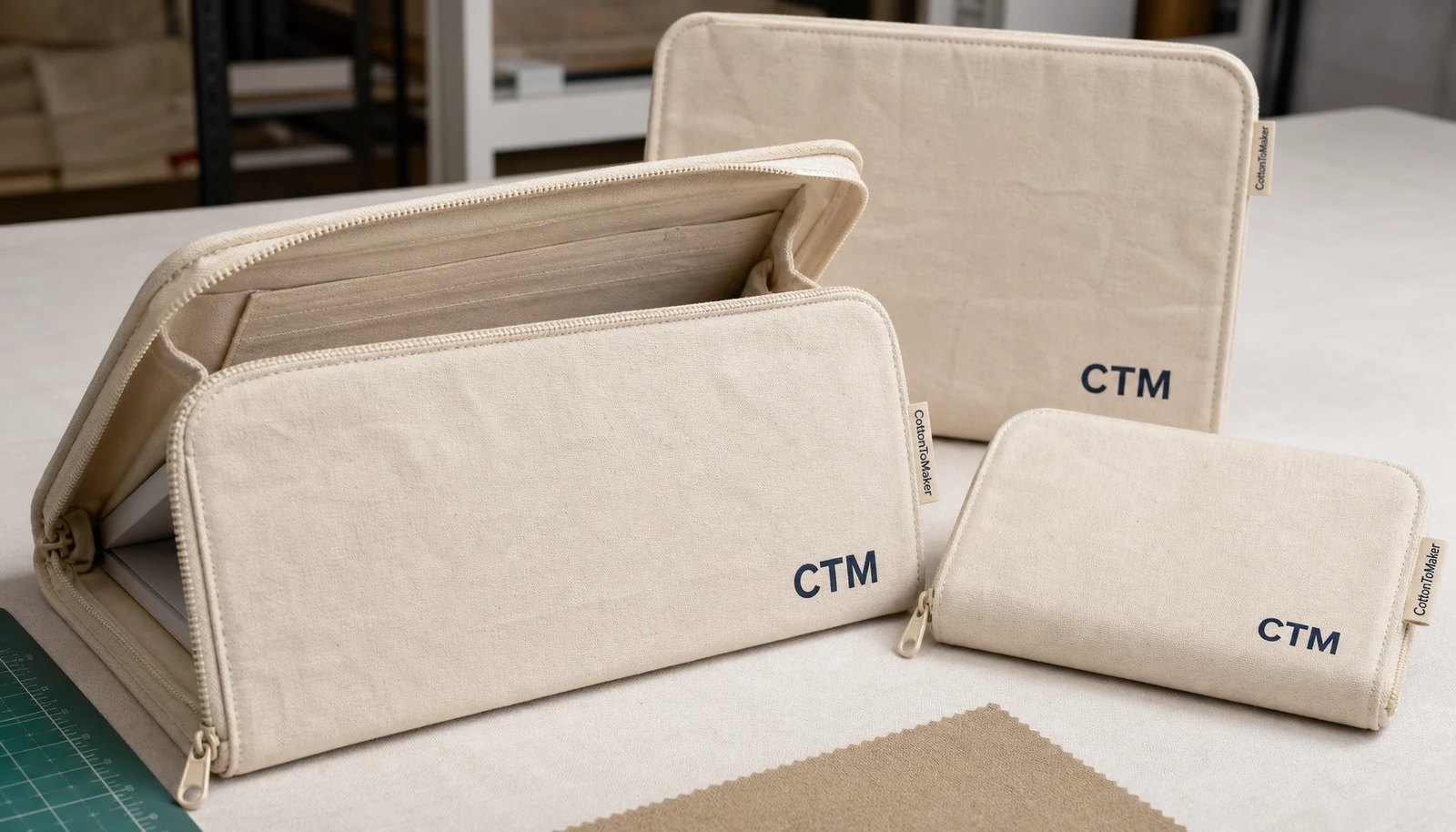
1. Why the RFQ Has to Be More Specific Than the Product Name
A canvas zipper portfolio sounds straightforward until three suppliers quote three different products. One may price a flat 10 oz cotton canvas pouch with a standard zipper and bulk export packing. Another may assume 14 oz canvas, lining, reinforced zipper ends, an inside divider, a two-color licensed university mark, barcode labels, and retail-ready cartons. Both quotes may use the same product name, but they do not represent the same cost, quality level, or landed freight profile.
For university bookstore buyers, that gap matters. These portfolios may be handled by students, parents, faculty, alumni, admissions teams, retail staff, and distributor receiving teams. A zipper that drags, a natural canvas panel with handling stains, a crest printed off-center, or an opening that barely fits course materials can quickly turn a low unit price into markdowns, returns, or event-day frustration. If the item is tied to orientation, admissions, back-to-school, or a department launch, late or unusable goods can disrupt a fixed campus calendar rather than simply delay a replenishment order.
A useful RFQ removes interpretation before price comparison begins. It states function, contents, fabric, construction, decoration, packing, timing, and inspection standards. It also separates the required base specification from optional upgrades. Ask each factory to quote the same base version, then list separate adders for lining, gussets, extra pockets, custom zipper tape, branded pullers, woven labels, barcode stickers, and retail packing. That approach shows whether one quote is genuinely competitive or merely missing half the requirements.
- Use the RFQ to define how the portfolio must perform, not just how it should look.
- State the buying channel before finalizing construction and packing.
- Request one base quote plus separate option pricing for upgrades.
- Require carton dimensions, weight, CBM, packing method, Incoterm, and quote validity with the first quotation.
- Attach approved artwork, swatch, sample photos, and packing instructions to the final purchase order.
2. Start With the Campus Program, Not the Fabric Color
The first decision is the use case. A bookstore resale item needs a clean front panel, reliable barcode/SKU control, and a finish that feels suitable for the shelf price. An orientation kit portfolio may prioritize document fit, fast receiving, count accuracy, and predictable delivery. A donor or alumni gift often needs a more polished interior, such as lining, a divider, a card pocket, or a pen loop. A conference pack may need simple access, a large print area, and enough room for schedules, badges, maps, and handouts.
The RFQ should list the actual contents the portfolio must hold. US letter sheets, A4 documents, legal forms, notebooks, planners, tablets, course packets, and retail insert cards all change the size target. The outside dimensions do not tell the whole story. A portfolio can measure correctly on the panel and still be awkward if the zipper mouth is narrow or the corners catch the document stack. For US letter documents, buyers often begin around 13 x 10 in. For A4, a common starting point is about 34 x 26 cm. In both cases, the usable zipper opening must be stated and checked separately.
Also describe how the goods will move through the campus supply chain. Will they be sold flat on shelves, hung on pegs, inserted into welcome kits, shipped to multiple departments, or routed through a distributor? Retail programs may need hangtags, barcode stickers, individual protection, and shelf-ready carton marks. Kitting programs often prefer counted bundles that receiving teams can verify quickly. Distributor replenishment may require neutral export marks, SKU labels, pallet instructions, routing-guide compliance, and clear carton data. These are not afterthoughts; they affect labor, cost, lead time, and inspection.
- Bookstore resale: prioritize retail presentation, barcode accuracy, clean logo panels, and shelf-ready cartons.
- Orientation kits: prioritize document fit, event-date delivery, easy-count packing, and low receiving complexity.
- Alumni or donor gifts: prioritize lining, trim consistency, stitching quality, and premium brand presentation.
- Department programs: prioritize correct artwork version, pocket layout, reorder consistency, and shipment sorting.
- Distributor orders: prioritize carton data, SKU control, pallet requirements, and repeatable production standards.
3. Define Size, Capacity, and Opening Before You Compare Prices
Size disputes are common because buyers and factories may measure different things. The RFQ should give outside width and height, but it should also give the usable zipper opening. Documents are inserted through the mouth, not through the theoretical panel size. On a one-edge zipper design, zipper ends, seam allowance, and corner stitching reduce the practical opening. A wraparound zipper gives better access, but it adds sewing steps and demands closer inspection at the corners.
Capacity needs the same discipline. A flat portfolio works well for forms, brochures, admissions documents, thin notebooks, and retail inserts. It stacks neatly and usually keeps carton volume lower. A gusseted portfolio, often in the 2-4 cm range, carries thicker course packets, planners, chargers, or accessories, but it increases pattern complexity, carton CBM, and stress near the zipper ends. If the design includes a gusset, state the maximum intended load and ask the supplier to test the sample with comparable contents.
Put tolerances in the RFQ, not only in the inspection booking. For many flat canvas portfolios, a finished size tolerance of +/- 0.5 cm is a practical starting point unless the approved sample or pattern calls for a different limit. The usable zipper opening should have its own tolerance, especially if the portfolio is marketed for US letter or A4 documents. Logo placement tolerance is normally tighter because shoppers see it immediately; +/- 3 mm to 5 mm is a common target for visible retail placement. Without written tolerances, factories may apply internal standards that do not match bookstore expectations.
- State outside dimensions and usable zipper opening as separate measurements.
- Load the sample with the real document stack during approval, not only a ruler check.
- Confirm flat or gusseted construction before requesting final price.
- Use +/- 0.5 cm as a starting point for finished flat size unless the approved sample sets another standard.
- Set visible logo placement tolerance during artwork approval, commonly +/- 3 mm to 5 mm.
4. Canvas Fabric: Weight, Color, Finish, and Lot Control
Canvas should be specified by weight and approximate GSM because the word canvas covers a wide range of fabrics. For most university bookstore zipper portfolios, 12 oz to 14 oz cotton canvas, roughly 400-475 GSM depending on weave and finishing, is a practical retail-grade range. It gives enough structure for daily document carry without making seams too bulky. A 10 oz canvas may suit lower-cost event programs if the sample still feels acceptable. A 16 oz canvas can feel substantial, but it may increase needle stress, seam bulk, zipper corner resistance, carton weight, and freight cost.
Natural canvas remains popular for campus merchandise because it has a classic collegiate look and pairs well with navy, black, maroon, forest, gray, and other school-color prints. It also shows handling marks easily. The RFQ should call for clean cutting tables, protected packing, and inspection for oil marks, dirt, carton dust, dark yarns, excessive slubs, and shade inconsistency. Natural canvas will not look perfectly uniform, so buyers should approve a swatch that reflects acceptable texture instead of relying on a vague expectation of clean cotton.
Dyed canvas adds another layer of control. Stock dyed fabric can shorten lead time, but shade may vary by lot. Custom dyed school colors usually require a lab dip or fabric swatch approval and may increase MOQ. Dark dyed canvas should be checked for rubbing or crocking risk because the portfolio may touch white paper, light apparel, or retail packaging. If the bookstore expects repeat orders each semester, ask whether the same fabric quality and shade can be maintained. A low MOQ on the first order may come from leftover stock that cannot be repeated.
- Retail-grade starting point: 12 oz to 14 oz cotton canvas, approximately 400-475 GSM.
- Budget programs: use lighter canvas only after physical sample approval confirms acceptable hand feel and structure.
- Natural canvas: inspect for dirt, oil marks, dark yarns, excessive slubs, and handling stains.
- Dyed canvas: require shade approval and basic rubbing/colorfastness review.
- Repeat programs: keep an approved swatch and ask whether fabric is stock, continuous, or a one-time lot.
5. Construction Choices That Change Unit Cost and Return Risk
Construction decisions shape both price and durability. A flat body with one zipper edge is the most efficient format for document carry and bookstore display. It has fewer sewing operations, stacks well, and usually packs compactly. A wraparound zipper across two or three sides gives better access and a more premium feel, but it needs careful development. Zipper corners can become wavy, tight, or resistant if the pattern, tape tension, and seam allowance are not controlled. If wraparound access is required, ask for open-sample photos and corner close-ups before production approval.
Interior finishing should be stated plainly. A lined interior, often using 210D polyester or a similar light lining, covers seam allowances and gives the portfolio a more finished retail feel. Bound seams can be a good middle option when the buyer wants a cleaner inside without the labor of full lining. Unlined construction may work for value programs, but the RFQ must define raw-edge appearance, seam strength, thread trimming, and acceptable inside finish. Otherwise, an inexpensive quote may arrive with loose threads that make the item feel unfinished.
Pockets and dividers should earn their place. Each feature needs a size and a purpose: notebook pocket, loose document divider, card slot, pen loop, tablet sleeve, or retail insert pocket. Extra pockets add sewing time and can distort the front panel if the fabric and lining are not balanced. A tablet sleeve or heavy divider changes load stress. During sample review, fill every pocket with its intended object and check whether the lining pulls, the outer print panel bulges, or the zipper path is blocked.
- Flat body: lower cost, easier stacking, lower carton volume, and strong document function.
- 2-4 cm gusset: more capacity, more carton CBM, and more corner QC required.
- One-edge zipper: efficient and suitable for simple document access.
- Wraparound zipper: better access, but inspect for smooth corner movement.
- Lined interior: better retail feel, but check turning, seam allowance, and lining clearance from zipper teeth.
- Pocket layout: define each pocket by size and contents instead of vague wording such as inside pocket.
6. Zipper Details: Size, Slider, Puller, Tape, and Reinforcement
The zipper is a performance component, not a small trim line. For most canvas document portfolios, a No. 5 nylon coil zipper is a practical default because it balances flexibility, durability, and cost. A smaller zipper may save a little money but can feel weak or drag when the portfolio is loaded. A larger zipper may suit a rugged design, yet it can look bulky on a slim bookstore item. The RFQ should name the zipper type and size instead of allowing each supplier to choose a house standard.
Slider and puller choices also affect price and approval time. A basic metal slider with a standard puller may be enough for orientation kits or department programs. A branded puller can improve perceived value for retail, but it may bring tooling charges, higher MOQ, longer lead time, and another approval step. Zipper tape color should be specified as matching, contrast, black, natural, navy, or custom dyed. Custom tape can support school branding, but it adds shade-control risk and may increase minimums. If finish matters, define silver, antique brass, black nickel, matte black, or another approved finish.
Zipper end reinforcement deserves close attention because many failures begin where the pull direction meets a loaded corner. Weak end stitching, missing zipper tabs, or poor seam allowance near the mouth can cause early returns. The sample and inspection process should include repeated opening and closing while the portfolio holds the intended contents. Check for trapped lining, missing coil sections, loose sliders, rough movement, sharp puller edges, broken pullers, and weak reinforcement stitches.
- Default recommendation: No. 5 nylon coil zipper unless the design requires another type.
- Specify tape color, slider finish, puller shape, opening direction, and reinforcement method.
- Flag custom pullers early because they may require tooling, higher MOQ, and longer approval time.
- Test zipper movement with the portfolio loaded, not only empty.
- Inspect zipper ends, corners, and lining clearance because many daily-use failures start there.
7. Logo and Licensed Mark Controls for University Merchandise
University artwork often includes crest text, shields, mascots, department names, registration marks, and strict color rules. The RFQ should include vector artwork, Pantone or brand-color references, logo size, placement, and licensing or brand-use restrictions. Placement should be measured from fixed points such as the lower left seam, zipper edge, or panel centerline. If the instruction only says front logo, suppliers may choose different scale and position, which makes samples and quotes difficult to compare.
Screen printing is usually the most cost-controlled method for one to three solid colors on canvas. It works well for bold bookstore graphics, orientation-year artwork, department names, and simplified university marks. Canvas texture, however, can swallow fine detail. Small crest text, gradients, thin outlines, and detailed mascot art may reproduce better as a woven label, transfer, or simplified graphic. Embroidery can look premium on simple marks, but dense stitching may pucker a flat panel if the fabric is not stabilized or the stitch count is too high.
A logo strike-off is worth the extra checkpoint. It lets the buyer review ink opacity, edge sharpness, registration, color match, small-text readability, and curing before a full pre-production sample is built. For transfers, request adhesion and flex review on the selected canvas. For embroidery, check puckering, thread color, backing, and inside finish. For woven labels, review size, edge finish, color interpretation, and sewing placement. For licensed university merchandise, keep the approved artwork version, strike-off, swatch, and pre-production sample as the production standard.
- Provide vector artwork, Pantone references, logo size, and fixed placement measurements.
- Use screen print for bold one- to three-color designs where canvas texture will not hide detail.
- Use woven labels for detailed crests or artwork with many small color areas.
- Use embroidery for simple premium marks after checking puckering and back-side finish.
- Use transfers only after adhesion, flexibility, and edge-lift checks on the selected canvas.
- Control placement with a template and a tolerance of about +/- 3 mm to 5 mm for visible retail logos.
8. MOQ, Price Breaks, and Comparable Quote Structure
MOQ is usually driven by materials, setup, and production efficiency, not by one fixed factory rule. A natural canvas portfolio using stock fabric, standard zipper tape, and one-color screen print may support a test order around 300-500 pieces, depending on supplier capacity and material availability. Custom dyed fabric, custom zipper tape, molded pullers, printed lining, woven crest labels, or complex retail packing may move the practical MOQ to 1000 pieces or more. Ask which element is pushing the minimum so you can decide whether to simplify the design or increase quantity.
For comparison, lock the base specification and ask all suppliers for price breaks at the same quantities, such as 500, 1000, and 3000 pieces. Setup charges should be separated from unit price. Common setup items include print screens, woven label development, embroidery digitizing, custom puller tooling, hangtag printing, barcode labels, and special packaging. If these costs are not separated, one supplier may hide setup in the unit cost while another lists it honestly, or a supplier may omit the charge until after sample approval.
Do not judge the quote by unit price alone. A lower price may use lighter canvas, a smaller zipper, no lining, weaker zipper ends, bulk packing instead of retail packing, or no barcode application. A higher quote may include approved logo proofing, individual protection, cleaner carton data, and stronger construction. Procurement teams should compare fabric weight, construction, zipper grade, logo method, packing, Incoterm, lead time, quote validity, and QC scope before making a sourcing decision.
- Ask for price breaks at 500, 1000, and 3000 pieces using the same base specification.
- Separate setup charges from unit costs for screens, labels, pullers, hangtags, barcodes, and packaging.
- Ask which exact specification element changes the MOQ.
- Compare quotes only after fabric, zipper, construction, decoration, packing, Incoterm, and inspection scope match.
- Request quote validity so internal approvals do not depend on expired material or exchange-rate assumptions.
9. Sample Approval: Prove Function Before Bulk Cutting
Sample approval should prove the portfolio works for the campus program, not just that it photographs well. Review fabric hand feel, panel stiffness, zipper smoothness, logo clarity, pocket dimensions, usable opening, interior finish, and packing presentation. If the calendar is tight, use staged approvals: fabric swatch first, logo strike-off second, and full pre-production sample third. Bulk cutting should wait until written pre-production approval is complete.
Load the sample with actual or equivalent contents. For orientation packets, insert the real packet thickness and watch whether corners catch during loading. For bookstore retail, add a notebook, pen, and insert card, then check whether the front panel still looks clean. If the design includes a tablet sleeve, test the target tablet dimensions and confirm that the sleeve does not pull the lining or interfere with the zipper. If the item will carry a hangtag or barcode, check where it sits and whether it creates pressure marks or distracts from the logo panel.
Feedback should be measurable. Instead of saying the logo should be higher, specify the new distance from the lower seam or zipper edge. Instead of saying the zipper feels rough, identify whether resistance occurs at the corner, end reinforcement, or lining overlap. Instead of saying the canvas is too soft, decide whether to increase fabric weight, add lining, adjust seam structure, or revise the pattern. Clear sample comments reduce revision cycles and make the approved standard easier to inspect.
- Approve fabric swatch, logo strike-off, and pre-production sample as separate checkpoints.
- Measure outside size, usable zipper opening, logo placement, and pocket dimensions.
- Test the sample with actual documents, notebooks, tablets, or packet thickness.
- Open and close the zipper repeatedly with the sample loaded.
- Photograph every required change and label it mandatory or preferred.
- Do not release bulk cutting until written pre-production approval is complete.
10. Packing, Lead Time, and QC Terms to Put in the RFQ
Packing affects both quality and landed cost. Bookstore retail orders may need individual polybags, recycled paper bands, hangtags, barcode labels, SKU stickers, or shelf-ready cartons. Orientation programs may prefer bulk cartons with counted bundles. Natural canvas needs protection from dirt, moisture, carton dust, and zipper-pull pressure. If units are packed too tightly, pullers can mark the fabric. If cartons are weak or damp, long transit can lead to odor, staining, or crushed presentation. State the packing method instead of accepting default export packing.
Ask for carton data before issuing the purchase order: quantity per carton, carton dimensions, gross weight, net weight, and estimated CBM. This information helps compare landed cost, especially when weighing flat versus gusseted construction or individual packing versus bulk packing. A carton range of 25-50 pieces may be common depending on size, fabric weight, gusset, and packing style, but the final carton plan should come from the supplier after the specification is fixed. If the bookstore or distributor has routing guides, pallet limits, carton mark formats, or barcode requirements, include them in the RFQ.
Lead time should be broken into milestones. Ask suppliers to list days for artwork proof, fabric sourcing, trim sourcing, sample making, sample revision, bulk cutting, logo application, sewing, trimming, final inspection, packing, and handover to the forwarder. University programs often revolve around orientation, back-to-school, admissions days, alumni events, and semester launches. Build the schedule backward from the in-store or event distribution date, and allow time for brand-office review when licensed artwork is involved.
QC terms should be written before production begins. For larger orders, an AQL-based final inspection can be used, but the defect definitions should be practical. Critical defects include wrong logo, broken zipper, unsafe sharp hardware, unusable size, or mixed SKU cartons that create receiving errors. Major defects include dirty front panels, print outside tolerance, poor zipper smoothness, open seams, severe shade mismatch, or pockets that fail the approved sample. Minor defects include small loose threads or slight approved shade variation that does not affect saleability. The approved sample, swatch, artwork proof, and packing instruction should become the inspection standard.
- Require unit packing, carton quantity, carton dimensions, GW, NW, and CBM in the quotation.
- Protect natural canvas from dirt, moisture, carton dust, and zipper-pull pressure marks.
- Break lead time into artwork, sourcing, sampling, revision, production, inspection, packing, and shipping handover.
- Build the schedule backward from the required bookstore in-store date or event distribution date.
- Define critical, major, and minor defects before production begins.
- Attach the final spec sheet, artwork proof, approved swatch, sample photos, and packing instructions to the PO.
Specification comparison for buyers
| Spec decision | Recommended RFQ wording | When it fits | Buyer risk to check |
|---|---|---|---|
| Outer canvas fabric | 12 oz to 14 oz cotton canvas, approximately 400-475 GSM depending on weave and finish; supplier to submit swatch and GSM record | Bookstore retail, admissions packs, alumni gifts, staff folders, department merchandise, and daily document carry | Generic canvas wording hides quality gaps; too light can feel promotional, while too heavy can create bulky seams, higher carton weight, and zipper corner stress |
| Fabric color | Natural canvas, stock dyed color, or custom dyed school color; include approved swatch, shade tolerance, and rubbing/colorfastness requirement for dyed goods | Natural fits classic campus retail displays; navy, black, maroon, forest, gray, or custom colors support brand assortments | Natural canvas shows dirt and oil marks; dyed canvas needs shade control, crocking checks, and repeat-order lot consistency |
| Finished size | State outside dimensions plus usable zipper opening; common targets are about 13 x 10 in for US letter or 34 x 26 cm for A4, adjusted for gusset and contents | Course packets, admissions forms, notebooks, planners, retail inserts, and bookstore shelf sets | Outside size can pass while the zipper mouth is too tight; test with the actual document stack |
| Dimensional tolerance | Finished flat size tolerance normally +/- 0.5 cm; zipper opening tolerance +/- 0.5 cm; logo placement +/- 3 mm to 5 mm unless otherwise approved | Comparable RFQs, final inspection, and disputes over fit or logo position | No tolerance means each factory applies its own standard; small size loss can stop US letter or A4 documents from sliding in easily |
| Lining construction | 210D polyester lining for premium retail; bound inner seams for value retail; unlined only with approved raw-edge and thread-trim standards | Lined for bookstore resale and gifts; bound seams for orientation kits and budget programs | Unlined interiors can expose loose threads; lined portfolios need clean turning, correct seam allowance, and no lining caught in the zipper |
| Zipper type | No. 5 nylon coil zipper with smooth slider, matching or contrast tape color, specified slider finish, reinforced zipper ends, and puller style | Most document portfolios, one-edge zipper designs, and wraparound access where repeated student use is expected | Small or low-grade sliders cause returns; test zipper performance with documents, notebook, pen, and any tablet-sized insert loaded inside |
| Gusset and capacity | Flat for slim documents; 2-4 cm gusset for planners, course packs, or accessories; define maximum intended contents | Flat stacks neatly and reduces freight volume; gusset improves capacity and perceived utility | Gussets increase carton CBM, corner sewing difficulty, and loaded stress at zipper ends |
| Internal features | List each pocket by size and function: slip pocket, divider, pen loop, card slot, tablet sleeve, or no pocket | Advisor packs, department gifts, premium bookstore retail, student onboarding, and conference programs | Extra pockets add labor and can distort the front panel; pocket dimensions must be tested with real contents |
| Logo method | Screen print for 1-3 solid colors; woven label for detailed crest; embroidery for simple premium marks; transfer only after adhesion and flex test | Cost-controlled bookstore graphics, licensed marks, department names, alumni logos, and mascot artwork | Fine crest lines may fill in on canvas; require vector art, Pantone targets, print size, strike-off, and placement tolerance |
Buyer checklist before sampling
- Define the buying channel: university bookstore resale, orientation kit, admissions pack, alumni gift, department merchandise, conference pack, staff issue, or distributor replenishment.
- State the intended contents: US letter, A4, legal documents, course packet thickness, notebook size, planner, tablet dimensions, pen, card, insert sheet, or retail information card.
- Specify outside dimensions and usable zipper opening separately; include acceptable tolerance, normally +/- 0.5 cm for finished flat size unless the approved sample sets another standard.
- Specify outer fabric by ounce and approximate GSM, color, weave/finish if known, shrinkage expectation, and whether fabric must be stock, custom dyed, washed, or preshrunk.
- Confirm construction before quoting: flat or gusseted body, one-edge or wraparound zipper, lining or bound seams, pocket layout, seam allowance, topstitching, zipper end tabs, and corner reinforcement.
- Confirm zipper details before sampling: No. 5 nylon coil or other specified zipper, tape color, slider finish, puller style, opening direction, end reinforcement, and any custom puller tooling requirement.
- Send vector logo artwork with Pantone references, print size, print location measured from fixed seams, brand-use restrictions, and accepted placement tolerance of +/- 3 mm to 5 mm for visible retail placement.
- Ask for a logo strike-off when the university mark includes fine crest text, thin lines, gradients, mascot detail, registration marks, or multiple school colors.
- Request sample photos of the front, back, interior, pocket layout, zipper ends, corners, logo registration, seam binding, lining clearance, and carton packing before shipping the physical sample.
- Require written approval of fabric swatch, logo strike-off, and pre-production sample before bulk cutting, especially when the portfolio uses a licensed university mark or fixed semester launch date.
Factory quote questions to send
- What exact canvas ounce and approximate GSM are included in the quote, and is the fabric greige, natural, dyed, washed, preshrunk, softened, or finished in another way?
- Is the canvas from stock inventory or a new production lot, and what shade tolerance and reorder availability can be expected for the next semester or annual program?
- What construction is quoted: flat, gusseted, one-edge zipper, wraparound zipper, lined, bound seams, unlined, internal pocket, pen loop, card slot, divider, tablet sleeve, or simple document sleeve?
- What outside dimensions and usable zipper opening are quoted, and what measurement tolerance will be used during final inspection?
- Is the quoted zipper a No. 5 nylon coil zipper or another size/type, and what are the slider material, slider finish, puller design, tape color, opening direction, and zipper end reinforcement details?
- Does the unit price include lining, inside pockets, pen loop, card sleeve, zipper end tabs, seam binding, reinforcement patches, hangtag, barcode label, individual packing, and retail carton labeling?
- Which logo method is quoted, how many colors are included, what Pantone or shade tolerance can be targeted, and what minimum readable line width is realistic on the selected canvas?
- Can you provide a screen-print strike-off, embroidery sample, transfer test, or woven label proof before the pre-production sample if the university crest has fine details?
- What is the MOQ for the quoted base specification, and what changes if the order uses custom fabric color, custom zipper tape, custom puller, printed lining, woven label, or special retail packing?
- What is the price at 500, 1000, and 3000 pieces using the same specification, and are setup charges for screens, labels, pullers, hangtags, or barcodes listed separately from unit cost?
Quality-control points to confirm
- Canvas weight should be verified by approved swatch and GSM record, not judged only by hand feel or the supplier's generic canvas description.
- Finished flat size tolerance should normally stay within +/- 0.5 cm unless the approved sample, gusset design, or PO specification states another tolerance.
- Usable zipper opening should be measured separately from outside dimensions because document fit depends on the mouth opening, not only panel size.
- Logo placement should be controlled by a positioning template measured from fixed seams or panel centerline, with an agreed tolerance commonly +/- 3 mm to 5 mm for bookstore-grade retail goods.
- Printed logos should be checked for correct artwork version, Pantone target, opacity, curing, edge sharpness, cracking, smudging, registration between colors, and readable small text.
- Zippers must open and close smoothly across the full length with no missing coil sections, loose slider, broken puller, trapped lining, sharp edges, or weak end stitching.
- Topstitching should be straight at visible edges, with no skipped stitches, loose threads, broken needle marks, uneven seam allowance, puckering, or open seams.
- Corners and zipper ends need reinforcement because many daily-use failures start at the pull direction, loaded document corners, and stress points near the mouth opening.
- Inside pockets must fit the intended notebook, tablet, pen, card, or insert dimensions without pulling the lining, distorting the outer panel, or blocking zipper movement.
- Natural canvas should be inspected under good light for stains, oil marks, dirty handling, dark yarns, excessive slubs, and shade inconsistency beyond the approved swatch.