Start With the Bookstore Buying Job
Canvas zipper portfolios ordered for university bookstores are not just promotional folders with a zipper added. They may be sold as campus merchandise, packed into orientation kits, used for graduation documents, bundled with department materials, or given to alumni and visiting speakers. One order can involve merchandising, licensing, purchasing, receiving, and event operations, so the artwork position needs to be treated as a measurable product specification.
Most production problems begin with vague instructions such as "logo on front." That phrase does not tell the factory where the mark sits in relation to zipper tape, binding, corner curve, side seam, interior pocket, hangtag, barcode label, or shelf-facing edge. A digital mockup can look balanced while the finished portfolio feels cramped, tilted, or partly hidden once it is stacked at retail.
A stronger RFQ turns brand intent into working dimensions. Define finished size, intended contents, canvas, zipper, interior layout, decoration method, logo width, logo position, no-print zones, packing, tolerance, and approval sequence. This gives competing suppliers the same target and gives the buyer a clear reference for licensing review, sample approval, purchase order release, and final inspection.
- Define the primary use: retail shelf item, orientation kit, graduation folder, alumni gift, conference kit, or department program.
- State how the product will be displayed: stacked flat, hung, placed at checkout, packed in kits, or shipped to campus locations.
- Treat zipper tape, binding, curved corners, seam allowance, side labels, pocket seams, hangtags, and barcode labels as placement constraints.
- Attach the approved millimeter placement drawing to the purchase order.
- Keep university marks separate from bookstore, department, event, or supplier branding unless the licensing office has approved the full lockup.
Define the Portfolio Before the Logo
Logo placement cannot be finalized until the product body is defined. For North American bookstore programs, a closed size around 255 x 335 mm to 270 x 350 mm is a practical starting range for letter-size paper. A4 sheets, certificates, tablets, notebooks, or thicker course packets may need more room. Send the real insert dimensions and target thickness before the pattern is made, not after the first sample arrives.
A flat retail portfolio often includes a front canvas panel, back canvas panel, No.5 nylon coil zipper, one interior document sleeve, and one flat card pocket or pen loop. This construction keeps the front panel smooth and makes packing predictable. More pockets can be useful, but stitched dividers, elastic loops, padding, or gussets may create raised areas that show through the branding zone when the portfolios are stacked.
The visual center is not always the geometric center. A zipper around three sides, wider binding, or rounded corners can shrink the usable print area. Ask the supplier to mark the printable zone on the production pattern, then place artwork within that zone instead of centering it on the outside rectangle alone.
- State closed size, open size, corner radius, zipper path, seam allowance target, and acceptable finished thickness.
- List the actual contents: letter sheet, A4 sheet, certificate, notebook, tablet, course packet, insert card, or gift-set component.
- Use those contents during sample review and confirm the zipper closes without forcing the corners.
- Keep the area behind the front logo flat unless pressure marks or stitch lines have been approved.
- Ask whether the quoted size is edge-to-edge, seam-to-seam, or based on usable interior capacity.
Choose Canvas for Print and Handling
The common canvas range for zipper portfolios is 10 oz to 14 oz. A 12 oz cotton canvas, roughly 380-410 GSM depending on mill and finish, is a strong baseline for bookstore merchandise. It feels substantial, accepts screen print well, and can still turn around zipper corners without too much bulk. A 10 oz canvas, around 300-340 GSM, can work for event-driven quantities but may wrinkle more easily. A 14 oz canvas, around 430-450 GSM, can feel premium, but it needs corner, zipper, and packing tests before approval.
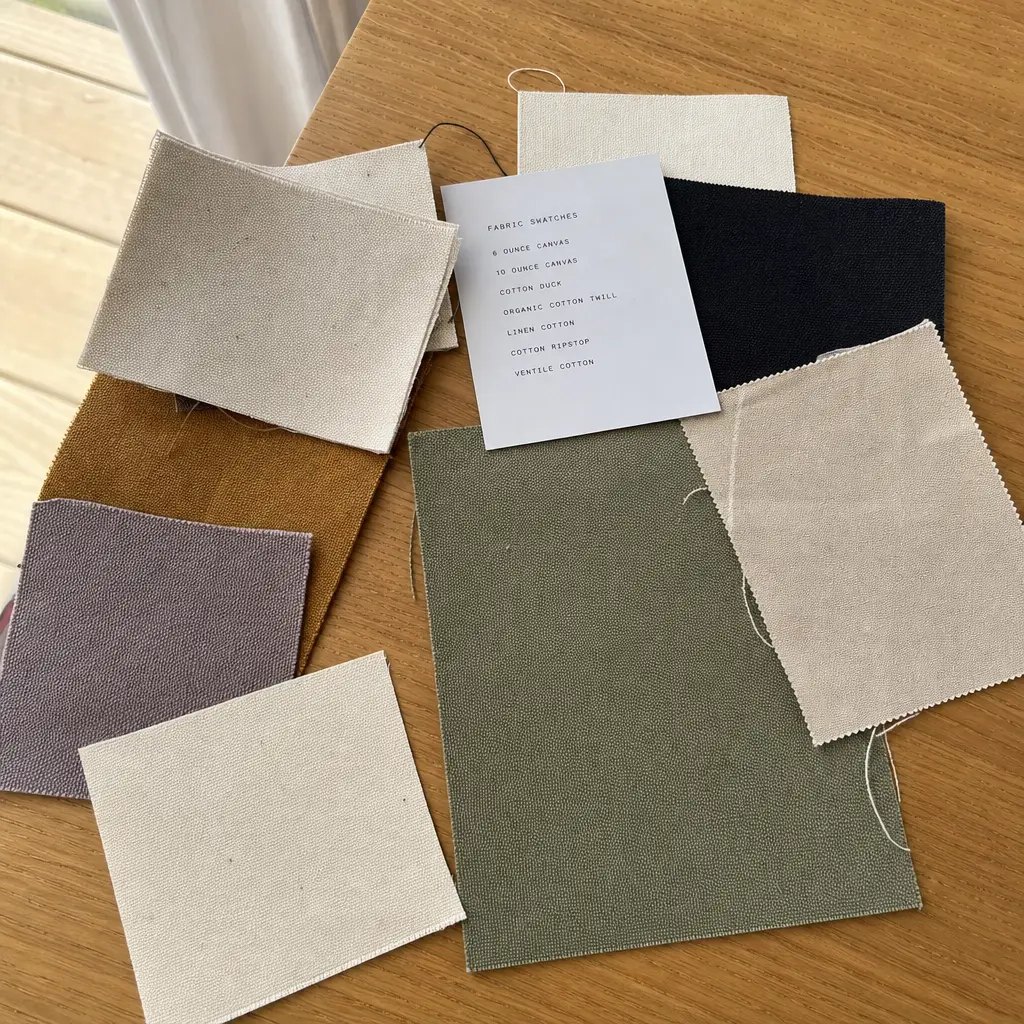
Weight alone is not enough for sourcing. Ask for composition, weave, finish, backing, lining, interlining, shrinkage expectations, and whether the material is natural or dyed. Natural cotton canvas may include flecks, seed specks, and shade variation. That can suit campus lifestyle merchandise, but heavy slubs through a seal or small wordmark can hurt readability. Dyed canvas supports school-color programs, yet navy, black, burgundy, forest green, and similar deep shades should be controlled by lab dip or current swatch approval.
Finish affects both shape and decoration. A stiff finish helps the portfolio sit flat on a shelf, but thick ink may crack if the panel flexes. A washed finish feels softer, though print edges can look less crisp. Coated or laminated canvas may require different inks or transfer settings. For repeat orders, ask how reorders will be matched if the original dye lot is no longer available.
- Baseline retail spec: 12 oz / about 380-410 GSM cotton canvas with light backing or interlining.
- Budget event spec: 10 oz / about 300-340 GSM canvas with simple construction and a modest print area.
- Premium spec: 14 oz / about 430-450 GSM canvas only after zipper-corner and packing tests.
- Require a current swatch, lab dip, or sample panel from available production material.
- State whether slubs, speckles, shade variation, or neps are acceptable inside the logo area.
Map the Front Branding Zone
The best logo placement guidance begins with exclusion zones. Keep artwork away from the zipper path, side seams, bottom stitch line, curved corners, binding, front pocket seams, handle attachment points, side-label seams, and any area likely to receive a barcode, price sticker, or hangtag. What remains is the actual branding zone.
For most flat bookstore portfolios, the safest primary positions are the lower right front panel or the centered lower third. A practical starting point is 25-35 mm above the bottom stitch line and at least 20 mm from side seams. These numbers should be adjusted to the approved pattern, but they give the supplier a clear starting point for sampling. The placement drawing should show logo width, logo height, and distance from at least two fixed reference points, such as the bottom edge and right seam.
Lower-right placement often works well at retail because the mark can remain visible when portfolios are stacked, held under the arm, or partly covered by a shelf lip. Centered lower-third placement feels more formal and may suit university seals, graduation programs, or certificate packaging. Upper placement can work for hanging displays, but it may interfere with header cards, hang holes, price labels, or top shelf coverage.
- Use lower right or centered lower third for most retail bookstore portfolios.
- Start 25-35 mm above the bottom stitch line and at least 20 mm from side seams, then confirm against the pattern.
- Keep the logo clear of curved zipper corners, raised binding, side labels, front pocket seams, and zipper pull contact points.
- Define the printed size in millimeters, not by approximate visual scale on a mockup.
- Keep one final placement drawing with dimensions, artwork version, approval date, and sample reference number.
Size Artwork for Canvas Texture
University artwork can include fine seal text, thin rings, small registration marks, mascot details, department names, and strict clear-space rules. Canvas is a textured textile, so artwork that looks sharp on a monitor may not hold at small scale. For many bookstore wordmarks, 80-130 mm wide is a practical front-panel range. For crests, department marks, or secondary graphics, 45-75 mm may work if the detail is not too fine.
Clear space matters as much as size. A logo placed close to binding may technically fit, yet still look squeezed by seam thickness. Buyers should preserve the university brand clear-space rule and add practical production clearance for fabric movement. If the mark must sit near the lower right corner, it may need to be slightly smaller to avoid the zipper curve and bottom seam.
When several identities are involved, keep the hierarchy simple. One main front mark is usually cleaner than a crowded lockup. Bookstore names, department versions, event dates, or supplier identity can move to a woven side label, inner patch, zipper pull tab, belly band, insert card, or hangtag. This also helps multi-department orders because the base portfolio can stay consistent while the changeable element moves to decoration or packing.
- Ask the supplier to confirm minimum line width, minimum letter height, and registration tolerance for the selected method.
- Use one main front logo whenever possible; move secondary details to a label, hangtag, insert, or zipper pull.
- Avoid placing detailed seals over coarse slubs, seams, pockets, or high-flex areas.
- Check whether the official artwork permits resizing, one-color conversion, simplified seal use, or alternate lockups.
- Approve actual printed size in millimeters, not only a percentage scale in a PDF proof.
Match Decoration to the Mark
Screen printing is usually the strongest default for canvas zipper portfolios with one to three solid colors. It is cost-effective at bookstore quantities, works well on cotton canvas, and can be repeatable for university names, bookstore wordmarks, bold mascot art, and department versions. Its limits are fine detail, heavy ink deposits, and registration on textured surfaces. A strike-off on actual canvas is the right checkpoint for edge sharpness, opacity, color, and handfeel.
Heat transfer can reproduce full-color or highly detailed artwork, but it needs testing on flexible canvas. A transfer may look perfect on a flat sample and then lift at the edge after bending, rubbing, or carton pressure. Embroidery adds texture and a premium feel, but it can pucker the panel, especially on thin canvas or large stitch areas. It is rarely the best choice for tiny seal text.
Woven labels are useful for small detailed marks, supplier identity, reorder control, and quiet secondary branding. Sewn patches can create a strong retail look, especially for alumni or lifestyle assortments, but patch material, edge finish, colorfastness, tooling, and sewing tolerance should be quoted separately. Branded zipper pulls can add value if they do not scratch the print during packing.
- Screen print: best for one to three solid colors, wordmarks, bold mascot art, and repeat orders.
- Heat transfer: useful for full-color graphics, but test bend resistance, edge adhesion, rubbing, and carton pressure marks.
- Embroidery: premium texture, higher cost, possible puckering, and limited readability for small seal text.
- Woven label: strong for detailed secondary marks, side labels, inner branding, and reusable base portfolio programs.
- Sewn patch: good for alumni or lifestyle merchandise; confirm patch MOQ, tooling, edge stitching, and shade tolerance.
- Branded zipper pull: useful as a secondary detail; verify it does not scratch or dent the printed front panel.
Build a Quote Buyers Can Compare
A useful RFQ prevents suppliers from quoting different products under the same name. Include finished size, usable interior capacity, canvas GSM, composition, color, zipper specification, interior layout, logo method, logo size, placement drawing, packing, carton requirements, sample process, inspection needs, Incoterm, and target delivery date. Without that detail, one supplier may quote a light unlined portfolio with a basic zipper while another quotes a heavier lined version with retail packing and inspection support.
Ask suppliers to separate the main cost drivers. Fabric cost changes with GSM, dyeing, washing, lining, interlining, and cutting yield. Sewing cost changes with zipper length, corner finish, binding, pockets, pen loops, trimming, and thread cleaning. Decoration cost changes with color count, screen count, print size, transfer area, patch tooling, label weaving, and number of positions. Packing cost changes with bags, belly bands, hangtags, barcode labels, insert cards, stronger cartons, and sorting by location.
MOQ should be reviewed by component, not only by total quantity. A factory may support lower volume when the buyer uses stock natural canvas, stock zipper tape, standard lining, and one print position. Custom dyed canvas, school-color zipper tape, custom pullers, woven labels, sewn patches, or special retail packing may each carry a separate minimum. For multi-campus or distributor orders, one efficient path is to keep the base portfolio identical and vary only the print, label, or hangtag.
- Request unit price with fabric, sewing, one logo position, standard packing, and export carton clearly included.
- Itemize screen charges, transfer setup, patch tooling, woven label setup, sample costs, revised samples, and packing upgrades.
- Compare MOQ per fabric color, zipper color, artwork version, label, patch, packing format, and shipment split.
- Request carton dimensions, pieces per carton, gross weight, net weight, and total CBM during quoting.
- State Incoterm, destination, inspection requirement, and latest acceptable delivery date in the RFQ.
Approve Samples in Sequence
Sample approval should prove the production method, not just the concept. A showroom sample can help confirm general handfeel, but it should not release bulk production for a licensed university item. A better sequence is current canvas swatch or lab dip, artwork proof, decoration strike-off on actual canvas, full pre-production sample, packing sample, and written production approval. Each step catches a different risk.
The pre-production sample should use final canvas, zipper tape, slider, puller, lining, interlining, thread, logo method, logo size, placement, interior layout, labels, and packing wherever possible. Any substitute material should be recorded as a sample limitation, not treated as bulk approval. Measure the sample instead of relying only on photos. Check finished size, logo distance from bottom edge and side seam, pocket opening, zipper length, and panel flatness.
Use the sample the way the bookstore will use the product. Put the intended contents inside, close the zipper, open it several times, and stack the portfolio under light pressure overnight. Look for pressure marks from zipper pulls, label hardware, hangtag cords, or insert edges. Keep the approved artwork proof, strike-off, sample photos with ruler marks, final placement drawing, sample approval date, and purchase order together.
- Approve fabric swatch or lab dip before committing to school-color production.
- Approve artwork proof with Pantone references, logo size, clear space, and placement dimensions.
- Approve a strike-off on actual canvas before approving the full pre-production sample.
- Approve the full sample only after checking size, zipper travel, print quality, interior structure, label position, and panel flatness.
- Pack the sample as proposed and inspect it after 24 hours for creases, pressure marks, and puller contact with the logo.
- Keep one sealed approved sample for inspection reference and one working sample for handling tests.
Set Inspection Tolerances Early
Quality control should be agreed before bulk cutting and printing begin. For flat canvas zipper portfolios, a finished size tolerance of +/-5 mm for length and width is a practical starting point. Logo placement commonly needs +/-3 mm for simple front prints and +/-5 mm for larger artwork, textured fabric, or sewn patches. Write these tolerances on the purchase order or inspection checklist so the factory and inspector are judging the same standard.
Print inspection should cover both appearance and durability. Color should be checked against the approved Pantone reference or physical strike-off under consistent lighting. Inspect edge definition, opacity, pinholes, bleeding, misregistration, and whether small seal detail remains readable. A dry rub test, light tape pull test, and bend check can catch weak adhesion before shipment. For heat transfers, pay special attention to edge lifting after flexing and after the item has been packed flat.
Construction inspection should cover zipper travel, corner smoothness, slider strength, zipper stops, seam security, stitch density, backtacks, thread trimming, pocket alignment, odor, stains, and packing marks. The zipper should complete at least three full open-close cycles without snagging at corners or separating under normal hand tension. If the order includes multiple campus or department versions, inspection reports should separate results by artwork version.
- Finished size: typically +/-5 mm for flat portfolios unless padding, gussets, or special contents require another tolerance.
- Logo placement: typically +/-3 mm for simple prints and +/-5 mm for larger artwork, patches, or textured canvas.
- Print color: compare with the approved strike-off under consistent light, not only from phone photos.
- Zipper function: test at least three full cycles, including corner travel, puller strength, and stop security.
- Stitching: check skipped stitches, loose threads, backtacks, seam waviness, exposed raw edges, and zipper tape alignment.
- Canvas: reject oil marks, mildew odor, dye stains, major slubs through the logo, hard creases, and obvious shade mismatches.
- Packing: verify carton count, flat stacking, barcode position, carton marks, and separation by artwork version.
Control Packing, Cartons, and Timing
Canvas zipper portfolios should usually be packed flat unless a folding method has been tested and approved. Folding can reduce carton volume, but it may leave permanent creases through the logo. Individual OPP bags are common; recyclable polybags, paper belly bands, tissue sheets, or plastic-free sleeves may be requested for bookstore sustainability programs. The packing must protect the printed panel from zipper pulls, hangtag cords, metal hardware, label edges, and carton compression.
Carton loading affects both quality and landed cost. A typical range is 25-40 pieces per export carton, depending on portfolio size, canvas weight, lining, hangtags, and insert cards. Overfilled cartons can bend corners and press hardware into the logo. Underfilled cartons increase CBM and freight cost. Ask for carton dimensions, net weight, gross weight, carton strength, total CBM, and pallet loading assumptions before the purchase order is finalized.
Lead time should be counted from final written approval, not from the first quote. University bookstore orders often include licensing review, buyer approval, sample shipping, revised artwork, and fixed dates for orientation, homecoming, graduation, or store launches. Build the schedule around proofing, lab dip or swatch approval, strike-off, pre-production sample, material preparation, cutting, decoration, sewing, inline inspection, final inspection, packing, export handover, freight, customs, and local delivery.
- Pack flat with the logo protected from zipper pulls, hangtag cords, barcode labels, and hard insert edges.
- Define individual bag type, barcode location, hangtag placement, insert card, retail label, and sustainability requirements.
- Request carton quantity, carton size, net weight, gross weight, CBM, and carton mark format before final quote comparison.
- Mark cartons by campus, department, artwork version, color, purchase order, production lot, and carton number when applicable.
- Count production time from final approved sample or written production release, not from the RFQ date.
- Confirm stock status for canvas, zipper tape, slider, lining, label, thread, packing material, and cartons before accepting any rush schedule.
Specification comparison for buyers
| Procurement decision | Recommended specification | Best use case | Buyer risk to verify |
|---|---|---|---|
| Closed size and capacity | For letter-size contents, start around 255 x 335 mm to 270 x 350 mm closed. For A4 sheets, certificates, tablets, notebooks, or thick course packets, confirm actual insert dimensions and target thickness before pattern making. | Retail bookstore stock, orientation packets, graduation documents, alumni gifts, department welcome folders, conference kits, and campus merchandise bundles. | A portfolio quoted from paper size alone may become too tight after seam allowance, zipper tape, lining, pocket layers, and corner radius are added. Test with real contents. |
| Primary logo placement | Lower right front panel or centered lower third. A useful starting point is 25-35 mm above the bottom stitch line and at least 20 mm from side seams, adjusted to the final pattern. | Flat shelf display, checkout counter merchandising, licensed campus products, and programs where the mark should stay visible without overwhelming the item. | PDF mockups may ignore zipper bulk, curved corners, side labels, hangtags, barcode labels, and shelf overlap. Require a millimeter placement drawing. |
| Logo size range | 80-130 mm wide for bookstore or university wordmarks. 45-75 mm wide for crests, department marks, or secondary identifiers, depending on artwork detail and decoration method. | Balanced retail presentation where the portfolio feels like durable campus merchandise rather than disposable event collateral. | Oversized logos can crowd seams, crack over flex areas, distort on textured canvas, or make the product look less retail-ready. |
| Canvas weight and handfeel | 12 oz / about 380-410 GSM cotton canvas with light backing or interlining is a strong baseline. Use 10 oz / about 300-340 GSM for budget event programs. Test 14 oz / about 430-450 GSM before approving bulk. | Mid-range bookstore portfolios needing structure, printability, flat packing, and consistent shelf appearance. | Light canvas may wrinkle and show interior pockets. Heavy canvas may create bulky corners, uneven zipper travel, higher CBM, and carton pressure marks. |
| Decoration method and landed-cost tradeoff | Screen print is usually best for one to three solid colors. Heat transfer supports detailed color art after adhesion testing. Woven labels, patches, branded zipper pulls, and hangtags can carry secondary branding. | Repeat bookstore programs, alumni assortments, orientation versions, department editions, and licensed campus merchandise. | The lowest unit price may not be the lowest landed cost if it adds setup charges, high defect risk, extra samples, larger cartons, or separate MOQs by artwork version. |
| Zipper specification | No.5 nylon coil zipper with smooth slider, reinforced zipper ends, secure top and bottom stops, and a puller checked against the printed front panel. | Daily student, faculty, alumni, and staff handling; document storage; kit packing; retail counter use. | Low-grade sliders can snag at corners, separate under tension, scratch the print, or create uneven closure on heavier canvas. |
| Interior layout | One document sleeve plus one flat card pocket or pen loop. Avoid thick layered pockets directly behind the front logo unless pressure marks are tested. | Functional portfolios for class packets, certificates, notebooks, welcome documents, recruiting kits, and gift sets. | Extra pockets increase labor, thickness, stitch lines, and panel pressure that may show through the front branding zone. |
| MOQ structure | 500-1000 pcs per colorway or artwork is common for fully custom fabric, zipper, lining, and print. Lower MOQs may be possible with stock canvas and one-color decoration. | Bookstore buyers, importers, and distributors consolidating campus, alumni, orientation, or department merchandise. | Low MOQ quotes may depend on stock-only materials, limited zipper colors, higher unit cost, shared fabric lots, or shade variation between batches. |
Buyer checklist before sampling
- Define closed size, open size, corner radius, zipper path, and target capacity in millimeters. Confirm whether the item must hold letter paper, A4 paper, certificates, notebooks, tablets, course packets, or gift-set inserts.
- Specify canvas weight by ounce and GSM, composition, weave, finish, backing, lining, interlining, color, shade tolerance, and whether bulk must match the approved sample lot.
- Create a front-panel placement drawing showing logo size, distance from bottom edge, distance from side seam, zipper seam, corner curve, pocket stitch line, binding, side label, hangtag, and barcode position.
- Send vector artwork with Pantone references, clear-space rules, licensing notes, version names, and the university approval sequence required before strike-off or sample production.
- Choose screen print, heat transfer, embroidery, woven label, sewn patch, debossed patch, or branded zipper pull based on artwork detail, canvas texture, retail handling, reorder needs, and target unit cost.
- Request a strike-off on actual bulk canvas and require closed-view, open-view, and detail photos with ruler marks before shipping the physical pre-production sample.
- Measure the pre-production sample for finished size, logo placement, zipper path, pocket opening, seam allowance, stitch density, panel flatness, and whether the portfolio lies flat after packing.
- Test zipper travel around all corners for at least three full open-close cycles, including slider pull strength, zipper end reinforcement, skipped teeth, tape waviness, and puller contact with the printed panel.
- Confirm individual packing, hangtag, insert card, barcode sticker, retail label location, carton quantity, carton dimensions, gross weight, net weight, carton strength, and total CBM before final PO release.
- Ask suppliers to separate unit price, artwork proof, screen charge, print setup, label or patch tooling, sample cost, revised sample cost, packing cost, inspection cost, and freight assumptions.
Factory quote questions to send
- What exact canvas weight, GSM, composition, weave, color, finish, backing, lining, and interlining are included, and can you send a swatch from the current available lot?
- Is the quoted logo made by screen print, heat transfer, embroidery, woven label, sewn patch, debossed patch, or branded zipper pull, and how many colors, positions, and artwork versions are included?
- What minimum line width, minimum letter height, registration tolerance, and maximum recommended print area do you advise for this artwork on the specified canvas texture?
- Can you provide a placement drawing showing logo distance from bottom edge, side seam, zipper seam, corner curve, pocket stitch line, handle, binding, side label, and hangtag or barcode area?
- What MOQ applies separately to fabric color, zipper tape color, zipper puller, logo artwork, woven label, patch, packing style, barcode labeling, and reorder production?
- How many working days are required for artwork proof, canvas swatch or lab dip, strike-off, pre-production sample, revised sample if needed, bulk cutting, printing, sewing, inspection, packing, and export handover?
- What are your normal production tolerances for finished size, logo placement, print color, fabric shade, stitch density, zipper function, seam allowance, carton quantity, and carton weight?
- Will bulk production use the same zipper slider, puller, canvas lot, lining, interlining, thread color, pocket layout, label, print ink, and packing material as the approved pre-production sample?
- Can you quote carton dimensions, pieces per carton, net weight, gross weight, estimated CBM, carton mark format, and recommended pallet loading for landed-cost comparison?
- Which inline and final inspection points do you recommend, and can you provide photos by artwork version, carton mark, purchase order, and production lot before shipment?
Quality-control points to confirm
- Finished size tolerance should normally stay within +/-5 mm for length and width on flat canvas portfolios unless the construction is padded, boxed, or intentionally oversized for contents.
- Logo placement tolerance should be approved before production, usually +/-3 mm for simple front prints and +/-5 mm for larger artwork, textured canvas, or patch applications.
- Screen print color should be checked against the approved Pantone reference or physical strike-off under consistent light, not only by phone photo or factory office lighting.
- Canvas shade should be compared to the approved swatch or lab dip, with natural slubs allowed only if they do not cross the main logo area in a distracting way or obscure fine artwork.
- The zipper must open and close smoothly for at least three full cycles during inspection, including corners, without snagging, slider separation, skipped teeth, tape twisting, or puller weakness.
- The portfolio should lie reasonably flat after normal packing, with no permanent creases through the logo, bent corners, or pressure marks from zipper pulls, labels, hangtag hardware, or carton straps.
- Canvas should be free from oil marks, dye stains, mildew odor, heavy weaving defects, excessive loose fibers, hard fold lines, and inconsistent backing that reduces retail appearance.
- Seams around zipper tape, binding, corners, and interior pockets should have even stitch density, secure backtacks, no skipped stitches, no loose thread tails, no exposed raw edge, and no twisted tape.
- Logo adhesion should pass the agreed dry rub test, light tape pull test, and bend check before bulk production, especially for heat transfers, thick ink deposits, and coated canvas surfaces.
- Cartons should match approved packing quantity, remain flat enough to prevent bending, and use carton marks that separate campus, department, artwork version, color, purchase order, and production lot.