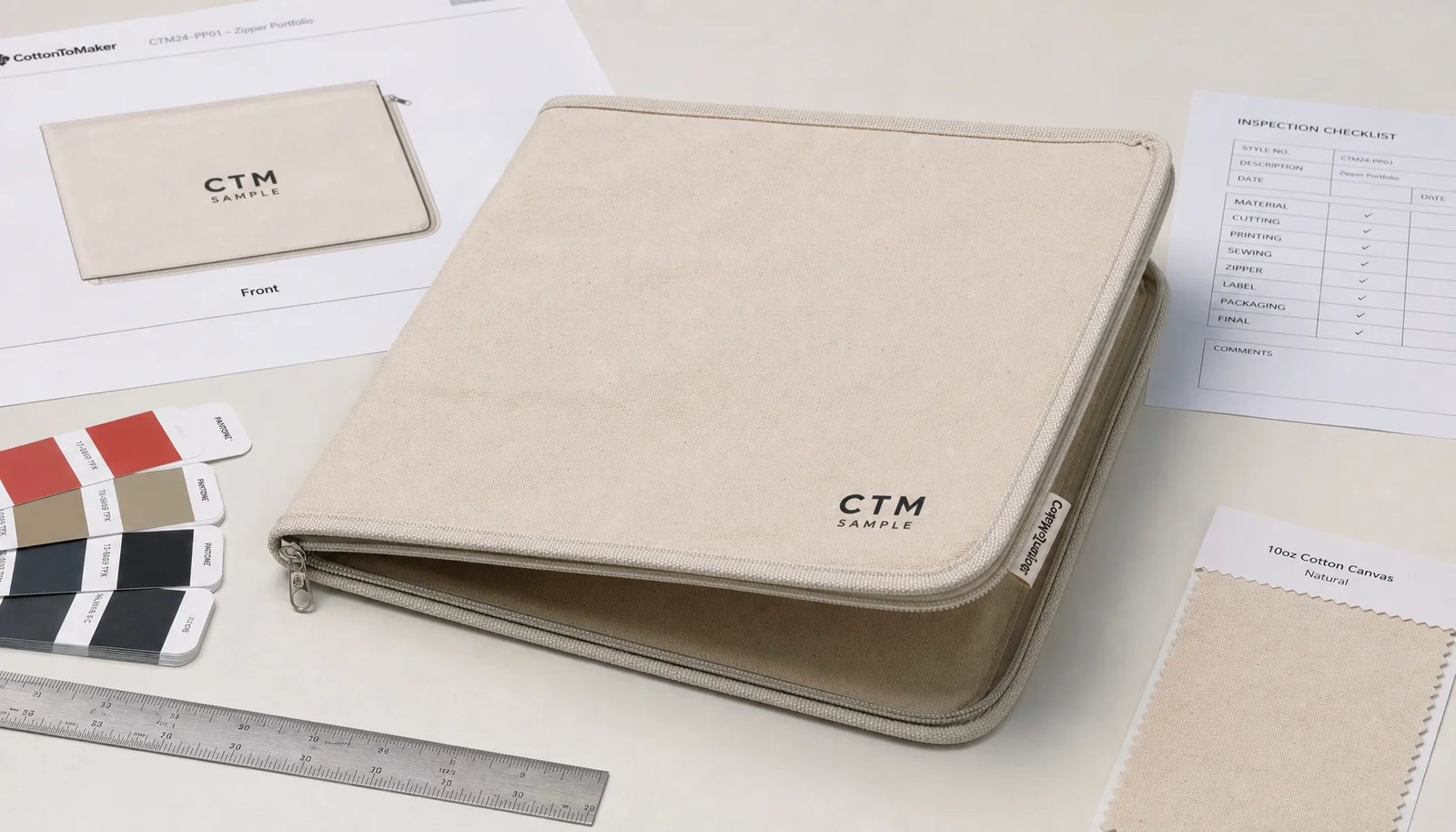
Start With the Exhibitor Job, Not the Logo
A canvas zipper portfolio for trade show exhibitors is a working sales tool, not only a promotional surface. It may carry price sheets, product brochures, contracts, lead forms, badge inserts, samples, a notebook, a tablet, or staff briefing materials. During the show it is opened repeatedly, moved between the booth and hotel, stacked on tables, and seen at close range by prospects. The print proofing checklist therefore has to protect brand presentation, physical function, and the fixed event schedule at the same time.
The first procurement decision is the use case. A staff kit should prioritize zipper durability, clean logo placement, stable structure, and comfortable handling because the same people will use it for several days. A visitor giveaway may be lighter, simpler, and packed more efficiently. A distributor resale item needs repeatability so a reorder does not arrive with a different canvas shade, zipper color, or logo position. A VIP meeting portfolio may justify heavier fabric, better backing, and a more controlled interior layout.
The most common sourcing error is approving a flat digital mockup before the product structure is fixed. A logo centered on a rectangle may look low once zipper tape, seam allowance, corner radius, side labels, and pocket stitching are added. A portfolio that looks flat when empty may bow or pull at the corners when filled with the actual sales kit. Procurement should ask suppliers to proof the artwork against the finished product, not against an imaginary flat panel.
Before price comparison, send a short use brief. Include who carries the portfolio, what goes inside, how long it must last, whether it is sold or given away, how close the viewer will be to the logo, and the required in-hands date. This gives factories enough context to quote an appropriate zipper, canvas weight, reinforcement, and packing method instead of defaulting to the cheapest construction.
- For exhibitor staff kits, prioritize zipper movement, front-panel appearance, structure, and filled-product comfort.
- For visitor giveaways, control cost with stock canvas, simple pockets, standard zipper tape, fewer print colors, and efficient packing.
- For distributor resale, lock the fabric, zipper, trim, label, print method, and packing details for future reorders.
- For premium meetings, approve the sample filled with the real insert stack, not only empty and photographed from the front.
- For event deadlines, reserve time for strike-off approval, pre-production sample approval, inspection, and freight before the in-hands date.
Translate A4 or Letter Into Real Dimensions
A4 portfolio and letter-size portfolio are useful search terms, but they are not purchase specifications. A4 paper is 210 x 297 mm, while US letter is 216 x 279 mm. The finished portfolio must be larger than the paper, and the usable internal area is always smaller than the outside because of zipper tape, seam allowance, lining, rounded corners, pocket construction, and material thickness. If the portfolio carries a 20-page brochure instead of a single sheet, the difference matters.
For an A4 sales kit, many buyers begin development around an outside size near 250 x 335 mm, then adjust for insert thickness, pocket design, and desired handling clearance. For US letter, a starting outside size around 245 x 320 mm may work for a simple document pouch, but it is not a substitute for testing. Tablets, spiral notebooks, thick catalogs, and rigid badge holders change the required clearance quickly. The correct size is the one that fits the real kit without forcing the zipper or curling the documents.
Procurement should ask for four measurements: finished outer width and height, usable inner width and height, document pocket depth, and zipper opening length. The zipper opening is often missed. A portfolio can be large enough internally but still hard to use if the opening is too short or the corner radius restricts insertion. If sales staff need to remove a price sheet during a conversation, the movement should feel easy and intentional, not like pulling paper out of a tight envelope.
Interior layout can also change front-panel appearance. A tablet sleeve, card bank, elastic loop, or thick document pocket seam may create pressure points beneath the printed logo. If the front print is large or uses a solid ink block, keep bulky seams and reinforcement edges away from the print zone where possible. Always review one sample empty and one sample filled.
- Record finished outer size, usable internal clearance, document pocket depth, and zipper opening length in millimeters.
- Measure the actual insert stack, including paper thickness, brochure count, notebook, tablet case, pen, cards, and badges.
- Allow removal clearance; a fit that is technically possible may still be too slow for booth conversations.
- Ask whether the size tolerance applies to outer dimensions, pocket dimensions, zipper opening, or all three.
- Reject vague size terms such as A4 compatible unless the supplier also confirms the actual usable measurements.
Specify Canvas Like a Material Buyer
Canvas weight affects structure, print result, sewing quality, packing volume, and freight cost. A 10 oz canvas can work for a light giveaway or low-cost pouch, but it may wrinkle around the zipper and feel soft when loaded. A 12 oz cotton canvas, often about 380-420 GSM depending on yarn construction and finishing, is a practical middle point for many canvas zipper portfolios for trade show exhibitors. A 14-16 oz canvas gives more body, but it can increase needle resistance, seam bulk, carton CBM, and the chance of puckering if the pattern is not adjusted.
Ask suppliers to quote canvas in both ounces and GSM. Ounces may refer to ounces per square yard, while GSM is grams per square meter, and not every supplier uses the terms consistently. Also ask whether the weight is before or after finishing. Washing, softening, coating, and shrinkage control can change hand feel and dimensions. If the buyer wants a flatter portfolio, interlining may be better than simply increasing canvas weight.
Canvas base color is part of the print specification. Natural canvas has flecks and a warm tone, which can soften black edges and reduce contrast for pale gray, white, or pastel artwork. Bleached canvas gives a cleaner print base but may not match a natural, unbleached brand look. Dyed canvas can support stronger brand alignment, but it introduces lab dips, dye-lot variation, higher fabric MOQ, and longer lead time. The purchase order should separate fabric color approval from logo color approval.
For repeat programs, retain a signed fabric swatch and a print strike-off. Canvas is not a perfectly uniform substrate, so the standard should allow normal yarn character while rejecting stains, oil marks, severe slubs, and visible shade panels. If a reorder uses a different canvas lot, the buyer should recheck both the fabric shade and the logo color on that fabric.
- Use 10 oz canvas for lighter-duty giveaways only when a softer structure is acceptable.
- Use 12 oz canvas for balanced printability, sewing efficiency, structure, and freight cost.
- Use 14 oz or heavier canvas when a premium hand feel or heavier insert load justifies added bulk and cost.
- Record canvas weight in oz and GSM, plus base color, finish, shrinkage expectation, and stock or custom sourcing.
- For dyed fabric, approve lab dip, bulk shade, and print result as separate checkpoints.
- Keep a signed fabric swatch for inspection and repeat-order comparison.
Match Print Method to Artwork Risk
Screen printing is often the most efficient option for a solid logo, event name, or one- to three-color sponsor mark. It can provide good opacity and stable cost at volume, but canvas texture limits fine detail. Thin strokes, small reverse text, tight gaps, and small registration areas can fill in or blur. For many canvas screen prints, strokes below about 1.2-1.5 mm should be treated as a risk until a strike-off proves readability.
Heat transfer, digital transfer, or direct-to-fabric digital printing may suit gradients, photographs, multi-color event graphics, or many sponsor logos. These methods can reproduce detail that is difficult with screens, but buyers should test adhesion, edge feel, gloss level, hand feel, and behavior after bending. A transfer that looks sharp on a flat sample can feel plasticky, lift at the edge, or crack if the chemistry and canvas finish are not compatible.
Embroidery, woven patches, rubber labels, leather-look patches, and metal plates can also work on canvas zipper portfolios, but they are decoration methods with their own engineering issues. Embroidery with a high stitch count may distort an unsupported panel. Patches and plates add thickness, tooling, MOQ, and placement complexity. They may be right for premium programs, but they should not be substituted casually for a printed logo after the quote has been approved.
Small sponsor logos and QR codes deserve special treatment. A QR code should be printed at final size on the actual fabric, then scanned under realistic booth lighting and from a normal handling distance. Sponsor text should be checked at full size, not zoomed on a PDF. The buyer should ask the factory for the minimum readable line width, minimum negative gap, and recommended minimum QR code size for the selected print method.
- Use screen print for bold one- to three-color artwork with limited fine detail.
- Use transfer or digital methods when gradients, photos, or many sponsor marks are required.
- Treat strokes under about 1.2-1.5 mm as proof-required on textured canvas.
- Scan QR codes from the printed sample and from bulk inspection pieces, not only from the digital file.
- Require physical strike-offs for metallic, puff, reflective, high-density, or heavy solid ink effects.
- For patches or embroidery, confirm backing, placement, edge finish, and impact on panel flatness.
Build a Proof That Inspectors Can Measure
A procurement-grade print proof is not just a pretty mockup. It should state final artwork dimensions, color references, print method, placement references, tolerance, artwork revision, and approval date. Measurement points must be fixed product references such as zipper seam, side seam, bottom seam, top edge, finished panel center, handle edge, or label position. Phrases such as centered nicely, same as sample, or standard placement do not help an inspector make a clear decision.
The proof should also state the production route. Printing before cutting gives the factory a flat surface and is common for canvas panels, but trimming and sewing can shift the final visual position. Printing after cutting may improve control on individual panels. Printing after sewing may help simple logos align to the finished product, but zipper bulk and seams can limit the print area. If placement matters, the tolerance should be measured on the finished sewn portfolio, because that is what the exhibitor and prospect will see.
Typical tolerances should be written before production. For many front-panel logos, +/-3 mm placement on finished goods is practical if the pattern and process are stable. Print size may be controlled around +/-2 mm for simple artwork, depending on method and fabric movement. Finished outer size is commonly allowed around +/-5 mm for width and height, but tighter requirements may be needed for tablet sleeves or fitted document packs. The supplier should confirm whether it can hold these limits before accepting the order.
Version control prevents expensive errors. When agencies, distributors, and factories exchange files, old sponsor marks can easily reappear. File names should include artwork version and date, and obsolete proofs should be removed from the approval chain. If a sponsor changes after screens, films, or transfers are made, the supplier must confirm whether new setup charges or lead time apply before bulk production continues.
- Send AI, EPS, or PDF vector artwork with fonts outlined and color references named.
- Include print width, print height, orientation, print position, tolerance, and fixed measurement references.
- State whether tolerance is measured on cut panels or finished sewn portfolios.
- Mark zipper opening direction so the logo reads correctly during actual use.
- Use artwork version numbers and approval dates on every proof.
- Do not approve bulk production from a flat digital mockup when fabric texture, color, or fine detail is important.
Approve Samples in a Controlled Sequence
A strong sample sequence reduces argument and rework: material swatch, print strike-off, prototype sample, then pre-production sample. A digital proof confirms layout, but it cannot show ink absorption, canvas flecks, edge sharpness, opacity, hand feel, curing, or rub resistance. The strike-off catches these issues before bulk panels are printed. Skipping it may save several days at the start and cost much more when the event date is fixed.
The material swatch confirms canvas weight, shade, finishing, hand feel, and shrinkage risk. If dyed canvas is used, approve a lab dip first and then a bulk fabric cutting if the color is critical. If natural canvas is used, define the acceptable level of flecks, slubs, and shade variation. Normal cotton character should not be treated as a defect, but stains, oil marks, severe color panels, and dirty yarns should be rejected.
A prototype sample can use substitute trims when the purpose is to confirm size, shape, pocket logic, and zipper route. The pre-production sample should not use substitutes. It should include the actual bulk canvas, final zipper, final puller, final print method, final pocket structure, labels, reinforcement, and intended packing. Bulk approval should refer to the pre-production sample and written specification together.
Keep physical references under control. One signed master sample should remain at the factory, and one should remain with the buyer or inspector. A flat strike-off is also useful for print comparison because finished samples may be handled frequently and become dirty. The PO should state that bulk goods must match the approved sample, approved strike-off, and written specification, with the written specification controlling any measurable requirement.
- Material swatch approval checks canvas weight, shade, hand feel, finishing, and visible fabric character.
- Print strike-off approval checks color, opacity, edge quality, fine detail, curing, and rub resistance on actual canvas.
- Prototype approval checks size, opening, interior layout, reinforcement concept, and basic construction.
- Pre-production approval checks actual materials, print, zipper, sewing, labels, and packing before bulk cutting.
- Keep signed references at the factory and with the buyer or inspection team.
- Do not release bulk production until artwork, fabric, zipper, pocket layout, reinforcement, and packing are all approved.
Control Zipper, Stitching, and Reinforcement
The zipper is the part exhibitors touch most, so it deserves more detail than standard zipper in the RFQ. A No. 5 nylon coil zipper is common for canvas zipper portfolios because it bends around corners better than rigid metal teeth and remains cost efficient. For heavier portfolios or repeated staff use, the buyer may ask for a higher-grade coil zipper, smoother slider, stronger puller, or reinforced zipper ends. The zipper must be tested with the portfolio filled, not only empty.
Zipper tape color, teeth color, slider finish, and puller style affect both appearance and function. Black tape on natural canvas may be intentional and graphic; an off-white tape may look cleaner but show dirt more easily. Painted pullers should be checked for chipping, and metal pullers should be checked for burrs, plating marks, sharp edges, and secure attachment. If a branded puller is used, confirm tooling cost, MOQ, mold approval, and replacement timing if the first sample is wrong.
Sewing quality can make a correctly printed logo look wrong. If the front panel is pulled unevenly into the zipper seam, the logo may appear tilted or off center even when the print placement was correct on the panel. Seam allowance, stitch density, thread tension, corner shaping, and zipper end finishing should be consistent. For medium canvas, the stitch should be strong enough to hold the shape without cutting or puckering the fabric.
Reinforcement is useful when the portfolio needs a flatter, more premium presentation. Light interlining, localized backing, or 250-300 GSM board-like reinforcement may help, depending on the construction. Too much stiffness creates other problems: bulky corners, hard zipper movement, cracking at fold areas, and higher carton volume. The sample should be reviewed empty, filled, zipped, unzipped, and opened flat.
- Specify zipper size, type, tape color, teeth color, slider finish, puller material, puller shape, and opening direction.
- Test zipper smoothness around corners with the expected insert stack inside.
- Inspect for rippled tape, stuck points, skipped teeth, loose puller rings, sharp trim, and weak zipper stops.
- Define thread color, stitch density expectation, seam allowance control, corner symmetry, and loose-thread trimming.
- Use reinforcement only where it improves structure without straining the zipper or increasing bulk unnecessarily.
- Keep hard seams and backing edges away from large front print areas whenever the design allows.
Compare Quotes by Specification, Not Unit Price Alone
MOQ for canvas zipper portfolios is driven by more than factory preference. Fabric sourcing, dyeing, cutting yield, zipper procurement, print setup, label production, packing materials, and sewing-line setup all contribute. A simple natural canvas portfolio with one-color screen print may be practical around 300-500 pieces at many factories, but this is not a universal rule. Dyed canvas, custom zipper tape, branded pullers, complex organizer panels, or multiple print positions can push MOQ higher.
Ask suppliers to separate unit price from setup charges. Screen charges, film output, transfer setup, sample development, artwork adjustment, custom labels, puller tooling, carton labels, and inspection support may be quoted separately. A low unit price may exclude essential proofing steps. A higher unit price may include better canvas, stronger zipper, interlining, individual packing, and clearer inspection support. Procurement should compare landed cost at the same specification.
Clarify what changes at lower quantities. The factory may replace dyed fabric with stock canvas, use standard black zipper tape instead of custom tape, switch print method, remove reinforcement, reduce pocket count, or substitute available trim. These changes may be acceptable, but they must be visible before internal stakeholders approve samples. Otherwise the bulk order may not match the version shown in meetings.
Lead time should be quoted by stage. A useful quote separates artwork review, material sourcing, strike-off, prototype sample, pre-production sample, bulk production, inspection, and freight. Event projects often fail because all lead time is described as production days, while approval days and freight booking are ignored. The buyer should work backward from the required event warehouse delivery date, not the show opening date only.
- Cost drivers include canvas weight, dyed fabric, print color count, logo size, print positions, zipper grade, reinforcement, pocket count, labels, and packing.
- Screen printing usually has setup cost per color and per print position.
- Custom zipper tape, branded pullers, woven labels, rubber patches, and special hardware may add MOQ, tooling, and approval steps.
- Heavy canvas and stiff backing can increase freight cost through carton weight and CBM.
- Ask for sample cost, setup cost, unit price, carton details, lead time, and validity period in one quote format.
- Compare suppliers only after confirming they quoted the same finished size, fabric, zipper, pockets, print method, and packing.
Set QC Limits Before Bulk Production
Quality control should be written before production starts. For finished outer size, +/-5 mm is a common working tolerance for soft sewn items, but fitted tablet sleeves or exact insert packs may require tighter limits. For front logo placement, +/-3 mm on the finished sewn product is often practical for centered artwork. For print color, the strongest reference is a signed strike-off on the approved canvas, reviewed under agreed lighting such as D65 or the buyer's normal inspection light.
Defect classification helps inspection decisions stay objective. Critical defects include wrong logo, wrong artwork version, unsafe sharp trim, unusable zipper, missing required component, or severe size error that prevents use. Major defects include visible front logo shift, heavy ink bleeding, cracked print, broken stitches, wrong fabric color, wrong zipper color, incorrect pocket layout, or wrong packing count. Minor defects may include small thread ends or slight shade variation within the approved range.
Print QC should include color, opacity, registration, edge quality, pinholes, bleeding, ghosting, cracking, and rub resistance. Large solid ink areas need special attention because canvas texture can leave small unprinted points. Fine sponsor logos should be read at actual size. QR codes should be scanned from real printed units. If the product includes several print positions, each position needs placement and appearance checks.
Construction QC should include zipper movement, seam strength, stitch consistency, pocket fit, corner shape, panel flatness, and loose thread trimming. Inspectors should test filled portfolios because empty products can hide tight zippers, stressed seams, and poor capacity. The inspection plan should reference the approved specification, approved strike-off, approved pre-production sample, and purchase order together.
- Use critical, major, and minor defect definitions before inspection starts.
- Measure finished dimensions, pocket dimensions, zipper opening, print size, and print placement against the written spec.
- Inspect print under agreed lighting and compare against the signed strike-off, not only a Pantone number on paper.
- Perform dry rub and bending checks on printed panels according to the approved standard or buyer method.
- Scan QR codes and read sponsor text from printed units at actual scale.
- Test zipper function and capacity with the real insert stack, not only empty portfolios.
Pack for Event Delivery and Receiving
Packing is part of the product specification because printed canvas can scuff, crease, absorb moisture, or transfer ink under pressure. Individual polybags are common, but buyers may request recycled-content bags, paper sleeves, belly bands, master polybags, or bulk packing depending on market and sustainability requirements. If the print is dark, heavy, or large, tissue or interleaving between printed faces may reduce abrasion and blocking risk.
Curing time should be confirmed before packing. Heavy screen prints stacked too early may transfer ink to the next portfolio or stick under carton pressure. Transfer prints should be checked after cooling and handling to confirm edge adhesion. The PO should state that packing begins only after the print passes the agreed curing and rub requirement, especially when goods ship directly to an event warehouse with little time for rework.
Carton planning affects both freight and event handling. Depending on size, canvas weight, reinforcement, and packing method, a carton may hold roughly 20-40 portfolios, but the supplier should confirm actual dimensions, gross weight, net weight, and CBM after the pre-production sample. Overweight cartons are harder to handle and may be rejected by some receiving operations. Underfilled cartons waste freight and may crush if they lack support.
Carton marks must match the receiving route. A distributor, 3PL, or event warehouse may require PO number, item code, event name, booth number, destination, barcode label, carton count, country of origin marking, or mixed-carton warning. These details look administrative, but a mislabeled carton can create a real delivery problem when the show date is fixed.
- Specify individual bag type, recycled-content preference if any, warning text, barcode label, and retail or bulk packing format.
- Use tissue, interleaving, or controlled stacking when printed faces contact each other under carton pressure.
- Confirm print curing before packing to reduce blocking, transfer, and scuffing.
- Approve carton quantity, carton dimensions, gross weight, net weight, CBM, item code, PO number, and carton sequence marks.
- Set maximum carton weight according to importer, distributor, or event warehouse requirements.
- Request carton photos and label photos before shipment when goods go directly to a third-party warehouse or show site.
Specification comparison for buyers
| Spec decision | Recommended option | When it fits | Buyer risk to check |
|---|---|---|---|
| Finished size basis | Specify finished outer size, usable internal clearance, pocket opening, and zipper opening in millimeters; verify with the actual insert stack | Exhibitor staff kits holding brochures, price sheets, lead forms, badges, contracts, notebooks, or tablets | A portfolio sold as A4 or letter size may still be too tight after seam allowance, zipper tape, lining, pocket depth, and insert thickness are added |
| Typical size range | For A4 contents, many buyers start around 250 x 335 mm outside; for US letter, around 245 x 320 mm, then adjust for capacity and construction | Programs where the buyer needs a starting point before sample development | These are not universal standards. Confirm the exact paper size, stack thickness, tablet model, and desired clearance before issuing a PO |
| Outer canvas weight | 12 oz cotton canvas, often about 380-420 GSM depending on yarn and finishing, with shade and shrinkage controls recorded | Most trade show portfolios requiring structure without excessive sewing cost, carton weight, or freight volume | Canvas under 10 oz can wrinkle near the zipper and show print distortion; 14-16 oz canvas feels stronger but may increase bulk, needle marks, and CBM |
| Canvas base color | Natural or bleached stock canvas for standard programs; dyed canvas only when brand color control, MOQ, and lead time support it | Natural canvas fits practical event kits; bleached canvas improves contrast; dyed canvas supports brand alignment | Natural flecks and base tone change perceived ink color. Dyed fabric may require lab dips, dye-lot approval, and higher fabric MOQ |
| Print method for front logo | Screen print for solid one- to three-color marks; heat transfer, digital transfer, or direct print testing for gradients, photos, or many sponsor logos | Repeat event orders with stable logos, distributor programs, and sponsor-branded portfolios | Fine strokes below about 1.2-1.5 mm, tight negative spaces, QR codes, and small sponsor marks require a strike-off on the actual fabric |
| Logo placement tolerance | Measure finished-product print position from fixed references and use a practical tolerance such as +/-3 mm for front-panel centered artwork | Front-panel branding near zipper seams, corner radius, handles, labels, or stitch lines | Printing before sewing can shift visually after cutting, folding, zipper insertion, and final pressing. Define where and when measurement occurs |
| Zipper specification | No. 5 nylon coil zipper with approved tape color, teeth color, slider, puller finish, end reinforcement, and smoothness test | A4 or letter-size portfolios opened repeatedly by booth staff during a show week | Low-grade tape can ripple on canvas; poor sliders can catch around corners; sharp pullers, loose rings, or weak stops become visible event failures |
| Interior structure | Document pocket plus selected card slots, pen loop, notebook pocket, tablet sleeve, or mesh pocket based on the real sales kit | Exhibitor portfolios where staff need organized access rather than a simple pouch | Too many pockets add sewing labor, create lumps under the front print, reduce usable capacity, and complicate inspection |
| Panel reinforcement | Use light interlining, 250-300 GSM backing, or localized reinforcement only when a flatter, more premium presentation is needed | Premium staff kits, distributor meetings, folders carrying thicker catalog sets, or retail-style resale programs | Overly stiff reinforcement can crack at fold points, make corners bulky, strain the zipper, and increase carton volume |
Buyer checklist before sampling
- Define the intended user: booth staff, visitor giveaway, distributor resale, VIP meeting kit, or internal sales team portfolio.
- List the exact contents: brochure size, sheet count, paper GSM, catalog thickness, tablet model, notebook size, pen diameter, business card quantity, badge insert, and total stack height.
- Specify finished outer width and height, usable inner width and height, document pocket depth, pocket opening width, and zipper opening length in millimeters.
- Require a filled-sample test using the real insert stack and confirm that documents can be removed without bending or forcing the zipper.
- State outer canvas weight in both ounces and approximate GSM, plus color, finish, washing, lamination, coating, or treatment if any.
- Ask whether the quoted canvas is stock fabric or made to order, and record expected shrinkage after finishing, fabric shade range, and roll-to-roll variation control.
- For dyed canvas, request lab dip approval, bulk fabric cutting approval, MOQ, shade tolerance, and added lead time compared with natural or bleached stock canvas.
- Send vector artwork with fonts outlined, Pantone references, final print size, print method preference, and a placement diagram measured from zipper seam, side seam, bottom seam, or finished panel center.
- State whether print placement tolerance is measured on flat cut panels or on finished sewn portfolios after zipper installation and final shaping.
- Request a strike-off on the actual canvas lot when color accuracy, fine text, QR codes, large solid ink areas, sponsor logos, or repeat-order consistency matter.
Factory quote questions to send
- What finished outer size, usable inner size, pocket depth, and zipper opening length are included in your quotation, and what insert stack did you assume?
- Can you confirm the largest document size and maximum recommended stack thickness for the quoted construction?
- What canvas weight, yarn construction if known, GSM range, color, finishing, and shrinkage standard are included, and is the fabric from stock or made to order?
- If the canvas is dyed, what fabric MOQ, lab dip timing, bulk shade tolerance, dye-lot approval step, and extra lead time apply?
- Is the quoted canvas pre-shrunk, washed, coated, laminated, or untreated, and how will that affect print adhesion and dimensional tolerance?
- Will the logo be printed before cutting, after cutting, or after sewing, and what placement tolerance can you hold on finished goods?
- Can you provide a printed strike-off on the actual bulk canvas before we approve the pre-production sample?
- What is the minimum readable stroke width, minimum gap, and smallest recommended QR code size for our artwork on this canvas using your proposed print method?
- How will you control Pantone color on natural or dyed canvas, and what light condition, master swatch, or signed strike-off will inspection use?
- Which zipper size, zipper type, tape color, teeth color, slider material, puller material, puller finish, puller shape, and zipper end construction are included?
Quality-control points to confirm
- Finished outer width and height should normally stay within +/-5 mm unless the portfolio must hold a tight tablet, contract pack, or fitted insert that requires tighter control.
- Usable inner pocket dimensions should be checked with the actual specified contents, not only by measuring an empty sample on a table.
- Document pocket depth and zipper opening length should allow easy removal of the insert stack without curled paper, torn corners, or forced zipper closure.
- Logo placement should be measured on the finished sewn portfolio from approved reference points, with a typical tolerance of +/-3 mm for centered front-panel artwork unless otherwise approved.
- Print size should match the approved proof within the agreed tolerance, commonly +/-2 mm for width or height on simple front logos when the process supports it.
- Screen print should show acceptable opacity, edge definition, registration, and coverage on the canvas texture without obvious pinholes, bleeding, ghosting, or unintended ink deposits on the visible front panel.
- Dry rub testing should show no obvious transfer under the agreed method, and the print should not crack or flake after reasonable bending of the printed panel.
- Print color should be compared with the approved strike-off or master sample under agreed lighting; canvas base shade must be treated as part of the approved visual result.
- Fine artwork, small sponsor text, and QR codes should be inspected at actual viewing distance; QR codes must be scanned from the printed sample and from bulk inspection pieces.
- Zipper must open and close smoothly around straight sections and corners without tape waviness, skipped teeth, stuck points, detached pullers, sharp edges, weak stops, or uneven ends.