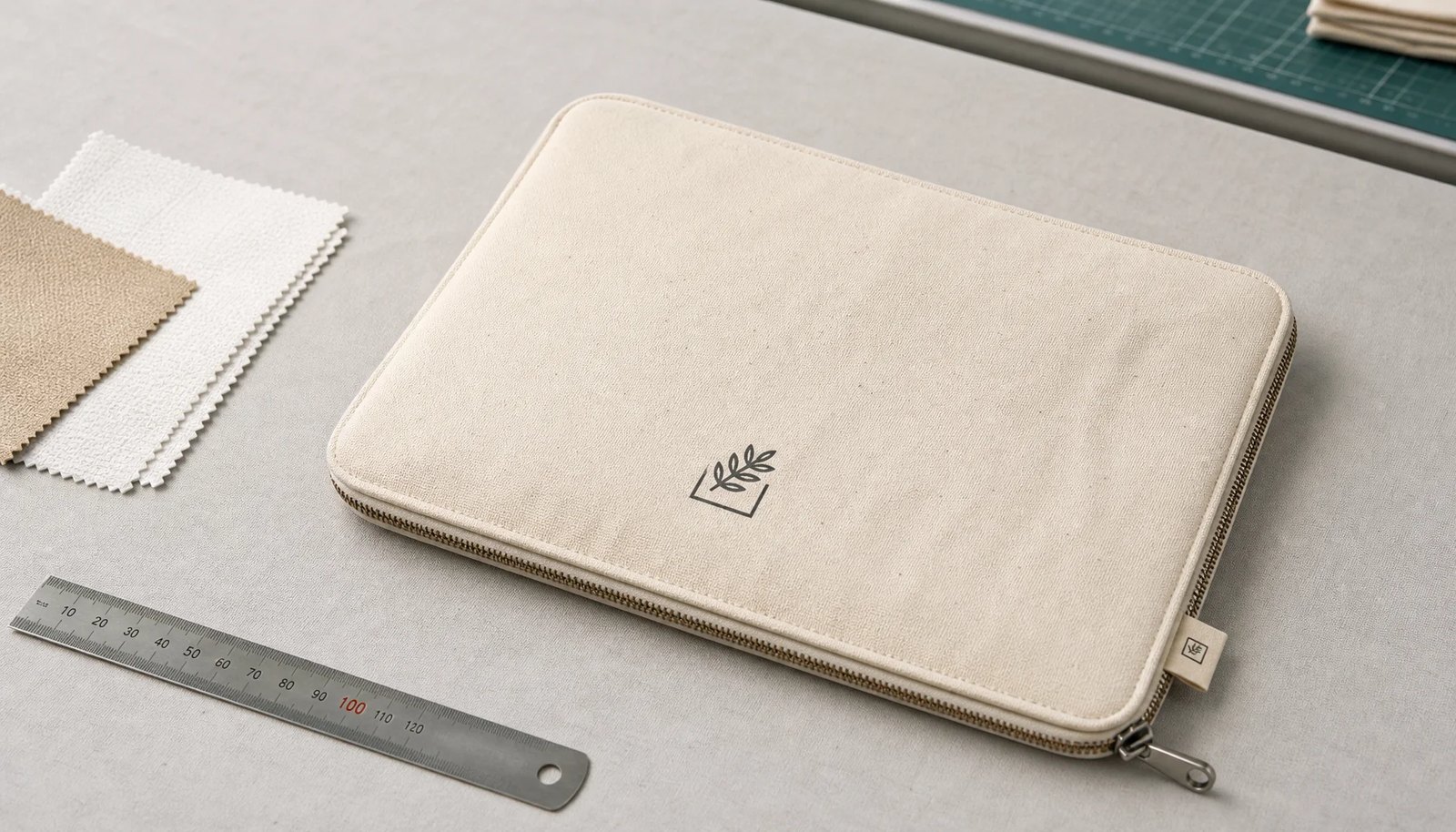
Start with the event job, not the artwork
Canvas zipper portfolios for trade show exhibitors are deadline products. They have to organize documents, protect sponsor inserts, move through registration desks, sit neatly on booth counters, and carry a brand in a way that looks intentional. Logo placement is therefore a procurement specification, not just a graphic-design decision. A mark that looks centered in a flat PDF can look low, tilted, or crowded once zipper tape, seam allowance, rounded corners, pocket seams, and panel thickness enter the real product.
Begin with the job the portfolio must do. A general attendee giveaway usually needs a clear front-panel logo, efficient packing, and a decoration method that can hold cost across a large run. A VIP sponsor portfolio may need a quieter front mark, better zipper puller, woven side label, and cleaner interior finish. A sales-meeting folder may need card pockets, a pen loop, a document divider, and a logo that stays visible when the portfolio is carried under an arm. A resale or distributor item needs tighter version control, barcode placement, carton count accuracy, and a finish that looks consistent on a shelf or display table.
The contents matter too. Event teams may load A4 or letter-size sheets, catalogs, badge sets, notepads, pens, business cards, sponsor flyers, or thin sample sheets. That load affects panel flatness. A portfolio made only for a few papers can use lighter support. One that must hold a thick sponsor packet may need interlining or board support so the front panel does not collapse around the logo.
In the RFQ, describe the finished sewn product rather than only the front artwork. Ask the supplier to mark the printable or decorable zone on a pattern, sample, or technical drawing measured from finished edges. The quote should state where the logo sits, how large it is, which decoration method is used, what tolerance applies, and whether inspection is based on the logo centerline, logo edge, or full artwork bounding box.
- Define the business use before choosing logo size, method, or placement.
- Confirm the expected document load because it affects panel support and logo flatness.
- Require a finished-product logo map before approving sampling or bulk price.
Choose construction that keeps the front panel stable
A clean logo starts with construction. For many B2B trade show portfolios, 10 oz to 12 oz cotton canvas is a practical working range. A 10 oz canvas can suit a budget giveaway when the shape is simple and the logo is bold. A 12 oz canvas is often a safer starting point when the buyer wants more structure without adding too much corner bulk. Some 12 oz canvas qualities fall around 390 gsm to 430 gsm, but ounce and gsm are not exact equivalents across mills, yarns, weaves, and finishes. Always ask for the actual gsm range and tolerance.
Heavier is not automatically better. A 14 oz canvas can feel more substantial, but it may increase sewing difficulty, zipper-corner bulk, carton weight, freight cost, and the chance of uneven seams. If the logo needs a very flat surface, panel support may matter more than extra fabric weight. Light non-woven interlining, thin foam, or paperboard can improve shape and help the mark read cleanly on a table.
Support materials must be specified, not assumed. Bonded interlining, loose board, stitched stiffener, foam, and laminated structures all behave differently. A hard insert can create a ridge under the logo. A soft insert can compress during carton packing. A stiff portfolio may look sharp but become harder to zip around corners. The approved sample should show the exact balance between structure, hand feel, and zipper function.
Interior features can also change the logo area. A tablet sleeve, front pocket, card slots, pen loop, mesh pocket, or document divider may add stitch lines or pull tension across the front panel. If those details are added after the artwork map is approved, the logo may end up too close to a seam or hard edge. Lock the interior structure before final logo approval, especially on orders where brand placement will be inspected closely.
- Use 10 oz to 12 oz canvas for most trade show orders; validate actual gsm, finish, and shrinkage.
- Keep logos away from pocket seams, stiff insert edges, zipper curves, and bulky corners.
- Confirm lining, interlining, pockets, and zipper construction before final artwork approval.
Map the primary logo zone in millimeters
The front panel is usually the main logo area, but the best position is not always the geometric center of the outside rectangle. On a simple top-zip portfolio, a centered or upper-center logo often works well. On a zip-around design, the zipper pull, curved corners, and side tension can make the visual center feel different from the measured center. On a portfolio with a front pocket, the safe zone may sit above the pocket seam, or on the pocket itself if the pocket is large, flat, and decorated before assembly.
A usable artwork map should include logo width, logo height, distance from finished top edge, distance from finished side edge, and clear space from zipper tape, seam lines, fold lines, pocket edges, corner curves, label tabs, and insert edges. For many canvas zipper portfolios, keeping the logo edge 25 mm to 40 mm away from structural edges is a practical starting point. Smaller portfolios may need a tighter margin. Bulky zip-around styles may need more room.
Be exact about reference points. If the specification says the logo is 80 mm from the top, state whether that means the top edge of the logo, the logo centerline, or the top of the full artwork bounding box. If it says centered, state whether the logo is centered on the full outside width, the visible flat panel, or the area inside the zipper seam. These details prevent arguments when factory QC or a third-party inspector measures the bulk order.
Set a tolerance that the construction can actually hold. For stable front-panel screen printing or transfer printing, +/-5 mm from the approved artwork map is a common target. Washed canvas, hand-cut panels, bulky zip-around construction, or decoration before sewing may require +/-8 mm to +/-10 mm. Printing before sewing gives a flatter print surface, but sewing and turning can shift the finished placement. Printing after sewing allows finished-edge measurement, but zipper bulk may limit access for screens, transfer presses, or fixtures.
- Define logo size and location from finished edges in millimeters.
- Use 25 mm to 40 mm safe space from structural edges unless the approved sample proves otherwise.
- State whether tolerance applies to the logo edge, centerline, or full artwork bounding box.
Match decoration method to artwork risk
Screen printing is usually the most economical and controllable choice for bold one-color or two-color logos on canvas zipper portfolios. It works best with solid shapes, enough line weight, and artwork that does not depend on tight registration. Textured cotton canvas is not a smooth coated sheet, so tiny type, hairline strokes, and reversed-out details can lose clarity. As a practical check, ask the printer whether lines below about 0.3 mm and text below about 6 pt to 7 pt will remain readable on the chosen canvas.
Screen print pricing depends on print size, number of colors, setup, and quantity. One large front print is easier to control than several small placements across the product. If the same portfolio will be reordered for annual shows, keeping logo size, ink color, and placement stable can reduce approval work and make reorders more consistent. Still, approve a fresh strike-off when the fabric color, finish, ink system, or supplier changes.
Heat transfer, DTF, and related transfer methods can handle multicolor artwork, gradients, small sponsor logos, and details that are not practical for screen printing. The tradeoff is feel and durability risk. A portfolio is handled, flexed, stacked, zipped, and shipped under pressure. Test transfers on the actual canvas color and finish. Check edge lift, cracking after bending, bubbling, tackiness, scorch marks, excessive shine, and color shift. A paper proof or digital mockup is not enough.
Embroidery, woven labels, debossed patches, and custom zipper pullers can make the item feel more premium. They work well when the buyer wants a quieter textile detail instead of a large printed face. They also add variables. Embroidery may need backing and can pucker lighter canvas. Patches add thickness. Custom pullers often have separate MOQ, tooling, and lead time. Quote these options separately so cost, setup, and schedule stay visible.
- Use screen print for bold, simple, repeatable event logos.
- Use transfer methods for multicolor or small-detail artwork, then test adhesion and flex behavior.
- Use labels, patches, embroidery, or pullers for premium cues, but quote their MOQ and tooling separately.
Use secondary branding only where it helps
Secondary branding can be useful, but it should earn its place. A woven side label helps when portfolios are stacked on a registration table. An inside label can carry distributor information, fiber content, country of origin, care guidance, or compliance details. A branded zipper puller is visible during use. A back-panel mark can carry sponsor or event information when the front needs to stay clean. Each placement adds value only if it matches how the product will be handled.
Co-branded trade show orders can become messy quickly. One program may include a corporate logo, event name, regional message, and sponsor mark. The lowest-risk setup is often one primary front-panel decoration plus one secondary label or puller. Multiple sponsor logos across multiple zones can work, but the file control must be disciplined. Every version needs a unique artwork code, approved proof, sample photo, carton label, and packing separation rule.
Think through distribution before approving extra marks. If staff pull portfolios from cartons behind a booth, a side label or clear carton version label may save time. If the portfolio sits flat on a check-in desk, the front logo will do most of the work. If it will be used in private sales meetings after the show, a smaller upper-center logo may feel more suitable than a large promotional print.
Secondary branding should be priced as separate quote lines. A woven label line, an inside print line, a patch line, and a custom puller line make comparisons cleaner. If the buyer later needs to reduce cost or protect the schedule, one option can be removed without rewriting the whole specification. Bundled pricing can hide setup charges and make late decisions more expensive than expected.
- Limit secondary branding to placements with a clear use case.
- Give every logo version a unique code, proof, sample photo, and carton label.
- Quote extra labels, pullers, patches, and prints as separate lines.
Write an RFQ suppliers can price consistently
The phrase canvas zipper portfolio is too broad for serious price comparison. One supplier may quote 10 oz unlined canvas with a basic zipper and one-color print. Another may include 12 oz canvas, lining, board insert, smoother slider, tissue over the logo, barcode label, and export carton marks. The lower unit price may simply be missing the work your event program requires.
A strong RFQ standardizes the product before pricing begins. Include finished size in millimeters, internal usable dimensions if the portfolio must fit A4 or letter-size papers, canvas weight and color, lining or support, zipper size and color, interior features, logo method, logo size, logo placement map, color count, packing method, quantity tiers, inspection expectations, delivery term, and required arrival date. Put the logo tolerance in the RFQ, not only in later inspection notes.
MOQ should be broken down by component. A factory may have one MOQ for custom-dyed canvas, another for zipper tape color, another for woven labels, another for pullers, and another for print setup. A 1,000-piece order split across four colors and three logo versions can be less efficient than a 2,000-piece order in one color with one logo. Ask suppliers to show price breaks and identify which component controls the minimum.
Separate one-time costs from repeat unit costs. Screen setup, film, digital setup, custom label tooling, puller molds, sample fees, courier charges, and third-party inspection are not the same as the bulk unit price. Ask whether setup charges repeat on reorders and whether screens, files, or tooling will be stored. This is especially useful for annual trade show programs where the same portfolio returns with small event-name changes.
The schedule should be quoted in approval gates, not only sewing days. A practical timeline includes artwork proof, material confirmation, strike-off, pre-production sample, sample transit, buyer review, revisions, material purchasing, decoration, sewing, trimming, QC, packing, final inspection, export handover, and freight. Give suppliers the must-arrive event date and the latest acceptable ship date so they can flag timing risk early.
- Standardize fabric, zipper, construction, logo, packing, quantity, and deadline before comparing prices.
- Ask for MOQ by component, color, logo version, decoration method, and packing format.
- Separate setup charges, sample fees, tooling, bulk unit price, inspection, and freight assumptions.
Approve samples as production evidence
A pre-production sample should prove the supplier can make the actual product, not just something similar. It should use the final canvas weight, final fabric color, final zipper, final thread, final lining or interlining, final decoration method, final logo size, final logo position, and intended packing method. If any item is substituted, the supplier should list the difference in writing before the buyer approves the sample.
Sampling can be staged without becoming complicated. First, approve the digital artwork proof for size, placement, and color references. Second, approve a print strike-off or decorated panel on the actual canvas when color, detail, or adhesion matters. Third, approve the full pre-production sample with final construction. This route is especially helpful when the logo has strict brand-color requirements, small text, multiple sponsor marks, or a transfer that must survive flexing.
Sample review should be practical. Lay the portfolio flat and measure the logo from finished edges. Check whether the print is level, clear, and positioned according to the approved reference. Open and close the zipper several times, including around corners and end stops. Insert the intended contents and check whether the front panel bulges, pulls, or distorts the logo. Look inside for pocket alignment, label position, seam finish, loose threads, stains, and odor.
Keep a simple approval record. It should list product code, material spec, finished dimensions, zipper spec, decoration method, logo size, logo position, packing method, sample photos, approval date, and approved tolerances. The factory should keep one approved reference sample for production, and the buyer should keep one for incoming inspection or third-party QC. For a logo-sensitive order, this record is the evidence that keeps inspection objective.
- Approve final materials and final decoration, not just a visual mockup.
- Use a strike-off or decorated panel before the full sample when logo detail or color is critical.
- Keep a signed sample record with dimensions, placement, photos, tolerances, and packing details.
Control quality where logo placement can fail
Logo placement can fail long before the final inspection. Artwork may be scaled incorrectly. Operators may align from the wrong edge. A print fixture may move. Sewing may pull the decorated panel. Heat pressing may flatten one area more than another. Packing pressure may crease the branded face. Final random inspection matters, but early production checks are what prevent a full order from drifting out of spec.
For placement-sensitive orders, request artwork proof confirmation, print setup photos, first-off decorated panel photos, first-off sewn sample photos, and packing-start photos. The first production piece should be measured against the approved artwork map before the line continues. If the first 20 to 50 pieces show a trend, such as the logo moving toward the zipper side, the supplier should correct the setup before the full batch is completed.
Defect classification should be agreed before inspection. A wrong logo version, missing logo, upside-down print, wrong decoration method, severe color mismatch, or zipper that does not open should normally be treated as critical or major depending on the buyer's standard. Logo shift outside tolerance, visible smudging, transfer edge lift, broken zipper stop, open seam, stain on the front panel, or incorrect carton label should usually be major. Loose thread, a minor crease, or a small internal cosmetic mark may be minor if function and presentation are not affected.
Inspection should test use, not only appearance. Fill the portfolio with the expected document load, zip it closed, unzip it, and check whether the panel still lies reasonably flat and the logo remains readable. Check zipper smoothness, slider security, zipper tape fray, end reinforcement, seam strength, stitch density, pocket placement, label alignment, odor, stains, and carton condition. A well-placed logo does not rescue a portfolio that jams, stains, or arrives in mixed cartons.
If using AQL inspection, state the inspection level and acceptance limits in the purchase order. If the buyer uses another sampling plan, state the quantity and pass-fail rules. The inspector needs the approved sample, artwork map, packing specification, and defect classification. Without those documents, inspection becomes opinion rather than control.
- Check print setup and first-off production before bulk sewing continues.
- Measure logo placement from finished edges using the approved artwork map.
- Classify wrong logo, out-of-tolerance placement, zipper failure, stains, and carton mix-ups before inspection.
Specify packing so the logo arrives clean
Packing is part of logo quality. Canvas can crease under carton pressure. Zipper sliders and pullers can dent or rub against printed faces. Dark components can leave marks if products are packed too tightly or before decoration is fully cured. A portfolio can pass inspection at the factory and still look poor when the event team opens the carton.
The packing method should protect the branded face. Depending on the budget and decoration method, options include tissue over the logo, paper sheets between units, zipper-head positioning away from the print, a thin board insert, or individual polybag. Premium sponsor kits may justify a board insert to maintain shape. Lower-cost giveaways may only need a clean protective layer and sensible stacking. The right answer depends on the product, transit time, and how the event team will distribute the portfolios.
Carton details matter for show logistics. State pieces per inner pack if used, pieces per master carton, carton dimensions, gross weight limit, carton marks, and pallet requirements if applicable. If there are multiple logo versions, carton labels should identify version code, quantity, and destination. Mixed versions in unmarked cartons can slow down a booth team even when the products are otherwise acceptable.
Ask for packing photos before shipment. Useful photos show one finished unit, one protected unit, the stack inside the carton, inner packaging if used, carton marks, and carton seal. For logo-sensitive orders, request a photo showing that zipper heads do not press directly into the printed face. If a third-party inspection is scheduled, include packing condition and carton labeling in the checklist.
- Protect printed faces from zipper sliders, pullers, pressure marks, and carton rub.
- Approve unit packing, carton count, carton marks, and version labels before shipment.
- Request packing photos that show the finished unit, protected stack, and carton labeling.
Plan lead time around approval gates
Trade show dates are fixed, so the sourcing calendar should work backward from the required arrival date. Buyers often ask for bulk production time and miss the approval steps that must happen first. A realistic schedule includes artwork proof, material confirmation, print strike-off, pre-production sample, sample transit, buyer review, sample revision if needed, material purchasing, decoration, sewing, trimming, QC, packing, final inspection, export handling, and freight.
The biggest timing risks often appear before sewing begins. Custom canvas color, dyed zipper tape, custom woven labels, custom pullers, Pantone ink matching, multiple sponsor logos, and late event-name approvals can all push the schedule. If one component has separate tooling or MOQ, it may become the long-lead item. Ask the supplier which decision must be locked first and what date is the last safe approval date for each gate.
Version control is another schedule risk. A buyer may need one portfolio design for each region, sponsor, sales team, or event tier. Each version needs its own artwork file, proof or sample record, production code, carton label, and packing list line. Late version changes can require new screens, new transfer files, or rework of decorated panels. Limit post-sample changes unless there is time to re-approve the affected step.
Build the purchase order around gates: artwork map approval, strike-off approval, pre-production sample approval, bulk material confirmation, first-off production approval, final inspection, and shipment release. State what can change after each gate. A carton label may be adjustable late in the process. Moving the front logo by 10 mm after screen setup may require new fixtures, new sampling, or rework.
- Work backward from the event arrival date, not from estimated sewing time.
- Identify long-lead components such as custom canvas, zipper tape, woven labels, pullers, and complex artwork.
- Use approval gates for artwork, strike-off, pre-production sample, first-off production, inspection, and shipment release.
Specification comparison for buyers
| Spec decision | Recommended option | When it fits | Buyer risk to check |
|---|---|---|---|
| Primary logo placement | Centered or upper-center front-panel logo, with the logo edge kept 25 mm to 40 mm away from zipper tape, seam joins, corner curves, fold lines, pocket seams, and hard insert edges | Most exhibitor giveaways, sponsor welcome kits, meeting folders, media kits, and document portfolios where fast brand recognition matters | A digital center mark can look visually off-center after sewing; require measurement from finished edges after assembly and set a written logo-position tolerance |
| Logo-position tolerance | Target +/-5 mm for screen print or transfer on a stable sewn panel; allow +/-8 mm to +/-10 mm only for bulky zip-around construction, washed canvas, or pre-sewn panel printing | Orders where the buyer needs objective incoming inspection and fewer disputes over placement | If tolerance is not stated, the factory may treat visible drift as acceptable; if tolerance is too tight for the construction, sampling will stall |
| Secondary logo placement | Small woven side label, inside label, zipper pull tab, debossed patch, or discreet back-panel mark | Co-branded sponsor programs, retail-style merchandise, distributor identification, or portfolios stacked on tables | Extra placements add setup cost and inspection points; each placement needs its own artwork map, tolerance, and approval sample |
| Decoration method | 1-color or 2-color screen print on 10 oz to 12 oz cotton canvas, using a test print or strike-off before bulk | Bold corporate logos, repeat event programs, simple artwork, and medium-to-high quantity orders | Fine type below about 6 pt to 7 pt, thin lines below about 0.3 mm, gradients, and tight registration can lose clarity on textured canvas |
| Complex artwork route | Heat transfer, DTF, or transfer print, tested on the actual canvas color and finish | Multicolor sponsor logos, gradients, small lettering, QR-style details, or artwork that exceeds practical screen-print color count | Check adhesion, edge lift, shine, hand feel, cracking after flexing, and whether transfer edges catch dust or abrasion during handling |
| Premium branding option | Woven label, embroidered badge, debossed PU/cork/cotton patch, or branded zipper puller | Executive sponsor kits, retail-like gifting, lower-contrast branding, and reusable sales portfolios | Embroidery can pucker canvas; patches add thickness; custom pullers often have separate MOQ, tooling, and longer lead time |
| Canvas specification | 12 oz cotton canvas, commonly around 390 gsm to 430 gsm depending on yarn and finish, with light interlining or board support if the front panel must stay flat | Balanced structure, decoration clarity, sewing efficiency, and carton weight for most trade show portfolio orders | Canvas ounce and gsm are not exact equivalents across mills; confirm actual gsm tolerance, shrinkage, shade standard, and whether fabric is dyed, washed, or coated |
| Zipper specification | No. 5 nylon coil zipper with matching or contrast tape, smooth slider, puller suitable for repeated booth handling, and reinforced zipper ends | Document loads, catalogs, sponsor inserts, badge sets, notepads, and repeated opening during events | Low-grade sliders can drag, split, or fail at corners; inspect zipper smoothness before packing and after filling the portfolio with expected contents |
| Sampling route | Artwork proof, print strike-off or decorated panel, then full pre-production sample using final components and packing | Orders with strict brand placement, trade show deadlines, or multiple logo versions | Approving a mockup or non-final sample creates weak QC evidence; every substitution must be listed before bulk approval |
Buyer checklist before sampling
- Define the portfolio use case: general booth giveaway, exhibitor registration kit, VIP sponsor package, sales-meeting folder, sample-document holder, or resale merchandise.
- State finished dimensions in millimeters, including width, height, gusset or thickness if applicable, corner radius, zipper opening direction, and acceptable tolerance for each dimension.
- Specify fabric by fiber content, canvas weight in oz and gsm if available, weave, color standard, dyeing or washing process, finish, shrinkage expectation, and surface requirements for printing.
- Define whether the portfolio has lining, interlining, paperboard, foam, stiffener, document sleeves, tablet sleeve, pen loop, card pocket, mesh pocket, or a simple unlined interior.
- Mark the primary logo zone in millimeters from finished top edge, side edge, bottom edge, zipper tape, seam line, corner curve, pocket seam, fold line, and insert edge.
- Set a written logo-position tolerance, such as +/-5 mm for stable front-panel printing, and state whether inspection is from the logo centerline, logo edge, or full artwork bounding box.
- Confirm the decoration method, logo size, color count, ink or transfer type, Pantone or brand color reference, minimum line weight, smallest text size, and clear-space rule.
- Ask whether decoration is done before sewing, after sewing, or on a sub-assembled panel, because each route changes placement tolerance and print-surface limitations.
- Specify zipper size, zipper tape material and color, slider type, puller style, auto-lock or non-lock function if required, end stops, corner reinforcement, and opening direction.
- Confirm thread color, stitch density target, bartack locations, seam allowance, topstitching style, label position, and whether loose-thread trimming is included in final finishing.
Factory quote questions to send
- What exact canvas fiber content, yarn or weave description, oz weight, gsm range, color process, finish, and bulk fabric tolerance are included in your price?
- What finished dimensions are quoted, how are they measured after sewing and packing, and what tolerance do you allow for width, height, thickness, corner radius, and panel flatness?
- Which construction is included: lining, interlining, paperboard insert, foam, interior sleeves, pen loop, card pocket, front pocket, reinforced corners, and binding or turned seams?
- Which decoration method is included in the unit price, how many colors and placements are included, and what are the screen, setup, film, tooling, or digital setup charges?
- What minimum line weight, smallest readable text size, trapping or registration allowance, and safe margin do you recommend for this actual canvas texture and color?
- Can you provide a finished-product artwork map showing usable logo area in millimeters from finished edges, zipper tape, seam allowances, pocket seams, corner curves, and insert edges?
- Is the logo printed before sewing, after sewing, or after partial assembly, and what placement tolerance can you hold on bulk production for this route?
- What zipper size, zipper tape width, tape color, slider material, slider finish, puller style, end stop, and corner reinforcement are included as standard?
- Does the quotation include thread matching, trimming, pressing, stain removal, tissue over logo, individual polybag, barcode label, hangtag, master carton marks, and export carton packing?
- What is the MOQ by canvas color, zipper color, logo version, decoration method, woven label or puller, and packing format, and what are the next two price breaks?
Quality-control points to confirm
- Finished dimensions should be checked after sewing and normal packing relaxation, using the same reference points stated in the approved spec sheet.
- Logo position should match the approved artwork map. For most stable front-panel prints, use a target tolerance of +/-5 mm; if the construction requires wider tolerance, approve that before bulk production.
- Logo placement should be measured from finished product edges, not raw cut panels, unless the buyer specifically approves a pre-sewing measurement method and related tolerance.
- The logo should not cross zipper tape, seam bulk, pocket seam, fold line, corner radius, label tab, or the hard edge of an insert unless the approved design intentionally allows it.
- Screen print edges should be clean, with no feathering, pinholes, smudging, ghosting, obvious mesh marks, color break, registration shift, or ink buildup caused by uneven canvas texture.
- Brand color should be compared with an approved strike-off or swatch under consistent lighting, noting that natural, dyed, or washed canvas can influence perceived ink color.
- Transfer, DTF, or heat-applied logos should show firm adhesion, no lifting edge, no bubbling, no tacky surface, no scorch mark, and no visible cracking after bending the panel by hand.
- Embroidery should sit flat without puckering, thread loops, broken stitches, backing exposure, dense-thread distortion, or misalignment against the approved placement guide.
- Zipper should run smoothly from end to end without catching, splitting, twisting, rough corner drag, loose puller, missing stop, frayed tape, or exposed raw edges.
- Zipper ends, corner seams, bartacks, pocket openings, handles if any, and high-stress pull areas should be reinforced consistently with the approved sample.