Start with the use case and shipment path
Canvas zipper portfolios can mean very different products: a slim document case, a padded tablet organizer, a conference giveaway folio, a sales presentation pack, or a retail-ready business accessory. If an RFQ only names the product, suppliers may quote different constructions and create a price comparison that looks useful but is not equivalent.
A practical RFQ should state who will use the portfolio, what it must carry, how long it should last, and where it ships after production. An employee onboarding kit may need smoother zipper performance and stronger pockets than a one-day event giveaway. An investor meeting portfolio may need flatter panels, cleaner lining, and more controlled logo placement. A retail or distributor version may require barcode labels, warning labels, individual packaging, and more consistent appearance across cartons.
Distribution also affects the specification. A portfolio shipping to a 3PL warehouse needs carton marks and scannable receiving information. A portfolio going into a fixed welcome-box size needs thickness control and protection against corner deformation. A product that ships to regional offices may need cartons that can be opened, counted, and repacked without damaging the portfolio shape.
- For event giveaways, prioritize fast production, simple branding, and controlled unit cost.
- For onboarding kits, prioritize zipper reliability, useful pockets, and repeatable packing.
- For investor or sales kits, prioritize flat presentation, clean lining, and brand color control.
- For retail channels, prioritize barcode labels, individual packaging, carton strength, and consistent appearance.
Define size by real contents, not labels
Broad size terms such as A4 portfolio, letter-size folder, or tablet folio are not enough for factory costing. The RFQ should list every item the portfolio must hold: paper size, notebook thickness, tablet model, protective case, charger, cable bundle, badge, pen, card, or insert. The finished size must allow for contents, seam allowance, zipper path, panel thickness, and enough clearance for users to insert and remove items easily.
A4 and US letter are close but not identical. If the same portfolio supports global programs, check both paper formats and make sure the zipper line does not curl document corners. If a tablet sleeve is included, specify the maximum device dimensions with case or keyboard cover. A sleeve approved around a bare tablet may fail in daily use when employees insert a protected device.
A simple content map is often better than a long description. Mark pocket positions, depths, card slots, pen loop width, cable holder, and whether the portfolio must lie flat when open. This gives suppliers the information they need to estimate sewing time and component use correctly.
- A4 paper is 210 x 297 mm; US letter is about 216 x 279 mm, so export programs should check both.
- Add clearance for inserted documents when the zipper runs around three sides.
- State tablet model, case allowance, sleeve depth, padding requirement, and closure type.
- Avoid adding pockets that do not serve a real kit item; unnecessary compartments raise labor cost.
Specify canvas, lining, and finishing clearly
Fabric weight matters, but it should not be the only material field in the RFQ. For business-grade canvas zipper portfolios, 12 oz to 16 oz cotton canvas is a useful starting range because it gives enough body without making zipper corners too bulky. Lighter 10 oz to 12 oz canvas can work for simple promotional portfolios. Heavier fabric can feel premium, but it may require better corner engineering, stronger needles, and looser packing density.
Ask suppliers to quote the actual material offered, not a generic canvas description. Two fabrics with similar GSM can differ in yarn density, weave tightness, surface texture, and stiffness. Natural canvas may include slubs and seed flecks that fit an eco-style brand but look inconsistent in an executive gift. Dyed canvas gives stronger color direction but may increase MOQ and shade-control work. Washed canvas feels softer, while coated or stiffened canvas may affect print adhesion and hand feel.
Lining should match the intended finish. Polyester lining, often 210D or 300D, creates a cleaner interior and works well with multiple pockets. An unlined canvas style can reduce components and support a natural look, but internal seams must be bound or finished neatly. Loose lining is a real risk because it can catch in the zipper path.
- Use 10 oz to 12 oz canvas for simpler event or document portfolios.
- Use 12 oz to 16 oz canvas for reusable onboarding, investor, and sales kits.
- Request finished GSM tolerance because dyeing, washing, and coating can change fabric behavior.
- Approve natural slub, shade variation, and hand feel with a physical swatch.
Control structure before decoration
Logo placement is visible, but structure usually drives cost, quality risk, and user satisfaction. A canvas zipper portfolio may include outer shell, lining, seam binding, zipper tape, puller, inner pockets, elastic holders, foam, board, labels, piping, and carton inserts. Each feature can add value, but each also adds labor and possible variation.
Reinforcement should be targeted. Foam or PE board can improve flatness and protect a tablet sleeve, but full-panel stiffness is not always necessary. Too much board increases carton volume and can create crushed corners if packing is tight. Many programs get better value by reinforcing the front panel, back panel, spine, zipper ends, or pocket corners instead of thickening every layer.
Corner construction deserves attention in both prototype and pre-production samples. Zipper portfolios often fail at the curve because the seam bulk, lining, zipper tape, and panel stiffness meet in one area. If the zipper opens around three sides, ask suppliers how they control the corner radius and whether the sample uses the exact mass-production build.
- Use lining when the interior must look corporate and smooth.
- Use bound seams for a more natural, lower-component canvas style.
- Use foam or board only where it improves presentation or protection.
- Check zipper corners, spine fold, and pocket edges before approving bulk cutting.
Match zipper and hardware to use frequency
The zipper is a core functional part, not a minor trim. A No. 5 nylon coil zipper is a practical choice for most document and onboarding portfolios because it balances flexibility, cost, and smooth movement. A No. 8 zipper may be better for thick, padded, or accessory-heavy builds. The decision should reflect panel thickness, curve radius, and how often users will open the portfolio.
Specify zipper tape color, puller style, puller finish, opening direction, stopper neatness, and whether the zipper must move around three sides. If the startup wants a custom molded or engraved puller, ask the supplier to separate tooling cost, minimum trim quantity, and replacement lead time. These costs may be worthwhile for repeat programs but excessive for a small first order.
Zipper performance should be tested on a physical sample. Open and close the portfolio with the intended contents inside, including documents or a tablet if relevant. Look for catching, twisting, uneven corners, sharp pullers, weak stoppers, and lining interference.
- No. 5 nylon coil fits most standard canvas zipper portfolios.
- No. 8 can help thicker padded designs or heavier accessory loads.
- Approve exact zipper tape color and puller style on the pre-production sample.
- Separate custom puller tooling and trim MOQ from the unit price.
Choose branding for canvas texture and reorders
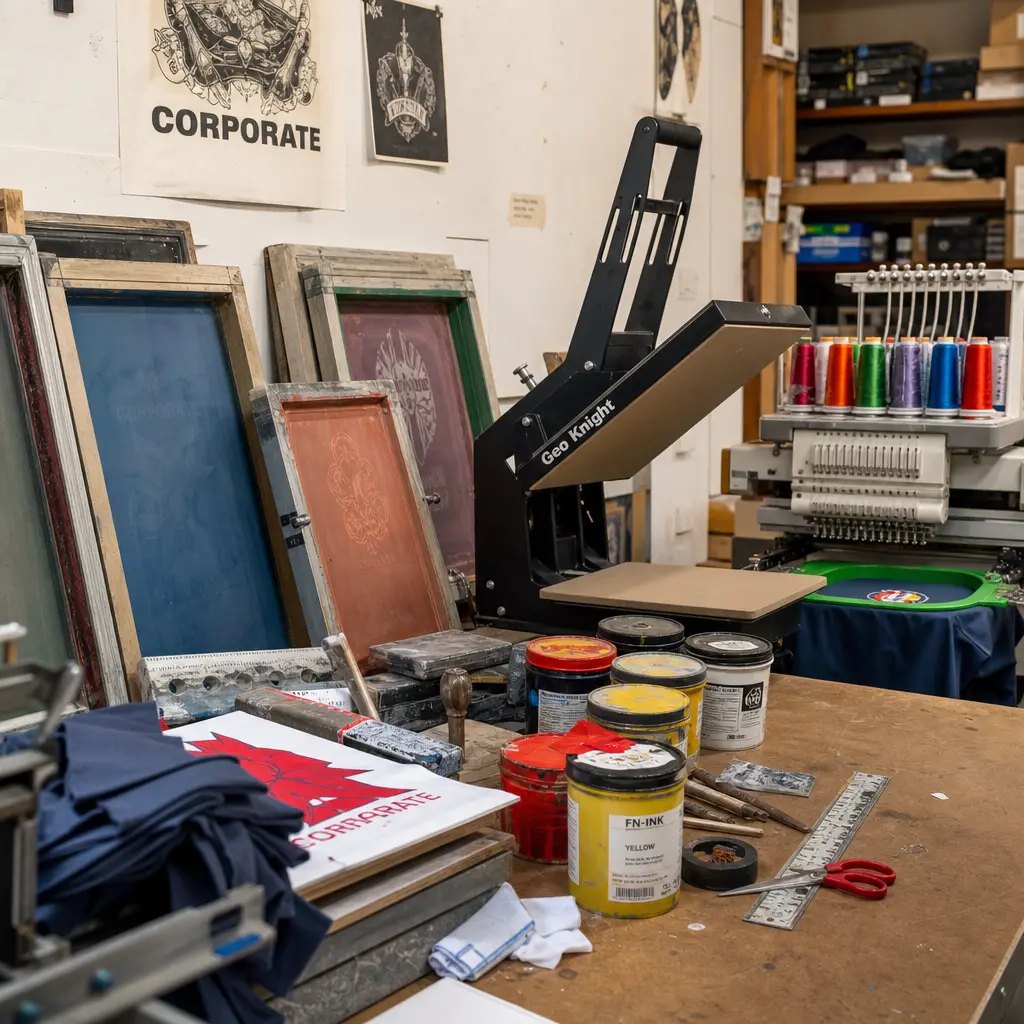
Screen printing is often the most practical branding method for tech startup logos on canvas, especially for one to three solid colors. It is cost-efficient and can look integrated when the print zone is flat and not too close to bulky seams. However, canvas texture affects edge sharpness, and natural fabric color can warm or dull ink appearance.
A logo strike-off on production fabric is the safest approval step when brand color matters. Pantone references help, but they do not guarantee the same visual result on natural cotton canvas. Fine type, thin lines, gradients, and very large prints should be reviewed early because each may require a different method or adjusted artwork.
Heat transfer can support gradients and complex color, but on rough canvas it may feel applied rather than printed into the fabric. Embroidery can look premium for small marks, but it needs backing and can distort thinner panels. Woven labels are useful when the same brand element will repeat across bags, pouches, and accessories because the label can support consistency across future orders.
- Use screen print for clean one to three color logos.
- Use woven labels for repeat programs and cross-product branding.
- Use embroidery for small premium marks on reinforced areas.
- Keep decoration away from zipper tape, bulky seams, and heavy corner reinforcement.
Use MOQ and quote tiers strategically
MOQ usually reflects real production economics: fabric sourcing, dye lots, trim procurement, cutting efficiency, print setup, and line planning. A portfolio using stock natural canvas, stock zipper tape, and a simple logo may be available at a lower MOQ. Custom-dyed canvas, custom zipper tape, printed lining, molded pullers, and retail packaging usually raise the minimum or add setup charges.
For tech startup buyers, a two-option RFQ is often efficient. Ask for one launch version using stock materials and simple branding, then ask for a fully customized version for larger reorder planning. This separates the cost of launch speed from the cost of deeper brand customization.
Be careful with very low MOQ promises. They may be valid, but they often depend on stock trims, simplified structure, or setup costs hidden inside the unit price. The right question is not only how low the supplier can go, but what changes when quantity increases.
- Ask for price tiers at 300, 500, 1,000, and 3,000 pieces if demand is uncertain.
- Compare stock-material and fully custom versions side by side.
- Separate sample, screen, mold, label, special packing, and testing charges.
- Confirm which components are custom and which are stock substitutions.
Send a quote-sheet template, not only questions
A supplier-friendly RFQ should force comparable answers. Without a structured quote sheet, one factory may include packing, another may exclude sample fees, and another may quote a different zipper or lining. Unit price alone is not enough for procurement comparison.
The quote sheet can be simple. Include program name, target quantity, Incoterm, delivery deadline, portfolio size, material spec, lining spec, zipper spec, pocket layout, logo method, packing method, carton data, sample stages, lead time, payment assumptions, quote validity, and excluded costs. Ask the supplier to mark every field as included, excluded, or optional. This makes gaps visible before sampling begins.
A practical RFQ field template also helps internal approval. Marketing can review logo placement, operations can review packing and carton data, finance can review setup charges, and procurement can compare landed cost more accurately.
- RFQ field: finished size, allowed tolerance, and contents list.
- RFQ field: canvas weight, color, finish, lining, zipper size, puller, and reinforcement zones.
- RFQ field: logo method, artwork file, Pantone reference, print size, and placement.
- RFQ field: unit price tiers, sample fee, tooling, packing, carton dimensions, gross weight, lead time, Incoterm, and quote validity.
Approve samples and QC standards before bulk production
Photo approval is not enough for canvas zipper portfolios. Key risks are tactile and functional: zipper movement, pocket fit, panel stiffness, lining behavior, odor, corner bulk, and packing thickness. For important programs, use staged approval: material swatch, logo strike-off, prototype if the layout is new, and final pre-production sample with mass-production materials.
Evaluate the sample with actual contents. Insert the documents, tablet, notebook, cables, pen, and cards expected in the kit. Close the zipper fully and open it repeatedly. Check if papers curl, if the lining catches, if the pen loop is too tight, if the tablet sleeve depth works, and if the portfolio still looks neat when partly filled. If it must go into a welcome box, test that packing before approving production.
QC expectations should be written before deposit and cutting. Define critical defects such as broken zipper, wrong logo, unsafe hardware, mildew, strong odor, missing components, or clearly wrong color. Define major defects such as zipper catching, severe stains, warped panels, unusable pockets, poor seams, or print misalignment beyond the agreed tolerance. Minor defects may include limited loose threads or approved natural canvas variation, but too many minor issues still damage kit presentation.
Any numeric tolerance should be buyer-defined and supplier-confirmed unless tied to a specific agreed standard. The approved sample, artwork file, strike-off, packing instructions, and defect list should be available during inspection.
- Measure finished size, pocket depth, and logo placement against the approved spec sheet.
- Check zipper movement around corners with the approved sample as the benchmark.
- Classify critical, major, and minor defects before production starts.
- Open cartons during inspection to check corner crushing, pressure marks, and shape recovery.
Specification comparison for buyers
| Spec decision | Recommended option | When it fits | Buyer risk to check |
|---|---|---|---|
| Outer canvas weight | 12 oz to 16 oz cotton canvas, roughly 407 to 542 GSM before washing | Reusable startup portfolios for documents, tablets, notebooks, onboarding papers, and sales inserts | Quotes using only GSM may hide different yarn density or finishing; request swatch, finished GSM tolerance, and fabric construction if available |
| Lining structure | 210D or 300D polyester lining, or unlined canvas with bound seams | Lining gives a cleaner corporate interior; unlined canvas fits natural, lower-component programs | Loose lining can catch in the zipper; unlined designs need clean internal binding and controlled seam trimming |
| Closure zipper | No. 5 nylon coil for standard portfolios; No. 8 for heavier padded builds | No. 5 suits most event, onboarding, and document kits; No. 8 helps thicker structures move smoothly | Low-cost zippers often fail at corners; require exact zipper sample, tape color approval, and puller approval |
| Logo method | Screen print for solid logos, woven label for repeat programs, embroidery for small premium marks | Screen print fits one to three color startup logos; labels are useful when branding repeats across multiple bag styles | Canvas texture can shift print color and edge sharpness; approve strike-off on production fabric |
| Stiffness and padding | Targeted foam or PE board in front/back panels, tablet sleeve, or spine only where needed | Investor packs, retail bundles, and sales kits that need a flatter presentation | Too much board increases carton volume and corner damage risk; check carton fit and compression |
| MOQ logic | 300 to 500 pieces for basic stock-material print; 800 to 1,000+ pieces for custom dye, zipper tape, or molded pullers | Lets startups test launch quantities before committing to deeper customization | Very low MOQ may mean stock trim substitution; confirm exactly which elements are custom |
| Sample approval | Material swatch, logo strike-off if needed, prototype for new layouts, final pre-production sample | Important for branded kits, reseller programs, and any portfolio with pockets or padding | Photo approval cannot confirm hand feel, zipper movement, pocket fit, odor, stiffness, or packing thickness |
| Export packing | Individual recycled polybag or paper sleeve; 20 to 40 pieces per carton depending on size and padding | Works for 3PL receiving, kit assembly, distributor warehouses, and corporate rollout | Over-tight cartons deform corners; request carton dimensions, gross weight, and packing density before approval |
Buyer checklist before sampling
- Define finished size by actual contents: tablet, A4 sheets, US letter sheets, notebook, pen, cable, badge, charger, onboarding card, or presentation inserts.
- State the use case: conference giveaway, employee onboarding, investor meeting, retail sale, distributor resale, sales team kit, or internal document organizer.
- Specify outer fabric by oz or GSM, color, weave, finishing, shrinkage tolerance, color tolerance, and whether natural slubs or seed flecks are acceptable.
- Choose zipper size, zipper color, tape material, puller type, opening direction, and whether the zipper must run around three sides smoothly.
- Provide logo artwork in vector format with Pantone references, print size, placement from seam or zipper edge, and acceptable placement tolerance.
- List internal pocket layout with pocket depth, tablet size, card slot count, pen loop width, cable holder details, and whether pockets need elastic, Velcro, mesh, or padding.
- Clarify reinforcement zones: front panel, back panel, tablet sleeve, spine, pocket corners, zipper ends, and whether the portfolio must lie flat when open.
- Require a physical pre-production sample using final materials, final logo method, final hardware, and final packing before bulk cutting starts.
- Set acceptance criteria for print alignment, seam quality, zipper movement, odor, loose threads, panel warping, corner shape, pocket fit, and carton deformation.
- Request quote data by line item: fabric, lining, zipper, puller, logo, label, packing, sample fee, mold fee if any, testing, inspection support, carton details, and Incoterm.
Factory quote questions to send
- What canvas weight, yarn construction, finished GSM, and tolerance are included in the quote?
- Is the fabric stock color, custom dyed, pigment dyed, reactive dyed, washed, or coated, and how does each option change MOQ and lead time?
- Which zipper size, grade, tape color, and puller style are quoted, and can the sample show the exact corner construction?
- Which logo method do you recommend for our artwork on this canvas, and what is the maximum print area away from seams and stiffened zones?
- Are internal pockets made from canvas, polyester lining, mesh, felt, elastic, or another material, and are all pocket materials included in the MOQ?
- Which sample stages are included: material swatch, logo strike-off, prototype, and pre-production sample?
- Can you quote price tiers at 300, 500, 1,000, and 3,000 pieces with the same specification?
- What are the carton dimensions, pieces per carton, estimated gross weight, and loading quantity for our target order volume?
- What production lead time applies after sample approval and deposit, and which material or trim has the longest procurement time?
- Can you separate tooling, sample, print screen, custom label, zipper puller mold, special packing, and testing costs from the unit price?
Quality-control points to confirm
- Finished size tolerance should be agreed on the spec sheet; as a buyer-defined example, main body tolerance may be plus or minus 5 mm and functional pockets or logo placement plus or minus 3 mm.
- Zipper performance should be checked with the approved sample as reference; buyers may define an inspection check such as 20 open-close cycles around corners without catching lining, binding, pocket edges, or loose threads.
- Print position and color should be judged against the approved strike-off under agreed lighting; any numeric tolerance should be written into the PO or quality standard.
- Seam allowance, binding, bartacks, and stitch density should be consistent at stress points, especially zipper ends, spine folds, optional handle points, and pocket corners.
- Panel stiffness must match the approved sample; warped boards, bubbling lamination, collapsed edge support, or crushed corners should be classified before production as major or critical defects.
- Odor, oil marks, mildew, water stains, rust transfer from hardware, and excessive fabric slubs outside the approved natural canvas standard should not be accepted.
- Pocket usability should be checked with the actual approved contents so tablet sleeve depth, document clearance, and pen loop width function as specified.
- Cartons should protect shape without over-compression; flattened zipper corners, bent portfolios, or pressure marks after carton opening indicate packing density should be revised.