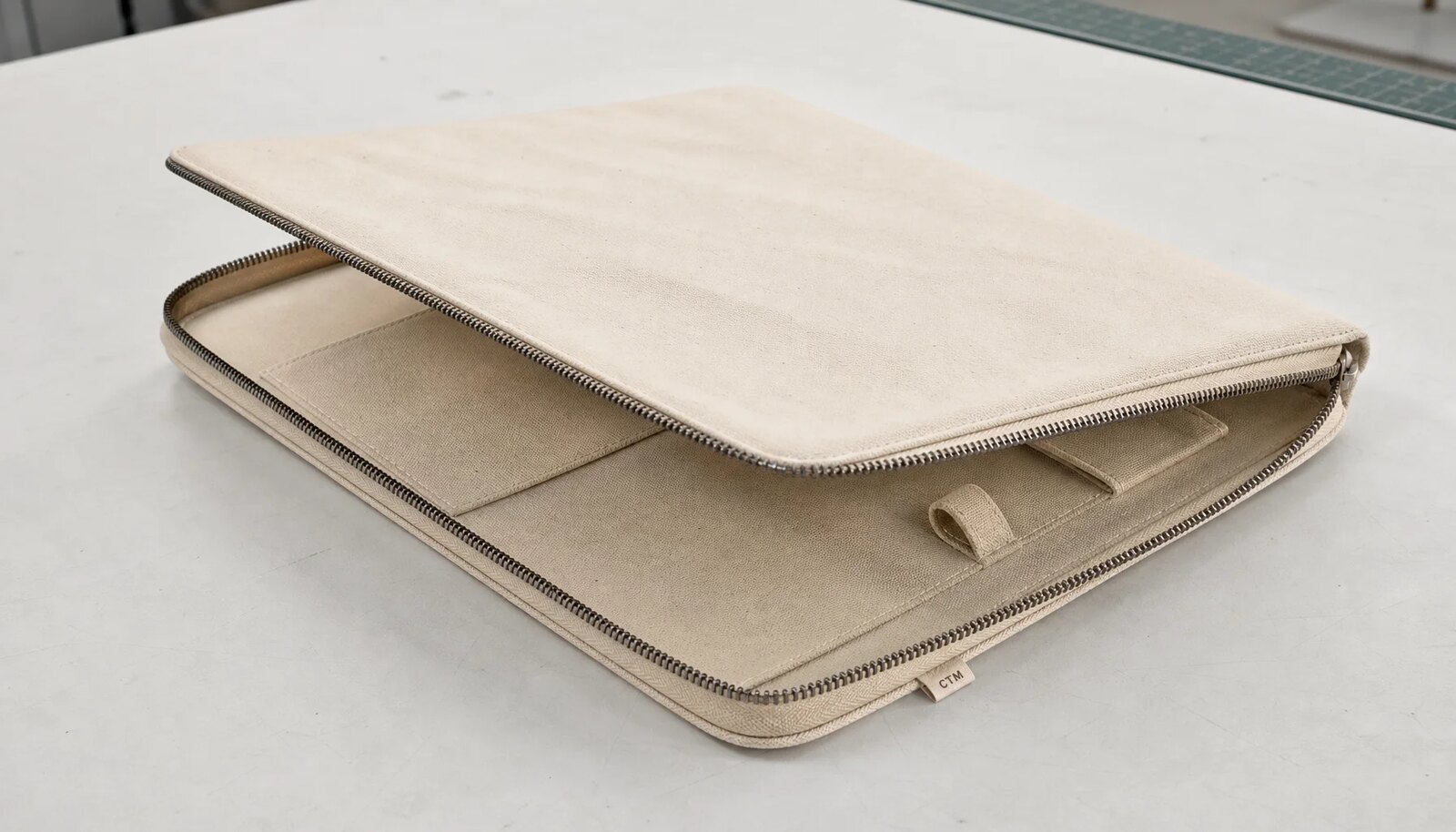
Start with the event job, not the catalog item
A canvas zipper portfolio is often bought like a simple promotional bag, but for event planners it performs several jobs at once. It protects documents, organizes kit contents, carries the client's branding, and has to arrive in countable cartons before a fixed event date. A low unit price does not help if the zipper catches, the logo sits crooked in sponsor photos, or the cartons arrive packed in a way that slows venue distribution.
Procurement should define the user journey before requesting quotes. A speaker portfolio may need a divider, pen loop, and premium hand feel. A general attendee handout may only need a flat document sleeve with a smooth zipper and clean print. A VIP client gift may require retail-ready packing, barcode labels, or insert cards. Those are different products even if the outside silhouette looks similar.
The most useful RFQ starts with intended contents. Tell suppliers whether the portfolio must carry A4 or letter documents, a notebook, a pen, a badge, a small phone, or a tablet. Include target thickness and whether the item must remain flat after packing. This prevents the supplier from quoting a portfolio that looks acceptable in a photo but strains at the zipper once loaded.
- Define the event channel: speaker, attendee, exhibitor, sponsor, VIP, or retail-style kit.
- List contents by size and thickness before asking for price.
- Decide whether presentation, speed of distribution, or low cost is the main buying priority.
Build the RFQ around measurable construction
For many event programs, 10 to 12 oz canvas is a practical starting range for lighter document portfolios. When the buyer wants more structure or tablet carry, 12 to 14 oz may be more appropriate. In GSM terms, buyers often see rough ranges around 340 to 475 GSM, depending on weave, washing, finish, and backing. Do not treat the weight number as the whole quality story. A loose weave at a higher weight can feel weaker than a more stable fabric at a moderate weight.
Ask how the body will be stabilized. Some suppliers rely on canvas density alone; others use washing, coating, lamination, interlining, or backing. Each choice affects hand feel, print behavior, packing thickness, and cost. If the portfolio will be screen printed, confirm that the surface finish supports clean ink edges and normal drying. If it will use a woven label or patch, check how the attachment sits over seams or pockets.
The zipper needs the same level of specificity. At minimum, define zipper type, tape color, slider finish, pull-tab style, and opening direction. If the supplier works with zipper gauge numbers, include them in the trim card. Ask for zipper samples or photos before approving the product sample. For visible hardware, the zipper is part of the brand experience and should not be treated as an invisible commodity.
- State canvas weight in both oz and GSM where possible.
- Specify body feel: soft, semi-structured, or firm.
- Record zipper tape, slider, puller, and trim color on an approved trim card.
Use a supplier compliance checklist inside the buying workflow
For canvas zipper portfolios for event planners, supplier compliance is not a separate paperwork exercise after price negotiation. It belongs in the RFQ stage, because missing documents can affect whether the supplier is suitable for a corporate buyer, retail program, or regulated destination market. A practical supplier compliance checklist should ask what the factory can prove, what materials are traceable, and what labeling or testing rules apply to the order.
Start with supplier identity and manufacturing control. Request the factory profile, business registration details where appropriate, factory address, production capability, and whether any sewing, printing, packing, or inspection work is subcontracted. If your company requires vendor onboarding, ask for the supplier's audit status or social-compliance audit records if available. Do not assume every supplier will have the same audit format; the buyer's job is to confirm whether the documentation meets the customer's requirement.
Next, review material and market documents. For some programs, restricted substances testing may be required for fabric, dyes, zipper components, labels, or coatings. For retail or corporate brand orders, labeling rules may include country of origin, fiber content, care information, warning labels, barcode labels, or customer-specific carton marks. Traceability records can include fabric purchase records, trim cards, batch references, production lot numbers, and inspection reports. The right document list depends on destination market and buyer policy, so name the requirement instead of asking vaguely for compliance.
- Ask for factory profile, business identity, production address, and subcontracting disclosure.
- Confirm audit status or vendor onboarding documents when the buyer requires them.
- Request restricted substances testing, labeling review, and traceability records by destination market.
Supplier comparison should expose hidden risk
A supplier comparison table is only useful when every quote is based on the same spec. Before comparing unit prices, normalize the fabric weight, zipper trim, logo method, internal layout, packing style, carton count, Incoterms, sample cost, and inspection scope. Otherwise the cheaper quote may simply be a different product.
When reviewing suppliers, look at the quote behavior as much as the price. A factory that separates fabric, zipper, lining, logo, label, packing, and carton costs is showing better production awareness than one that offers a single vague number. A trading company can still be a good choice if it names the factory, controls inspection, and communicates clearly. A promotional-products supplier may be the fastest path for a simple event run, but the buyer must lock the construction details because stock catalog language often leaves too much room for substitution.
The supplier's risk profile should match the event. For a one-time low-complexity giveaway, stock canvas and standard print may be enough. For a sponsor-branded conference kit, a premium client folder, or a multi-site event, the supplier needs stronger packing, documentation, sample control, and delivery discipline. Procurement should choose the route that protects the event outcome, not only the lowest ex-factory price.
- Compare only normalized quotes with the same construction and packing assumptions.
- Treat line-item quoting as a sign of better production control.
- Match supplier capability to event risk, distribution complexity, and documentation requirements.
MOQ and price breaks need component-level logic
MOQ is not one number for this product category. It changes with body fabric, fabric color, zipper tape color, puller finish, logo method, label type, and packing configuration. A stock natural canvas body with one-color screen print may be available at a lower MOQ than a custom dyed body with custom zipper tape and a stitched patch. That does not make the supplier difficult; it reflects the minimums behind fabric buying, dyeing, trim sourcing, and setup work.
Ask for price breaks at realistic volumes rather than a single best-case quantity. A useful quote may include a trial order, a replenishment order, and a full event-program quantity. This shows where cost savings actually begin. It also helps planners decide whether to consolidate colorways, reduce logo methods, or use stock trims to reach a better price without weakening the product.
Be careful with mixed orders. If 1,000 portfolios are split into five body colors, three logo placements, and two packing styles, the supplier may treat it as several small jobs. That affects setup time, inspection complexity, and carton separation. Procurement should ask whether MOQ applies by total order, by color, by print, by zipper, or by SKU. This is especially important for event agencies managing multiple sponsor versions.
- Request MOQ by body color, zipper color, logo method, and SKU.
- Ask for three price tiers tied to real purchase scenarios.
- Use stock trims or fewer colorways when deadline and cost matter more than customization.
Sample approval must freeze the production standard
The sample stage is where expensive mistakes are cheapest to correct. Do not approve a canvas zipper portfolio only by looking at photos. Load the sample with the actual event contents, close the zipper fully, open it repeatedly, check the corners, and inspect whether the body creases, bows, or strains. If the item includes a divider, pen loop, phone pocket, or tablet sleeve, test those features with real objects.
Different sample types should be named clearly. A proto sample may confirm size and layout while using substitute fabric or trim. A logo strike-off confirms print, embroidery, label, or patch execution. A pre-production sample should use final fabric, final zipper, final logo, final lining, final label, and final packing as closely as possible. The golden sample is the approved benchmark for bulk production and inspection.
Approval records matter. Sign or photograph the golden sample, record its version date, and list frozen details: fabric weight, color, zipper trim, puller, logo placement, print color, internal layout, finished dimensions, packing method, and carton count. If changes happen after approval, require written confirmation of cost, lead time, and inspection impact. This avoids disputes when the bulk run differs from what the event team expected.
- Separate proto sample, logo strike-off, pre-production sample, and golden sample.
- Test the sample loaded, not empty.
- Freeze approved details in writing before bulk production starts.
Quality control should be measurable, not cosmetic
A good QC plan turns buyer expectations into checkable standards. For bag products, many procurement teams use ANSI/ASQ Z1.4 or ISO 2859-1 sampling plans with agreed AQL levels, but the exact standard should be confirmed before the purchase order. The key is to define what counts as critical, major, and minor before inspection day. If the event date is near, there may be no time to debate whether a defect is acceptable.
Zipper testing deserves its own line in the inspection checklist. The inspector should open and close selected units through the full travel path, especially around corners and stress points. Set a practical cycle target, such as 50 to 100 manual open-close cycles for random samples, unless your internal standard requires another method. Check for snagging, slider roughness, tape splitting, loose stitching at zipper ends, and any sharp puller edges.
Seam and construction checks should focus on failure points: zipper ends, handle attachments if used, pocket corners, divider seams, edge binding, and topstitch lines. Use pull checks or seam-strength checks agreed with the supplier. Measure finished dimensions against tolerance, including document fit and pocket size. For branding, inspect logo position against a fixed reference point such as the zipper edge or side seam, not just by eye.
Carton QC matters because event orders are time-bound. Inspect carton count, inner pack quantity, carton marks, barcode visibility if used, gross weight, and moisture protection. If goods will be palletized or stacked at a venue, agree on reasonable carton compression, drop, or stacking expectations based on freight mode. A perfect portfolio packed in weak cartons can still become a receiving problem.
- Set AQL level and defect classifications before production.
- Use zipper cycle checks and seam checks on random samples.
- Inspect cartons for count accuracy, strength, marks, and distribution readiness.
Logo, labeling, and market rules should be checked early
Branding decisions should follow the fabric and use case. Screen print is usually practical for simple one-color artwork on stable canvas. Woven labels and stitched patches can protect small text and premium identity. Embroidery can work on heavier canvas, but fine details may lose clarity if the artwork is too small. Heat transfer may be useful for certain multi-color logos, but buyers should check adhesion, hand feel, and edge behavior on the selected canvas.
Placement should be approved on a physical sample or at least a scaled placement proof tied to actual dimensions. Logos can look balanced in a render and still sit too close to the zipper, fold line, or pocket seam. Define placement tolerance in millimeters and state whether slight hand variation is acceptable. For multi-sponsor event portfolios, create a placement map so the factory does not improvise between versions.
Labeling is part of compliance, not decoration. Depending on market and sales channel, the buyer may need country of origin, fiber content, care label, product warning, barcode, SKU label, or customer-specific hangtag. If the portfolios are distributed at a private event, labeling may be simpler, but carton marks and internal receiving labels can still be critical. Ask the supplier to review the destination and channel before sample approval so label changes do not delay packing.
- Choose logo method after testing it on the selected canvas.
- Set logo placement tolerance from fixed edges or seams.
- Confirm product labels, carton labels, and market-specific labeling rules before bulk packing.
Packing should match the distribution plan
Packing is often where a good product becomes hard to use. Event planners may need to unload cartons, count units, split kits by room, or ship to multiple venues. If portfolios are packed too tightly, they crease or deform. If they are packed loosely, freight cost rises. If carton marks are vague, local teams waste time sorting. Packing instructions should be part of the RFQ, not a last-minute warehouse request.
Decide whether each unit needs a polybag, paper band, insert card, tissue, barcode label, or protective board. For sustainability programs, confirm whether plastic-free packing is required and whether it still protects the canvas from moisture and abrasion. For retail-style presentation, the buyer may need cleaner unit packing. For direct conference distribution, fast counting and carton clarity may matter more than decorative packaging.
Carton planning should reflect the final route. A single-venue delivery may use standard master cartons with clear quantity labels. A multi-site event may need cartons packed by city, room, sponsor, kit number, or delivery wave. Ask for carton dimensions and gross weight before freight booking so the logistics team can estimate volumetric weight and handling needs. Carton marks should match the packing list exactly.
- Specify unit packing, inner count, master carton count, and carton marks in the RFQ.
- Request carton dimensions and gross weight before confirming freight.
- Pack by venue, kit, SKU, or sponsor when distribution complexity is high.
Lead time control is about approvals and handoffs
Sewing time is only one part of the calendar. The actual critical path may include artwork cleanup, logo strike-off, fabric color approval, zipper tape sourcing, label proofing, carton marks, pre-production sample approval, bulk production, inspection, export documents, freight booking, customs clearance, and local delivery. For event planners, the final delivery date is fixed, so the schedule must work backward from the event.
Ask the supplier to break lead time into stages. Sample production, sample review, material procurement, cutting, sewing, logo application, packing, inspection, and shipment handover should each have a target date. This makes it easier to see which decisions can stop the order. Custom zipper tape, custom dyed canvas, new woven labels, and revised carton labels are common delay points.
Procurement should also name the approval owner on the buyer side. Many orders lose days because artwork, sample comments, or packing instructions sit between departments. A clean approval path protects both sides. If the event deadline is tight, reduce customization rather than compressing inspection or packing time. The product still has to arrive usable, countable, and ready for distribution.
- Build the timeline backward from the event delivery date.
- Separate sample, material, production, inspection, and shipping milestones.
- Identify the buyer-side approval owner for artwork, sample, labels, and packing.
Specification comparison for buyers
| Supplier option | What to verify | Commercial advantage | Buyer risk to control |
|---|---|---|---|
| Direct sewing factory | zipper source record, production-line zipper test photos, approved trim card, cutting marker photos, and final open-carton count | Better sample-to-bulk control and faster production feedback | May be weaker on export paperwork or branded packing unless checked early |
| Trading company | Factory name, production photos, trim-source proof, and who owns QC decisions | Can coordinate small mixed orders and extra services | Markup can hide real factory capability and slow defect decisions |
| Specialized bag workshop | zipper gauge, zipper tape width, puller finish, binding tape, corner reinforcement, seam allowance, and document-size tolerance | More practical for detailed construction, trims, and repeat programs | Capacity may be limited during peak seasons |
| Low-price general supplier | 300D-600D polyester, 10-12 oz canvas, or recycled PET with backing stiffness matched to document weight | Useful for simple promotional runs with loose specs | Material downgrades, weak packing, and vague inspection scope can erase savings |
| Retail-ready supplier | flat packing, insert board if needed, SKU bundles, carton weight limit, moisture protection, and barcode visibility | Can handle labels, SKU separation, carton marks, and receiving rules | Higher unit cost must be compared against reduced warehouse work |
| Compliance-focused supplier | Fabric records, labeling review, test plan, and production traceability | Safer for retail programs and repeat brand orders | Documentation claims need evidence, not only sales language |
| Local sample room plus bulk factory | Signed sample, bulk factory handoff, first-piece photos, and deviation owner | Good for complex branding before large production | Sample room quality may not match bulk line unless handoff is controlled |
Buyer checklist before sampling
- Define the exact use case: speaker kit, attendee handout holder, VIP document case, exhibitor folder, or retail-style gift set.
- List the intended contents and target thickness before requesting price, including brochures, notebook, pen, badge, phone, or tablet.
- Lock finished size, zipper opening direction, internal pockets, pen loop, divider, handle, and acceptable dimensional tolerance.
- Specify canvas weight in oz and GSM, plus whether the body should feel soft, semi-structured, or firm.
- Name the zipper type, zipper gauge if known, tape color, slider finish, pull-tab style, and minimum open-close test expectation.
- Choose one logo method for the first order and state artwork size, placement, color count, and approval method.
- Request a pre-production or golden sample using final fabric, zipper, lining, label, logo, and packing.
- Ask for supplier compliance files: factory profile, audit status if available, restricted substances test records, labeling review, and traceability records relevant to the selling market.
- Require line-item quote detail for fabric, zipper, lining, label, logo application, insert card, polybag, carton, inspection, and shipping term.
- Confirm MOQ by body color, zipper color, logo method, size, and packing configuration so reorder planning is realistic.
Factory quote questions to send
- What canvas weight do you propose in oz and GSM, and what finish or backing will you use for body structure?
- Is the canvas stock, custom dyed, washed, coated, laminated, or certified under any material program you can document?
- What zipper type, approximate gauge, pull type, tape color, and slider finish will you supply, and can you show the exact trim card?
- Which logo method do you recommend for this fabric, and what are the limits on logo size, fine text, color count, and placement tolerance?
- What is your MOQ by body color, zipper color, logo method, size, and carton configuration?
- What sample type will you send, what parts will be final, what parts may be substitute, and how long does each sample round take?
- Can you quote body fabric, zipper, lining, label, logo application, insert card, polybag, carton, inspection, and freight basis separately?
- What compliance documents can you provide for our destination market: factory profile, audit status, restricted substances testing, labeling review, and traceability records?
- What inspection standard do you normally use for bags, including AQL level, zipper cycle count, seam checks, and carton drop or stacking checks?
- What are your tolerances for overrun, shortage, finished dimensions, seam variation, logo placement, color shade, and carton quantity?
Quality-control points to confirm
- Use a defined inspection plan such as ANSI/ASQ Z1.4 or ISO 2859-1 with AQL levels agreed before production; many buyers use tighter levels for critical defects and standard levels for major/minor defects.
- Classify critical defects as unsafe sharp edges, broken zipper teeth, mold or contamination, wrong logo, wrong product, missing required label, or carton count errors that block delivery.
- Classify major defects as zipper snagging or splitting, open seams, visible stains, badly misaligned logo, incorrect pocket layout, severe color shade variation, or portfolios that do not fit the approved contents.
- Classify minor defects as loose threads, light chalk marks, slight stitch waviness, small non-front-facing shade variation, or packaging scuffs that do not affect presentation.
- Canvas weight should match the approved oz/GSM tolerance stated in the spec, with fabric hand feel and body structure compared against the golden sample.
- Zipper should pass repeated open-close checks on random samples; set a practical cycle target before production, such as 50 to 100 manual cycles for event-use portfolios unless your buyer standard requires more.
- Zipper must travel through the full opening range without catching at corners, splitting the tape, pulling away from the seam, or scratching the user's hand.
- Seams at zipper ends, pocket corners, handle points, divider edges, and stress points should pass pull checks or seam-strength checks agreed with the supplier before bulk sewing.
- Logo placement should stay within the approved tolerance, commonly controlled in millimeters from zipper, seam, or edge reference points, and color should match the approved strike-off or print proof.
- Finished dimensions should be checked against the approved size with a stated tolerance, including document fit, pocket width, tablet clearance if required, and zipper opening width.