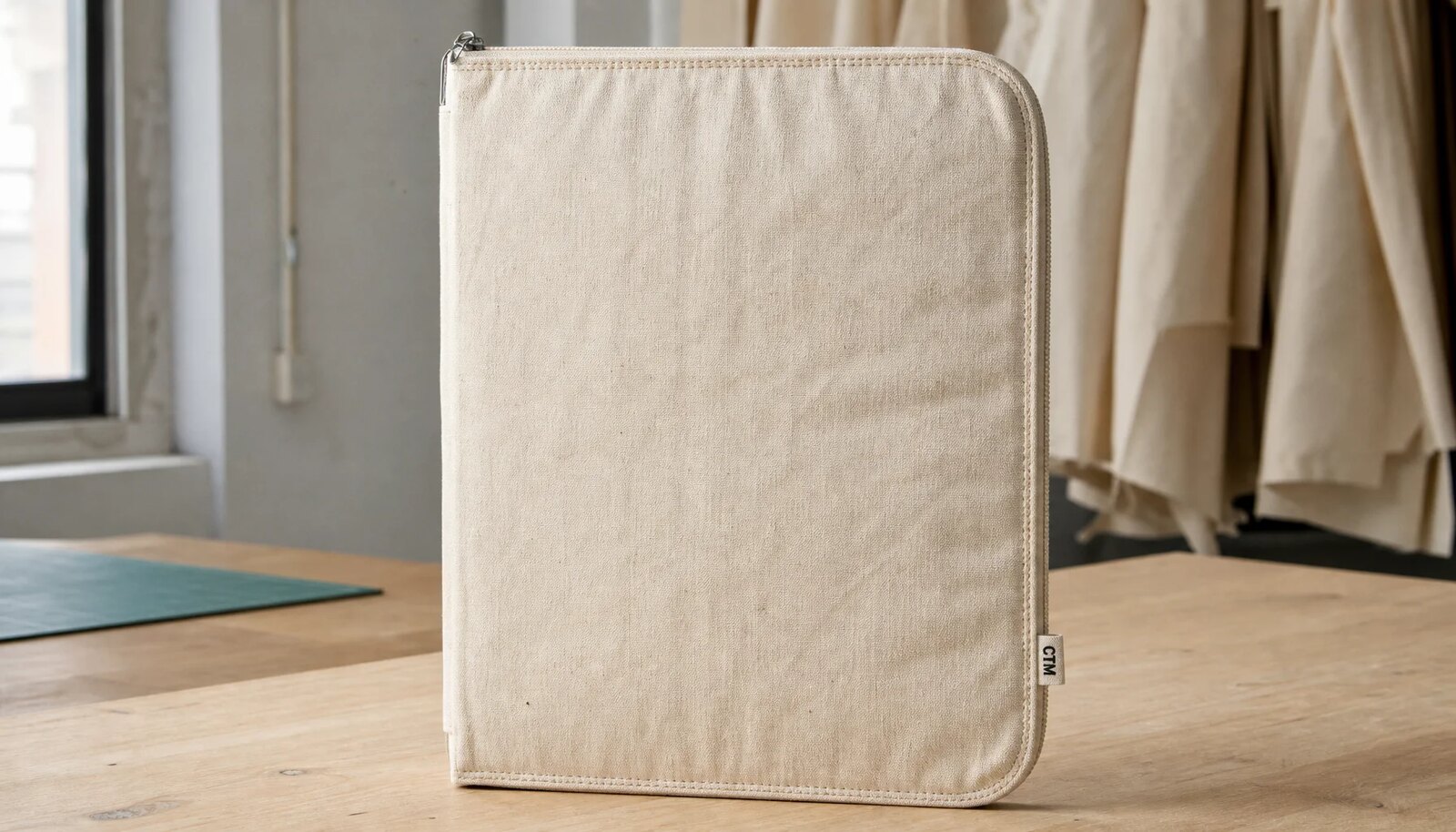
Start With a Procurement Brief, Not a Product Nickname
“Canvas zipper portfolio” sounds specific, but it is still too loose for a purchase order. One supplier may quote a slim document pouch. Another may quote a structured presentation folder with lining, binding, and retail packing. A third may assume a lower-cost canvas-look polyester pouch because the RFQ does not define the material. Those differences change price, MOQ, carton volume, lead time, and inspection criteria.
For an eco apparel brand, the portfolio is part of the selling environment. It may carry lookbooks, line sheets, fabric swatches, press documents, or buyer-meeting materials. If the canvas feels weak, the zipper catches, the print sits off-center, or the carton arrives dusty, the accessory can undermine the brand message even if the garments are well presented.
A strong brief explains what the item must carry, where it will ship, and which claims will appear on the product or packaging. Include finished size, usable internal size, expected fill thickness, canvas type, zipper grade, branding method, logo placement, lining or binding, packing format, destination market, warehouse rules, and compliance documents. Suppliers can then quote the same item instead of filling gaps with assumptions.
- State the end use: lookbook carrier, sales-kit folder, press pack, distributor pouch, swatch kit, or internal handout.
- Define both outer finished size and usable internal size because seams and zipper tape reduce capacity.
- List every branding position, including front print, side label, inner label, patch, pull tab, or back mark.
- Identify whether the product is internal-use, distributor-facing, event-use, or retail-ready.
- Separate required eco claims from general preferences so the supplier knows what must be documented.
Build a Technical Specification Suppliers Can Repeat
A photo can show style, but it cannot control production. A repeatable specification tells the factory what to buy, cut, sew, pack, and inspect. For light document handouts, 12 oz cotton canvas, often around 340 GSM depending on supplier conversion, may be enough. For many apparel brand presentation programs, 14 oz canvas, around 390 to 420 GSM, is a practical middle ground: substantial in the hand without becoming too bulky in cartons. For thicker catalogs or swatch cards, 16 oz canvas, often around 450 GSM or above, can add structure but also increases sewing resistance, cost, and freight volume.
Be precise with the word “canvas.” It can mean conventional cotton canvas, organic cotton canvas, recycled cotton blend, recycled polyester fabric with a canvas texture, cotton-poly blend, or another woven textile. These materials differ in hand feel, shade consistency, shrinkage, dye behavior, price, and documentation. If your product or packaging will say “organic cotton” or “recycled content,” the RFQ must use the same wording and request evidence tied to the actual material.
Construction details matter as much as fabric. Confirm whether the portfolio is unlined, lined, bound at interior seams, reinforced at zipper ends, or supported with an insert. A simple unlined pouch may work for internal papers. A lined or bound interior looks cleaner when a sales rep opens it in front of buyers. Add seam allowance, corner shape, thread color, label placement, zipper path, and raw-edge rules to the spec.
- Use 14 oz, approximately 400 GSM, as a practical starting point when no special performance need is known.
- Specify fiber composition, canvas weight, weave, finish, color standard, coating status, and shrinkage expectation.
- Confirm whether the item is unlined, lined, bound, padded, reinforced, or flat-seamed.
- Record usable internal size after zipper tape and seams, not only outside dimensions.
- Attach the same technical sheet to the RFQ, approved sample, purchase order, and inspection brief.
Use Tolerances Instead of Subjective Quality Language
Words like “premium,” “neat,” and “accurate” create disputes because they do not tell an inspector when to pass or fail a unit. A canvas zipper portfolio is a sewn textile product, so some variation is normal, especially with heavier cotton and manual sewing. The buyer’s job is to define how much variation still protects presentation and function.
For slim portfolios, many buyers start with finished width and height tolerance around +/-3 mm to +/-5 mm, depending on size, fabric behavior, and construction. Gusset depth or loaded thickness needs a separate tolerance because it depends on the intended fill. If the portfolio must hold a catalog and swatch cards, test that real set during sampling instead of relying only on nominal dimensions.
Logo and label placement need their own numbers. A small woven side label may need +/-2 mm to +/-3 mm from the approved seam position because a small shift is visible. A larger screen print may work at +/-3 mm to +/-5 mm if it remains visually centered and clear of seams. If artwork sits close to zipper tape, corners, or stitching, specify a minimum safe distance.
Do the same for finishing. Ask the factory to record the approved sample’s stitch density and seam appearance, then use that sample as the reference. Define thread trimming clearly, such as no loose thread longer than 5 mm on visible surfaces and no internal loose thread that can snag documents.
- Set finished width and height tolerance before bulk cutting, commonly +/-3 mm to +/-5 mm for slim portfolios.
- Set placement tolerance separately for labels, prints, patches, embroidery, and pull tabs.
- Define loose-thread allowance, stain rejection, raw-edge rules, and acceptable canvas slub variation.
- Use the signed gold seal sample as the reference for hand feel, shape, stitch appearance, and zipper path.
- Share tolerances with the factory and inspector before production, not after defects appear.
Specify Zipper, Thread, and Reinforcement Before Price Comparison
The zipper is the working part of the product. If it drags, catches, or separates, the whole portfolio feels cheap even when the canvas is correct. For slim document portfolios, a No. 5 nylon coil zipper is usually sufficient. For heavier fill, frequent opening, swatch kits, or rougher distributor handling, a No. 8 coil zipper gives more margin. The RFQ should name zipper size, tape color, tape width if required, slider type, puller style, visible finish, top-stop method, and whether the zipper is closed-end or runs around the portfolio.
Avoid vague wording such as “metal zipper” or “good zipper.” Many canvas zipper portfolios use nylon coil zippers with metal sliders or pullers. The visible part may look metal while the coil itself is nylon. If the buyer wants a certain appearance, write it clearly: antique brass puller, matte nickel slider, black oxide finish, or self-fabric pull tab. If a custom branded puller is required, treat it as a custom trim with tooling cost, MOQ, approval sample, and added lead time.
Thread and reinforcement affect durability and appearance. Ask whether the supplier will use polyester or cotton thread, and whether thread color will match the body, zipper tape, logo, or contrast design. Confirm reinforcement at zipper ends, corners, patches, labels, and any tab or handle points. Backstitching, bartack, or reinforced seam passes should be sampled and approved.
- Use No. 5 nylon coil zipper for slim paper use; consider No. 8 for heavier or frequent-use portfolios.
- Specify zipper tape color, slider finish, puller shape, puller length, and top-stop security.
- Clarify whether the metal appearance applies to slider and puller, not the zipper coil.
- Confirm thread type, thread color, seam allowance, and reinforcement at stress points.
- Require written approval before any zipper, slider, puller, thread, label, lining, or binding substitution.
Choose Branding That Works With Canvas Texture and MOQ
Branding should fit the artwork, fabric surface, and order structure. Screen printing is efficient for simple one- or two-color artwork on flat canvas panels. It can work well on natural or dyed cotton canvas, but a strike-off matters because canvas texture affects edge sharpness and ink coverage. If brand color is important, provide a Pantone reference and remember that ink on natural canvas will not look exactly like ink on coated white paper.
A woven label is often dependable for eco apparel brands that prefer quieter branding. It can also work across multiple body colors if the label design is planned well. A sewn patch adds texture but increases sewing time, can create pressure marks during packing, and needs its own placement tolerance. Embroidery can look premium, yet dense stitching on heavy canvas may pucker the panel, especially near seams or zippers.
Heat transfers may suit detailed artwork, but verify adhesion, hand feel, rub performance if relevant, and compatibility with the fabric finish. Whatever method is chosen, approve artwork scale, print area, placement, color standard, and acceptable variation. If the order includes multiple artworks or colors, ask whether MOQ and setup charges apply per artwork, per body color, per label design, or per production run.
- Use screen print for simple flat logos and request a strike-off before bulk production.
- Use woven labels when repeatability across fabric shades is more important than large front branding.
- Sample embroidery to check puckering, thread tension, and backing visibility.
- Confirm setup charges for screens, label tooling, patches, pull tabs, and color changes.
- Keep approved artwork, strike-offs, and label proofs with the purchase order and inspection file.
Request Compliance Evidence Tied to the Actual Product
Supplier compliance is not a marketing phrase. For eco apparel brands, words such as organic, recycled, responsible, low-impact, biodegradable, plastic-free, compostable, or sustainable may trigger internal review, retailer review, or legal review. The supplier should provide evidence tied to the actual material, factory, packaging, and production route—not a generic brochure or certificate for a different program.
For organic cotton, ask for the documentation path before confirming the claim. Depending on the buyer’s standard and sales channel, this may include supplier scope certificates, chain-of-custody records, material declarations, and transaction documentation connected to the relevant material lot. For recycled cotton or recycled polyester canvas-look fabric, ask whether recycled-content transaction certificates, supplier declarations, or other traceability records are available for the actual fabric used. The document names, company names, site addresses, material categories, issue dates, and expiry dates should align with the order.
Also review restricted substances and factory compliance. Request a material declaration for canvas, zipper, thread, lining, binding, labels, patches, coatings, finishes, inks, and packaging where relevant. Ask whether the supplier can support a restricted-substance review or buyer RSL confirmation for inks, dyes, coatings, trims, and packaging. For factory compliance, request the factory audit or social compliance file your brand requires, such as an internal audit, customer audit, or recognized third-party social compliance record if applicable. If packaging claims are used, such as recycled paper, FSC paper, plastic-free packing, or compostable bags, request evidence specific to that packaging claim.
- Request legal entity, production-site address, production role, and compliance contact for the actual factory.
- For organic cotton, check scope certificate path, material lot traceability, and claim wording before approval.
- For recycled content, ask about transaction certificates or product-specific recycled-content records where applicable.
- Request material declarations for canvas, zipper, thread, lining, labels, patches, coatings, inks, and packaging.
- Keep compliance files, trim cards, signed samples, carton records, and shipment documents together for traceability.
Turn Every Quote Into a Comparable Production Plan
A unit price is useful only when you know what is included. A professional quote for wholesale canvas zipper portfolios should state fabric type and weight, zipper specification, logo method, print colors, label type, lining or binding, sample stages, tooling charges, packing method, carton quantity, estimated carton dimensions, payment terms, Incoterms, MOQ, production lead time, inspection scope, and compliance documents included.
MOQ is usually driven by material and setup, not the portfolio shape alone. Stock natural canvas and standard zipper tape can support lower quantities. Custom-dyed canvas, special zipper tape, custom pullers, woven labels, multiple artworks, or SKU-specific packing can raise MOQ quickly. Ask whether MOQ applies per body color, zipper color, artwork, label design, packing format, shipment, or total order.
For landed-cost comparison, collect carton quantity, gross weight, carton dimensions, estimated CBM, export terms, inspection cost, document charges, and inland freight or handling. A lower ex-works price can lose its advantage if cartons are inefficient, labels are wrong, or documents are missing. Use one RFQ template for every supplier so omissions are easy to identify.
- Compare suppliers only when fabric, zipper, logo, lining, packing, and compliance scope are identical.
- Treat missing line items as risk, not savings.
- Confirm quoted dimensions are finished dimensions, not cut-panel dimensions.
- Ask whether sample fees, screens, and label tooling are credited after bulk order placement.
- Require Incoterms, payment terms, lead time trigger, carton data, and inspection scope in the quote.
Use Sampling to Prevent Bulk Production Failures
Sampling should test the complete product, not only the front-panel look. Start with a fabric swatch if the material is new or if a claim depends on a specific source. If fabric is dyed, review lab dips or an agreed color standard. Approve a print strike-off or label proof before building the final pre-production sample. If the structure is new, request a plain prototype first to check size, zipper path, corner shape, loading thickness, and internal fit.
The pre-production sample should use the exact fabric, zipper, thread, label, print, lining, binding, and packing planned for bulk. Load it with real documents, catalogs, line sheets, or swatch cards. Zip and unzip it repeatedly. Place it flat on a table. Check whether the body twists, bulges, puckers, or curls. Open it and inspect inside seams because paper snagging often starts with rough binding, exposed raw edges, or loose thread.
The final approved sample becomes the gold seal reference. Sign and date it, photograph it from all sides, record measurements, and note any approved deviations. Keep one sample with the buyer and one with the factory if possible. If approval is issued “with comments,” the factory should provide corrected photos or a revised sample before bulk cutting.
- Approve swatch, strike-off or label proof, prototype if needed, pre-production sample, packed sample, and gold seal sample in sequence.
- Load the sample with the heaviest expected document set before approving structure.
- Open and close the zipper repeatedly to check snagging, tape tension, top stops, and slider movement.
- Measure finished size, internal size, logo placement, and zipper path, then record results.
- Sign, date, photograph, and archive the approved sample before bulk production starts.
Set In-Line and Final Inspection Standards
Quality control needs measurable rules before cutting starts. Common defects include uneven panels, twisted shape, zipper misalignment, skipped stitches, loose threads, weak top stops, crooked labels, artwork drift, stains, shade variation, odor, damp cartons, and packing damage. The purchase order or inspection brief should define size tolerance, stitch expectations, zipper operation, logo placement, fabric shade range, thread trimming, defect classification, packing accuracy, and carton condition.
Use defect classes. Critical defects include wrong material, wrong logo, unsafe sharp hardware, broken zipper, torn seam, mold odor, heavy stain, or any issue that makes the product unusable. Major defects include visible logo misplacement, severe puckering, zipper snagging, mixed SKU packing, incorrect carton quantity, wrong zipper color, or body distortion that affects normal use. Minor defects may include short thread ends, slight slub variation within the approved reference, or small cosmetic marks that do not affect presentation.
For final inspection, many buyers reference ANSI/ASQ Z1.4 or ISO 2859-1 sampling with General Inspection Level II, unless their company standard requires another plan. Set AQL levels before production; the buyer may choose stricter handling for critical defects and separate limits for major and minor defects. Inspection should include random carton selection, open-carton counts, measurement checks, zipper pull-cycle checks, seam-strength checks, logo review, interior finish checks, odor checks, packing verification, and carton mark confirmation.
- Classify critical, major, and minor defects before production begins.
- Use a defined sample-size plan, such as ANSI/ASQ Z1.4 or ISO 2859-1, if applicable to the order.
- Check zipper operation on sampled units, not only on display samples.
- Inspect internal seams and binding because they affect document usability.
- Send the same technical sheet, PO, packing spec, compliance requirements, and gold seal sample to the inspector.
Design Packing for Protection, Freight, and Receiving
Packing affects both product quality and landed cost. Flat packing usually reduces cubic volume for slim portfolios, but the product must not develop permanent fold lines, zipper impressions, crushed corners, or print transfer. If the portfolio has embroidery, a raised patch, structured insert, or thick swatch capacity, it may need tissue, paper wrap, insert board, or a looser carton configuration. Approve a packed sample before bulk packing begins.
Eco apparel brands often want less plastic. That goal is reasonable, but packing still has to protect natural canvas from dust, moisture, odor, and abrasion during export handling. If individual polybags are not desired, test paper wrap, belly bands, or bulk inner packs. Natural and undyed canvas can show water marks and oil marks easily, so clean packing tables, moisture control, sealed cartons, and suitable warehouse handling matter. If silica gel, moisture liners, recycled paper, or compostable bags are used, confirm destination rules and evidence for any claims.
Carton specifications should be written in detail. State unit pack method, inner pack count, master carton count, carton dimensions, gross weight limit, carton marks, SKU label position, barcode placement, destination address format, and whether mixed cartons are permitted. Many avoidable costs occur after production because cartons are too heavy, too large, mislabeled, damp, or mixed in a way that forces manual sorting.
- Approve packed sample format before bulk packing starts.
- Specify flat pack, folded pack, paper wrap, polybag, tissue, belly band, insert board, silica gel, and moisture-liner rules.
- Set inner pack, master carton quantity, carton dimensions, and gross weight limit.
- Define carton marks, SKU labels, barcode placement, mixed-carton rules, and receiving-label format.
- Request photos of open cartons, top layer, side packing, carton marks, and sealed cartons before shipment.
Specification comparison for buyers
| Supplier option | What to verify | Commercial advantage | Buyer risk to control |
|---|---|---|---|
| Direct sewing factory | zipper source record, production-line zipper test photos, approved trim card, cutting marker photos, and final open-carton count | Better sample-to-bulk control and faster production feedback | May be weaker on export paperwork or branded packing unless checked early |
| Trading company | Factory name, production photos, trim-source proof, and who owns QC decisions | Can coordinate small mixed orders and extra services | Markup can hide real factory capability and slow defect decisions |
| Specialized bag workshop | zipper gauge, zipper tape width, puller finish, binding tape, corner reinforcement, seam allowance, and document-size tolerance | More practical for detailed construction, trims, and repeat programs | Capacity may be limited during peak seasons |
| Low-price general supplier | 300D-600D polyester, 10-12 oz canvas, or recycled PET with backing stiffness matched to document weight | Useful for simple promotional runs with loose specs | Material downgrades, weak packing, and vague inspection scope can erase savings |
| Retail-ready supplier | flat packing, insert board if needed, SKU bundles, carton weight limit, moisture protection, and barcode visibility | Can handle labels, SKU separation, carton marks, and receiving rules | Higher unit cost must be compared against reduced warehouse work |
| Compliance-focused supplier | Fabric records, labeling review, test plan, and production traceability | Safer for retail programs and repeat brand orders | Documentation claims need evidence, not only sales language |
| Local sample room plus bulk factory | Signed sample, bulk factory handoff, first-piece photos, and deviation owner | Good for complex branding before large production | Sample room quality may not match bulk line unless handoff is controlled |
Buyer checklist before sampling
- Define the end use: showroom lookbook carrier, sales-kit folder, distributor document pouch, press pack, reusable swatch kit, or internal meeting handout.
- Lock finished closed size, usable internal document size, gusset or fill allowance, maximum loaded thickness, and whether the portfolio must stay flat when zipped.
- Specify fabric by fiber, weave, weight, color, finish, coating status, and shrinkage expectation; for example, 14 oz cotton canvas, approximately 400 GSM, plain weave, natural, uncoated.
- Match material wording to evidence: conventional cotton, organic cotton, recycled cotton blend, recycled polyester canvas-look fabric, or another approved material.
- Choose zipper details before price comparison: No. 5 or No. 8 nylon coil, tape width, tape color, slider type, puller shape, finish, top stop, bottom stop, and replacement approval rule.
- Confirm branding method and placement: screen print, woven label, sewn patch, embroidery, heat transfer, custom pull tab, inner label, or mixed methods with tolerances.
- Define sample stages: swatch, lab dip if dyed, print strike-off or label proof, structure prototype if new, pre-production sample, packed sample, and signed gold seal sample.
- Set measurable tolerances for finished size, logo placement, stitch density, zipper function, shade variation, thread trimming, stain allowance, odor, and carton quantity accuracy.
- Agree packing before production: unit wrap, inner pack count, master carton count, carton dimensions, gross weight limit, moisture protection, barcode position, and mixed-carton rules.
- Use one quote basis for every supplier: fabric, zipper, logo, lining or binding, packing, compliance documents, sample charges, tooling, MOQ, Incoterms, payment terms, lead time, and inspection scope.
Factory quote questions to send
- What exact fabric is included: fiber composition, canvas weight in oz and GSM, weave, color standard, dye method if any, finish, coating, and expected shrinkage range?
- What evidence supports the material description: conventional cotton declaration, organic cotton scope certificate path, recycled-content transaction certificate path, or supplier material declaration?
- What finished size and usable internal size are quoted, and what tolerance applies to width, height, seam allowance, gusset, and loaded thickness?
- Which zipper is included: No. 5 or No. 8 coil, tape width, tape color, slider material, puller style, finish, top stop, bottom stop, zipper supplier, and approval process for substitutions?
- What thread type, thread color, stitch density, seam allowance, and reinforcement method will be used at zipper ends, corners, labels, patches, tabs, and stress points?
- Which branding method is assumed, how many print colors are included, what artwork size is included, and what are the charges for screens, Pantone matching, strike-offs, label tooling, or artwork revisions?
- Does MOQ apply per body color, fabric lot, zipper tape color, artwork, print color, woven label design, packing configuration, shipment, or total order?
- Which sample stages are included, what is the lead time for each stage, and are sample fees, screens, or tooling charges credited after bulk order placement?
- Which packing spec is included: flat pack, folded pack, individual polybag, paper wrap, tissue, belly band, insert board, silica gel, inner carton, export carton, or retail-ready labels?
- When does bulk lead time start: deposit receipt, artwork approval, material approval, sample approval, compliance approval, purchase order confirmation, or all approvals complete?
Quality-control points to confirm
- Use an agreed inspection plan, commonly ANSI/ASQ Z1.4 or ISO 2859-1 with General Inspection Level II for final random inspection, unless the order size or buyer standard requires another level.
- Set AQL limits before production; many buyers use stricter limits for critical defects, then separate major and minor limits based on brand risk and distribution channel.
- Finished closed dimensions should follow approved tolerance, commonly +/-3 mm to +/-5 mm for slim portfolios, with separate tolerance for gusset or loaded thickness.
- Usable internal size must be checked with the actual lookbook, line sheet, catalog, or swatch card set because seams and zipper tape reduce capacity.
- Critical defects can include wrong material, wrong logo, broken zipper, sharp hardware, mold odor, heavy stain, torn seam, unsafe trim, or any issue making the portfolio unusable.
- Major defects can include zipper snagging, severe panel distortion, visible logo misplacement, incorrect zipper color, mixed SKU packing, wrong carton quantity, seam weakness, or obvious shade mismatch.
- Minor defects can include short loose threads, slight canvas slub variation within the approved reference, or small cosmetic marks that do not affect use or presentation.
- Run zipper pull-cycle checks on sampled units, opening and closing fully multiple times to identify snagging, weak top stops, loose pullers, misaligned tape, or slider failure.
- Check seam strength at corners, zipper ends, label attachment, patches, pockets, and tabs by reasonable manual pull testing or a buyer-specified lab method for higher-risk programs.
- Handle moisture and odor seriously: inspect cartons for dampness, musty smell, water marks, oil transfer, mold risk, and insufficient drying before packing.