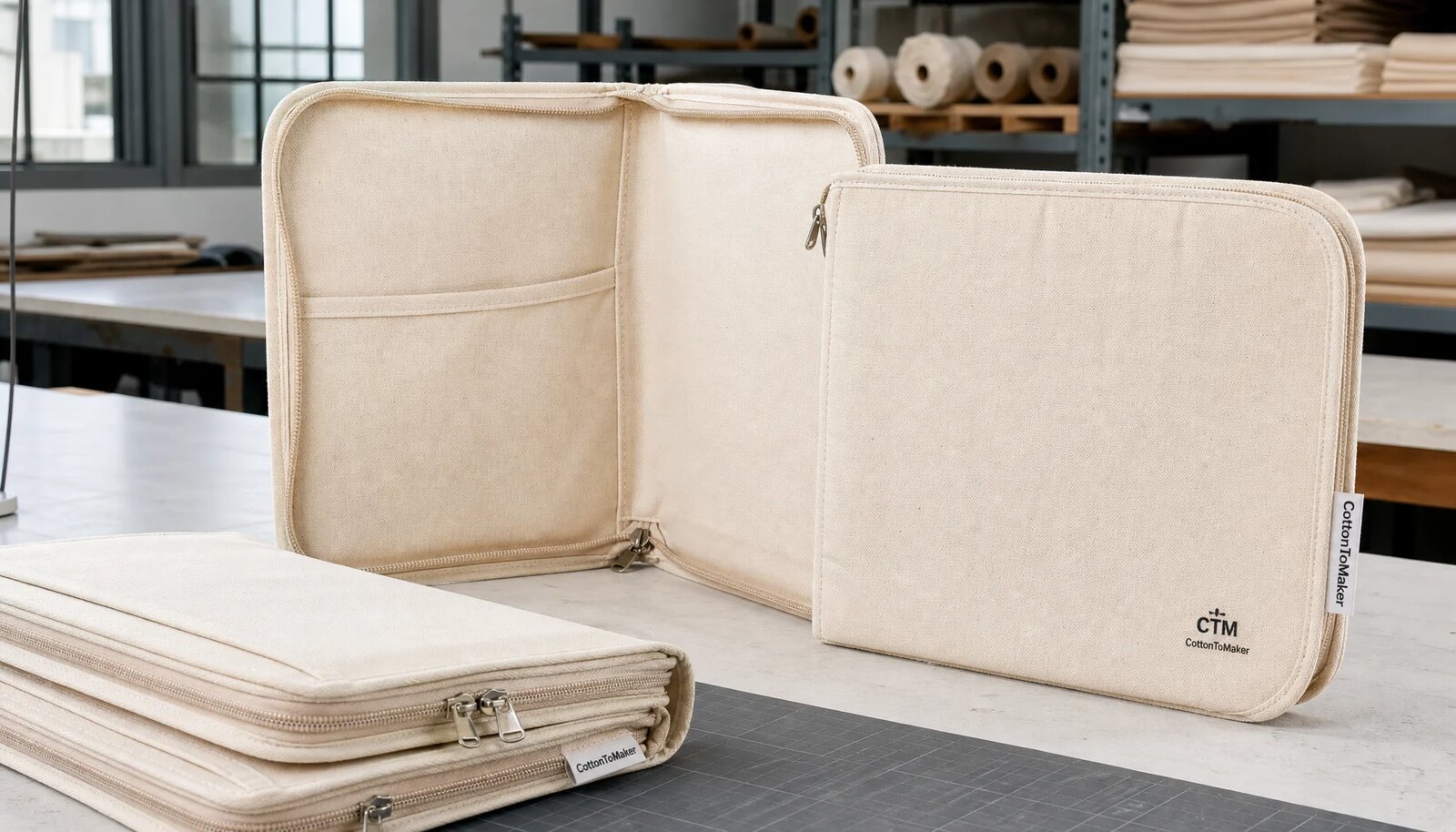
Why craft fair portfolios need a tighter supplier checklist
Canvas zipper portfolios look straightforward until they reach a busy craft fair table. Then every small decision shows. A portfolio may be sold as maker merchandise, packed with stationery, used for workshop handouts, bundled with embroidery patterns, or handed to vendors as an event kit. It gets stacked in crates, opened by customers, zipped repeatedly, and judged up close for fabric cleanliness, logo position, and zipper feel.
That is why quote comparability matters. One supplier may price 12 oz cotton canvas, a #5 nylon coil zipper, bound inside seams, screen print, and individual packing. Another may price a lighter cotton-poly canvas, smaller zipper, raw inside seams, temporary logo sample, and bulk cartons. Both can point to the same product photo. They are not quoting the same product.
A practical canvas zipper portfolios supplier compliance checklist for craft fairs turns a visual idea into measurable buying requirements. It covers fabric, zipper, logo method, packing, sample approval, inspection, and shipment records. For B2B buyers, compliance is not only a legal file. It is the ability to prove that the approved materials, trims, artwork, and packing were used on the actual order.
Legal and documentation needs depend on the sales channel, destination market, and product claims. An adult document portfolio has a different risk profile from a children’s craft kit component. A plain cotton portfolio is different from one marketed as organic, recycled, eco-friendly, azo-free, or child-safe. Put those claims in the RFQ before pricing. If the supplier prices the wrong document package, the cheap quote may become expensive later.
- Procurement goal: comparable quotes based on the same size, usable opening, fabric weight, zipper grade, decoration method, packing format, and inspection standard.
- Hidden cost drivers: fabric downgrade, smaller zipper, weak puller, crooked logo, print cracking, fraying seams, mixed natural-canvas shades, pressure marks, and inaccurate carton labels.
- Event risk: craft fair dates do not move, so late sample corrections or failed inspection can mean missed sales rather than delayed inventory.
- B2B rule: treat the item as a retail-ready business bag whenever it carries a brand, barcode, resale value, or customer-facing event use.
Start the RFQ with dimensions and real contents
Avoid vague terms such as A4 portfolio or document pouch. They invite mismatched quotes. A4 can mean the outside dimensions are A4, the inside space fits A4 paper, or the shape simply resembles an A4 sleeve. Those are different products with different patterns, zipper lengths, and costs.
Write the size in functional terms. State finished outside width and height, usable inside width and height, zipper opening length, gusset depth if any, and corner shape. If a 9 x 12 in art print must fit with a backing board, the usable space must account for board thickness, seam allowance, zipper tape, and the corner curve. A sample that fits one loose sheet may fail when loaded with a kit.
The contents determine construction. Flat art prints need clean inside seams and enough structure to reduce bending. Stationery bundles need a wider opening and smooth corners. Workshop kits may include booklets, thread cards, small tools, or sample packets that create pressure near the zipper ends. Vendor document portfolios are opened again and again across a show season, so zipper smoothness and back-tacking become more important than they would be on a giveaway pouch.
Set tolerances that the factory can actually hold. For many flat canvas portfolios, ±5 mm on finished width and height is workable. For larger formats, heavy canvas, washed fabric, or gusseted construction, ±8 mm may be more realistic. The zipper opening length needs its own tolerance because the outside size can pass inspection while the usable opening is still too short.
- RFQ dimension line: finished outside width x height, usable inside width x height, zipper opening length, gusset depth, corner shape, and written tolerance.
- Content line: insert size, insert thickness, approximate filled weight, whether contents must stay flat, and whether the product is for resale, workshop use, or internal event distribution.
- Construction line: top zipper, side zipper, L-shaped zipper, flat body, gusset, boxed bottom, internal pocket, binding, overlock, label position, and seam finish.
- Approval method: check the sample empty, filled with intended contents, zipped closed, stacked, and measured from finished edges instead of cut panels.
Specify canvas in oz, GSM, composition, finish, and shade
Fabric drives the first impression. It also drives sewing difficulty, print behavior, freight weight, and customer perception. Canvas is often quoted in ounces per square yard, while technical files may use GSM. Request both. Supplier terminology is not always consistent, and a number without a unit can create avoidable arguments.
As a sourcing guide, 8-10 oz canvas, about 270-340 GSM, can work for light document sleeves, budget promotional use, or internal event materials. A 12 oz canvas, about 400 GSM, is often a balanced starting point for branded craft fair resale: substantial enough to feel credible, but still practical for sewing and packing. Heavy 14-16 oz canvas, about 475-540 GSM, can feel premium and hold shape better, but it increases seam bulk, needle wear, unit weight, print stiffness, and carton weight.
Composition must be exact. Natural cotton canvas, bleached cotton, dyed cotton, cotton-poly blend, recycled cotton blend, and organic cotton are not interchangeable. They differ in hand feel, shrinkage, color absorption, print result, claim support, and cost. If the buyer will market the portfolio as cotton, recycled, organic, or sustainable, ask what documents are available for the actual material lot and whether the buyer’s channel requires transaction certificates or claim-specific paperwork.
Shade control deserves more attention than many buyers give it. Natural unbleached cotton can range from cream to beige depending on yarn and finishing. Some variation can look appropriate for a handmade craft fair product. Too much variation, especially within one carton or SKU, looks like poor control. For dyed canvas, approve a lab dip or physical swatch. For natural canvas, approve a shade range and decide whether visibly different lots may be mixed.
Finish changes performance. Washed or pre-shrunk canvas may be softer and less rigid. Backed canvas can add structure but may affect odor, flexibility, sewing bulk, and compliance review. Water-resistant or coated finishes can influence print adhesion and may require additional documentation. For sea freight or humid storage, add odor and mildew checks to the final inspection plan.
- Light duty: 8-10 oz, approximately 270-340 GSM, for simple document sleeves, low-cost giveaways, or internal event materials.
- Standard resale: 12 oz, approximately 400 GSM, for branded craft fair portfolios with a sturdy but sewable hand feel.
- Premium or heavier load: 14-16 oz, approximately 475-540 GSM, for gift kits, heavier inserts, or higher perceived value after sample testing.
- Fabric evidence: composition statement, fabric weight confirmation, roll swatch, shade range, dye or finish description, shrinkage expectation, and claim-related documents if used.
- Lot rule: do not mix visibly different fabric lots within one SKU or carton unless the buyer approves that variation in writing.
Treat the zipper as a functional specification, not a trim detail
The zipper is the part customers touch first and the easiest place for a supplier to save money quietly. A low quote may use a smaller zipper, narrow tape, weak slider, thin puller, or inconsistent end stops. The portfolio can look fine in photos and still feel cheap when opened.
For many canvas zipper portfolios, a #5 nylon coil zipper is a sensible baseline. It is flexible, smooth, widely available, and suitable for flat fabric goods. Metal zippers can look premium, but they add weight and may have rough edges or pressure-mark risks if packed tightly. Resin zippers are more about rugged styling and are not usually necessary for slim document portfolios.
Put the zipper description in the PO, not only in emails. Include zipper type, size, tape width, tape color, teeth or coil color, slider finish, puller shape, puller thickness if important, end-stop method, and zipper opening length. On natural canvas, zipper tape color changes the whole look. Beige, black, antique brass, nickel, and natural tones all send different retail signals.
Test the zipper with real use in mind. During sample approval, open and close it at least 10 cycles while the portfolio is empty, then repeat with the intended contents inside. Watch for catching at corners, seam allowance entering the coil, loose threads, tape twisting, and puller burrs. During final inspection, the zipper must be operated on units from different cartons, not checked visually on the top carton only.
- Recommended baseline: #5 nylon coil zipper with standard metal slider and smooth puller for most flat craft fair portfolios.
- Premium option: metal zipper or branded puller only after checking plating quality, puller comfort, pressure-mark risk, MOQ, and sample timing.
- RFQ zipper fields: type, size, tape width, tape color, teeth or coil color, slider finish, puller shape, end treatment, opening length, and substitution approval rule.
- Sample test: operate the zipper at least 10 cycles empty and filled; inspect both ends, puller edges, slider movement, and fabric interference.
- Defect rule: zipper separation, missing teeth, slider failure, tape detachment, rough burrs, or catching caused by sewing should be treated as major or critical according to safety impact.
Choose branding that works with canvas texture
Branding carries the commercial value. The portfolio may represent a maker, sponsor, workshop host, museum store, stationery brand, or fair organizer. A clean logo can make a simple canvas piece feel finished. A crooked or cracking logo does the opposite.
Screen printing is common because it works well for bold artwork and one- to three-color marks. It is often best applied to flat panels before sewing, but then cutting and sewing must be accurate enough for the final placement to match the approved sample. Printing after sewing can help align a small front mark, yet seams, zipper bulk, and gussets may limit the print area.
Heat transfer can handle detailed artwork, gradients, and smaller runs. On textured cotton canvas, however, it may look less integrated than ink. Test hand feel, edge lifting, gloss, rub resistance, and bending on the actual fabric. Embroidery gives a premium handmade impression for small marks, initials, or badges, but dense embroidery can pucker lighter canvas and raise cost. Woven labels and side tabs are useful for repeat programs because they avoid print-curing problems, though label material and sew position still need approval.
Artwork files should be managed like production documents. Provide vector files, Pantone references, finished print size, orientation, and placement from finished edges or a defined centerline. A mockup is helpful, but it is not enough unless it includes measurements. For multiple artwork versions, create a SKU matrix with artwork file name, quantity, fabric color, zipper color, barcode, packing label, and carton mark.
- Screen print: best for bold logos, event names, simple illustrations, and cost-controlled repeat orders.
- Heat transfer: useful for full-color or detailed art; test edge lifting, gloss, rub resistance, and bend performance on the actual canvas.
- Embroidery: suitable for small premium marks; confirm puckering, backing, thread color, stitch count, and cost before bulk approval.
- Woven label or side tab: strong for subtle repeat branding; approve label MOQ, material, fold type, size, and sewing position.
- Placement control: define print size, distance from edge, orientation, tolerance, and measurement point; use ±3 mm for small marks or ±5 mm for larger artwork when appropriate.
- Multi-SKU control: use an artwork matrix for screens, transfers, barcode labels, carton marks, and final counts by version.
Ask for supplier evidence that matches the product claim
Supplier compliance should be scaled to the order. A simple adult portfolio sold at a local craft fair usually needs a leaner file than a children’s craft storage item or a national retail program. Still, every B2B order should have a basic production record: final specification sheet, material description, zipper description, artwork approval, trim card, pre-production sample approval, packing standard, purchase order, and inspection report.
Do not limit material review to the canvas. Dye, print ink, heat-transfer film, zipper teeth, puller plating, sewing thread, labels, hangtags, and packaging can all matter depending on the market. EU buyers may ask about REACH-related declarations. U.S. buyers may need to consider CPSIA if the item is marketed for children or bundled with children’s craft goods. Country-of-origin labeling, fiber labeling, and routing requirements should be reviewed based on where and how the portfolios will be sold.
Claims need discipline. Organic cotton, recycled cotton, eco-friendly, azo-free, non-toxic, and child-safe are not harmless adjectives. Use them only when documents support the exact material, product, shipment, and destination market. A catalog statement or sales message is not enough for a regulated claim or a retailer-audited program. If the buyer does not need a claim, it may be safer to specify the material plainly and keep unsupported wording off labels and product pages.
Evidence should prove control of the actual order. Useful records include fabric roll labels, zipper carton labels, trim cards, cutting photos, first-piece approval photos, in-line inspection notes, print setup photos, packing-line photos, and open-carton count verification. Business licenses and audit summaries can support supplier review, but they do not prove that the approved fabric, zipper, and artwork were used on this shipment.
- Core file: approved spec sheet, signed golden sample record, trim card, material descriptions, artwork approval, packing standard, PO, production schedule, and inspection report.
- Material questions: canvas composition, dye or finish, zipper material, puller plating, print ink or transfer film, label material, thread, and packaging material.
- Claim control: organic, recycled, eco-friendly, azo-free, or child-safe wording should be used only when documentation supports the exact market requirement.
- Traceability evidence: fabric lot, zipper source, print batch, production date, carton numbers, SKU split, and inspection sample size.
- Deviation rule: no fabric, zipper, logo, label, seam finish, or packing substitution without written buyer approval before production continues.
Compare MOQ and price by landed cost
MOQ is not only a sewing number. Fabric roll minimums, zipper purchase quantity, print setup, cutting efficiency, label MOQ, packing labor, carton configuration, and production scheduling all influence the minimum order. A supplier may accept 100 pieces, but setup time spread across a small run can make the unit cost high. For stock fabric with one size, one zipper color, and one artwork, 500 pieces is often a more workable commercial starting point, though the real MOQ depends on factory, material, trim, season, and decoration method.
Craft fair programs often split one order across several designs. A 1,000-piece order divided into four artwork versions of 250 pieces may require four screens, four transfer batches, four barcode labels, extra sorting, and separate carton marks. If each version also uses a different fabric or zipper color, material minimums and leftover trim risk may apply. Ask for a base quote and split-scenario quotes instead of accepting a blended price that hides setup charges.
A strong RFQ asks for enough cost detail to compare suppliers fairly. At minimum, identify unit price, sample fee, screen or setup fee, decoration charge, label charge, individual packing charge, carton charge, inspection support if any, inland freight, export handling, Incoterm, port, currency, payment terms, and quote validity. A supplier that excludes retail packing should not be compared directly with one that includes barcode labels and carton separation.
The better number is landed cost per sellable unit. Include estimated defects, inspection cost, relabeling, repacking, inland transport, duties, freight, warehousing labor, and event deadline risk. A portfolio that arrives dirty, mislabeled, or late can cost more than a higher unit-price order with stronger packing and production control.
- Base MOQ question: what is the MOQ for one size, one fabric color, one zipper color, one artwork, and standard packing?
- Split-design question: what changes if 1,000 pieces are split into four artwork versions of 250 pieces?
- Custom trim question: what MOQ and lead time apply for dyed zipper tape, branded puller, woven label, leather patch, rubber patch, or custom belly band?
- Quote breakdown: unit price, sample fee, setup fee, logo charge, label charge, packing charge, carton charge, inspection support, freight term, and quote validity.
- Commercial comparison: calculate landed cost per sellable unit after defects, repacking, relabeling, inland freight, duty, and missed-deadline risk.
Approve samples in stages, not by photos alone
Photo approval is too thin for canvas zipper portfolios. Separate the concept sample from the pre-production sample. The concept sample confirms general shape, size direction, construction approach, and branding scale. The pre-production sample confirms the real production package: bulk fabric, bulk zipper, final thread, final label, logo process, seam finish, and packing.
If a sample uses substitute fabric, a temporary zipper, or digital print instead of final screen print, say so in the approval record. Approving the shape is not the same as approving the material. Buyers and factories avoid many disputes when the sample sheet states exactly what is approved and what is still open.
Test the sample with the actual contents. Insert the intended documents, backing boards, art prints, booklets, or craft supplies. Close the zipper without forcing it. Stack several filled pieces. Check whether corners distort, the zipper strains, or the print rubs against pullers. Measure the sample empty, filled, and after closure. If the zipper jams or the corners wrinkle badly, adjust size, seam allowance, zipper length, fabric weight, or corner shape before bulk cutting.
Branding needs a ruler, not only a visual check. Record distance from the left edge, bottom edge, zipper edge, or centerline. Compare print color against Pantone or a physical reference, keeping in mind that cotton canvas texture can make colors look different from coated paper. Screen print and heat transfer should be checked for adhesion, hand feel, curing, edge lifting, and stacking marks.
Packing deserves sample approval too. A perfect portfolio can arrive damaged if zipper pulls press into printed panels, cartons are overfilled, paper bands crease the fabric, or individual bags trap moisture. The pre-production packing sample should show unit bag or sleeve, barcode label, hangtag, insert board if used, inner carton, master carton orientation, and carton mark.
- Concept sample approval: shape, approximate size, construction direction, artwork scale, and obvious usability concerns.
- Pre-production sample approval: bulk fabric, zipper, thread, logo method, label, seam finish, packing, and measurable tolerances.
- Fit test: insert actual contents, close zipper without force, stack samples, and check corners, zipper path, and print surface.
- Measurement record: finished outside size, usable inside size, zipper opening, logo placement, stitch density, seam allowance, and carton packing count.
- Retention rule: keep one signed golden sample with the buyer and one with the factory, marked by date, version number, and approved specification.
Build QC checkpoints before final inspection
Final inspection matters, but it should not be the first time anyone checks the order. Quality control works better in stages. At material receipt, verify fabric shade, weight, stains, and trim match. At cutting, check panel direction, cutting size, and lot separation. At printing, confirm artwork version, color, placement, curing, and transfer marks. At sewing, inspect zipper alignment, seam allowance, stitch density, back-tacking, label position, corner shape, and inside finishing. At packing, verify SKU count, barcode, carton marks, moisture protection, product orientation, and carton weight.
Defect classification should be agreed before production. Critical defects may include broken needle contamination, sharp metal likely to injure users, mold, serious contamination, or illegal labeling. Major defects include wrong size, wrong fabric, zipper failure, wrong artwork, severe stains, open seams, missing labels, incorrect barcode, incorrect packing, and unsellable print defects. Minor defects include small loose threads, minor slubs within the approved standard, or slight cosmetic variation that does not affect saleability.
If the buyer uses AQL, state the level and inspection method in the PO and inspection booking. Do not leave it for the factory gate. The inspector needs to know sample size, defect classes, measurement tolerances, and which tests are mandatory. The report should show photos of the front, back, inside seam, zipper, logo close-up, unit packing, barcode label, carton label, carton count, and defects found.
Zipper testing needs its own line. Inspectors should operate the zipper across the full length and check slider smoothness, end-stop security, puller finish, thread interference, and filled-product function. A zipper that works empty but jams when filled is a functional failure for the intended use.
Print QC should include placement, color, adhesion, cleanliness, and stacking marks. Natural canvas will have texture, but heavy ink skipping, cracking, smearing, ghosting, or transfer stains should be classified. Thick ink can crack when the portfolio bends. Heat transfers should be checked for edge lifting and gloss mismatch. Embroidery should be checked for puckering, thread breaks, backing exposure, and correct thread color.
- Cutting QC: fabric shade, stains, slubs, panel direction, cutting dimensions, and lot separation.
- Printing QC: artwork version, Pantone target, placement tolerance, curing, adhesion, smearing, cracking, and transfer marks.
- Sewing QC: zipper alignment, seam allowance, stitch density, back-tacking, label placement, corner shape, and inside seam finish.
- Functional QC: filled fit, zipper cycle test, puller comfort, opening length, and no interference from thread or fabric bulk.
- Packing QC: correct SKU count, individual packing, barcode, hangtag, carton label, carton strength, moisture protection, and pressure-mark prevention.
- Inspection evidence: report by lot or SKU with photos, sample size, defect list, carton count, and corrective action if defects exceed acceptance limits.
Plan packing and lead time around the event date
Packing affects presentation, receiving labor, damage risk, and event readiness. Bulk packing can work for internal vendor kits or distributor inventory when staff will assemble sets later. Retail resale usually needs cleaner unit-level packing such as recyclable polybags, paper sleeves, belly bands, hangtags, barcode labels, or insert boards. These choices belong in the RFQ because they change labor, material cost, carton volume, and inspection scope.
Canvas can crease, absorb odor, and show pressure marks. Printed surfaces should not sit directly against zipper pulls or rough carton surfaces. Heavy portfolios should not be compressed so tightly that corners bend. If the shipment travels by sea or sits in humid storage, add moisture control, clean-carton handling, and odor checks. Ask the supplier for pieces per inner bag, pieces per master carton, carton dimensions, net weight, gross weight, and carton marks before production starts.
Build the timeline backward from the required warehouse date, not from the factory’s sewing estimate. A phrase such as 25 days production may exclude artwork approval, sample making, sample transit, sample revisions, material purchase, final inspection, export booking, international transit, customs clearance, inland delivery, and event kit assembly. A realistic custom overseas program can require 8-12 weeks, especially with custom colors, several artwork versions, or retail packing.
Urgent orders should reduce variables. Use stock canvas, a standard #5 zipper, one artwork, one print color, a standard label, and simple packing. Custom pullers, dyed zipper tape, multiple barcodes, complex belly bands, and special claims all add approval points. They may be worthwhile, but they need time.
Put milestone dates in the purchase order: artwork freeze, sample approval deadline, material purchase date, cutting start, first-piece approval, in-line inspection, packing completion, final inspection, latest ship date, and required warehouse date. Leave time for corrective action after inspection. If final inspection happens one day before courier pickup or vessel closing, defects become a negotiation problem instead of a fixable production issue.
- Packing options: bulk inner bag for event kits, individual recyclable bag for clean handling, paper sleeve for low-plastic presentation, belly band for retail branding, and hangtag for boutique display.
- Carton marks: item number, SKU, artwork version, color, quantity, carton number, gross weight, net weight, carton dimensions, destination, and country of origin where required.
- Damage prevention: flat stacking, no zipper pull pressure on print, no over-compression, moisture protection when needed, clean handling, and no mixed dirty cartons.
- Timeline controls: artwork freeze, sample approval, material purchase, production start, mid-line check, packing completion, final inspection, latest ship date, and required warehouse date.
- Urgent-order simplification: stock 12 oz canvas, standard #5 nylon zipper, one screen print, no custom puller, standard label, and simple carton packing.
Specification comparison for buyers
| Supplier option | What to verify | Commercial advantage | Buyer risk to control |
|---|---|---|---|
| Direct sewing factory | zipper source record, production-line zipper test photos, approved trim card, cutting marker photos, and final open-carton count | Better sample-to-bulk control and faster production feedback | May be weaker on export paperwork or branded packing unless checked early |
| Trading company | Factory name, production photos, trim-source proof, and who owns QC decisions | Can coordinate small mixed orders and extra services | Markup can hide real factory capability and slow defect decisions |
| Specialized bag workshop | zipper gauge, zipper tape width, puller finish, binding tape, corner reinforcement, seam allowance, and document-size tolerance | More practical for detailed construction, trims, and repeat programs | Capacity may be limited during peak seasons |
| Low-price general supplier | 300D-600D polyester, 10-12 oz canvas, or recycled PET with backing stiffness matched to document weight | Useful for simple promotional runs with loose specs | Material downgrades, weak packing, and vague inspection scope can erase savings |
| Retail-ready supplier | flat packing, insert board if needed, SKU bundles, carton weight limit, moisture protection, and barcode visibility | Can handle labels, SKU separation, carton marks, and receiving rules | Higher unit cost must be compared against reduced warehouse work |
| Compliance-focused supplier | Fabric records, labeling review, test plan, and production traceability | Safer for retail programs and repeat brand orders | Documentation claims need evidence, not only sales language |
| Local sample room plus bulk factory | Signed sample, bulk factory handoff, first-piece photos, and deviation owner | Good for complex branding before large production | Sample room quality may not match bulk line unless handoff is controlled |
Buyer checklist before sampling
- Define finished outside dimensions and usable inside dimensions separately; include width, height, gusset depth if any, zipper opening length, corner shape, and a written tolerance such as ±5 mm for many flat formats or ±8 mm for larger or gusseted formats.
- State the real loading use: 8.5 x 11 in documents, A4 sheets, 9 x 12 in art prints with backing board, stationery sets, workshop booklets, embroidery patterns, vendor forms, catalogs, craft tools, or retail gift kits.
- Select canvas weight by use case and confirm both oz/yd² and GSM: 8-10 oz, about 270-340 GSM, for light sleeves; 12 oz, about 400 GSM, for standard resale; and 14-16 oz, about 475-540 GSM, for heavier or premium portfolios.
- Specify fabric composition and finish: 100% cotton, cotton-poly blend, recycled cotton blend, organic cotton claim, natural, bleached, dyed, washed, pre-shrunk, backed, unbacked, or water-resistant finish; define acceptable shade range and whether lot mixing is allowed.
- Control zipper details in writing: nylon coil, metal, or resin; size such as #5; tape width; tape color; teeth or coil color; slider finish; puller shape; end-stop style; zipper opening length; and no substitution without buyer approval.
- Lock artwork before sampling: vector file name, Pantone references, maximum artwork size, print area, placement from finished edges, placement tolerance, color count, decoration method, and whether panels are printed before sewing or after sewing.
- Require a pre-production sample made with bulk fabric, bulk zipper, final thread, final label, final logo method, final seam finish, and intended unit packing before mass production starts.
- Set measurable QC points for finished size, usable opening, zipper function, stitch density, seam allowance, inside seam finishing, logo placement, print adhesion, fabric stains, loose threads, odor, carton count, and barcode accuracy.
- Clarify retail packing at RFQ stage: bulk pack, individual recyclable polybag, paper sleeve, belly band, hangtag, barcode label, insert board, inner carton, master carton, carton marks, carton drop protection, and maximum gross weight per carton.
- Ask for quote breakdowns covering fabric, zipper, thread, decoration, label, packing, sample fee, screen or setup fee, inspection support, inland freight, export handling, Incoterms, payment terms, quote validity, and lead time after sample approval.
Factory quote questions to send
- What finished outside size, usable internal size, zipper opening length, and dimensional tolerances are included in this quote?
- What canvas weight in oz/yd² and GSM is included, what is the fabric composition, and is the fabric stock, custom dyed, washed, backed, or made to order?
- What fabric weight tolerance and shade tolerance do you apply in bulk production, and can you provide a roll swatch or shade range before cutting?
- Can you provide a fabric composition statement, shrinkage expectation, dye or finish description, and any claim-related documents tied to the quoted fabric lot?
- Which zipper type is included: nylon coil, metal, or resin; what zipper size, tape width, teeth color, tape color, slider finish, puller shape, and zipper supplier grade are included?
- What zipper substitutions are allowed if the original zipper is unavailable, and who must approve a substitute before production continues?
- Is the logo cost based on screen print, heat transfer, embroidery, woven label, leather patch, rubber patch, or another method, and what maximum artwork size and color count are included?
- Will decoration happen before sewing or after sewing, and how will you control placement tolerance from finished edges rather than cut panels?
- What is the MOQ for one size, one fabric color, one zipper color, one artwork, and one packing method; how does price change if we split colors, artwork versions, or barcode labels?
- Will the pre-production sample use the same fabric, zipper, thread, label, logo method, seam finish, and packing as the bulk order? If not, what is substituted and when will final materials be confirmed?
Quality-control points to confirm
- Finished outside size should normally be controlled within ±5 mm for small flat portfolios and ±8 mm for larger or gusseted formats unless the approved specification states another tolerance.
- Usable inside space must be checked with the buyer’s intended insert, not only with a ruler; documents, backing boards, or kits should slide in and zip closed without forcing the slider.
- Fabric weight should be verified against the approved specification within a realistic production tolerance agreed in writing; a 12 oz approval sample should not become an 8 oz or heavily blended bulk shipment without buyer approval.
- Fabric composition and finish should match the purchase order; natural cotton, cotton-poly blend, recycled blend, washed canvas, backed canvas, and dyed canvas are separate specifications.
- Fabric shade should be compared against the signed swatch or golden sample under consistent light; natural variation may be accepted only when the approved shade range and lot-mixing rule are defined.
- Zipper must open and close smoothly across the full length without catching at corners, lining, seam allowance, binding, loose thread, or printed areas.
- Zipper pullers should have no sharp burrs, rust marks, plating flaking, rough edges, or finish inconsistency that could damage documents, art prints, or customer hands.
- Stitch density should be consistent, commonly around 7-9 stitches per inch for many canvas goods, with secure back-tacking at zipper ends, corners, labels, handles if any, and other stress points.
- Seam allowance should be consistent and sufficient for canvas; raw edges should be overlocked, bound, folded, taped, or otherwise finished to reduce fraying during normal handling.
- Logo placement should stay within the approved tolerance, commonly ±3 mm for small front marks and ±5 mm for larger artwork, measured from finished edges or a defined centerline.