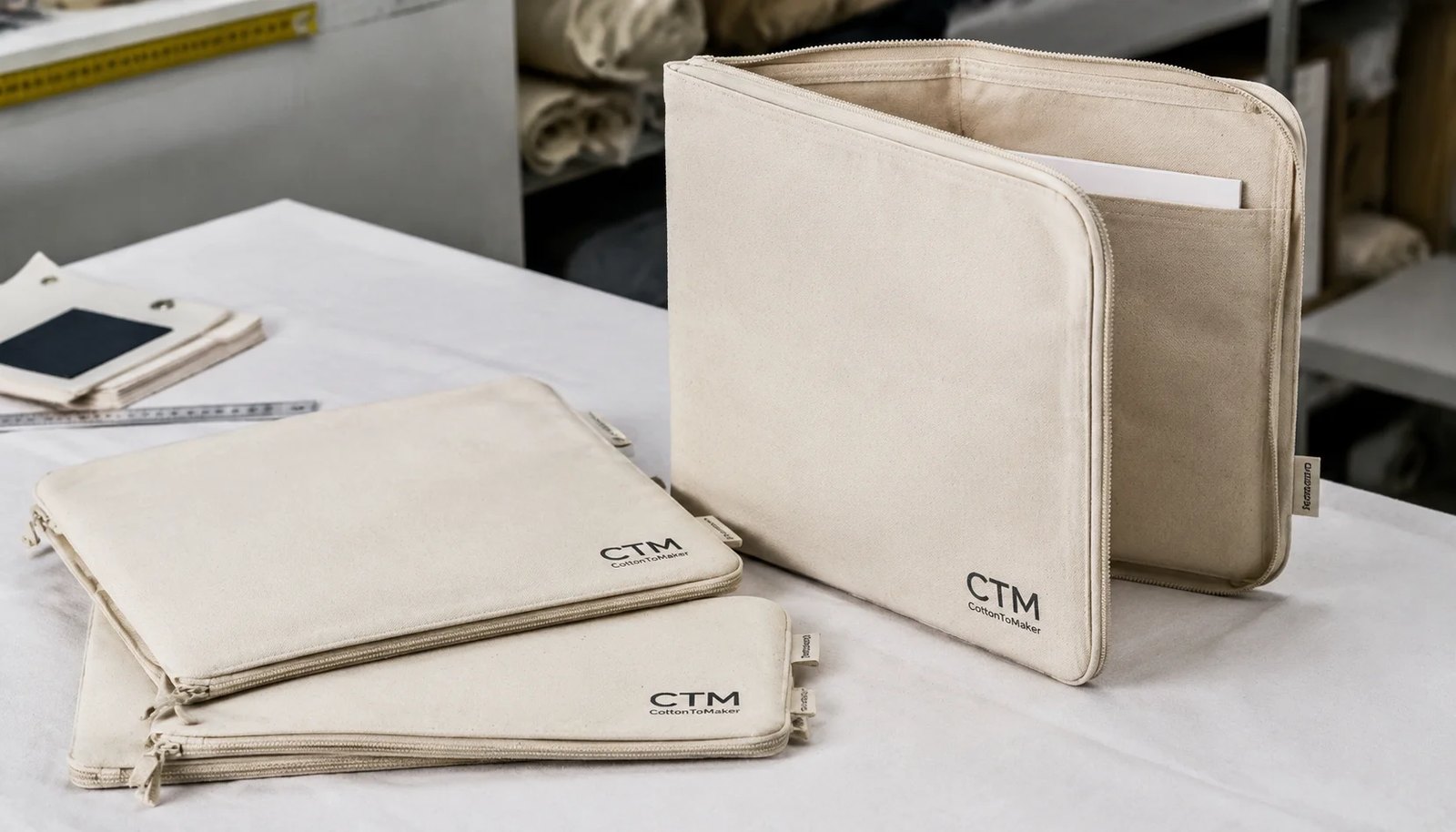
Buying Problem
Canvas zipper portfolios look simple in a photo, but bulk pricing changes quickly when the buyer changes canvas weight, zipper grade, logo method, lining, or packing. For skincare brands, the portfolio often has to carry more than paper. It may hold sheet masks, sample sachets, mini jars, sales cards, spa training sheets, ingredient leaflets, or a full retail gift insert. A quote based only on size and quantity will usually miss the details that decide whether the bag feels retail-ready or promotional.
The main buying problem is not finding the lowest unit price. It is building a specification that lets different suppliers quote the same product, then checking whether the savings at higher quantity are real after setup, packing, carton volume, and rework risk. A useful bulk pricing plan should show which details must stay fixed, which options can be upgraded, and which changes trigger a new MOQ.
- Use this guide when comparing canvas zipper portfolio quotes for skincare launches, seasonal gift sets, sales kits, and distributor programs.
- Keep one master specification for every pricing tier so the quote curve is comparable.
- Treat sample approval as part of the cost plan, not an optional decoration step.
Core Specification
For most skincare programs, a flat zipper portfolio in 12 oz cotton canvas, roughly 400 GSM, is a practical starting point. It has enough body to protect documents and light product samples without making the portfolio feel like luggage. If the contents are only paper, 10 oz canvas can work. If the portfolio must hold glass jars, boxed sets, or repeated sales rep use, 14 oz or a lined structure may be justified. The important point is to specify the weight and finish in the RFQ instead of writing only natural canvas.
Size should be based on the actual contents plus handling room. A4 documents need more than A4 dimensions because seams and zipper curves reduce usable space. For skincare, buyers should measure the thickest product carton, the widest leaflet, and the maximum stack height. If the portfolio will be mailed inside another carton, also define the maximum folded or flat-packed dimensions.
- Common flat size: around 34 x 25 cm for A4 documents, adjusted for seam allowance and zipper opening.
- Typical canvas range: 10 oz for paper kits, 12 oz for balanced retail or sales use, 14 oz for heavier premium programs.
- Finish options: natural unbleached for clean skincare positioning, bleached for brighter print contrast, dyed for campaign colors.
- Structure options: flat pouch for lowest cost, gusseted pouch for thicker product sets, lined portfolio for better interior presentation.
Cost Drivers
Canvas weight is one cost driver, but it is not the only one. The zipper, print process, cutting efficiency, seam complexity, lining, labels, and packing method can each change the final unit price. A portfolio with a simple one-color screen print and standard zipper may price very differently from the same size with dyed canvas, custom puller, woven label, inner pocket, and individual paper sleeve.
A reliable bulk pricing plan separates fixed setup costs from variable production costs. Screen setup, label mold, sample labor, and color matching do not scale the same way as canvas consumption and sewing time. This is why the price difference between 500 and 1000 pieces can be large, while the difference between 3000 and 5000 pieces may be smaller. Procurement teams should read the quote by cost behavior, not only by the final number.
- Fabric cost rises with GSM, dyed color, washing, lamination, and cutting waste from unusual shapes.
- Sewing cost rises with lining, pockets, binding, rounded corners, reinforced zipper ends, and tight tolerances.
- Branding cost rises with more print colors, larger coverage, special inks, woven labels, emboss patches, or custom zipper pullers.
- Packing cost rises with individual sleeves, tissue separators, hangtags, barcode stickers, inner cartons, and strict carton sorting.
MOQ Logic
MOQ is often controlled by materials before it is controlled by sewing capacity. Natural canvas in common weights may be available at lower minimums. Dyed canvas, unusual zipper tape colors, custom pullers, woven labels, and branded paper sleeves can each have their own minimum. A supplier may accept 500 pieces for sewing, but the zipper factory or dye house may require more material than that order consumes.
For a skincare brand testing a new gift set, the cleanest approach is to request four pricing tiers with the same specification: 500, 1000, 3000, and 5000 pieces. If the supplier changes fabric source, zipper grade, packing, or logo method at different tiers, the comparison loses value. Buyers should also ask whether leftover materials can be held for repeat orders and whether color shade can be repeated from the same fabric lot.
- Low MOQ is easier with natural canvas, stock zipper colors, standard pullers, and screen print.
- Higher MOQ becomes likely with custom dyed canvas, custom woven labels, metal logo plates, or special packaging.
- A split shipment can help launch timing, but it may raise inland handling and carton management cost.
- Repeat orders should reference the approved sample, fabric lot data if available, and previous carton specification.
Logo Method
Skincare branding usually favors a clean logo, controlled color, and a surface that does not look overdecorated. Screen print is the most common choice for canvas zipper portfolios because it handles solid logos well and keeps the price efficient in bulk. It works best when the artwork uses one to three colors and avoids tiny ingredient text. For a more retail-grade finish, a woven label or cotton side label can carry the brand without covering the canvas face.
Digital print can reproduce more colors, but it may not be the best first choice on textured canvas if the brand expects sharp small lettering. Embroidery adds texture but can distort flat portfolios if the stitch area is large or close to the zipper. Embossed leather or PU patches can look premium, but they add material MOQ, sewing steps, and compliance questions if the brand avoids animal-derived materials.
- Screen print: efficient for solid skincare logos, campaign marks, and simple color blocks.
- Woven label: good for reusable portfolios and subtle retail positioning.
- Embroidery: best for small marks, not large filled logos on thin canvas.
- Patch branding: suitable for premium gift sets, but confirm material, colorfastness, and sewing position.
- Print tolerance: define logo size, edge distance, Pantone color, and acceptable placement variation.
Sample Approval
A sales sample made from similar canvas is useful for shape discussion, but it is not enough for production approval. The pre-production sample should use actual bulk canvas weight, actual zipper type, actual puller, actual logo process, and the final packing method. This is where the buyer can confirm hand feel, opening width, print contrast, zipper smoothness, and whether the skincare contents fit without forcing the zipper.
The approval should be written, measured, and photographed. Mark the approved sample with date, version, size, fabric weight, zipper type, logo process, and packing method. If the factory later changes a component because stock is unavailable, the buyer should receive a revised sample or at least a documented approval photo and component description before bulk production continues.
- Load test the sample with the actual skincare contents for fit and zipper stress.
- Measure finished width, height, gusset if any, zipper opening length, and logo placement.
- Rub the printed logo after curing to check basic adhesion and surface cracking.
- Open and close the zipper several times to catch corner binding or weak end stops.
- Place the packed sample into the intended mailer or master carton to confirm shipping fit.
Quote Data
A useful factory quote should include more than unit price. For canvas zipper portfolios, procurement needs the material description, component assumptions, sample cost, setup cost, lead time, carton data, payment terms, and validity period. Without carton quantity, gross weight, and CBM, landed cost cannot be compared accurately. A slightly cheaper unit price can become more expensive if the packing method doubles the carton volume.
Buyers should also require the factory to state what is included and excluded. Some quotes include logo screen charges, sample cost, and standard export carton. Others list them separately or add them after artwork review. For skincare brands managing launch budgets, this difference matters because packaging inserts, barcode labels, and individual sleeves can push the final purchase order above the approved budget.
- Quote line should state: size, canvas GSM, color, zipper type, logo method, lining status, packing, and quantity.
- Commercial data should state: unit price, setup charges, sample charge, courier charge, payment term, quote validity, and incoterm.
- Logistics data should state: pieces per carton, carton dimensions, gross weight, net weight, and estimated CBM.
- Schedule data should state: sample days, revision days, material preparation, bulk production days, inspection window, and export packing days.
Packing Plan
Packing is part of the product specification because canvas can crease, printed logos can mark against zipper pullers, and corners can deform in overfilled cartons. For basic bulk programs, individual OPP bags are common. For skincare brands with a cleaner sustainability message, recycled paper sleeves or belly bands may be preferred, but they need a rub test and moisture review. Paper can scuff during freight if the carton is loose.
Carton packing should be designed around both protection and freight efficiency. A flat portfolio may pack 50 to 100 pieces per carton depending on size, canvas thickness, and individual packing. Very heavy cartons increase handling damage and warehouse complaints. Very loose cartons waste CBM. The buyer should set a target carton gross weight and require the supplier to confirm the packing layout before bulk production.
- Use tissue or separator sheets when metal zipper pullers can touch printed logo areas.
- Avoid over-compression if the portfolio has padding, lining, or a shaped gusset.
- Add desiccant when shipping natural cotton goods through humid routes or long ocean transit.
- Define carton marks, SKU labels, barcode labels, and mixed-carton rules before packing starts.
- Keep one approved packing sample for final inspection comparison.
Schedule Risk
Lead time depends on material availability, artwork approval, sample revision, and factory loading. A typical sequence includes material sourcing, sample making, buyer review, bulk fabric preparation, printing, cutting, sewing, trimming, inspection, and packing. The schedule becomes risky when the buyer approves the shape but not the final print, or when the logo color is still changing after fabric has been cut.
For skincare launches, the portfolio often connects to a product fill date, retail delivery window, or influencer mailing schedule. The safer plan is to lock the bag specification before final product assembly. If ingredient claims, leaflet dimensions, or kit contents are still moving, the portfolio size should include a buffer, or the buyer should delay bulk cutting until the pack-out dimensions are final.
- Do not start bulk cutting before confirming the largest item that must fit inside.
- Reserve extra days for dyed canvas, custom zipper colors, woven labels, or special paper packaging.
- Approve print color under consistent lighting, especially on natural or dyed canvas.
- Build an inspection window into the schedule instead of placing inspection on the planned ship date.
- Confirm whether the supplier will ship flat, folded, or nested, because this changes packing time and carton volume.
QC Thresholds
Canvas zipper portfolios should be inspected as functional packaging, not only as fabric goods. The zipper must run smoothly, the corners must sit cleanly, the logo must be positioned consistently, and the portfolio must hold the intended skincare contents without strain. If the item will be sold or gifted as part of a premium kit, visible stains, heavy slubs through the logo area, or crooked labels should be treated as major defects.
Acceptance criteria should be written before production. For many flat canvas portfolios, a finished size tolerance of plus or minus 5 mm is workable. Logo placement can often be controlled within plus or minus 3 mm when the print area is flat and the cutting process is stable. Stitching should be even, with no skipped stitches, loose thread nests, broken seams, or unsecured zipper ends.
- Critical defects: broken zipper, wrong logo, wrong size preventing product fit, mildew odor, sharp metal burrs, or contaminated fabric.
- Major defects: crooked zipper, visible print smearing, seam opening, wrong packing, heavy stain, or logo outside tolerance.
- Minor defects: small loose thread, slight natural slub away from logo area, or minor crease removable by normal handling.
- Functional test: load with approved contents, close zipper fully, hold and turn gently to check seam and zipper stress.
- Packing audit: count pieces per carton, verify carton marks, inspect moisture protection, and compare carton size to quote.
Specification comparison for buyers
| Spec decision | Recommended option | When it fits | Buyer risk to check |
|---|---|---|---|
| Outer canvas weight | 12 oz cotton canvas, about 400 GSM, with light starch or washed finish | Good balance for skincare sales kits, retail gift sets, PR mailers, and distributor documents | Too light may wrinkle around the zipper; too heavy can raise freight weight and make corners bulky |
| Portfolio structure | Flat zipper pouch style with one main compartment and optional inner slip pocket | Works for sheet masks, brochures, product cards, mini jars, samples, invoices, or training sheets | A gusseted shape costs more and may collapse unless the side panel and seam allowance are specified |
| Zipper type | No. 5 nylon coil zipper with metal or matte plastic puller | Suitable for repeated opening at counters, trade shows, and sales rep visits | Cheap zipper tape can wave on canvas; puller plating can scratch if packed without tissue or separator |
| Branding method | Screen print for one to three solid colors; woven label for premium reusable positioning | Best for skincare brands using simple marks, natural packaging colors, and clean logo placement | Fine gradients, tiny ingredient text, and metallic inks need print proofing before bulk production |
| Lining decision | Unlined for lower unit cost; cotton lining only when products need cleaner interior presentation | Unlined fits document portfolios and basic promotional kits; lined fits higher-value gift packs | Lining can shrink differently from outer canvas and may wrinkle near zipper corners if not sampled |
| MOQ planning | Start quotation at 500, 1000, 3000, and 5000 pieces with the same approved spec | Lets procurement compare setup cost absorption, fabric purchasing efficiency, and packing labor | Changing size, print colors, zipper color, or packing between tiers makes the price comparison unreliable |
| Packing format | Individual OPP or recycled paper sleeve, then 50 to 100 pieces per export carton depending on size | Protects printed surfaces and keeps zipper pulls from marking neighboring pieces | Overpacked cartons raise CBM; underpacked cartons can deform corners during ocean freight |
| Sample approval | Pre-production sample in actual fabric, actual zipper, actual print, and final packing method | Required before bulk cutting when color, logo placement, and size tolerance matter | A photo-only approval hides zipper smoothness, odor, handle feel, and whether skincare items fit inside |
Buyer checklist before sampling
- Define the portfolio use: retail gift pouch, sales rep document case, PR mailer, spa counter kit, or distributor presentation pack.
- Give the factory the finished size in width x height x gusset, not only the product size going inside.
- State the target canvas weight in oz or GSM and whether the finish should be natural, bleached, dyed, washed, or laminated.
- Specify zipper color, zipper tape color, puller material, puller shape, and whether the zipper should match or contrast with the canvas.
- Send logo artwork in vector format and include print size, print position, Pantone references, and tolerance for placement.
- List all contents that must fit inside, including product carton dimensions, brochure thickness, and any sample sachets.
- Request tiered pricing using the same specification at 500, 1000, 3000, and 5000 pieces to compare the real MOQ curve.
- Require a pre-production sample with actual materials and final packing before approving bulk cutting.
- Set carton packing limits by gross weight and carton dimensions so the freight quote is not based on guesswork.
- Include inspection criteria for zipper function, print adhesion, stitch density, seam strength, odor, stains, and size tolerance.
Factory quote questions to send
- What canvas weight, composition, and finish are you quoting, and can you state both oz and approximate GSM?
- Is the quoted zipper a No. 5 nylon coil zipper or another type, and what puller material is included?
- Does the price include logo setup, screen charge, woven label mold, color matching, and sample courier cost?
- What is the MOQ for the chosen canvas color, zipper color, print method, and packing method separately?
- What unit price do you offer at 500, 1000, 3000, and 5000 pieces with no specification changes between tiers?
- What is the estimated carton size, pieces per carton, gross weight, and CBM for each pricing tier?
- How many days are needed for material sourcing, sample making, sample revision, bulk production, inspection, and export packing?
- Which parts are made in-house and which are outsourced, such as dyeing, screen printing, zipper sourcing, woven labels, or washing?
- What size tolerance, print placement tolerance, and defect acceptance level will you use during final inspection?
- Can you make a pre-production sample using actual bulk fabric, actual zipper, actual logo process, and final packing?
Quality-control points to confirm
- Finished size tolerance should normally be within plus or minus 5 mm for flat portfolios unless a larger gusset or padded structure is used.
- Zipper must open and close smoothly for several full cycles without catching at the corner seam or pulling loose from the end stop.
- Stitch density should be consistent, commonly around 7 to 9 stitches per inch for canvas portfolio seams, with secure backstitching at stress points.
- Logo placement should be measured from the same edge on every piece, with a written tolerance such as plus or minus 3 mm for standard screen print.
- Screen print should pass a dry rub check and light scratch check after curing; ink should not crack when the fabric is flexed.
- Canvas surface should be free from obvious oil marks, dye streaks, mildew odor, loose threads, broken yarns, and heavy slubs on the logo area.
- Inner seams should be trimmed cleanly, and zipper tape edges should not scratch product cartons or skincare sachets.
- Cartons should match the approved packing plan, with correct quantity, carton mark, polybag or paper sleeve status, and moisture protection when needed.