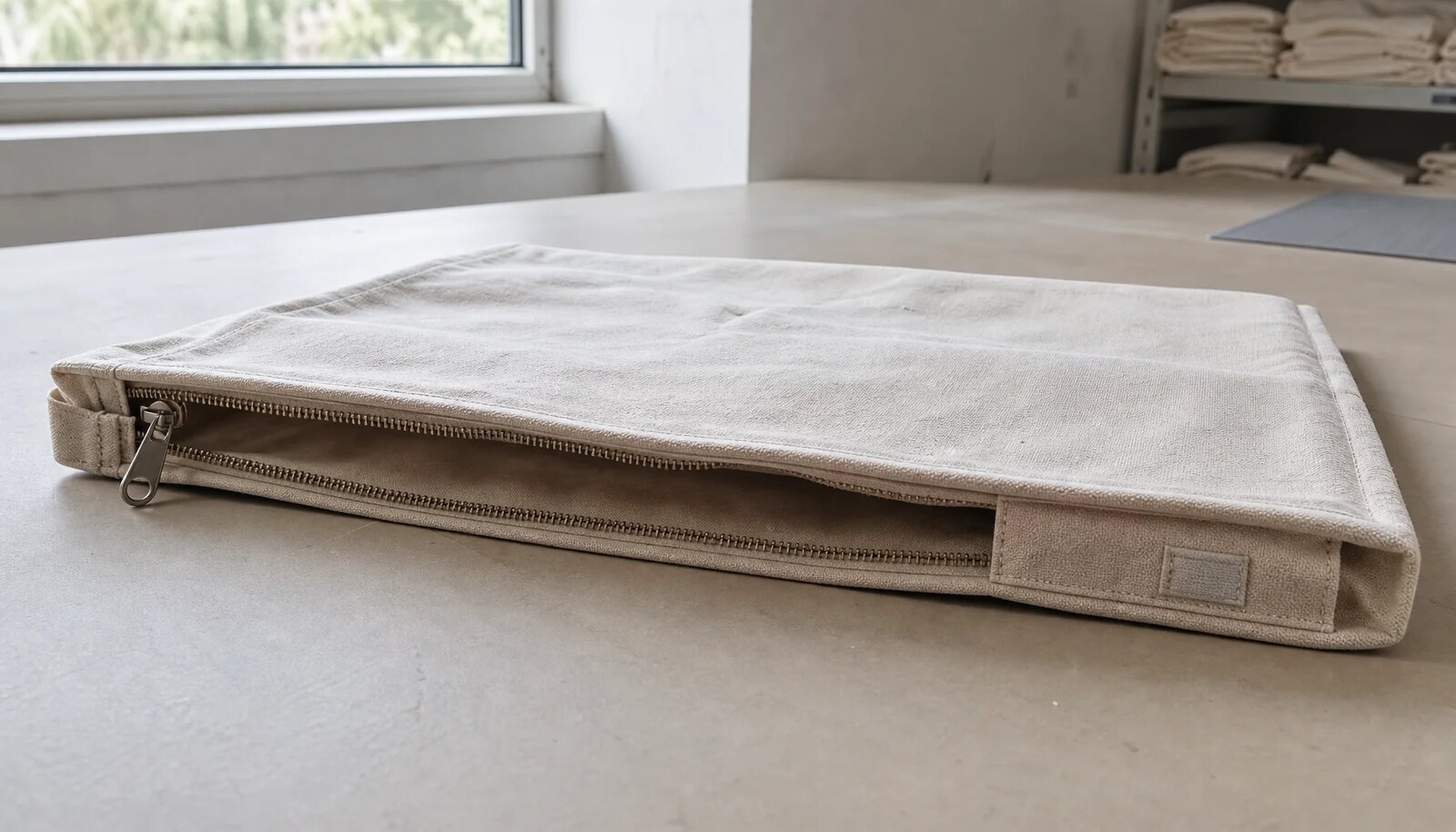
Treat the carton as part of the product spec
Canvas zipper portfolios are easy to underestimate because the item looks simple: canvas panels, a zipper, a logo, and a master carton. For B2B procurement, that is only half the product. The shipped portfolio also includes its folded shape, protective wrap, insert card, zipper pull orientation, carton fill, carton strength, and the way those cartons load onto a pallet or into a courier network. If those details are left until after sample approval, the buyer may approve a good-looking portfolio that is expensive or risky to ship.
For eco apparel brands, the portfolio is often part of a larger brand moment: a wholesale document pack, retail launch kit, sample-room organizer, staff onboarding set, press kit, or reusable packaging accessory. It may need to protect lookbooks, hangtag sets, swatch cards, order forms, or product cards. That use case should be stated in the RFQ because it changes the fabric weight, zipper choice, packaging, and carton plan. A portfolio carrying a few papers can be lighter and flatter than one carrying a rigid insert stack.
The carton plan should be quoted at the same time as the product. Ask the supplier to show finished unit dimensions, packed unit thickness, master carton size, units per carton, net weight, gross weight, total carton count, CBM, and dimensional weight if air or courier shipment is possible. This turns a generic product quote into a procurement-ready quote. It also gives the forwarder enough information to estimate freight before the deposit is paid.
- Do not approve only the flat product drawing; approve the packed form as well.
- Ask for carton data at RFQ stage, not after mass production starts.
- Make the supplier quote the same packing method they will use in bulk production.
Choose canvas weight by use case, not habit
The common recommendation for canvas zipper portfolios is 12oz to 14oz, and that range is useful for many apparel-brand programs. It gives enough body for repeated handling, prints cleanly, and usually resists collapse better than very light canvas. But it should not be treated as a universal rule. A small A5 pouch for paper inserts may work well at 10oz or 12oz. A large A3 portfolio with catalogs, sample cards, or rigid boards may need 14oz, 16oz, lining, or reinforcement at stress points.
Canvas weight affects more than unit price. Heavier fabric can improve perceived value, but it also adds bulk and can reduce units per carton. Washed canvas may have a softer premium handfeel, but it can be thicker after finishing. Raw canvas may pack flatter, but it can show dirt and creasing more easily. Pre-shrunk canvas is useful when logo placement and finished size tolerance are tight, yet buyers should confirm whether the quoted dimensions are before or after washing.
A credible spec should include both oz and GSM where possible, because suppliers and buyers may use different conventions. The RFQ should also describe finish, color, shrinkage tolerance, and whether the portfolio will contact light-colored apparel or paper. If a dyed canvas rubs onto a white insert card, the product can fail commercially even if the sewing is acceptable. That is why colorfastness and rub checks belong in the same conversation as fabric weight.
- Light promo use: consider 10oz-12oz if the portfolio is small and carries only papers.
- Mainstream reusable brand accessory: 12oz-14oz is often the practical starting point.
- Premium or heavy insert use: consider 14oz-16oz, lining, reinforced corners, or a different packing count.
Build sustainability claims from documents
Eco apparel buyers are under pressure to avoid vague product claims. A supplier saying organic, recycled, natural, low impact, or eco-friendly is not enough for a sourcing file. The buyer should define which claims will appear on the product, packaging, website, or wholesale documentation, then ask for documents that support those exact claims. This is especially important when the portfolio is used by an eco apparel brand, because the accessory can create claim risk even if the apparel line itself is well documented.
For organic cotton canvas, ask whether the supplier can provide valid GOTS scope certification and transaction certificate support where the claim requires it. For recycled cotton or recycled polyester components, ask for GRS scope certification and transaction certificate support. For chemical safety, OEKO-TEX Standard 100 or equivalent restricted-substance documentation can be relevant, depending on the buyer's market and use. If the zipper tape, thread, print ink, label, or packaging material is part of the claim, include those materials in the document review.
Packaging claims need the same discipline. Recycled polybag, recyclable paper sleeve, FSC paper insert, compostable bag, and plastic-free packaging all mean different things and may require different proof. A supplier may be able to provide recycled-content declarations, FSC certificate details, packaging material specifications, or ink statements, but the buyer should verify scope and wording before using the claim publicly. Keep the RFQ practical: ask for document names, certificate numbers where applicable, scope, expiry date, transaction documents where relevant, and whether the certificate covers the producing facility or only an upstream mill.
- Match each sustainability claim to a document, not to a sales phrase.
- Check certificate scope, expiry, material coverage, and transaction evidence where needed.
- Control packaging claims separately from fabric claims.
Decoration method changes packing risk
Decoration is often treated as an aesthetic decision, but it can change packing density and defect risk. Screen print is usually the most stable option for simple one-color or two-color canvas portfolio logos. It is cost-effective for repeat orders and can handle normal folding when ink and curing are controlled. Large screen prints, however, may need tissue interleaving if the printed face touches zipper pullers, rough seams, or another printed surface inside a tight carton.
Heat transfer is useful for short runs, gradients, or detailed graphics, but it should be tested under the actual packing condition. Some transfers look excellent on the sample table and then show edge lift, whitening, or cracking after compression and bending. Embroidery gives a premium look and can fit higher-tier apparel programs, but it adds a raised area that may leave pressure marks on adjacent units. Woven labels are durable and brand-friendly, yet they introduce another MOQ, another color approval, and sometimes another sustainability-document question.
The buyer should send vector artwork, Pantone references, maximum print size, logo placement tolerance, and whether small shifts are acceptable. The quote should state setup charges, screen or plate cost, color change charges, and reorder rules. For bulk approval, inspect decoration after the sample has been folded and packed, not only when it is flat. A print that passes flat review but fails after carton compression is still a procurement problem.
- Screen print: strong for simple repeatable branding, but cure and rub resistance must be checked.
- Heat transfer: useful for detail or small runs, but requires bend, rub, and adhesion checks.
- Embroidery or labels: premium option, but confirm raised thickness, MOQ, carton pressure, and claim documentation.
Separate MOQ before comparing prices
A low MOQ can hide several separate minimums. Canvas zipper portfolios may have one MOQ for the body fabric, another for dyeing, another for zipper tape color, another for screen printing, another for woven labels, and another for custom packaging. If procurement compares only the headline MOQ, the quote can look attractive until the first artwork variant, color split, or reorder exposes the true cost.
A useful RFQ asks suppliers to separate MOQ by component and process. For example, a factory may cut 1,000 units of a standard natural canvas portfolio, but a custom dyed canvas color may need 2,000 or 3,000 units. A woven label supplier may require 3,000 labels even if the bag factory will produce 1,000 portfolios. A recycled polybag may have its own minimum. If the brand needs five artwork versions, the supplier should state whether each version has a separate setup fee and whether mixed cartons are allowed.
MOQ also affects carton planning. A 3,000-unit order in one SKU may load cleanly into 30 cartons at 100 units per carton. The same 3,000 units split across six colors may create partial cartons, more carton labels, more warehouse handling, and more inspection time. If the goods ship to multiple distribution centers, the packing plan should state whether cartons are single-SKU, mixed-SKU, or pre-allocated by destination.
- Ask for product MOQ, fabric MOQ, color MOQ, decoration MOQ, label MOQ, packaging MOQ, and carton-printing MOQ.
- Check whether reorders can use leftover labels, screens, or packaging materials.
- Plan carton count by SKU, not only by total order quantity.
Use carton math before approving a quote
The most useful supplier comparison is not only unit price. It is unit price plus the cost of shipping the packed product. For canvas zipper portfolios, freight can be driven by volume rather than weight, especially when the item is folded, wrapped, or packed with inserts. A supplier quoting fewer units per carton may produce a lower ex-factory price and still lose on total landed cost.
Start with simple formulas. Carton CBM equals length x width x height in meters. A 58 x 38 x 32 cm carton is 0.58 x 0.38 x 0.32, or about 0.071 CBM. If it holds 100 units, the carton volume is about 0.00071 CBM per unit. For courier or air freight, dimensional weight may be calculated as L x W x H in centimeters divided by 5000 or 6000, depending on the carrier. Using the 5000 formula, 58 x 38 x 32 / 5000 equals 14.1 kg dimensional weight. If the actual gross weight is 12.5 kg, the carrier may charge the higher dimensional weight.
Now compare two quote scenarios. Supplier A quotes 100 units per 58 x 38 x 32 cm carton: 10 cartons for 1,000 units, about 0.71 CBM total. Supplier B quotes 70 units per 55 x 40 x 35 cm carton: 15 cartons for 1,000 units, about 1.16 CBM total. Supplier B may have a lower piece price, but it creates more cartons, more CBM, more carton handling, and possibly more dimensional weight. The buyer does not need perfect freight math at RFQ stage, but this simple comparison prevents obviously weak quotes from becoming the benchmark.
- CBM formula: carton length x width x height in meters.
- Dimensional weight example: L x W x H in centimeters divided by the carrier factor, often 5000 or 6000.
- Compare carton count and CBM at each order quantity: 1,000, 3,000, and 5,000 units.
Specify packing so protection does not become waste
Eco apparel brands often want low-waste packaging, but the portfolio still has to arrive clean and sellable. The right balance depends on shipment mode, surface color, decoration, and destination handling. A raw natural canvas portfolio with no individual wrap may be acceptable for internal warehouse use. A white or light canvas portfolio with a large print may need tissue, a paper sleeve, or a recycled polybag to prevent dirt, rub marks, and moisture exposure. A premium retail set may require an insert card or inner box, but that will change carton count and cost.
Buyers should define whether individual packaging is functional, retail-facing, or only protective. If a polybag is used, ask whether it is virgin plastic, recycled-content plastic, or a material required by the destination customer. If paper packaging is used, ask about paper weight, coating, recyclability, FSC claims if needed, and whether the paper will scuff the print. If desiccant is used, specify placement and quantity per carton or per unit. Avoid language such as eco packaging included unless the material, claim, and cost are stated.
Packing instructions should include folding direction, zipper pull position, tissue placement, units per bundle, bundles per carton, carton liner if any, and master carton strength. The packed-carton sample or photo set should show the first layer, middle layer, top layer, carton closure, and carton markings. This level of detail may feel basic, but it prevents the common problem where production units are packed differently from samples because the line workers had no written packing standard.
- Define whether packaging is for protection, retail presentation, sustainability positioning, or warehouse handling.
- Control zipper pull orientation so metal or plastic hardware does not press into the printed face.
- Ask for packing photos before mass cartons are sealed.
Compare suppliers on landed cost and controllability
A strong supplier quote for canvas zipper portfolios should be boring in the best way: clear materials, clear decoration, clear packing, clear carton data, clear lead time, and clear documents. Procurement teams should be wary of quotes that provide a low unit price but avoid carton dimensions, units per carton, or certificate scope. That is not enough information for a buyer managing freight, launch timing, sustainability claims, and inbound quality.
Direct factories usually offer better control over sewing, packing, and carton execution because the production and packing lines are closer to the quoting team. Traders or agents can still be useful, especially for mixed orders or buyers who need communication support, but they should be able to provide the same concrete data. The deciding factor is not supplier type alone; it is whether the supplier can repeat the approved product and carton plan on future orders.
A practical landed-cost comparison should show unit price, setup fees, packaging cost, sample cost, bank charges if relevant, domestic freight to port under FOB, freight estimate, duty assumption, delivery charge, carton count, CBM, and gross weight. For early supplier screening, a simplified version is enough: piece price plus packaging adders plus estimated freight per unit. Once finalists are selected, compare EXW, FOB, and DDP only with the same carton count and packing spec. Otherwise, the comparison is mathematically neat but commercially false.
- Red flag: quote says heavy canvas but gives no oz or GSM.
- Red flag: supplier cannot provide carton dimensions until after production.
- Red flag: sustainability claims are not tied to certificate scope or transaction documents.
- Red flag: supplier refuses packed-sample photos or changes packing language between quote and PI.
Write inspection criteria before production
Quality control should not begin when the inspector arrives. It should be written into the purchase order, tech pack, or supplier confirmation. For canvas zipper portfolios, the inspection plan should cover appearance, measurements, zipper function, stitching strength, decoration durability, moisture risk, and carton condition. A typical final inspection can use ANSI/ASQ Z1.4 or ISO 2859-1, general inspection level II, with AQL 0 for critical defects, 2.5 for major defects, and 4.0 for minor defects. Buyers with stricter retail requirements can adjust those levels, but the standard should be stated before production.
Zipper checks should include repeated full open-close cycles on sampled units. The inspector should look for skipped teeth, slider catching, uneven tape tension, weak end stops, frayed tape, and zipper pullers that scratch the fabric or print. Seam checks should focus on zipper ends, bottom corners, gussets, handle joins if present, pen loops, and pocket attachments. A simple controlled pull test can be agreed with the supplier for stress points, especially if the portfolio carries catalogs or sample cards.
Decoration checks should include placement tolerance, color match, print clarity, rub resistance, bend performance, and adhesion where suitable for the method. For screen print, check curing and cracking. For heat transfer, check edge lift and whitening. For embroidery, check thread trimming, backing, puckering, and pressure marks. Carton checks should include moisture, odor, carton strength, drop damage, compression marks, correct units per carton, carton label accuracy, and whether the packed goods match the approved folding method. The goal is not to overcomplicate a simple product; it is to inspect the failure points that actually create claims.
- Set AQL level and defect classification before production starts.
- Inspect zipper, seams, print, fabric, moisture, and carton integrity as separate checkpoints.
- Use the approved packed sample as the reference for bulk packing.
Use a one-page RFQ that forces clarity
A good RFQ for canvas zipper portfolios shipping carton planning for eco apparel brands does not need to be long, but it must be specific. It should tell the factory the finished size, intended use, expected insert weight, canvas weight or target handfeel, fabric finish, color, zipper details, decoration method, packaging preference, carton target, certificate requirements, order quantity, SKU split, Incoterm, and delivery deadline. When these details are missing, suppliers make assumptions, and each supplier may assume something different.
The RFQ should also ask for alternates. For example, request pricing for 12oz and 14oz canvas if the buyer is still balancing cost and structure. Ask for screen print and woven label options if the brand is deciding between promotional and premium positioning. Ask for carton loading at two packing densities if freight cost matters. A supplier that can explain the trade-offs is more useful than one that simply sends the lowest number.
Finally, turn quote comparison into a small table before shortlisting. Columns should include supplier name, fabric spec, decoration, unit price, setup cost, MOQ, sample time, production lead time, packing method, units per carton, carton dimensions, CBM, gross weight, sustainability documents, inspection support, and Incoterm. This table quickly shows which quote is truly complete. It also gives the internal team a defensible reason for choosing a supplier that may not have the lowest piece price but offers stronger control over shipping, claims, and quality.
- Include end use, insert weight, fabric spec, decoration, packing, carton data, documents, and Incoterm in the RFQ.
- Ask for costed alternates when fabric weight, print method, or packaging is not final.
- Shortlist suppliers by complete quote quality, not only by unit price.
Specification comparison for buyers
| Procurement decision | Example option to compare | Carton and cost impact | Buyer risk to check |
|---|---|---|---|
| Portfolio size and use | A4 document portfolio at 350 x 260 mm, flat construction | May pack 80-120 units per 58 x 38 x 32 cm carton depending on fabric and wrap; CBM per carton is about 0.071 | Supplier quotes flat dimensions but ignores zipper pull position, folded thickness, or insert card thickness |
| Canvas weight | 10oz, 12oz, 14oz, or 16oz cotton canvas | Heavier canvas may reduce units per carton by 10-25% and increase carton pressure marks if packed too tightly | 12oz-14oz is practical for many programs, but 10oz can fit light promo use and 16oz may suit premium kits or heavy inserts |
| Fabric finish | Raw, dyed, washed, or pre-shrunk canvas | Washed and pre-shrunk fabric can improve size stability but may add lead time and slightly higher bulk because of handfeel | Quote does not state oz/GSM after finishing, shrinkage tolerance, dye lot control, or colorfastness target |
| Decoration method | One-color screen print, woven label, embroidery, or heat transfer | Large prints and embroidery can require tissue interleaving; transfers may need lower compression and fewer units per carton | Decoration is priced but not tested for rub, bending, print adhesion, or pressure marks after packed-carton storage |
| Packing format | No individual bag, tissue wrap, paper sleeve, recycled polybag, or inner box | A recycled polybag or paper sleeve can add 1-3 mm per unit; inner boxes can double carton volume | Supplier uses sustainability language without material claim support or without confirming whether packaging is recyclable in target market |
| Carton loading | 100 units/carton, 58 x 38 x 32 cm, 12.5 kg gross weight | CBM: 0.071; sea freight uses CBM, while air/courier may use dimensional weight: L x W x H / 5000 = 14.1 kg | A cheaper quote with 60 units/carton may create more cartons, higher CBM, more handling, and weaker landed cost |
| Pallet planning | Example pallet 120 x 100 cm, 4 cartons per layer, 5 layers if carton compression allows | 20 cartons/pallet equals 2,000 units at 100 units/carton; confirm stack height and compression limits | Factory estimates pallet loading without carton drop/compression check or without matching the forwarder's pallet standard |
| MOQ structure | 1,000 units body MOQ; 500 units per color; 1,000 units print setup; 3,000 woven labels | Low unit price may depend on combining variants or holding leftover labels for a reorder | MOQ is presented as one number, hiding separate fabric, dyeing, zipper, label, print screen, and packaging minimums |
| Incoterms comparison | FOB at same carton count versus DDP based on confirmed carton dimensions | A valid landed-cost comparison needs unit cost, carton count, CBM, gross weight, local charges, duty assumptions, and delivery term | Buyer compares EXW from one supplier with DDP from another, or compares before carton size is locked |
Buyer checklist before sampling
- Lock finished size, gusset depth, zipper opening, puller style, and whether the portfolio must fit A4, US letter, product cards, catalogs, or a custom insert stack.
- Specify canvas in oz and GSM, then state finish: raw, dyed, washed, enzyme-washed, pre-shrunk, organic cotton, recycled cotton blend, or conventional cotton.
- Define the real carrying load: empty document sleeve, light launch kit, stationery set, retail insert pack, or heavier sample-card program.
- Confirm sustainability documentation needed before quotation: GOTS transaction certificate where applicable, GRS scope and transaction certificate for recycled content, OEKO-TEX Standard 100 certificate, restricted substance compliance, dye/print chemical restrictions, and packaging material claims.
- State artwork size, colors, Pantone target, print location, logo tolerance, and accepted methods such as screen print, woven label, embroidery, or heat transfer.
- Separate MOQ by body fabric, zipper color, dye lot, print setup, woven label, insert card, recycled polybag, and carton printing.
- Ask for carton dimensions, units per carton, gross weight, net weight, CBM, dimensional weight calculation, pallet loading estimate, and whether cartons are single-wall or double-wall.
- Require one approved product sample and one packed-carton sample or packed-carton photo set before bulk packing starts.
- Set inspection basis in writing: AQL level, defect classification, zipper cycle checks, seam strength checks, rub/colorfastness checks, print adhesion checks, moisture checks, carton drop/compression checks, and carton marking verification.
- Compare quotes only after the product spec, packing spec, carton count, Incoterm, lead time, and sustainability documents are stated on the same basis.
Factory quote questions to send
- Which canvas weight do you recommend for our finished size and insert weight, and can you quote it in both oz and GSM after finishing?
- Is the fabric raw, dyed, washed, pre-shrunk, organic, recycled, or conventional, and what certificates or transaction documents can you provide for the claim?
- What zipper size, tape material, slider type, puller finish, and zipper color are included in the price?
- Which decoration method is included, and what are the setup fees, MOQ, and durability checks for screen print, heat transfer, embroidery, or woven label?
- What is the exact packing method per unit: folded or flat, tissue or no tissue, paper sleeve, recycled polybag, insert card, desiccant, inner carton, or master carton only?
- What are the master carton dimensions, units per carton, net weight, gross weight, CBM per carton, and dimensional weight by courier formula?
- How many cartons and total CBM would the order create at 1,000, 3,000, and 5,000 units?
- Can you provide a pallet loading estimate for our destination warehouse standard, including cartons per layer, layers per pallet, and maximum stack height?
- What is the MOQ for the bag body, fabric color, zipper color, print setup, woven label, packaging material, and carton printing?
- Can you quote EXW, FOB, and DDP using the same product spec, packing spec, carton count, and shipment quantity?
Quality-control points to confirm
- Use an agreed inspection plan such as ANSI/ASQ Z1.4 or ISO 2859-1, general inspection level II for final inspection, with AQL 0 critical, 2.5 major, and 4.0 minor unless the buyer's internal standard is stricter.
- Classify critical defects as unsafe sharp metal, broken needle contamination, mold, strong chemical odor, wrong product, or packaging that prevents sale or safe handling.
- Classify major defects as wrong size outside tolerance, wrong canvas weight, zipper failure, open seam, serious stain, incorrect logo, print cracking, severe color mismatch, missing required sustainability label, or carton count error.
- Classify minor defects as light thread ends, slight removable dust, small acceptable shade variation within tolerance, or minor wrinkle not visible after normal unpacking.
- Confirm canvas weight by cutting or supplier test report against the approved oz/GSM tolerance; do not accept descriptions such as heavy canvas without measurable fabric data.
- Check finished size, zipper opening, gusset depth, logo placement, and sewing alignment against the approved sample and tech pack.
- Run zipper cycle checks on sampled units: open and close the full track repeatedly, checking slider smoothness, skipped teeth, slider pull strength, tape puckering, and end-stop security.
- Inspect seam strength at zipper ends, bottom corners, handle joins if present, and pocket/loop attachment points using agreed pull expectations or a simple controlled pull test matched to intended load.
- Check print quality with rub testing, light bend testing, tape adhesion where suitable for the print method, and visual review for pinholes, bleeding, misregistration, ghosting, and pressure marks.
- For dyed or washed canvas, request colorfastness or rub test data where the product contacts light apparel, papers, or retail inserts.