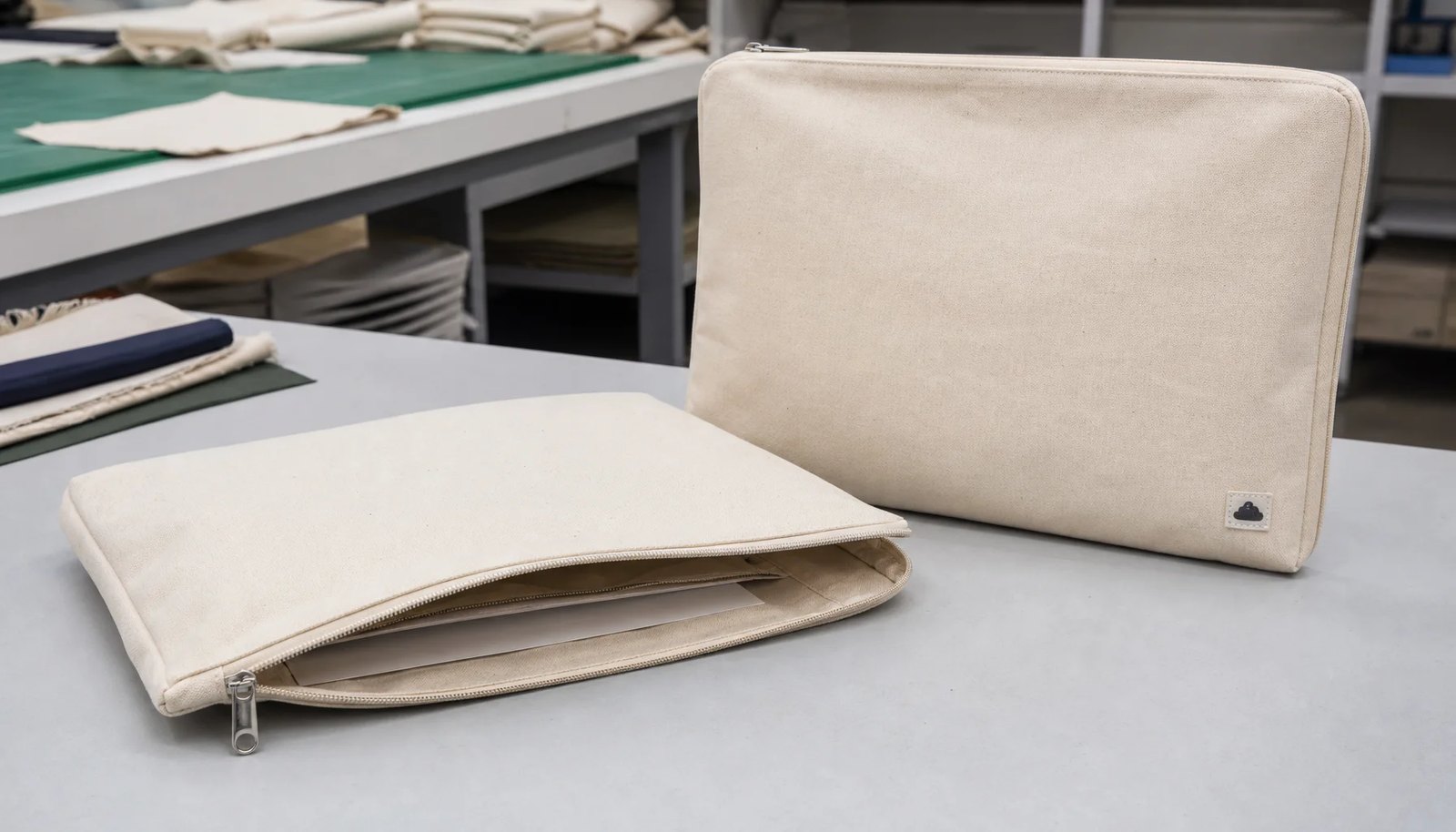
Define the bookstore program first
A canvas zipper portfolio can be a paid retail item, an orientation kit component, an admissions packet holder, an alumni gift, or a department giveaway. Those programs may use a similar base product, but the buying requirements are different. Retail units need clean presentation, barcode handling, SKU separation, and a zipper that feels good when a customer tests it. Giveaway units may use simpler construction, but they still need to hold documents without bent corners and survive bulk kitting.
Start the RFQ with the job the portfolio must do. State who will handle it, what it must hold, how it will be distributed, and whether it will be sold, gifted, stored, or shipped through campus e-commerce. This context helps suppliers recommend the right canvas weight, lining, zipper size, decoration method, and packing format. It also prevents quotes from mixing a budget event pouch with a shelf-ready bookstore product.
Use practical language instead of catalog language. Rather than asking for a canvas zipper portfolio with university logo, specify that the item must hold 20 sheets of US letter paper and a 3 mm brochure stack, close smoothly, carry a barcode label, and ship in cartons sorted by department or SKU.
- Retail sale: define shelf presentation, hangtag, barcode placement, individual packing, return-risk expectations, and carton sorting.
- Orientation kits: list every insert and maximum loaded thickness so the opening and zipper strength are not guessed.
- Admissions or alumni gifts: define hand feel, inside finish, logo approval path, and presentation level before final costing.
- Department orders: list each logo version, cost center, ship-to address, delivery date, and any shared materials across versions.
- E-commerce use: state whether each unit must be dust-protected, individually scannable, and parcel-ready without repacking.
Use an RFQ structure suppliers can price
The best RFQ lets several suppliers quote the same product, not several interpretations of it. University bookstores often coordinate input from student affairs, admissions, alumni relations, athletics, brand offices, and departments. If requirements arrive after sampling, the supplier may need to revise the pattern, repeat artwork strike-offs, change labels, or rework packing.
Organize the RFQ into product specification, branding, quantity, commercial terms, sampling, quality control, packing, and timing. For each line, ask the supplier to confirm compliance or list a specific exception. This makes low quotes easier to read. A lower price may reflect lighter canvas, a smaller zipper, bulk packing, missing barcode application, or setup charges excluded from the unit price.
Include commercial details early. Trade term, payment terms, sample charges, courier costs, price validity, and delivery window all affect the real buying decision. If the bookstore needs internal approval by program or cost center, ask the supplier to show setup fees separately from unit price.
- Product fields: finished size, usable opening, canvas weight, lining, zipper type, seam finish, stitch density, and insert-fit test.
- Branding fields: vector artwork, Pantone colors, logo size, placement, print method, labels, hangtags, and approval steps.
- Commercial fields: quantity by SKU, MOQ by version, setup fees, sample fees, price breaks, payment terms, and trade term.
- Packing fields: individual or bulk packing, carton quantity, barcode label, carton marks, carton weight, and plastic-reduction limits.
- Timeline fields: swatch date, sample due date, approval deadline, production start, inspection booking, ex-factory date, and receiving date.
Specify canvas by measurable fabric data
The words cotton canvas are not enough for procurement. Fabric weight affects hand feel, stiffness, sewing performance, print coverage, carton weight, and perceived value. For zipper portfolios, 10 oz canvas, often around 300-340 GSM depending on weave and finishing, can work for light document giveaways. A 12 oz canvas, often around 380-420 GSM, is a practical starting point for many bookstore programs. A 14 oz canvas, often around 430-480 GSM, can feel more premium but needs review for zipper sewing, corner bulk, and freight impact.
Ask for both oz/yd² and finished GSM. Some suppliers quote greige fabric weight while the buyer expects finished fabric weight. Others may offer a heavier-looking but loose weave that prints less sharply. Natural canvas should include acceptance rules for seed flecks, slubs, shade variation, and whether imperfections are allowed near the logo. Dyed canvas needs lab dip or swatch approval, lot control, and shade tolerance.
Finishing matters. Washing, dyeing, calendaring, and heat curing can change dimensions and hand feel. If the portfolio must fit a specific insert set, shelf tray, mailer, or storage bin, the pattern should be made around the actual production fabric or a clearly identified stock equivalent.
- 10 oz canvas: consider for cost-sensitive events, light inserts, and large-volume programs where carton weight matters.
- 12 oz canvas: consider for most retail, admissions, and orientation programs needing better hand feel and reliable print coverage.
- 14 oz canvas: consider for premium gifts after checking zipper strength, corner bulk, lining, machine sewing, and freight cost.
- Natural canvas: define acceptable flecks, yarn slubs, shade variation, odor, and logo-area surface requirements.
- Dyed canvas: require lab dip or swatch approval, shade tolerance, lot control, and confirmation of MOQ or lead-time changes.
Control size, fit, and zipper opening
Finished outside size is only one part of the specification. A portfolio can measure correctly and still be hard to use if the zipper opening is short, seam allowance is too wide, the lining steals space, or the corners are bulky. Bookstore staff may need to load hundreds or thousands of pieces before an event, so a tight opening can create real labor problems.
Define the insert test in the RFQ. For US letter documents, many buyers start near 355 x 265 mm outside size, then adjust based on seam style, zipper position, and loaded thickness. A4 documents, spiral notebooks, tablet sleeves, or mixed packets may require different proportions. The supplier should build the pattern around the maximum insert width, height, and thickness.
Write tolerances in millimeters and define the measurement method with the item laid flat. For flat cotton canvas portfolios, plus or minus 5 mm on outside dimensions is common unless the construction requires something different. The usable zipper opening should be measured and approved instead of assumed from the outside size.
- State finished width and height, measurement method, and tolerance for each dimension.
- Define usable zipper opening length, zipper stop position, and whether the zipper must run close to the corners.
- List the filled test load, such as 20 sheets of US letter paper plus a 3 mm brochure stack.
- Ask for sample photos or video showing insertion, zipper closure, corner fit, and loaded flatness.
- Confirm whether lining, labels, zipper-end tabs, or seam binding reduce usable capacity.
Treat the zipper as a functional component
The zipper carries much of the user experience. Customers may test it in the bookstore, and staff depend on it during kitting. If the zipper catches, splits, or feels flimsy, the portfolio will disappoint even when the canvas and logo look correct. For medium-weight canvas portfolios, a #5 nylon coil zipper is often a sensible default because it is flexible, light, widely available, and suitable for flat fabric goods.
The RFQ should name the zipper type, size, tape color, slider finish, puller style, puller length, end stops, topstitching, and reinforcement. If the buyer wants a school-color zipper, ask whether it is available from stock or requires custom dyeing. Custom zipper tape can change MOQ, shade approval, and lead time. Branded pulls or special pull tabs should be quoted separately from the base zipper.
Do not rely on one smooth showroom sample. Bulk zipper performance can change after sewing tension, print curing heat, compression packing, and carton stacking. Require in-line checks and final inspection checks, and define failure types before production starts.
- Use #5 nylon coil zipper for most medium-weight canvas portfolios unless the approved sample supports another size.
- Specify tape color, slider finish, puller material, puller length, end stops, topstitching, and zipper-end reinforcement.
- Ask whether school-color zipper tape is stock, custom dyed, or substituted with a close commercial color.
- Classify zipper jamming, split coil, missing teeth, detached puller, and end-stop failure as major or critical based on severity.
- Require open-close testing on sampled inspection units and basic smoothness checks before goods are packed.
Match decoration to university artwork
University artwork is usually controlled by brand standards, so decoration cannot be left open-ended. Provide vector files, Pantone or brand color references, clear-space rules, trademark marks, minimum size requirements, and placement instructions. A low-resolution image may support a rough mockup, but it is not enough for factory pricing because it hides line weight, small text, gradients, and registration risk.
Screen printing is usually the first method to consider for solid university logos on canvas portfolios. It can offer good coverage and efficient pricing at volume, but canvas texture affects fine lines and small type. Coarse yarns can break thin strokes, and heavy ink can fill small counters. A print strike-off on production-equivalent canvas is the right approval step before bulk printing.
Heat transfer can help with gradients, full-color mascot art, and shorter runs, but it changes hand feel and should be checked for edge lift, cracking, gloss level, and fabric texture show-through. Embroidery can look premium, but it may pucker flat panels and needs backing. Woven patches or labels can solve fine-detail problems for repeat programs.
- Screen print: best for one to four solid colors, clean logos, larger orders, and standard bookstore merchandise.
- Heat transfer: useful for full-color art or gradients; test edge lift, cracking, gloss level, and texture show-through.
- Embroidery: suitable for premium gifts; review puckering, backing, stitch density, and distance from zipper seams.
- Woven patch or label: useful for small details, subtle branding, and repeat programs needing consistent logo presentation.
- Approval rule: bulk decoration should not start until the buyer signs a strike-off made on production-equivalent canvas.
Break MOQ into real cost drivers
MOQ is rarely one simple number. The real minimum depends on fabric color, zipper color, logo version, print color count, packing style, and production batch. A bookstore order for 2,000 units split across four departments, three logos, and two delivery dates is not the same as 2,000 identical units. If the RFQ lists only the total quantity, the first quote may look attractive and then rise once the SKU split is clear.
Ask for a quote table that separates unit price from setup fees. Screen charges, strike-offs, dyed fabric, custom zipper tape, custom pulls, woven labels, barcode application, hangtags, inner cartons, and export cartons may each carry costs. University buyers often need to allocate those charges by department or program.
Document reorder assumptions. Many bookstore programs repeat annually with updated dates, sponsor marks, or department names. Ask how long the supplier keeps patterns, screens, artwork files, and sealed specifications. Confirm whether reorder pricing assumes the same fabric, zipper color, decoration method, and packing.
- Separate quantities by fabric color, zipper color, logo version, print color count, packing style, delivery batch, and ship-to location.
- Request price breaks at relevant volumes such as 500, 1,000, 2,500, and 5,000 pieces when budgeting scenarios.
- List setup fees for screens, samples, strike-offs, custom labels, custom zipper pulls, barcode application, and cartons.
- Ask whether departments can share fabric and zipper materials while paying only separate logo setup charges.
- Confirm reorder rules for saved screens, patterns, artwork revisions, approved materials, and minimum repeat quantities.
Approve samples in the right order
A digital mockup can make a product look ready before key risks are checked. For canvas zipper portfolios, sample review should cover fabric hand, zipper smoothness, seam shape, inside finish, logo placement, loaded capacity, and packing fold. Digital layouts are useful for discussion, but they cannot approve fabric texture, ink absorption, zipper behavior, corner bulk, or shelf presentation.
Use staged approval. Start with fabric swatches and zipper cards to lock materials. Approve a blank construction sample to confirm pattern, opening, lining, seam finish, and document fit. Then approve a decoration strike-off on the same canvas or production-equivalent fabric. Finally, approve a pre-production sample with all confirmed components, labels, and packing. The signed pre-production sample becomes the sealed reference for bulk production and final inspection.
Assign owners and dates in the RFQ. State who pays sample and courier costs, how many samples are needed for purchasing, bookstore management, and brand office review, and what happens if a sample fails. For fixed event dates, avoid starting bulk material purchase or printing before written approval unless the buyer accepts that risk in writing.
- Fabric swatch: verify GSM, weave, color, stiffness, odor, surface slubs, shade, and print suitability.
- Zipper card: verify tape color, zipper size, slider finish, puller length, smoothness, and compatibility with canvas weight.
- Blank sample: verify size, opening, seam allowance, lining, corner shape, stitch density, and filled-document fit.
- Decoration strike-off: verify Pantone match, line clarity, ink coverage, registration, curing, edge quality, and rub resistance.
- Pre-production sample: verify final materials, construction, logo, labels, packing, carton marks, and sealed-sample sign-off.
Write QC criteria before cutting fabric
Quality control should cover visual, dimensional, functional, and packing checks. Generic soft-goods inspection may catch stains and loose threads but miss what matters to bookstores: jammed zippers, wrong logo versions, weak print adhesion, portfolios that do not fit documents, unreadable barcodes, or cartons sorted in a way that slows receiving. The RFQ should define these risks before bulk fabric is cut.
Use defect categories so the factory, third-party inspector, and buyer judge the goods the same way. Critical defects may include the wrong university logo, missing logo, mold odor, unsafe sharp edge, severe contamination, or a product that cannot be used as intended. Major defects may include broken zipper, open seam, wrong size outside tolerance, print misregistration, visible front-panel stain, wrong packing, or unreadable barcode. Minor defects may include small loose threads, slight slubs outside the logo area, or light creasing that does not affect retail appearance.
AQL can be useful when paired with product-specific checks. Many general merchandise buyers use AQL 2.5 for major defects and 4.0 for minor defects, but buyer policy should control if different. Inspection sampling should cover every SKU, logo version, fabric color, and packing configuration.
- Dimensions: measure outside width, height, and usable opening against the signed sample and tolerance.
- Logo placement: check distance from edges, orientation, and version accuracy for each SKU.
- Zipper function: open and close every sampled unit at least three times and reject catching, split coil, loose slider, or puller failure.
- Print durability: check dry rub, handling resistance, registration, cracking, pinholes, bleeding, and visible shade drift.
- Seam security: inspect zipper ends, corners, backtacks, stress points, skipped stitches, open seams, and thread breaks.
- Packing accuracy: verify SKU labels, barcode readability, carton counts, mixed-carton rules, carton marks, and PO references.
Plan packing, freight, and receiving
Packing affects landed cost, retail condition, and campus labor. Canvas portfolios can crease, dent along the zipper line, collect carton dust, or pick up pressure marks if packed poorly. Flat packing protects presentation but increases carton volume. A light fold may reduce freight, but it should be approved only after checking crease recovery, print transfer, and zipper pressure marks.
Ask for carton quantity, carton dimensions, net weight, gross weight, and estimated CBM. These figures help compare landed cost and receiving impact. A low unit price can become less attractive if cartons are oversized, too heavy for campus teams, or packed in a way that requires steaming, wiping, or relabeling before sale. Request packing photos or a physical packing mockup before bulk packing starts.
Include receiving rules in the RFQ. Some stores need each unit individually barcoded. Others need cartons sorted by department, event, purchase order, or campus location. Mixed cartons can save freight, but only if they are marked clearly. If goods ship to several campuses, a central warehouse, or a 3PL, list the ship-to rules, carton marks, and label formats before the supplier quotes.
- Flat pack: best for premium retail units where print smoothness and zipper condition matter more than carton volume.
- Approved light fold: acceptable only after checking crease recovery, print transfer, zipper pressure marks, and shelf presentation.
- Individual polybag: useful for cleanliness, barcode application, warehouse picking, and protection from dust or carton abrasion.
- Paper band or tissue: useful for reduced-plastic programs when the buyer accepts more handling risk.
- Carton planning: request pieces per carton, carton dimensions, gross weight, CBM, and maximum lifting weight.
- SKU control: define barcode labels, hangtags, inner assortments, mixed-carton rules, carton marks, and PO references.
Specification comparison for buyers
| Decision area | RFQ specification to request | Best bookstore fit | Supplier risk to verify |
|---|---|---|---|
| Canvas fabric | Quote cotton content, finished GSM, oz/yd², weave, color, finish, and acceptable slubs. Ask for a swatch from the intended bulk fabric or named stock fabric. | Retail portfolios, orientation folders, alumni gifts, admissions packets, and department merchandise where hand feel and print quality matter. | Supplier may quote greige weight, loose weave, or showroom fabric. Confirm finished GSM, fabric lot, and shade tolerance before PO. |
| Size and fit | State outside dimensions, usable zipper opening, insert test, and tolerance. For US letter, many buyers start near 355 x 265 mm, then adjust for lining and insert thickness. | Course packets, welcome letters, brochures, notebooks, receipts, and event materials loaded by bookstore or campus staff. | Outside size can pass while the opening is too tight. Require a filled sample test with the approved insert stack. |
| Zipper build | Specify zipper type and size, commonly #5 nylon coil for medium canvas, plus tape color, slider finish, puller style, end stops, and reinforcement. | Daily-use merchandise, orientation kits, and e-commerce items handled repeatedly before sale or distribution. | Unspecified zippers may be undersized, rough, or weak. Define zipper jamming, split coil, loose slider, and end-stop failure as inspection defects. |
| Construction level | Choose unlined, self-lined, cotton-lined, or polyester-lined construction. Define seam finish, stitch density, zipper-end tabs, corner turning, and label placement. | Unlined for budget events; lined for paid retail, alumni gifts, and premium conference folders. | Lining can reduce capacity or distort corners. Approve a blank sample before logo work if the construction is new. |
| Branding method | Provide vector art, Pantone references, logo size, placement, clear-space rules, trademark marks, and decoration method. Require a strike-off on production-equivalent canvas. | University marks, bookstore private label, mascot art, department logos, sponsor marks, and event versions. | Mockups hide ink absorption, registration drift, and fine-line loss. Review real print or transfer samples before bulk decoration. |
| MOQ and pricing | Break quantities by fabric color, zipper color, logo version, print colors, packing style, delivery batch, and ship-to. Request price breaks at relevant volumes. | Programs combining bookstore retail, orientation, admissions, alumni, and department orders in one purchase cycle. | A supplier may accept the total order but charge separate setup minimums. Ask for itemized setup, sample, label, carton, and custom material charges. |
| Sample approvals | Require fabric swatch, zipper card, blank sample, artwork strike-off, pre-production sample, packing mockup, and sealed reference sample. | Programs with fixed retail launch, orientation, conference, commencement, or admissions deadlines. | Skipping stages can move unresolved fabric, fit, zipper, or logo issues into bulk. State that production starts after written PPS approval. |
| QC standard | Use buyer policy or an agreed AQL, often 2.5 major / 4.0 minor for general merchandise, with product-specific checks for zipper, logo, size, packing, and barcode. | Imported retail goods where wrong logos, missed events, returns, or receiving delays are costly. | Generic soft-goods inspection may miss functional and SKU errors. Include critical, major, and minor defect definitions. |
| Packing and receiving | Specify flat pack or approved light fold, individual polybag or paper band, barcode label, hangtag, carton quantity, carton marks, max gross weight, and SKU sorting. | Retail shelves, campus warehouse receiving, e-commerce picking, and multi-department distribution. | Poor folding can crease canvas or mark prints; mixed cartons can slow receiving. Approve packing format before bulk packing. |
Buyer checklist before sampling
- Define the program use: retail sale, orientation kit, admissions packet, alumni gift, conference folder, department merchandise, campus e-commerce item, or bundled course-material holder.
- State the target retail price or landed-cost band if it affects canvas weight, lining, zipper size, decoration, labeling, and packing choices.
- List the exact contents the portfolio must hold, including document format, notebook size, brochure stack, tablet sleeve, or maximum insert thickness.
- Specify finished outside width and height, usable zipper opening, zipper stop position, and dimensional tolerance in millimeters.
- Identify canvas by cotton content, finished GSM, oz/yd², weave, color, finish, shade tolerance, odor requirement, and acceptable natural flecks or slubs.
- Confirm construction: unlined or lined, seam finish, stitch density, corner turning, zipper-end reinforcement, and label placement.
- Specify zipper type, size, tape color, slider finish, puller style, puller length, end stops, and required smooth open-close performance.
- Provide vector artwork, Pantone or brand references, logo size, placement from edges, trademark marks, minimum line thickness, and placement tolerance.
- Break quantities by SKU, fabric color, zipper color, logo version, print color count, packing style, delivery window, ship-to address, and reorder expectation.
- Request setup and extra charges separately for screens, strike-offs, dyed fabric, custom zipper tape, labels, hangtags, barcodes, inner cartons, and export cartons.
Factory quote questions to send
- What exact canvas are you quoting by cotton content, finished GSM, oz/yd², weave, width, finish, and color?
- Can you provide a swatch from the intended production fabric or named stock fabric before we approve the PO?
- Is the fabric natural, bleached, dyed, pigment dyed, reactive dyed, or washed, and what shade tolerance applies between sample and bulk?
- What shrinkage range should we expect after finishing or print curing, and how is the pattern adjusted to keep finished size within tolerance?
- What is the MOQ by fabric color, zipper color, logo version, print color count, packing style, and shipment batch?
- Which zipper type and size are included, and what tape material, slider grade, puller style, end-stop construction, and reinforcement are priced?
- Are school-color zipper tapes available from stock, or would matching require custom dyeing, higher MOQ, longer lead time, and separate approval?
- Which decoration method do you recommend for our artwork on canvas, and what are the limits for fine lines, small text, gradients, and Pantone matching?
- Can you provide a print strike-off on production-equivalent canvas before bulk production, and what is the lead time if the first strike-off is rejected?
- How do you test zipper function, logo placement, barcode accuracy, carton sorting, and final packing during in-line and final inspection?
Quality-control points to confirm
- Finished width and height should remain within the signed tolerance, commonly plus or minus 5 mm for flat canvas portfolios unless another tolerance is approved.
- Usable zipper opening must fit the approved insert stack without bending paper, scraping notebook corners, or forcing staff to stretch the fabric during loading.
- Zipper must open and close smoothly with no catching, split coil, missing teeth, loose slider, broken puller, sharp burr, open end, or misaligned tape.
- Inspection samples should be opened and closed at least three times; any jam, slider failure, or end-stop failure should be treated as a major defect unless safety-related.
- Logo position should match the sealed sample, with practical tolerance such as plus or minus 3 mm for small marks and plus or minus 5 mm for larger prints.
- Print color should follow the approved Pantone, brand standard, or signed strike-off, with no visible shade drift across panels, cartons, batches, or SKU versions.
- Print surface should show no cracking, heavy ink buildup, pinholes, ghosting, poor registration, bleeding, transfer marks, or weak adhesion after reasonable dry-rub checks.
- Seams should be straight, secure, and backstitched at stress points, with no open seam, skipped stitch, severe puckering, broken thread, exposed raw edge, or loose loops.
- Canvas surface should be free from oil marks, mildew odor, heavy dirt, water marks, shade-panel mixing, severe creasing, and unacceptable slubs in the logo area.
- Packing should match the approved method, with correct SKU labels, barcode readability, carton count, carton marks, PO references, and ship-to sorting.