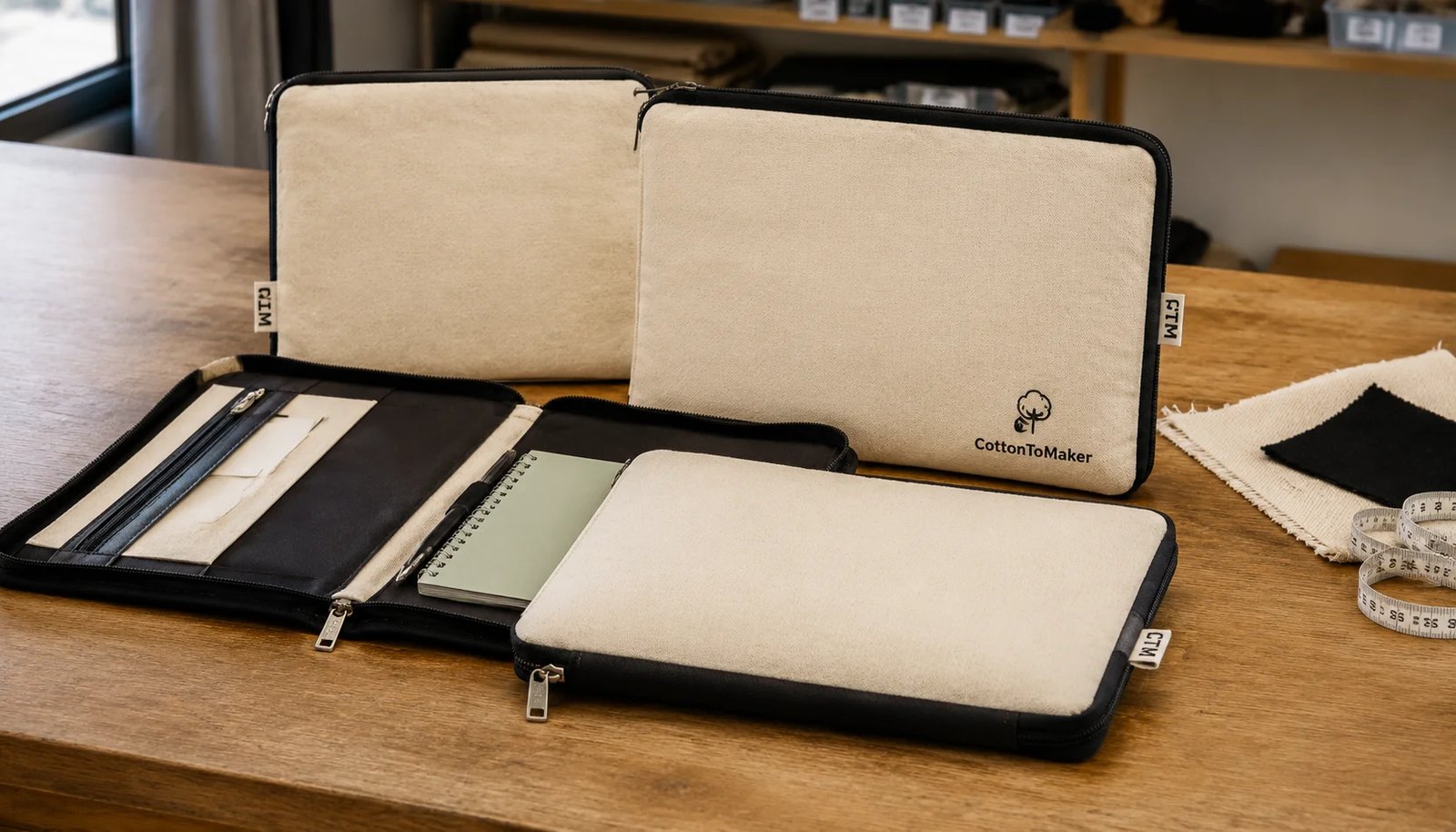
Why canvas zipper portfolios create quote confusion in grocery programs
Canvas zipper portfolios look simple on a line sheet, but they are one of the easier bags to under-spec in an RFQ. Buyers often send a reference photo, approximate size, and logo file, then receive quotes that appear comparable but are based on very different assumptions. One factory may price a soft 8 oz canvas shell with minimal internals, while another includes 12 oz canvas, a sewn document sleeve, pen loop, and stronger zipper. The quote gap can be large, but the lower price is not necessarily cheaper once the sample is corrected.
Natural grocer programs add another layer because the product often needs a clean, low-plastic appearance, subtle branding, and practical function for store teams, field merchandisers, community outreach packs, or supplier documents. If the RFQ does not define fabric weight, zipper quality, inside layout, and packing route, the buyer ends up comparing unlike-for-like offers. The main buying problem is not finding a portfolio supplier; it is standardizing the quote basis early enough to avoid sample churn and unplanned cost increases.
- Common quote mismatch: same outer dimensions, different internal structure
- Common quality failure: portfolio too floppy because fabric weight was not specified
- Common schedule loss: logo method changed after first sample because print on natural canvas looked weak
- Common landed-cost surprise: oversized cartons caused by excessive insert boards or retail-style packing
Build the RFQ around the use case, not just the bag shape
Start from the real use condition. A canvas zipper portfolio for a natural grocer may be used by store managers carrying forms, by community teams distributing wellness packets, or by brand representatives storing product sheets and tablets. Those use cases change the construction. A lightweight leave-behind conference folder can use softer canvas and simpler internals. A working field portfolio that opens several times a day needs stronger edge sewing, smoother zipper travel, and enough structure to keep paper corners from catching.
The most useful RFQ language describes what the item must hold and how often it will be handled. That gives the factory a practical basis for pattern allowances and internal pocket sizing. For example, saying 'must fit letter-size paperwork, a standard notepad, and 2 to 3 product sheets without bulging at the zipper corners' is far more useful than saying 'standard business portfolio.' Buyers who define functional load reduce both overbuilding and underbuilding.
- Document capacity example: 30 to 50 sheets plus one notepad
- Tablet capacity example: 10-inch tablet sleeve requires padding decision and seam ease
- Presentation use: flatter profile and cleaner print may matter more than heavy storage
- Field-use version: prioritize zipper durability and reinforced stress points near corners
Choose construction specs that factories can quote consistently
For most natural grocer programs, 10 oz to 12 oz canvas is the practical range. Around 280 to 340 GSM usually gives enough body for a presentable portfolio without turning it into a rigid case. Below that range, the panel can wrinkle around the zipper and logo print. Above that range, sewing gets heavier and edge bulk increases, especially if multiple inside pockets and binding are used. If the portfolio needs more structure, it is often better to add a thin internal board or interlining selectively rather than move the entire shell to a much heavier canvas.
Define the closure and interior in manufacturing language. A nylon coil zipper is usually the safest route for smooth operation and lower cost. Metal zippers can look premium but add weight, cost, and sometimes scratching risk if the item is stacked. Inside, keep the pocket architecture simple unless there is a strong use need. Every added card slot, mesh panel, gusset, or elastic holder increases labor time and alignment defects. In RFQs, list each internal element separately so suppliers do not make different assumptions.
- Typical shell fabric: 10 oz canvas about 280 GSM for light-duty use; 12 oz canvas about 340 GSM for stronger daily handling
- Common lining choice: unlined body for natural look, or light poly/cotton lining if print strike-through or interior finish matters
- Closure default: #5 nylon coil zipper for smoother opening and easier sourcing
- Organization default: one full document pocket, one notepad sleeve, one pen loop, limited card slots
Logo method and fabric finish drive more rework than buyers expect
Natural canvas behaves differently from coated or synthetic surfaces. If the portfolio body is unbleached natural cotton, the base tone can vary from lot to lot and the yarn texture can influence print coverage. A one-color screen print is usually the most practical choice for earthy retail branding, but the artwork should be tested on the actual production fabric. Fine lines, large solid dark blocks, and exact Pantone expectations all need discussion before bulk. A woven side label is a good alternative if the buyer wants subtle branding and lower print risk.
If the logo area is large and the brand insists on very solid coverage, the supplier may suggest a tighter canvas, pre-treatment, or a different print route. Heat transfer can produce sharper detail, but it may not match the natural look some grocery buyers want. Embossed patches or sewn labels can reduce ink variability but add sewing operations. The best RFQ does not just state the logo file; it defines the acceptable branding methods in order of preference and the visual standard to approve against.
- Best value branding: 1-color screen print on outer front panel
- Low-risk brand mark: woven side label stitched into seam
- Higher-detail logo route: heat transfer, but validate handfeel and appearance on canvas
- Sample requirement: print strike-off on actual canvas before approving bulk
MOQ logic: how quantity, SKU split, and setup charges really affect unit cost
Procurement teams often ask for a low minimum across several logo variants, then wonder why quote differences are wide. Factories price canvas zipper portfolios through a mix of material usage, labor content, print setup, and packing efficiency. If all colorways share the same body fabric and zipper but use different front logos, the order may still be efficient if the artwork changes are simple and quantities per version are meaningful. Once quantities fall too low per SKU, setup and line balancing start raising the unit cost sharply.
For this product type, MOQ is rarely only about fabric availability. It is more often about printing setup, cutting efficiency, and whether the factory can run the same pattern continuously. A buyer can usually improve price without increasing total quantity by reducing unnecessary variants. For example, holding one natural canvas shell and one zipper color across all regions but changing only a small printed logo is easier than splitting body colors and internal layouts at the same time.
- Lowest-cost route: one construction, one fabric, one zipper color, one print position
- Manageable variant route: same construction with 2 to 3 artwork changes
- Cost spike trigger: mixed body colors plus mixed internals plus small per-SKU quantity
- Useful RFQ field: quote break at 500, 1000, 3000, and 5000 pieces with setup fees listed separately
Sample approvals should prove function, not just appearance
A surprising number of portfolio programs approve the first sample because the front logo and general shape look right. That is not enough. The sample should be tested with the real paper set, notepad, or tablet the end user will carry. Many production corrections come from practical issues: pockets too shallow, pen loop too tight, zipper catches on paper corners, or a notepad back board making the folder too bulky when closed. These are easy to catch before bulk if the sample review is done against actual inserts.
Use a staged approval path. Start with a layout or tech sketch if the factory is building the pattern from scratch. Then review a blank construction sample for dimensions and pocket function before spending time on final print. After that, approve a printed pre-production sample made with the intended fabric and zipper. This sequence avoids expensive revisions where the buyer changes structure after print tooling has already been prepared.
- Blank sample test: actual document fit, corner clearance, and zipper closure under load
- Printed sample test: logo position, color coverage, and visual balance on natural fabric
- Critical approval note: photograph sample with ruler or dimension card for record
- Useful record: signed sample comments covering size, pocket layout, logo, zipper, and packing
Quote breakdown: where the price moves on this product
Unit price on a canvas zipper portfolio usually moves from six main variables: canvas weight, internal organization complexity, zipper quality, logo method, packing level, and order fragmentation. Buyers often focus on shell fabric first, but labor-heavy internals can change the cost just as much. A plain shell with one pocket is a different labor profile from a portfolio with multiple card slots, tablet sleeve, pen loop, and bound edges throughout. If two quotes differ significantly, review labor content before assuming one factory has cheaper materials.
Packing also changes the delivered economics more than many teams expect. A portfolio packed flat with simple protection is usually freight-efficient. Add thick insert boards, tissue, retail swing tags, or nested gift-style presentation, and carton cube rises fast. For natural grocer support programs that are not sold as premium retail accessories, simpler bulk packing usually gives the better landed cost. The right quote request separates ex-works product cost from decoration, packing extras, and carton data.
- Main material driver: 280 GSM vs 340 GSM canvas
- Main labor driver: number of internal stitched components
- Decoration driver: screen print setup, color count, label application
- Freight driver: carton dimensions, not just carton count
- Quote format to request: unit price plus tooling/setup, sample cost, carton spec, and incoterm
Quality thresholds that prevent the usual production disputes
Because a portfolio is handled close-up, cosmetic defects are noticed quickly. Buyers should define acceptance criteria in plain production terms. Front panel print should sit within the agreed tolerance from the edge and zipper seam. The body should close without twisting. Bound edges should remain even, and the zipper should travel cleanly through corner turns. On natural canvas, small yarn slubs can be acceptable if stated, but front-facing stains, dark streaks, and oil marks should not be. Without written defect rules, a supplier may pass units the buyer considers unusable.
Functional quality matters just as much. Interior pockets should be tested with real inserts. If the product includes a notepad slot, verify that the board slides in without deforming the shell. If the portfolio carries heavier paperwork, stress points at pocket tops and zipper ends may need reinforcement stitching. AQL selection is useful, but it should be paired with specific defect definitions for this item. Generic bag inspection language is not enough.
- Major defect examples: zipper jams, wrong size, print off-position beyond tolerance, open seams
- Minor defect examples if allowed: small non-front slub, light interior thread end, slight natural shade variation within approved range
- Practical test: close portfolio with intended load and inspect edge shape and zipper strain
- Useful record standard: approved golden sample plus defect photo sheet
Packing, carton planning, and DC handling need early decisions
Packing should match the program channel. If the portfolio is being distributed internally or used for field kits, individual luxury presentation usually adds cost without adding value. Most buyers do better with clean folded or flat-packed units, a simple protective polybag only if necessary, and master cartons sized for safe stacking. If the logo print is prone to rubbing, an interleaf or light protection may be justified, but test that need rather than applying retail-style packaging by default.
Carton planning matters for grocery distribution and import cost. A heavy or overstuffed carton causes receiving issues and can increase damage risk. The buyer should request carton dimensions, pack quantity, gross weight, and palletization assumptions at quotation stage. If there are multiple logo versions in one order, define carton marking and inner sorting clearly so the warehouse does not need to open every carton to separate SKUs.
- Good default: 20 to 30 pcs per master carton depending on thickness
- Moisture control: consider desiccant for long ocean transit with natural canvas
- Carton marks: PO number, SKU, quantity, gross/net weight, carton number range
- Mixed-SKU orders: use clear inner bundle labels or carton-end labels to reduce receiving errors
Lead time risk is usually in sampling and trim approval, not sewing capacity
Buyers often treat the lead time as a single number, but for canvas zipper portfolios the real schedule risk is front-loaded. Delays usually come from artwork adjustment, construction revision after first sample, waiting on zipper color match, or changing the internal layout after the pre-production sample. Sewing itself is not typically the bottleneck unless the order is highly fragmented. A buyer who locks the pattern and logo method early often sees a much smoother production window.
The practical way to manage schedule is to break the timeline into milestones: RFQ and quote clarification, sample revision rounds, artwork approval, pre-production sample approval, material booking, bulk cutting, sewing, final inspection, and shipment booking. If the item is tied to a store rollout or event date, build buffer around sample approval rather than assuming the factory can compress every later stage. Late structural changes are the biggest avoidable lead time loss.
- Typical risk point: first sample approved visually but rejected functionally after internal review
- Typical trim risk: zipper puller finish or custom label arrives later than shell fabric
- Schedule control method: no bulk material booking until key dimensions and logo method are signed off
- Best RFQ addition: required in-factory completion window after final sample approval, not before
Specification comparison for buyers
| Spec decision | Recommended option | When it fits | Buyer risk to check |
|---|---|---|---|
| Canvas weight | 12 oz natural canvas, about 340 GSM | Best balance for grocery program portfolios carrying forms, tablets, and sales sheets without feeling too soft | Below 280 GSM often collapses at the edges and prints can look wavier on large panels |
| Closure type | Nylon coil zipper with metal puller | Daily retail and field team use where smooth opening matters more than premium look | Cheap zipper tape can ripple after sewing; request zipper brand or performance standard and cycle test sample |
| Portfolio size | A4 / letter compatible finished size with 1.5 to 2 cm internal ease | Works for store paperwork, onboarding packs, vendor forms, and clipboards | Exact document-fit specs without ease can cause tight corners and zipper stress when fully loaded |
| Inner organization | One document sleeve, one card slot panel, one pen loop, one notepad slot | Most grocer support kits need simple organization without driving labor cost too high | Too many stitched pockets increase rejection risk for skewed alignment and make quote comparisons uneven |
| Logo method | 1-color screen print on outer panel for natural canvas; woven side label if brand wants subtle marking | Good for earthy retail branding and moderate quantities | Large dark prints on untreated canvas can vary in coverage; ask for print strike-off on production fabric |
| Trim material | Canvas body with PU-free simple webbing edge or self-fabric binding where possible | Fits natural-positioned brands trying to avoid a synthetic-heavy look | Edge binding inconsistency is common; define binding width tolerance and color match expectation |
| MOQ route | Single colorway consolidated across 2 to 3 artwork versions | Useful when regional teams need different logos but same construction | Too many SKUs below factory-efficient split quantity can push unit cost up sharply or delay packing |
| Packing format | Individual polybag only if required, then 20 to 30 pcs master carton with desiccant if ocean freight | Protects print and zipper while keeping carton count manageable for DC receiving | Overpacking each piece with inserts and tissue adds cost and carton cube without improving sell-through for non-retail kits |
| Sourcing route | Direct factory with in-house sampling or controlled stitching line | Best when buyer needs custom pockets, logo placement control, and repeat program ordering | Trading-only supplier may quote low but struggle to control pattern revisions, zipper quality, and packing accuracy |
Buyer checklist before sampling
- State finished size closed and open, with tolerance in millimeters, not just 'A4 portfolio'.
- Specify canvas weight in GSM or oz and whether fabric is natural, dyed, washed, or laminated.
- Define zipper type, zipper color, puller finish, and whether left-hand or right-hand opening matters.
- List every internal feature: document pocket depth, card slots, pen loop width, tablet sleeve, notepad slot, elastic holders, or ring binder requirement.
- Include artwork size, print location, print colors, and whether woven labels or embossed patches are acceptable alternatives.
- Note if fabric must remain unbleached natural shade or if optical white variation is acceptable.
- Set sample approval stages: digital layout, blank construction sample, printed pre-production sample, and bulk production standard.
- State packaging requirement by piece and by carton, including barcode labels, carton marks, and any retailer routing labels.
- Request quote split by sample charge, unit price, printing, setup, carton dimensions, gross weight, and shipping term.
- Define inspection level and major defects that are not acceptable, especially zipper failure, skewed print, and wrong pocket size.
Factory quote questions to send
- What is the exact canvas composition and finished fabric weight in GSM after washing or finishing?
- Is the quoted zipper nylon coil, metal, or molded plastic, and what tape and puller specification is included?
- How many stitching operations are included for the internal pocket set in the quoted price?
- What MOQ is required for one color body, one print artwork, and each additional artwork change on the same construction?
- Does the quote include screen charges, woven label setup, pre-production sample cost, and courier cost?
- What unit price changes if the buyer removes inner card slots or adds a notepad sleeve board stiffener?
- How are natural canvas shade variations controlled between bulk lots and sample approvals?
- What are the carton pack quantity, carton size, and estimated gross weight per carton for ocean freight planning?
- What in-line and final inspection points are used for zipper operation, print position, and size tolerance?
- What lead time is realistic from artwork approval, not from deposit date, and what materials are on critical path?
Quality-control points to confirm
- Finished size tolerance should be defined, for example ±5 mm on closed width and height, with tighter tolerance only if pattern complexity is low.
- Zipper must open and close smoothly without tape waviness, skipped teeth, or seam puckering at both corners.
- Screen print position should match approved placement tolerance, commonly within ±3 mm to ±5 mm depending on logo size.
- Print coverage on natural canvas should be even, with no obvious pinholes, ghosting, or strike-through on inner panels.
- Internal pocket depth and width must fit the intended insert size; test with actual documents or sample notepad.
- Stitch density should be consistent on edge binding and stress points, with no loose threads, open seams, or back-tack failure.
- Canvas panels should be free from major weaving slubs, stains, holes, oil marks, and severe shade variation on front-facing panels.
- Logo labels must be sewn straight and securely, with no frayed edges visible from the front presentation side.
- Cartons must meet agreed count, barcode, carton mark, and drop integrity expectations to avoid DC receiving issues.
- Random bulk inspection should verify odor, moisture risk, and metal puller finish where long ocean transit is planned.