Begin With the Buying Context
A canvas zipper portfolio looks simple until it enters a hotel retail program. Then small decisions start carrying cost: canvas weight, lining, zipper grade, pocket layout, print method, barcode labels, property-level sorting, retail sleeves, carton marks, and export packing. A useful RFQ begins with the business use, not with a photo and the words please quote.
A boutique retail item needs a cleaner surface and stronger shelf presentation than a back-office document pouch. A meeting gift may need reliable document capacity, a visible logo, and fast bulk distribution. A distributor program may need one base construction with several hotel property logos, separate barcode labels, and cartons sorted by destination.
Use the keyword idea behind a canvas zipper portfolios RFQ template guide for hotel retail in a practical way: make every supplier quote the same article, under the same commercial assumptions. If one factory prices 10 oz unlined natural canvas with a stock zipper and another prices 12 oz lined canvas with retail packing, the cheaper quote is not necessarily better. It is a different product.
- State the commercial use: boutique retail, welcome kit, meeting gift, front-desk document pack, spa folder, loyalty gift, e-commerce item, or distributor stock item.
- List the intended contents: A4 papers, US letter sheets, tablet, notebook, key cards, welcome letter, resort map, menu, voucher pack, or mixed insert set.
- Define the selling tier: budget amenity, mid-range retail, premium executive gift, loyalty-member merchandise, or private-label stock program.
- Explain the order structure: one hotel logo, multiple property logos, blank stock, seasonal artwork, or distributor assortment.
- Identify the handling route: shelf display, kit assembly, back-office storage, direct-to-property shipping, or e-commerce fulfillment.
- Name the non-negotiables: target landed cost, launch date, brand color, retail presentation, inspection level, and sample approval deadline.
Specify Size Like an Inspector Will Measure It
Finished size should be written in two ways: outside dimensions and internal usable space. A phrase such as fits A4 is not enough. A4 paper is 210 x 297 mm, and US letter is 216 x 279 mm, but the portfolio needs extra room for seam allowance, zipper tape, lining thickness, corner turning, and the movement of the user placing documents inside.
For a simple document portfolio, many buyers allow at least 15-25 mm of clearance beyond the paper width and height, depending on lining, zipper opening, and insert thickness. That is not a universal rule; it is a starting point for discussion. If the portfolio must hold a tablet, quote the exact device dimensions and whether it will be inside a protective case. If a welcome pack includes brochures, vouchers, maps, and cards, provide the stack thickness, not just the largest sheet size.
A simple annotated drawing is often enough for quotation. Show front and back panels, zipper position, seam allowance, pocket locations, logo placement, label placement, and opening direction. For each pocket, note the width, height, opening side, reinforcement point, and material. This keeps one supplier from quoting a shallow slip pocket while another quotes a full-depth lined sleeve.
- List finished outside width and height in millimeters.
- List minimum internal usable width and height after sewing.
- State zipper opening length where access is narrower than the body size.
- Provide actual insert measurements for documents, tablets, notebooks, menus, cards, and brochures.
- Define the opening: top zipper, side zipper, two-side opening, three-side opening, or L-shaped zipper.
- State whether corners are square, rounded, bound, turned, reinforced, or lightly padded.
Choose Canvas Weight and Finish With Care
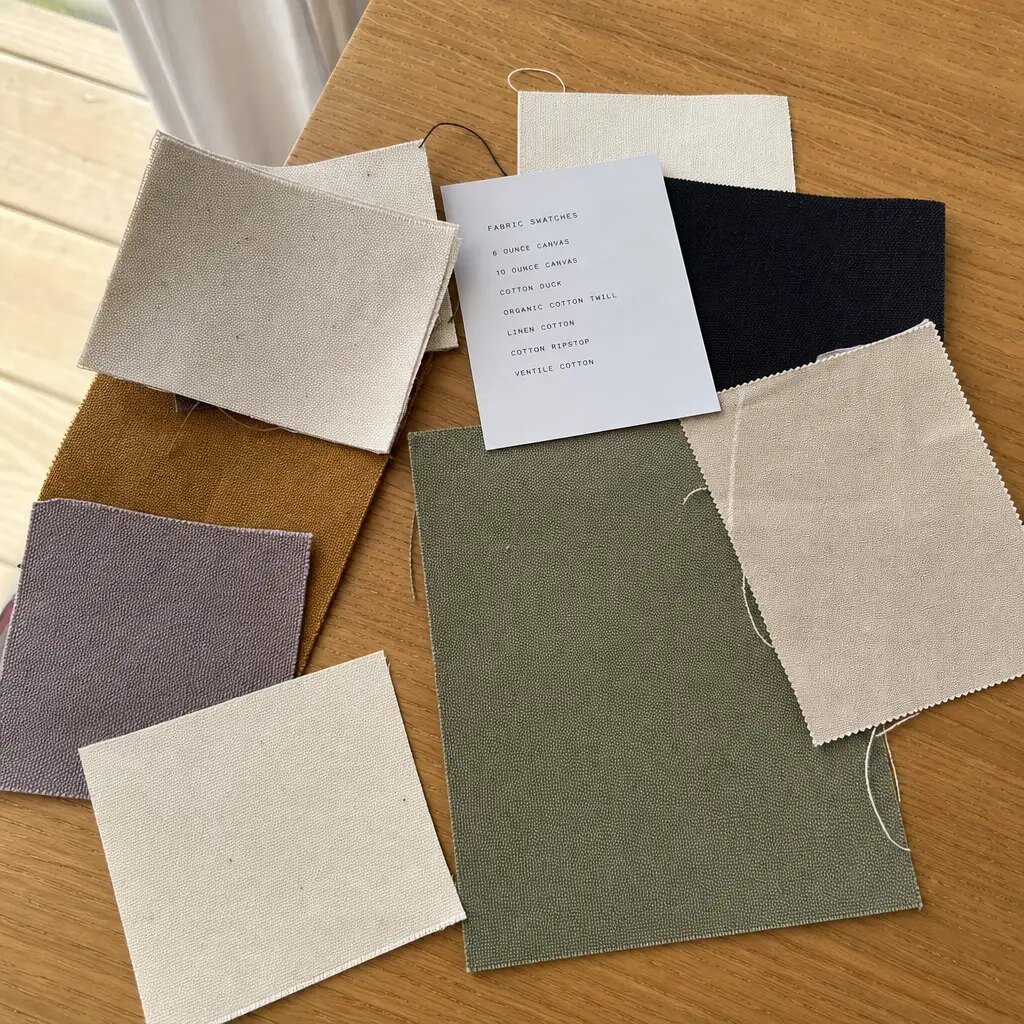
Canvas specifications should use both ounces and GSM because buyers and factories may describe fabric weight differently. The conversion is not exact; yarn, weave, finishing, dyeing, and washing all affect the final result. As a practical sourcing reference, 10 oz canvas is often around 320-350 GSM, 12 oz around 390-420 GSM, and 14 oz around 450-480 GSM. The approved swatch and agreed tolerance matter more than the name alone.
For most hotel retail zipper portfolios, 12 oz canvas around 390-420 GSM is a sensible starting point. It has enough body for retail handling, usually takes screen print well, and remains manageable around zipper seams. Lighter 8-10 oz canvas can work for event document pouches or budget welcome kits, but it may collapse near the zipper and feel less retail-ready. Heavier 14 oz canvas gives a firmer handfeel, but it increases fabric cost, corner bulk, sewing difficulty, shipping weight, and the risk of zipper waviness.
Finish changes both appearance and production risk. Natural unbleached canvas supports an eco, resort, or relaxed boutique look, but it includes cotton flecks and shade variation. Bleached canvas gives a cleaner base for bright logos. Dyed canvas supports brand color matching but needs lab dips and may raise MOQ. Washed or enzyme-washed canvas feels softer, while laminated or coated canvas can improve wipe-clean performance but may affect print adhesion and handfeel.
Set the appearance standard before cutting. Small cotton seed flecks may be acceptable on natural canvas. Oil marks, mildew, water stains, dirty panels, heavy slubs, shade panels, and foreign fibers should be treated as defects for retail orders. Keep a sealed fabric swatch with the signed pre-production sample so inspection has a physical reference.
- Use 10 oz or about 320-350 GSM for budget event pouches and low-cost welcome-kit inserts where shelf value is secondary.
- Use 12 oz or about 390-420 GSM for most hotel retail portfolios with zipper closure, screen print, and simple internal organization.
- Use 14 oz or about 450-480 GSM when a firmer premium handfeel justifies higher cost, weight, and sewing complexity.
- Specify finish: natural, bleached, dyed, washed, enzyme washed, laminated, coated, or water-resistant treated.
- Require a GSM tolerance and approved swatch before bulk cutting.
- Separate acceptable natural flecks from stains, mildew, oil, dirt, shade panels, and weaving defects.
Define Construction Before Asking for Price
Construction is one of the biggest reasons similar-looking portfolios receive very different quotes. A basic version may be two canvas panels with a straight zipper. A retail organizer may include lining, binding, internal sleeves, card pockets, pen loops, padding, woven labels, and reinforced corners. Every feature adds material, cutting time, sewing operations, and inspection points.
The RFQ should say whether the product is unlined, lined, padded, bound, turned-and-stitched, flat, or gusseted. Unlined canvas can fit a natural style and reduce cost, but the inside still needs clean seam finishing and trimmed threads. A 190T or 210D polyester lining creates a neater interior and can hide seam allowances. Padding, such as 2-3 mm foam, can help tablet or executive gift programs, but it also adds bulk and can cause puckering if the pattern is not adjusted.
Internal organization should earn its place. A practical hotel retail layout often includes one document sleeve, one card pocket, and one pen loop. Tablet padding, mesh pockets, elastic holders, or multiple card slots can support higher-value programs, but they also create more seams, tolerance issues, and possible defects. When cost targets are tight, ask suppliers to quote optional features separately instead of weakening the base specification without telling you.
- Define unlined, lined, padded, bound edge, turned edge, flat panel, reinforced corner, or gusset construction.
- Specify lining material and weight, such as 190T polyester, 210D polyester, cotton lining, or recycled polyester.
- State padding material and thickness if tablet protection or firmer structure is required.
- List each pocket with width, height, depth, opening side, material, stitch line, and intended content.
- Do not approve from a catalog photo if internal construction and seam finishing are not visible.
- Ask for alternate quotes with and without lining, padding, and extra pockets when value engineering is needed.
Detail the Zipper and Opening
The zipper is both a working component and a visible quality cue. For most canvas zipper portfolios, a No. 5 nylon coil zipper is the safest default because it runs smoothly, tolerates light bending, and works well on flat textile products. Resin zippers can create a bolder look but may feel bulkier. Metal zippers can look premium, yet they add cost and weight and need checks for oxidation, sharp edges, plating scratches, and staining risk, especially for humid destinations.
Do not write zipper and leave the rest to the supplier. State zipper type, size, tape color, teeth color, slider finish, puller style, opening direction, and end treatment. A small stock puller may be economical, but it can look weak on a retail item. A fabric pull tab, leather-look pull, or custom metal puller can raise perceived value. Ask about mold charges, MOQ, sampling time, finish standard, and replacement policy before committing.
Opening layout affects usability and factory risk. A straight top zipper is easiest to sew and inspect, and it works for many document pouches and gift-shop products. An L-shaped zipper gives better access for documents, tablets, and meeting packs, but the corner has to be right. Poor corner sewing can cause puckering, slider resistance, fabric bite, and uneven tape exposure. Test the pre-production sample repeatedly around the corner before approval.
- Use No. 5 nylon coil zipper as the default unless the brand requires resin or metal appearance.
- Specify tape color, teeth color, slider finish, puller design, end stop, and opening direction.
- For custom pullers, ask about mold fee, MOQ, lead time, finish standard, pull strength, and replacement policy.
- For L-shaped openings, require smooth movement around the corner without catching, puckering, or fabric bite.
- Keep an approved zipper component card with the signed pre-production sample.
- Treat non-closing zippers, missing pullers, broken sliders, and severe catching as major or critical defects.
Match Branding to Canvas Reality
Branding should be described as a production process, not a request to add logo. Screen printing is usually the best starting point for hotel retail canvas zipper portfolios because it suits solid logos, monograms, resort marks, and one to three spot colors. It also gives predictable bulk pricing. The texture of canvas can reduce edge sharpness, though, and small serif type or thin strokes may fill in. The RFQ should include vector artwork, Pantone references, print size, print position, ink finish, and position tolerance.
Heat transfer can reproduce fine details, gradients, photographic elements, or many colors that would be costly to screen print. It can work well for seasonal resort graphics or illustrated destination merchandise. The tradeoff is that the transfer may feel less integrated with the fabric, so edge durability and packing-contact transfer should be checked. Embroidery can look premium, but it works best on heavier panels, patches, or simple artwork. Dense stitching near zipper seams or pocket folds can distort the fabric.
Hotel retail branding often continues beyond the front logo. Buyers may need a woven side label, internal care label, hangtag, kraft sleeve, belly band, barcode sticker, or property-specific carton label. These items affect MOQ, sampling, and packing labor. Quote them separately from the base portfolio so procurement can compare retail upgrades without losing sight of the core product cost.
- Use screen print for simple hotel logos, solid marks, monograms, and one to three spot colors.
- Use heat transfer for fine details, gradients, many colors, or seasonal illustrated artwork.
- Use embroidery only where canvas weight, logo size, and panel position can support clean stitching.
- State logo size, position from seams, Pantone targets, ink finish, registration tolerance, and position tolerance.
- Request a strike-off on the actual approved canvas, not only a digital mockup.
- Quote woven labels, hangtags, barcode stickers, kraft sleeves, and belly bands as separate line items.
Build MOQ and Price Ladders Around Real Variables
MOQ for canvas zipper portfolios is not one fixed number. It depends on fabric availability, dyeing, zipper tape color, puller type, lining, labels, decoration method, retail packing, and artwork versions. A supplier may offer a lower MOQ with stock natural canvas, stock zipper tape, standard pullers, and one-color print. MOQ can rise quickly with custom dyed canvas, custom zipper tape, printed kraft sleeves, woven labels, or several property logos.
Separate MOQ by base construction, fabric color, zipper color, artwork, label, and packing version. This is especially important for hotel groups. A 1,000-piece base order may be realistic, but the factory may still need a minimum per logo because of screen setup, sorting, inspection, and carton labeling. Ask this before sampling, not after the purchase order is split across properties.
Request price ladders at practical quantities such as 500, 1,000, 3,000, and 5,000 pieces, or the quantities your rollout actually needs. The ladder shows whether savings come from material purchasing, printing efficiency, or labor scale. If the price barely changes by quantity, the item may be labor-heavy. If it drops sharply, setup charges, fabric MOQ, or packing efficiency may be driving the difference.
- Request MOQ per base construction, fabric color, zipper color, artwork, label, hangtag, and packing version.
- Ask for price ladders at 500, 1,000, 3,000, and 5,000 pieces or your expected rollout quantities.
- Group multiple property logos under one shared construction where possible.
- Ask which substitutions lower MOQ, such as stock natural canvas, stock zipper tape, standard puller, one-color print, or bulk packing.
- Separate one-time charges for screens, sample fees, custom puller molds, label setup, and printed sleeve setup.
- Review very low MOQ quotes carefully if they do not explain material limits, setup fees, or artwork sorting cost.
Read the Quote Beyond Unit Price
A useful quote includes more than an FOB unit price. The lower number may exclude screen charges, sample fees, custom puller molds, woven labels, barcode stickers, retail sleeves, inner cartons, or carton marking. It may also assume a thinner canvas, no lining, stock zipper tape, bulk packing, or a different Incoterm. Require suppliers to list what is included and what is excluded line by line.
Keep Incoterms consistent when comparing factories. FOB is often a clean basis for export quotations when the buyer controls freight, but some teams use EXW, CIF, DAP, or DDP. EXW may look cheaper while shifting local transport and export handling to the buyer. DDP can simplify budgeting, but it may hide freight, duty, and delivery assumptions. State the required Incoterm, loading port or delivery point, currency, payment terms, and quote validity.
Lead time should be broken into stages: swatch approval, decoration strike-off, counter sample, pre-production sample, material purchase, bulk production, packing, inspection, and handover. Hotel retail programs often connect to opening dates, events, conference schedules, or seasonal merchandising windows. If a supplier quotes a very short lead time, ask whether it assumes stock fabric, stock zipper tape, standard pullers, and simple packing.
- Request price by quantity and specification option rather than one blended number.
- Require separate lines for setup charges, sample fees, custom molds, labels, hangtags, sleeves, and barcode work.
- Require carton dimensions, pieces per carton, net weight, gross weight, and CBM for landed-cost comparison.
- State Incoterm, loading port or delivery point, quote currency, payment terms, and quote validity.
- Ask suppliers to list exclusions so packing, labels, inspection support, and artwork changes are not added later.
- Break lead time into sampling, material preparation, production, packing, inspection, and shipping handover.
Control Sampling Before Bulk Cutting
Sampling should move through clear checkpoints. A fabric swatch confirms weight, color, finish, texture, and shade range. A zipper card confirms tape, teeth, slider, puller, and finish. A print strike-off confirms artwork scale, ink opacity, edge sharpness, and color on the actual canvas. A counter sample confirms construction and usability. A pre-production sample confirms the final product that bulk production must follow.
Do not approve the first full sample as final if it uses substitute materials. If the sample uses available canvas, a temporary zipper, or unfinished packing, label it as a construction sample only. The final pre-production sample should use approved canvas, zipper, lining, pockets, decoration, woven label, care label, hangtag, barcode sticker, retail sleeve, and export packing method. That sample becomes the inspection standard.
Sample feedback should be measurable. Instead of saying make it cleaner, specify the change: move the logo 15 mm upward, keep logo centerline within +/-3 mm, increase ink opacity, reduce zipper tape exposure, change thread to matching beige, increase card pocket depth to 90 mm, or change carton quantity to 30 pieces. Clear feedback reduces sample rounds and helps the factory update cost when changes affect material or labor.
- Approve fabric swatch, zipper card, decoration strike-off, label, counter sample, packed sample, and pre-production sample as separate checkpoints.
- Use final materials for pre-production approval; mark substitute-material samples as construction samples only.
- Test intended documents, tablets, or insert packs for easy insertion and removal before approval.
- Open and close the zipper repeatedly, especially through corners and end stops.
- Check print rub, ink transfer, packed appearance, barcode position, sleeve fit, and carton mark on the packed sample.
- Keep one signed pre-production sample with the factory and one with the buyer or inspection agent before bulk cutting.
Set QC Standards That Can Be Checked
Quality control needs inspectable language. Good sewing is not a standard; it is a hope. The RFQ should define finished size tolerance, print position tolerance, stitch density range, zipper function, acceptable fabric marks, loose thread limits, pocket strength, carton mark accuracy, and barcode readability. For simple flat portfolios, +/-5 mm is a common finished-size tolerance when agreed in advance. Tighter control may be possible, but it should be priced and confirmed.
Buyers can use AQL inspection or a stricter internal standard for first shipments, but the defect list should match the retail use. A hotel boutique item needs cleaner fabric, straighter print, and better packing appearance than a back-of-house pouch. Major defects should include wrong logo, wrong artwork version, non-functioning zipper, severe stain, broken puller, unreadable barcode, incorrect size outside tolerance, and wrong carton mix. Critical defects should include safety issues such as sharp metal edges or contamination.
Natural canvas deserves special attention because its acceptable character can be confused with defects. Small flecks may pass if agreed in the standard. Oil marks, mildew, dirt, water stains, heavy shade panels, and foreign fibers should not pass retail inspection. For multi-property hotel orders, QC must also check artwork allocation and carton labeling so the right logo reaches the right property.
- Set finished size tolerance, commonly +/-5 mm for simple portfolios unless tighter control is agreed.
- Set print position tolerance, commonly +/-3 mm to +/-5 mm depending on artwork size and placement.
- Check stitch density, skipped stitches, broken thread, loose backstitching, seam holes, and loose internal threads.
- Check zipper smoothness, end stops, puller strength, fabric catching, missing teeth, waviness, and corner operation.
- Define acceptable natural flecks separately from stains, mildew, oil, dirt, shade panels, and weaving defects.
- Verify barcode, hangtag, sleeve, carton mark, artwork count, property allocation, and packing list accuracy.
Specification comparison for buyers
| RFQ decision | Procurement-ready specification | Why it matters for hotel retail | Quote or QC risk to control |
|---|---|---|---|
| Finished size and capacity | Quote finished outside dimensions, minimum internal usable width and height, zipper opening length, target insert size, and tolerance. Use millimeters. For simple flat portfolios, +/-5 mm is a common finished-size tolerance when agreed in advance. | A4 documents, US letter sheets, tablets, menus, spa brochures, vouchers, and welcome-kit inserts need clearance for seams, zipper tape, lining, corner turning, and easy removal. | If the RFQ only says fits A4, suppliers may quote different seam allowances, zipper clearance, and true capacity. |
| Outer canvas weight | Use both oz and GSM. As practical references, 10 oz is often about 320-350 GSM, 12 oz about 390-420 GSM, and 14 oz about 450-480 GSM. Request a GSM tolerance and approve a sealed swatch. | Canvas weight drives handfeel, print coverage, zipper stability, sewing difficulty, corner bulk, and landed weight. | Low GSM can feel promotional. Heavy canvas can create bulky corners and zipper waviness if the pattern and sewing method are not adjusted. |
| Canvas finish | Specify natural, bleached, dyed, washed, enzyme washed, laminated, coated, or water-resistant treated canvas. Approve lab dips or swatches before bulk cutting. | Hotel retail programs often need a consistent appearance across properties, seasons, and replenishment orders. | Natural canvas has flecks and shade variation. Custom dyeing may increase MOQ and requires lab dip approval. |
| Lining and structure | Define unlined, lined with 190T or 210D polyester, padded with 2-3 mm foam, bound edge, turned edge, gusseted, flat panel, or reinforced corner construction. | Lining and structure affect shelf appearance, internal cleanliness, durability, document protection, and perceived retail value. | Lining and padding add labor, shrinkage risk, puckering risk, and more internal defect points. |
| Zipper specification | Default to No. 5 nylon coil zipper for smooth handling on most canvas portfolios. State tape color, teeth color, slider finish, puller type, end stop, and opening direction. | The zipper is the first functional part many guests touch, so it becomes a fast quality signal. | Cheap zipper tape can wave on canvas. L-shaped openings need corner checks for smooth movement and fabric bite. |
| Opening layout | Use a straight top zipper for cost control. Use an L-shaped zipper when contents need wider access. Confirm bend radius and corner behavior during sample review. | Meeting gifts and document kits often benefit from wider access, while simple retail pouches can use a straight top opening. | L-shaped zippers require better sewing control and should not be approved from photos only. |
| Branding method | Use screen print for solid one to three color logos, heat transfer for fine multicolor artwork, and embroidery only on suitable heavier panels or patches. State Pantone targets and print position tolerance. | Hotel artwork may include property marks, resort icons, loyalty logos, seasonal graphics, or private-label packaging. | Small type can fill in on coarse canvas. Require vector artwork, strike-off approval, and artwork version control. |
| Internal organization | Specify document sleeve, card pocket, pen loop, tablet padding, mesh pocket, elastic holder, care label, and woven label with dimensions and materials. | Each feature changes cutting, sewing time, material use, usability, and inspection workload. | Vague pocket descriptions lead to non-comparable quotes and disputes during sampling or inspection. |
| MOQ and artwork logic | Request MOQ per base construction, fabric color, zipper color, artwork, woven label, hangtag, retail packing version, and hotel property logo. | Hotel groups often want one shared construction with several property logos or destination labels. | A 500-piece MOQ may not include custom dyed canvas, custom zipper tape, retail sleeves, or multiple artwork versions. |
Buyer checklist before sampling
- Define the exact commercial use case: hotel boutique retail, guest welcome kit, meeting gift, front-desk document pack, spa folder, loyalty gift, e-commerce item, or distributor stock program.
- State the finished outside size, internal usable width and height, opening size, and intended contents; include A4, US letter, tablet, notebook, menu, brochure, or insert pack measurements.
- Specify canvas weight in oz and GSM, fabric finish, color standard, GSM tolerance, shade tolerance, and whether the fabric is stock, custom dyed, washed, laminated, or coated.
- Confirm construction: unlined, lined, padded, bound, turned-and-stitched, gusseted, reinforced at corners, or flat panel; attach a simple drawing with pocket dimensions.
- Specify zipper type, size, tape color, teeth color, slider finish, puller design, opening layout, end treatment, and any pull or cycle test requirement.
- Attach vector artwork with logo dimensions, Pantone references, print method, print position from seam edges, acceptable position tolerance, and artwork version list by hotel property.
- List all internal features with dimensions and materials: document sleeve, card pocket, pen loop, mesh pocket, tablet padding, elastic holder, woven label, care label, hangtag loop, or barcode label.
- Request staged approvals: fabric swatch, zipper card, decoration strike-off, counter sample, packed sample, and final pre-production sample using approved components.
- Set packing rules: individual polybag, kraft sleeve, belly band, hangtag, barcode position, inner pack quantity, carton marks, maximum gross weight, moisture control, and artwork sorting method.
- Require quote data for unit price by quantity, MOQ by color and artwork, setup charges, sample cost, lead time breakdown, carton dimensions, gross weight, CBM, payment terms, and Incoterm.
Factory quote questions to send
- What exact canvas weight in oz and GSM is included, what GSM tolerance applies, and is the fabric stock, custom woven, dyed, washed, laminated, or coated?
- What finished outside dimensions, internal usable space, and zipper opening length are you quoting, and what finished size tolerance will you accept at final inspection?
- Which construction is included: unlined, lined, padded, bound edge, turned edge, reinforced corners, gusset, or flat panel? Please identify all materials used inside.
- Is the zipper nylon coil, resin, or metal, and what size, tape color, teeth color, slider finish, puller design, end stop, and opening direction are included?
- Which opening layout is quoted: straight top zipper, side zipper, three-side opening, or L-shaped zipper, and how will zipper smoothness be controlled at the corner?
- Which decoration method is included, how many colors are allowed, what Pantone matching method will be used, and what screen, setup, or artwork charges apply?
- Can you quote one-color screen print, two-color screen print, heat transfer, woven label, embroidery, and blank stock as separate line items?
- What is the MOQ per fabric color, zipper color, artwork, label, retail packing version, and hotel property logo, and what changes if stock materials are used?
- Does the sample cost include final fabric, final zipper, final print, inner pockets, woven label, barcode sticker, retail sleeve, and export carton, or only a construction sample?
- What inspection tolerances can you accept for finished size, GSM, print position, print color, stitch density, zipper performance, carton weight, and artwork sorting?
Quality-control points to confirm
- Finished size should match the signed pre-production sample within the agreed tolerance, commonly +/-5 mm for simple flat portfolios unless tighter control is priced and approved.
- Internal usable space should be checked with the intended documents, tablet, notebook, or insert pack so contents slide in without bending, catching, or stressing the zipper seam.
- Canvas GSM should be checked against the approved swatch and stated tolerance because GSM reductions change handfeel, shelf value, print coverage, and zipper stability.
- Natural canvas should be inspected by agreed criteria that separate acceptable cotton flecks from unacceptable oil marks, dirt, mildew, water stains, shade panels, heavy slubs, or foreign fibers.
- Zippers should open and close smoothly across the full opening without fabric catching, waviness, missing teeth, broken sliders, loose pullers, sharp edges, or uneven end stops.
- L-shaped zipper corners should be tested repeatedly because tight turns can cause puckering, slider resistance, fabric bite, uneven tape exposure, or corner distortion.
- Stitch density should be consistent on zipper seams, pocket seams, labels, bindings, and corners; skipped stitches, broken thread, loose backstitching, seam holes, and unraveling should be rejected.
- Print color, edge sharpness, opacity, registration, artwork version, and print position should match the signed strike-off within the agreed tolerance.
- Print durability should be checked with light dry rubbing and packing-contact review so ink does not transfer to polybags, kraft sleeves, separator sheets, or adjacent portfolios.
- Inner pockets should hold the intended contents without tearing, sagging, loose threads, sharp corners, blocked openings, or interference with zipper closure.