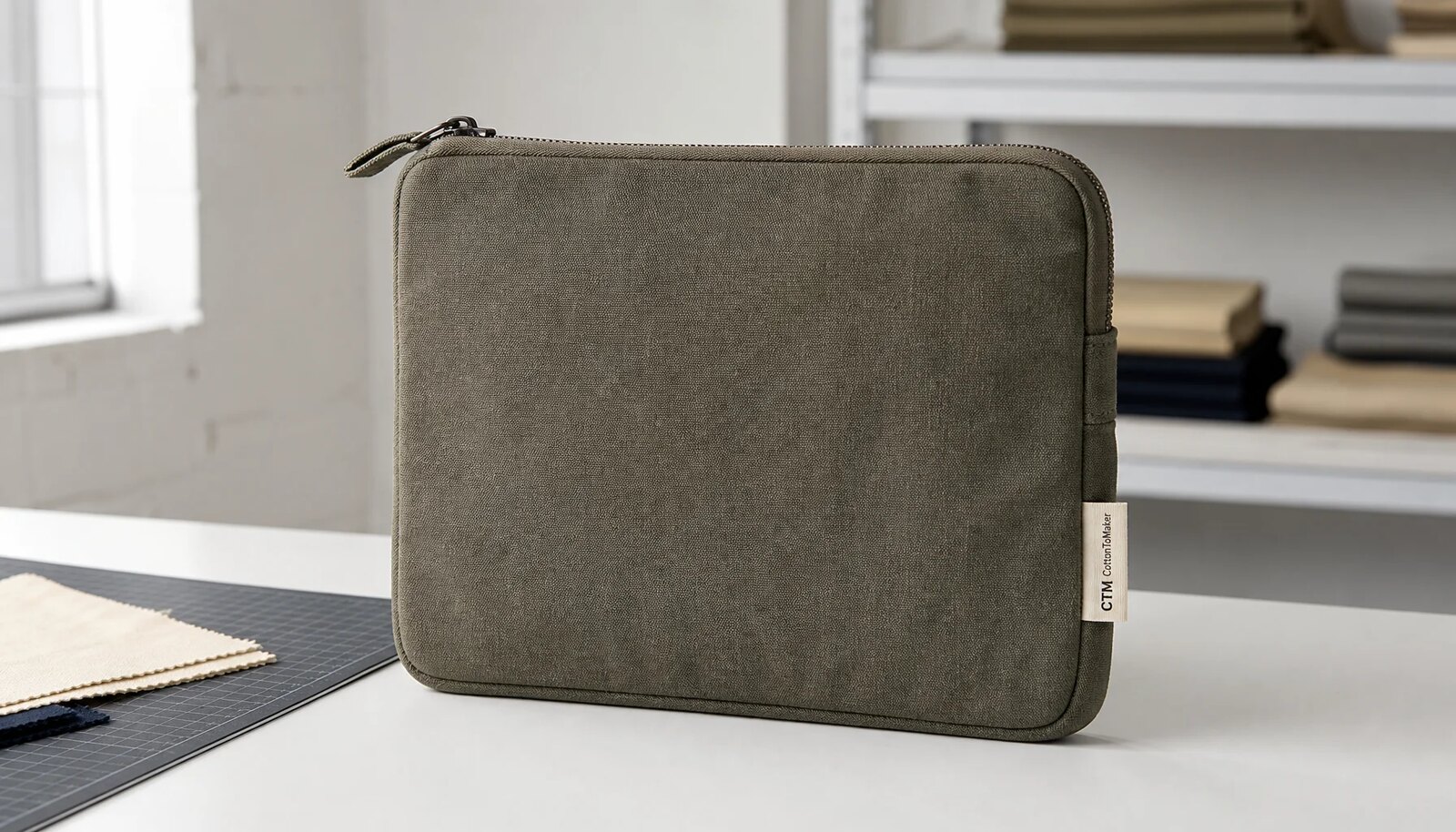
1. Start With the Event Job
A canvas zipper portfolio looks simple in a catalog, but the buying reason changes the build. A planner tool for site visits may need stronger corners, a secure pen loop, and a layout that works while standing. A delegate document pouch may only need to protect an agenda, badge envelope, and venue map through registration. A sponsor gift may need cleaner branding, better lining, and more controlled individual packing.
Open the RFQ with a short use statement before listing materials. For example: canvas zipper portfolio for corporate event planners, sized for US letter proposal sheets plus a 40-page schedule and two pens, front screen print logo, packed by sponsor version for venue delivery. That sentence gives a supplier a real product target. It also helps procurement avoid comparing a basic flat pouch against a reinforced organizer.
This is especially useful when several stakeholders are involved. Marketing may care about logo appearance, events may care about packing by date or location, and procurement may care about MOQ, lead time, and landed cost. Naming the job at the start keeps those priorities visible.
- Name the channel: internal planner tool, attendee kit, sponsor gift, venue sales folder, distributor item, or retail merchandise.
- List expected contents and approximate thickness rather than asking for a general document holder.
- State whether the item will be mailed, warehoused, handed out at registration, or packed into client-specific kits.
- Define the presentation level: promotional, corporate standard, premium gift, or retail-facing finish.
- Tell the supplier if multiple logo versions, event destinations, ship-to splits, or fulfillment labels must be managed.
2. Control Size and Capacity
Size should appear early in the RFQ because it is the fastest way for quotes to diverge. A4 and US letter portfolios are not interchangeable. A top-zip flat pouch, an L-shaped opening, and a three-sided zipper all behave differently once documents are inserted. If the buyer says only canvas zipper portfolio, many suppliers will quote whichever pattern is already convenient.
Capacity is not just a dimension on paper. Samples often look tidy when empty, then struggle with a real event packet. Paper corners bend, the zipper pulls out of line, or pockets reduce usable space. If the portfolio must hold 50 sheets of 80 gsm paper, a slim notebook, two pens, and a badge envelope, the RFQ should say so. If a tablet is included, provide device dimensions with case allowance.
Soft sewn items need practical tolerances. A body tolerance such as +/- 5 mm is usually more workable than expecting molded precision. Logo placement may need tighter visual control, often +/- 3 mm to +/- 5 mm depending on artwork and decoration method.
- Use exact finished dimensions in millimeters or inches, such as 330 x 250 mm plus a stated tolerance.
- Identify the document standard: A4, US letter, legal, half-letter, custom proposal packet, or folded event map.
- Specify opening style: top zip, side zip, L-shaped opening, three-sided zipper, or full-around zipper.
- Define load testing, such as closes smoothly with 50 sheets of 80 gsm paper plus one slim notebook.
- Measure pocket depth, document sleeve width, pen loop size, card slot opening, and tablet sleeve clearance.
- Ask for a simple technical sketch or dieline before sample approval if the buyer does not provide one.
3. Specify Canvas Without Guesswork
Canvas weight affects hand feel, print behavior, seam bulk, carton weight, and perceived value. A 10 oz or 12 oz canvas may work for a low-cost giveaway, but it can feel light for a business portfolio. For many B2B event programs, 14 oz to 16 oz canvas, roughly 400 to 540 gsm, is a practical range because it gives the item body without making cartons unnecessarily heavy.
Buyers should also ask how the weight is measured. Greige canvas, dyed canvas, washed canvas, coated canvas, waxed canvas, and pre-shrunk canvas can all finish differently. A supplier quoting 16 oz before finishing may not deliver the same feel as one quoting finished 16 oz fabric. Color matters too: stock natural canvas may support a lower MOQ, while custom dyed canvas may require a dye-lot minimum and longer lead time.
The RFQ should include composition, weave, finished weight, color method, surface finish, shrinkage expectation, and shade tolerance. If the item will be stored in humid venue warehouses or shipped long distance, odor, mildew prevention, and carton protection should also be included in the quality plan.
- Specify composition, such as cotton canvas, cotton-poly blend, recycled cotton blend, or another approved material.
- State fabric weight in oz or gsm and ask whether it is finished fabric weight after dyeing or treatment.
- Identify finish: untreated, washed, enzyme washed, pigment dyed, coated, waxed, pre-shrunk, or water-repellent where applicable.
- Ask for expected shrinkage, shade variation, colorfastness approach, and minimum dye-lot quantity for custom colors.
- Confirm whether stock fabric can meet the brand color or whether a custom dye approval is needed.
4. Separate Structure From Fabric
A heavier canvas is not the only way to make a portfolio feel substantial. Lining, interfacing, foam, board reinforcement, binding, and corner support all change structure. A clean presentation folder may need stiffness so it sits flat on a meeting table. A planner field organizer may need flexibility so it packs easily with other job materials. A mailed kit may need enough support to protect documents without pushing dimensional freight higher.
The useful RFQ separates these layers instead of hiding them under construction. Ask the supplier to state whether the quoted item is unlined, lined, lightly interfaced, foam supported, board reinforced, or bound. If the design includes a stiff panel, confirm whether it creates hard edges, corner wear, or sewing bulk near the zipper.
This is where sample handling matters. Put the intended contents inside the sample and carry it the way the recipient will. A portfolio can look premium on a table but feel too rigid in a kit box, or it can feel efficient in hand but look limp when presented as a sponsor gift.
- Quote unlined, lined, interfaced, foam-supported, and board-reinforced versions separately if the structure is undecided.
- Specify lining color and material, such as polyester lining, cotton lining, or no lining.
- Confirm binding width, corner reinforcement, thread color, thread size, and stitch density if appearance is important.
- Check whether reinforcement affects zipper corners, pocket openings, or document clearance.
- Avoid adding pockets or layers that increase cost without improving the event workflow.
5. Treat the Zipper as the Main Function
The zipper is the part users touch first. A portfolio with good canvas can still feel cheap if the slider catches, the tape waves, the puller loosens, or the end stop fails. For many canvas zipper portfolios used by event planners, a #5 nylon coil zipper is a balanced choice because it is flexible around corners, smooth in use, and less bulky than heavier molded teeth.
The RFQ should name the zipper type, gauge, tape color, slider material, puller style, puller finish, end-stop method, and opening format. Single-pull zippers are simple and cost efficient. Double-pull formats can suit wider openings or premium organizer layouts, but they add another component to inspect. A custom puller may support branding, yet it can add tooling, MOQ, approval time, and replacement risk.
Do zipper approval with the portfolio loaded. The tape should sit flat, corners should not ripple, and the slider should move without catching at seam intersections. For three-sided openings, corner stitching and tape alignment deserve extra attention because small sewing errors become obvious during use.
- Specify nylon coil, molded plastic, or metal zipper, plus gauge, with #5 nylon coil as a common balanced option.
- Confirm tape color, slider color, puller shape, puller finish, end-stop method, and stock versus custom trim.
- State whether the portfolio needs single-pull or double-pull opening.
- Require loaded zipper testing with the approved paper stack, notebook, inserts, pens, or tablet dummy.
- Inspect slider movement, coil or tooth separation, tape waviness, loose pullers, misaligned ends, and sharp exposed hardware.
- Ask whether zipper tape, pullers, and sliders are inspected incoming before sewing.
6. Match Branding to Canvas
Canvas texture is part of the product appeal, but it affects decoration. The weave can soften print edges, interrupt fine lines, and make small typography harder to read. Screen print is usually efficient for bold one-color or two-color event marks. Heat transfer may work for certain artwork, but adhesion and surface compatibility should be tested. Woven labels, cotton labels, and PU patches can look cleaner when the artwork is detailed or the brand wants a more durable finish.
A supplier needs more than a logo file. Include file format, logo dimensions, placement measured from finished edges, Pantone or brand references, decoration method, seam clearance, and approval steps. A digital mockup helps with layout, but it does not prove ink coverage, color, patch stitching, label orientation, or edge finish. Request a strike-off, label sample, patch sample, or decorated pre-production sample before bulk approval.
Event orders often add version-control work. One PO may include sponsor logos, venue names, regional versions, department versions, or different event dates. Each version can affect screens, setup fees, label MOQ, sorting labor, carton marks, and warehouse receiving. Put the version list in the RFQ, not after pricing.
- Provide vector artwork such as AI, EPS, or production-ready PDF when possible.
- Set logo dimensions, color target, and placement from finished edges, not from a flat mockup only.
- Choose screen print for bold simple marks; use woven labels, cotton labels, or patches when durability or fine detail matters.
- Request strike-offs for print and physical samples for labels, patches, or custom pullers.
- Define allowed placement tolerance and minimum clearance from zipper tape, seams, binding, pockets, and fold lines.
- Quote setup cost, screen cost, label MOQ, and packing requirements separately for each logo version.
7. Design the Interior Around Real Inserts
Interior layout should be driven by the event packet, not by a feature list. A document sleeve that is too shallow, a pen loop that is too tight, or a card slot placed under a bulky seam creates friction for planners and attendees. Extra compartments also add labor, material, and inspection points, so each one should earn its place.
Describe every interior feature by quantity, dimension, position, opening direction, and material. If a sleeve holds A4 or US letter documents, state the usable clearance after seams and binding. If there is a tablet sleeve, provide the device or dummy dimensions. If the order includes pens, badge envelopes, folded maps, sponsor inserts, or contracts, test the layout with those items before approving production.
The best interior depends on the buyer scenario. A registration giveaway may need one broad sleeve and a pen loop. An internal planner tool may need separated documents and secure storage. A VIP folder may need fewer compartments so the exterior presentation stays crisp and the product does not feel overbuilt.
- List each sleeve, pocket, loop, slot, divider, or elastic feature by count and finished measurement.
- State pocket opening direction and whether the contents should be visible, hidden, or secured.
- Confirm pen loop circumference or flat width using the actual pen or a defined sample pen diameter.
- Check that sleeves do not block the zipper path or reduce the usable document opening.
- Test with the real event packet, including page count, badge envelope, map folds, notebook thickness, and any device dummy.
- Ask the factory to mark all internal measurements on the pre-production sample photos for approval.
8. Make MOQ and Cost Drivers Visible
A single unit price is not enough for a fair comparison. Canvas zipper portfolios can change cost through fabric weight, zipper grade, lining, reinforcement, logo method, pocket count, packing, carton size, setup fees, sample fees, inspection support, and freight assumptions. If those details are bundled into one number, the lowest quote may simply be a lighter product with simpler packing.
MOQ should be broken down by component. A supplier may offer a low minimum using stock natural canvas, stock zipper tape, a standard puller, one screen print, and bulk packing. The same supplier may need higher minimums for custom dyed canvas, special zipper tape, woven labels, custom pullers, PU patches, multiple sponsor versions, or retail-ready packaging.
Ask for price tiers using the same specification, such as 300, 500, 1,000, 2,500, and 5,000 pieces. Then compare setup charges, sample costs, packing costs, carton data, inspection support, and shipping terms alongside unit price. A quote with clear assumptions is easier to manage than a low number that depends on substitutions.
- Request price tiers at the same specification and artwork assumptions.
- Ask for line-item costs for canvas shell, zipper, puller, lining, reinforcement, decoration, labor, packing, cartons, setup, samples, and tooling.
- Confirm MOQ by fabric color, zipper color, lining color, logo version, label or patch type, puller type, and packing method.
- Ask which requested feature creates the largest cost increase and which simplification would reduce MOQ or lead time.
- Separate ex-works, FOB, CIF, DDP, and landed-cost assumptions when comparing suppliers.
- Require suppliers to identify substitutions in writing rather than burying them inside the quoted price.
9. Approve Samples Like Production Standards
The sample stage turns the RFQ into a physical product. It should verify size, capacity, materials, zipper function, branding, pocket layout, and packing. Photos are useful, but they cannot prove loaded closure, hand feel, pocket usefulness, print opacity, or zipper smoothness. Handle the sample with the actual insert stack or a realistic substitute inside.
Name the sample type. A reference sample may only show factory capability. A prototype may test dimensions and layout with substitute material. A pre-production sample should match bulk production in canvas, lining, reinforcement, zipper, puller, decoration, interior layout, thread, and packing. Unless substitutions are documented and accepted, only the pre-production sample should become the signed production standard.
Feedback should be measurable. Instead of saying the portfolio feels weak, state that the front panel needs light interfacing, the pocket depth is short by 15 mm, or the zipper corner snags when loaded with the approved paper stack. Keep one signed approval sample for buyer records and ask the factory to keep one for production reference.
- Load the sample with the agreed documents, notebook, pens, badge packet, or device dummy before approval.
- Measure finished size, pocket dimensions, zipper opening, logo placement, and corner alignment.
- Check every material against the RFQ: canvas, lining, zipper, puller, thread, label, patch, binding, and reinforcement.
- Separate must-correct items from optional improvements so the factory can respond clearly.
- Do not approve bulk production if the sample uses substitute canvas, placeholder zipper, or temporary branding without written acceptance.
- Ask for a packed sample or packing photo when individual protection, barcodes, inserts, or version sorting matter.
10. Verify QC, Packing, and Supplier Fit
Quality rules should be written before the PO. Inspection should cover function, appearance, measurement, decoration, and packing. Function includes loaded capacity, zipper smoothness, pocket strength, and stress-point reinforcement. Appearance includes shade, print clarity, panel alignment, stitching, thread trimming, odor, and cleanliness. Packing includes unit protection, carton count, carton marks, barcode labels, and version separation.
Defect classification keeps decisions consistent. Critical defects make the product unsafe or unusable, such as broken zipper hardware, sharp exposed trim, mildew odor, missing major components, or severe contamination. Major defects affect brand presentation or function, such as wrong logo position, incorrect pocket layout, zipper failure, severe stains, distorted panels, wrong material, or mixed versions. Minor defects are small cosmetic issues within agreed limits.
Supplier selection should include verification, not only direct factory versus trader labels. Ask which processes are in-house, which are outsourced, how incoming materials are checked, who controls decoration, and where final inspection happens. Request business license or export capability where relevant, production photos, sample history for similar sewn goods, carton data, and a lead-time path from material booking to shipment. Compare landed cost and execution discipline, not just the first unit price.
- Set body measurement tolerance, pocket placement tolerance, logo placement tolerance, and acceptable panel alignment standards.
- Require zipper checks for repeated open-close cycles, loaded closure, slider smoothness, tape alignment, and end-stop security.
- Inspect stress points at zipper ends, corners, pocket mouths, pen loops, binding joins, labels, patches, and any handle attachment.
- Quote bulk pack, individual polybag, tissue or interleaf protection, retail insert, hangtag, and barcode label as separate options.
- Inspect packed cartons for count, carton marks, version labels, barcode labels, gross weight, carton condition, and product protection.
- Confirm sampling, sample revision, material booking, production, inspection, packing, export handling, and shipment booking lead times.
Specification comparison for buyers
| RFQ item | Procurement-ready specification | Why it matters for event buyers | Quote or QC risk to control |
|---|---|---|---|
| Product intent | State the event use case, recipient group, expected contents, distribution method, branding level, and whether the item is single-use, reusable, or retail-facing. | A delegate document pouch, planner site-visit tool, sponsor gift, and venue sales folder can look similar online but need different structure, pockets, packing, and presentation. | Generic words such as premium, durable, or standard let suppliers quote different products under the same item name. |
| Finished size and tolerance | Give outside dimensions, inside usable clearance, zipper opening length, gusset or spine depth, pocket dimensions, and tolerances such as +/- 5 mm for body size and +/- 3 mm to +/- 5 mm for logo placement. | Event packets often include A4 or US letter documents, schedules, maps, badge envelopes, contracts, notebooks, pens, or tablet inserts. Tight sizing bends paper and strains the zipper. | Confirm whether the quote is based on A4, US letter, legal size, or an existing factory pattern. Do not accept standard size without measurements. |
| Canvas material | Specify composition, finished fabric weight, weave, color method, finish, shrinkage expectation, and shade tolerance. Common B2B ranges are 14 oz to 16 oz, approximately 400 to 540 gsm. | Fabric affects hand feel, print quality, seam bulk, carton weight, freight cost, and perceived value at registration or gifting. | Ask whether weight is measured before or after dyeing, washing, coating, waxing, or pre-shrink treatment. |
| Lining and reinforcement | Separate shell fabric, lining, interfacing, foam, board reinforcement, binding, corner reinforcement, thread, and trim as individual assumptions. | A flat presentation folder may need stiffness, while a planner field organizer may need flexibility and lower packed bulk. | Overbuilding increases cost and carton volume; underbuilding creates curling, limp panels, distorted corners, and zipper stress. |
| Zipper specification | Declare zipper type, gauge, tape color, slider material, puller style, finish, end-stop method, and single-pull or double-pull format. #5 nylon coil is a common balanced option. | The zipper is the main functional component and one of the first failure points users notice. | Check smoothness, tape alignment, puller security, end stops, corner behavior, and loaded closing performance during sampling and inspection. |
| Branding method | Match decoration to artwork and canvas surface: screen print for bold marks, woven or cotton labels for texture and durability, and PU patches where suitable for the brand standard. | Event orders often include sponsor, venue, region, department, or date versions that affect setup, sorting, MOQ, and carton labeling. | Require artwork files, Pantone targets, placement measurements, strike-offs, version lists, and separate quote lines for each logo version. |
| Interior layout | Specify each document sleeve, pocket, pen loop, card slot, tablet sleeve, divider, or label by count, dimensions, opening direction, and location. | Extra compartments add labor and can reduce usable document capacity if they are not built around the real insert stack. | Test the sample with actual documents, notebook, badge packet, pen, map, or device dummy before production approval. |
| MOQ and price breaks | Quote realistic tiers and identify MOQ by canvas color, zipper color, lining color, logo version, decoration method, custom puller, label, and packing format. | One blended MOQ can hide the true constraint and make later version changes expensive. | Ask suppliers to name which component sets the minimum and which choices could reduce MOQ without changing function. |
| Packing and carton data | Quote bulk pack, individual polybag, interleaf or tissue protection, retail insert, barcode label, version label, and master carton marks separately. | Event shipments often move through fulfillment centers, venue warehouses, kit assembly teams, and multiple ship-to locations. | Request pieces per carton, carton dimensions, net and gross weight, inner packs, carton numbering, version labels, and packed-carton photos. |
Buyer checklist before sampling
- Define the buying scenario: internal planner tool, delegate kit, sponsor gift, sales meeting portfolio, venue proposal folder, retail merchandise, or fulfillment insert.
- State finished outside dimensions, internal usable clearance, gusset or spine depth, zipper opening style, and measurement tolerance in millimeters or inches.
- List the exact load: A4 or US letter sheets, number of pages, paper weight such as 80 gsm, contract packet, event schedule, floor plan, slim notebook, badge envelope, pen count, or tablet size.
- Specify canvas composition, finished weight in oz or gsm, weave, color, finish, shrinkage expectation, and whether stock fabric or custom dyeing is required.
- Separate shell, lining, interfacing, board, foam, binding, corner reinforcement, thread, and trim requirements instead of bundling them under construction.
- Define zipper type, gauge, tape color, slider material, puller style, finish, end stops, single-pull or double-pull format, and loaded closure performance.
- Provide vector artwork, Pantone or brand references, logo dimensions, placement from finished edges, decoration method, seam clearance, and placement tolerance.
- Describe every interior feature by quantity, dimensions, position, opening direction, and material, including document sleeves, flat pockets, pen loops, card slots, and tablet sleeves.
- Ask for MOQ by canvas color, zipper color, lining color, logo version, decoration method, custom puller, woven label, packing format, and ship-to split.
- Request price tiers for realistic order quantities and line-item costs for body, zipper, lining, reinforcement, decoration, labor, packing, cartons, samples, setup, tooling, inspection support, and shipping terms.
Factory quote questions to send
- What exact outside dimensions, inside usable clearance, gusset or spine depth, pocket dimensions, and zipper opening length are included in your quote?
- What measurement tolerances do you normally hold for this shape after cutting, sewing, lining, zipper installation, and pressing or finishing?
- Which document standard is the pattern designed for: A4, US letter, legal, custom event packets, or a buyer-supplied insert stack?
- What load has the portfolio been designed to close around, such as 50 sheets of 80 gsm paper, a 40-page schedule, a slim notebook, pens, or a tablet dummy?
- What canvas composition, weave, finished weight, color method, and surface finish are quoted, and is the weight measured before or after finishing?
- Is the fabric stock, custom dyed, washed, coated, waxed, pigment dyed, pre-shrunk, or untreated, and what shade variation or shrinkage tolerance should we expect?
- Is the interior unlined, lined, lightly interfaced, foam supported, board reinforced, or bound, and what material specifications are included in the unit price?
- Which zipper type, gauge, tape color, slider material, puller style, puller finish, end-stop method, and single-pull or double-pull format are included?
- What zipper inspection do you perform for smoothness, slider pull strength, tape alignment, coil or tooth separation, end-stop security, and loaded closure?
- Which logo method are you quoting: screen print, heat transfer, embroidery, woven label, cotton label, PU patch, leather patch, debossed patch, or zipper pull branding?
Quality-control points to confirm
- Finished width, height, corner shape, gusset or spine depth, zipper opening length, pocket depth, and logo position are checked against the approved specification and tolerance.
- The portfolio closes smoothly with the agreed loaded contents, without forcing the slider, bending paper corners, distorting panels, or pulling the zipper tape out of alignment.
- Canvas composition, finished weight, weave, color, surface finish, shrinkage behavior, and hand feel match the signed sample or written material specification.
- Fabric is free from unacceptable shade mismatch, dye streaks, water marks, mildew odor, chemical odor, oil stains, holes, needle damage, heavy slubs, and visible contamination.
- Zipper opens and closes repeatedly without snagging, slider sticking, coil or tooth separation, puller looseness, end-stop failure, tape waviness, or sharp exposed metal.
- Zipper tape is installed evenly around straight edges and corners, with clean anchors, secure backstitching, bar tacks where specified, and no twisting at the ends.
- Stitching is straight, evenly spaced, locked at starts and stops, and free from skipped stitches, broken thread, loose tension, puckering, unraveling, and excessive thread tails.
- Stress points at corners, zipper ends, pocket mouths, pen loops, binding joins, handles if any, and label or patch attachment points are reinforced according to the approved sample.
- Logo execution matches approval for size, placement, color, opacity, registration, edge sharpness, label orientation, patch stitching, seam clearance, and version sorting.
- Screen print or heat transfer has no bleeding, ghosting, cracking, peeling, pinholes, lint contamination, offset marks, or loss of opacity after normal handling.