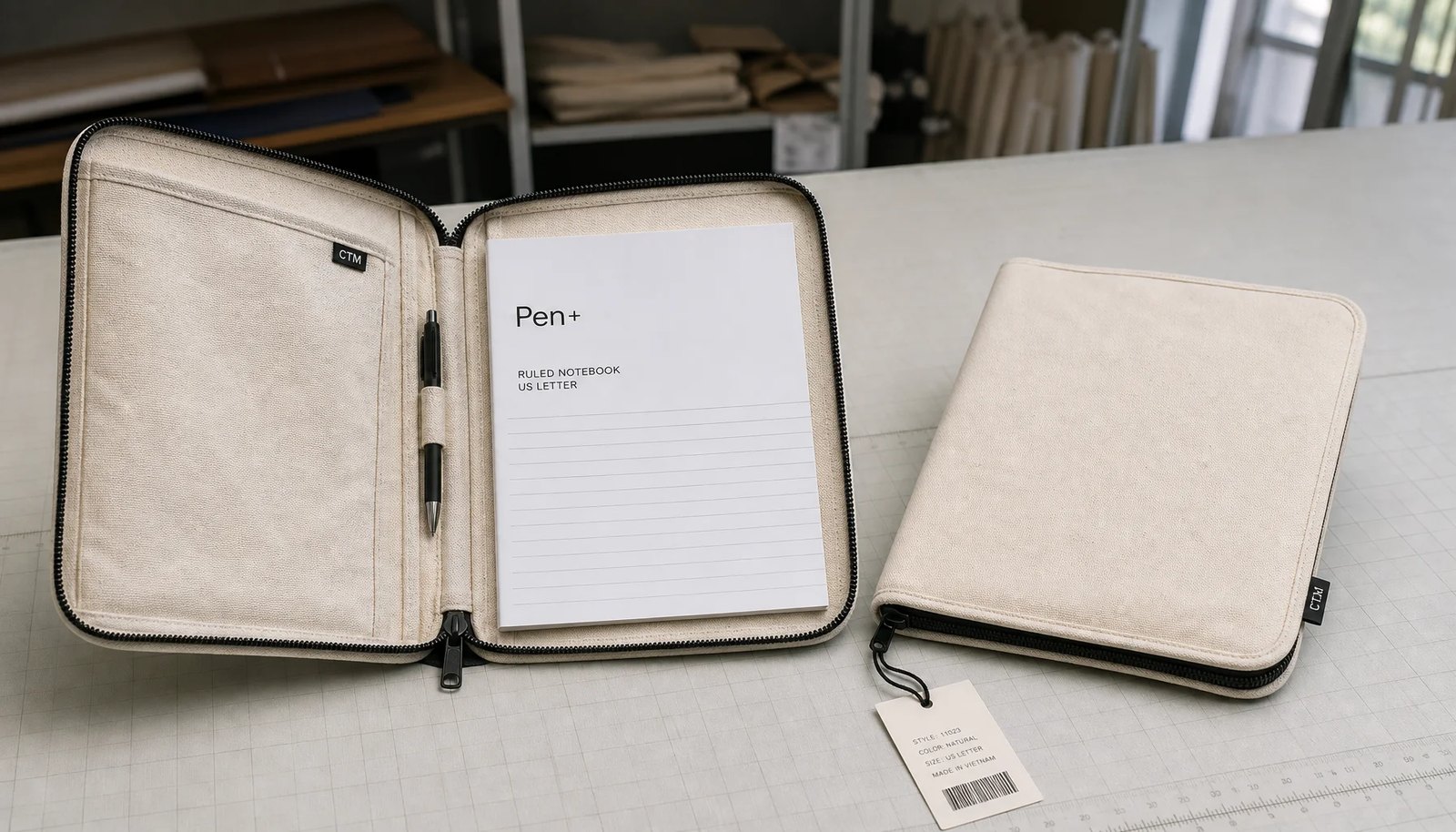
Begin with the bookstore use case
A canvas zipper portfolio may look like a simple cut-and-sew item, but university bookstore buyers usually need more than a plain pouch with a logo. The product has to hold documents cleanly, open without zipper drag, present well on a shelf, scan correctly at receiving, and protect the campus mark. It may be sold as a stationery item, packed into an orientation kit, given to alumni, or ordered by a department for a course or event. Each use changes the acceptable price, construction, logo method, and inspection standard.
The most common sourcing mistake is asking factories to quote a “canvas zipper portfolio with university logo” and assuming the replies describe the same product. One supplier may price 10 oz unlined canvas, a basic zipper, and bulk packing. Another may include 16 oz canvas, lining, a No. 5 nylon coil zipper, pocket reinforcement, a woven side label, and individual barcode packing. Both quotes can sound reasonable, but they are not comparable. A useful canvas zipper portfolios quality inspection checklist for university bookstores should therefore begin before the first sample, not at the final inspection table.
Campus calendars leave little room for repair. Orientation, back-to-school, alumni weekend, graduation, and department programs usually have fixed selling or distribution dates. If the logo is wrong, the zipper fails, or cartons arrive mixed by artwork, the buyer may not have time to remake goods. Treat the checklist as an RFQ control document: it should tell every supplier what the portfolio must hold, how it should open, how the logo must sit, which defects will fail inspection, and how the cartons must arrive.
- Use the checklist during RFQ, sample approval, inline QC, and final inspection.
- Compare suppliers only after fabric, zipper, lining, decoration, packing, and tolerance assumptions are normalized.
- Treat the item as a retail soft good with function and brand requirements, not as a disposable giveaway pouch.
- Connect every specification to the selling date, receiving process, and expected student or department use.
Define fit before discussing price
The first technical question is not fabric weight or logo method. It is what the portfolio must hold. A course-pack holder may need US letter paper, handouts, a notebook, pens, and a slim charger. An international program may require A4 fit. A tablet-oriented portfolio needs the tablet plus the protective case, not just the device name. A graduation gift may prioritize a clean outside panel and a more polished lining. The RFQ should describe the contents and the use case before requesting unit price.
Separate the finished outside dimensions from the usable inside opening. A portfolio can measure correctly on the outside and still fail because zipper tape, seam allowance, lining, and corner radius reduce the real opening. For document fit, the minimum usable opening should normally exceed the required contents by about 10-15 mm in width and height unless the design is meant to be snug. If the item must hold US letter sheets, do not accept an outside dimension that is only slightly larger than 216 mm x 279 mm. If it must hold A4, build in clearance beyond 210 mm x 297 mm.
Put tolerances in millimeters and attach them to the purchase order or tech pack. For flat letter-size canvas zipper portfolios, +/- 5 mm is a practical finished-size tolerance for many bulk orders. For larger, gusseted, or heavily lined organizer styles, +/- 8 mm may be more realistic unless the supplier proves tighter control. Print placement can often be held to +/- 3-5 mm when artwork is printed on flat panels before sewing. It becomes harder when printing after assembly or when natural canvas has more distortion. Pocket depth, pen loop width, gusset depth, and zipper path also need tolerances because small changes can affect use.
- State finished outside size and minimum usable inside opening as two separate measurements.
- List exact contents: US letter, A4, notebook, tablet with case, pens, charger, course inserts, or bookstore retail card.
- Define whether the style is flat, gusseted, or an organizer layout before comparing quotes.
- Identify front panel, zipper start point, pull direction, artwork orientation, and barcode orientation.
- Set written tolerances for finished size, usable opening, gusset depth, pocket depth, pen loop width, and print placement.
Specify canvas beyond the ounce label
Canvas weight affects cost, hand feel, sewing difficulty, shipping weight, and retail presentation. For many university bookstore retail programs, 12 oz to 16 oz cotton canvas, roughly 380-540 GSM depending on yarn count, weave, sizing, and finish, is a strong starting range. It feels more substantial than lightweight promotional fabric without making zipper corners too bulky. A lighter 10 oz to 12 oz canvas can work for orientation kits or budget event merchandise if the expected load is modest. Above 16 oz, the portfolio may feel more structured, but seams become bulkier and may create needle marks, corner drag, higher freight weight, and less even turning.
Ask for both oz and GSM. Suppliers may use local conventions, marketing descriptions, or fabric references that do not translate perfectly across markets. The same ounce description can feel different after washing, dyeing, sizing, or finishing. Request a fabric swatch or material card and keep the approved fabric reference with the purchase order. If color is important, remember that natural canvas includes cotton flecks and shade variation. Dyed canvas can better support school colors, but it usually adds MOQ, approval steps, and lead time.
Structure matters as much as fabric weight. Unlined construction can be efficient when seams are bound or overlocked neatly. Lined construction gives a cleaner interior and supports pockets, but it can also hide loose threads, trapped fabric, uneven seam allowance, and weak pocket tacks. If the portfolio includes a document sleeve, divider, tablet pocket, or organizer panel, specify the lining material and approximate lining weight. Also ask whether the factory plans to use interfacing, foam, cardboard, or reinforcement panels. Those hidden materials change flexibility, thickness, packing behavior, and sewing risk.
- Use 10 oz to 12 oz canvas for lighter-duty, cost-sensitive programs only when the load is limited.
- Use 12 oz to 16 oz canvas as the main bookstore retail range for a stronger hand feel.
- Specify natural, bleached, dyed, washed, organic, recycled-content, stock, greige, or custom woven canvas.
- Require oz, GSM, finish, fabric shade reference, and approved swatch details on the quote and sample tag.
- Control lining, binding, interfacing, reinforcement panels, and inner pockets as part of the material specification.
Make the zipper a controlled component
The zipper is the part buyers and students touch most, so it deserves more attention than a single line in the quote. For most flat canvas zipper portfolios, a No. 5 nylon coil zipper is the safest baseline. It bends around soft fabric corners more smoothly than low-grade metal teeth and has enough strength for repeated use. A No. 8 nylon coil zipper may be suitable for thicker gusseted portfolios or heavier organizer versions, but it adds bulk and can make corners harder to sew. Very small zippers may reduce cost, yet they often make the finished item feel weak.
Inspect the zipper as a system: tape, coil, slider, puller, stopper, stitching, end reinforcement, and corner radius. A good coil can still jam if the tape is sewn under uneven tension. A weak slider can make a better zipper feel rough. Short tape allowance concentrates stress at the end of the opening. During sample review, open and close the zipper at least 20 times, then repeat with representative contents inside. During final inspection, operate the zipper fully on every sampled unit rather than checking only the visual line of the teeth.
Reinforcement should be visible, repeatable, and located exactly where stress occurs. Zipper ends, pocket corners, pen loops, label points, and handle tabs should use bar tacks, backstitching, double stitching, folded construction, or another approved method. Avoid vague language such as “reinforced” unless the method and location are defined. Reject missing backstitching, loose bar tacks, open seams, broken thread, weak end stops, sharp burrs, detached pullers, and sliders that pull into soft seams.
- Use a No. 5 nylon coil zipper as the default for most flat bookstore portfolios.
- Use a No. 8 nylon coil zipper only when gusset depth or load justifies the extra bulk and cost.
- Test zipper movement empty and loaded, including corners, stoppers, and end reinforcement.
- Specify zipper tape color, tape width, slider finish, puller style, stopper type, and zipper start point.
- Reject jamming, separation, loose stoppers, sharp burrs, broken sliders, wavy tape, and rough corner drag.
Protect the campus logo standard
University bookstore merchandise often carries marks that are more tightly controlled than ordinary promotional artwork. The logo may represent the university, a department, athletics, an alumni office, or a one-time event. For one to three solid colors, screen printing is usually practical on canvas because it gives a familiar retail look and works well at bulk quantities. Heat transfer can support full-color art, gradients, or fine detail, but buyers should check edge adhesion, film hand feel, and appearance after handling. Embroidery can add perceived value, yet it may distort lighter canvas unless backing, stitch density, and thread tension are controlled.
Natural canvas changes how colors read. White ink can look warm, dark colors may lose crispness, and cotton flecks can show through thin ink coverage. Provide Pantone or official brand references, but do not rely on a digital proof as the only approval standard. A strike-off or pre-production sample on final fabric is much safer. If the campus brand requires a very tight color match, discuss underbase printing, dyed canvas, or another decoration method before bulk production begins.
Placement standards prevent avoidable disputes. Define logo size, measurement points, front panel orientation, distance from zipper seam, and tolerance. For many flat portfolios, +/- 3 mm to +/- 5 mm placement tolerance is practical when printing flat panels before sewing. For multiple campus logos on the same base item, each artwork version should have its own approved layout, SKU, barcode, and carton mark. That separation reduces the chance that wrong-logo goods pass inspection simply because the total quantity looks correct.
- Use screen print for solid campus logos when repeatability, cost, and retail appearance matter.
- Use heat transfer for full-color designs only after checking edge adhesion, film hand feel, and handling performance.
- Use embroidery only with suitable canvas weight, backing, stitch density, and approved puckering limits.
- Approve final ink or decoration on final fabric, not only a digital proof or substitute swatch.
- Define logo size, placement reference points, tolerance, color standard, curing expectation, and acceptable shade variation.
Compare quotes without hidden substitutions
MOQ and unit price depend on more than the body shape. A stock natural canvas portfolio with a standard zipper and one-color print may be possible at 300-500 pieces if the supplier already has a similar pattern and material. Dyed canvas, custom lining, custom zipper pulls, special zipper tape colors, embroidery, woven labels, retail sleeves, and multiple artwork versions can move the practical MOQ to 800-1000 pieces or more. Ask whether MOQ applies to the full order, each fabric color, each logo, each zipper color, or each packing SKU.
A quote breakdown helps procurement teams make cleaner decisions. Ask suppliers to separate fabric, sewing, zipper, lining, decoration, labels, zipper pulls, packing, sample charges, screen or plate fees, inspection support, and inland transport. A low unit price may exclude barcode labels, retail sleeves, carton separation, or final inspection cooperation. A higher price may include stronger canvas, a smoother zipper, cleaner lining, better reinforcement, and receiving-friendly packing. Without the breakdown, the cheapest quote can become the more expensive landed option after corrections and add-ons.
For multi-campus, athletics, alumni, or department programs, standardize the base construction where possible. One body size, fabric, zipper, lining, and packing format can improve consistency and reduce development time. Vary only artwork, label, or sleeve when the program allows it. If the supplier offers one combined MOQ across several logos, confirm that all versions use the same approved fabric lot, zipper components, lining, and packing standard. Also confirm setup charges, print sequence, SKU separation, inspection sampling, and carton marking by logo.
- Ask whether MOQ is by total order, fabric color, logo, zipper color, label, or packing SKU.
- Separate base sewing cost from material upgrades, decoration, labels, packing, samples, and logistics.
- Confirm whether several campus logos can share one base production run without material substitutions.
- Identify which processes are in-house and which are subcontracted, especially printing, embroidery, labels, and zipper pulls.
- Request carton dimensions, gross weight, net weight, and CBM before confirming landed cost.
Use samples as working tools
A photo sample is not enough for a canvas zipper portfolio. Buyers need to handle the product, load it, operate the zipper, inspect the inside, and review the retail pack. Canvas stiffness, shade variation, print opacity, zipper smoothness, and corner behavior are difficult to judge from images. A sample can look clean in a supplier photo and still have a tight opening, weak pocket attachment, crooked lining, or zipper drag at the corner.
When timing allows, use two sample stages. The first is a construction sample for size, gusset, zipper path, pocket layout, pen loop, lining, seam finish, and reinforcement. The second is a pre-production sample using final fabric, final zipper, final thread, final decoration, final label, final barcode, and final individual packing. If the schedule allows only one sample, make it as close to bulk production as possible and document any differences in writing. Do not approve a sample made with substitute fabric or temporary print unless the supplier explains exactly what will change and how the change will be verified.
Sample review should feel practical, not ceremonial. Insert the required documents, notebook, tablet case, or course materials and confirm that contents slide in without curling. Open and close the zipper at least 20 cycles, including loaded closure. Pull lightly on pockets, pen loops, zipper ends, and labels to expose weak reinforcement. Check whether the portfolio lies flat, corners are square, and the front panel presents well for retail display. Then pack the sample in the proposed polybag, paper sleeve, belly band, or hangtag format to confirm the packaging does not bend corners, hide barcode data, or weaken shelf presentation.
- Keep one signed approval sample with the buyer and one matching reference sample with the factory.
- Verify document fit with the actual paper size, notebook, tablet case, or course insert.
- Run at least 20 zipper cycles during sample review and record any corner drag, jamming, or end-stop weakness.
- Check pockets, pen loops, labels, and zipper ends with a light pull test.
- Approve the sample inside its proposed retail packing, not only loose on a table.
Agree on AQL and defect levels
A quality inspection checklist is strongest when defect categories are agreed before production. Critical defects make the product unsafe, unsellable, or unacceptable for campus brand use. Examples include mold, strong chemical odor, wrong university logo, severe contamination, sharp metal burrs, or a zipper failure that prevents opening and closing. Major defects materially affect function, appearance, or retail acceptance: open seams, broken zippers, incorrect size beyond tolerance, missing pockets, wrong fabric color, badly crooked print, weak reinforcement, or wrong barcode. Minor defects are small workmanship issues that do not prevent sale if they remain within agreed limits, such as short thread tails or slight wrinkles.
AQL sampling can be useful, but the inspection plan must define the lot clearly. If the shipment contains several logos, colors, bookstore purchase order lines, or packing versions, sampling should cover each SKU. Do not inspect a mixed order only as one large lot. A small wrong-logo batch can create a serious receiving and brand problem even when the overall defect percentage is low. Many buyers use General Inspection Level II with separate acceptance limits for critical, major, and minor defects, but exact AQL values should follow the buyer’s compliance policy or third-party inspector instructions.
Inspection should cover function, dimensions, appearance, and packing. Functional checks include zipper operation, loaded document fit, pocket strength, and reinforcement. Dimensional checks include finished size, usable opening, gusset depth, pocket depth, and print position. Cosmetic checks include canvas shade, stains, loose threads, wrinkles, print defects, and lining finish. Packing checks include barcode readability, carton marks, SKU separation, quantity, moisture control, and carton condition. A visual-only inspection is not enough for a product that must be opened, filled, scanned, displayed, and sold.
- Classify mold, strong odor, unsafe sharp parts, wrong logo, and severe contamination as critical defects.
- Classify broken zipper, open seam, wrong size, wrong color, missing pocket, and badly crooked logo as major defects.
- Classify short thread tails or slight wrinkles as minor only when retail presentation is not affected.
- Sample each SKU, logo, colorway, and packing version in the shipment.
- Require inspection photos of the front panel, zipper operation, inside pockets, labels, barcodes, and carton marks.
Inspect from carton to loaded product
Final inspection should start at carton level. Verify carton count, carton marks, purchase order number, SKU, color, logo version, quantity, destination, carton condition, and moisture exposure. Open cartons from different parts of the shipment, especially when the order includes several artwork versions. Check whether goods are packed by SKU as agreed, whether any mixed cartons follow the approved ratio, and whether barcode labels are readable and placed where receiving teams expect them.
Product inspection should compare bulk pieces to the signed approval sample. Measure finished outside size, usable inside opening, gusset depth, pocket depth, and logo position. Confirm canvas hand feel, shade, surface cleanliness, and fabric defects under consistent light. Operate the zipper across its full path and inspect tape, coil, slider, puller, stopper, and end reinforcement. Review stitching for consistent density, balanced tension, skipped stitches, broken thread, open seams, and loose reinforcement. Turn the portfolio enough to check lining, hidden thread tails, pockets, pen loops, divider panels, and labels.
A loaded-use check is especially useful for bookstore portfolios. Place the required documents or representative notebook inside, then close the zipper. The portfolio should not twist, force the zipper, curl paper, strain pocket corners, or distort the front panel. If there is a gusset, it should expand evenly without collapsed corners. After handling, inspect whether the print rubs, zipper marks appear, or seams show stress. These practical checks catch problems that a quick tabletop review often misses.
- Verify carton marks, SKU separation, barcode placement, quantity, gross weight, and carton dryness first.
- Measure finished size, usable opening, gusset depth, pocket depth, and print position against tolerance.
- Operate the zipper fully on every sampled unit, including corners and end stops.
- Inspect canvas cleanliness, logo curing, loose threads, lining finish, labels, and reinforcement points.
- Perform loaded document fit checks before shipment approval.
Plan packing and timing together
Packing is part of quality for university bookstore procurement. A well-made portfolio can still create operational problems if cartons are mixed randomly, barcode labels are hidden, or products are compressed so tightly that corners bend. Specify individual packing early: polybag, recyclable paper sleeve, belly band, retail card, hangtag, or no individual pack. Polybags protect canvas from moisture and dirt, but some campuses prefer plastic reduction. Paper sleeves and belly bands can improve presentation and reduce plastic, yet they provide less moisture protection during freight and warehouse handling.
Cartons should be packed by SKU, artwork, color, and purchase order line whenever possible. University bookstores often receive goods during compressed seasonal windows, and receiving teams need to scan, count, and route inventory quickly. Carton marks should include item number, description, color, logo version, quantity, PO number, carton number, and destination if required. Set a practical gross weight limit because heavy canvas items can make cartons difficult to handle. Many soft-goods buyers prefer a manageable warehouse weight instead of maximizing units per carton.
Lead time should be planned backward from the campus selling date. Include specification confirmation, artwork approval, material booking, sample making, sample shipment, sample approval, bulk cutting, printing or decoration, sewing, inline QC, final inspection, packing, export documents, and freight handover. Dyed canvas, custom zipper pulls, embroidery, custom labels, retail sleeves, and multiple artwork approvals add time. Barcode files and carton label formats should be approved before goods reach the packing line, so finished portfolios do not sit in cartons while receiving data is corrected.
- Choose polybag, paper sleeve, belly band, or retail card based on moisture risk and campus sustainability goals.
- Pack by SKU, logo, color, and purchase order line to reduce bookstore receiving errors.
- Approve carton marks and barcode placement before production packing begins.
- Request carton dimensions, gross weight, net weight, and CBM for freight planning.
- Build corrective-action time between final inspection and freight cutoff before back-to-school deadlines.
Specification comparison for buyers
| Spec decision | Recommended option | When it fits | Buyer risk to check |
|---|---|---|---|
| Outer canvas weight | 12 oz to 16 oz cotton canvas, approximately 380-540 GSM depending on yarn count, weave, sizing, and finish | Best baseline for bookstore retail, orientation merchandise, alumni gifts, department programs, and private-label stationery where the item needs a substantial hand feel without becoming too bulky | Below 10 oz may collapse and feel disposable; above 16 oz can increase sewing bulk, freight weight, needle marks, and zipper-corner drag |
| Finished size tolerance | +/- 5 mm for flat letter-size portfolios; +/- 8 mm for gusseted or larger organizer styles unless tighter tolerance is approved in writing | Supports document fit, shelf presentation, barcode consistency, carton packing, and repeat orders across academic seasons | Loose tolerance can reduce usable opening, create tight zipper closure, misalign printed logos, and cause inconsistent retail display |
| Usable inside opening | Minimum opening should exceed the target contents by 10-15 mm on width and height after zipper tape, seam allowance, lining, and corner radius are installed | Important for US letter sheets, A4 paper, course handouts, notebooks, slim tablets, orientation packets, or department inserts | Outside dimensions alone can pass while the real opening is too tight, causing paper curling, zipper strain, or returns |
| Lining and seam finish | Unlined with bound or overlocked seams for value programs; lined cotton, polyester, or blended fabric for premium retail and organizer layouts | Use lining for tablet sleeves, document dividers, organizer panels, higher retail price points, or cleaner interior presentation | Lining can hide loose threads, uneven turning, skipped stitches, weak pocket tacks, and trapped fabric if not inspected inside |
| Zipper type | No. 5 nylon coil zipper for most flat portfolios; No. 8 nylon coil for thick gusseted versions or heavier loading | Nylon coil handles soft canvas corners better than low-grade metal teeth and is practical for repeated student use | Low-grade sliders, weak pullers, short tape allowance, tight radius, missing stoppers, and uneven tape tension cause jamming or early failure |
| Logo decoration | Screen print for 1-3 solid colors; heat transfer for complex full-color art; embroidery only when canvas weight, backing, and budget support it | Screen print works for campus marks, bookstore private label, orientation programs, and repeat SKUs on canvas | Under-cured ink, color drift on natural canvas, poor opacity, cracking, crooked placement, and artwork mix-ups should be tested before bulk production |
| Reinforcement points | Bar tack, backstitch, double stitching, or folded seam reinforcement at zipper ends, pocket corners, pen loops, label points, and any handle tab | Needed when students carry notebooks, chargers, stationery, packets, retail inserts, or tablet accessories daily | Decorative-looking reinforcement may fail if stitch density, thread tension, or seam allowance is weak |
| MOQ and split logic | 300-500 pcs may be possible for stock natural canvas with standard zipper and one-color print; 800-1000+ pcs is more realistic for dyed fabric, custom lining, custom zipper pulls, or multiple artwork splits | Helps separate a bookstore pilot order from a full seasonal program with several campus SKUs | Very low MOQ may depend on substituted fabric, existing patterns, manual cutting, simplified packing, or mixed material lots |
| Packing method | Individual polybag, recyclable paper sleeve, belly band, or retail hangtag; inner cartons by SKU; export cartons with moisture control and clear carton marks | Supports bookstore receiving, SKU control, shelf replenishment, and back-to-school inventory handling | Random mixed packing slows receiving, increases barcode errors, and can create wrong-logo or wrong-color inventory issues |
Buyer checklist before sampling
- Define the exact commercial use: bookstore retail SKU, orientation kit, alumni gift, department giveaway, course-pack holder, private-label stationery item, event merchandise, or seasonal campus program.
- Specify finished outside dimensions, minimum usable inside opening, gusset depth, zipper path, opening direction, pocket layout, pen loop width, and whether the portfolio must fit US letter, A4, a notebook, a tablet with case, or bound course materials.
- State canvas weight in both oz and GSM, plus fabric type and finish: natural, bleached, dyed, washed, organic cotton, recycled-content cotton, stock canvas, greige canvas finished for printing, or custom woven canvas.
- Confirm construction details including lining material and weight, seam binding, stitch length target, thread type, thread color, reinforcement method, zipper size, slider finish, zipper pull shape, label placement, and corner radius.
- Approve a physical pre-production sample with final fabric, zipper, slider, puller, lining, thread, print method, logo scale, label, barcode, individual packing, and carton mark format before bulk cutting or printing starts.
- Set dimensional tolerances in writing: typical finished size +/- 5 mm for flat portfolios, +/- 8 mm for gusseted styles, print placement +/- 3-5 mm, and pocket depth tolerance +/- 5 mm unless the design requires tighter control.
- Set decoration criteria: Pantone or approved brand reference, logo size, placement measurement points, curing expectation, rub resistance, acceptable shade variation on natural canvas, and whether the artwork must align to zipper seam, center panel, or pocket edge.
- Require functional QC checks: at least 20 zipper cycles during sample review, loaded document fit test, pocket pull check, seam strength review, zipper-end reinforcement check, puller attachment review, and inspection for loose threads inside the lining.
- Define defect levels before production: critical defects such as mold, unsafe sharp edges, wrong logo, or strong odor; major defects such as broken zipper, open seam, wrong size, or crooked logo; minor defects such as short trim threads within an approved limit.
- Confirm packing by SKU, artwork, color, bookstore purchase order line, barcode position, hangtag or sleeve format, carton marks, gross weight limit, carton dimensions, moisture protection, desiccant use if required, and plastic-free packing requirements.
Factory quote questions to send
- What exact canvas weight will be used in oz and GSM, and is the fabric stock, newly woven, dyed, washed, bleached, natural, or greige canvas finished for this order?
- What yarn count, weave type, and finish are you quoting, and can you provide a fabric swatch or material card for buyer approval before sample making?
- Can you provide the finished outside dimensions and the minimum usable inside document opening after seam allowance, zipper tape, lining, and corner sewing are included?
- What zipper size, zipper type, zipper tape width, slider grade, puller style, stopper construction, and zipper tape color are included in the price?
- Are zipper, slider, and puller components sourced from a nominated supplier, local stock, or a subcontractor, and can the same components be reserved for bulk production?
- How many open-close cycles are checked during sample review and final QC, and do you test the zipper both empty and loaded with representative documents?
- Is the quoted decoration screen print, heat transfer, embroidery, woven label, patch, debossed puller, or another process, and what is the setup cost for each color and artwork?
- What print placement tolerance, logo color tolerance, curing standard, and rub-test method do you use for printed cotton canvas?
- What MOQ applies to the base portfolio, and how does MOQ change for dyed canvas, custom lining, custom zipper pulls, woven labels, retail sleeves, or multiple bookstore logos?
- Can one base MOQ be split across several campus logos or colorways, or does MOQ apply separately by artwork, fabric color, zipper color, or packing SKU?
Quality-control points to confirm
- Canvas fabric should match the approved hand feel, shade, GSM, weave density, surface finish, shrinkage expectation, and cleanliness before cutting begins.
- Fabric should be inspected under consistent light for stains, oil marks, holes, rust transfer, severe slubs, shade bands, weaving defects, and unacceptable cotton seed contamination on the retail face.
- Fabric panels should be cut consistently and on grain where practical, with controlled panel size so finished portfolios remain square after sewing and zipper installation.
- Finished portfolio size should remain within the agreed tolerance, with square corners, correct gusset depth if applicable, and no twisting after the zipper is closed.
- The minimum usable inside opening should accept the required document size, notebook, tablet, or insert without curling, forcing, catching on zipper tape, or stressing the seams.
- Zipper should open and close smoothly across the full path with no skipped teeth, separated coil, broken slider, loose stopper, sharp burr, misaligned tape, wavy tape, or tight drag at corners.
- Zipper ends should be reinforced with approved bar tacks, backstitching, folded construction, or other secure method that prevents the slider from pulling into a weak seam.
- Seams should show consistent stitch density, balanced thread tension, no skipped stitches, no broken thread, no open seam, and secure reinforcement at pocket corners, pen loops, zipper ends, and label points.
- Print should match approved artwork scale, color reference, curing quality, and placement tolerance, with no smearing, ghosting, pinholes through key logo areas, ink buildup, peeling, cracking, or obvious registration shift.
- Embroidery, if used, should be checked for backing, thread tension, puckering, loose thread loops, needle damage, and distortion of the portfolio panel.