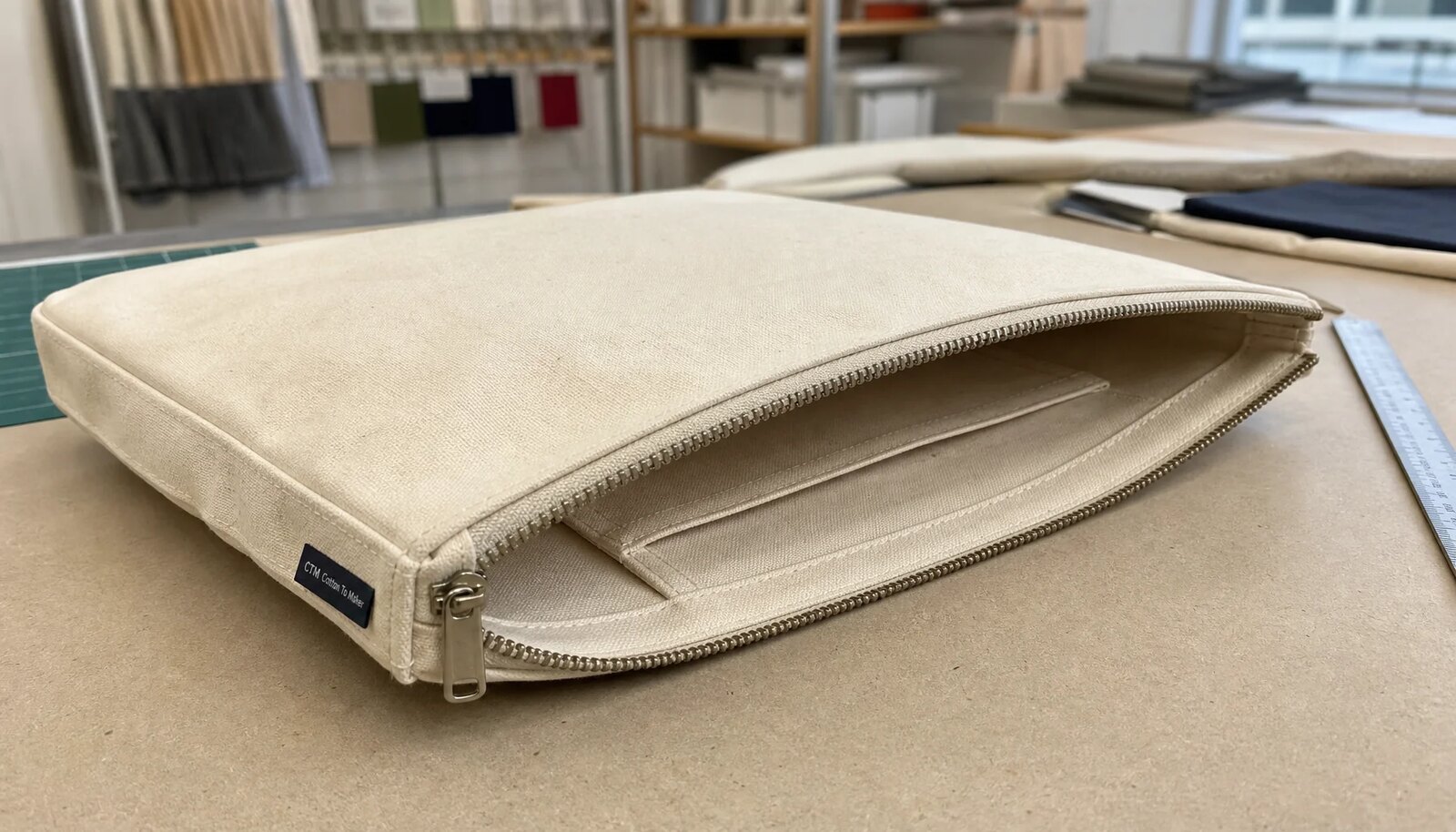
What Hotel Retail Buyers Are Really Inspecting
Canvas zipper portfolios look simple on a quote sheet, but hotel retail buyers usually reject them for small execution problems: a zipper that waves, a print that sits 8 mm too low, a corner that curls after packing, or a natural canvas shade that changes between cartons. These are not design issues after production starts. They are specification and inspection issues that should be controlled before cutting bulk fabric.
For hotel retail, the product often sits beside spa goods, room stationery, resort apparel, or conference accessories. It must look orderly on a shelf and survive guest handling. A quality inspection checklist should therefore cover appearance, structure, function, packing, and SKU control. If the RFQ only says “canvas zipper portfolio with logo,” every supplier will fill in the missing details differently.
- Treat the portfolio as a retail accessory, not only a document pouch.
- Control flatness, zipper movement, logo placement, and fabric cleanliness as critical points.
- Use the approved sample as the visual standard, but add measurable tolerances for bulk inspection.
- Separate cosmetic defects from functional defects so the factory understands what causes rejection.
Core Specification Before Any Quote
The first RFQ block should define finished size, fabric, zipper, logo, inner structure, packing, and inspection level. Finished size must be stated after sewing, not as fabric cutting size. A portfolio listed as 13 x 9.5 inches can finish smaller if the factory allows large seam allowance or if washed canvas shrinks after cutting. For hotel retail, a tolerance of plus or minus 0.25 inch is usually workable, but premium lines may need tighter control.
Fabric should be quoted by weight and construction. Common choices are 12 oz, 14 oz, and 16 oz cotton canvas. In GSM terms, these often sit roughly around 400 to 540 GSM depending on weave and finishing, but buyers should not rely on ounce conversion alone. Ask the supplier to state actual GSM, composition, and shrinkage. Natural canvas may have seed flecks and shade variation; dyed canvas needs lab dip or color card approval before bulk.
- Useful size range: A4 or letter document fit, tablet fit, or compact travel document fit.
- Common fabric: 14 oz cotton canvas for balance of structure, sewing efficiency, and retail handfeel.
- Premium fabric: 16 oz canvas when stiffness and durability matter more than unit cost.
- Avoid vague fabric terms such as heavy canvas, thick cotton, or eco canvas without GSM and composition.
Fabric Weight and Handfeel Tradeoffs
A lighter 10 oz to 12 oz canvas can reduce cost and carton weight, but it may not hold a clean rectangular shape after zipper installation. That matters for portfolios because the zipper edge can pull the panel into a wave. A heavier 18 oz canvas feels substantial but creates bulky corners, slower sewing, and higher needle breakage risk. The practical middle for hotel retail is often 14 oz to 16 oz, especially when the product has no rigid board inside.
The fabric finish also affects inspection results. Greige or natural canvas has more visible slubs and cotton seed particles, which can be acceptable if the approved sample clearly shows that look. Bleached or dyed canvas shows stains, oil marks, and thread contrast more easily. If the buyer wants a clean luxury hotel look, define acceptable natural marks during sample approval instead of arguing about them during final inspection.
- 12 oz canvas: lower cost, softer handfeel, higher risk of limp presentation.
- 14 oz canvas: stable for most zipper portfolios and still efficient to sew.
- 16 oz canvas: stronger shelf presence, better for premium hotel boutiques.
- 18 oz canvas: use only when the design allows bulkier seams and higher cost.
Zipper and Sewing Details That Cause Rejections
The zipper is the main functional component, so it deserves more detail than “good zipper.” For most canvas zipper portfolios, a No. 5 nylon zipper gives a clean look and smooth operation. Metal zippers can raise perceived value, but they add weight and can scratch neighboring items if packed too tightly. Resin zippers are durable but may look too casual depending on the hotel retail positioning.
During inspection, zipper failure is not only a broken zipper. A slider that feels rough, a zipper tape that is not parallel to the top seam, or a puller finish that rubs off can all damage the selling quality. Reinforcement at zipper ends is also important. If the end is not secured properly, repeated opening will stress the corner seam and create loose threads or a split seam.
- Set zipper type: nylon, resin, or metal, plus size such as No. 5.
- Set zipper tape color: matching canvas, contrast color, or brand color.
- Set slider finish: antique brass, nickel, matte black, painted, or self-color.
- Inspect zipper straightness, smooth travel, end reinforcement, and puller finish.
Logo Method and Retail Appearance
For canvas zipper portfolios, the logo method should match the retail price point. Screen printing is cost-effective for solid artwork and larger hotel logos. Heat transfer can show fine details but may feel less natural on heavy canvas and needs adhesion testing. Embroidery looks premium but can distort flat panels, especially with dense stitching. Woven labels, cotton labels, and leather-look patches work well when the brand wants a quieter retail presentation.
Logo approval should include exact position from the nearest seam, artwork size, color reference, and acceptable variation. On a flat portfolio, even a small skew is visible because the eye compares the logo with the zipper line. For screen print, ask for curing control and rub resistance. For patches and labels, inspect edge finish, stitch spacing, and alignment. The factory should not switch label material or backing during bulk production without approval.
- Screen print: practical for simple logos, solid color marks, and medium to large runs.
- Woven label: good for subtle branding and lower print-failure risk.
- Patch: useful for premium look but adds sewing alignment checks.
- Embroidery: attractive but should be sampled early to judge panel distortion.
MOQ Logic and Cost Drivers
The MOQ for canvas zipper portfolios is not only about sewing capacity. It is usually driven by fabric purchasing, dyeing, zipper tape color, logo setup, label weaving, and packing materials. If the buyer uses stock natural canvas, standard zipper, and screen print, 500 to 1,000 pieces per design may be realistic with many factories. Custom dyed canvas, custom woven labels, or special zipper pullers can increase the practical MOQ even if the sewing line can make fewer pieces.
When comparing quotes, break the cost into material, labor, logo, packing, and export handling. A very low unit price may exclude stronger cartons, individual retail packing, barcode labels, sample remake, or inspection preparation. A higher quote may include better zipper, heavier canvas, and cleaner packing. Procurement teams should compare what is included, not only the unit price.
- Fabric cost rises with GSM, dyeing, washing, and tighter shade control.
- Labor cost rises with lining, inner pockets, patches, binding, and reinforced corners.
- Logo cost changes with print size, color count, screen setup, patch mold, or label MOQ.
- Packing cost changes with individual bags, hangtags, barcode labels, inserts, and carton strength.
Sample Approval Before Bulk Cutting
A sales sample made from substitute fabric is useful for shape discussion, but it should not be treated as production approval. The pre-production sample should use bulk canvas, bulk zipper, final thread, final logo method, and intended packing. This is the moment to measure size, test zipper function, review logo placement, assess fabric shade, and decide whether the product looks strong enough for hotel retail shelves.
Sample comments should be written as production instructions. Instead of saying “make logo higher,” state “move logo center 15 mm upward from approved sample; final logo center to sit 75 mm from top zipper seam.” Instead of “zipper smoother,” state the zipper must open and close five full cycles without catching, splitting, or loose slider movement. Clear sample comments reduce translation gaps between merchandising, cutting, sewing, and QC teams.
- Approve one sealed sample for construction and one artwork proof for logo color if needed.
- Measure the sample after it has rested flat, not while compressed in courier packing.
- Photograph front, back, zipper end, inside pocket, logo, and carton packing method.
- Do not release bulk cutting until size, logo, zipper, fabric shade, and packing are all signed off.
Inspection Criteria for Bulk Production
A practical inspection checklist should define critical, major, and minor defects. Critical defects include sharp metal parts, mold, serious contamination, or broken zipper function that prevents use. Major defects include wrong size beyond tolerance, logo misplacement, obvious stains, open seams, zipper jamming, wrong fabric weight, wrong color, or incorrect packing. Minor defects may include small thread ends, slight natural canvas slubs within the approved standard, or tiny cosmetic marks not visible at normal viewing distance.
For canvas zipper portfolios, inspect a mix of units from different cartons, not only top-layer pieces. Open and close the zipper fully, measure width and height, check diagonal alignment, inspect print durability, and review carton labels. If possible, add an in-line inspection after the first finished pieces so the factory can correct zipper alignment and print placement before the full lot is packed.
- Size tolerance: commonly plus or minus 0.25 inch unless buyer requires tighter control.
- Logo placement tolerance: commonly plus or minus 3 mm to 5 mm depending on artwork size.
- Stitching: no skipped stitches, open seams, thread nests, or weak zipper-end reinforcement.
- Appearance: no oil stains, mold, heavy creases, color bleeding, or visible carton rub marks.
Packing, Cartons, and Shelf Readiness
Packing is often where good canvas portfolios lose their retail appearance. If the products are squeezed into undersized cartons, corners bend and zipper teeth leave pressure marks on the canvas. If they are packed too loose, the portfolios rub during transport and collect abrasion marks. For hotel retail, individual protection is usually worth the small cost, especially for light-colored natural or white canvas.
Carton planning should be part of the quote. A common packing method may be one piece per polybag or paper-based protective bag, then 25 to 50 pieces per export carton depending on size and fabric weight. Keep gross weight manageable for warehouse handling. Add desiccant when shipping through humid routes or storing before hotel season launch. Carton labels should match PO, SKU, color, quantity, and destination requirements.
- Use flat packing when the product must arrive shelf-ready and crease control matters.
- Avoid over-compression because zipper, patch, or label impressions may mark the canvas.
- Specify barcode, hangtag, insert card, and retail price label requirements before production.
- Request carton photos and packed-carton dimensions before final balance payment.
Lead Time and Schedule Risk
A normal production schedule includes artwork confirmation, material sourcing, sample making, sample approval, bulk cutting, printing or label preparation, sewing, trimming, inspection, packing, and export booking. The lead time clock should not start from the first inquiry. It should start from deposit, final artwork, and approved pre-production sample, depending on the factory’s workflow. Buyers should clarify this in the PO to avoid missed hotel launch windows.
Schedule risk usually comes from custom materials and late artwork changes. Custom dyed canvas can require lab dip approval and bulk dyeing time. Woven labels may have a separate production lead time. Metal zipper stock may be limited by finish. If the order is for a hotel retail season, build a timeline with decision deadlines: artwork approval date, sample approval date, material arrival date, in-line inspection date, final inspection date, and vessel or air booking date.
- Fastest route: stock canvas, stock zipper, one-color screen print, standard packing.
- Higher-risk route: custom dyed canvas, custom zipper puller, patch, lining, and retail inserts.
- Protect launch dates by freezing artwork before sample production.
- Use in-line inspection when the order quantity is large or the delivery window is tight.
Specification comparison for buyers
| Spec decision | Recommended option | When it fits | Buyer risk to check |
|---|---|---|---|
| Outer canvas weight | 14 oz to 16 oz cotton canvas, pre-shrunk if possible | Hotel boutique retail, conference welcome packs, spa or guest gift portfolios needing a firm handfeel | Below 12 oz may collapse after packing; above 18 oz increases sewing difficulty, freight weight, and corner bulk |
| Construction style | Flat zipper portfolio with one main compartment and optional internal slip pocket | Retail buyers who need a clean shelf presentation and easy document or tablet storage | Too many pockets add labor cost and create more seam tolerance points during inspection |
| Zipper selection | No. 5 nylon zipper for standard orders; No. 5 metal zipper for premium retail lines | Nylon suits mid-price hotel retail; metal suits upscale gifting where weight and finish matter | Cheap sliders chip, jam, or discolor; zipper tape color must match approved sample and bulk fabric |
| Logo method | Screen print for solid logos; woven label or leather-look patch for premium subdued branding | Screen print fits larger retail artwork; labels or patches fit minimalist hotel branding | Print cracking, label skew, patch color variation, and poor edge finishing are common rejection causes |
| Lining decision | Unlined canvas for simple retail; cotton lining for higher perceived value | Unlined works for lower MOQ and easier QC; lining works when interior finish affects shelf price | Lining adds shrinkage, seam puckering, loose threads, and color migration risks if not tested |
| MOQ logic | Start from 500 to 1,000 pcs per color when fabric and zipper are standard | Good for hotel groups, resort retail programs, distributor seasonal assortments, or brand test orders | Custom dyed canvas, custom zipper tape, or private woven labels may push MOQ higher than bag sewing MOQ |
| Packing format | Individual recycled polybag or glassine-style bag, then 50 pcs per export carton with desiccant | Works for retail stockrooms, hotel boutiques, and distributor pick-and-pack operations | Over-tight cartons deform corners; loose cartons cause scuffing, zipper impressions, and crushed patches |
| Inspection level | AQL inspection with tightened checks on zipper function, dimensions, print placement, stains, and carton marks | Best for importers that cannot rework goods after arrival or sell through multiple hotel outlets | A generic bag inspection may miss portfolio flatness, zipper smoothness, and inner pocket alignment |
Buyer checklist before sampling
- Define finished size with tolerance, not only target size; for example 13 x 9.5 inches with plus or minus 0.25 inch after sewing and pressing.
- Lock fabric as GSM or ounce weight, weave type, color standard, shrinkage requirement, and whether the canvas is washed, natural, dyed, or bleached.
- Approve zipper type, zipper length, slider finish, puller shape, tape color, end stop quality, and whether the portfolio must open fully flat.
- Set logo placement from seam edges in millimeters or inches, including print color Pantone, print method, and maximum allowed skew.
- Request a pre-production sample using bulk fabric, bulk zipper, bulk thread, and final logo method before cutting full quantity.
- Specify retail packing, carton strength, carton dimensions, carton weight limit, barcode or SKU label position, and moisture protection.
- Include inspection thresholds for stains, broken stitches, loose threads, zipper jamming, size deviation, print defects, and carton damage.
- Require quote data separated by material, logo, packing, sample fee, tooling or screen cost, inland freight, export carton count, and lead time.
Factory quote questions to send
- What canvas weight, composition, weave, and shrinkage rate are included in your quote?
- Is the quoted zipper nylon, resin, or metal, and which zipper size and slider finish are included?
- Does the MOQ apply per total order, per canvas color, per logo design, or per zipper tape color?
- Can the pre-production sample be made from actual bulk fabric and final zipper stock?
- What logo method is included, and what is the maximum print area before the price changes?
- How many pieces are packed per inner carton or export carton, and what is the estimated carton size and gross weight?
- What inspection standard do you use for zipper function, seam strength, stains, print placement, and size tolerance?
- What production lead time starts after deposit, artwork approval, material arrival, or pre-production sample approval?
- Which quote terms are used: EXW, FOB, CIF, or DDP, and which local charges are excluded?
- What happens if bulk canvas shade, zipper tape color, or print color is outside the approved sample range?
Quality-control points to confirm
- Finished size should stay within the approved tolerance after sewing, trimming, pressing, and packing.
- Canvas surface should be free from oil marks, weaving holes, dark slubs beyond the approved standard, and visible handling stains.
- Zipper should open and close smoothly for the full travel distance without catching fabric, splitting, or losing the slider pull.
- Stitch density should be consistent, commonly around 7 to 9 stitches per inch unless another standard is approved.
- Seam allowance should be even enough to prevent fraying and weak corners, especially near zipper ends.
- Logo should match approved artwork in color, position, size, sharpness, and curing or attachment strength.
- Corners should be square and flat, not twisted, wavy, or over-trimmed after turning.
- Loose threads should be trimmed inside and outside before packing, with no thread nests near zipper ends.
- Individual packing should protect the canvas from abrasion, humidity, carton ink transfer, and zipper pressure marks.
- Carton labels should match purchase order, SKU, color, quantity, gross weight, net weight, and destination requirements.