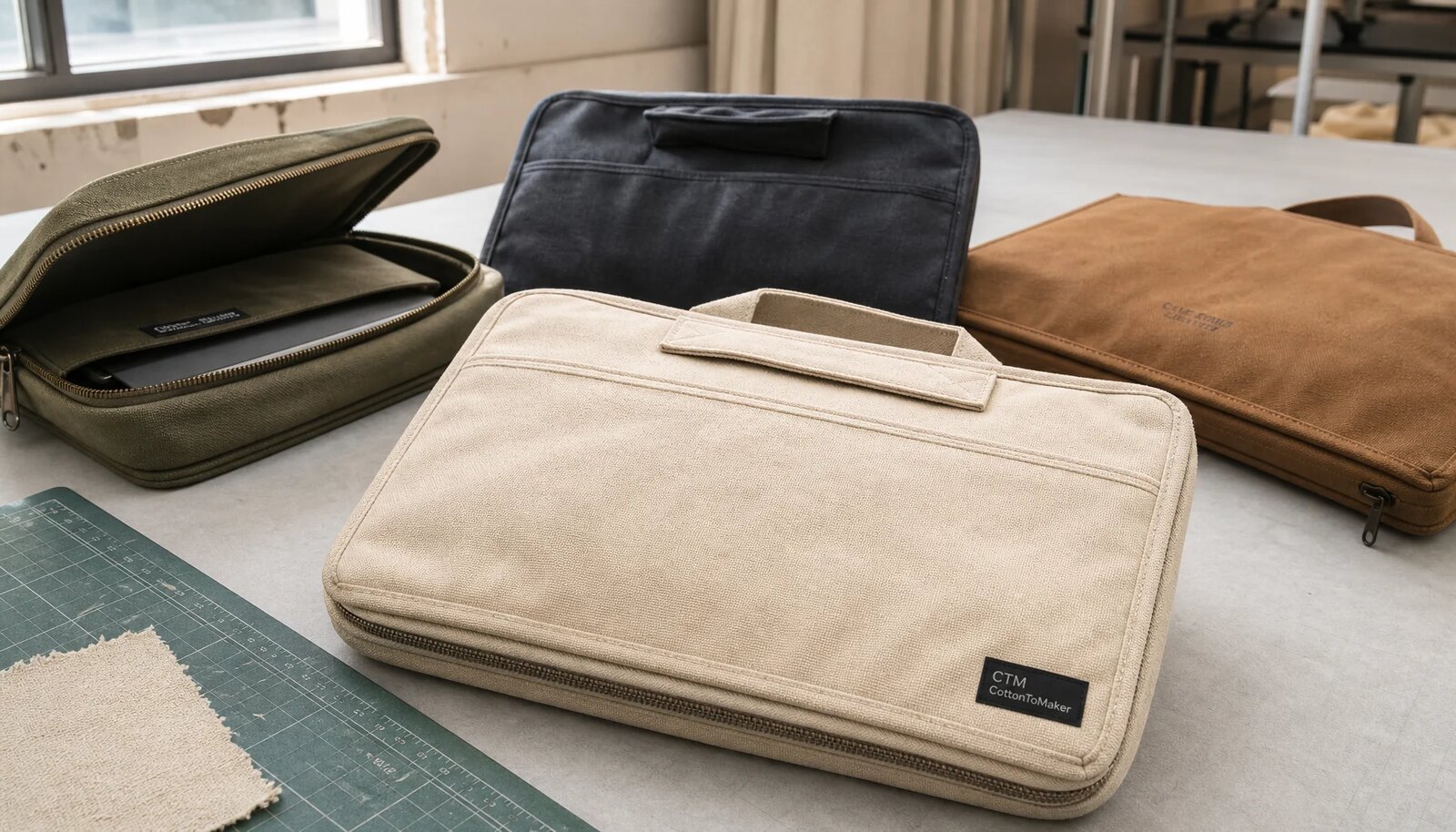
1. Start With The Event Workflow, Not The Logo
A canvas zipper portfolio used at an event has a harder job than a flat promotional sleeve. It may leave the factory, pass through export handling, arrive at a warehouse, be added to a kit, move to a hotel or venue, sit behind registration, and then be handled repeatedly by attendees. The product needs to protect papers, agendas, contracts, badges, sponsor inserts, notebooks, or small accessories without looking crushed or unfinished when handed out.
The correct specification depends on that workflow. A one-day attendee folder can be simpler and lighter. A speaker, VIP, or board-meeting portfolio may need cleaner shape, smoother zipper travel, tighter logo placement, and better unit protection. If the portfolios will be mailed before the event, crease control and individual packing matter more. If they will be stacked on a registration desk, surface cleanliness and logo alignment become highly visible.
Avoid overbuilding by default. Heavy canvas, custom zipper tape, metal pullers, stitched patches, and individual gift boxes may be justified for a premium client program, but they add cost, time, carton volume, and inspection risk. Better sourcing starts with how the portfolio will be used.
- List the actual contents: letter paper, A4 paper, agenda booklet, catalog, notebook, pen, badge, cards, charger, or slim accessory.
- Define the audience: general attendee, sponsor, speaker, VIP, press, internal staff, sales team, or client recipient.
- Define the distribution route: warehouse kitting, registration handout, hotel-room drop, pre-event mailer, regional shipment, or multi-venue delivery.
- Define the expected life: single-day use, multi-day conference use, annual program, sales follow-up tool, or reusable client gift.
2. Convert Preferences Into Measurable Specifications
Words such as sturdy, premium, centered, and smooth are useful in early conversation, but they do not work as inspection standards. A production-ready brief should define finished size, usable internal size, fabric, zipper, sewing method, decoration, tolerances, packing, and inspection plan.
Size is a common source of avoidable problems. Outside dimensions do not equal usable internal space. Seam allowance, zipper tape, lining, binding, and pockets all reduce real document capacity. If the portfolio must hold letter paper, A4 paper, a sponsor booklet, or a full registration kit, state the contents and required clearance. A tight portfolio stresses the zipper and bends document corners; an oversized portfolio can look loose and unfinished.
Tolerances should be written into the purchase order and golden sample record. For many sewn portfolios, +/-5 mm on overall width or height and +/-3 mm on visible logo placement are practical starting points when the supplier confirms capability. The exact tolerance should match the design, fabric thickness, and decoration method.
- State outside finished dimensions and usable internal dimensions in millimeters or inches.
- Confirm document fit: letter, A4, notebook, catalog, tablet-adjacent item, or mixed event kit.
- Set tolerances for width, height, gusset, zipper opening, pocket placement, divider position, and logo placement.
- Identify construction details: unlined, lined, bound seams, turned seams, sleeve pocket, divider, card pocket, or pen loop.
- Define the preferred corner shape and reinforcement method before sampling.
3. Specify Canvas Beyond Weight Alone
Canvas is not one universal material. Weight, yarn count, weave density, fiber content, dye method, and finishing all affect the finished portfolio. A 12 oz natural cotton canvas may feel casual and flexible, while a 16 oz dyed canvas may feel more structured. A heavier canvas can look attractive as a swatch but create bulky seams, wavy zipper lines, or thick corners after sewing.
For event document portfolios, 12 to 16 oz canvas is often a practical sourcing range, but it should not be treated as a rule. Lower weights may work for cost-controlled paper kits. Mid-weight canvas is usually better when repeated handling and a more structured feel are required. Heavier fabric should be sampled with the final zipper, pockets, decoration, and expected contents before approval.
Ask whether the fabric weight is measured before or after finishing. Dyeing, washing, coating, softening, or calendaring can change hand feel and measured weight. Approve a physical swatch card with date, supplier name, weight, finish notes, and color reference. Photos are helpful for communication, but they cannot confirm shade, texture, odor, or hand feel.
- Request both oz and GSM when possible, plus the basis of measurement.
- Confirm fiber composition: cotton, cotton-poly blend, recycled cotton blend, or another stated material.
- Record weave and finish: plain weave, washed, dyed, pigment dyed, coated, softened, or unwashed natural canvas.
- Approve shade range for natural canvas and a color standard for dyed canvas.
- Check bulk fabric for odor, stains, crocking risk, shrinkage, slubs, and panel skew before cutting.
4. Treat The Zipper As A Functional Component
The zipper is one of the highest-risk components because every user touches it. Buyers sometimes focus on artwork and leave the zipper to the factory default. That can produce a portfolio that looks acceptable in photos but feels rough during check-in or fails after being filled with documents.
Nylon coil zippers are a common starting point for soft canvas business bags because they are flexible and generally smooth. A No. 5 coil zipper is often suitable for medium portfolios, but the supplier should confirm the choice against size, fabric thickness, and load. Metal zippers can look premium, but they require careful packing because pullers may press into decorated panels. Resin zippers may suit casual styles but can look bulky on a flat business portfolio.
The RFQ should name the zipper type, size, tape color, slider finish, puller style, end stop method, and opening length. Reinforcement at both zipper ends should be visible in the sample and repeated in bulk production. During sample review, fill the portfolio with real event contents and zip it several times. If it catches, bows, or strains in the sample, solve the pattern or trim issue before mass production.
- Specify nylon coil, metal, or resin zipper and confirm size with the supplier.
- Define tape color, slider finish, puller style, and grip requirement.
- Measure zipper opening length against the real contents, not only the outside product width.
- Require reinforced zipper ends and back-tacking at stress points.
- Inspect for straight zipper tape, even stitching, smooth travel, secure stops, and no separation.
- Test loaded and unloaded samples because contents can expose zipper bowing.
5. Choose Decoration For Canvas And Event Variants
Decoration quality depends on the artwork, canvas surface, quantity, and event context. Screen print is often cost-effective for simple solid logos, especially one to three colors, but coarse weave can soften fine lines and dark fabric may need an underbase. Tight registration and small text should be reviewed carefully before approval.
Embroidery, woven labels, cotton labels, heat transfers, patches, and badges each solve different problems. Embroidery adds texture but can pucker lighter canvas if backing and stitch density are not controlled. Woven labels usually handle small text better than embroidery. Patches can create a premium focal point, but their edges and attachment strength need inspection.
Sponsor programs require extra discipline. One order may include multiple logos, language versions, destinations, or VIP variants. The quote should separate setup fees, color changes, artwork approvals, and packing segregation. Logo placement must be measured on the finished sewn product from fixed points such as side seam, bottom seam, zipper edge, or panel centerline.
- Use screen print for simple logos, larger quantities, and controlled budgets.
- Use woven or cotton labels for small text, repeat durability, or subtle branding.
- Use embroidery only after checking backing, stitch density, coverage, and fabric puckering.
- Use patches or badges for a premium look, but inspect edge lift and stitch strength.
- Approve each sponsor version with its own artwork file, placement note, and packing rule.
- Set tolerances for logo position, color, registration, rub resistance, and visible decoration defects.
6. Approve Samples In The Right Order
Sampling should be staged. A development sample helps confirm shape, interior layout, zipper position, and decoration scale. It may not use final fabric, final trim, or final packing, so it should not automatically become the bulk standard.
The preproduction sample should be made with final canvas, final zipper, final decoration, final pocket layout, final stitching method, and final packing. This is the golden sample. It should be measured, photographed, signed or formally approved, and referenced on the purchase order. The factory, buyer, and inspector should all know which sample controls final judgment.
Any change after golden sample approval should be treated as a deviation. Moving from natural to dyed canvas, changing zipper color, increasing logo size, adding a divider, or switching packing format can affect appearance, cost, lead time, and inspection results. Material, construction, decoration, or packing changes should trigger written approval and, when risk is meaningful, a revised sample.
- Request a fabric and trim card before the full sample when color or material matching matters.
- Use a development sample to confirm shape, layout, zipper choice, and decoration scale.
- Approve the golden sample only when final materials and production methods are used.
- Photograph front, back, interior, zipper ends, seams, logo, label, pockets, and unit packing.
- Keep one signed physical golden sample for inspection comparison.
- Record any approved deviation after changes to fabric, zipper, artwork, size, construction, or packing.
7. Make Inspection Executable, Not Subjective
A useful inspection plan separates critical, major, and minor defects before production starts. This prevents end-of-line arguments. A zipper that will not close is a major functional defect. A missing sponsor logo or mixed logo version can be critical for an event because the goods may be unusable. A logo printed 10 mm off position is major if the written tolerance is 3 mm. A loose internal thread may be minor if it can be trimmed and does not affect presentation.
For pre-shipment inspection, many buyers use ANSI/ASQ Z1.4 or ISO 2859-1 General Inspection Level II with AQL levels such as Critical 0, Major 2.5, and Minor 4.0. These levels are not mandatory for every order, but the sampling method and acceptance limits should be agreed before production. Higher-risk orders with many sponsor versions, tight dates, or premium decoration may need tighter limits or extra inline checks.
Inspection timing matters. A final inspection should normally occur when all goods are produced and at least 80% are packed, so cartons, labels, segregation, and packing quality can be checked. Samples should be pulled randomly from ready-to-ship cartons across the lot, not selected by the factory. Each color, logo version, and destination should be represented.
- Critical: wrong product, wrong logo, unsafe hardware, mold, severe odor, or mixed sponsor versions.
- Major functional: broken zipper, open seam, missing reinforcement, wrong size, failed pocket, or unusable closure.
- Major appearance: visible stain, severe shade mismatch, print transfer, off-tolerance logo, distorted panel, or decoration damage.
- Minor: trimmable threads, small internal marks, slight stitch variation, or minor packaging scuffs.
- Measure width, height, gusset, zipper opening, pocket opening, divider position, and logo placement.
- Check unit count, version accuracy, carton marks, carton condition, gross weight, and packing list match.
8. Compare Quotes By Cost Drivers, Not Unit Price Alone
MOQ is rarely one simple number for custom canvas zipper portfolios. A supplier may have one MOQ for stock natural canvas, another for custom dyed fabric, another for zipper tape color, and another for woven labels, patches, or special packing. Decoration has its own setup logic. A single-color logo is different from six sponsor versions with separate screens, approvals, carton marks, and destination splits.
A useful quote separates blank portfolio cost, decoration cost, setup charges, sample fees, packing cost, inspection assumptions, and price breaks. Ask for breaks that match real buying scenarios such as 500, 1,000, 2,500, 3,000, and 5,000 units. If the order may be split across venues, disclose that before quote approval. A 3,000-piece single-SKU order is not the same job as 3,000 pieces split by sponsor, language, and delivery date.
Compare landed cost per usable unit. Heavy canvas, metal pullers, individual polybags, insert cards, carton dividers, and multiple SKUs can affect freight and receiving labor. Weak specifications may look cheaper at quote stage but create shortages, sorting work, or late rework before the event.
- Ask for MOQ by fabric, color, zipper, decoration, label or patch, and packing format.
- Request price breaks at realistic quantities instead of one headline price.
- Separate blank cost, decoration cost, setup cost, sample cost, packing cost, and freight assumptions.
- Disclose sponsor versions, language versions, destination splits, carton sorting, and delivery dates.
- Compare landed cost after inspection, freight, receiving labor, and defect allowance.
- Flag quotes that omit fabric weight, zipper type, tolerances, packing rules, or inspection standards.
9. Protect The Order Through Packing And Documentation
Packing is part of product quality for event portfolios. These items may pass through export handling, warehouse receiving, kitting, venue delivery, and registration staging before the attendee sees them. If packed too tightly, canvas can crease and zipper sliders can press into printed panels. If packed too loosely, corners can bend and decorated surfaces can rub. Natural canvas can also absorb odor or show moisture marks if cartons are poorly handled.
Unit packing should match the distribution plan. Individual polybags can protect printed surfaces and keep units clean for multi-location shipping, though some buyers may prefer reduced-plastic options. Bulk packing can work when decoration is durable and one warehouse will handle the order, but interleaving or controlled orientation may still be needed so pullers and patches do not damage adjacent panels.
Lead time should be managed as a chain of approvals, not a single production number. The schedule should include artwork confirmation, swatch approval, sample making, sample shipping, buyer review, material booking, bulk sewing, decoration, inspection, rework time, packing, export documents, and dispatch. For fixed-date events, schedule inspection early enough to allow one correction loop.
- Define unit packing: polybag, tissue, no bag, insert card, barcode label, hangtag, or sponsor-specific insert.
- Set master carton quantity, carton size target, gross weight limit, and whether dividers or interleaving are required.
- Require carton marks with PO number, SKU, logo version, quantity, destination, carton number, and gross weight.
- Check that zipper sliders, metal pullers, and patches do not press into printed panels during compression.
- Request a timeline covering artwork, swatch, sample, buyer review, material booking, production, inspection, packing, and dispatch.
- Confirm holiday closures, peak capacity, trade show rush periods, and buyer-side approval days before locking delivery dates.
Specification comparison for buyers
| Procurement decision | Recommended specification | Cost / MOQ / lead-time impact | Inspection priority |
|---|---|---|---|
| Finished size and usable document space | State outside dimensions, usable internal dimensions, zipper opening length, pocket opening, and document clearance for letter, A4, or event inserts. | Low cost impact if defined early. High rework risk if discovered after sampling because pattern and zipper length may change. | High. Measure finished width, height, gusset, zipper opening, pocket placement, and actual document fit. |
| Canvas weight and material | Request oz and GSM, fiber composition, weave, finish, color reference, and whether weight is measured before or after finishing. | Stock natural canvas is usually faster than custom dyed fabric. Exact color or special finish may add fabric MOQ and lab-dip time. | High. Check weight, shade, odor, stains, panel skew, and consistency against approved swatch. |
| Zipper type and puller | Define nylon coil, resin, or metal zipper; size; tape color; slider finish; puller style; stop construction; and end reinforcement. | Stock zipper colors are faster. Custom tape, metal finish, or branded puller can add MOQ, tooling, and approval time. | High. Test smooth travel, stop security, puller strength, tape alignment, and repeated open-close performance. |
| Decoration method | Specify screen print, embroidery, woven label, cotton label, patch, heat transfer, or badge with artwork size, color standard, and placement tolerance. | Multi-color prints, embroidery, patches, and sponsor variants increase setup, inspection time, and segregation work. | High. Check color, placement, rub transfer, registration, puckering, peeling, label curl, and version accuracy. |
| Interior layout | Define divider, sleeve pocket, card pocket, pen loop, lining, binding, and reinforcement points. | Extra pockets raise sewing time and defect risk. Small changes can affect document fit and zipper closure. | Medium to high. Check pocket size, placement, seam security, loose threads, and usability with real contents. |
| Tolerance plan | Use written tolerances such as +/-5 mm for overall sewn dimensions and +/-3 mm for visible logo or pocket placement when supplier capability supports it. | No meaningful cost impact if agreed early. Late tolerance disputes can delay shipment or force sorting. | High. Inspect against numbers in PO and golden sample, not subjective words such as neat or centered. |
| Packing format | Define unit packing, interleaving, carton quantity, carton marks, carton numbering, version segregation, and gross weight limits. | Individual bags, inserts, barcodes, dividers, and split shipments add cost and packing time but reduce event receiving risk. | High. Verify carton count, SKU, logo version, destination, packing list, carton marks, and damage from compression. |
| Inspection plan | Agree sample timing, sampling standard, AQL levels, defect definitions, and required documents before production starts. | Third-party inspection and reinspection add cost but are often lower risk than discovering defects at the event warehouse. | Critical. Pull samples from ready-to-ship cartons across all versions; review defects by critical, major, and minor severity. |
Buyer checklist before sampling
- Define the event use before quoting: document size, expected contents, audience tier, distribution method, event duration, and reuse expectation.
- Specify finished outside size and usable internal size, including zipper opening length, pocket opening, pen loop size, divider position, and document clearance.
- Set practical tolerances in writing, for example +/-5 mm on overall sewn dimensions and +/-3 mm on visible logo placement when the design requires consistency.
- Confirm canvas weight in oz and GSM, fiber composition, weave, finish, color reference, and whether the weight is measured before or after finishing.
- Request a material and trim card showing body fabric, lining, zipper tape, slider, puller, sewing thread, labels, patches, backing, and packing material.
- Approve zipper type, size, tape color, slider finish, puller style, end stop method, opening length, and reinforcement method.
- Define stress areas that need reinforcement, including zipper ends, corners, pocket openings, handle tabs if any, and patch or label attachment points.
- Choose the decoration method and do not allow substitution after price approval without written signoff and, when needed, a revised sample.
- State artwork size, placement reference points, color standard, print hand feel, version names, and sponsor-specific packing rules.
- Require a preproduction golden sample made with final fabric, final zipper, final decoration, final construction, and final packing before bulk authorization.
Factory quote questions to send
- What is the canvas weight in oz and GSM, and is the measurement based on greige fabric, finished fabric, or the fabric supplier invoice?
- What is the fiber composition, weave type, dye or finish process, shrinkage expectation, and shade tolerance against the approved swatch?
- Is the fabric stock, custom dyed, washed, coated, or specially finished, and what MOQ and approval time apply to that fabric?
- Which zipper is included in the quote: nylon coil, resin, or metal; what are the size, tape width, slider material, puller style, and stop construction?
- Are zipper tape, sewing thread, lining, labels, and pullers stock colors or exact matched colors, and what MOQ changes if exact matching is required?
- What reinforcement is included at zipper ends, corners, pocket openings, divider seams, handle tabs, and patch or label attachment points?
- What stitch density and thread type are planned for main seams and zipper attachment, and how will skipped stitches on heavier canvas be controlled?
- What decoration method is quoted, and what setup fees apply per logo color, logo position, sponsor version, and repeat order?
- What artwork placement tolerance can the factory hold on finished sewn goods, and from which seam, edge, zipper line, or centerline will it be measured?
- What pre-shipment documents will be supplied: final packing list, carton list, inspection report, defect photos, production photos, approved sample reference, and corrective-action notes if defects are found?
Quality-control points to confirm
- Use a defined sampling plan before production starts. For many event orders, buyers use ANSI/ASQ Z1.4 or ISO 2859-1 General Inspection Level II with Critical 0, Major 2.5, and Minor 4.0, adjusted by order risk.
- Inspect only when production is complete and at least 80% of goods are packed, unless the buyer has also scheduled inline inspection during production.
- Pull samples randomly from multiple finished cartons across all colors, logo versions, destinations, and packing formats; do not accept factory-selected samples only.
- Classify critical defects as wrong logo, wrong product, unsafe sharp hardware, mold, severe odor, mixed sponsor versions, or any issue that makes the portfolio unusable for the event.
- Classify major defects as broken zipper, separated zipper, open seam, missing reinforcement, wrong size outside tolerance, failed pocket, obvious stain, severe shade mismatch, print transfer, or logo placement outside tolerance.
- Classify minor defects as trimmable loose threads, slight internal marks, minor stitch variation within tolerance, or small packaging scuffs that do not affect function or presentation.
- Measure finished width, height, gusset, zipper opening, pocket opening, divider position, pen loop size, and logo placement against the PO and golden sample.
- Open and close each sampled zipper at least five times, including loaded samples from several cartons; check slider smoothness, stop security, tape alignment, and puller strength.
- Check decoration for placement, color, edge bleeding, rub transfer, ink cure, embroidery puckering, thread breaks, label curl, patch adhesion, and version accuracy.
- Require pre-shipment photos and documents: sampled cartons, carton marks, carton count, packing list, defect summary, measurement sheet, zipper test notes, decoration checks, and any approved deviations.