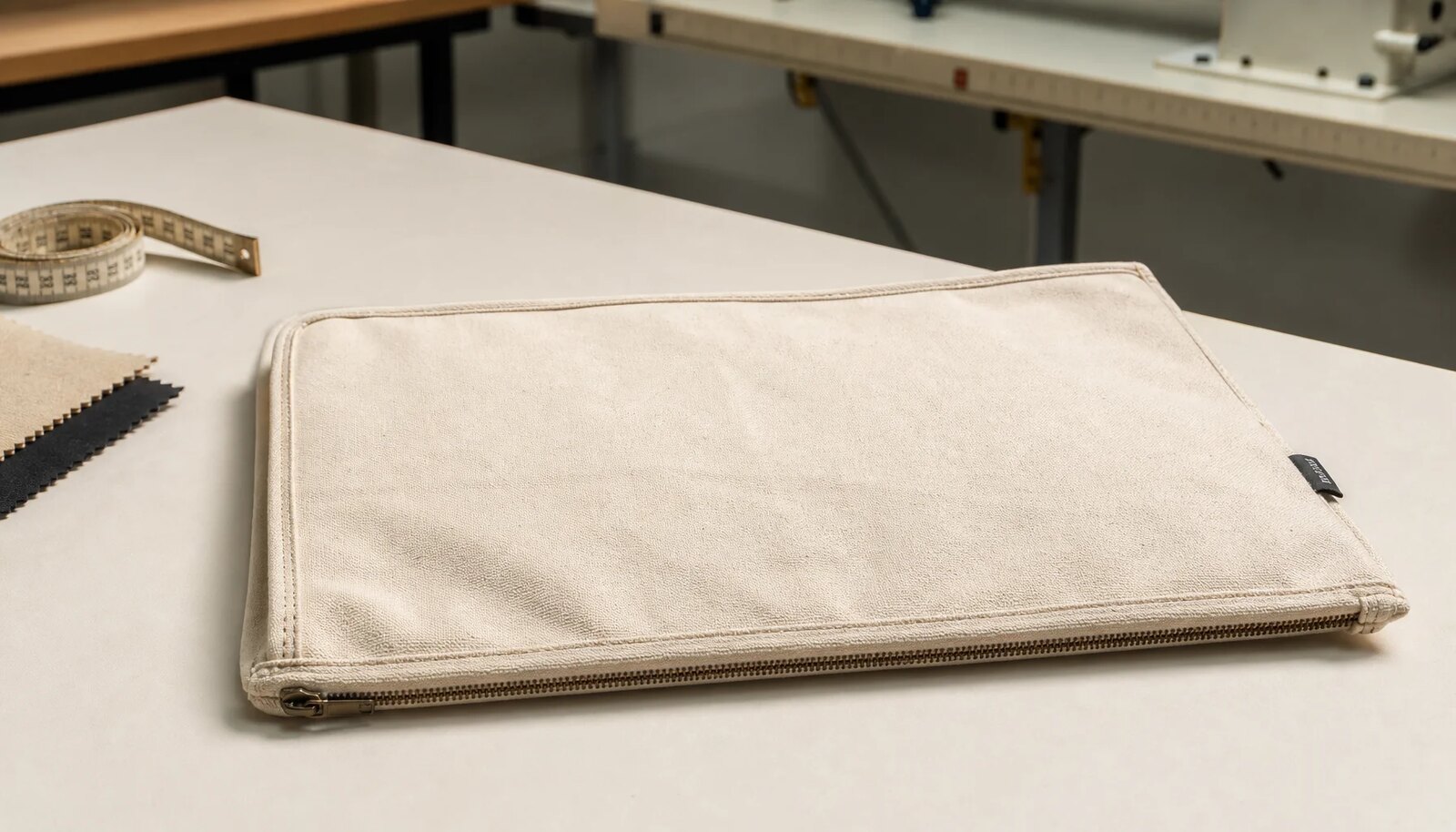
Define the product before comparing prices
Canvas zipper portfolios look simple, which is why they are often quoted too loosely. In a B2B apparel program, the item may carry wholesale line sheets, swatches, hangtag sets, launch notes, catalogs, notebooks, or a complete buyer presentation pack. It may also support the brand's reuse and material story. Those jobs require more detail than “canvas pouch with logo.”
Before sending artwork, define the portfolio's commercial role. A lightweight document sleeve has different requirements from a reusable sales kit that travels with a rep and is opened repeatedly. The contents determine fabric body, zipper opening length, panel flatness, reinforcement, and packing. The sales channel determines how strict the visual inspection should be.
Procurement should ask suppliers to quote the same construction. One factory may price light canvas, stock zipper trim, loose packing, and basic print. Another may include heavier canvas, reinforced zipper ends, bound seams, tighter logo tolerance, and better carton protection. Both prices can be honest, but they are not the same product.
- List the intended contents and whether they must slide in without bending.
- State whether the item is for retail sale, wholesale presentation, trade show use, or internal sales-team use.
- Break quantity down by color, artwork, size, and delivery batch.
- Use the PO, approved sample, and quality checklist together as the production standard.
Canvas specifications that belong in the PO
Canvas should be specified in measurable terms. For many canvas zipper portfolios, 12-16 oz canvas is a practical range, often about 280-380 GSM depending on weave and finish. Lighter fabric can suit simple document programs. Heavier fabric gives more structure, but it may create bulk near zipper seams and corners if the factory's sewing setup is not matched to the fabric.
Use both GSM and oz weight when sourcing across regions. Ask for weave, yarn count if known, fabric width, finish, shrinkage expectation, and whether the fabric is natural greige, dyed, pre-shrunk, washed, enzyme washed, coated, or uncoated. If natural canvas is desired, define the acceptable level of seed flecks, slubs, tone variation, and panel shade difference.
Finish affects print and size control. Washed canvas can feel softer but may distort after cutting. Dyed canvas needs lab dip approval and bulk shade control. Natural greige canvas supports an undyed look, but lot-to-lot tone can shift. If the logo is printed, test on the actual approved fabric because canvas texture can break up small text and fine lines.
- State target fabric weight and tolerance, such as 320 GSM +/-5%.
- Approve a swatch or lab dip before PP sample approval.
- Define unacceptable defects: holes, stains, oil marks, rust marks, mold, strong odor, severe slubs, and panel shade mismatch.
- Require the PP sample to use the same fabric quality planned for bulk production.
Eco claims need source documents
Eco apparel brands often want the portfolio to align with the apparel line, but design language and verifiable claims are not the same. Natural color does not prove organic cotton. Recycled cotton is not the same claim as recycled polyester lining. A paper wrap is not automatically safer for export shipping than a protective inner bag.
Name each claim by component. The body fabric, lining, zipper tape, zipper puller, thread, woven label, hangtag, inner packing, and carton can all carry different requirements. Ask the supplier what documentation is available before putting a claim into product copy or retail materials. Useful documentation categories may include material certificates, transaction records, test reports, supplier declarations, chain-of-custody records, recycled-content documents, or packing material specifications, depending on the claim and market.
Be realistic about MOQ and repeatability. Organic or recycled canvas may have different stock availability, shade range, and lead time. Natural canvas may suit the brand look but requires an approved surface standard. Dyed material may give clearer color direction but introduces lab dips and bulk shade checks.
- Specify which components need a material claim and which only need a preferred appearance.
- Ask for available documentation before confirming marketing language.
- Confirm whether claim documents are included in the quote or billed separately.
- Balance lower-plastic packing goals against moisture, dust, abrasion, and carton compression risk.
Zipper construction is the functional core
The zipper is the part most likely to create user complaints. A portfolio can look clean in photos and still fail if the slider catches, the tape waves, the puller loosens, the coil splits, or the zipper end is not secured. Procurement should specify zipper type and construction, not only color.
A No. 5 nylon coil zipper is a strong default for many bulk canvas zipper portfolios because it is smooth, flexible, and efficient to sew. Metal zippers can look premium but add weight and may scratch nearby contents if packed loosely. Resin zippers can be durable but may feel bulky on a flat business portfolio. The best choice depends on fabric weight, portfolio size, brand look, and expected use.
Zipper opening length needs its own measurement. Outside dimensions may pass while documents still catch at the opening. A too-short zipper makes loading awkward; a too-long zipper can create corner puckering. Approve zipper type, size, tape color, slider finish, puller, length, end stop, and zipper-end reinforcement on the PP sample.
- Cycle-test samples empty and loaded with intended contents.
- Check rough movement, split coil, missing teeth, loose puller, torn tape, sharp edges, and fabric caught near corners.
- Ask whether zipper trim is stock or custom, and confirm MOQ, tooling cost, color tolerance, lead time, and replacement policy.
- Classify broken sliders, torn tape, unusable zipper function, and unsecured zipper ends as major defects or worse.
Stitching, shape, and tolerance control
Flat canvas products reveal sewing problems quickly. Wavy topstitching, twisted corners, uneven zipper tape, and skewed panels make a portfolio look poorly controlled even when it still holds papers. The RFQ should state stitch type, SPI, thread color, seam allowance, binding method, reinforcement points, and dimensional tolerance.
For medium canvas, lockstitch is common on visible seams. A practical SPI range is often 7-9 SPI, but the final standard should be validated by the supplier using the actual fabric, needle, thread, and seam thickness. Too few stitches may look coarse and weaken seams. Too many can perforate corners or create puckering. Loose tension can catch contents inside the portfolio; tight tension can distort flat panels.
Write tolerance by measurement point. Finished width and height for small to mid-sized flat portfolios are often controlled around +/-5 mm, but zipper opening length, logo placement, label placement, barcode placement, panel skew, and corner symmetry need separate limits. A product can pass outside size and still fail function or appearance.
- Mark reinforcement locations on the tech pack or approved sample photos.
- Define width, height, gusset, zipper opening, logo placement, label placement, and panel skew tolerances.
- Use the approved sample as the visual standard for topstitching, corner shape, panel flatness, and binding finish.
- Treat open seams, broken stitches, skipped stitches, needle cuts, and unsecured stress points as major defects.
Branding methods that work on canvas
Branding should be chosen for the fabric surface, not only for the digital artwork. Screen print is practical for simple logos, bold graphics, and repeat orders. It can be clean and cost-efficient, but rough canvas can reduce edge sharpness and fill in small text. Ask the supplier to confirm minimum line thickness, smallest readable text, ink type, curing method, opacity, and rub performance.
Heat transfer can reproduce more detail but changes surface feel and may not fit every eco-positioned program. Embroidery can look premium, yet it may pucker thinner canvas and is usually poor for tiny lettering. Woven labels, cotton labels, and side tabs often suit eco apparel brands because they feel textile-based and avoid large ink coverage. Their risks are label MOQ, fold accuracy, placement drift, fraying, and attachment security.
Decoration approval should include both file control and a physical standard. For print, inspect color, placement, registration, opacity, edge clarity, adhesion, curing, cracking, tackiness, and rub transfer. For labels, inspect size, fold type, straightness, fraying, edge lifting, and stitching. Digital mockups are useful for layout, but first orders need a physical approval sample.
- State artwork file version and approved physical color standard.
- Use logo placement tolerance such as +/-3 mm to +/-5 mm depending on design scale and position.
- Test print curing and rub resistance on the approved fabric quality.
- Approve embroidery only after checking puckering, backing, loose threads, and readability.
Compare supplier quotes by construction
A useful quote should make the product visible. It should list fabric GSM and finish, zipper details, lining if any, dimensions, decoration method, stitch construction, packing, sample charge, setup fees, MOQ, lead time, payment terms, carton dimensions, pieces per carton, net weight, and gross weight. A quote that says “standard canvas zipper portfolio with logo” is not enough for purchase approval.
When two prices differ, compare the assumptions. The lower price may use lighter canvas, stock zipper tape in a near color, a smaller logo, no lining, wider tolerance, thinner packing, or less reinforcement. It may also exclude setup charges, label costs, inspection reports, or upgraded cartons. Those choices can be acceptable if they are intentional and documented.
Ask suppliers to identify the MOQ driver. Fabric, dyeing, zipper tape, custom pullers, woven labels, print screens, embroidery, and packing can each set a different minimum. Once the constraint is clear, buyers can adjust intelligently: use a stock zipper color, simplify print colors, accept a standard puller on the first order, or consolidate artwork versions.
- Separate unit price from screens, molds, labels, samples, packing upgrades, and freight-related carton data.
- Ask what changes price: artwork size, print color count, zipper color, lining, canvas finish, carton quantity, or inspection requirements.
- Compare carton data because flat portfolios can ship inefficiently if carton count is not planned.
- Avoid undefined phrases such as standard quality, normal zipper, and export packing.
Sample approval should prove production readiness
A showroom sample can help choose direction, but it may not use bulk fabric, final zipper tape, correct thread, approved ink, final label, or real packing. For production approval, request a PP sample made with the same materials, construction, decoration, and packing planned for bulk.
Inspect the sample like final goods. Load it with intended contents, place it flat, measure outside dimensions and zipper opening, open and close the zipper repeatedly, inspect inside seams, and rub the print after curing. Look for loose threads, fabric caught in the zipper path, panel twisting, label drift, shade mismatch, rough zipper movement, and corner puckering.
Give comments the factory can act on. Separate must-fix issues from preferences. Wrong GSM, zipper jamming, open seam, crooked logo, poor curing, wrong label, and incorrect packing are production blockers. A slightly warmer natural canvas tone may be acceptable only if the approved shade range allows it. Keep one signed approved sample with the buyer and one with the factory.
- Measure width, height, zipper opening, logo placement, label placement, panel skew, and gusset if any.
- Run zipper tests empty and loaded.
- Inspect interior trimming, binding, lining behavior, and loose debris.
- Confirm sample packing when retail presentation, carton protection, or plastic reduction matters.
Inspection plan and defect classes
A practical quality inspection checklist for canvas zipper portfolios should be specific enough to prevent arguments and simple enough for inspectors to use. Cover material, dimensions, zipper function, stitching, reinforcement, branding, cleanliness, packing, carton marks, SKU separation, and comparison against the approved sample.
Define severity before production starts. Critical defects include safety, contamination, or complete functional failures, such as sharp metal edges, mold, severe chemical odor, wrong product, or a zipper that makes the portfolio unusable. Major defects affect saleability, brand presentation, or normal function: open seams, wrong fabric weight beyond tolerance, severe stains, broken zipper, missing label, wrong logo, poor curing, severe print misalignment, wrong dimensions, or carton mix errors. Minor defects are small appearance issues within agreed limits, such as short thread ends or tiny natural slubs matching the approved standard.
Use staged inspection instead of waiting for finished cartons. Incoming checks catch GSM, shade, odor, contamination, zipper tape color, puller finish, and label errors before cutting. First-article and inline checks catch sewing and decoration issues while correction is still possible. Pre-pack inspection catches loose threads, stains, print problems, and zipper function issues before sealing cartons. Final inspection verifies random product quality, quantity, SKU separation, carton marks, and packing condition. Common B2B AQL settings are critical 0, major 2.5, minor 4.0, but the buyer's own standard should control.
- Incoming: fabric GSM, shade, odor, surface defects, zipper tape, puller finish, label correctness.
- Inline: seam allowance, SPI, reinforcement, zipper insertion, panel alignment, topstitching, corner shape.
- Pre-pack: trimming, cleanliness, print curing, zipper function, interior debris, loose thread removal.
- Final: AQL sampling, carton count, SKU mix, labels, dimensions, function, and packing condition.
Specification comparison for buyers
| Spec decision | Recommended option | Best fit | Tradeoff or inspection risk |
|---|---|---|---|
| Canvas body fabric | 12-16 oz canvas, often about 280-380 GSM, with tested GSM tolerance such as +/-5% | Wholesale line sheets, catalog kits, swatch packs, reusable apparel-brand presentation folders | Lighter fabric lowers cost and shipping weight but may sag, twist, or show print bleed; heavier fabric improves body but can bulk at zipper seams |
| Canvas finish | Natural greige, dyed, pre-shrunk, washed, or enzyme washed stated in RFQ and PO | Natural for undyed appearance; dyed for tighter brand color; washed for softer hand feel | Natural lots need limits for flecks and slubs; dyed lots need lab dip and shade-band approval; washed fabric can shrink or distort |
| Lining choice | Unlined with bound seams, or 210D recycled polyester/cotton lining when interior presentation matters | Unlined for simple document use; lined for retail-ready kits, premium buyer packs, or contents needing a cleaner interior | Lining adds cost and sewing complexity; thin or loose lining can wrinkle into the zipper path or trap thread ends |
| Zipper specification | No. 5 nylon coil zipper as a reliable default; metal only when appearance justifies added weight | Bulk portfolio programs needing smooth function and flexible sewing | Weak tape, rough slider, color mismatch, split coil, loose puller, or sharp metal edges can become major or critical defects |
| Zipper-end construction | Approved bar-tack, box stitch, binding, fabric tab, or stopper method | Any portfolio opened repeatedly or loaded with paper, catalogs, samples, or tablet accessories | Unsecured ends cause jamming, slider detachment, corner tearing, or visible puckering |
| Stitching standard | Lockstitch with agreed SPI, commonly 7-9 SPI for medium canvas unless sample validates another range | Flat business bags needing clean visible seams and repeated handling | Too few stitches may weaken seams; too many can perforate corners; poor tension causes loops, puckering, and skipped stitches |
| Branding method | Screen print for simple logos; woven/cotton label for textile branding; embroidery only after pucker test | Eco apparel brands needing restrained, repeatable branding | Print has curing and rub risk; labels add MOQ and placement checks; embroidery can pucker or distort small text |
| Print and label tolerance | Logo placement often +/-3 mm to +/-5 mm depending on design; Pantone or approved physical color standard | Centered logos, side labels, wholesale packs, and retail-ready presentation items | A logo can be within numeric tolerance but visually off-center; canvas texture can reduce line clarity and opacity |
| Packing method | Paper wrap, belly band, recyclable poly alternative, or individual poly only when protection requires it | Brands balancing lower plastic use with clean delivery through export shipping | Plastic reduction can increase dust, moisture, and abrasion risk if carton protection is weak |
Buyer checklist before sampling
- Define the use case: contents, loading weight if known, sales channel, whether the portfolio must stay flat, and whether it is for retail sale, wholesale presentation, trade show use, or reusable packaging.
- Specify canvas weight in GSM and oz, weave, finish, shrinkage expectation, dye status, and acceptable limits for natural slub, seed fleck, shade variation, stains, and odor.
- Request a physical fabric swatch or lab dip when shade, hand feel, material claim, or print result is commercially important.
- Approve zipper type, size, tape color, slider finish, puller shape, zipper opening length, end stop, and zipper-end reinforcement on a pre-production sample.
- State tolerances for finished width, height, gusset if any, zipper opening length, panel skew, logo placement, label placement, and barcode placement if used.
- Lock branding details: artwork version, Pantone or approved color standard, print size, minimum line thickness, placement tolerance, curing requirement, label dimensions, and sewing method.
- Request seam details including stitch type, SPI range, seam allowance, binding method, thread fiber and color, bar-tack locations, zipper-end reinforcement, and corner reinforcement.
- Ask suppliers to separate unit price, sample charge, print screen/setup charge, mold/tooling charge, label charge, packing upgrade, carton data, and freight assumptions.
- Confirm claim documentation categories needed for body fabric, lining, zipper tape, label, and packing, such as material certificates, transaction records, test reports, declarations, or chain-of-custody documents where applicable.
- Write defect classifications into the PO or quality manual for zipper failure, open seams, stains, odor, wrong material, print defects, size errors, contamination, and packing mistakes.
Factory quote questions to send
- What exact canvas are you quoting, including GSM, oz weight, weave, yarn count if known, fabric width, finish, shrinkage expectation, dye method, and shade tolerance?
- Is the quoted fabric conventional cotton, recycled cotton, organic cotton, blended canvas, or another material, and what documentation can you provide if a claim is required?
- Is the quoted zipper nylon coil, resin, or metal, and what zipper size, tape color, slider material, slider finish, puller type, tape width, and end-stop method are included?
- Is the zipper stock trim or custom trim? If custom, what MOQ, tooling cost, color tolerance, trim lead time, and replacement policy apply?
- What reinforcement is included at zipper ends and stress points: bar-tack, binding, fabric tabs, box stitch, backtack, or another method?
- Which branding method is included, and what setup charges, color charges, label charges, embroidery charges, or mold charges apply for each placement?
- What print tolerance do you apply for placement, registration, color difference, minimum line thickness, opacity, curing, and rub performance on this canvas?
- What stitch type, SPI range, seam allowance, reinforcement points, thread type, thread color, and edge finishing are included in your standard construction?
- Will the pre-production sample use the same fabric lot or approved bulk fabric, zipper tape, puller, print ink, thread, lining, label, and packing material planned for production?
- What finished-size tolerance are you quoting for width, height, gusset, zipper opening, logo placement, label placement, and panel alignment?
Quality-control points to confirm
- Canvas GSM must be checked against the written tolerance, commonly +/-5% unless the buyer specifies a tighter range and test method.
- Fabric surface must be free from major oil marks, rust marks, mold, contamination, strong chemical odor, excessive loose fiber, and shade variation beyond the approved standard.
- Natural canvas features such as seed flecks, small slubs, or tone variation must be judged against the approved swatch and written limits rather than personal preference.
- Finished dimensions must match the approved sample and PO tolerance for width, height, gusset depth if applicable, zipper opening, panel alignment, and corner symmetry.
- Zipper must run smoothly from end to end, close cleanly, and show no split coil, missing teeth, broken slider, loose puller, torn tape, sharp burr, or fabric trapped in the path.
- Zipper ends must be secured by the approved method so the slider does not jam, detach, or pull into the seam during normal opening and closing.
- Stitching must be straight, secure, and consistent, with no open seams, skipped stitches, broken threads, needle cuts, loose tension loops, exposed raw edges, or messy backstitching on visible areas.
- Stress points such as corners, zipper ends, side tabs, handle attachments if any, and label attachment points must include agreed reinforcement and must not pucker, tear, or loosen under light hand pull.
- Screen print or transfer must match approved artwork for color, placement, registration, opacity, edge clarity, adhesion, curing, and surface feel, with no sticky, cracked, smudged, or peeling areas.
- Embroidery or woven labels must sit flat and straight, with no puckering, fraying, loose thread, sharp backing, misfolded label edge, or crooked attachment.