Start With The Event Use Case
Canvas zipper portfolios for trade show exhibitors sit between promotional goods and business bags. They are not simple flat pouches, and they are not full office organizers. A buyer usually needs them to hold printed sales material, protect documents during booth setup, present a clean logo on a table, and open smoothly in front of prospects. That mixed use is why vague RFQ language such as cotton zipper folder or canvas document case creates trouble. Suppliers may quote different canvas weights, lining choices, zipper grades, pocket layouts, and packing styles while all appearing to answer the same request.
The inspection target should be written from the actual event scenario. A portfolio used for visitor welcome packs may prioritize unit cost, easy carton distribution, and a clean one-color logo. A staff sales kit may need stronger zipper function, a better pen loop, a card pocket, and more controlled interior layout. A sponsor gift may require tighter logo alignment, better hand feel, and neater individual packaging. The buyer should convert that scenario into measurable specifications before comparing prices.
For B2B procurement, the most useful canvas zipper portfolios quality inspection checklist for trade show exhibitors is not only a final QC form. It is a control document that links RFQ, sample approval, purchase order, production monitoring, and pre-shipment inspection. If the checklist is created only after the goods are finished, it may catch defects but cannot prevent avoidable mismatches.
- Define who will receive the portfolio: visitors, VIP buyers, sales staff, dealers, speakers, or media guests.
- List the exact contents by size and thickness, including catalog, brochure stack, notebook, pen, badge insert, tablet, or charger.
- Decide whether the portfolio must lie flat on a booth table, be carried in a tote, or ship pre-packed with event materials.
- State whether appearance, function, unit cost, or delivery deadline is the main priority when trade-offs arise.
Build A Factory-Ready Specification
A strong specification starts with dimensions. Buyers should define finished outside width and height, usable inside dimensions, zipper opening length, and any spine or gusset thickness. For A4, letter, or catalog inserts, do not assume the paper size is enough. Documents need clearance at the corners, and the zipper tape, seam allowance, lining, and pocket edges all reduce usable space. A typical flat portfolio may use a finished tolerance of +/-5 mm, but the purchase order should state the tolerance instead of relying on factory habit.
The bill of materials should name every visible and functional component: outer canvas, lining, interlining, zipper, slider, puller, thread, binding, label, print ink, pocket fabric, and packing material. If a supplier quotes from a reference photo without a BOM, procurement cannot tell whether price differences come from efficiency or from downgraded materials. Even when the design is simple, a one-page spec sheet prevents substitutions that become disputes later.
Terminology also matters. Canvas weight should not be written only as heavy, premium, or thick. Zipper should not be written only as good quality. Logo should not be written only as centered. Use measurable language and fixed reference points. For example, logo centerline aligned to panel centerline within +/-3 mm is much clearer than centered on front.
- Record outside size, inside usable size, zipper opening, pocket size, pen loop diameter, and placement reference points.
- Name materials by composition, weight, finish, color, and approved supplier sample where possible.
- Use tolerances for finished size, logo placement, pocket placement, and color variation where the buyer has a strict visual requirement.
- Attach artwork, packing drawings, carton marks, and approved sample photos to the same approval package.
Canvas Weight And Finish Control
For most trade show zipper portfolios, 12 oz to 16 oz cotton canvas is the practical range, roughly 380 to 540 GSM depending on yarn count, weave, and finishing. A 10 oz canvas can work for a budget giveaway if supported with interlining, but it may wrinkle easily and feel soft when loaded. An 18 oz canvas can feel substantial, yet it may create bulky corners, heavier cartons, and more zipper resistance. The best choice is not the heaviest fabric; it is the fabric that gives the right hand feel, print result, and zipper performance in the final construction.
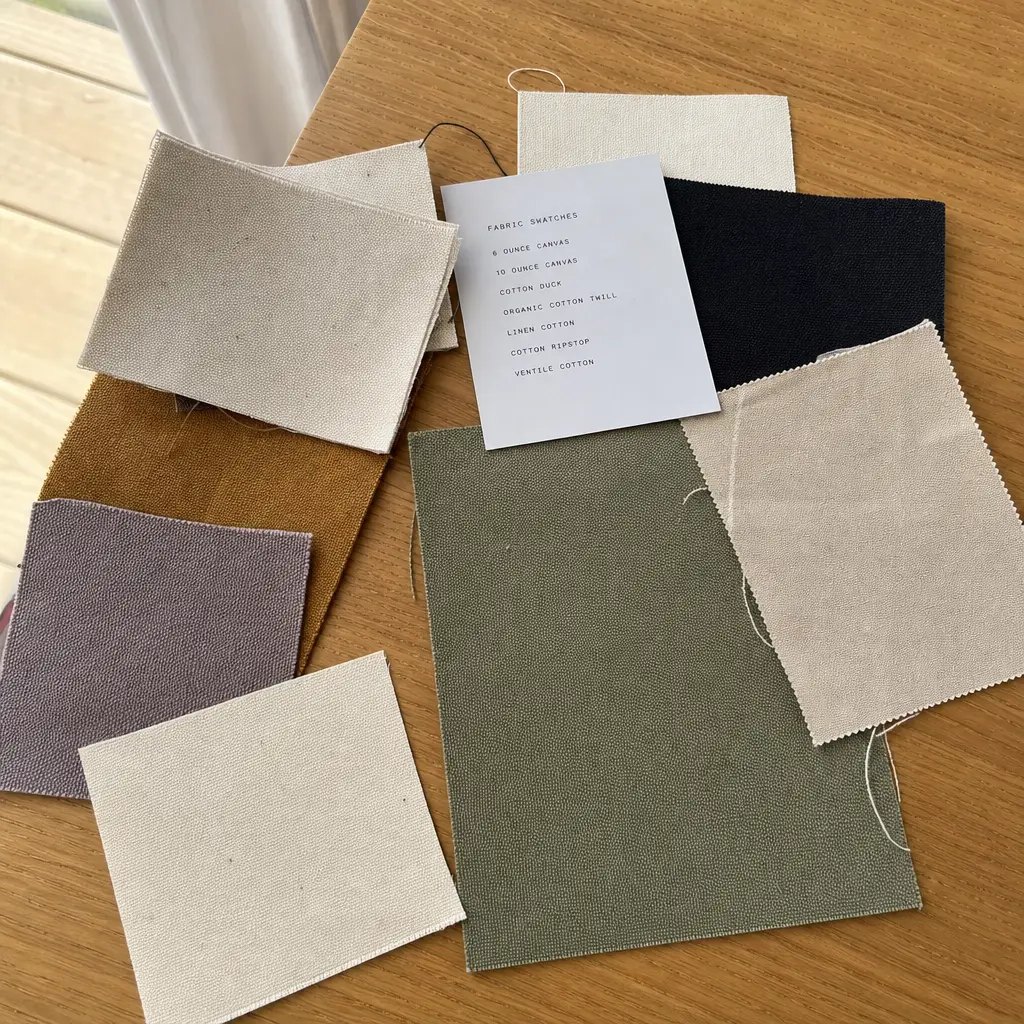
Buyers should ask whether the quoted fabric weight is measured before or after dyeing, coating, washing, or other finishing. Cotton canvas can shrink, soften, stiffen, or change surface texture during finishing. A natural canvas, bleached canvas, reactive dyed canvas, washed canvas, and coated canvas may all print and sew differently even at the same nominal oz. If a program requires repeated orders across multiple events, approve a fabric swatch and request a GSM test reference so future lots can be compared more consistently.
Inspection should cover both measurable and visual fabric issues. GSM can be checked by lab or supplier test report, while shade, slubs, stains, weaving faults, coating streaks, and hand feel are judged against the approved sample. Natural cotton canvas may have small fiber specks; the buyer should decide whether those are acceptable before production. For premium sponsor portfolios, surface cleanliness and shade consistency should be stricter than for a low-cost mass handout.
- Common value range: 10 oz to 12 oz canvas with lining or light interlining for economical event distribution.
- Standard range: 12 oz to 14 oz canvas for balanced structure, printability, and manageable carton weight.
- Premium range: 14 oz to 16 oz canvas with cleaner lining, better edge control, and tighter logo presentation.
- Inspection note: confirm GSM tolerance in writing; +/-5 percent is often workable, but the approved sample remains the commercial reference.
Zipper Engineering And Function Tests
The zipper is the main functional failure point. A No.5 nylon coil zipper is usually the most practical option for canvas zipper portfolios because it bends around corners, runs smoothly, and is less likely to scratch printed inserts. A No.5 metal zipper can look premium, but it adds weight and requires cleaner sewing, better corner radius, and careful slider control. Resin zippers may be used in some designs, but they are bulkier and should be tested on the actual portfolio size before approval.
The RFQ should specify zipper size, type, tape color, teeth color, slider finish, puller style, and end-stop construction. If these details are not locked, a supplier may substitute an available zipper that changes the look or performance. The zipper path is also part of the specification. Tight corners increase resistance and can cause puckering. Rounded corners need enough radius for the zipper to travel without forcing the slider through a compressed turn.
Final inspection should test zippers on loaded units, not only empty units. The inspector should insert the intended contents or a defined equivalent thickness, then open and close the zipper 3 to 5 full cycles. Any catching at corners, trapping of lining, tooth separation, jammed slider, detached puller, or rough stop should be classified clearly. For event shipments, a small zipper issue becomes visible quickly because products are opened repeatedly at the booth.
- Reject as critical if the zipper cannot open or close through the full path under normal hand force.
- Reject as major if the zipper catches repeatedly, traps lining, separates teeth, or has a loose slider or puller.
- Trim loose threads near the zipper track before packing; do not treat them as harmless if they can enter the slider.
- Check that zipper color and metal finish match the approved sample under normal viewing distance.
Logo Method And Tolerance
Branding is often the reason the portfolio exists, so logo control deserves more than a mockup approval. Screen printing is normally suitable for solid one to three color logos, sponsor marks, and simple event artwork. Heat transfer is useful for gradients, fine lines, and full-color artwork, but adhesion and edge feel must be tested on the exact canvas finish. Embroidery can work for small premium logos, but high stitch density can pucker the panel or create an uneven backside. A woven label is a good option when the buyer wants subtle repeat branding or a retail-style detail.
The buyer should define logo size, color, placement, acceptable registration, and defect limits. Placement should be measured from fixed physical points such as bottom edge, side seam, zipper seam, or panel centerline. A typical placement tolerance may be +/-3 mm for a small label or premium front logo and +/-5 mm for larger screen prints, but the correct value depends on construction and artwork. If the logo is close to the zipper or pocket seam, tighter control may be harder and should be confirmed at sample stage.
Color expectations must be realistic on cotton canvas. Pantone references are useful, but ink looks different on natural, bleached, dyed, or coated canvas. The approved physical sample or print strike-off should become the shipment reference. For important programs, ask for a print strike-off before full production and keep it with the inspection file. Do not approve logo color from a phone photo alone, because factory lighting and camera settings can hide obvious differences.
- Screen print control: edge clarity, registration, ink coverage, pinholes, cracking, and dry-rub transfer.
- Heat transfer control: adhesion, film edge, surface shine, cracking at folds, and compatibility with canvas texture.
- Embroidery control: stitch density, thread color, puckering, loose ends, and backing comfort inside the portfolio.
- Woven label control: label size, weave clarity, fold type, stitch position, and fraying at cut edges.
Interior Layout And Usability
Many portfolio designs become expensive because the interior is overbuilt. Every pocket adds cutting, folding, sewing, trimming, alignment, and inspection points. For trade show exhibitors, the most common useful layout is one document sleeve, one business card pocket, and one pen loop. A tablet strap, notebook pocket, mesh pocket, or zipper mesh compartment may be justified for sales teams, but each addition should be tied to a real item that will be carried.
The sample must be tested with the real insert pack. A catalog printed on heavy coated paper may be much thicker than the PDF suggests. A pen loop that fits a slim pen may not fit a branded marker. A tablet with a protective case can be several millimeters thicker and wider than the device specification. If contents create a bulge, the zipper will work harder and the portfolio may no longer lie flat on a booth counter.
Interior QC should include pocket dimension, placement, stitch reinforcement, and insertion function. Document sleeve depth should prevent papers from falling out when the portfolio is opened. Card pockets should not bend card corners. Pen loops should be tight enough to retain the selected pen but not so tight that users tear stitches during insertion. Pocket edges should not sit in the zipper path.
- Measure pocket width and depth against the approved sample and the real contents, not only against the pattern.
- Backtack pocket corners, pen loop ends, and elastic strap ends where repeated use creates stress.
- Avoid thick pockets directly behind the exterior logo if front-panel smoothness is important.
- Check that the loaded interior does not distort exterior print, warp the panel, or prevent full zipper closure.
Quote Structure And Cost Drivers
Procurement teams should make suppliers quote the same product, not similar-looking products. The unit cost depends on canvas GSM, lining, interlining, zipper grade, hardware finish, pocket count, print method, print size, number of colors, packing, inspection requirements, and order split. A cheaper quote may exclude individual packing, use lighter canvas, quote a smaller zipper, assume one-color print, omit interlining, or use bulk carton packing.
A useful RFQ asks for base price and visible adders. For example, request one price for one size, one canvas color, one zipper color, one logo version, and standard individual packing. Then ask for separate price effects for extra logo versions, custom dyed fabric, matched zipper tape, woven label, barcode label, insert card, reinforced carton, or palletization. This makes negotiations cleaner and prevents late surprises after artwork approval.
MOQ should be discussed by version, not only total quantity. One 3,000-piece order with one logo is a different production job from 3,000 pieces split across six sponsor logos. Each version may require separate print setup, drying space, packing separation, inspection tracking, and carton labels. Custom dyed canvas, custom zipper tape, and woven labels can also have their own MOQs that are higher than the sewing MOQ.
- Material cost drivers: canvas GSM, dyeing, coating, lining, interlining, zipper, hardware, labels, and thread.
- Labor cost drivers: zipper path complexity, pocket count, binding, reinforcement, trimming standard, and inspection sorting.
- Branding cost drivers: print method, number of colors, print size, print positions, strike-offs, screens, transfer films, and label MOQ.
- Logistics cost drivers: individual packing, carton strength, carton quantity, gross weight, pallet rules, and destination handling requirements.
Sample Approval And Pre-Production Lock
A photo sample is not enough for canvas zipper portfolios. Buyers need a physical pre-production sample because zipper feel, panel stiffness, canvas hand, pocket function, logo surface, odor, and packing shape cannot be judged reliably from images. If the first sample uses substitute fabric or a different zipper, label it as a construction sample only. It should not be treated as the final production reference.
The approval package should include the physical sample, measurement sheet, bill of materials, fabric swatch, logo artwork, print reference, packing reference, and written list of approved deviations. If the logo is accepted at 82 mm wide instead of the 85 mm artwork request, record it. If the zipper puller changes from antique brass to nickel, update the BOM. Small decisions made in chat can become expensive disputes if they are not moved into the final spec.
Before bulk cutting, load the sample with the actual event contents and leave it packed overnight. This simple test can reveal panel warping, zipper strain, pressure marks, or pocket placement problems. Also run a dry rub check on the logo with a clean white cloth, inspect for obvious ink transfer, and open and close the zipper while loaded. The point is to find construction problems before fabric is cut and printed at scale.
- Approve sample version, date, material references, logo version, and packing version in writing.
- Measure outside size, inside size, zipper opening, pocket dimensions, pen loop, label position, and logo placement.
- Confirm any accepted exception so inspectors do not reject approved differences or accept unapproved substitutions.
- Freeze artwork and materials before cutting, printing, transfer film production, or woven label production begins.
AQL Defects And Inspection Detail
A strong inspection checklist separates critical, major, and minor defects. Critical defects usually include wrong logo, wrong product type, unusable zipper, mold, unsafe sharp metal burrs, needle fragments, or strong chemical odor. Major defects include zipper catching, open seams, missing pockets, wrong fabric, wrong color, severe stains, badly tilted logo, serious print failure, warped panels, or packing that damages the product. Minor defects may include small loose threads, slight removable dust, or small creases that disappear after normal handling.
AQL level should be agreed by the buyer and supplier before production. Many promotional and soft goods inspections use general inspection level II with acceptable quality limits such as 0 for critical, 2.5 for major, and 4.0 for minor defects, but the buyer should set its own standard based on risk, quantity, and event deadline. The most important point is to define product-specific defects. A generic soft goods checklist may say zipper ok, while this product needs loaded zipper cycles, corner checks, pocket checks, and logo measurement.
Inspection should include measurement, appearance, workmanship, function, smell, packing, and carton verification. For versioned orders, the inspector should confirm logo mix, SKU separation, carton marks, and quantity by version. If the shipment is going directly to an event warehouse, carton labeling and packing accuracy are not administrative details; they decide whether the right goods reach the right booth on time.
- Critical examples: wrong logo, unusable zipper, mold, needle fragment, unsafe burr, wrong construction, severe odor.
- Major examples: open seam, repeated zipper jam, missing pocket, wrong canvas color, severe print defect, crushed panel, mixed SKU carton.
- Minor examples: trim thread away from zipper path, slight crease, tiny washable surface mark, small shade variation within approved range.
- Require 100 percent sorting if inspection finds repeated zipper failure, mixed logo versions, wrong carton marks, or safety-related defects.
Packing For Trade Show Delivery
Packing protects the presentation. Canvas zipper portfolios can be damaged by compression, rubbing, moisture, and careless version mixing. If units are loose in a carton, logo surfaces may rub against zipper sliders or neighboring canvas. If cartons are overfilled, corners can crush and panels can warp. If cartons are underfilled, products shift during transport. Event delivery often includes extra handling through forwarders, warehouses, hotels, show halls, and booth contractors, so carton design deserves early attention.
A practical packing plan usually closes the zipper, lays the portfolio flat, protects each unit with a polybag or paper sleeve, aligns units consistently, and uses a fixed carton quantity. The zipper slider should be positioned consistently so it does not press randomly into the front logo area. If the buyer has sustainability requirements, paper sleeves or recycled polybags can be used, but they still need to prevent dust and rubbing. Any insert card, barcode, SKU label, or event code must be approved before packing starts.
Carton marks should include product name, PO number, SKU or logo version, quantity, carton number, gross weight, net weight if required, destination, and any event routing code requested by the warehouse. For multiple logos or exhibitors, separate by inner carton or master carton and mark clearly. Mixed cartons may look efficient at the factory but create slow sorting and errors at the event site.
- Set carton quantity and gross weight limit so event staff can move cartons safely and quickly.
- Use flat packing, edge alignment, and adequate carton fill to reduce bending and corner deformation.
- Separate logo versions physically and by carton mark; do not rely only on a small sticker inside the carton.
- For sea freight or humid storage, consider carton liners, desiccant, and dry warehouse handling for natural cotton canvas.
Specification comparison for buyers
| Procurement decision | Recommended specification range | Inspection method | Common buying risk |
|---|---|---|---|
| Outer canvas | 12 oz to 16 oz cotton canvas, approximately 380 to 540 GSM before coating or washing; record composition and finish | Compare approved swatch, GSM test report, hand feel, shade, and surface defects on sampled units | Quoting only by oz can hide weave, finish, shrinkage, and stiffness differences between suppliers |
| Finished size | Set outside size and usable inside opening; typical tolerance +/-5 mm for width and height unless construction requires tighter control | Measure flat with a steel ruler from agreed reference points; test with real A4, letter, catalog, or tablet load | Specifying only paper size can produce a portfolio that technically fits but catches documents in the zipper path |
| Panel structure | Light interlining, foam, or stiffener only where needed; avoid rigid board unless the design requires it | Check flatness, edge shape, corner recovery after packing, and whether the product rocks on a table | Too soft feels cheap; too stiff can crack, warp, or make zipper corners hard to close |
| Zipper | No.5 nylon coil for most bulk exhibitor programs; No.5 metal zipper for premium programs after corner testing | Run 3 to 5 full open-close cycles on sampled loaded units; inspect tape, teeth, slider, puller, stops, and corner alignment | A zipper that works on an empty sample may jam after brochures, notebook, pen, and badge inserts are loaded |
| Logo method | Screen print for solid 1 to 3 color logos; heat transfer for fine detail; woven label for subtle repeat branding | Measure logo size and placement; compare color to approved physical sample under consistent light; rub test for transfer | Artwork may look sharp on a PDF but lose edge clarity or color strength on textured canvas |
| Interior layout | Document sleeve, card pocket, pen loop, and optional tablet strap; minimize unused pockets | Check pocket dimensions, stitch security, insertion/removal function, and whether pockets interfere with zipper closure | Extra pockets increase labor, defect points, bulk, and inspection time without improving event usefulness |
| MOQ and versioning | Quote by one size, one canvas color, one zipper color, one logo version, then price each split separately | Ask for setup, material, printing, packing, and version-sorting costs as separate quotation notes | Six sponsor logos in one order may price and schedule like six small jobs, not one efficient bulk run |
| Packing | Zipper closed, product flat, individual sleeve or bag, fixed carton quantity, clean carton marks, version separation | Inspect unit protection, carton fill, corner crush, rubbing marks, moisture risk, carton labels, and SKU mix | Poor packing can crush corners or rub logos before the portfolios reach the booth |
| QC plan | AQL inspection plus product-specific critical, major, and minor defect definitions | Review measurements, function, workmanship, logo, odor, packing, and carton count before shipment release | A generic visual inspection misses zipper drag, weak seams, wrong pocket layout, and mixed logo versions |
Buyer checklist before sampling
- Define outside finished size, usable inside size, zipper opening length, and measurement tolerance before requesting quotations.
- List canvas composition, nominal oz and GSM, finish type, color standard, and whether weight is measured before or after washing, dyeing, or coating.
- Specify lining, interlining, foam, stiffener, binding, edge finish, and any reinforced points such as corners, pen loop, or strap attachment.
- Confirm zipper type, zipper size, tape color, teeth color, slider finish, puller style, end stops, and zipper path radius.
- Provide vector artwork with logo size, print position, color reference, print method, and acceptable placement tolerance, commonly +/-3 mm to +/-5 mm depending on design.
- Require a physical pre-production sample made with final or clearly identified substitute materials before bulk cutting.
- Test the sample with real trade show contents, including brochures, catalog, notebook, pen, badge insert, tablet, charger, or sales sheet bundle.
- Set written acceptance criteria for zipper smoothness, seam alignment, stitch density, skipped stitches, stains, odor, logo clarity, panel warping, and corner shape.
- Define defect severity before inspection: critical for wrong logo or unusable zipper, major for open seams or severe stains, minor for small trim threads.
- Agree on an AQL plan or inspection sample size, plus any 100 percent checks required for zipper function, logo version, or carton labeling.
Factory quote questions to send
- What canvas composition, oz, GSM, weave, finish, and color standard are included in the quote?
- Can you provide a fabric swatch and GSM test result, and is the quoted weight before or after dyeing, washing, or coating?
- What are the finished outside dimensions, usable inside dimensions, zipper opening length, and proposed tolerances?
- What lining, interlining, foam, or stiffener is included, and where is it applied in the construction?
- Is the zipper nylon coil, resin, or metal, and what size, tape color, teeth color, slider finish, puller, and stops are quoted?
- What minimum zipper corner radius do you recommend for smooth operation on this portfolio size?
- Which logo method is included in the unit price, and how many logo colors, print positions, or labels are covered?
- What logo placement tolerance can you hold in bulk production, and what reference edge will be used for measurement?
- What is the MOQ for one size, one canvas color, one zipper color, and one logo version?
- How does price and lead time change for two or more logo versions, custom dyed canvas, matched zipper tape, or woven labels?
Quality-control points to confirm
- Canvas GSM should match the approved material specification within the agreed tolerance, commonly +/-5 percent when both parties accept that range in writing.
- Finished outside width and height should be within the approved tolerance, commonly +/-5 mm for flat portfolios, with inside clearance adequate for the intended contents.
- Canvas shade, weave, coating, and hand feel should match the approved swatch or sample, allowing only the written shade tolerance.
- Zipper should open and close smoothly for at least 3 full cycles on sampled loaded units without catching lining, thread, seam allowance, or document corners.
- Slider, puller, teeth, zipper tape, end stops, and metal finish should match the approved bill of materials and sample.
- Seams should have consistent stitch density, no open seams, no skipped stitch runs, no broken lockstitch areas, and no loose threads entering the zipper track.
- Main stress points, including pocket corners, pen loop ends, strap points, and zipper ends, should be backtacked or otherwise reinforced as approved.
- Logo size should match the approved artwork or sample, and placement should stay within the agreed tolerance from fixed edges such as side seam, bottom edge, or zipper seam.
- Print should be free from severe ink bleeding, cracking, pinholes, misregistration, ghosting, transfer marks, and dirt embedded in the ink surface.
- Logo color should be checked against the approved physical reference under consistent lighting, not judged only from phone photos or mixed factory light.