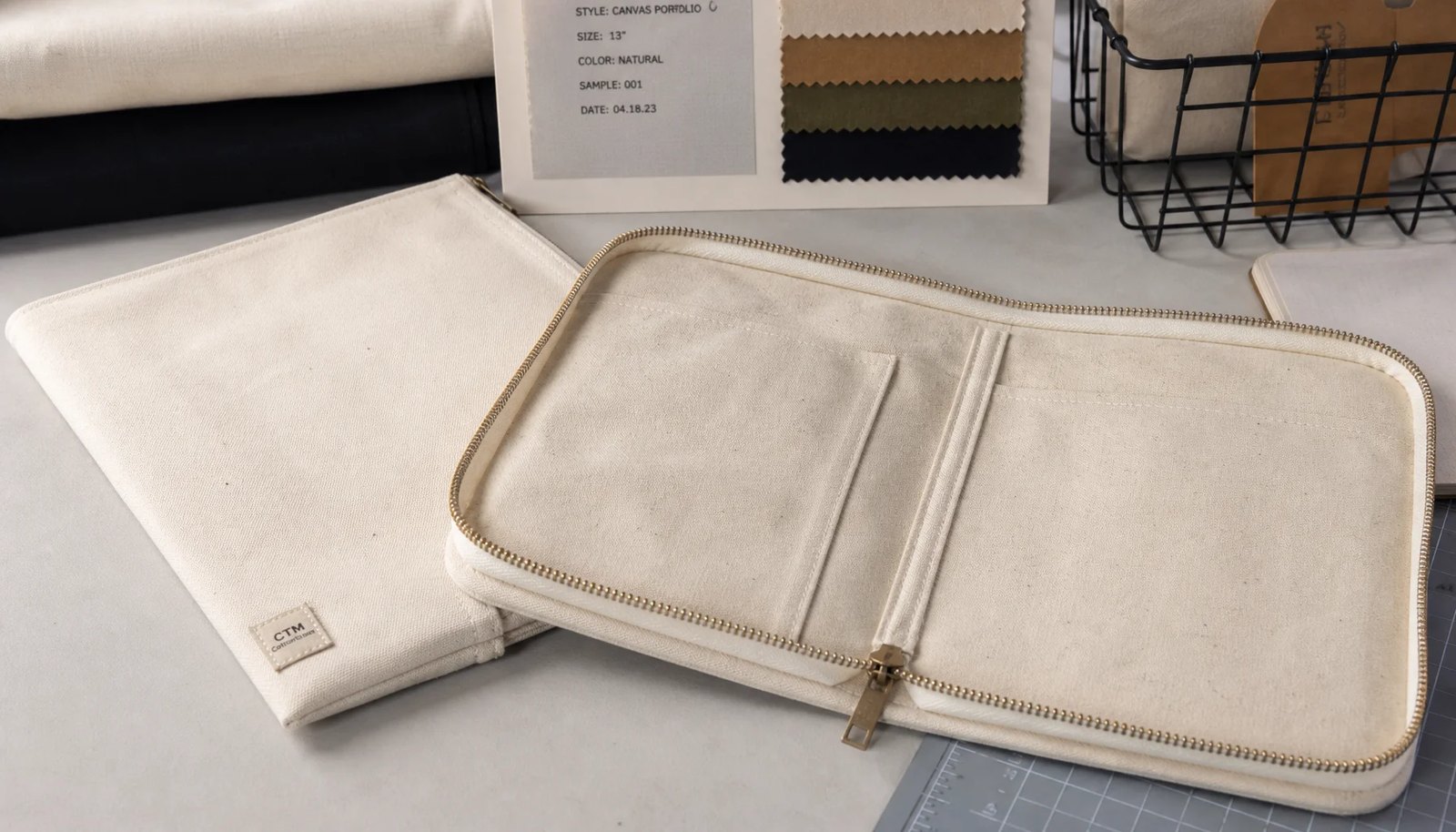
Define The Portfolio Before You Approve Artwork
A canvas zipper portfolio looks simple until procurement has to repeat it across events, regions, and reorder cycles. The first sourcing decision should be the product build, not the logo. Start with the job the portfolio must do: hold a brochure set, protect price sheets, carry small textile or material samples, organize booth paperwork, or become part of a sales kit. A portfolio that only holds letter-size inserts can be lighter and flatter than one expected to carry catalogs, swatches, chargers, or sample cards. That functional difference affects canvas weight, zipper gauge, gusset depth, lining, pocket construction, carton size, and final freight cost.
For most trade show exhibitors, a practical canvas range is 10 oz to 12 oz for document portfolios and 14 oz to 16 oz when the item needs stronger body. Because mills and suppliers may quote weight differently, ask for both oz and GSM. Common approximations are 10 oz at about 340 GSM, 12 oz at about 407 GSM, and 16 oz at about 542 GSM, though exact values depend on the textile reference used and finish. Natural canvas may also show cotton flecks or shade variation. That can be acceptable for a casual brand look, but it should be approved deliberately rather than discovered after cartons arrive.
The most useful RFQ line is not “canvas zipper portfolio with logo.” A buyer-ready line reads more like: finished size, usable inside size, canvas weight and finish, zipper type and gauge, lining material, internal organization, print method, print size, placement, packing, and inspection standard. That detail may feel slower at the start, but it prevents suppliers from quoting different products under the same name.
- Separate finished outside dimensions from usable internal dimensions.
- Choose canvas weight based on contents, handling frequency, and freight impact.
- Approve natural cotton character, shade, and texture before treating the sample as a color standard.
Use Dimensions That Match The Exhibitor Use Case
Trade show buyers often specify the portfolio by artwork size or by the document format it should hold. Both are incomplete. A portfolio intended for A4 or US letter inserts needs enough usable internal width after seam allowance, zipper tape, lining, and pocket stitching are installed. If the product has a gusset, the gusset depth should be measured as usable depth, not just the theoretical side panel width before sewing. A portfolio can meet the outside size on paper and still be too tight for the sales kit if the inner pocket consumes space.
Write the RFQ with dimensional hierarchy. First, state the required content: A4 sheets, US letter sheets, 9 x 12 inch literature, 11 x 17 folded brochures, tablet model, sample cards, or catalog thickness. Second, state the target finished size. Third, state the allowable tolerance. For many sewn canvas products, plus or minus 5 mm on finished size is a realistic starting point, while print placement can often be controlled to plus or minus 3 mm when artwork is centered and the factory uses consistent fixtures. If the artwork aligns to a zipper, pocket edge, or label, ask the factory to confirm whether that tolerance is achievable before you approve the design.
Clearance matters. Keep print at least 15 mm away from seams, zipper teeth, fold lines, and high-pressure corners unless a physical proof confirms the design survives production and packing. Logos that look centered on a flat digital mockup can appear too high once the zipper tape and seam allowance visually frame the panel.
- State the actual contents the portfolio must hold, not only the nominal bag size.
- Use plus or minus 5 mm as a practical sewn-size tolerance unless the supplier confirms tighter control.
- Keep logo art clear of seams, zipper paths, folds, and pocket stitching.
Specify Canvas, Lining, And Hand Feel In Procurement Language
Canvas sourcing needs more than a weight number. Procurement should define fiber content, surface, finish, and color route. Cotton canvas is common for this category, but some suppliers may quote cotton-poly blends, recycled cotton blends, or coated canvas if the RFQ is vague. Each option changes print behavior and hand feel. A smoother bleached canvas may produce a cleaner print edge than rough natural canvas, while heavier unwashed canvas may feel structured but show sharper fold memory in cartons.
Lining is another hidden cost and performance variable. An unlined canvas portfolio can reduce labor and material, but the inside seams may look more casual and inserts may not slide smoothly. A 210D polyester lining is a common functional option for business bags when the buyer wants a cleaner interior without moving into a premium padded construction. If the portfolio must hold devices, samples, or higher-value sales materials, specify whether padding, binding tape, pocket reinforcement, or a divider panel is required. Do not assume the factory will include these details because a reference photo shows them.
If the product is intended for a brand environment where touch matters, ask for fabric swatches before the final sample. A 12 oz natural canvas from one mill can feel softer, looser, or more yellow than another. Swatch approval is especially important when the portfolio will sit beside other branded bags, aprons, pouches, or booth textiles. The written spec should say whether the approved swatch controls shade, texture, weight, or only general appearance.
- Define fiber content, weight, finish, and color route in the RFQ.
- Use lining specs to control interior appearance and insert handling.
- Approve bulk fabric swatches when shade and texture affect brand presentation.
Choose The Zipper Like A Functional Component
The zipper is not trim; it is the main mechanical part of the portfolio. A No. 5 nylon coil zipper is often sufficient for light document portfolios because it is flexible, relatively smooth, and cost-effective. For heavier sample portfolios or frequent-use sales kits, a No. 8 nylon coil or stronger metal zipper may be more appropriate. Metal zippers can create a premium look, but they add weight and may be less forgiving around corners. Nylon coil is generally easier for curved or wrap-around constructions, especially when the portfolio needs to lay flat.
The RFQ should identify zipper gauge, zipper type, tape color, puller material, puller finish, and whether the zipper is straight, L-shaped, or around three sides. A wrap-around zipper changes sewing complexity and inspection risk because corner tension can create wave, twist, or catching. If the buyer wants a branded puller, ask whether it requires tooling, what MOQ applies, and whether the custom puller changes lead time. Custom metal pullers, color-matched tape, and uncommon finishes can delay production even when the canvas body is ready.
Zipper quality control should happen after sewing, not only before assembly. A zipper that glides well as loose trim can catch when installed into a tight seam or curved corner. Sample approval should include repeated opening and closing at the intended fill level. During final inspection, sample units should be cycled at least 10 times and checked for catching, missing teeth, broken pullers, weak end stops, and zipper tape that buckles the portfolio face.
- Use No. 5 coil for light document use and heavier gauges for sample-heavy programs.
- Specify tape color, puller finish, end stops, and zipper path.
- Test zipper glide after sewing and with realistic contents inside.
Match Print Method To Artwork, Canvas, And Quantity
A strong canvas zipper portfolios print proofing checklist for trade show exhibitors starts with the print method. Screen printing is usually the best fit for one to three spot-color logos, especially when the buyer needs solid coverage and repeatable event branding. It carries setup cost for screens, but the per-unit economics usually improve as volume rises. Heat transfer or digital printing can be useful for gradients, small text, photo-style artwork, variable event graphics, or shorter runs where screen setup is less attractive. Embroidery works best as a small accent, patch, or label; large embroidery fields can distort flexible canvas panels and interfere with flat packing.
The factory should review the actual artwork before confirming the print route. Ask about minimum line width, minimum text height, registration tolerance between colors, ink opacity on natural or dark canvas, and whether the print needs an underbase. Thin lines and small type that look crisp in a vector file may fill in or break up on textured canvas. A large white logo on natural canvas may need more ink control than a dark logo on bleached fabric. If the print is close to the zipper edge, allow clearance so the puller does not abrade the ink during use.
A PDF proof is not enough for production approval. Use it to confirm placement, scale, and spelling, then request a physical strikeoff or pre-production sample using the same canvas, ink system, and curing method planned for bulk. The proof should be reviewed for color, opacity, sharpness, registration, surface feel, cracking when flexed, and dry rub performance. If the program will repeat, keep the strikeoff with the signed golden sample.
- Screen print simple spot-color logos; use digital or transfer for gradients and fine detail.
- Confirm print limits for line width, text size, registration, opacity, and underbase.
- Approve a physical print proof on production canvas before bulk printing.
Build A Proofing Checklist That Finds Real Production Errors
Print proofing should catch manufacturing issues, not just graphic-design errors. Start by checking the artwork file: vector format where possible, outlined fonts, correct Pantone or brand color references, final print dimensions, and correct orientation. Then check the proof at actual size against the physical product. Centering should be measured from the finished panel or agreed reference point, not from an unstretched fabric edge that disappears into a seam. For front-panel prints, a plus or minus 3 mm placement tolerance is a useful starting point when the supplier confirms fixture control.
Color review needs a controlled reference. Screens, phone photos, and office lighting are poor approval tools. Use Pantone references, approved ink drawdowns, or a signed strikeoff. For natural canvas, the base fabric color changes the perceived ink color, so compare the strikeoff on the production canvas rather than a white paper proof. If the logo has multiple colors, inspect registration at edges and small details. If the art includes fine text, read it at normal viewing distance and close range; illegible microcopy should be corrected before screens or plates are finalized.
The proofing checklist should also include fabric tension and packing effects. Close the zipper, flex the printed panel, and place the portfolio in the intended fold or polybag position. If the print cracks, wrinkles badly, or lands on a fold line, revise placement before bulk. Trade show deadlines make late corrections expensive, so this is the stage where procurement should be fussy.
- Check artwork file format, fonts, Pantone references, scale, and orientation.
- Measure print placement from the agreed finished-product reference point.
- Review the print after closing, flexing, folding, and packing the portfolio.
Write An RFQ Suppliers Can Price Without Guesswork
A vague RFQ invites suppliers to fill gaps with cheaper assumptions. Two quotes may both say “12 oz canvas zipper portfolio,” but one may include lining, a No. 8 zipper, individual polybags, and a physical proof while another includes none of those. The cleaner approach is to use a structured RFQ with product, decoration, packing, commercial, and quality sections. This allows procurement to compare suppliers line by line and quickly spot missing costs.
The product section should include finished size, usable inside size, gusset depth, canvas weight, fabric finish, zipper spec, lining, pockets, loops, labels, reinforcement, and thread color. The decoration section should include print method, print area, colors, artwork files, Pantone references, placement, clearance from seams, and proof requirements. The packing section should cover individual polybags, insert cards, barcode labels, carton quantity, carton marks, and any pallet or routing requirements. The commercial section should list MOQ, price breaks, sample fees, screen or plate fees, tooling, lead time, Incoterm, named place, and payment terms.
Ask suppliers to quote alternatives in the same table when you are still deciding. For example, request 10 oz versus 12 oz canvas, screen print versus transfer print, or No. 5 versus No. 8 zipper. A factory that gives clear option pricing helps procurement understand the cost drivers instead of negotiating blindly against one blended number.
- Divide the RFQ into product, decoration, packing, commercial, and quality sections.
- Request price breaks and option pricing in the same format.
- Treat missing quote fields as risk, not as savings.
Compare Supplier Routes By Control, Not Only Price
Supplier model affects risk. A direct factory with sewing and printing under one management system can give better control over material, print placement, and production timing. This is useful for repeat trade show programs where the buyer wants the same portfolio across multiple events. A trading company can be helpful when procurement needs one contact for several bag categories or has limited sourcing bandwidth, but the buyer should confirm which factory cuts, prints, sews, inspects, and packs the goods. Responsibility must be clear before defects appear.
A stock blank plus local print partner can be the right route when the event date is close. The tradeoff is that the buyer is accepting the blank’s existing size, zipper, fabric, and color lot. Reorders may not match if the blank supplier changes inventory or fabric source. A full custom OEM factory gives more control over zipper pullers, pockets, labels, lining, and packing, but it usually introduces MOQ and tooling considerations. The best route depends on whether speed, repeatability, customization, or landed cost is the main driver.
For event-critical orders, ask every supplier where the biggest schedule risk sits. It may be fabric dyeing, zipper color, custom puller tooling, print proof approval, or freight booking. A supplier who names the constraint is often easier to manage than one who simply says the order is “no problem.” Procurement should reward transparency because the real objective is not the lowest sample price; it is product that arrives on time and matches the approved standard.
- Use direct factory routes for repeatable, controlled production.
- Use stock blanks for urgent orders only after accepting inventory and lot limits.
- Clarify who owns QC and rework when sewing and printing are split.
Set Production QC With Defect Classes And Tolerances
Quality control should be written before production starts. A canvas zipper portfolio can fail through wrong artwork, broken zipper, incorrect fabric, weak seams, stains, odor, missing labels, or carton-label errors. Some of these are critical because the item cannot be distributed at the trade show. Others are major or minor depending on severity. Define defect classes in the purchase order or inspection instruction so the factory and inspector make the same judgment.
Critical defects should include wrong logo, wrong brand color outside approved tolerance, broken or nonfunctional zipper, sharp metal edges, mold, contamination, missing required compliance label, and packaging that prevents correct receiving. Major defects can include visible print shift beyond tolerance, severe puckering, open seams, skipped stitches in stress areas, incorrect zipper color, wrong lining, or unusable pockets. Minor defects may include small thread tails, slight natural canvas slubs within the approved standard, or tiny cosmetic marks outside the logo area if they do not affect brand presentation.
Use measurable checks where possible. Inspect finished size to the agreed tolerance, often plus or minus 5 mm for sewn canvas goods. Check print placement to the agreed tolerance, often plus or minus 3 mm for straightforward centered prints. Count stitch density, commonly 7 to 9 stitches per inch for many canvas bag seams unless the factory uses a different approved construction. Cycle sampled zippers at least 10 times. Photograph first-line production, mid-run output, packed cartons, carton marks, and any deviations. This documentation protects both buyer and supplier during reorder discussions.
- Classify defects as critical, major, or minor before inspection.
- Use written tolerances for size, print placement, stitch density, and zipper function.
- Document approved deviations so they do not become reorder confusion.
Pack And Schedule For A Fixed Show Date
Packing is part of the product specification because trade show goods are deadline-driven. A portfolio that looks perfect at the factory can arrive creased, dirty, mislabeled, or difficult to count if packing is not controlled. Decide whether individual polybags are required for cleanliness and counting, whether insert cards or barcode labels are needed, and whether the portfolio can be folded. If folded, the fold line should not run through the logo, and the zipper should not press into the printed face. For natural canvas, use clean packing surfaces and dry cartons to avoid marks and odor.
Request carton dimensions, units per carton, gross weight, net weight, and CBM before production is complete. These numbers drive freight quotes and receiving plans. If cartons are too heavy, warehouse teams may repack. If cartons are too large, air freight cost can jump because dimensional weight becomes the charge basis. Carton marks should match the commercial invoice and packing list exactly, especially when goods are routed to a venue, advance warehouse, distributor, or multiple event locations.
Build the schedule backward from the in-hand date, not the ship date. Include artwork finalization, supplier artwork review, physical proof, sample courier time, buyer approval, material purchasing, cutting, printing, curing, sewing, trimming, inspection, packing, export handling, freight booking, customs clearance, and delivery to the final receiving point. If the event date cannot move, freeze changes early. Adding a custom puller, changing zipper color, or revising artwork after sample approval can consume the contingency that was supposed to protect freight and inspection.
- Approve fold method, carton marks, labels, and carton data before packing.
- Plan from required in-hand date rather than factory completion date.
- Freeze custom components early to protect proofing, production, and freight time.
Specification comparison for buyers
| Spec decision | Recommended option | When it fits | Buyer risk to check |
|---|---|---|---|
| Canvas weight | 10 oz to 12 oz cotton canvas for most trade show portfolios; 14 oz to 16 oz when more structure is required | Use 10 oz for lightweight document handouts, 12 oz for balanced structure and freight control, and 14 oz plus for heavier sample kits | Confirm whether oz is per square yard and whether the factory’s GSM conversion is approximate; common references are about 340 GSM for 10 oz, 407 GSM for 12 oz, and 542 GSM for 16 oz |
| Fabric finish | Natural or dyed canvas with pre-shrink or controlled shrinkage notes | Use natural canvas for lower dye complexity and casual branding; use dyed canvas when brand color is part of the requirement | Ask for fabric lot approval and shade tolerance because natural cotton and dyed lots can vary between sample and bulk |
| Zipper gauge | No. 5 nylon coil for light portfolios; No. 8 nylon coil or metal zipper for heavier use | Use No. 5 when the portfolio carries papers and brochures; move up when it carries samples, catalogs, or frequent-use sales kits | Check zipper tape color, puller finish, end stops, and glide after sewing because a good loose zipper can perform poorly once stitched into a tight corner |
| Print method | Screen print for 1 to 3 spot colors; heat transfer or digital print for gradients and fine detail | Screen print works for repeatable logos and larger quantities; digital or transfer helps when artwork changes by event or includes tonal artwork | Require an actual-size strikeoff or production proof on the same canvas color and finish, not only a PDF mockup |
| Print placement tolerance | Plus or minus 3 mm for simple front-panel placement; tighter only when the factory confirms fixture control | Use when artwork is centered on the portfolio face or aligned to a pocket, zipper edge, or woven label | Avoid approving artwork too close to seams, zipper teeth, or fold lines; maintain at least 15 mm clearance unless tested |
| Finished size tolerance | Plus or minus 5 mm for common sewn canvas dimensions; define usable internal width separately | Use for sewn portfolios where fabric cutting, seam allowance, and pressing create normal variance | Do not accept outside dimensions as a substitute for usable internal capacity if the item must hold A4, letter, catalogs, or sample sheets |
| Stitching spec | 7 to 9 stitches per inch for common canvas portfolio seams, with reinforcement at zipper ends and stress points | Use as a practical starting spec for durable business-bag construction | Inspect skipped stitches, loose thread tails, seam puckering, and needle holes around printed panels |
| Packing route | Individual polybag plus master carton for clean counting; bulk packed for low-cost internal event distribution | Use individual bags when receiving teams need easy count control or the portfolio is part of a kit | Confirm fold method, units per carton, gross weight, carton burst strength, barcode labels, and whether packing compression affects logo appearance |
| Supplier model | Factory with sewing and print control for repeat programs; stock blank plus local decorator for urgent short lead orders | Use factory production for repeatable B2B procurement specs; use stock blanks when the event date is too close for full custom build | Verify who owns final QC and rework cost when printing and sewing are handled by different parties |
Buyer checklist before sampling
- Confirm the finished outside dimensions and the usable inside dimensions separately, especially if the portfolio must hold A4, US letter, catalogs, tablets, or sample sheets.
- State the canvas weight in oz and GSM, and specify whether the quote is for natural, bleached, dyed, laminated, coated, washed, or unwashed canvas.
- Define acceptable fabric shade variation using an approved swatch or lab dip, and note whether natural cotton specks, slubs, or seed marks are acceptable.
- Specify zipper gauge, zipper type, tape color, puller material, puller finish, end-stop treatment, and whether the zipper must run straight, L-shaped, or around three sides.
- List lining material, lining weight, internal pocket sizes, card slots, elastic loops, pen loops, document sleeves, and reinforcement patches as separate RFQ lines.
- Set print method, print size, print location, number of colors, Pantone or brand color references, artwork clearance from seams, and whether printing is one side or two sides.
- Require a physical print proof or strikeoff on the production canvas before bulk printing, with color, opacity, registration, edge sharpness, and abrasion checked at actual size.
- Write tolerances into the purchase order: finished size, print placement, stitch density, zipper function, fabric shade range, and carton quantity tolerance.
- Ask the supplier to confirm whether pre-production samples, counter-samples, bulk fabric swatches, and first-line production photos are included in the timeline.
- Separate unit price from sample fee, screen fee, plate fee, custom zipper pull tooling, woven label MOQ, insert card, barcode label, polybag, and carton cost.
Factory quote questions to send
- What exact canvas construction are you quoting, including weight in oz and GSM, yarn or weave description if available, finish, shrinkage expectation, and whether the fabric is pre-washed or untreated?
- Is the canvas natural, bleached, dyed, coated, laminated, or treated for water resistance, and what shade tolerance will you use for bulk fabric against the approved sample?
- Which zipper gauge, zipper type, tape material, puller material, puller finish, and end-stop construction are included in the unit price?
- Is the print handled in-house or by an outside decorator, and who is responsible for approving and controlling color, placement, curing, and rework?
- Which print process do you recommend for this artwork, and what are the limits for minimum line width, small text, registration, ink opacity, and print area on textured canvas?
- Can you provide an actual-size print strikeoff on the same canvas before bulk production, and is the strikeoff cost included, refundable, or billed separately?
- What is your MOQ by body color, print method, zipper color, lining color, woven label, and custom puller, and which component creates the highest MOQ pressure?
- What finished-size tolerance, print-placement tolerance, stitch density range, and zipper-function standard do you apply during in-line and final inspection?
- What sample types do you provide: prototype, salesman sample, pre-production sample, sealed approval sample, and production reference sample?
- How many days are required for artwork review, material sourcing, sample making, sample courier, bulk production, inspection, packing, and freight booking after approval?
Quality-control points to confirm
- Measure outside dimensions and usable inside dimensions against the signed spec; for common sewn canvas portfolios, a plus or minus 5 mm finished-size tolerance is a practical starting point unless tighter control is agreed.
- Check fabric weight from a representative bulk cutting or lab report, and confirm that quoted oz and GSM align with the approved material rather than a lighter substitute.
- Compare bulk fabric shade to the approved swatch under consistent lighting, and record whether natural cotton flecks, slubs, or shade bands exceed the agreed appearance standard.
- Inspect print placement with a simple measurement jig or ruler; for centered front-panel prints, plus or minus 3 mm is commonly achievable when the panel is cut and printed consistently.
- Review print color, opacity, registration, edge sharpness, and pinholes on the first production pieces, mid-run pieces, and final packed samples.
- Run a dry rub check on the printed area using the same canvas finish that ships; textured canvas can make ink wear appear faster than it did on a smooth proof substrate.
- Open and close sampled zippers at least 10 cycles during inspection, checking for catching, wave, exposed teeth, broken pullers, weak end stops, and uneven corners.
- Inspect stitch density, skipped stitches, loose thread tails, back-tacking, seam allowance, corner reinforcement, zipper-end reinforcement, and any pocket stress points.
- Check that the portfolio lies reasonably flat when closed and that the zipper path does not twist the body, buckle the fabric, or pull the printed face out of shape.
- Verify that internal pockets, pen loops, elastic bands, and document sleeves hold the intended insert size without reducing usable width below the buyer’s requirement.