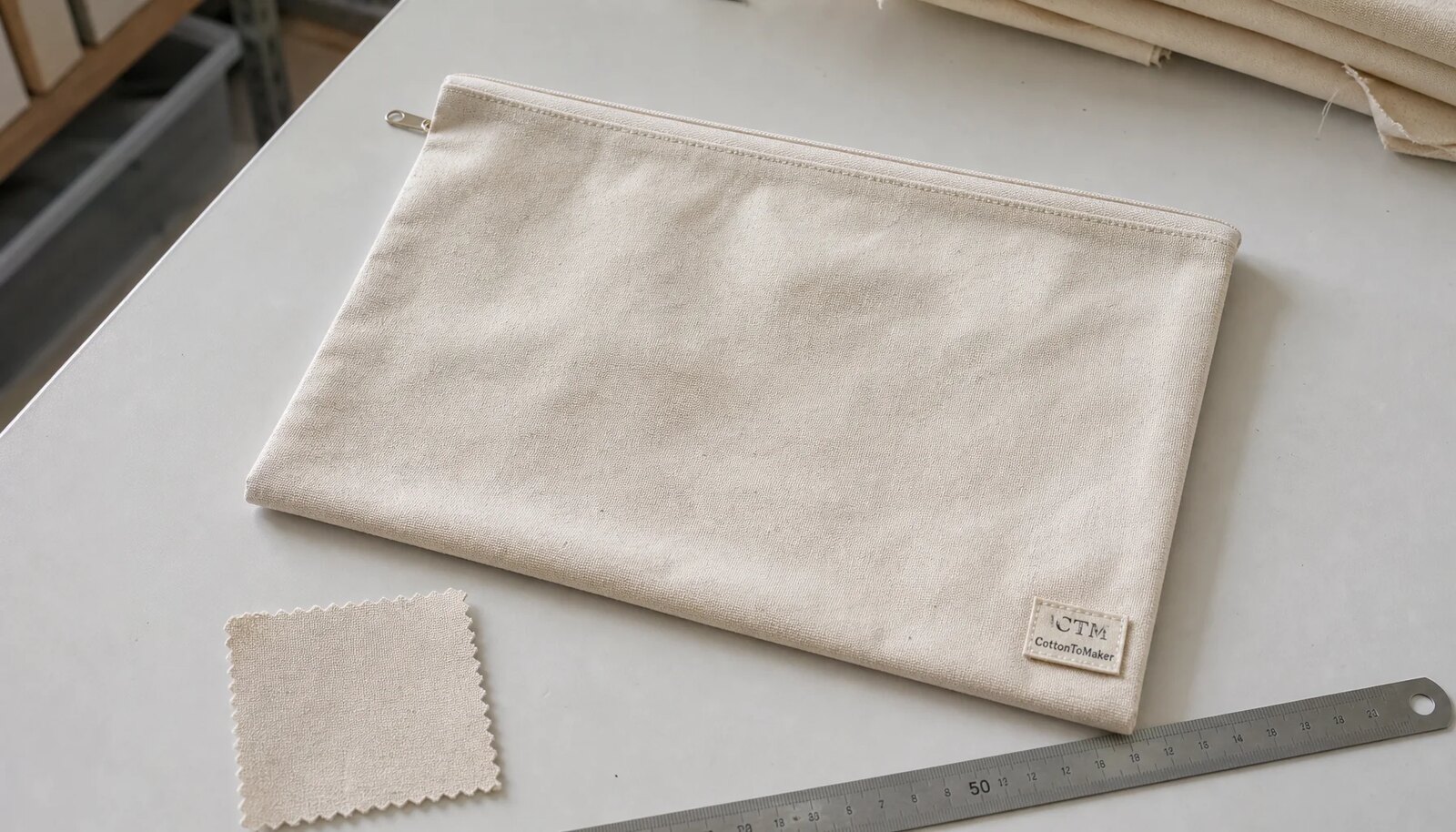
Proof the finished product
A canvas zipper portfolio is not a flat print job. The logo may start on a panel, but the buyer receives a sewn product affected by canvas weight, zipper tension, seam allowance, lining bulk, turning, pressing, and packing. A proof that looks correct on a PDF can shift, skew, pucker, or lose detail once the portfolio is assembled.
For apparel brands, these portfolios often appear in buyer meetings, showroom appointments, trade shows, distributor launches, and sales-team kits. They may carry line sheets, swatches, hangtags, catalogs, order forms, or sample cards. That makes print proofing part of the brand presentation and part of procurement risk control.
Use a canvas zipper portfolios print proofing checklist for eco apparel brands in a fixed order: approve the canvas, confirm construction, map the print area, test the print on final fabric, approve a sewn pre-production sample, and inspect bulk against written measurements. The order matters because later approvals depend on earlier material and construction choices.
- Treat the sewn portfolio, not the artwork file, as the approval standard.
- Use physical proofing for new suppliers, new fabric, fine artwork, visible launches, and eco-positioned programs.
- Measure artwork from fixed construction points rather than visual mockup edges.
- Tie approval to artwork version, canvas spec, zipper spec, trim card, sample date, and packing method.
Choose canvas by use
Canvas weight affects structure, print behavior, unit cost, packing weight, and buyer perception. A 10 oz canvas can work for short-term folders or lightweight document packs, but it may soften quickly when filled. A 12 oz canvas is often a practical default for B2B apparel portfolios because it gives the panel body without making the zipper edge too stiff. A 14 oz canvas can feel more premium, but it increases seam bulk and may require better sewing control.
The RFQ should state weight in oz or gsm, fiber content, weave appearance, finish, color standard, shade tolerance, and shrinkage expectation. Also define whether the material is natural, dyed, washed, brushed, coated, laminated, recycled-content, organic, undyed, or unbleached. Those words change sourcing, documentation, print behavior, and customer-facing claims.
Natural canvas supports a clean apparel presentation, but flecks and slubs can interrupt fine details. Washed canvas may feel softer, yet raised fibers can blur print edges. Recycled-content canvas can vary by supplier and lot, so the buyer should approve a real swatch and print strike-off before treating the artwork as final.
- Request fabric weight, fiber content, weave, finish, color reference, and shade tolerance in the first quote.
- Compare 10 oz, 12 oz, and 14 oz samples with intended documents inside.
- Ask whether bulk fabric will match the approved lot or require new approval.
- Test fine lines, small type, and reversed details on the final canvas surface.
Make eco claims documentable
Eco language should be specific enough to support and restrained enough to avoid overstating the product. Words such as recycled, organic, undyed, unbleached, low-impact, natural, biodegradable, sustainable, and responsible can carry different proof requirements depending on the buyer, retailer, market, and jurisdiction.
The safest procurement habit is to match each claim to documents before packaging, labels, carton marks, or sales pages are approved. Useful files may include supplier declarations, material composition sheets, purchase invoices, fabric or yarn transaction records, chain-of-custody records, test reports, transaction certificates, or certification copies where applicable. Not every order will have every document, but every claim should have a support file.
Claim wording should also be reviewed by the brand's compliance or legal team for the selling market. A supplier may be able to document recycled-content material, but that does not automatically justify broad sustainability claims about the finished portfolio, its packaging, or the full supply chain.
- List each intended claim and the document used to support it.
- Keep PO wording, labels, carton text, website copy, and buyer presentations consistent.
- Avoid broad claims when the document only supports a narrow material attribute.
- Confirm jurisdictional review for consumer-facing or retailer-facing eco language.
Map artwork to construction
Logo placement should be engineered into the product. Useful reference points include zipper edge, side seam, bottom seam, binding edge, pocket opening, gusset seam, and fold line. For a centered mark, define artwork size, horizontal centerline, and vertical distance from a fixed edge. For a corner mark, define exact x-y offsets in millimeters.
Safe area is especially important on zipper portfolios. Artwork close to the zipper can look crowded after the bag is filled. A straight baseline near the bottom seam makes small skew visible. Borders, thin rules, registered colors, and small text need more allowance than a solid one-color logo.
The buyer should ask for the factory's normal placement tolerance and then verify it during sampling. If the sample proves that plus or minus 3 mm is realistic, write that into the PO. If the construction is larger, softer, or printed before sewing, plus or minus 5 mm may be more realistic. The key is to agree before bulk production begins.
- Include print size, x-y position, safe area, and artwork version on the proof drawing.
- Measure from zipper edge, side seam, bottom seam, binding, pocket opening, or fold line.
- Keep print clear of zipper tape, gussets, heavy seams, and folds unless sampling proves the location.
- Approve the sewn sample by measurement and visual balance.
Select the print method
Screen printing is usually the strongest default for canvas zipper portfolios with bold apparel logos, spot colors, and repeat quantities. It should still be specified carefully: ink type, color reference, opacity expectation, curing method, hand feel, print stage, and approval route should all be written into the order.
The artwork determines proofing risk. Thin strokes, small reversed type, close letter spacing, halftones, gradients, and tight registration can fail on a canvas texture that looks acceptable by itself. Ink may gain into the weave, small gaps may close, and raised fibers may break fine detail. A final-canvas strike-off is the cheapest place to discover this.
Digital print and heat transfer can support more colors or shorter variant runs, but the buyer should test film edge, hand feel, rub resistance, cracking, and color consistency. Embroidery can work for a small mark, patch, or woven label, but large stitch fields may pull the panel out of shape and make the portfolio less flat.
- Use screen print for repeatable spot-color marks and bold logos.
- Use a strike-off for small type, reversed detail, thin rules, unusual ink, or natural canvas texture.
- Confirm whether printing happens on roll fabric, cut panels, partially sewn goods, or finished portfolios.
- Evaluate the finished surface for opacity, edge clarity, rub, hand feel, and distortion after sewing.
Build a precise RFQ
A strong RFQ prevents suppliers from pricing different products under the same product name. Include business use, finished outside dimensions, usable inside dimensions, canvas spec, lining, pockets, zipper details, labels, artwork files, print method, packing, carton marks, incoterm, delivery target, and inspection expectations.
Artwork should be production ready. Send vector files with fonts outlined, print size in millimeters, Pantone or brand references, artwork version number, and a marked placement drawing. For multiple versions, list each SKU, quantity, print colors, packing requirement, barcode, and carton mark so setup, sorting, and inspection are priced correctly.
Request line-item pricing where possible. A single unit price can hide basic zippers, weak packing, outsourced decoration risk, unpriced screen charges, or unclear sample costs. Separate fabric, cutting, sewing, zipper, lining, label, print setup, print run charge, packing, cartons, samples, inland transport, export handling, and optional testing.
- Give all suppliers the same dimensions, artwork count, trim spec, packout, incoterm, and delivery date.
- Ask suppliers to state assumptions, exclusions, substitute materials, MOQ triggers, and lead-time dependencies.
- Separate setup fees from unit costs for screens, labels, samples, and cartons.
- Normalize zipper and packing specs before comparing unit prices.
Approve samples in stages
Sampling should create the bulk standard, not just a photo for internal signoff. For first orders, new suppliers, new canvas, visible launches, or fine artwork, start with a print strike-off on the final canvas. This verifies color, opacity, edge clarity, small type, curing, hand feel, and obvious rub risk before sewing adds cost.
Next, approve a sewn pre-production sample made with final canvas, zipper, thread, lining, label, print method, and packing format. A rough prototype can be useful for checking size or pocket layout, but it should not become final print approval if the fabric, zipper, or sewing sequence differs from bulk.
The approval record should name artwork version, canvas weight, fabric lot or standard, zipper spec, thread color, lining, label, print method, packing route, and sample date. Keep one golden sample with the buyer and one with the factory. Any material, artwork, zipper, label, or packing change after approval should trigger resampling or a written waiver.
- Approve a final-canvas print strike-off before the sewn sample when branding matters.
- Release bulk only from a final-material pre-production sample.
- Record the exact artwork, fabric, trim, print, and packing approvals.
- Define which changes require new approval before production continues.
Specify zipper and sewing
The zipper is a major quality signal on a document portfolio. Nylon coil zippers are often practical because they are flexible, smooth, and lighter at the edge. Metal zippers may fit a fashion-led direction, but they add weight and stiffness and can create more abrasion risk. The quote should state zipper type, gauge, tape color, slider material, slider finish, puller style, length, end stop, and reinforcement.
Sewing can make a correct print look wrong. If zipper tape is stretched during attachment, the front panel may pucker. If seam allowance varies, the logo may appear shifted even if the panel was printed correctly. If lining, divider, gusset, or card pockets add tension, the outside panel may bow when filled.
Inspect the portfolio fully sewn, zipped, handled, and lightly filled with intended contents. A flat sample photo can pass while the actual product catches at the lining, feels weak at the zipper end, or bends printed corners during normal use.
- Specify zipper gauge, tape color, slider finish, puller design, length, end stop, and reinforcement.
- Check zipper sewing for puckering, twisting, waviness, and pressure near the print.
- Inspect the portfolio empty and filled with typical documents or swatches.
- Include stitch density, seam allowance, backtack, lining, corners, and loose threads in QC.
Set measurable QC gates
Tolerances make inspection useful. Exact numbers should match the supplier's capability and approved sample, but the buyer should define the categories before bulk production. Common checkpoints include finished dimensions, logo position, logo size, print color range, stitch density, zipper function, shade variation, label placement, barcode readability, carton quantity, and SKU separation.
Example acceptance ranges can be used as a starting point, then adjusted after sampling. Finished dimensions may be controlled around plus or minus 5 mm on smaller edges and plus or minus 8 mm on larger edges. Logo placement may be plus or minus 3 mm for small marks or plus or minus 5 mm for larger front-panel prints. Logo size may be plus or minus 2 mm. Stitch density may be checked against a range such as 7 to 9 stitches per inch if that matches the approved construction.
Defect classification should be written in practical language. Critical defects include unsupported product claims, unsafe sharp components, or a zipper that prevents opening. Major defects include wrong artwork, visible print misplacement, unacceptable stains, broken stitching, poor zipper function, wrong SKU packing, serious dimension failure, or unreadable barcodes. Minor defects may include small loose threads or internal cosmetic issues that do not affect presentation or use.
- Use the buyer's AQL or agreed sampling plan, plus portfolio-specific checkpoints.
- Measure placement from the same fixed references on every inspected unit.
- Run zipper open-close cycles and a repeatable dry rub check on printed areas.
- Record critical, major, and minor defects before inspection starts.
Control variants and packing
Variants can quickly turn a simple portfolio order into a sorting and receiving problem. One shared body with one print is straightforward. Regional logos, department names, event dates, different zipper tape colors, custom labels, and separate carton marks require clearer MOQ, setup, and inspection rules.
Ask for MOQ by body color, canvas type, artwork version, print color count, print position, zipper tape color, label, and packout. Separate fixed costs such as artwork setup, screens, sample fees, label setup, cutting dies, and carton artwork from variable costs such as canvas, zipper, sewing, print labor, packing, cartons, and handling.
Packing should protect the print and support receiving. Approve sleeve or paper band, stacking direction, tissue if needed, barcode placement, SKU labels, inner cartons, master carton quantity, carton marks, and photo documentation. Loose packing can scuff ink, bend corners, mix versions, hide barcode errors, and delay distribution-center receiving.
- Standardize the body, zipper, label, and packing when several teams need different artwork.
- Request MOQ and setup cost by each variant driver.
- Define reorder rules for screens, fabric lots, trim substitutions, samples, and carton marks.
- Approve packout photos before shipment, including SKU separation and carton labels.
Specification comparison for buyers
| Option | Best use | Buyer advantages | Watch points before approval |
|---|---|---|---|
| 10 oz cotton canvas | Light promotional folders, short campaigns, lower-fill document packs | Lower weight, easier folding, often lower unit cost | Can crease, collapse, or show print-through more easily; confirm hand feel with intended contents |
| 12 oz cotton or cotton-blend canvas | Most apparel line-review portfolios, showroom folders, trade-show kits | Good balance of structure, flexibility, and print surface | Natural flecks and slubs can interrupt fine artwork; approve strike-off on final fabric |
| 14 oz canvas | Premium sales-team tools, heavier catalogs, reusable buyer packs | More body and perceived durability | Higher sewing tension, thicker seams, possible zipper waviness; test filled sample |
| Screen print | 1 to 3 spot-color logos, bold marks, repeat orders | Good opacity control and predictable unit cost after setup | Small reversed type, thin rules, and tight gaps may fill on textured canvas |
| Digital print or transfer | Multi-color artwork, gradients, short-run variants | More color flexibility and fewer screens | Hand feel, edge durability, wash/rub resistance, and film edge must be tested |
| Nylon coil zipper | Most document portfolios and soft-sided business bags | Flexible edge, smooth travel, lighter feel, broad color availability | Specify gauge, tape color, slider finish, puller style, end stops, and reinforcement |
| Metal zipper | Fashion-led programs where hardware look matters | Stronger visual statement and premium trim impression | Adds weight and stiffness; check scratching, slider smoothness, and fabric distortion |
| Direct factory route | Repeatable orders where buyer can manage specs and QC | Clearer cost structure and direct technical feedback | Buyer must control artwork, documents, inspections, and change approvals |
| Trading or sourcing partner route | Multi-component orders, mixed suppliers, compressed sourcing timelines | One commercial contact and coordination support | Confirm who owns print failure, zipper substitution, eco documents, final QC, and packing errors |
Buyer checklist before sampling
- Define the commercial use: buyer meeting portfolio, line-sheet holder, swatch pack, distributor kit, sales-team launch, PR sample folder, or event document pouch.
- Confirm finished outside dimensions and usable inside dimensions for A4 sheets, letter documents, swatch cards, hangtags, catalogs, or sample inserts.
- Select canvas weight in oz or gsm, fiber content, weave appearance, finish, color reference, shade tolerance, and expected shrinkage before finalizing artwork placement.
- Choose the trim package: zipper type, gauge, tape color, slider finish, puller style, thread color, lining, label, binding, and pocket construction.
- Send vector artwork with outlined fonts, Pantone or brand color references, final print size in millimeters, artwork version number, and a marked safe area.
- Define logo position from fixed construction points such as zipper edge, side seam, bottom seam, pocket opening, binding edge, gusset seam, or fold line.
- Approve a printed strike-off on final canvas for first orders, new suppliers, new fabric lots, fine artwork, or eco-positioned programs with visible branding.
- Approve a sewn pre-production sample using final canvas, zipper, thread, lining, label, print method, and packing format before releasing bulk production.
- Match recycled, organic, undyed, unbleached, low-impact, or similar wording to available documents before claims appear on product, label, carton, or sales copy.
- Set written QC tolerances for finished dimensions, logo placement, logo size, stitch density, zipper operation, print rub, shade variation, carton quantity, and barcode readability.
Factory quote questions to send
- What exact canvas is quoted: weight in oz or gsm, fiber content, weave if known, finish, color reference, and expected shade range?
- Will bulk use the same fabric lot as the approved sample, and what approval is required if the fabric lot changes?
- Which canvas weights can you offer for this portfolio size, and how do 10 oz, 12 oz, and 14 oz affect structure, print quality, seam bulk, and cost?
- Which decoration method do you recommend for this artwork, and what minimum line width, reversed type size, and gap should we use on this canvas?
- Can you provide a final-canvas print strike-off before sewing the pre-production sample, and what lead time and cost apply?
- Is printing handled in-house or by an outside decorator, and who is responsible if color, opacity, placement, curing, or durability misses the approved standard?
- At what stage is the logo printed: roll fabric, cut panel, partially sewn panel, or finished portfolio, and what placement tolerance applies?
- What zipper spec is included: nylon coil or metal, gauge or size, tape color, slider material, slider finish, puller style, zipper length, end stop, and reinforcement?
- What standard tolerances do you accept for finished dimensions, logo placement, logo size, stitch density, zipper pull strength, print rub, carton quantity, and barcode labels?
- Which documents can support recycled, organic, undyed, unbleached, or other eco-positioning claims: supplier declaration, material composition sheet, purchase invoice, transaction certificate, chain-of-custody record, test report, or certification copy where applicable?
Quality-control points to confirm
- Check incoming canvas against the approved sample for weight, width, color, hand feel, finish, weave appearance, shade bands, stains, holes, odor, oil marks, and heavy slubs.
- Verify fiber-content, recycled-content, organic, undyed, unbleached, or other eco-related wording against the purchase order and available documentation before labels or cartons are printed.
- Confirm print screens, artwork version, ink color, ink type, print size, print location, and production stage before bulk printing begins.
- Measure finished dimensions; common portfolio programs often use an acceptance range around plus or minus 5 mm for smaller dimensions and plus or minus 8 mm for larger dimensions, unless the approved sample proves tighter control.
- Measure logo placement from the same fixed references on each inspected unit; a practical starting range is often plus or minus 3 mm for small logos and plus or minus 5 mm for larger front-panel marks.
- Check logo size against the approved proof; use a defined range such as plus or minus 2 mm or an agreed percentage when artwork size is large.
- Inspect print opacity, registration, edge sharpness, pinholes, fuzzy detail, broken lines, reversed type, color consistency, distortion after sewing, and ink buildup on canvas texture.
- Run a simple dry rub check with white cotton cloth for repeated strokes, and reject obvious transfer, flaking, cracking, tackiness, or ink marking on adjacent canvas.
- Check stitch density against the approved sample; many canvas portfolios sit around 7 to 9 stitches per inch, but the agreed range should reflect fabric weight and seam type.
- Open and close sampled zippers at least 10 cycles to check smooth travel, slider security, end stops, puller attachment, tape waviness, and no catching against lining or seam allowance.