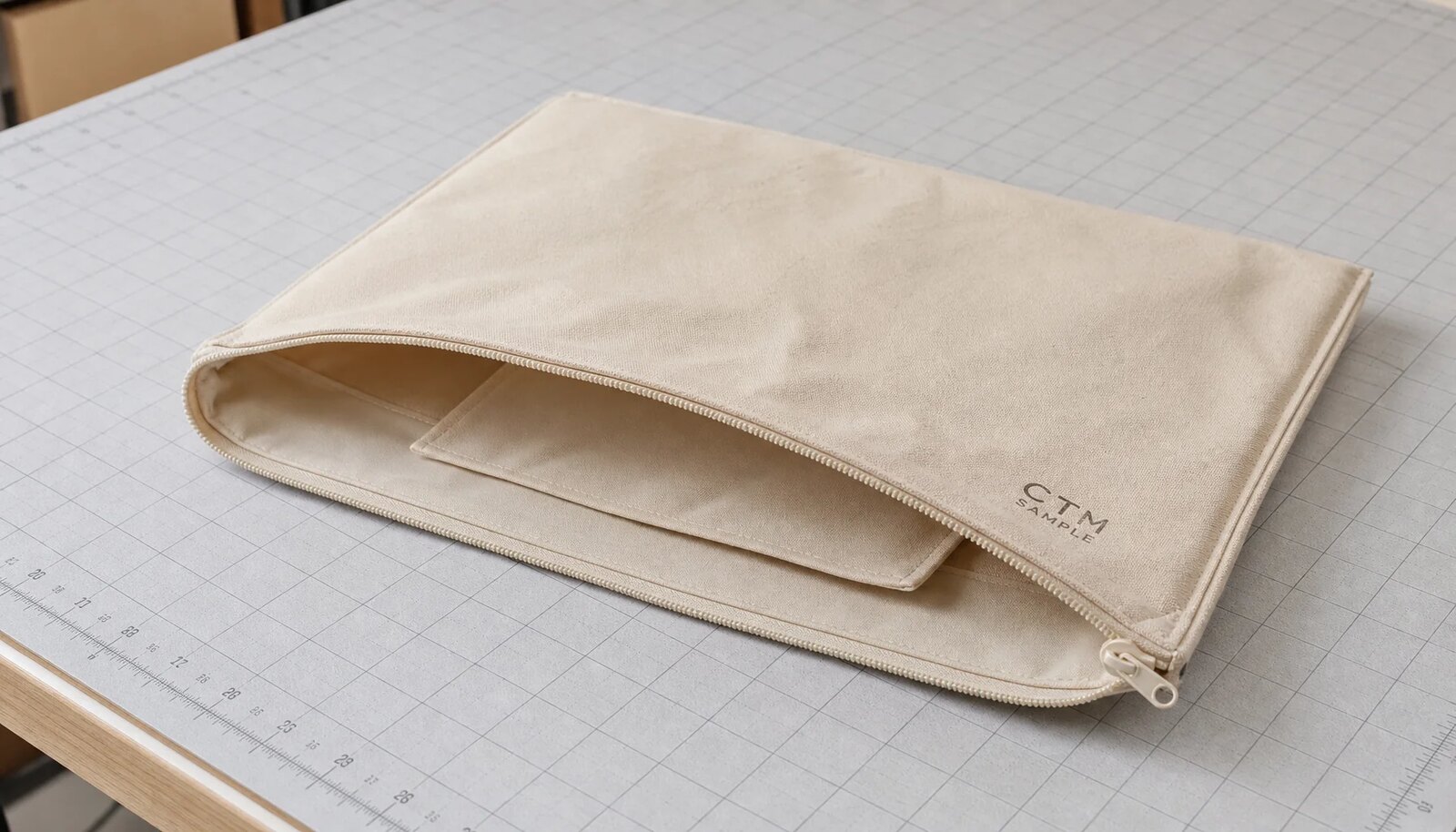
Why this product needs tighter sourcing control
Canvas zipper portfolios for craft fairs are not quite promotional pouches, and they are not full business briefcases either. They sit in the middle. They hold order forms, artist catalogs, line sheets, price lists, receipts, wholesale packets, fabric swatches, sample cards, and sometimes small giveaway inserts. They are handled at the booth, passed to buyers, opened on tables, packed into event bins, and sometimes sold as branded merchandise. That means a crooked logo, stiff zipper, stained panel, or tight document pocket is immediately visible.
For procurement teams, the common mistake is treating the order as a simple logo-on-canvas project. A portfolio combines textile sourcing, zipper installation, internal pocket sewing, print curing, trimming, pressing, and flat export packing. Each step can change the finished product. A canvas panel may look smooth before sewing and ripple after zipper tape is attached. A logo that looks clean in a PDF can print darker, warmer, or fuzzier on natural cotton. A sample that looks acceptable empty may fail once 20 sheets and a 5 mm catalog are inserted.
Craft fair schedules leave little room for recovery. If the print proof is not checked until bulk panels are already printed, the buyer may have to accept defects, pay for urgent rework, ship by air, or miss the event date. The better approach is not complicated, but it must be written down: define the contents, approve physical materials, set measurable print tolerances, confirm zipper construction, and inspect against an approved sample instead of opinion.
- Treat the item as a functional business bag, not only a promotional sleeve.
- Approve physical materials and a print proof before releasing the pre-production sample.
- Use measurable tolerances so inspection is not based on taste or memory.
- Link product decisions to freight, carton volume, warehouse handling, and event distribution timing.
- Keep one signed buyer sample, one sealed factory sample, and one inspector reference set.
Start the RFQ with what the portfolio must hold
The best RFQ starts with contents, not dimensions. A4 paper, US letter sheets, half-letter order forms, postcards, business cards, pens, folded brochures, and thin catalogs all create different construction needs. If the RFQ only says “canvas zipper portfolio, 340 x 250 mm,” a supplier may quote a shell that looks right from the outside but loses too much space to seams, zipper tape, binding, and pocket stitching.
Usable internal size matters more than outside size. Buyers should define the largest insert, expected sheet count, and whether documents must slide in without bending. For A4 and US letter programs, adding roughly 10-15 mm of internal allowance on width and height often prevents curled corners. The exact clearance still depends on canvas thickness, zipper opening shape, lining, and pocket structure. A portfolio made in 14 oz canvas needs more practical clearance than the same style made in 10 oz canvas.
Also define how the user opens the product at the booth. A one-side zipper is simple and usually cost-efficient for flat documents. A two-side zipper improves access without making construction too complex. A three-side zipper feels more like a binder opening, but it requires better control of corner sewing, zipper tape tension, slider travel, and flatness after packing. None of these options is automatically best. The right answer depends on contents, budget, and how the portfolio will be used during the craft fair.
- Specify largest insert size, sheet count, catalog thickness, card quantity, and pen requirement if any.
- Quote finished outside size and usable internal document area separately.
- Define zipper opening style: one-side, two-side, or three-side.
- Confirm whether documents load from the long edge or short edge.
- Ask for a document-fit test using the approved contents before PP sample approval.
Canvas specification: weight, weave, finish, and shrinkage
Canvas weight should be written in both oz and approximate GSM because buyers, suppliers, and inspectors may not use the same reference. A 10 oz cotton canvas is commonly around 320-340 GSM and can work for lighter, budget-sensitive programs. A 12 oz cotton canvas, often around 390-410 GSM, is a practical starting point for craft fair zipper portfolios that need structure without becoming bulky. A 14 oz canvas, often around 450-475 GSM, can feel more premium, but it can also create thick zipper corners, heavier cartons, and more pressure marks if packing is not tested.
Do not approve fabric by weight alone. Yarn size, weave density, finishing, washing, and shrinkage control all influence hand feel, print clarity, and sewing behavior. A loose weave may absorb ink quickly and cause fuzzy logo edges. A tighter weave may print more sharply but feel stiff when the portfolio is loaded. Natural unbleached cotton may include seed flecks, but the approval standard should still reject oil stains, mildew odor, large dark marks, obvious panel-to-panel shade mismatch, and slubs beyond the agreed natural-cotton character.
Shrinkage still matters even when the portfolio is not marketed as washable. Fabric can relax during printing, curing, pressing, humidity exposure, and storage. If panels are cut before the fabric is stabilized, the finished size may run small, or the logo may shift relative to the zipper and pocket seams. Ask whether the fabric is pre-shrunk, washed, or finished before cutting. Then record the expected shrinkage range and GSM tolerance in the specification sheet.
- Mainstream spec: 12 oz cotton canvas, about 390-410 GSM, with approved shade and GSM tolerance.
- Budget spec: 10 oz, about 320-340 GSM, for lighter contents and lower carton weight.
- Premium spec: 14 oz, about 450-475 GSM, only after testing zipper corners and flat packing.
- Fabric tolerance: commonly +/-5% GSM against approved sample or test report.
- Fabric approval: physical swatch with color, finish, hand feel, shrinkage note, and acceptable natural fleck level.
Zipper, pocket, and label construction details
The zipper is often the first component users blame when a portfolio feels cheap. For most craft fair applications, a No. 5 nylon coil zipper is a sensible choice because it is flexible, smooth, and easier to sew around canvas edges than heavier hardware. Metal zippers can look premium, but they add weight, may scratch printed panels, and can leave pressure marks in flat cartons. If the brand insists on metal hardware, test the exact finished product in the intended packing format before approving bulk.
Zipper tape should be specified by color, width, and quality level. Low-grade tape can wave after sewing, especially when attached to heavier canvas. Slider and puller quality should be checked by hand. The puller should not wobble excessively, the slider should not separate from the coil, and there should be no sharp edge that can snag documents or abrade the print. Pay attention to end stops. Many failures begin at the start or end of the zipper path, where repeated pulling stresses the seam.
Internal features should earn their place. One flat document pocket is usually enough for order paperwork and line sheets. A card slot or pen loop can be useful, but every added seam increases labor time, bulk, inspection points, and the chance of sample revisions. Labels, hangtags, barcode stickers, care/content labels, and insert cards should be locked before PP sample approval. A late label change may sound minor, but it can alter the sewing sequence or block document insertion.
- Use a No. 5 nylon coil zipper unless a different zipper is justified and tested.
- Specify tape color, slider finish, puller shape, end stop method, and end reinforcement.
- Check zipper movement with the approved contents inside the portfolio, not only when empty.
- Place labels away from zipper stress points and document insertion paths.
- Avoid late additions of card pockets, pen loops, hangtags, or barcode labels after PP approval.
Choose the print method by artwork, fabric, and order plan
Screen printing is usually the strongest option for one to three solid-color logos on canvas zipper portfolios. It gives repeatable coverage, predictable bulk cost, and a natural appearance when the ink system is selected and cured correctly. Water-based or pigment systems can give cotton canvas a softer hand feel. Higher-opacity ink may be needed for darker fabrics. Large solid logos deserve extra attention because they can show uneven coverage, tackiness, blocking, or pressure marks after stacking.
Heat transfer has a place when artwork includes gradients, full-color illustrations, small runs, or frequent design changes. The tradeoff is surface feel. Transfers can sit like a film on textured canvas, and edges may lift if the portfolio is flexed, rubbed, or stacked under pressure. If heat transfer is selected, approval should include edge adhesion, flexibility, film thickness, cracking, and appearance after packing.
Digital printing can work for short runs and variable artwork, but canvas is not smooth paper. Natural cotton shade, pretreatment, ink absorption, and curing all affect color strength and detail. A monitor proof is not enough. Even a beautiful PDF cannot predict how a muted green, warm beige, or fine serif type will appear on a textured natural fabric.
Fine detail needs limits. On textured canvas, strokes below about 0.3 mm may break, fill in, or look uneven depending on weave and ink deposit. Small reversed-out type, low-contrast colors, and tight multi-color registration should be tested at final size. Enlarged artwork proofs often hide problems that appear immediately on the finished portfolio.
- Use screen print for solid logos, event marks, and repeatable bulk production.
- Use heat transfer for full-color detail only after testing adhesion and surface feel.
- Use digital print for short runs or variable artwork with physical proofing on canvas.
- Avoid heavy ink across seams, zipper edges, folds, and high-rub packing areas.
- Confirm whether screens, separations, artwork cleanup, and proof revisions are included in the quote.
Print proofing checklist before bulk release
A reliable proofing process has three gates: artwork proof, print strike-off, and pre-production sample. The artwork proof confirms file format, final size, Pantone references, line thickness, registration, and placement measurements. The strike-off shows how the ink behaves on the actual or bulk-equivalent canvas. The PP sample proves that the approved print still works after cutting, sewing, zipper installation, trimming, pressing, and packing.
For a new canvas zipper portfolio order, approval should be physical whenever possible. A PDF mockup is useful for scale and placement, but it cannot show canvas texture, ink absorption, shade shift, curing, rub resistance, or carton pressure. A paper ink drawdown can show ink color in isolation, but not how that ink sits on cotton canvas. If remote approval is unavoidable, request photos taken with the canvas swatch, Pantone chip, and a neutral reference card in the same frame. Even then, keep a signed physical standard for inspection as soon as practical.
Write tolerances before production starts. Common starting points are print placement within +/-3 mm from agreed reference edges, print size within +/-2 mm, and finished outer size within +/-5 mm. If the logo is visually centered rather than measured from fixed edges, state that method clearly and provide an approved diagram. Otherwise, the buyer, supplier, and inspector may each judge “centered” differently.
Proofing should include curing and packing, not just fresh print appearance. Ask the supplier to confirm normal curing time before stacking. Rub the cured print with a clean dry white cloth and check for transfer. Put the sample into the approved sleeve or paper wrap, stack it under normal carton pressure, and inspect later for blocking, tackiness, puller marks, and ink transfer.
- Artwork file: vector AI, PDF, EPS, or SVG with fonts outlined and Pantone targets listed.
- Placement proof: final print width, height, and distance from top/side reference edges.
- Strike-off: same or bulk-equivalent canvas, same ink system, and same print size where possible.
- Color approval: signed physical proof under neutral light, not supplier phone photo only.
- Durability check: dry rub, bend near printed area, and inspect after packing stack pressure.
- Bulk release: approve only after PP sample matches fabric, zipper, print, label, and packing requirements.
MOQ, price tiers, and landed-cost drivers
MOQ is rarely a single fixed number. It is shaped by fabric availability, zipper sourcing, print setup, sewing efficiency, packing requirements, and the number of artwork versions. A natural stock canvas with standard black zipper tape and a one-color screen print can usually support a lower MOQ than custom-dyed canvas, custom zipper tape, full-color transfer, lining, multi-pocket interiors, and retailer-specific packing.
Ask what is driving the MOQ. Sometimes the real limit is the fabric lot. Sometimes it is zipper tape color, screen setup, or sewing-line efficiency. If several craft fair logos share the same portfolio construction, the supplier may be able to keep the base material order efficient while separating artwork by print run. However, each logo version may still add screen charges, changeover time, packing separation, and inspection complexity.
Review unit price together with logistics data. A thicker canvas, oversized format, rigid insert, or low carton quantity can increase CBM enough to offset a lower unit cost. Request carton dimensions, pieces per carton, gross weight, net weight, and total CBM during quotation, not after the PO is issued. For event distribution, carton marks and design separation matter. The team setting up a booth or warehouse staging area needs to find the right batch quickly.
Compare quotes on the same specification. A price that excludes print strike-off, screen charges, individual sleeves, barcode labels, or final inspection support is not equivalent to a quote that includes them. Ask suppliers to list inclusions and exclusions clearly. Procurement should compare total order cost and execution risk, not only the FOB unit price.
- Ask for price breaks at 500, 1000, 3000, and 5000 pieces using the same spec.
- Separate one-time costs: sample fee, screens, artwork cleanup, mold if any, and courier cost.
- Confirm cost impact of multiple logo versions, carton marks, inserts, and barcode labels.
- Compare carton CBM and gross weight, not only FOB unit price.
- Reduce MOQ pressure by using stock canvas, standard zipper tape, one construction, and controlled artwork variation.
Sample approval and inspection standards
A sales sample helps the buyer understand style and hand feel, but it is not a production standard unless it uses the same materials and process as bulk. The approved PP sample should include bulk canvas, bulk zipper, final print method, approved ink color, label placement, internal pocket layout, seam construction, and intended packing. If any substitute is used, the supplier should identify it in writing and explain how bulk will differ.
Build a sample approval file. Include signed photos, measured dimensions, print-position diagram, approved artwork, canvas swatch, zipper reference, label reference, packing photos, and accepted deviations. Keep one approved sample with the buyer, one sealed at the factory, and one digital package for the inspector. This prevents avoidable arguments about print height, pocket width, zipper waviness, fabric shade, and label position.
Inspection criteria should separate critical, major, and minor defects before production. Critical defects may include unsafe sharp hardware or contamination. Major defects usually include wrong artwork, wrong print color, zipper failure, open seams, major stains, wrong size outside tolerance, unusable internal space, incorrect packing, and barcode errors. Minor defects may include small loose threads, slight wrinkles, or natural-fiber variation within the approved standard.
Many buyers use ANSI/ASQ Z1.4 or ISO 2859-1 sampling concepts with agreed AQL limits. The exact plan should match order risk and buyer requirements. Whatever sampling method is used, inspectors still need objective checks: dimensions, document fit, zipper cycling, seam security, print position, color against signed proof, rub behavior, packing count, and carton marks.
- Approve the PP sample only after actual contents fit without zipper strain.
- Measure outside size, usable inside size, zipper opening, pocket size, and print placement.
- Cycle zippers at least 10 times on inspected samples and record failures by carton.
- Classify zipper failure, open seams, wrong artwork, and major stains as major or critical defects.
- Use signed physical proof and PP sample as the inspection reference, not email comments alone.
Packing for craft fair and retail distribution
Packing must protect presentation, not simply survive shipping. Canvas zipper portfolios may pass through factory storage, export transit, importer warehouses, event staging, and booth setup before reaching the final user. Light canvas shades show dirt quickly. Large printed logos can pick up pressure marks if pieces are stacked face-to-face too soon after curing or without protection.
Flat packing is normally preferred. Rolling can create zipper memory, canvas creases, and distorted corners. For flat cartons, check puller orientation. A heavy or sharp puller pressed into a printed panel can leave a visible mark. Alternating puller direction, using tissue, or placing the print face away from hardware may reduce damage without a major cost increase.
Carton quantity should balance freight efficiency with handling. Many portfolios fit 25-50 pieces per carton, but the right count depends on size, canvas weight, pocket bulk, and carton strength. Keep gross weight practical for manual handling, often below 18-20 kg unless the buyer has approved heavier cartons. Request net weight, gross weight, carton size, and total CBM before placing the PO.
Sustainability requirements should be practical and specific. Recyclable polybags, glassine sleeves, paper wraps, belly bands, and master polybags each have tradeoffs in moisture protection, print protection, presentation, and cost. If plastic-free packing is required, test whether the print stays clean and whether cartons can handle humidity during ocean transit or event storage.
- Use individual protection when the portfolio has light canvas, large print area, or retail presentation needs.
- Confirm print-face orientation, puller position, tissue use, and carton stacking method.
- Request carton size, pieces per carton, gross weight, net weight, and total CBM in the quote.
- Mark cartons by PO, item number, color, print version, quantity, destination, and event batch.
- Check barcode, insert card, hangtag, and label accuracy during final inspection.
Purchase order wording that prevents common disputes
Once the sample is approved, the purchase order should carry the same details. Do not rely on a chat thread or an old mockup file. The PO or attached technical sheet should state canvas weight and GSM range, fabric color standard, finished outside size, usable internal area, zipper type, pocket layout, label placement, print method, artwork file name, Pantone targets, packing method, carton marks, and inspection tolerances.
Clear wording is especially important when the portfolio is produced for multiple craft fairs or multiple logo versions. State whether all versions use the same base fabric and construction. List each artwork version, quantity, carton mark, barcode, and destination if applicable. If the supplier is allowed to gang print versions or combine cartons, define how pieces must be separated for receiving and event distribution.
Finally, define what triggers bulk production. Some suppliers count lead time from deposit. Others count from fabric approval, artwork approval, strike-off approval, or signed PP sample approval. For event-driven orders, this difference matters. The PO should state the agreed start point, approval deadlines, inspection window, and required delivery date. A clear production calendar is often the cheapest risk control in the order.
- Attach the final tech sheet, approved artwork, and signed PP sample photos to the PO.
- List each logo version with quantity, barcode, carton mark, and destination requirement.
- State that bulk production starts only after the agreed approval gate is complete.
- Include inspection tolerances for fabric GSM, size, print placement, print size, zipper function, and packing.
- Confirm whether supplier substitutions require written buyer approval before production.
Specification comparison for buyers
| Sourcing decision | B2B recommendation | Typical tolerance or check | Procurement risk |
|---|---|---|---|
| Canvas weight | 10 oz for light programs; 12 oz, about 390-410 GSM, for most structured portfolios; 14 oz only after corner, zipper, and carton testing | Fabric GSM often controlled within +/-5% against approved swatch or test report | Buying by oz only can hide loose weave, shade variation, shrinkage, and a poor print surface |
| Finished size | Quote both outside size and usable internal document space for A4, US letter, catalogs, and order forms | Finished size commonly +/-5 mm; usable internal space must pass the approved document-fit test | Outer dimensions alone do not prevent tight pockets, curled paper corners, or zipper strain |
| Zipper construction | No. 5 nylon coil zipper with approved tape color, smooth slider, non-sharp puller, and reinforced end stops | Cycle test at least 10 full openings on inspected samples; check end reinforcement and slider security | Low-grade zipper tape can wave on canvas, jam at corners, or fail at the end stop |
| Print method | Spot-color screen print for 1-3 solid colors; heat transfer or digital only when artwork requires full color, gradients, or frequent changes | Print position +/-3 mm; print size +/-2 mm; minimum stroke usually 0.3 mm or larger on textured canvas | Digital mockups do not show ink absorption, canvas shade shift, curing, rub behavior, or packing pressure |
| Color proof | Physical strike-off on production or bulk-equivalent canvas, signed before PP sample approval | Compare under neutral D65-style light where possible, with Pantone reference and approved canvas swatch | Natural canvas warms and mutes many colors; supplier photos are not reliable approval standards |
| Inner layout | One flat document pocket plus optional card slot or pen loop for most craft fair use | Pocket opening and usable space checked with approved paper count, catalog thickness, cards, and pen if included | Too many compartments increase sewing minutes, bulk, defect points, and sample revision cycles |
| Labels and compliance | Confirm woven label, cotton label, printed care/content label, hangtag, barcode, and carton marks before PP sample | Label position tolerance usually +/-5 mm unless design requires tighter control | Late label changes can alter sewing sequence, block document insertion, or delay production |
| Packing | Individual recyclable polybag, glassine sleeve, paper wrap, or tissue protection; flat stack in export cartons | 25-50 pcs/carton depending on size and weight; carton gross weight often kept below 18-20 kg | Overfilled cartons can crease corners, press pullers into prints, and cause ink transfer |
| Approval sample | Pre-production sample using bulk fabric, bulk zipper, approved ink, final label, and intended packing | Keep signed buyer sample, sealed factory sample, and inspection reference photos | Sales samples made with substitute materials are weak evidence for bulk disputes |
Buyer checklist before sampling
- Define the contents first: A4, US letter, catalog size, postcard size, business card size, sheet count, and maximum catalog thickness that must fit without bending.
- Specify both finished outside dimensions and usable internal document area measured inside seams; include seam allowance expectations and zipper opening length.
- State canvas weight in oz and GSM range, fabric color, weave/finish, shrinkage expectation, and whether the fabric is natural, bleached, dyed, washed, or pre-shrunk.
- Request physical swatches for canvas shade, zipper tape, puller finish, label material, lining if any, and packing material before approving the PP sample.
- Send vector artwork with final print size, Pantone references, outlined fonts, registration notes, minimum stroke width, and print-position measurements from agreed reference edges.
- Require a print strike-off on production canvas or bulk-equivalent canvas; do not approve a new canvas zipper portfolio order from a PDF mockup or paper ink drawdown only.
- Set measurable tolerances: print position +/-3 mm, print size +/-2 mm, finished size +/-5 mm, fabric GSM +/-5%, unless tighter limits are confirmed by the factory before sampling.
- Confirm zipper spec: No. 5 coil or alternative, tape color, slider finish, puller style, end stop method, corner sewing method, and reinforcement at zipper ends.
- Lock internal pocket layout, label placement, barcode needs, insert cards, hangtags, and carton marks before pre-production approval to avoid cost and lead-time resets.
- Ask for quote breakdown by MOQ and tiers at 500, 1000, 3000, and 5000 pieces, including sample fees, screen charges, packing, carton data, and estimated CBM.
Factory quote questions to send
- What exact canvas specification is included in the price: oz weight, GSM range, yarn/weave description, finish, color standard, shrinkage rate, and GSM tolerance?
- Is the fabric stock, made-to-order, dyed-to-order, washed, pre-shrunk, certified, or subject to minimum fabric lot quantity separate from the product MOQ?
- Which zipper is quoted: No. 5 nylon coil, molded, or metal; tape width and color; slider material; puller style; end stop method; and reinforcement stitching?
- What finished outer size, usable internal size, seam allowance, zipper opening length, and pocket dimensions are included in the quoted construction?
- Which print process is quoted: screen print, pigment print, water-based ink, heat transfer, digital print, or another method; and what limits apply to fine lines, small text, and registration?
- Does the quote include artwork cleanup, color separation, screens, a physical strike-off on bulk canvas, and one revision, or are these charged separately?
- What are the unit prices at 500, 1000, 3000, and 5000 pieces for the same construction, and what changes if there are multiple logo versions?
- What is the sample plan: material swatch timing, artwork proof timing, strike-off timing, PP sample timing, sample fee, revision fee, and courier cost?
- When does bulk lead time start: after deposit, fabric approval, artwork approval, print proof approval, or signed PP sample approval?
- What packing is included: individual sleeve type, tissue or face protection, pieces per carton, carton size, gross weight, net weight, CBM, carton marks, and pallet option if required?
Quality-control points to confirm
- Canvas GSM should be within the agreed range, commonly +/-5% against approved swatch or test report, with no unacceptable oil marks, mildew odor, heavy stains, obvious panel shade mismatch, or severe slubs outside the approved natural-cotton character.
- Finished outside dimensions should remain within +/-5 mm unless otherwise agreed, and the usable internal space must fit the approved document test pack without curled corners, strained zipper movement, or distorted pockets.
- Print placement should remain within +/-3 mm from the approved reference edges, and print size should remain within +/-2 mm from the signed artwork proof or PP sample.
- Logo quality should match the approved physical proof with no missing strokes, heavy bleeding, smudging, ghosting, misregistration, pinholes visible at normal inspection distance, or ink build-up that changes hand feel beyond approval.
- Print color should be compared against the signed strike-off under neutral light, allowing agreed natural canvas shade variation but rejecting obvious batch drift, wrong ink color, or uneven opacity across panels.
- Cured print should pass an agreed dry rub check with a clean white cloth and show no unacceptable transfer, tackiness, cracking, blocking, or carton pressure marks after normal packing rest time.
- Zipper operation should be tested for at least 10 complete open-close cycles on inspected samples, with no jamming, tooth separation, loose slider, broken puller, sharp puller edge, or failed end reinforcement.
- Seams at zipper tape, binding, pocket edges, labels, and stress points should show secure backstitching, no open seams, no broken thread chains, no skipped stitches longer than 10 mm, and no raw sharp thread ends.
- Inside pockets and slots should match approved layout, hold the intended paper/card contents, avoid blocking zipper travel, and show no exposed raw edges unless the design intentionally uses bound or overlocked raw-edge detailing.
- Packing should match the approved method: individual protection, print-face orientation, piece count, barcode and label accuracy, carton marks, moisture protection if required, design separation, and cartons free from crushing or water damage.