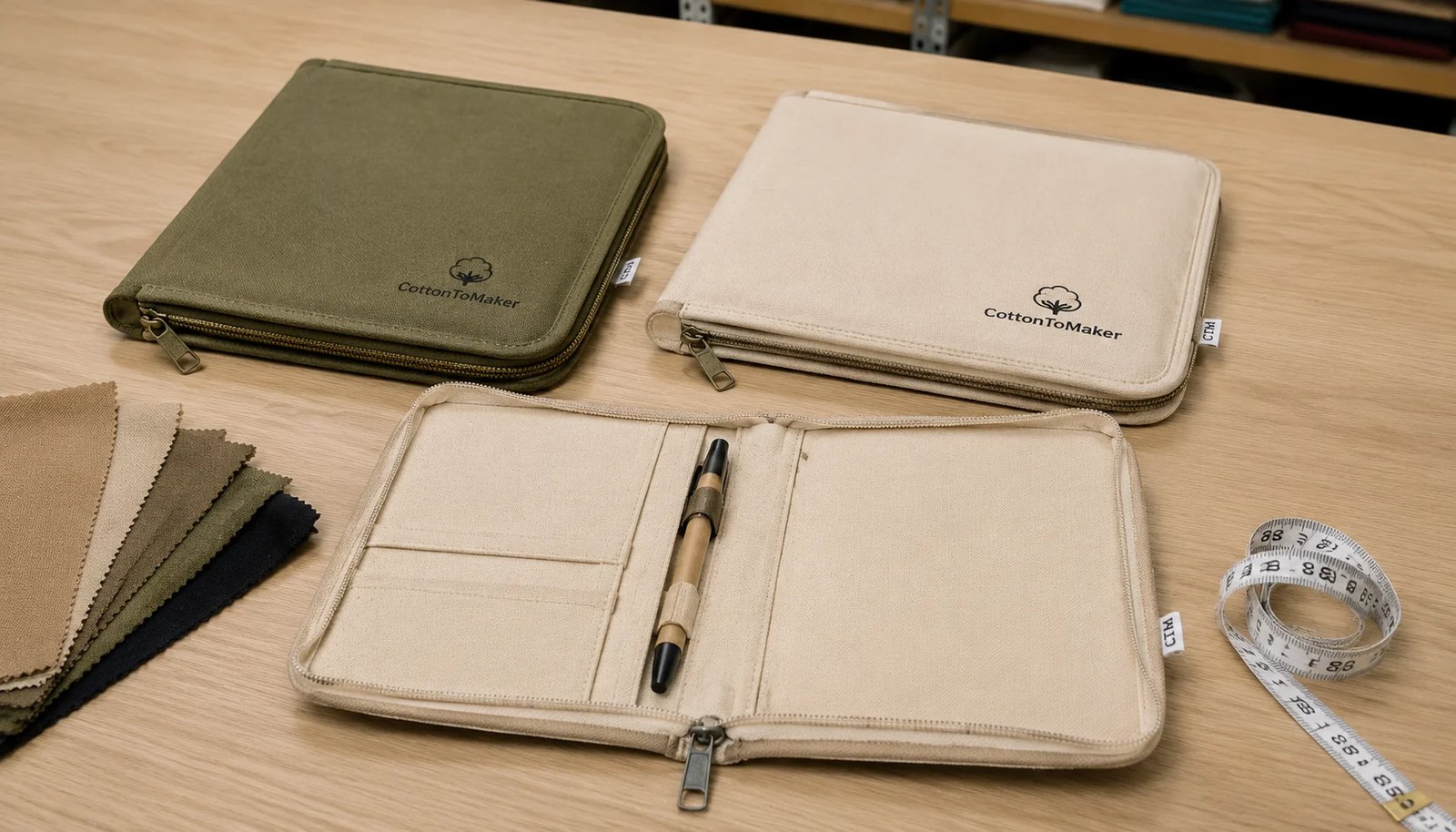
Why durability is the main buying problem for natural grocer portfolios
Canvas zipper portfolios for natural grocers usually sit in an awkward middle ground between promotion and daily-use equipment. They are often expected to hold training documents, vendor notes, refill-program forms, community outreach materials, or category review packets. That means the item is handled more like a working tool than a giveaway. Buyers who source it as a simple promo item often get the wrong construction: light canvas, decorative zippers, and weak corners that look acceptable on arrival but fail after a few weeks of regular opening and closing.
The core buying problem is not whether the portfolio looks good in a photo. It is whether the construction survives repetitive use without the zipper twisting, the corners fraying, or the inside organizer sagging. For procurement teams, the cheapest quote is frequently based on lighter canvas, low-cost board inserts, and underbuilt binding. Those details do not show clearly on a quote sheet unless the RFQ is tight. A durability checklist helps align suppliers before sampling begins, so quote comparisons reflect the same build level.
- Typical failure points: zipper corners, edge binding, pocket attachment seams, panel warping, print cracking
- Most hidden cost drivers: heavier canvas, better zipper, thicker insert board, tighter sewing tolerance
- Best RFQ mindset: treat the item as a reusable operations folder, not just branded packaging
Start with the right construction spec before testing anything
A durability test is only meaningful if the base specification fits the actual use. For most natural grocer portfolio programs, 10oz to 12oz canvas, roughly 280 to 340 GSM, is the practical starting point. This weight gives enough body to resist corner collapse while still allowing clean zipper movement around the perimeter. At 8oz canvas, the product may feel too soft once a board insert is added, and the outer shell can wrinkle around the zipper tape. At 14oz and above, the item can become too rigid unless the pattern and seam allowance are adjusted, which some low-cost suppliers do not manage well.
The second structural choice is the panel reinforcement. Buyers often request 'stiff' or 'firm' without defining the insert type. Recycled board is common and cost-effective, but it is vulnerable to humidity during ocean shipment if not protected. PP sheet costs more but resists warping and holds shape better in wet or variable climates. If the portfolio is intended for store trainers, category managers, or external vendor meetings, a PP insert usually gives better field durability. If it is a short-term promo item with moderate use, sealed board may be sufficient.
- Recommended base spec: 280-340 GSM cotton canvas, #5 nylon coil zipper, bound edges, reinforced corners
- Use PP insert when humid storage or frequent writing support matters
- State whether inside pockets are self-fabric, lining fabric, or nonwoven to avoid underquoted substitutions
The durability checklist should match the actual use environment
Natural grocer programs have specific wear patterns. Portfolios may be carried between head office and stores, stacked in DC cartons, used on foldout tables at community events, or handled by store staff with dry, rough, or occasionally damp hands. Unlike fashion accessories, these items are frequently opened flat, packed with loose papers, and tossed into larger totes or backseat bins. A durability checklist should therefore focus on repetitive opening, edge abrasion, panel shape retention, and print behavior on natural canvas.
This is where buyers should avoid generic textile test language copied from unrelated bag programs. A lab abrasion score is useful, but it does not replace practical factory handling tests. If the zipper catches at the top curve because the seam binding is too bulky, the product will fail in real use even if the fabric itself is strong. Good suppliers combine simple in-house function tests with dimensional and visual QC standards that are easy to inspect during production.
- Match test priorities to use: opening cycles, corner wear, pocket hold, board stability, print adhesion
- Use practical function checks alongside material checks
- Write acceptance by use condition, not only by abstract fabric standard
What to test on canvas, zipper, seams, and internal layout
For the canvas body, the first check is actual GSM versus quoted GSM. This matters because some suppliers quote 12oz by habit, then source a lighter stock canvas if the buyer does not verify the fabric roll. Heavier canvas usually gives better abrasion resistance, but weave tightness also matters. A loosely woven heavy canvas can still fray at cut points and distort around the zipper line. During sampling, inspect not only thickness but also whether the shell stays smooth after the zipper is sewn in. Rippling usually means the tension or seam allowance is off.
For the zipper, the most practical standard is smooth operation through repeated opening and closing without snagging. Nylon coil #5 is usually the safest choice for this product category. It bends around corners better than metal tooth zippers and generally reduces field complaints. Seams should be back-tacked at stress points, especially where the zipper starts and ends. Inside layout must also be trial-fitted with the actual contents. A document pocket that is 5 mm too tight can force users to overstuff the unit, which then stresses the zipper and corner shape.
- Canvas checks: GSM verification, weave density, shrink tendency, corner fray resistance
- Zipper checks: slider smoothness, stop security, tape alignment, corner turning performance
- Seam checks: skipped stitches, seam slippage, back-tack length, thread tension consistency
- Layout checks: notepad fit, paper insertion, card slot width, pen loop elasticity if included
Print method and branding details can create hidden durability failures
Brand owners often focus on logo appearance and miss how the decoration method changes wear behavior. For natural grocer programs, one- or two-color screen printing is usually the most stable and cost-efficient option on canvas zipper portfolios. It preserves the natural handfeel better than thick transfer films and is easier to control across larger runs. On unbleached or natural cotton canvas, however, buyers should accept that the base fabric tone can influence final color appearance. White underbase may be needed for exact bright colors, and that adds cost and slightly stiffer print hand.
Embroidery and woven labels are useful, but they must fit the construction. Embroidery on a light or medium canvas front panel can create puckering, especially near the zipper curve. A sewn woven label is safer when the logo size is small. Debossed patches can work if the portfolio is positioned as a premium admin or vendor kit, but they add material and assembly steps. In quote comparison, branding should be reviewed not only by unit cost but by reject risk. A clean screen print with controlled ink deposit can outperform a more expensive decoration that distorts the product.
- Best default branding for this item: screen print on outer panel plus woven side label if needed
- Use embroidery only on heavier canvas with stabilized backing
- Request print strike-off on the actual canvas color, not only paper proof
- Define logo position tolerance so suppliers do not argue over off-center placement later
MOQ logic and quote comparisons: why low MOQ often gives misleading prices
Canvas zipper portfolios are assembly-heavy compared with simple tote bags. Pattern cutting, panel reinforcement, pocket sewing, zipper installation, edge binding, and final pressing all add labor steps. Because of that, MOQ has a strong effect on unit cost. When a supplier accepts very low MOQs, they often compensate by using available stock canvas, standard zipper colors, and less efficient cutting plans. That is not always wrong, but buyers need to understand what is being traded away: exact color matching, optimized panel layout, and often tighter QC attention.
For custom natural grocer programs, 500 to 1000 pieces per colorway is a practical range for a stable quote. Below that, setup charges and material fragmentation become visible. At larger volumes, the savings may come more from fabric and print efficiency than labor reduction. Buyers comparing quotes should request a simple cost ladder at 500, 1000, 3000, and 5000 pieces. That quickly shows whether a supplier is truly manufacturing the item or mostly brokering it through multiple subcontract steps.
- Low MOQ often means stock canvas, stock zipper, limited color control, and less efficient cutting
- A cost ladder reveals whether pricing drops logically with print and fabric volume
- Ask if MOQ is per SKU, per color, or shared across artwork versions
Use a sample approval flow that catches failures before bulk cutting
Sample approval for this product should happen in stages, not as one final yes or no. The development sample confirms pattern and feature layout. The revised sample should confirm zipper path, pocket usability, and panel stiffness. The pre-production sample should use actual production canvas, trim, logo method, and packing components. Skipping straight from an early hand-made sample to bulk production is where many avoidable failures start, especially on zipper portfolios that combine textile and semi-rigid structure.
A useful sample review is hands-on rather than cosmetic. Open and close the sample multiple times, insert the intended documents, hold the item by the edge, and leave it packed overnight to see if panel distortion appears. If the buyer wants lower-plastic packing, test whether tissue interleaving and carton pressure still protect zipper shape. The golden sample should include every visible and hidden detail that affects durability because suppliers will otherwise substitute at the least visible points.
- Stage 1 sample: pattern, size, and feature validation
- Stage 2 revised sample: zipper run, pocket fit, reinforcement feel, logo placement
- Pre-production sample: final materials, final artwork, final packing method
- Golden sample should include approved thread, zipper, insert, label, and carton pack note
Packing and carton planning affect field durability more than many buyers expect
A well-made portfolio can arrive looking damaged if carton planning is poor. The most common issues are crushed corners, zipper wave marks, and bent panel inserts caused by overpacking. For medium-sized zipper portfolios, many factories can fit 20 to 40 pieces per export carton depending on finished size and internal reinforcement. More is not always better. If gross weight rises too high, carton handling becomes rougher and the bottom layer can deform during transit and warehousing.
Procurement teams should decide early whether individual polybags are required. For some retail or distributor channels they are mandatory, but for natural grocer programs with sustainability messaging, tissue interleaf or paper banding may be preferred. That choice can affect scuffing, moisture protection, and unpacking speed at the DC. If units are packed flat, make sure zipper pull direction and stacking orientation are consistent so the outer panels do not telegraph marks from internal hardware.
- Avoid overfilled cartons that crush perimeter zippers and bend corners
- Set carton gross weight limits aligned with your warehouse handling standard
- Define unit packing: polybag, recycled poly, tissue wrap, paper sleeve, or no individual pack
- Request a packed-drop photo set or transit simulation for first orders
Lead time risks usually come from fabric booking and trim approval, not sewing speed
Buyers often think sewing capacity is the main lead time variable, but for canvas zipper portfolios the upstream approvals usually decide the schedule. If the canvas color is custom dyed, fabric booking and lab dip approval can take longer than expected. If the zipper puller finish or custom woven labels are undecided, production can stall even after cutting starts. The more internal organizers the portfolio has, the more dependent the factory becomes on synchronized trim arrival.
A realistic schedule should separate sample revision time, material booking, pre-production approval, bulk sewing, and final inspection. For repeat orders using stock natural canvas and standard zippers, lead time can be relatively stable. For first-time custom programs, delays commonly come from artwork revision, print strike-offs, and insert material substitution discussions. Buyers should build a schedule buffer around those decision points rather than treating the whole lead time as one single factory promise.
- Schedule risk points: lab dip approval, zipper color match, print strike-off, insert material sourcing
- Require milestone dates, not one total lead time line
- If launch timing is fixed, prioritize stock canvas colors and standard zipper finishes where acceptable
How to compare quotes on landed value instead of only unit price
The lowest FOB price is often attached to the highest replacement and complaint risk. For this item, landed value should consider not just the factory quote but also reject exposure, repack labor, and program interruption. A portfolio used for staff materials or vendor packets is not easy to swap at store level once distributed. If 8% arrive with warped panels or sticky zippers, the cost is far above the cents saved in production. That is why quote analysis should include material level, packing density, expected defect control, and sample discipline.
A practical quote review line-up is simple: compare canvas GSM, zipper type, insert material, print method, carton count, sample policy, and lead time assumptions side by side. If one supplier is lower because they omit PP insert, reduce canvas weight, or pack 60 pieces in one carton, that is a different offer, not a better one. Procurement teams that standardize these quote variables usually get faster negotiations and fewer quality disputes because suppliers know where substitution is not allowed.
- Include defect risk and replacement effort in landed-cost thinking
- Normalize quote variables before comparing unit prices
- Flag suspiciously low offers that use vague terms like 'heavy canvas' or 'good zipper quality' without data
Specification comparison for buyers
| Spec decision | Recommended option | When it fits | Buyer risk to check |
|---|---|---|---|
| Outer canvas weight | 10oz-12oz canvas, about 280-340 GSM | Best balance for grocery operations, community outreach kits, staff onboarding folders, and repeated store-level handling | Below 260 GSM can look too soft and wear faster at corners; above 380 GSM can raise cost and make zippers run less smoothly on tight bends |
| Canvas composition | 100% cotton canvas for natural look; cotton-poly blend only when stain resistance matters more than brand feel | Cotton works for organic, farm, refill, and wellness brand positioning where handfeel matters | Blends may print differently and can create shade variation between body panels and trim if dye lots are mixed |
| Zipper construction | Nylon coil zipper #5 with metal puller | Most reliable for frequent opening, lighter weight, and smoother operation around portfolio corners | Metal tooth zippers can snag canvas edge tape and increase reject rate if sewing tolerance is loose |
| Edge finishing | Bound edges with cotton or polyester tape plus back-tack at stress points | Good for full-zip portfolios with interior organizers and document pockets | Turned-edge construction can look cleaner but may distort shape if board insert thickness is inconsistent |
| Internal stiffener | 1.2-1.5 mm recycled board or PP sheet in front and back panels | Suitable when buyers want writing support during vendor meetings, demos, or staff training use | Board can warp in humid transit if not sealed; PP sheet is more stable but changes feel and cost |
| Logo application | Screen print for simple 1-2 color artwork; woven label for small logo placement; embroidery only on heavier canvas | Screen print is cost-efficient at medium to large runs and keeps branding visible on natural canvas | Large solid prints can crack if ink add-on is too thick; embroidery on light canvas may pucker the panel |
| MOQ structure | 500-1000 pcs per colorway for custom size and print; 300 pcs possible if using stock canvas and standard construction | Works for regional grocer chains, distributor programs, and private-label promotional bundles | Very low MOQ usually pushes up unit price, sample revision time, and color inconsistency risk if fabric is pieced from remnant stock |
| Packing format | Individual polybag only if required; otherwise tissue interleaf and 20-40 pcs per export carton depending on size | Useful when buyers need lower packaging waste or easier floor-ready unpacking at DC | Overpacked cartons can cause zipper deformation and corner crush during sea transit |
| Durability validation route | Golden sample plus pre-production sample plus inline zipper and seam pull checks | Best for programs where appearance and daily function matter more than formal lab certification | Relying on photo approval alone often misses fit issues between zipper curve, binding thickness, and interior pocket layout |
Buyer checklist before sampling
- Define the actual use case first: meeting portfolio, training folder, refill-program document case, or retail gift-with-purchase item, because durability targets differ by use frequency.
- State finished size closed and opened, including spine depth tolerance, so suppliers quote the same pattern and board insert size.
- Specify canvas weight in GSM or oz, not just 'canvas', to avoid mixed quote bases.
- Name zipper type, tape color, slider finish, and whether the zipper should close on three sides or full perimeter.
- List all internal features: document pockets, pen loop, card slots, notepad sleeve, elastic holders, tablet pocket, and stiffener type.
- Approve print method by artwork type: screen print, heat transfer, woven label, embroidery, or debossed patch.
- Set appearance tolerances for natural canvas, especially slub, seed speck, and slight shade variation if using unbleached fabric.
- Request seam strength and zipper cycling checks in the sample stage, not only after mass production starts.
- Confirm carton quantity, carton size, gross weight limit, and whether retail units need barcode labels or suffocation warnings.
- Tie approval to a signed golden sample that includes final canvas, zipper, puller, stitching color, inside layout, and packaging.
Factory quote questions to send
- What exact canvas weight and weave are you quoting, in both oz and GSM, and is it stock fabric or custom woven?
- Is the quoted zipper nylon coil, metal tooth, or molded plastic, and what size number is it?
- What internal reinforcement is included in the quote: paper board, recycled board, gray board, EVA, or PP sheet?
- How many print colors, print positions, and print method are included, and what is the expected artwork tolerance on natural canvas?
- What is your MOQ by colorway and by logo version, and how does pricing change at 500, 1000, 3000, and 5000 pieces?
- Can you provide a pre-production sample using production canvas and final zipper before bulk cutting starts?
- Which durability tests do you perform in-house for zipper run, seam slippage, handle stress if any, and edge binding wear?
- What is your standard stitching SPI range and reinforcement method at zipper ends, corners, and pocket attachments?
- How are units packed per inner and outer carton, and what carton dimensions and gross weight are expected?
- What lead time applies for sample revision, fabric booking, bulk production, and final inspection after approval?
Quality-control points to confirm
- Canvas weight must match approved sample within a practical mill tolerance; random rolls should be verified before cutting.
- Body panels must stay square and zipper track must lie flat without rippling when the portfolio is closed.
- Zipper should open and close smoothly through three full cycles during inspection without catching on binding or lining.
- Corner seams and zipper end stops should show no skipped stitches, exposed raw edges, or loose thread tails longer than agreed tolerance.
- Interior pocket dimensions must fit the intended insert, such as A5 pad, letter sheet, or vendor forms, with trial fitting during inline QC.
- Screen print coverage should be even with no pinholes, ghosting, or severe strike-through on lighter natural canvas.
- Embroidery, if used, should not pucker the front panel or distort zipper alignment.
- Board or PP insert must sit flat inside panels with no cracking, warping, or edge telegraphing through the canvas face.
- Cartons must pass drop handling expectation without crushing zipper pulls or bending portfolio corners.
- Final packed quantity, assortment, barcode labels, and carton marks must match the purchase order and packing list.