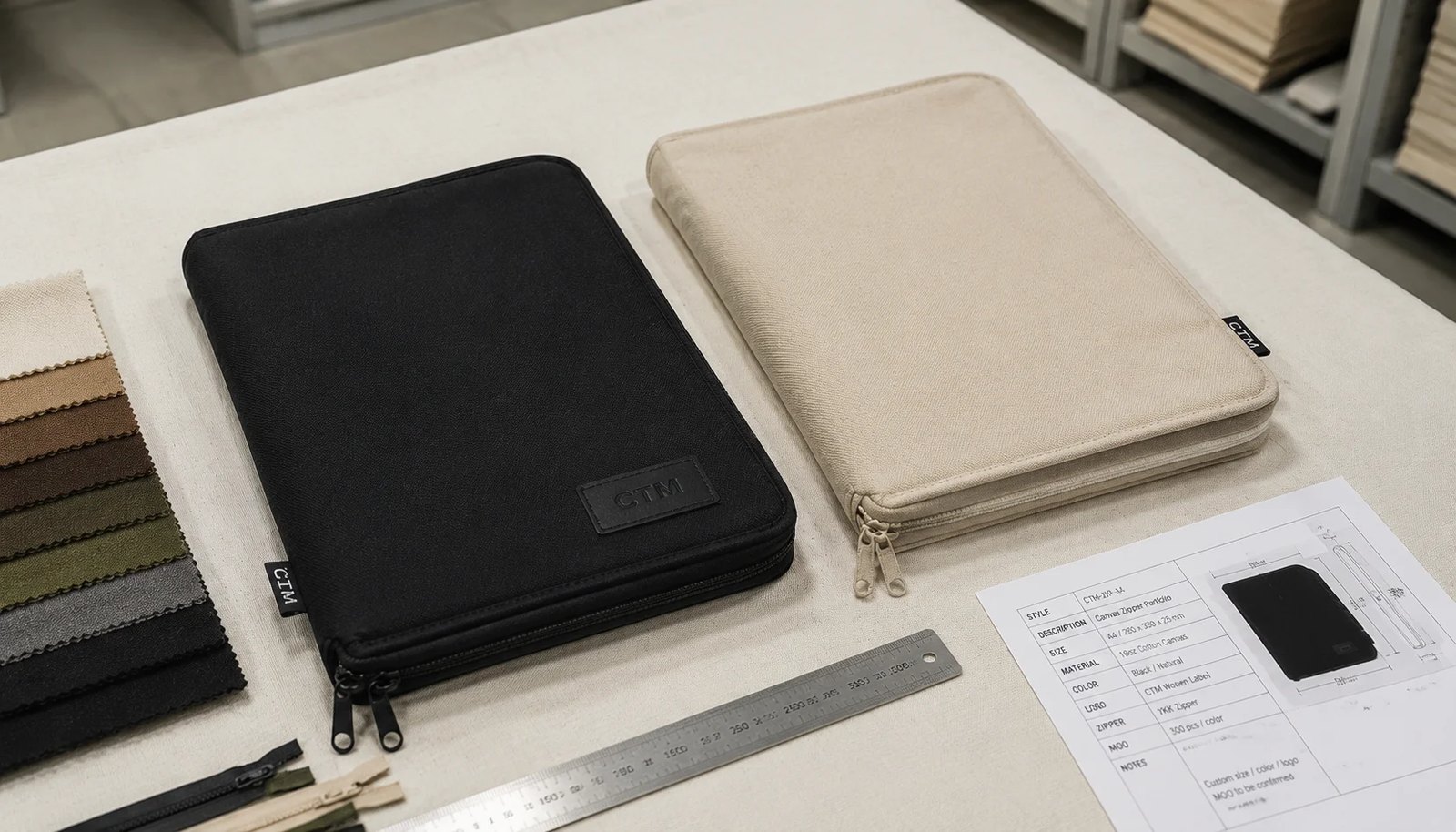
Why MOQ gets difficult on canvas zipper portfolios for liquor retail programs
Canvas zipper portfolios for liquor retailers sit in a middle zone that creates negotiation tension. They are more structured than simple promotional totes, yet they often do not carry the high unit value of executive leather folders or complex laptop bags. A factory sees multiple labor steps: cutting shell fabric, preparing reinforcement, sewing zipper turns, building inside pockets, finishing edges, inspecting shape, and packing to a retailer-specific assortment. A buyer sees what looks like a relatively simple branded padfolio. MOQ friction starts when those two views do not meet in the same spreadsheet.
Liquor retail programs also tend to fragment volume. One banner may want a distributor meeting folder, another may need a tasting-event handout portfolio, and a third may want a premium account-opening organizer for store managers. Total annual demand may be healthy, but the opening purchase order is often split by region, logo, event timing, and allocation destination. That split turns one medium program into several small production runs unless the buyer intentionally standardizes the base construction.
The most useful procurement mindset is to treat MOQ as a production-efficiency issue rather than a supplier attitude issue. In most cases, the factory is not resisting small volume for no reason. It is trying to protect utilization across printing, cutting, and sewing. Buyers get better results when they show where the order is common and where it varies. If the shell, reinforcement, zipper, lining, and packaging stay constant, the supplier can often relax MOQ on artwork variations without losing line efficiency.
This is why a clear RFQ matters more on structured portfolios than on many soft promotional bags. A loose brief such as 'thick black canvas portfolio with zipper and logo' invites each supplier to assume different materials, different inside construction, and different hidden costs. Once those assumptions are baked into quotes, MOQ discussion becomes messy. A more disciplined spec sheet creates a cleaner negotiation base and exposes which variables actually trigger minimums.
- Main MOQ drivers: fabric dye lot, print setup, patch mold, cutting efficiency, lining color, zipper color, and carton split count
- Typical friction point: buyer wants 300 pieces in total but split into 6 artworks and 4 colors
- Easier MOQ negotiation: same body construction, same zipper, same lining, shared canvas color, only front branding changes
- Harder MOQ negotiation: custom dyed canvas, multiple inside layouts, several puller finishes, and special gift packaging
- Useful internal question: is this one program with branding variations, or several different products sharing a category name?
Start with the right portfolio specification before negotiating price or MOQ
MOQ negotiation works best when the item itself is commercially realistic. For most liquor retail buyers, the practical starting point is an A4 or letter-size zip-around portfolio with a 12 oz to 14 oz canvas shell, moderate reinforcement, a three-side nylon coil zipper, and a simplified interior. That construction balances presentation, cost, and freight better than either an underbuilt flat folder or an overbuilt executive case. Buyers should align the specification with actual field use instead of with a mood-board image.
The first specification decision is the shell fabric. Canvas around 340 to 400 GSM usually gives enough visual substance for retail support programs without becoming overly stiff. At lower weights, the shell may collapse around the board and show edge telegraphing. At much higher weights, sewing around curved zipper corners becomes harder and the final unit may feel heavier than necessary for distributor travel or event use. If a supplier proposes lighter fabric, verify whether extra foam or thick board is being added to compensate, because that can increase bulk without improving durability.
The second key decision is structure. For most business padfolios in this category, buyers do not need a heavy rigid board across every panel. A typical and workable build is 2 mm foam for hand feel plus around 1 to 1.5 mm board for front and back shape. Ask whether the spine is flexible, lightly reinforced, or fully rigid. A portfolio that must hold forms and writing pads during stand-up tastings may need more support than one used only to present account documents at a desk.
The third decision is the interior layout. This is where many buyers unintentionally over-specify. More pockets are not automatically better. Every extra card slot, divider seam, and elastic loop adds labor and can increase error risk during sewing. For liquor retail uses, a restrained interior often performs best: one full document pocket, one secondary slip pocket, one pen loop, and one notepad sleeve. If a tablet sleeve is needed, define the device size and whether a protective case is expected, because a sleeve that fits a naked device may fail in real field use.
Finally, specify the closure route and corner style. A #5 nylon coil zipper is the standard low-risk choice because it bends around three sides more smoothly than many metal alternatives. Curved corners usually look cleaner and zip more easily, but they demand stable sewing and consistent reinforcement trimming. Square corners can simplify some builds but may create a more abrupt turning point. If image matters for premium private-label programs, approve both shape and zipper appearance early.
- Common size choices: A4, US letter, or custom 10 x 13 inch closed size
- Practical shell: 12 oz to 14 oz canvas, about 340 to 400 GSM
- Typical reinforcement: 2 mm foam plus 1 to 1.5 mm board
- Most stable zipper route: #5 nylon coil around 3 sides
- Useful interior: one full document pocket, one slip pocket, pen loop, and notepad sleeve
- Early RFQ detail to include: whether notepad is inserted from top, side, or bottom corner flap
How usage by liquor retailers should shape the specification
A canvas zipper portfolio for liquor retailers is rarely just an office accessory. It usually supports a defined commercial workflow. That could be distributor onboarding, new account presentations, tasting-event note capture, field rep route organization, shelf-program paperwork, or premium gifting to key store partners. Procurement teams should start with the use case because the right build for one application may be wrong for another.
For example, a distributor sales portfolio may need to carry tasting notes, pricing sheets, sell-in forms, and a standard writing pad. In that case, document retention and zip closure reliability matter more than decorative hardware. A portfolio intended as a premium gift-with-purchase for a house label might prioritize visual finish, branding elegance, and touch feel, while internal storage can stay simple. A portfolio used at frequent in-store tastings may need easier wipe-down interiors and a dark lining that hides marks better than natural cotton.
The operating environment also matters. Liquor retail support items often move through warehouses, rep vehicles, event setups, and repeated handoffs. That means the buyer should think about edge wear, humidity, and shape retention after transport. If the item may sit in backroom storage before campaign release, low-density board is a risk. If it will be used outdoors or at events, lighter natural canvas may stain more easily than black or navy.
A strong procurement brief therefore translates commercial use into specification language. Instead of saying 'premium but affordable,' define performance expectations: must fit A4 handouts and 50-page pad, must zip flat when loaded, must survive repeated open-close use during a 3-month field campaign, must present cleanly after distribution-center handling, and must align to a target landed cost. That kind of wording leads to better supplier proposals and more disciplined MOQ discussion.
- Use-case examples: field sales folder, tasting event organizer, distributor starter kit, account-opening folder, premium supplier gift
- Operational factors to note: warehouse storage, event travel, vehicle handling, seasonal campaign timing, repeated document insertion
- Feature priorities change by use: presentation, load capacity, wipeability, shape retention, or branding visibility
- Best buyer habit: tie every requested feature to a real retail workflow, not to a generic inspiration sample
How logo method, decoration, and color choices change MOQ logic
Branding method is one of the fastest ways to change MOQ, setup cost, and defect risk on canvas zipper portfolios. Buyers often focus on shell material and miss the fact that decoration can determine whether a program behaves like one order or several smaller ones. For MOQ-sensitive projects, the goal is usually to keep the body common while reducing decoration complexity.
A one-color or two-color screen print on stock natural or black canvas is often the most efficient path. Screen setup is relatively straightforward, repeatability is acceptable when artwork is simple, and the base body can be shared across several variants. This works well for event names, regional banners, or distributor identifiers when the rest of the product stays the same. But buyers should ask about print coverage and ink type. Large solid areas on heavy canvas can crack or show uneven ink deposit if the fabric texture is pronounced.
Heat transfer can make sense for small runs with frequent artwork changes, especially if each liquor retail group needs a separate front logo. However, the buyer should review edge adhesion, hand feel, and abrasion risk. Transfers can solve a setup problem while creating a durability or appearance problem. Embroidery adds perceived value, but it slows production and may require backing changes when the shell includes foam or board. On structured portfolios, embroidery can also distort flatter front panels if stitch density is high.
Debossed or embossed PU patches offer a useful middle ground for premium programs. A shared patch size on a shared body can let different brands vary only the logo tooling or patch artwork. That can be more controlled visually than direct print, especially on dark canvas. Still, each custom mold or patch material can add cost and lead time. Buyers should separate body MOQ from patch MOQ in the quote request rather than bundling them into one vague number.
Color strategy is equally important. Stock black, natural, or dark navy usually keeps MOQ lower because the factory can source more easily and avoid fabric mill minimums. Custom dyed canvas may be necessary when a liquor retailer or supplier has strict brand standards, but buyers should understand that the mill's minimum can exceed the bag factory's minimum. A quote that seems feasible at 500 units can become impractical once custom fabric color is introduced. For many programs, branding on a stock base color is the cleaner commercial answer.
- Lowest setup route: 1-color screen print on stock natural or black canvas
- Premium route: debossed patch or woven label on shared body color
- Higher-risk route: large full-coverage print on dark dyed canvas
- Lower-MOQ strategy: keep body identical and vary only patch, label, or front print
- Ask separately: body MOQ, print MOQ, patch MOQ, and custom fabric MOQ
What factories are really calculating when they quote MOQ and unit cost
Factories rarely arrive at MOQ from a single fixed rule. They are balancing material utilization, setup time, labor efficiency, and the probability of mistakes. On a canvas zipper portfolio, they are considering cutting yield from the canvas width, reinforcement preparation time, zipper insertion complexity, interior sewing sequence, decoration setup, and final packing variation. If the order changes too many variables at once, output slows and quality risk rises.
From the supplier's side, a split order can behave like multiple micro-orders. Different front logos may require different print screens or patches. Different body colors may require separate fabric rolls and more difficult cutting plans. Different customer destinations may require separate carton marks, barcode labels, or pack ratios. Even when the total quantity is respectable, the line loses efficiency if workers must stop and switch too often. That is why buyers should not assume total volume alone will solve MOQ resistance.
A better quote request asks for cost breakpoints and assumption clarity. Instead of requesting only one quantity, ask for several quantity levels such as 300, 500, 1,000, and 2,000 pieces, and specify which variables are held constant. Also ask suppliers to identify one-time charges separately: screen fees, patch molds, sample costs, barcode setup, or assortment fees. Once those are visible, buyers can tell whether the MOQ barrier comes from materials, decoration, or handling complexity.
This approach also helps in internal approvals. Procurement can show stakeholders that reducing custom colors or simplifying packaging is not just a style compromise but a clear MOQ lever. In some cases, a buyer may decide to accept a higher first-order unit cost if the supplier can confirm that repeat orders on the same body will be more efficient. Annual demand visibility sometimes matters more than opening-order volume. A factory may accept a smaller first PO if it sees credible replenishment potential with stable construction.
Buyers should also watch for quotes that hide structure differences. A very low quote may omit board reinforcement, use a thinner lining, downgrade zipper quality, or exclude individual bagging and labels. Those omissions may keep MOQ flexible on paper while creating mismatch later. The procurement task is to compare normalized builds, not just bottom-line prices.
- Ask for price ladders by total quantity and by color split
- Separate one-time costs: screen setup, patch mold, sample charge, barcode sticker setup
- Identify hidden MOQ costs: carton split fee, inner pack fee, custom lining MOQ, custom zipper pull MOQ
- Use annual forecast volume if repeat orders are likely; some factories will relax first-order MOQ with forecast visibility
- Normalize assumptions before comparing unit prices across suppliers
A practical way to negotiate MOQ without triggering hidden surcharges
The strongest MOQ negotiation is operational, not emotional. Instead of asking only for a lower minimum, ask which parts of the program can be standardized to let the line run efficiently. Buyers who frame the discussion that way are more likely to receive useful options rather than a simple rejection or a misleadingly low quote that later collects surcharges.
A common and effective structure is the shared-shell model. Keep the canvas, dimensions, zipper, lining, reinforcement, inside layout, and carton style the same across the full program. Then vary only the front branding, side label, or carton label by retailer group. This gives the supplier one main material plan and one sewing process while still allowing commercial differentiation. For liquor retailers managing multiple regional banners, this is usually the most credible route to lower effective MOQ.
Another negotiation method is phased complexity. The first run may use stock black or natural canvas, a standard zipper puller, and one decoration method. If the program repeats successfully, the buyer can add custom dyed fabric, branded pullers, or more premium packaging later. This protects launch timing and allows both sides to validate sell-through or internal usage before locking into higher-complexity minimums.
Buyers can also negotiate around time rather than quantity. A supplier may not want to produce 300 pieces in four small artwork batches across different weeks, but it may accept 300 pieces if all units are produced in one run with clear pack segregation. Similarly, if retailer labels differ, ask whether labels can be applied during final packing instead of forcing separate production lots.
The most important protection is written surcharge visibility. If a factory agrees to a small MOQ, ask it to list all likely add-ons in the quote: print screens, carton split fee, barcode labeling, sample refund policy, custom color surcharge, or low-quantity handling fee. A transparent higher quote is usually safer than an attractive low quote with undefined operational extras.
Internally, procurement should align with marketing and sales before negotiation starts. If branding changes are still fluid, no MOQ concession is truly secure. Factories are more flexible when the buyer can confirm a locked construction and approved artwork path.
- Best leverage: standardize structure and vary branding only
- Use stock black, natural, or dark navy canvas to avoid mill dye minimums
- Negotiate total annual volume, not just opening PO quantity, if repeat replenishment is realistic
- Request surcharge visibility in writing so a low MOQ agreement does not get offset by many small fees
- If carton labels differ by retailer, ask whether label application can be done at packing without separate MOQ
- Useful buyer language: 'Which variables should we hold constant to make this order workable at our target volume?'
Sample approval checkpoints that catch the most expensive mistakes early
Structured portfolios should not move from artwork approval straight to mass production. The blank structure sample is one of the most useful control points in this category because it tests physical function before branding cost is layered on top. Buyers can verify dimensions, rigidity, zipper travel, opening angle, pocket usability, and overall proportion. This is where issues such as shallow document pockets, weak spines, or badly positioned pen loops are easiest to fix.
For liquor retail use, sample evaluation should be done with real contents, not only by visual inspection on a table. Insert the actual pad size, tasting sheets, agreement forms, shelf tags, or other intended paperwork. Close the zipper fully. Carry the portfolio vertically. Reopen it and check whether documents shift, corners curl, or the zipper line distorts. A portfolio that looks acceptable when empty can become awkward once loaded.
After the blank sample is approved, the pre-production sample should confirm final material interaction. This includes final fabric, final lining, final logo method, final labels, and intended packing. Decoration can change performance. A large cured print can stiffen one panel; a stitched patch can shadow through a thin lining; a dark body can show chalk marks or handling residue that was not obvious on natural canvas. The PPS should therefore be judged as a mini production standard, not as a branding formality.
Buyers should also approve orientation details. Is the notepad inserted from the top or bottom? Does the pen loop interfere with zip closure? Are card slots useful or merely decorative? Do front and back panels align when closed? Are corners evenly rounded? These are common production pain points that are easier to catch in sample form than in final inspection.
A practical sample process also needs ownership. Procurement should know who signs off structure, who signs off artwork, and who signs off packaging. Delays often happen because each team assumes another team has approved the functional aspects.
- Blank structure sample should verify dimensions, reinforcement, zipper path, and inside layout
- Pre-production sample should verify final fabric, color, logo, labels, and packing method
- Load test with real documents to see if the portfolio closes flat
- Approve edge straightness, panel symmetry, and spine alignment from front and top views
- If using dark canvas, inspect chalk marks or sewing guide residue before approving bulk
- Confirm sample comments in writing so they can be applied to bulk production
Quality-control standards that matter most on canvas zipper portfolios
For B2B procurement, quality control should focus first on use performance and consistency, then on appearance. A portfolio for liquor retail support does not need luxury-goods perfection, but it does need to function reliably across a distribution run. The most important controls usually involve structure stability, zipper performance, measurements, and usable inside layout.
Start with materials. Canvas weight should be checked against agreed GSM tolerance using swatch measurement rather than appearance alone. Reinforcement should match the approved build. If one supplier substitutes lighter board or uneven foam, the product may still pass a casual visual review but fail in shape retention after handling. Ask for confirmation that reinforcement material is consistent with the approved sample, especially on repeat orders.
Zipper performance deserves more attention than many buyers give it. The zipper should move smoothly around corners without tooth exposure, ripple, tape twisting, or puller sticking. Inspection should include repeated open-close cycles on samples from the lot, not only one heroic sample from the line. If the product is designed to close while holding a pad and documents, the zipper should be checked under light loaded condition, not just empty.
Measurement and alignment are next. Structured padfolios should close square, with front and back panels aligned and spine geometry stable. Wavy edges, skewed panel alignment, or corner mismatch are not only cosmetic issues; they can indicate unstable reinforcement placement or poor feed control during sewing. Logo placement, patch position, and label alignment should be checked to agreed tolerance because premium-looking front branding can be undermined by visible offset.
Inside construction should be inspected for practicality, not just stitch count. Pockets should retain papers when the portfolio is carried. Pen loops should fit the intended pen size. Notepad sleeves should hold the pad securely without buckling. Lining should lie flat and cover internal seams cleanly. Loose threads near high-stress areas, especially around zipper starts, patch stitching, and pocket corners, should be treated seriously because they often worsen with repeated opening and loading.
For final inspection, buyers should define major and minor defects in advance. A non-functioning zipper, wrong logo, missing reinforcement, twisted body, or incorrect dimensions should clearly count as major or critical depending on the program. Slight natural variation in canvas texture may be acceptable if it does not affect presentation. AQL only works well when the product-specific defect list is clear.
- Define zipper operation standard, for example smooth open-close over 10 cycles on inspection sample
- Set seam quality expectation: no skipped stitches, no broken threads, no puckering around zipper turns
- State structure acceptance: board must sit flat with no corner migration or panel twisting
- Set logo position tolerance and obvious print defect rejection criteria
- Use AQL with clear major defects such as non-functioning zipper, warped body, wrong size, wrong logo, or broken internal pocket stitching
- Include loaded-condition inspection if the portfolio is intended to hold pad plus documents
Packing, carton planning, and freight factors that change landed cost
Packing often receives less attention than specification or MOQ, yet it can change landed economics significantly. A structured canvas zipper portfolio has enough shape that poor packing can create distortion, while excessive packing can inflate carton volume and freight cost. For most liquor retail B2B channels, the right answer is controlled but efficient protection rather than consumer-gift presentation.
Start by defining the handling route. If the portfolios will ship to a distribution center and then move to stores or field teams, barcode visibility, accurate outer carton marks, and manageable carton weights may matter more than retail-ready individual presentation. If the item is a premium gift set or direct-to-recipient program, individual cosmetic protection may matter more. Procurement should not let the factory assume one route if the real route is another.
Individual polybags are common, but they should be justified. On dark canvas, light protection can reduce dust and scuff transfer. On natural canvas, paper bands or simple wraps may be enough if the product is not highly finish-sensitive. Overpacking with thick tissue, insert cards, or rigid gift boxes can make a reasonable ex-factory quote become an expensive landed-cost program due to carton cube.
Carton planning should be part of quoting, not an afterthought. Ask for pieces per carton, estimated carton dimensions, and gross weight. Structured portfolios with board inserts can become bulky quickly, and a small change in orientation may affect container utilization. If multiple retailer allocations are packed together, define assortment logic clearly so cartons are easy to receive and distribute. Mispacks create downstream handling cost that is rarely visible in the opening quote.
Buyers should also think about moisture and compression risk. If goods may sit in humid logistics environments, board quality and carton integrity matter. Alternating product orientation, adding simple separator sheets, or limiting stack height can reduce corner pressure without forcing premium packaging. The goal is to protect functional shape while preserving freight efficiency.
- Typical efficient pack: 1 piece per polybag only if required, then 20 to 40 pieces per export carton depending on structure thickness
- Set carton weight limit if your warehouse or retailer has handling rules, often below 15 to 18 kg
- Request carton dimensions in quote stage to estimate freight, not after production
- Use corner protect sheets or alternating orientation if board edges are vulnerable in transit
- Put SKU, color, quantity, PO, and carton number on outer marks if multiple retailer allocations are packed together
- Ask whether barcode or assortment labels are applied at unit level, inner pack level, or carton level
Lead time planning, quote comparison, and the key questions to ask suppliers
Lead time on canvas zipper portfolios is rarely determined by sewing alone. The critical path often starts with materials, sample approvals, and artwork decisions. Custom dyed canvas can add mill lead time. Deboss patch tooling or custom pullers can delay sampling. Internal buyer approvals can be slow if procurement, brand, and sales each review different aspects at different times. A realistic schedule separates sampling milestones from bulk production milestones.
For practical planning, buyers should map at least these stages: concept review, RFQ, blank structure sample, final branding approval, pre-production sample, material booking, bulk cutting and sewing, final inspection, and shipment booking. If the order supports a campaign date, work backward from the required in-warehouse date rather than from ex-factory date only. This helps expose whether custom color or premium packaging is worth the timeline risk.
Quote comparison should then move beyond ex-factory unit price. Normalize fabric weight, reinforcement, zipper spec, decoration method, lining, inside layout, packaging, and carton assumptions before comparing suppliers. A cheaper quote that omits board reinforcement, uses lighter canvas, or excludes barcode labeling may not be cheaper once fully aligned. Likewise, a quote with a slightly higher unit cost may still be the better choice if it packs more efficiently or has fewer variable charges for split allocations.
During supplier discussions, buyers should ask questions that force clarity rather than sales language. Ask what is included, what tolerance is allowed, what MOQ applies to each variable, what setup charges remain below standard MOQ, and what conditions would let the supplier lower minimums. Also ask which feature in your current brief is causing the biggest constraint. That question often reveals the fastest path to simplification.
For procurement teams using this canvas zipper portfolios for liquor retailers MOQ negotiation guide internally, a simple rule helps: compare landed value, not just line-item price. The right supplier is not always the cheapest ex-factory source. It is the source that can deliver the agreed construction, realistic MOQ flexibility, predictable lead time, and controllable quality without repeated hidden charges.
- Lead time elements: material booking, canvas dyeing if custom, patch tooling if needed, sample approval, bulk cutting, sewing, final inspection, and booking
- Most avoidable delay: waiting too long to approve internal layout sample
- Most common retail-side delay: barcode and carton mark changes after goods are already packed
- Use milestone dates: sample approval date, material readiness date, inspection window, ex-factory window
- Quote comparison rule: normalize specifications first, then compare total program cost
- Key supplier question: 'What is the main constraint preventing a lower MOQ on this build?'
Specification comparison for buyers
| Spec decision | Recommended option | When it fits | Buyer risk to check |
|---|---|---|---|
| Canvas body weight | 12 oz to 14 oz canvas, about 340 to 400 GSM | Best balance for liquor retail promotional portfolios that need shape without becoming too heavy | Some suppliers quote lower GSM and add heavy board inside to fake structure; verify actual fabric GSM and whether board is included |
| Inner structure | 2 mm foam plus 1.5 mm recycled board in front and back panels | Fits sales rep kits, distributor folders, tasting notes, and account-opening paperwork | Board can warp in humid storage if low density is used; request bend test and edge sealing detail |
| Zipper type | Nylon coil #5 with metal puller | Good for frequent open-close use, lower cost than metal zipper, smoother around corners | Cheap coil zipper teeth can snag at curved corners; approve zipper brand or at least cycle-test sample |
| Logo method | Screen print for simple 1 to 2 color artwork; debossed PU patch for premium store brand look | Screen print suits larger promo programs; patch suits smaller premium runs with higher perceived value | Large solid print can crack if low-grade ink is used on heavy canvas; patch color may not match Pantone exactly |
| MOQ structure | Negotiate by total order value and shared construction, not by each color SKU | Useful when one portfolio pattern is spread across multiple liquor store regions or house brands | Factories may agree low per-color MOQ but charge hidden setup, dye lot, or carton split fees |
| Lining choice | 210D polyester lining in black or natural cotton sheeting if brand requires plastic reduction | Polyester lining gives cleaner interior and lower stain visibility; cotton suits eco-positioned retail programs | Unlined or thin sheeting can expose raw seams and reduce shelf presentation; define finish level in RFQ |
| Packaging route | Individual polybag only if required by channel, otherwise paper band plus master carton | Works when portfolio is shipped to retail distribution centers rather than direct consumer ecommerce | Unnecessary individual packaging adds cost, carton volume, and plastic; but no bag can cause scuffing on dark canvas |
| Sampling path | Digital mockup, then blank structure sample, then pre-production sample with final print | Most efficient route when procurement must approve size and pocket layout before final branding | Skipping blank structure sample often causes rework on internal pocket depth, pen loop size, and zipper path |
Buyer checklist before sampling
- Define final use: sales meeting folder, distributor welcome pack, tasting event padfolio, field rep paperwork organizer, or premium gift-with-purchase item
- State finished size clearly, such as A4 portfolio, letter size, or custom dimensions including spine thickness when closed
- Specify canvas weight in GSM or oz, not just 'thick canvas'
- List whether structure includes foam, board, both, or neither, and where each reinforcement is placed
- Define zipper type, zipper color, puller finish, tape color, and whether corners are curved or square
- Include exact internal layout: document pocket count, card slots, pen loop, tablet sleeve, notepad slot, elastic retainers, or ring binder requirement
- State whether the portfolio must hold a standard top-insert notepad and whether the pad is supplied by the factory or sourced separately
- Name logo method for each position: screen print, heat transfer, embroidery, woven label, deboss patch, or metal plate
- Set acceptable color tolerance for dyed canvas if matching liquor brand colors is important
- State MOQ target by total order and by color split so quotes are comparable
Factory quote questions to send
- What is the quoted canvas weight in GSM after finishing, and what tolerance do you allow per batch?
- Is the portfolio body made from full canvas panels or mixed canvas plus non-woven reinforcement in hidden areas?
- What zipper specification are you quoting: nylon coil or metal, size number, puller finish, and corner construction method?
- What internal reinforcement is included in the price: foam thickness, board thickness, material type, and whether the board edges are wrapped or sealed?
- Does the quotation include lining, inside pockets, card slots, pen loop, notepad sleeve, and edge binding, or are these add-cost items?
- What is your MOQ by design, by color, and by logo artwork, and which setup charges still apply below standard MOQ?
- If we split one total order into multiple store groups or colorways, what is the surcharge per SKU, per artwork, or per carton split?
- What sample stages do you provide before mass production, and are sample charges refundable against the bulk order?
- What printing method do you recommend for our artwork, and what are the risks of cracking, fading, or color variation on this canvas?
- Can you quote both stock-color canvas and custom-dyed canvas so we can compare MOQ and lead-time impact?
Quality-control points to confirm
- Canvas GSM should stay within agreed tolerance; use a cut swatch weight check rather than visual judgment alone
- Finished size tolerance should be defined, for example plus or minus 5 mm on height and width for structured portfolios
- Zipper must run smoothly around corners without tooth exposure, wave, seam puckering, or puller jamming
- Zipper tape color and puller finish should match the approved standard, especially on premium dark-color programs
- Panel edges should be straight and symmetrical; warped board inserts or twisted foam layers should be rejected
- Front and back panels should align when closed, with no offset that causes the portfolio to skew or gap at corners
- Print position and patch placement should match approved artwork within agreed tolerance, such as plus or minus 3 mm
- Internal pocket depth must hold the intended contents without documents slipping out when the portfolio is carried vertically
- Pen loop size should fit the intended pen diameter without distorting the zipper line when closed
- Needle holes around deboss patches, labels, and zipper tape should be neat with no skipped stitches or loose thread ends