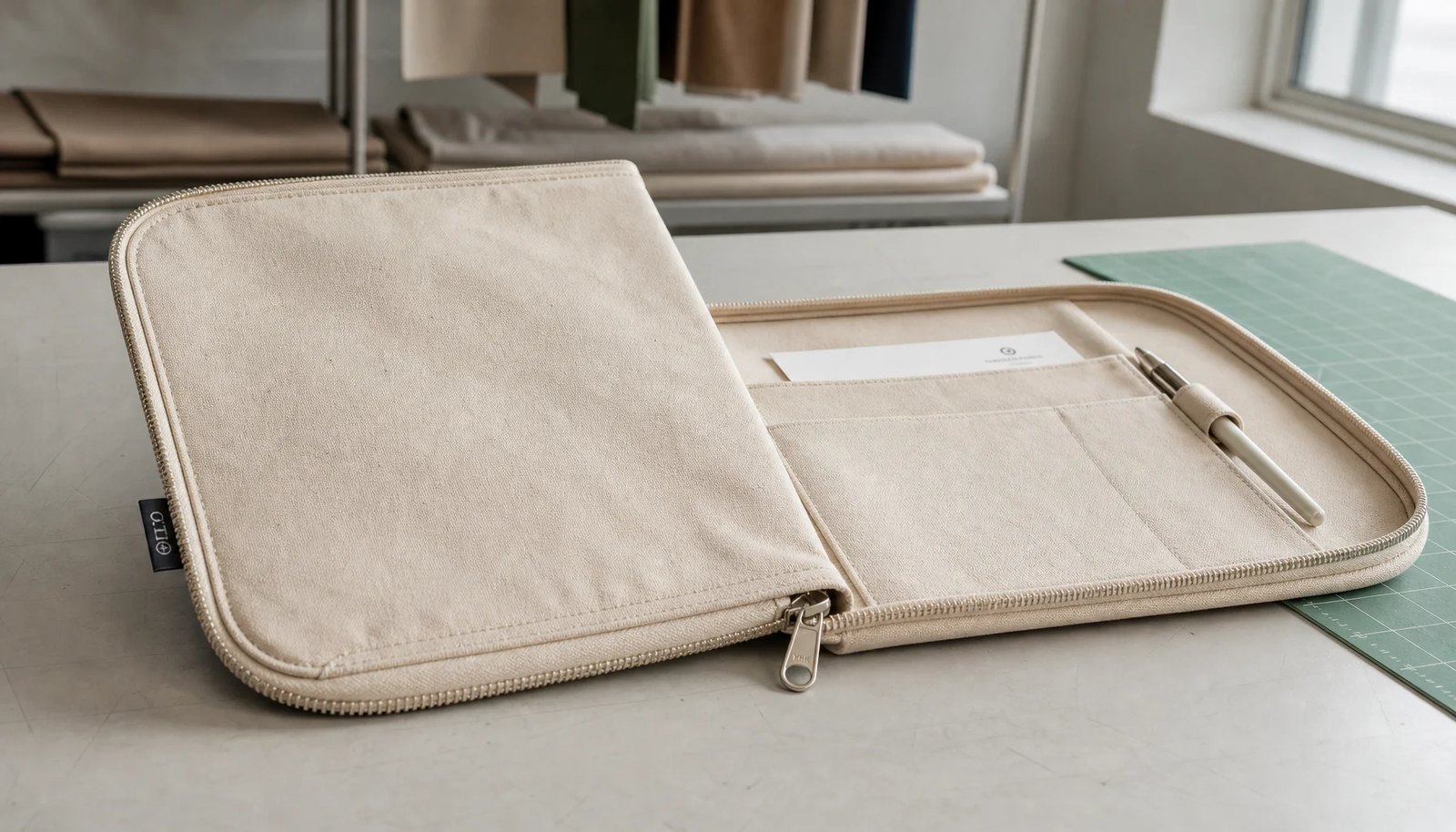
Start With the Event Job, Not the MOQ Number
For trade show exhibitors, a canvas zipper portfolio is a working item. It has to move through registration desks, meeting tables, press rooms, and booth storage without falling apart or looking improvised. In practice, it may hold printed catalogs, order forms, sample cards, USB drives, badges, charging cables, pens, and in some programs a slim tablet or a small swatch set. The contents determine the build. A document-only portfolio can be flatter and lighter. A hosted buyer kit with catalogs and sample cards needs more internal clearance, a stronger zipper installation, and better corner control.
That is why MOQ negotiation starts with the job. A booth handout can prioritize unit cost and easy packing. A sales team folder used across multiple shows needs repeatable size, clean seams, and better zipper life. A distributor kit may care more about carton labeling and destination sorting than decorative hardware. If a supplier only hears canvas zipper portfolio, they will tend to quote the easiest version in their sample room. If they hear the real contents, the handling pattern, and the delivery route, they can price the right build instead of a generic pouch.
The practical rule is to protect the product architecture before you ask for a lower minimum. A cheaper MOQ is only useful if the portfolio still behaves the way the event needs it to behave. If the factory gets there by moving from 14 oz canvas to 10 oz canvas, replacing the zipper with a rough slider, deleting reinforcement at the corners, or switching decoration methods without testing them on the fabric, the buyer has not negotiated well. The better move is to reduce colorways, decoration locations, component variety, and packing complexity while holding the functional spec steady.
- Write one use statement such as: "Holds two A4 catalogs, one order form set, ten sample cards, and one pen for a three-day booth program."
- Separate booth handouts from sales-team portfolios because handling and durability expectations are not the same.
- Tell the supplier whether the item must present cleanly on a meeting table or simply organize documents in a booth supply kit.
- Treat zipper quality, reinforcement, and packing as MOQ variables from the start, not as late production details.
Turn the Brief Into a Quoteable Spec
A strong RFQ makes quotes comparable. If one supplier is pricing a flat portfolio for letter-size papers, another is pricing a gusseted version for catalogs, and a third is silently adding a custom zipper tape, the lowest number means very little. The spec should include finished width and height, gusset depth if there is one, zipper opening length, usable document capacity, acceptable tolerance, fabric weight, fabric finish, zipper type, slider and puller details, decoration method, artwork size, placement, interior layout, label position, packing format, and delivery deadline. The goal is not paperwork for its own sake. The goal is to make every quote describe the same product.
Fabric language deserves discipline. Buyers often treat 12 oz canvas and 340 gsm canvas as close equivalents, while 14 to 16 oz often sits around 400 to 450 gsm. Those figures are useful only if both sides are measuring the same thing. Ask whether the weight is finished fabric weight after dyeing, washing, or coating. Washing can soften the hand and change shrinkage. Coating can add stiffness and dirt resistance, but it may also change print adhesion. Dyed canvas may require lab dip approval and a shade standard, especially if the thread and zipper tape are meant to sit quietly against the body color.
Dimensions should be written as finished product measurements, not only as the paper size the portfolio should accept. An A4 or letter-size insert needs clearance at the zipper path and at the seams. If the body is too tight, the user will force the zipper around paper corners and the edge will ripple under load. For many document portfolios, buyers set a finished-size tolerance around plus or minus 5 mm, but the right limit depends on the pattern and the intended contents. Print placement often needs a separate tolerance measured from a defined edge or seam reference, not from a fabric panel that can shift during sewing.
The zipper should be defined with the same care. A No. 5 nylon coil zipper is a practical baseline for many canvas zipper portfolios because it is flexible and widely available. But good zipper is not a spec. State tape color, slider material, slider finish, puller style, zipper-end reinforcement, and opening direction. For MOQ control, a stock black, white, natural, gray, or navy tape is usually easier than a custom-dyed tape matched to brand color.
- Use finished dimensions and usable capacity, not only the paper size the portfolio should hold.
- Specify canvas by weight, finish, color, shade standard, and hand-feel expectation instead of asking for heavy canvas.
- Name zipper size, zipper type, tape color, slider finish, puller style, opening direction, and zipper-end reinforcement.
- Attach artwork with print size, placement reference points, Pantone references, and method preference before requesting a firm quote.
Know Which Details Push MOQ Up
MOQ is usually a byproduct of setup and component purchasing, not a single factory policy. A one-color natural-canvas portfolio with one stock zipper, one screen print, and one flat-pack instruction is straightforward. A program with three canvas colors, two print positions, a custom zipper tape, logo pullers, an interior organizer, barcode labels, and destination-sorted cartons is several jobs inside one PO. Each variation adds purchasing minimums, setup time, inspection points, and the chance of line mistakes.
Decoration often drives MOQ more than buyers expect. Screen printing is efficient for simple solid logos because setup is contained and repeatable. Heat transfer or digital print can handle gradients, fine detail, or many colors, but the buyer should still ask for a proof on the actual canvas and a check for adhesion where the portfolio bends. Embroidery can look durable, yet it brings stitch time, backing, needle risk, and possible puckering on lighter canvas. If you are trying to get a smaller first run approved, one logo position and one decoration method are easier to negotiate than a heavily decorated layout.
Interior construction changes the minimum as well. One document pocket is usually manageable. Multiple organizer pockets, card slots, elastic loops, tablet padding, lining, binding, and hidden seams all add cutting, folding, alignment, and sewing operations. Those features may be worth the cost when the event kit truly needs them, but they should not be added by habit. In low-MOQ negotiation, every extra operation has to earn its place.
Component customization is another common surprise. Custom-dyed canvas, custom zipper tape, special slider plating, logo pullers, woven labels, printed inserts, and retail packaging can each carry separate MOQs. Sometimes the component MOQ is higher than the bag MOQ the sewing factory is willing to accept. A supplier may say yes to 300 bags, but the zipper source may require far more meters of custom tape. Buyers should ask for component minimums separately so the true constraint is visible before the order is placed.
- Common MOQ drivers include custom fabric color, custom zipper tape, special slider finish, logo pullers, multiple print colors, extra pockets, lining, and sorted packing.
- A lower pilot run is easier with one canvas color, one zipper color, one artwork location, one interior layout, and one carton format.
- If a supplier lowers MOQ, ask exactly which material, component, setup, or process constraint changed.
- Do not compare prices until every quote is tied to the same fabric weight, zipper grade, decoration method, interior layout, and packing instruction.
Choose the Supplier Route and Assign Accountability
Different supplier routes create different MOQ behavior. A direct bag factory with cutting and sewing control may ask for a cleaner minimum, but it can usually maintain pattern, seam, and sample consistency across repeat orders. A trading company may offer broader sourcing and easier communication, but the buyer needs visibility into which factory actually makes the goods and who controls inspection. A local decorator can be useful when branding blank portfolios, but it may not control base product quality, fabric weight, zipper grade, or sewing defects.
The right route depends on buying pattern. For a one-time event giveaway with a simple logo and flexible construction, a service-heavy supplier may be efficient. For an annual exhibitor kit, distributor program, or recurring sales folder, repeatability matters more. Patterns, approved samples, artwork screens, lab dips, and packing instructions should be retained so the next order does not need to be re-developed from zero.
Procurement should also make responsibility explicit. If print is subcontracted and fails adhesion testing, who replaces the panels? If the zipper tape arrives in the wrong shade, who absorbs the delay? If cartons are mislabeled, who fixes them before shipment? A supplier route is a risk structure, not just a price channel. A lower MOQ is not a bargain if accountability disappears between the sewing factory, the print shop, and the exporter.
Ask for evidence that is relevant but not exaggerated. Photos of similar canvas zipper portfolios, inspection checklists, sample-room images, or material references can help. What matters is whether the supplier can explain the build, name the component constraints, and commit to inspection standards that match the purchase order.
- Ask which facility handles pattern making, cutting, sewing, printing, trimming, packing, and final inspection.
- Confirm whether the MOQ comes from the sewing factory, fabric mill, zipper supplier, decorator, packaging supplier, or internal policy.
- For repeat programs, ask whether patterns, screens, lab dips, approved samples, and material references will be retained.
- Require one point of responsibility for decoration, rework, inspection, and shipment readiness.
Negotiate by Simplifying the Program
The cleanest way to negotiate MOQ is to simplify the program without weakening the product. A single SKU is easier than an assortment. One canvas color, one thread color, one stock zipper tape, one print position, one interior layout, and one packing format remove many reasons for a factory to ask for a larger minimum. That matters on trade show orders because the deadline is fixed. A simpler program is easier to quote, sample, inspect, pack, and ship.
A useful structure is a pilot-plus-reorder plan. The buyer places a smaller first run for the upcoming show and gives a realistic reorder decision date after the event or after internal distribution feedback. This is not a promise of future volume without evidence. It is a clear description of the decision window: event date, number of booth staff, expected buyer meetings, possible sales team allocation, and the date procurement can approve replenishment. Suppliers respond better to credible timelines than to vague volume language.
When negotiating, separate non-negotiables from flexible details. Non-negotiables may include finished size, fabric weight, zipper grade, seam allowance, reinforcement, and approved print quality. Flexible details may include stock zipper tape, a standard slider, a standard puller, one logo location, a simple pocket layout, and flat packing. That gives the supplier real ways to reduce setup burden without changing the utility of the portfolio.
Material reservation can help as well. If the factory must buy more canvas or zipper tape than the pilot quantity consumes, ask whether leftover material can be held for a defined reorder window. The agreement should say how long the material is held, who owns it, whether color variation is expected, and what happens if no reorder arrives. This is especially relevant for dyed canvas or custom zipper tape, where the next lot may not match perfectly.
- Protect fabric weight, zipper grade, seam allowance, reinforcement, approved print, and usable capacity.
- Flex stock zipper color, standard puller, one print placement, simple pockets, standard labels, and flat packing.
- Ask whether unused fabric or zipper stock can be reserved for a reorder and for how many days.
- Put the pilot quantity, reorder trigger, reorder decision date, and material-hold terms in writing.
Ask Questions That Expose Hidden Substitutions
A low quote only matters if it describes the same product. Hidden substitutions are common in soft goods sourcing because small changes are easy to bury in a spreadsheet. One factory may quote 14 oz finished canvas while another quotes a lighter fabric. One may include a physical pre-production sample, while another includes only a photo proof. One may quote stock zipper tape, while another is quietly assuming a custom tape minimum. The buyer needs questions that force those differences into the open.
Ask suppliers to separate unit price from sample fee, tooling, print setup, lab dip, artwork handling, packaging, carton labels, inspection support, and freight assumptions. That does not mean every line must be negotiated on its own. It means procurement can compare landed cost and operational cost, not just the unit price. For a small event order, setup charges can be a meaningful share of total spend. For a repeat program, the bigger question is whether the same materials and setup can be used again without relearning the product.
Deviation control should be formal. Ask each supplier for one quote that matches the RFQ exactly and a second section for value-engineering alternatives. A supplier may have a legitimate suggestion, such as switching from custom zipper tape to a stock neutral tape or reducing a pocket feature that adds labor. Those ideas are useful when they are visible. They become a problem when they are silently built into the price.
The quote should also state what approval is needed before bulk production. For canvas zipper portfolios, photos alone are not enough when fabric weight, zipper glide, print adhesion, and interior usability matter. At minimum, the quote should identify sample type, sample timing, correction timing, and whether the sample uses actual bulk materials.
- Request an exact-spec quote and a separate optional quote for any lower-MOQ alternative.
- Ask whether fabric, zipper, thread, labels, print materials, and packaging are stock or custom-purchased.
- Require visible line items for setup, sample, lab dip, tooling, packaging, carton labeling, and freight assumptions.
- Do not accept as sample language unless the sample is identified by date, version, and approved correction notes.
Approve Samples Against Real Use
Sampling should prove the production build, not just the idea. A reference sample can confirm general style, size direction, and visual feel, but it should not release bulk production unless it uses the actual canvas, zipper, thread, decoration method, interior layout, label placement, and packing plan. The pre-production sample is the critical approval point. It should be made with the production material set or with any differences clearly documented.
Review the sample using the real event contents. Put in the catalogs, forms, sample cards, pen, badge, cable, or tablet accessory that the portfolio is expected to hold. Close the zipper, open it repeatedly, and check whether the corners distort. A portfolio can look clean when empty and fail the moment it is loaded. Pay special attention to the zipper path near the gusset, the pocket opening, and the way the front panel sits when filled.
A practical sample review should include finished measurements, fabric hand, stiffness, color, odor, zipper glide, pocket usability, print position, edge finish, seam security, and packing crease behavior. Open and close the zipper at least 10 to 20 times during sample review to feel catching, roughness, slider looseness, or weak stops. If the sample is printed, bend the panel gently in the areas that will flex during packing and use, then check for edge lifting or cracking where relevant.
The approved sample should become the golden sample. The buyer and factory should each keep one if timing and cost allow. Photos help communication, but they cannot replace a physical standard for fabric hand, zipper feel, shade, and print adhesion. The purchase order should record the approved sample date, version number, artwork version, and any final comments. If bulk production differs, inspection can then compare against a known standard instead of memory.
- Approve a pre-production sample made with actual canvas, zipper, thread, decoration, pocket layout, and label placement.
- Test the sample with the real trade show contents, not only blank paper or an empty portfolio.
- Check zipper function repeatedly and inspect corners, stops, and stitching after the portfolio is filled.
- Record sample version, approval date, artwork version, measurement notes, and final corrections in the PO.
Set Measurable QC Standards Before Bulk Starts
Quality control for canvas zipper portfolios should be simple, written, and measurable. The buyer does not need an overly complex technical manual for every order, but the factory should know what will be rejected before cutting begins. Finished dimensions, zipper function, seam security, print placement, stains, loose threads, pocket alignment, odor, carton count, and carton marks are basic control points. If these are discussed only after production, the buyer has less leverage and the supplier may treat preventable defects as normal variation.
Dimensions should be tied to the use case. If the portfolio is meant to hold standard documents with limited clearance, even a 5 to 8 mm size loss can make the zipper difficult to close. If the gusset depth varies too much, the portfolio may twist or bulge. If the print is placed too close to the seam, it may look off-center after sewing even when the print was technically centered on the cut panel. Measurement points should be defined from stable edges or seams, and print placement tolerance should be written in millimeters.
Zipper and seam inspection deserve special attention because they affect the user experience at the booth. Inspectors should open and close a representative sample of pieces, checking for rough pull, splitting, catching, loose stops, sharp slider edges, and wavy installation. Stitching at zipper ends, pocket corners, gusset seams, and stress points should show secure back-tacking or bar-tacking where approved. Loose threads are not just cosmetic on a trade show product; buyers handle the item closely and will notice unfinished trimming.
Defect language should separate major and minor issues. Major defects may include broken zipper, open seam, wrong material, wrong artwork, severe stain, strong odor, missing pocket, unreadable logo, or incorrect carton count. Minor defects may include a short loose thread, slight shade variation within approved range, or a small removable mark, depending on the agreed standard. This keeps inspection decisions consistent and reduces arguments at shipment time.
- Set tolerances for finished width, height, gusset depth, zipper opening, print placement, and pocket position.
- Inspect zipper operation, slider security, stop strength, corner stitching, and pocket stress points before shipment.
- Reject wrong materials, broken zippers, open seams, severe stains, strong odor, cracked print, skipped load-area stitches, and incorrect carton counts.
- Tie inspection to the approved golden sample and list any allowed deviations in the purchase order.
Put Packing and Logistics Into the RFQ
Packing affects cost, presentation, freight volume, and event readiness. A canvas zipper portfolio packed badly can arrive with deep creases across the logo, dusty surfaces, crushed corners, mixed cartons, or missing destination labels. For a trade show exhibitor, that creates work during booth setup, warehouse receiving, or kit assembly, when time is already tight. Packing should be quoted with the product, not treated as an afterthought.
Decide whether each portfolio needs an individual polybag, tissue, hangtag, insert card, desiccant, barcode label, or no individual wrap. A premium hosted buyer kit may justify cleaner presentation and scuff protection. A bulk booth handout may only need simple flat packing with consistent carton counts. If the order is split across sales regions or event locations, cartons should be marked with PO number, SKU, color, quantity, destination reference, and event name where useful.
Carton configuration should match receiving and distribution needs. If a warehouse picks in sets of 25, packing 25 or 50 per carton may reduce repacking labor. If booth teams must carry cartons by hand, ask for a maximum gross weight that is realistic for handling. Many buyers set a practical carton gross weight limit around 15 to 18 kg, but the right limit depends on the receiving environment. Oversized cartons can bend flat portfolios, while underfilled cartons can collapse or shift during transit.
Freight planning needs carton dimensions, net weight, gross weight, and pieces per carton before booking. Canvas items can be light per unit but bulky when packed flat. If individual polybags, insert cards, or thicker gussets are added, cube changes. Ask for carton details after a packing trial or before final booking, not after the shipment is already sealed. For urgent event orders, incorrect carton data can delay freight quotes and warehouse planning.
- State pieces per inner pack, pieces per master carton, maximum gross weight, carton size target, and whether mixed cartons are allowed.
- Require carton marks that match PO, SKU, color, quantity, artwork version, destination, and event reference.
- Confirm whether portfolios are packed flat, lightly folded, or separated by tissue to prevent logo creases and zipper impressions.
- Align carton counts with booth distribution, sales team allocation, or warehouse pick quantities to reduce repacking.
Build the Schedule Around the Slowest Approval
Trade show sourcing is deadline-driven, so lead time needs to be planned backward from the required booth delivery date. Factory production days are only one part of the schedule. Buyers need time for RFQ clarification, artwork review, lab dip approval if dyed fabric is used, sample production, sample shipment, sample review, correction, material booking, cutting, bulk sewing, decoration, inspection, packing, export handling, freight, customs, local delivery, warehouse receiving, and booth move-in. A quote that says 30 days production does not confirm the order will arrive in time.
The slowest approval is often not sewing. It may be artwork, Pantone confirmation, zipper color, interior layout, or packing labels. If the brand team has not approved logo size or color, the print proof can stall. If the buyer requests custom zipper tape, the component supplier may have its own MOQ and lead time. If the first sample pocket is too shallow, pattern correction adds days. These are normal sourcing issues, but they need to be visible at quote stage.
Use milestone dates instead of one final promise. Ask the supplier to provide dates for artwork approval, sample dispatch, sample approval, material purchase, cutting start, inline check, decoration completion, final inspection, packing completion, and ex-works handover. This lets procurement see schedule risk while there is still time to simplify the product, switch to stock components, or adjust freight mode.
For important shows, buffer is part of the sourcing plan. Goods that arrive one day after booth setup have little value, no matter how well MOQ was negotiated. Build in time for customs, local transport, receiving check, and internal distribution. If the buyer must approve a physical pre-production sample, include courier time both ways. If the order has destination-sorted cartons, reserve time for packing verification before shipment.
- Work backward from booth delivery date and add buffers for customs, warehouse receiving, kit assembly, and local delivery.
- Separate sample time, correction time, material booking, production, decoration, inspection, packing, and freight in the calendar.
- Ask whether quoted production days include weekends, public holidays, and time waiting for buyer approvals.
- Keep artwork, Pantone references, packing instructions, carton labels, and sample comments ready before production booking.
Specification comparison for buyers
| Spec decision | Recommended option | When it fits | Buyer risk to check |
|---|---|---|---|
| Supplier route | Direct bag factory with in-house cutting and sewing, plus documented control of printing, trimming, packing, and final inspection | Repeat trade show programs, distributor kits, and orders where consistency matters across reorders | Confirm which steps are in-house, which are subcontracted, who signs off on decoration, and who pays for rework if print or sewing fails inspection |
| Fabric weight | 12 oz / about 340 gsm for light document use; 14 to 16 oz / about 400 to 450 gsm for heavier catalogs, swatches, or sales kits | Portfolios carrying brochures, order forms, sample cards, USB kits, compact swatches, or lightweight tablets | Confirm whether the quoted weight is finished fabric weight after dyeing, washing, or coating. Ask for measured gsm on the production lot, not only a nominal greige-fabric description |
| Fabric finish | Natural, dyed, pigment-dyed, enzyme-washed, or lightly coated canvas, with finish named in the PO and approved sample | Brand programs where color, hand feel, crease behavior, dirt resistance, or print result affects booth presentation | Check shrinkage, color shading, crocking, odor, coating tackiness, crease marks, and whether the finish changes ink adhesion or heat-transfer bonding |
| Zipper spec | No. 5 nylon coil zipper with stock tape color where possible, metal or molded slider, defined puller, and reinforced zipper ends | Most canvas zipper portfolios where smooth opening, flexibility, availability, and cost control matter more than a decorative zipper | Check zipper tape MOQ, slider finish MOQ, puller MOQ, stop strength, tape color availability, and whether zipper length is cut-to-size or ordered pre-made |
| Print method | Screen print for simple solid logos; heat transfer or digital print for gradients, small details, or many colors; embroidery only after puckering review | Trade show branding, sponsor logos, sales team programs, or retail-style event merchandise | Ask for production proof on the actual canvas, rub resistance, wipe expectations if relevant, edge definition, Pantone tolerance, and print placement tolerance |
| Body structure | Flat body or 2 to 4 cm gusset, 8 to 12 mm seam allowance target, reinforced zipper ends, back-tacking or bar-tacks at stress points | Document folders, hosted buyer kits, sample-card sets, or sales meeting portfolios that need capacity without becoming a full briefcase | Watch for reduced seam allowance, uneven gussets, zipper-wave distortion, weak corners, exposed raw edges, and trim sharp enough to damage inserts |
| Interior layout | One document pocket plus one pen loop or slim organizer pocket unless the event kit needs more | Exhibitor kits that need practical organization while keeping labor, alignment risk, and MOQ pressure controlled | Each added pocket adds cutting dies or templates, folding, stitching, alignment checks, and possible size-tolerance problems. Confirm pocket dimensions and usable opening |
| MOQ structure | One SKU for the first run, stock components where possible, and a written pilot-plus-reorder plan | Buyers needing a smaller first quantity before a trade show and possible replenishment after event feedback | Make sure the low MOQ is not achieved by reducing fabric weight, changing zipper grade, removing reinforcement, or switching decoration without approval |
| Packing method | Flat pack with individual polybag only when needed, consistent carton quantity, carton marks, and carton dimensions confirmed before freight booking | Booth handouts, hosted buyer kits, warehouse allocation, sales team drops, or event-by-event distribution | Confirm pack count, carton gross weight, mixed-carton rules, barcode or destination labels, crease prevention, and whether packing supports receiving and kit assembly |
Buyer checklist before sampling
- Define the trade show use case: booth handout, hosted buyer kit, sales team folder, distributor gift, media kit, or retail-style merchandise.
- List the real contents: catalog count, document size, sample cards, pens, badge, cable, small notebook, or tablet sleeve requirement.
- Lock finished width, height, gusset depth, zipper opening length, document clearance, and usable pocket dimensions before requesting price.
- State canvas weight in oz and gsm, and specify whether the value must be finished fabric weight after dyeing, washing, or coating.
- Name the canvas finish: natural, dyed, washed, coated, water-resistant finish, or untreated cotton canvas.
- Set target tolerances: finished size, gusset depth, print placement, pocket position, and acceptable color variation against the approved sample.
- Specify zipper type, size, tape color, slider material, slider finish, puller style, opening direction, and zipper-end reinforcement.
- Define sewing requirements: stitch density range, seam allowance target, back-tacking or bar-tacking, clean trimming, and seam finish.
- Fix artwork method, artwork size, print position, number of colors, Pantone references, proofing requirement, and rub or adhesion check.
- Define interior details: document pocket, card slot, pen loop, label position, tablet padding, binding, lining, and whether raw seams are acceptable.
Factory quote questions to send
- What finished size, gusset depth, seam allowance, and usable document capacity are you quoting?
- What is the exact fabric weight in oz and gsm, and is it measured before or after dyeing, washing, coating, or finishing?
- What weave and yarn appearance are you quoting: plain cotton canvas, duck canvas, recycled cotton blend, or another construction?
- Is the quoted fabric stock, made-to-order, dyed-to-order, or purchased against our PO? What is the fabric MOQ by color?
- What shrinkage, colorfastness, crocking, odor, and coating-transfer checks do you normally perform for this canvas?
- Is the zipper a No. 5 nylon coil zipper or another type? What tape color, slider material, slider finish, puller, and stop construction are included?
- What are the separate MOQs for zipper tape color, slider finish, logo puller, woven label, printed label, and special packaging?
- Which operations are in-house: pattern making, cutting, sewing, printing, embroidery, heat transfer, trimming, packing, and final inspection?
- If printing or embroidery is subcontracted, who approves the proof, who pays for rework, and how many days should be added to the schedule?
- What is the MOQ for one canvas color, one zipper color, one artwork, one interior layout, and one packing format?
Quality-control points to confirm
- Finished width, height, gusset depth, zipper opening, and pocket dimensions should be measured using the same method agreed in the PO, with tolerances suitable for the real inserts.
- Canvas weight, weave, color, finish, stiffness, and hand feel should match the approved sample, with no substitution to visibly lighter, thinner, stiffer, or overly coated fabric.
- Fabric should be checked before cutting for stains, oil marks, weaving defects, slubs beyond the approved standard, strong odor, color shading, dust, and excessive permanent creases.
- Natural canvas should be reviewed against an approved shade range because cotton shade can vary by lot; dyed canvas should be checked against lab dip or approved bulk standard.
- Zipper should open and close smoothly with no catching, splitting, loose stops, sharp slider edges, twisted tape, or wavy installation along the portfolio edge.
- Zipper-end reinforcement should match the approved sample, especially where users pull against the corner when the portfolio is full.
- Main seams, gusset seams, pocket seams, and zipper seams should show even stitch density, secure back-tacking, no skipped stitches in load areas, and no open seams.
- Stress points such as pocket corners, zipper ends, pull tabs, handles if any, and pen-loop attachment points should be reinforced as specified.
- Print placement should stay within the agreed tolerance from edge or seam reference points, with no visible tilt, ghosting, bleeding, pinholes, cracking, or registration error beyond approval.
- Screen print color should be checked against Pantone or approved drawdown under consistent light; heat transfers should be checked for edge lifting and adhesion after bending.