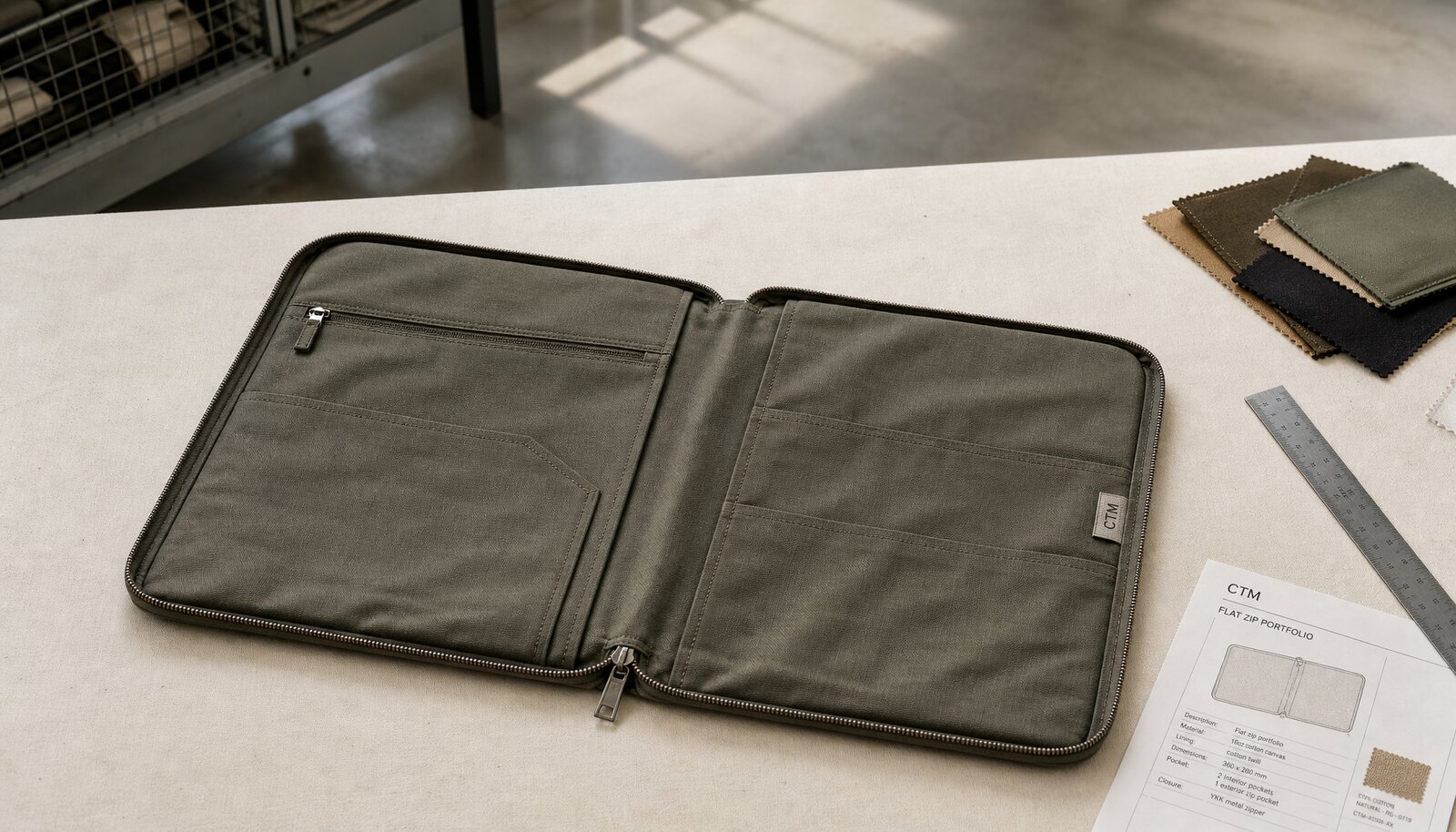
Why boutique wineries buy these portfolios differently
A canvas zipper portfolio for a boutique winery is not a generic stationery item. In practice, it may carry tasting notes, club forms, bottle allocations, winery maps, price sheets, reservation cards, or a small pen and insert card. That means the buying decision is tied to how the winery actually uses it across tasting-room handoffs, distributor meetings, club onboarding, and seasonal gift kits.
That use pattern changes the sourcing brief. A portfolio that stays behind the counter for staff can be simple and utilitarian. A portfolio that is handed to a buyer, a distributor, or a wine club member needs cleaner finishing and more consistent presentation. If the first question is "What does this need to do?" instead of "What can we print on it?", the order becomes easier to quote, easier to compare, and easier to repeat.
- Tasting-room use: prioritize durability, quick opening, and easy file handling.
- Club onboarding: prioritize neat presentation, insert retention, and low damage during packing.
- Distributor meetings: prioritize structure, clean branding, and a professional first impression.
- Holiday or gift kits: prioritize surface finish, carton presentation, and a repeatable unboxing experience.
Define the job before you write the spec
The fastest way to get inconsistent quotes is to lead with the logo and leave the rest vague. For canvas zipper portfolios, the real cost drivers are body fabric, interior build, zipper grade, decoration method, and packing format. Two suppliers can quote the same artwork and still be selling different products if one is unlined 12 oz canvas and the other is lined 14 oz canvas with custom trim.
For boutique wineries, the spec should start with the contents. Measure the biggest sheet, the number of inserts, whether the folder needs a pen loop, and whether it must open flat on a tasting-room counter or slip into a retail bag. A folder for event staff can be lean. A folder for a client-facing kit usually needs a cleaner interior and a more stable body so it does not flop open when someone puts it on a table.
- List the actual contents the portfolio must hold, not just the paper size.
- State whether the item will be opened repeatedly or handed out once.
- Decide whether the interior needs to protect printed sheets from scuffing.
- Avoid adding pockets, pen loops, or custom panels unless they are used in the winery workflow.
Build a base spec that buyers can compare
A useful RFQ starts with a common base. Ask every supplier to quote the same finished size, the same canvas weight, the same zipper type, the same print method, and the same packing format. Only after that should you ask for upgrade pricing. That keeps the comparison honest and exposes where the cost actually moves.
The best practice is to quote the base version first, then line-item the upgrades. For example: 12 oz unlined canvas, one-color screen print, stock coil zipper, bulk pack. Then ask for separate pricing on 14 oz canvas, lining, woven label, embroidery, custom puller, and individual polybagging. When the quote is broken down this way, you can see whether a higher price is coming from sewing time, trim, or just a decoration choice that is not worth it for your use case.
- Hold the same finished dimensions across suppliers.
- Keep the same logo location and size on every quote.
- Separate the base build from the upgrade menu.
- Ask for sample fees and setup costs to be shown separately from unit cost.
Read MOQ as a set of triggers, not one headline number
MOQ is rarely one clean number. It can come from fabric booking, zipper trim, print setup, packaging, or the factory's labor planning. If a supplier gives only one minimum, ask what actually drives it. That matters because the easiest way to reduce MOQ is often to reduce the number of variables the factory has to open for your order.
For a boutique winery, the first order should usually be the simplest order the brand can live with. One size, one canvas color, one decoration method, one zipper type, one packing format. If the winery needs multiple versions later for tasting-room, club, and distributor use, reserve that complexity for the reorder after the spec is already approved and the factory has the tooling or artwork in place.
- Ask for MOQ by color, by trim, by print method, and by packing format.
- If the order is small, keep the first run on stock materials whenever possible.
- Use one logo version for the launch run and add variants only after the base item is approved.
- Ask whether the factory can hold your spec for a repeat order window of 60 to 90 days.
Negotiate the first order by simplifying the run
The cleanest MOQ negotiation is not a hard bargain on price. It is a reduction in complexity. If the supplier wants a higher minimum for custom color canvas, ask whether a stock color can work for the first run. If embroidery pushes the order into a larger minimum, ask for a one-color print first and reserve embroidery for a later premium version. If individual packing creates the bottleneck, ask for bulk packing on the first order and retail packing only if the item proves out.
This matters for boutique wineries because demand is often event-driven. A harvest launch, holiday gifting season, club shipment, or distributor visit can create a short spike, but that does not mean the product should be over-customized. The buyer usually gets more leverage by saying, "Keep the first order close to stock so we can reorder quickly," than by asking the factory to bend every line item at once.
- Replace custom color with stock color if the first run is under 500 pieces.
- Replace embroidery with one-color print if the artwork is simple and the canvas is coarse.
- Replace individual packing with bulk pack if the item is used internally.
- Ask for repeat pricing on the same spec before you add a second version.
Use the winery calendar to size the order
Boutique wineries do not buy on a generic retail cycle. They buy around tasting-room traffic, member shipments, bottling releases, harvest, holiday gifting, trade events, and distributor meetings. That timing should shape the quantity and the packaging. If the item is part of a club shipment, the pack format has to survive fulfillment. If it is used for a seasonal launch, the lead time has to absorb sample approval before the calendar gets tight.
The practical move is to map expected demand by use case. Staff-use folders can be ordered in smaller replenishment batches because the risk is functional, not marketing-driven. Premium client kits usually need more conservative planning because a late or damaged run creates a visible brand problem. If the same portfolio is used in multiple workflows, do not force one spec to serve all of them. Split the program into a basic working version and a presentation version if the numbers justify it.
- Map volume to winery events, not just annual consumption.
- Keep one version for internal staff and one version for client-facing kits if the use cases are materially different.
- Build sample approval time into seasonal launches.
- Use reorder windows to avoid redesigning the item every quarter.
Choose the sourcing route by control, not by habit
Factory-direct is usually the strongest route when the buyer wants repeatability, material control, and a cleaner long-term cost structure. It works best when someone on the buyer side can read a spec, compare samples, and push back on vague wording. The tradeoff is that the buyer has to manage more of the approval chain, and the supplier may not automatically separate every cost line unless you ask for it.
A trader or domestic converter can make sense when the order is small, the timeline is short, or the winery team wants fewer sourcing tasks. That can be the right answer for event-driven or one-off buying. The downside is less transparency on which factory is doing what, which means the sample has to carry more weight in the approval process. If the program is likely to repeat, ask whether the route can support the same spec on the next run without reworking the files or rebooking materials.
- Use factory-direct when the program is repeatable and the team can manage specs tightly.
- Use a trader or domestic converter when speed and coordination matter more than lowest ex-factory price.
- Ask who owns the production decision if the sample and bulk units differ.
- Do not accept a quote that cannot explain where the product will actually be made.
Write the acceptance workflow before production starts
QC for canvas zipper portfolios should be written as a pass-fail workflow, not as a general idea. Start with a signed first article sample. Then ask for a small pilot run or first-in-line check so the factory can catch issues before the lot is complete. Finally, conduct a final inspection against the signed sample and the agreed defect standard. That gives the buyer a paper trail if the bulk order drifts from the approved version.
The inspection should be specific enough that a factory can execute it. Measure finished dimensions after sewing. Check zipper motion by opening and closing each sampled unit several times by hand. Confirm stitch integrity, print placement, and edge finish. If the winery is using the item for a client-facing kit or a holiday package, ask for carton photos and a sealed-carton check before shipment. The point is not to make the supplier do more paperwork. The point is to make acceptance objective.
- First article sample: one signed sample that becomes the reference for bulk production.
- Pilot check: inspect the first 20 units or the first carton from each line.
- Final inspection: sample against your AQL table or company standard.
- Acceptance documents: signed sample, inspection report, carton count, defect log, and packing list.
Make the QC standard measurable
The useful starting point for commercial buying is a defect standard with three buckets: critical, major, and minor. A common baseline is 0 critical, 2.5 major, and 4.0 minor if you are using an AQL framework, but the exact numbers should match the risk level of the program. A launch order for a premium winery gift set deserves a tighter standard than a routine staff-use folder.
The main failure points are predictable. The zipper must glide without snagging or separating under normal hand pressure. Stitching should be straight and free of loose tails longer than 5 mm. Print should sit in the approved location window and stay legible on the canvas texture. If embroidery is used, the buyer should check for puckering and distortion because a technically complete logo can still look overbuilt or warped. Carton quality matters too. A bag that passes hand inspection can still arrive scuffed or crushed if the pack-out is too tight.
- Reject any zipper that catches at the corners or does not close smoothly.
- Reject any unit with skipped stitches, weak bartacks, or loose thread tails over 5 mm.
- Reject any print that is outside the agreed placement window or visibly smeared.
- Reject any carton that crushes the zipper line, bends the front panel, or damages the surface finish.
Treat packing and cartons as part of the product
Packing changes the real cost of a canvas zipper portfolio more than many buyers expect. These items are bulky, and the zipper area can be damaged if cartons are packed too tightly. That is why carton dimensions, gross weight, and pieces per carton should be part of the quote from the start. A low unit price is not a useful number if the carton is inefficient and pushes freight higher than expected.
The packing decision should match the winery workflow. Bulk packing works for internal use, wholesale kits, or back-of-house storage. Individual polybags and an insert card make more sense when the item is retail-facing, gift-ready, or part of a club shipment that has to look finished on arrival. If the product will be handed to clients in a tasting room, ask for a pack format that keeps the front surface clean and the zipper from scuffing against neighboring units.
- Request carton dimensions and gross weight before you finalize the order.
- Avoid overpacked cartons that bend the zipper line or crease the front panel.
- Use individual packaging when presentation matters more than packing speed.
- Ask whether cartons can be packed by customer, by SKU, or by shipment sequence if the order is part of a club program.
Specification comparison for buyers
| Decision point | Lower-cost option | Higher-control option | Typical price impact | Buyer threshold |
|---|---|---|---|---|
| Body fabric | 12 oz canvas | 14 oz canvas | Planning range: about +$0.08 to +$0.20 per piece at 500 to 1,000 units, before freight; custom dye or narrow color matching can add more | Choose 12 oz for staff-use folders, tasting sheets, and simple handouts; choose 14 oz when the portfolio leaves the winery, needs more structure, or has to look more giftable in a client meeting |
| Interior build | Unlined | 210D polyester lining or equivalent | Planning range: about +$0.12 to +$0.35 per piece, plus more sewing time and a little more inspection time | Use unlined for short, low-friction internal use; add lining when papers must slide cleanly, the portfolio is opened often, or the item is part of a premium club or holiday kit |
| Logo method | 1-color screen print | Woven label or simple embroidery | Planning range: screen print is usually the lowest setup cost; woven labels or embroidery often add about +$0.10 to +$0.40 per piece and may raise minimums | Use screen print for bold marks and repeat orders; use a label or embroidery only when the artwork survives the canvas texture and the brand wants a more finished look |
| Zipper hardware | Stock nylon coil zipper | Custom tape color or upgraded puller | Planning range: about +$0.05 to +$0.25 per piece, with possible lead-time impact of 1 to 3 weeks if trim must be reserved | Stay with stock coil zippers unless the portfolio is display-facing, the brand needs a precise trim color, or the zipper is part of the premium feel buyers will notice immediately |
| Packing format | Bulk packed | Individual polybag plus insert card | Planning range: about +$0.08 to +$0.30 per piece, plus more carton volume and handling | Use bulk packing for internal winery use or wholesale kits; use individual packing when the item is retail-facing, gift-ready, or must arrive clean and flat |
| Supplier route | Factory-direct | Domestic converter or trader | Factory-direct usually gives the lowest ex-factory price; domestic or trading routes often cost more per unit but can reduce coordination burden on small orders | Go factory-direct when you can manage samples and QC. Use a domestic or trading route when speed, consolidated coordination, or fewer moving parts matters more than lowest unit price |
| MOQ lever | Many colors, many artwork versions | One base spec with one logo version | Simplifying the spec can reduce setup waste and may lower the effective MOQ more than a small price concession | If the first run is under 500 pieces, keep to one size, one canvas color, one decoration method, and one packing format whenever possible |
Buyer checklist before sampling
- Match the portfolio to the winery workflow first: tasting-room menus, club onboarding inserts, distributor sheets, or event kits.
- Confirm the finished size against the actual contents, including paper size, inserts, pens, cards, and any inner pockets.
- Lock the fabric spec in writing with a real weight target such as 12 oz or 14 oz, plus weave or finish if that affects the hand feel.
- Ask the supplier to break MOQ into separate triggers for fabric color, decoration method, zipper trim, and packing format.
- Request a pre-production sample and approve zipper feel, seam finish, print placement, and label placement before bulk sewing starts.
- Ask for a costed quote that separates fabric, cutting, sewing, decoration, packing, cartonization, and any setup charge.
- Write the defect standard into the PO or quality agreement, including the inspection level, what counts as a major defect, and how cartons will be sampled.
- Confirm carton size, pieces per carton, gross weight, and whether the zipper area is protected from compression during shipping.
- Clarify the lead time by stage: sample, material booking, bulk production, final inspection, and booking for transit.
- For reorders, ask the factory to hold artwork files, screens, or label specs so the next run does not restart the approval cycle.
Factory quote questions to send
- Please quote the same portfolio in 12 oz and 14 oz canvas, and show the unit-price difference for fabric, sewing, and freight weight.
- What is the MOQ by total order, by color, by logo version, by zipper trim, and by packing format for this exact construction?
- Please break out fabric, lining, zipper, decoration, sewing, packing, and cartonization instead of giving only one all-in unit price.
- Which decoration method is best for our artwork, and what are the setup, sample, and repeat-order costs for each option?
- Does the quoted price include zipper puller style, binding, label attachment, and packing materials, or are any of those treated as upgrades?
- What sample stages can you provide, and which sample becomes the approved production reference for bulk manufacturing?
- What are your overage and shortage tolerances, and what defect level do you accept for zipper function, stitching, print placement, and packaging damage?
- Can you hold the artwork, screen, embroidery file, or woven label spec for reorder pricing, and how long is the quote valid if we repeat the same spec?
- If we reduce the first run to one stock canvas color and one decoration method, what MOQ reduction can you offer?
- Please share carton dimensions, gross weight, and pieces per carton before we confirm, so we can calculate landed cost accurately.
Quality-control points to confirm
- Define the lot before inspection. For example, one PO line, one color, one decoration method, and one packing format should be treated as a single inspectable lot.
- Use a three-step sample approval flow: first article sample, pilot run sample, and signed golden sample that the bulk order must match.
- Set the fabric check to a real measurement, not a marketing term. Ask the factory to state the actual oz or GSM and keep the same cloth lot for the run if possible.
- Measure finished dimensions after sewing, not cut size. A practical commercial starting point is +/- 5 mm on length and width unless the contents need a tighter fit.
- Run a zipper function check on sample units by opening and closing each one several times by hand, then rejecting any unit that snags, catches at corners, or separates under normal use.
- Check stitch quality with measurable criteria: no skipped stitches, no loose thread tails longer than 5 mm, and bartacks that fully cover the stress points on handles, pocket corners, and zipper ends.
- For print, define a placement window before production starts. A practical starting point for simple logos is +/- 5 mm from the approved position, with no smearing, pinholes, or visible misregistration.
- If embroidery is used, check for puckering, stitch distortion, and backing show-through that makes the canvas surface look uneven or overbuilt.
- Use a normal commercial defect framework if you already have one, or start with 0 critical, 2.5 major, and 4.0 minor under your chosen AQL table.
- Ask for a first-in-line check on the first 20 units or the first full carton from each line so obvious issues are caught before the batch is complete.