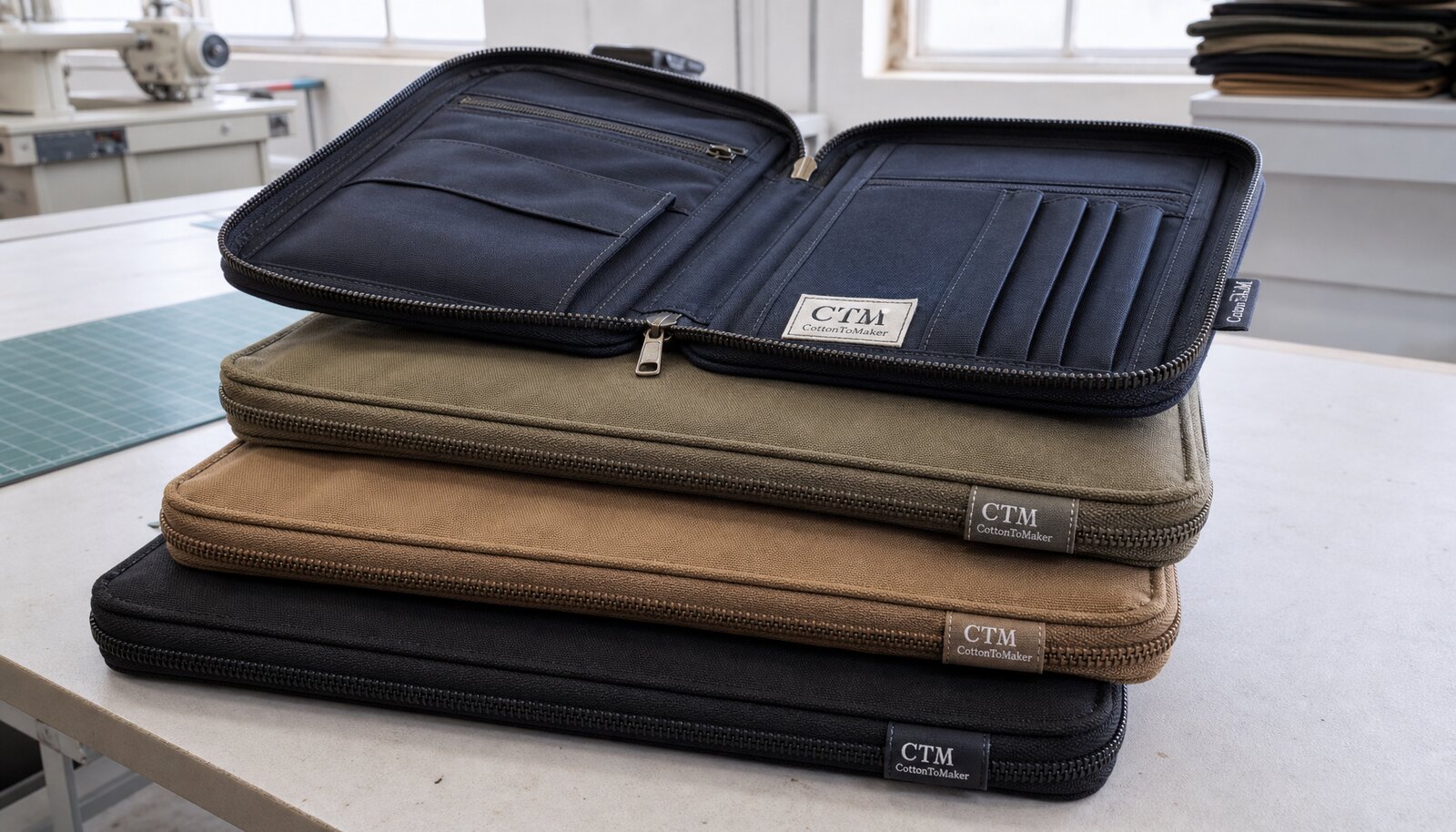
Why MOQ Gets Stuck on Canvas Zipper Portfolios
The MOQ problem with canvas zipper portfolios is rarely the canvas itself. The real friction comes from how many variables you change at once: body fabric, zipper color, puller style, logo method, lining, internal pockets, and packing. A factory can usually keep the MOQ reasonable if the order stays close to an existing pattern and uses common trim. Once the request becomes a custom conference portfolio with special pockets and a branded puller, the production line is no longer simple enough to keep the same minimum.
For corporate gifting, the buyer usually wants three things at once: a professional look, a controlled unit cost, and a quantity that fits the campaign budget. Those goals conflict when the spec is underdefined. If you want a better MOQ, start by deciding what must be custom and what can remain standard. A portfolio that uses a standard No. 5 nylon coil zipper, a common canvas weight, and one clean logo application is much easier to buy than a fully bespoke folder with colored zipper tape, multiple pockets, and branded packaging.
- The fewer new trims you introduce, the lower the setup burden.
- Factories quote tighter MOQs when they can reuse existing fabric, zipper tape, and packing materials.
- A simple logo gift should not be written like a luxury custom product.
Lock the Base Spec Before You Negotiate
A lot of negotiation noise disappears once the buyer freezes the base spec. For canvas zipper portfolios, the base spec should include finished size, canvas weight, construction type, zipper size, logo area, lining, and packing method. If any of those items stay vague, the supplier will protect itself by quoting a wider MOQ range or by adding hidden assumptions. That is how a quote that looks affordable on day one becomes expensive after sample review.
Canvas weight is one of the most important decisions. A lighter 280 to 320 gsm canvas can work for a slim document folder or giveaway piece, but it may feel too soft for a premium corporate gift. A common middle ground is around 340 to 380 gsm, which gives enough body without pushing the product into a bulky premium category. If the portfolio needs to stand upright or protect paperwork better, you may need a heavier canvas or a board insert. The right answer depends on the campaign, but the buyer should choose the weight before price talks begin.
- State fabric weight in GSM or oz, not just 'thick canvas'.
- Define whether the zipper must be nylon coil, metal, or concealed.
- List any internal structures such as board, gusset, pen loop, or business card pocket.
- Approve the artwork size and placement before asking for final MOQ.
Compare Sourcing Routes by MOQ, Not Just Unit Price
Different sourcing routes change MOQ in different ways, and buyers often compare them as if they are interchangeable. A direct factory quote may look stricter on minimum quantity, but it can be cheaper and more stable when the design is straightforward. A trading company may appear flexible because it can aggregate demand, yet the actual factory behind the scene can still impose the same component minimums. The useful question is not 'Who is cheapest?' but 'Which route lets us keep the spec and still hit the order size without surprises?'
For small or mid-sized corporate gifting programs, the best route is often a standard factory program with limited customization. That gives you a real production basis, not a reseller promise. If the buyer needs a mixed program across several departments or markets, a sourcing partner can help consolidate the order, but only if the trim and print assumptions are written clearly. The safest comparison is to ask each supplier to quote the same build in a standard version and a premium version, then compare the MOQ, setup charges, and sample lead time side by side.
- Compare the MOQ for the body, trim, print, and packing separately.
- Ask whether the supplier is quoting from stock components or from fresh procurement.
- Use the same artwork and same finished size across all supplier options.
- Do not compare a blank portfolio quote against a fully branded quote.
Build an RFQ That Forces Like-for-Like Quotes
The best RFQ for a canvas zipper portfolio is short enough to read, but specific enough to eliminate guessing. A strong request includes the intended use, finished size, target canvas weight, zipper spec, logo method, packing requirement, and target quantity by color or style. If you send only a reference image, you will get a wide spread of assumptions. One supplier may quote a simple document pouch, another a reinforced presentation folder, and the price gap will look like poor sourcing when it is really a spec problem.
A good RFQ also separates must-haves from nice-to-haves. For example, if the portfolio is for a client gift, maybe the front logo and smooth zipper matter more than a rigid board insert. If the item is for internal conference use, a lighter build and standard inner pocket may be acceptable. That distinction helps the factory recommend the right construction and prevents you from paying for features the recipient will not value.
- Include a dimensioned sketch or tech pack, not only a product photo.
- State the logo method, number of colors, and exact print area.
- Specify whether the quotation should include sample freight and bulk carton markings.
- Tell suppliers if mixed colors are allowed or if each color must be priced as a separate SKU.
Read the Quote Like a Factory Does
A useful quote is not just a unit price. It should show which part of the product is driving the cost and the MOQ. For canvas zipper portfolios, the usual cost drivers are canvas weight, zipper type, lining, print setup, and packing. If those lines are bundled into one number, you cannot tell whether the supplier is being efficient or simply hiding the expensive parts in the total. Ask for line-item data so you can see whether the price change is caused by a custom zipper puller, a new print screen, or a more complex inner layout.
The fastest way to compare quotes is to normalize them. Put each quote into the same structure: body fabric, zipper and puller, print, labor, packing, and cartons. Then ask whether the MOQ is attached to the full order or to each component. A quote that looks flexible may actually require minimum purchase per zipper color or per print screen. That distinction matters because a buyer can sometimes solve a total MOQ problem by changing only one variable, such as moving from a custom puller to a standard puller with a woven label.
- Look for separate pricing on fabric, trim, print, and packing.
- Identify any hidden minimums by color, artwork, or label type.
- Check whether the quoted fabric is greige, dyed, washed, or coated.
- Make sure the quote states whether sample cost is refundable after bulk order.
Sample Approval: What to Sign Off Before Bulk
For this kind of order, a picture approval is not enough. The buyer should approve a physical sample made with the final canvas, final zipper, final artwork, and final packing method. A good sample process usually has three checkpoints: prototype for shape, pre-production sample for final materials, and a sealed reference sample for bulk comparison. If the supplier skips from concept to bulk, you take on all the risk from trim mismatch, print drift, or a zipper that feels right in photos but poor in hand.
The sample should be evaluated like a retail product, not a factory exercise. Check zipper smoothness, pocket access, internal fit, logo placement, seam alignment, and how the folder closes when fully loaded with documents or a tablet sleeve. If the portfolio is a gift, presentation matters as much as function. A crooked logo, wrinkled lining, or loose thread at the zipper end is enough to downgrade the perceived value even if the product technically works.
- Approve the sample only after you have checked final fabric hand feel and zipper movement.
- Keep one sealed gold sample for bulk comparison.
- Verify the exact print color against an agreed reference, not just the artwork file.
- Test the portfolio with the real load it will carry in the field.
Bulk QC Thresholds That Protect Corporate Gifts
A corporate gift can be rejected for reasons that are small on paper but obvious in a client meeting. Bulk QC should therefore focus on visible consistency and function under light real-world use. For canvas zipper portfolios, the main risk points are zipper alignment, seam strength, logo clarity, and packing damage. The buyer should define what counts as a critical defect before production starts, because one factory's 'acceptable' may be another buyer's reject.
Typical acceptance criteria should cover size tolerance, print placement, stitch quality, and zipper action. If the logo is off center by a few millimeters, that may be acceptable on a utility pouch but not on a client gift. Likewise, a rough seam hidden on the inside might be acceptable, but exposed raw edges at the opening are not. Buyers should use a practical inspection standard and tie it to the purpose of the item, then make sure the factory signs off on the same rules.
- Use clear tolerance bands for finished size and print placement.
- Treat zipper snagging and seam failure as critical issues.
- Reject any visible oil stain, broken stitch line, or damage from packing compression.
- Inspect a sample from each carton lot, not just the first cartons off the line.
Packing Choices That Change MOQ and Freight
Packing is often treated as a last-minute detail, but it changes both MOQ and total cost. A portfolio packed loose in bulk is cheaper to handle, yet it may arrive with shape distortion or surface marks. Individual polybags improve cleanliness and presentation, but they also add material, labor, and carton volume. If you need retail-ready gifting, the packing spec should be written into the RFQ from the start, otherwise the factory will quote the product as a basic bulk item and add packaging later.
Carton planning matters as much as the inner pack. The buyer should decide whether the portfolio can be folded flat, whether it needs tissue, whether a stiffener board is required, and how many units fit safely per master carton. Over-packed cartons crush canvas corners and zipper heads. Under-packed cartons waste freight. The goal is a stable pack configuration that protects the product without forcing the supplier to buy a custom carton size for a small run.
- Specify whether each unit needs a polybag, tissue wrap, insert card, or desiccant.
- Set the master carton count and maximum gross weight target.
- Ask for carton dimensions before approving the packing method.
- Confirm whether custom carton printing or labels create an extra MOQ.
Lead Time Risks Hidden in Trim and Print Choices
Many buyers think lead time is driven by sewing capacity alone. For canvas zipper portfolios, the long pole is often the slowest component: custom zipper tape, woven labels, special pullers, or a multi-color print process. A simple body can move fast, but if one trim has to be sourced separately, the whole schedule slips. That is why quote review and timeline review should happen together. If the factory cannot book the trim until after artwork approval, then the real delivery date is already dependent on the sample cycle.
The safest way to manage schedule risk is to choose components that already sit within the factory's normal supply chain. Standard zipper colors, common canvas weights, and one or two print colors usually move faster than a fully customized trim package. If the campaign has a fixed event date, build in margin for pre-production sample approval, not just sewing time. The product may only take a few days to make, but the front-end decisions can stretch the calendar much more than the production floor.
- Treat trim sourcing, sample approval, and bulk sewing as separate timeline gates.
- Avoid unusual zipper colors if the shipment date is fixed.
- Do not approve final artwork late if the print method requires screens or new files.
- Ask which component is the schedule bottleneck before committing to the launch date.
Negotiation Levers and Landed-Cost Tradeoffs
The best MOQ negotiation is not about pushing the factory to absorb every custom request. It is about deciding which spec choices matter to the buyer and which ones can be standardized. If the budget is tight, simplify first: one fabric weight, one zipper color, one print location, standard puller, and simple packing. That often lowers the MOQ more effectively than arguing about labor cost. A factory can usually work with a cleaner spec because the material yield improves and the setup burden falls.
When you compare landed cost, include the cost of mistakes. A low quote with a vague zipper spec or poor sample control can become expensive if the first run misses the event or lands with cosmetic defects. The buyer should negotiate around component standardization, batch grouping, and forecasted repeat orders. If the program is recurring, tell the supplier that future releases may follow the same spec. That can improve the commercial terms without forcing the factory to guess at the next order.
- Simplify the spec before asking for a lower MOQ.
- Trade custom trim for better unit economics only if the branding impact is still acceptable.
- Use forecast visibility to negotiate a more practical production schedule.
- Compare total landed cost, not just ex-factory price.
Specification comparison for buyers
| Spec decision | Recommended option | When it fits | Buyer risk to check |
|---|---|---|---|
| Direct factory, standard portfolio build | Use a factory's existing pattern, standard canvas weight, and one-color logo print | Best when the order is the first run or the buyer only needs a clean logo gift at a controlled MOQ | Confirm the pattern is truly standard and not 'standard' only after a new tool charge appears in the quote |
| Direct factory, custom cut-and-sew | Specify your own panel layout, lining, pocket count, zipper length, and board insert | Fits brands that need a distinctive portfolio shape or a higher-end presentation | Watch MOQ inflation from extra pattern making, new cutting markers, and longer sample approval time |
| Factory with in-house print | Keep the portfolio build simple and let the factory handle screen print or heat transfer | Works when logo placement is fixed and the artwork is not heavily detailed | Check how many colors are included and whether each extra color adds a screen setup charge and separate MOQ |
| Trading company aggregation | Let a sourcing agent combine your order with other programs for shared fabric or trim buying | Useful when the requested quantity sits below a factory's efficient run size | Make sure the agent discloses the real factory, trim source, and who owns final QC responsibility |
| Blank import plus local decoration | Import undecorated portfolios and print or embroider locally | Useful for very small campaigns, regional personalization, or late-stage artwork changes | Lead time can split across two vendors, and fabric shade variation between blank lots is harder to control |
| Standard stock color with custom zipper puller | Hold the body color constant and customize only the puller, patch, or woven label | Good for buyers who want a branded touch without forcing a full custom material order | A custom trim still has its own MOQ, so do not assume the body MOQ applies to the puller or patch |
| One SKU per color, not mixed-color melt | Separate each colorway into its own SKU and avoid color-splitting the same production line | Appropriate when the gifting program can be split by department, market, or campaign | Mixed-color requests often look efficient on paper but create low yield on fabric and packaging |
| Factory program with reserved components | Book common canvas, lining, and zipper parts against a forecast, then release POs in waves | Best for recurring corporate gifting or annual conference cycles | If the forecast slips, the factory may reassign reserved material and your later release can miss the original cost assumption |
Buyer checklist before sampling
- Confirm the target portfolio size, folder depth, and whether it must hold A4, letter, or a tablet sleeve.
- Lock the fabric weight in GSM or oz before asking for quotes; do not leave 'heavy canvas' open to interpretation.
- State the zipper type, puller style, and whether the zipper must match the fabric color or can be standard black, natural, or navy.
- Define the logo method in the RFQ: screen print, heat transfer, woven label, embroidery, or sewn patch.
- Decide whether the portfolio needs a lining, board insert, pen loop, document pocket, or business card pocket.
- Specify packing: single polybag, tissue wrap, insert card, desiccant, master carton count, and outer carton mark format.
- Ask for a pre-production sample based on final fabric and final trim, not only a visual approval sample.
- Request the quote to break out fabric, zipper, print, labor, packing, and carton costs so you can see where MOQ pressure comes from.
Factory quote questions to send
- What MOQ applies to the body fabric, the zipper color, the logo method, and the packaging, and which item drives the highest minimum?
- Is the quoted canvas weight actual finished fabric weight or a nominal value before washing, coating, or lining?
- How many setup charges are included for print screens, embroidery files, pattern making, zipper sourcing, or custom labels?
- What size tolerance will you hold for the finished portfolio, zipper opening, and pocket placement?
- Can you quote the same portfolio in two versions: a cost-controlled version using standard components and a premium version using custom trims?
- What is the pre-production sample process, and will the sample use final materials or substitute materials?
- How is packing priced if we change from bulk packing to individual polybags with inserts and carton marks?
- Which raw material or trim has the longest lead time, and how does that affect the production calendar after sample approval?
Quality-control points to confirm
- Finished size should stay within an agreed tolerance, typically tight enough that the folder still fits the intended document size without forcing the zipper.
- Zipper must run smoothly through repeated open-close cycles with no catching on lining, seam bulk, or corner reinforcement.
- Print registration, logo placement, and color density should match the approved sample within the agreed visual tolerance.
- Stitch density, bar-tack strength, and seam straightness should be consistent at stress points such as zipper ends, handle attachments, and corners.
- No loose thread ends, skipped stitches, fabric damage, or exposed raw edges should remain on retail-facing surfaces.
- Puller, label, and patch placement should match the approved artwork and not shift after packing or pressing.
- Carton count, inner pack count, and outer marks should match the packing list and avoid mixed SKU cartons unless explicitly approved.
- Use an agreed AQL or inspection standard for bulk checking, and make sure the factory understands which defects are critical, major, and minor.