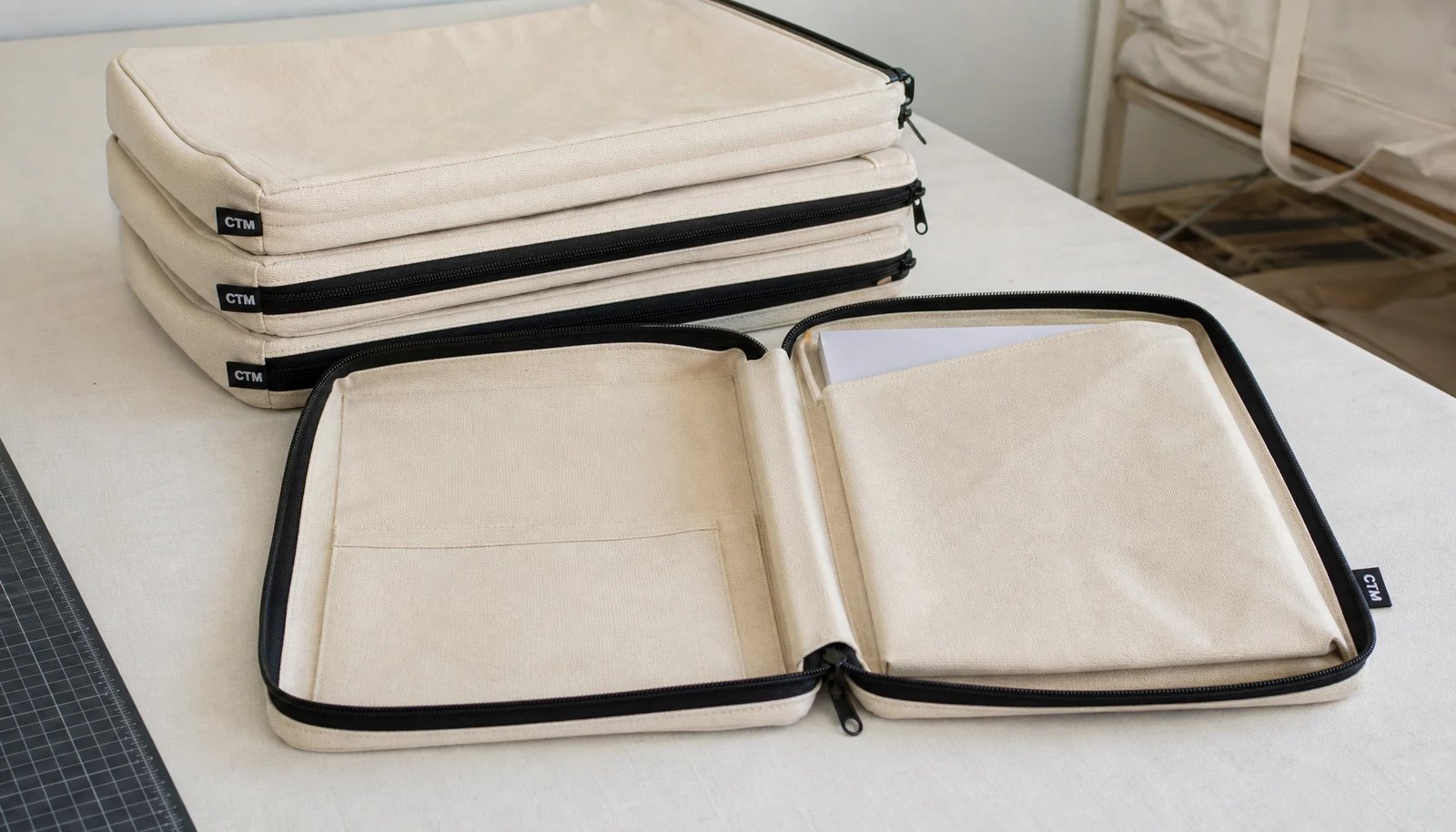
The MOQ Problem Bookstore Buyers Actually Face
Canvas zipper portfolios look simple, but MOQ negotiation becomes difficult when a university bookstore needs several department logos, one school color, and a fixed event date. A factory does not calculate MOQ only by unit quantity. It calculates setup time for cutting, zipper matching, printing screens, label sewing, packing, and inspection. If the RFQ does not separate these elements, one supplier may quote 300 pieces while another quotes 1,000 pieces, even though they are not quoting the same production risk.
The practical buying problem is not how to force the lowest number. It is how to build a specification that lets the factory combine materials efficiently while still giving the bookstore usable assortments. For example, one 12 oz natural canvas body with the same black zipper can often support several print artworks at a lower total MOQ than three different canvas colors, two zipper colors, and four label versions. The buyer’s job is to identify which features must vary and which features can stay common.
- Treat MOQ as a production setup question, not a simple sales minimum.
- Separate base product MOQ from artwork MOQ in the RFQ.
- Keep fabric, zipper, and size common when department logos need to vary.
- Compare total landed order value, not only the lowest stated MOQ.
Define the Portfolio Before Negotiating Quantity
A canvas zipper portfolio for a bookstore is different from a soft document pouch. Buyers usually need a cleaner structure, reliable zipper opening, and enough room for course packets, admissions papers, notebooks, tablets, or branded event inserts. The base specification should start with size, fabric weight, zipper position, inner pocket layout, and branding location. Without this, MOQ negotiation is premature because the supplier cannot know cutting yield or sewing complexity.
For most bookstore programs, a practical size is based on letter or A4 documents with extra allowance around the edges. If the intended use includes tablets, state the tablet model or maximum device dimensions instead of using a generic phrase such as fits tablets. A pattern that is too tight may reduce fabric consumption slightly, but it creates retail complaints when papers bend or the zipper catches the insert. A factory can help optimize size, but only after the buyer explains what must fit inside.
- For A4 documents, allow enough edge clearance so papers slide in without curling.
- For US letter documents, confirm orientation: horizontal portfolio, vertical sleeve, or book-style folder.
- For tablet use, define device size and whether padding is required.
- For bookstore resale, consider hangtag, barcode sticker, or shelf-ready packing at the RFQ stage.
Fabric Weight and Construction Choices That Change MOQ
Canvas weight affects both the retail feel and the factory’s sourcing flexibility. A 10 oz cotton canvas may be acceptable for a low-cost giveaway portfolio, but many bookstore buyers prefer 12 oz, around 400 GSM, because it feels more substantial without becoming too bulky. A 14 oz canvas can look premium, but it increases material cost, may require slower sewing, and can make zipper corners thicker. If the order is small, choosing a common fabric weight usually gives better MOQ leverage than asking for a special weave.
Natural cotton canvas is often easier for low-to-mid MOQ programs because factories may keep it in regular supply. Dyed canvas introduces minimums from dyeing mills, color approval time, and shade variation risk. If the school requires a specific campus color, ask whether stock canvas can match closely enough or whether lab-dip dyeing is required. For bookstores selling through retail shelves, fabric consistency matters because mixed shade cartons look like quality defects even when the product is technically usable.
- 10 oz canvas: lower cost, softer structure, better for giveaways than premium resale.
- 12 oz canvas: balanced hand feel, common for structured zipper portfolios.
- 14 oz canvas: stronger presentation, higher sewing and freight cost, thicker zipper corners.
- Dyed canvas: better brand color control but higher minimums and longer approval cycle.
- Natural canvas: easier MOQ negotiation but needs stain and slub acceptance standards.
Zipper, Stitching, and Inner Layout Decisions
The zipper is one of the first parts a retail buyer will notice in use. A No. 5 nylon coil zipper is normally the safe option for canvas portfolios because it is flexible, smooth, and cost-efficient. Metal zippers can look stronger but may add weight, scratch fabric during packing, and require closer inspection for plating issues. The zipper tape color should be defined clearly, especially when the bookstore expects black, natural, navy, or a campus-color contrast.
Inner layout is another MOQ and labor driver. A single sleeve or divider pocket is manageable for many factories. Multiple card slots, pen loops, elastic bands, gussets, and padded tablet panels turn the item into a more complex business organizer. That may be valid for a premium bookstore SKU, but it should be quoted separately from a simple document portfolio. More internal details mean more cutting pieces, more sewing operations, more inspection points, and sometimes a higher practical MOQ.
- Use No. 5 nylon coil zipper for most canvas zipper portfolio orders.
- Define zipper tape, slider, puller, and stitching color in the RFQ.
- Reinforce zipper ends and corners where stress concentrates.
- Keep inner structure simple when MOQ flexibility is the priority.
- Quote padded tablet versions separately from flat document versions.
Branding Method: Screen Print, Label, or Both
For university bookstores, logo handling often controls the production calendar. A one-color screen print on canvas is usually the most practical branding method for medium quantities. It gives a clear campus mark, works on flat panels, and does not require expensive hardware. However, coarse canvas does not behave like smooth paper. Fine serif lettering, small registration marks, and large solid ink blocks need testing on the actual fabric before approval.
A woven side label can be useful for repeat programs because it gives a retail finish and avoids reprinting the main panel for every version. The tradeoff is label MOQ and lead time. If the buyer wants the same CTM-style factory sample label, campus store brand label, and department print, each should be listed separately. Heat transfer can work for detailed artwork but may feel less natural on cotton canvas. Embroidery is durable but can distort lighter canvas or increase cost on large logos.
- Screen print fits simple campus logos, bookstore names, and event marks.
- Woven labels fit repeat retail programs and clean side-seam branding.
- Heat transfer fits detailed artwork but should be tested for hand feel and adhesion.
- Embroidery fits premium branding but may pull the fabric if the logo is dense.
- Licensed logos require a physical sample or at least a production fabric print strike-off.
How to Negotiate MOQ Without Creating Factory Confusion
The strongest MOQ negotiation is built around shared components. Instead of asking for one low MOQ across many versions, structure the order as one base canvas zipper portfolio with controlled variations. A buyer may request 1,200 total pieces with four printed department logos at 300 pieces each, all using the same fabric, same zipper, same size, and same packing. This is easier for a factory to plan than four unrelated 300-piece orders with different canvas colors and trims.
When comparing supplier quotes, look for whether MOQ is calculated per style, per color, per artwork, or per shipment. A quote that says MOQ 300 pieces may exclude fabric dyeing, label weaving, or printed artwork changes. Another supplier quoting MOQ 800 may include one fabric procurement run, print setup, and export packing. The correct question is not only what is your MOQ. It is what production element triggers the MOQ.
- Negotiate total quantity by common body fabric first.
- Then negotiate artwork split by logo version.
- Keep zipper color constant unless color variation has real retail value.
- Use shared packing for all versions to reduce carton and labeling errors.
- Ask whether setup fees apply when low artwork quantities are accepted.
Quote Data That Makes Supplier Comparison Fair
A useful quote for canvas zipper portfolios should include more than unit price. Procurement teams need enough data to compare construction, packing, freight exposure, and production risk. At minimum, the supplier should state fabric type and weight, finished dimensions, zipper specification, print method, included labeling, packing method, carton quantity, carton size, gross weight, sample cost, setup fees, payment terms, and lead time trigger. Without these details, a low unit price may simply reflect a lighter fabric or weaker zipper.
Quote comparisons should also separate one-time charges from repeat-order pricing. Screen charges, label setup, sample fees, and artwork adjustment may be acceptable if the bookstore repeats the item each semester. For a one-time orientation event, those same charges may make a low MOQ order expensive. Ask the supplier to show the cost impact of 300, 500, 1,000, and 2,000 pieces using the same specification. This reveals where the factory’s real efficiency begins.
- Request unit price at several quantity breaks using the same specification.
- Separate screen fees, sample fees, label setup, and special packing charges.
- Collect carton dimensions and gross weight for freight calculation.
- Confirm whether quoted price includes inner label, hangtag, barcode, or polybag.
- Require the supplier to state what changes would increase MOQ or lead time.
Sample Approval and Acceptance Criteria
A physical sample is important because canvas zipper portfolios involve touch, structure, and zipper feel. Photos can show print placement but not fabric stiffness, zipper resistance, document fit, or seam bulk. For a first order, a pre-production sample should use the confirmed canvas weight, zipper, thread color, print artwork, and packing method. If timing is tight, approve in stages: fabric swatch, blank construction sample, then printed pre-production sample.
Sample comments should be written as measurable changes, not general preferences. Instead of saying make it more premium, state increase fabric from 10 oz to 12 oz, reduce logo size to avoid zipper seam distortion, move print 20 mm lower, or change zipper puller to metal-look plastic. The approved sample becomes the production reference. If the buyer approves an unfinished or substitute-material sample, the supplier may not understand which details are mandatory.
- Test actual paper or booklet insertion before approving dimensions.
- Open and close the zipper repeatedly with contents inside the portfolio.
- Rub the printed logo after curing to check adhesion and surface cracking.
- Inspect corners for puckering, skipped stitches, and bulky seam allowances.
- Keep one approved sample with the buyer and one sealed sample at the factory.
Packing, Cartons, and Bookstore Receiving Needs
Packing is often treated as a small detail, but it affects landed cost and store labor. Individual polybags protect light-colored canvas from dust and zipper scratches, while paper bands may support plastic-reduction goals. Bulk packing is cheaper, but it can create scuffs and make it harder for bookstore staff to count or distribute items by department. If the product is sold at retail, barcode labeling and clean unit presentation may be worth the small added cost.
Export cartons should be sized so the portfolios do not crush, curl, or bend at the zipper edge. Heavy cartons can reduce handling efficiency and increase damage risk. The RFQ should request pieces per carton, carton dimensions, gross weight, carton marks, and whether mixed artwork versions can be packed in separate inner bundles. This is especially important when one purchase order serves several campus departments or event locations.
- Use individual polybags for light natural canvas when stain prevention is important.
- Use paper bands only after testing whether they protect the print and corners adequately.
- Specify barcode stickers if the bookstore will sell units through retail POS.
- Pack different artwork versions in clearly labeled bundles or separate cartons.
- Limit carton weight so receiving teams can handle cartons without repacking.
Lead Time Risks for Campus Buying Calendars
University bookstore orders often connect to fixed dates: orientation, admission mailings, alumni weekends, graduation, or course material launches. The risky part is not only factory sewing time. Artwork approval, trademark review, fabric sourcing, print sampling, packing confirmation, and freight booking all consume time. A reasonable planning model separates sample lead time from bulk production lead time and defines exactly when the bulk clock starts.
For many standard canvas zipper portfolio orders, sample making may take about 7 to 12 working days after artwork and material confirmation, while bulk production may take roughly 25 to 40 days after sample approval, depending on order size and season. These are planning ranges, not guaranteed promises. The buyer should build extra buffer if the order needs dyed canvas, multiple logo versions, licensed artwork approval, or delivery before fall rush.
- Start artwork review before waiting for final purchase order release.
- Avoid custom-dyed canvas when the delivery date is already tight.
- Approve carton marks and barcode requirements before bulk packing starts.
- Build time for inspection and freight booking, not only sewing production.
- For campus events, set a required in-warehouse date rather than only an ex-factory date.
Specification comparison for buyers
| Spec decision | Recommended option | When it fits | Buyer risk to check |
|---|---|---|---|
| Outer fabric weight | 12 oz cotton canvas, about 400 GSM, pre-shrunk when possible | Standard university bookstore retail and orientation programs needing a structured hand feel | Too light under 10 oz can wrinkle around the zipper and feel like a pouch, while very heavy canvas raises freight and sewing time |
| Zipper type | No. 5 nylon coil zipper with color-matched or contrast tape | Most A4 or letter-size portfolios where smooth opening matters more than luxury hardware | Cheap zipper tape may wave after sewing; test opening under filled document load, not empty only |
| Portfolio size | A4 or letter document size plus 20-30 mm tolerance around paper edges | Bookstore resale, admissions packets, alumni gifts, and seminar folders | A tight pattern saves fabric but causes bent papers and higher defect claims at retail |
| Branding method | 1-color screen print for logo, woven side label for repeat programs | Campus marks, college store logos, or department names with moderate detail | Large ink coverage on coarse canvas can crack or look uneven; fine serif text may fill in |
| MOQ negotiation lever | Consolidate body fabric, zipper, and size; vary print by department if factory allows | Multiple campus units sharing one base product but needing different artwork | Supplier may quote low MOQ per artwork but high setup fees; compare total order value, not MOQ alone |
| Inner construction | Single divider pocket or simple sleeve, no complex pen loops unless needed | Retail portfolios for documents, tablets, notebooks, and event materials | Extra compartments increase labor minutes and inspection points; MOQ may rise due to cutting and sewing setup |
| Packing method | Individual polybag or paper band plus export carton with size and color label | Campus stores that receive mixed SKUs or distribute by event | Bulk packing lowers unit cost but increases scuffing, picking errors, and repacking labor at the bookstore |
| Sample approval | Pre-production sample using confirmed fabric, zipper, print, and packing | Orders above small trial quantities or any licensed campus logo order | A photo sample is not enough for zipper feel, fabric stiffness, print adhesion, or actual document fit |
| Lead time buffer | Sample 7-12 working days after artwork, bulk 25-40 days after approval depending on season | Fall rush, admissions season, graduation, and orientation programs | Late logo approval or fabric dyeing can erase the buffer; set artwork and sample deadlines in the PO |
Buyer checklist before sampling
- Define exact portfolio size by document type: A4, letter, tablet sleeve, or bookstore-specific kit contents.
- Specify fabric weight in oz and GSM, not only the word canvas.
- State whether canvas should be natural, bleached, dyed, or color-matched to a campus brand shade.
- List zipper size, zipper color, puller type, and whether the zipper must pass repeated open-close testing.
- Provide logo artwork as vector files and define print size, placement, ink colors, and side label requirements.
- Separate MOQ by base product, fabric color, zipper color, and artwork so supplier quotes are comparable.
- Require a physical pre-production sample for any licensed logo or first production run.
- Confirm packing method, carton quantity, carton marks, barcode needs, and whether units are retail-ready.
- Ask for quote data including fabric weight, dimensions, print method, sample cost, tooling or screen fee, carton size, gross weight, and lead time.
- Set acceptance criteria for print alignment, zipper function, seam strength, stains, loose threads, and size tolerance.
Factory quote questions to send
- What is your MOQ for one base canvas zipper portfolio design, and how does it change by fabric color, zipper color, and artwork version?
- Which canvas weights can you source regularly for this item: 10 oz, 12 oz, 14 oz, or specific GSM ranges?
- Is the quote based on natural cotton canvas, dyed canvas, recycled cotton canvas, or another fabric blend?
- What zipper specification is included: nylon coil size, puller style, tape color, and slider color?
- Can multiple university departments share one production run if only the printed logo changes?
- What is the extra cost and MOQ impact for a woven CTM-style side label, inner label, hangtag, or barcode sticker?
- Which print method is quoted, and what is the maximum recommended print area on this fabric weight?
- What sample type will be supplied: material swatch, blank sample, printed sample, or full pre-production sample?
- What are the carton dimensions, pieces per carton, estimated gross weight, and packing method used in the quote?
- What production lead time starts after deposit, after artwork approval, or after pre-production sample approval?
Quality-control points to confirm
- Finished size tolerance should normally be within plus or minus 10 mm for document portfolios unless the design has tight tablet-fit requirements.
- Zipper must open and close smoothly across the full length without fabric catching, skipped teeth, or slider resistance.
- Seams at zipper ends and portfolio corners need reinforcement because these points receive the most stress during bookstore handling.
- Canvas surface should be free from heavy stains, oil marks, major slubs, needle holes, and obvious color variation within the same carton.
- Screen print should pass basic rub and tape tests after curing, with no severe cracking, pinholes, or blurred campus logo details.
- Logo placement tolerance should be agreed before production, commonly within plus or minus 5 mm for front-panel printing.
- Inner pockets must hold the intended paper, booklet, or tablet without bending, tight insertion, or seam distortion.
- Cartons should be dry, export-strength, correctly marked, and packed to avoid zipper pullers scratching the front panel.