Why MOQ Gets Complicated on Bakery Portfolio Orders
Canvas zipper portfolios look straightforward. In production, they are not just one sewn item. The factory has to secure canvas, lining, zipper tape, sliders, pullers, thread, labels, print materials, packing materials, cartons, and production-line time. Each input can have its own minimum. A sewing line may be happy to make 300 finished pieces, while a dye house, zipper supplier, or packaging printer needs a larger run before the order makes sense.
For artisan bakeries, the strongest target is not always the absolute lowest MOQ. The better target is the lowest practical MOQ that still protects the product. The portfolio must hold documents without bending, feel substantial enough for a bakery brand, zip smoothly, print cleanly, and arrive without crushed corners. A cheap MOQ deal can become expensive if the canvas feels limp, the zipper catches, the logo looks broken on textured fabric, or cartons arrive with pressure marks across the front panel.
Start by separating brand value from production complexity. A bakery may genuinely need natural canvas, a clean one-color logo, reliable zipper closure, and a size that fits wholesale price sheets. It may not need custom-dyed canvas, a molded logo puller, five interior compartments, or a printed retail box on the first order. Keep the features users notice. Simplify the features that quietly trigger component MOQs.
- High-value choices: document fit, canvas handfeel, zipper function, logo position, and front-panel appearance.
- MOQ-heavy choices: dyed canvas, custom pullers, special woven labels, multiple pocket modules, printed retail sleeves, and many artwork versions.
- Best opening position: ask for stock canvas, stock zipper tape, one size, one artwork, and standard export packing.
- Common mistake: comparing suppliers when each one quoted a different canvas weight, lining, zipper, or packing method.
- Procurement principle: reduce unused material and setup time, not the quality points that make the portfolio usable.
Start With the Business Use Case
A procurement brief should begin with the job the portfolio has to do. A wholesale sales rep carrying order forms has different needs from a franchise team sending onboarding documents. A trade fair handout has different cost pressure from a retail gift program where the portfolio becomes part of the customer-facing package. Before asking for MOQ, define who receives the item, what goes inside it, how often it will be opened, and whether the recipient is expected to keep it.
For wholesale and distributor work, function leads the specification. Menus, sell sheets, order forms, price lists, catalogs, and promotional inserts need to slide in cleanly and stay flat. For franchise, catering, or corporate account presentations, the buyer may justify a more polished lining, tighter logo placement, and stronger document capacity. For retail gift programs, surface grading, barcode labels, presentation sleeves, and SKU separation become more important.
A clear use case also prevents overbuilding. An internal sales-team portfolio may not need retail-grade packaging. A gift program may not need a complicated organizer if the exterior bakery branding is the main value. Put the use case in the RFQ so suppliers can recommend realistic construction and point out which requested features have the biggest MOQ impact.
- Wholesale kit: prioritize A4 or US letter fit, flat insertion, zipper reliability, and clear logo visibility.
- Franchise kit: prioritize document capacity, consistent branding, formal finish, and repeatable reorder specifications.
- Trade fair pack: prioritize simple construction, efficient packing, fast lead time, and campaign-level price breaks.
- Retail gift program: prioritize clean surface grading, barcode accuracy, presentation packing, and carton segregation by SKU.
- Internal staff use: prioritize durability, zipper comfort, easy handling, and reorder continuity over decorative accessories.
Lock the Base Product Specification
MOQ negotiation gets easier when the base product is specific. For many bakery document portfolios, 12 oz cotton canvas, typically about 380-410 GSM, is a practical starting point. It has more body than thin promotional cotton without the sewing difficulty and packed weight of very heavy canvas. Still, do not rely on the ounce description alone. Ask each supplier for composition, GSM range, finish, and weight tolerance because reporting methods vary across mills and markets.
Size should come from the documents, not from a phrase like standard folder. A4 and US letter are close, but they are not identical. Zipper tape, lining, seam allowance, and rounded corners all reduce usable interior space. For flat document portfolios, buyers often plan about 15-25 mm clearance beyond the paper size, then confirm the final number with the real insert stack. The RFQ should separate external finished dimensions, internal usable dimensions, opening direction, maximum filled thickness, and pocket depth.
Keep construction simple until the use case proves that more organization is needed. One flat pocket can hold price sheets or order forms while keeping cutting and sewing efficient. Pen loops, card slots, elastic straps, stitched dividers, gussets, and padded panels add parts, handling steps, alignment checks, and defects to inspect. If those upgrades are optional, ask for them as separate adders instead of building them into the base quote.
- Canvas: request composition, ounce weight, GSM range, finish, shrinkage basis, and confirmation that bulk fabric will match the approved sample.
- Lining: light cotton or poly-cotton lining improves finish but adds cutting, sewing, and puckering checks.
- Thread and stitching: specify matching or contrast thread and request consistent stitch density, commonly around 8-12 stitches per inch depending on construction.
- Dimensions: separate external size, internal usable space, document clearance, pocket depth, and maximum filled thickness.
- Structure: clarify whether the item is a flat sleeve, light organizer, padded folder, semi-rigid case, or retail gift pouch.
- Reinforcement: identify zipper ends, corners, pocket openings, and stress points before sampling.
Understand How Factories Count MOQ
Factories calculate MOQ from more than finished quantity. They look at material purchasing, cutting yield, setup time, sewing-line planning, printing setup, inspection effort, and leftover inventory. If a factory already uses natural canvas and common zipper colors, it has more room to discuss a lower finished-goods quantity. If the buyer wants custom burgundy canvas to match a bakery brand color, the mill may need a dye lot much larger than the first portfolio order.
MOQ can also be counted by variable. A supplier might accept 500 pieces in total but require 500 pieces per artwork, 300 pieces per zipper color, or a separate minimum for printed retail sleeves. A bakery group ordering ten store-name versions at 50 pieces each may think it is placing a 500-piece order. The factory may see ten small print runs, ten packing lots, and ten sets of carton labels.
The most useful MOQ question is not simply, can you lower it. Present a controlled base instead: one size, stock natural canvas, standard No.5 nylon coil zipper, stock tape color, one flat pocket, one-color print, and standard export packing. Then ask for quantity tiers and ask which changes would force a higher MOQ. That answer shows the real constraint.
- Order MOQ: minimum finished quantity for one purchase order under one approved specification.
- Color MOQ: minimum per canvas color, lining color, zipper tape color, or print color combination.
- Artwork MOQ: minimum per bakery logo, store name, franchise location, seasonal mark, or department version.
- Accessory MOQ: minimum for custom pullers, metal tags, woven labels, sliders, snaps, or specialty hardware.
- Packing MOQ: minimum for printed sleeves, insert cards, barcode labels, belly bands, hang tags, or custom cartons.
- Production MOQ: minimum needed for efficient cutting, printing, sewing, trimming, packing, and final inspection.
Cost Drivers That Change the Quote
Fabric area is only part of the price. Canvas portfolios use large visible panels, so cutting yield and surface grading matter. The factory must work around stains, severe shade differences, broken yarns, heavy slubs in the logo area, and panel distortion. Heavier canvas raises material cost, cutting resistance, needle wear, sewing time, packed weight, and freight cost. A 16 oz canvas may sound more premium, but it may not improve document support if a 12 oz lined construction already performs well.
Interior complexity changes labor cost quickly. A single flat pocket is efficient. Multiple pockets, pen loops, card slots, stitched dividers, elastic bands, and reinforced tabs require more folding, alignment, topstitching, trimming, and inspection. These upgrades can be worth it for a franchise kit or executive presentation folder. They may be wasteful for a first wholesale launch where the buyer mainly needs clean document storage and a strong logo panel.
Branding also affects cost and MOQ. One-color screen print is usually practical for bakery wordmarks, wheat icons, and simple line art. Fine serif fonts, small taglines, and distressed illustrations can lose sharpness on textured canvas. Heat transfer may hold more detail, but buyers should approve handfeel, edge appearance, adhesion, and cracking resistance. Embroidery can look premium, yet it may distort panels if backing and thread tension are not controlled. At low quantities, setup charges can matter more than the ink or thread itself.
- Fabric weight: lighter canvas can reduce cost but may collapse; heavier canvas increases sewing effort and freight weight.
- Fabric color: natural canvas generally supports lower MOQ; dyed fabric adds lab dip timing, shade risk, and dye-lot minimums.
- Zipper choice: stock nylon coil keeps sourcing efficient; custom pullers and special finishes can create separate accessory MOQ.
- Interior layout: one pocket is efficient; organizers add labor minutes, alignment risk, and extra defect points.
- Logo method: one-color print simplifies setup; multi-color print requires registration control and more approval steps.
- Packing: export dust protection is simpler; retail sleeves, barcode labels, and insert cards may have their own MOQ and lead time.
MOQ Negotiation Moves That Preserve Quality
A strong negotiation reduces complexity without weakening the product. Do not push the price down by accepting a weaker zipper, dropping canvas weight below the approved sample, removing stress-point reinforcement, or skipping print curing and inspection. Those shortcuts show up later: the zipper catches, seams open, documents bend, or the logo looks uneven. Treat quality-related concessions differently from packaging or decorative options.
One practical move is to keep the same body construction across channels. A bakery group can use one natural canvas zipper portfolio for wholesale, catering, franchise, and distributor teams, then change paper inserts or carton labels by department. That gives the supplier a larger body run without multiplying versions. Another move is to consolidate artwork. Print the master bakery brand on the portfolio and personalize store details through removable inserts, stickers, or paperwork.
You can also separate launch quantity from reorder planning. A first order of 500 pieces may be workable if it uses stock inputs and standard construction. A reorder can increase volume once demand is proven. A real forecast helps the supplier plan, but it should not be presented as a commitment unless procurement can honor it. If future orders will use the same approved specification, the supplier may have more flexibility because development work and sample approvals are already complete.
- Keep fixed: approved canvas weight, zipper grade, document fit, seam reinforcement, logo position, and inspection criteria.
- Simplify variables: one size, one canvas color, one zipper tape color, one lining, one pocket layout, and one packing method.
- Use stock inputs: natural canvas, standard zipper tape, common slider finish, common thread color, and standard carton marks.
- Reduce artwork versions: use one master logo and handle local bakery details through inserts, stickers, or carton labels where possible.
- Ask tiered pricing: compare 300, 500, 800, 1000, and 1500 pieces using the exact same construction and packing.
- Clarify reorders: request reorder MOQ, reorder lead time, and whether future orders can use the same approved sample standard.
Sampling Should Prove Fit, Function, and Branding
Sampling should answer practical questions before bulk cutting begins. A stock blank sample lets the buyer evaluate canvas handfeel, body structure, zipper path, lining, pocket usability, corner shape, and general workmanship. It may not match every final detail, but it shows whether the factory understands the product. Put real price sheets, menus, catalog pages, order forms, or gift-card inserts inside the sample and close the zipper without forcing it.
If the blank sample exposes fit or construction problems, fix those before printing. The printed pre-production sample should then confirm logo size, logo position, ink opacity, edge clarity, curing result, and color appearance on actual production canvas. Natural canvas is not a smooth white surface. Flecks, slubs, and uneven texture can change how a bakery logo reads, especially when the artwork uses fine lines, small type, or pale ink.
Sample approval needs to become a controlled reference, not a casual yes by email. Procurement can sign and date the physical sample, photograph measurements with a ruler, record fabric weight, confirm zipper type, and store the approved artwork file. The written approval should list allowed deviations and points that must not change. If marketing, sales, franchise, or retail teams need to review the portfolio, collect their comments before authorizing bulk materials.
- Fit test: insert the thickest intended document set and confirm papers do not bend, corners do not stress, and the zipper closes cleanly.
- Zipper test: open and close the sample at least 20 cycles to detect catching, uneven tape tension, hard corners, or sharp puller edges.
- Pocket test: slide documents in and out repeatedly to check pocket mouth strength, usable depth, lining smoothness, and seam interference.
- Print test: inspect logo edges, small letters, ink coverage, color appearance, rub resistance, and any texture break on canvas.
- Measurement record: photograph external size, internal opening, pocket depth, zipper path, and logo position against a ruler.
- Approval package: keep signed sample, artwork file, color reference, bill of materials, packing method, and written tolerances together.
Build a Quote Sheet Suppliers Can Price Accurately
Supplier comparison breaks down when every factory quotes a different product. One supplier may price 10 oz unlined canvas with a basic zipper and no inspection allowance. Another may price 12 oz lined canvas with reinforced zipper ends, individual dust protection, and stronger cartons. The lower unit price is not automatically the better offer. A procurement-ready RFQ gives every supplier the same dimensions, canvas target, lining, pocket layout, zipper details, print method, packing format, inspection expectation, and quantity tiers.
Price breaks are essential. Ask for 300, 500, 800, 1000, and 1500 pieces under the same specification. If the price drops sharply after one tier, the factory may need volume for cutting, sewing, or print efficiency. If the price barely changes, material purchasing or setup cost may be the main constraint. If MOQ rises only when retail packaging is added, paper packaging may be the bottleneck rather than the portfolio itself.
Separate one-time charges from recurring unit costs. Screens, transfer films, sample fees, lab dips, custom labels, barcode setup, and sleeve artwork may be one-time, batch-specific, or recurring. Breaking them out helps buyers compare launch cost, reorder cost, and total landed cost. The quote should also state incoterm, payment terms, quote validity, bulk lead time, inspection window, and what changes after approval will trigger revised pricing.
- Commercial data: unit price, MOQ basis, price breaks, setup charges, sample fees, payment terms, incoterm, quote validity, and reorder MOQ.
- Technical data: canvas GSM, ounce weight, composition, finish, lining, zipper size, zipper type, thread, pocket layout, seam allowance, and reinforcement points.
- Branding data: print method, number of colors, file format, logo size, Pantone or color reference, placement measurement, setup cost, and tolerance.
- Packing data: individual protection, pieces per carton, carton dimensions, gross weight, net weight, carton strength, carton marks, and SKU separation.
- Schedule data: blank sample time, printed sample time, material purchase timing, bulk production days, inspection window, and shipping handover date.
- Risk data: supplier assumptions, accepted tolerances, defect classifications, inspection method, and price or MOQ triggers for specification changes.
Write QC Standards Before Production
Quality control should be agreed before production, not negotiated after defects appear. Canvas is textured, so the standard must separate acceptable natural variation from unacceptable defects. Small slubs and neps may be fine if they do not weaken the fabric or interrupt the logo. Oil stains, mildew odor, large dark marks, broken yarns, severe front-panel shade mismatch, and defects inside the logo area should be treated more seriously for a bakery brand item.
Zipper performance deserves major attention. Inspectors should open and close the zipper across the full path, check that the coil is not skipped or broken, confirm tape is not twisted, and verify that end stops are secure. Curved corners need extra care because tape tension can create puckering or binding. If the portfolio will hold thick catalogs, the inspection should include the agreed document stack or a gauge representing that thickness.
Print quality should be judged by correctness, placement, readability, adhesion, and consistency. Wrong logo, wrong artwork version, wrong orientation, or wrong color family should not be treated as minor. Placement should be measured from fixed edges and compared with the approved pre-production sample. A practical placement tolerance for many canvas bags is about ±3-5 mm, but the exact tolerance should be agreed before production because logo size, panel shape, and print method change what is realistic.
- Critical defects: wrong logo, mold odor, unsafe sharp component, broken zipper, severe contamination, or wrong size that prevents document fit.
- Major defects: visible front stain, open seam, missing pocket, twisted zipper, severe print misalignment, wrong packing, or carton damage affecting goods.
- Minor defects: small loose thread, slight wrinkle, minor natural slub outside the logo area, or slight shade variation within the approved reference.
- Measurement checks: external length, external width, internal clearance, pocket depth, zipper length, logo placement, carton quantity, and carton weight.
- Function checks: zipper movement, document insertion, pocket access, corner seam strength, puller comfort, and lining flatness.
- Reference checks: compare bulk goods against the approved sample for canvas handfeel, print scale, print color, zipper tape, lining, and packing.
Packing and Landed Cost Matter to MOQ Decisions
Canvas zipper portfolios are flat, but packing still affects damage, freight, and warehouse handling. If too many pieces are compressed into a carton, zipper pullers can mark the canvas, corners can deform, and pressure lines can appear on the front panel. If too few pieces are packed, carton volume rises and the buyer pays to ship air. A practical plan uses individual dust protection, flat stacking, careful puller orientation, and about 40-80 pieces per export carton depending on size, lining, stiffness, and weight.
Packing should match the distribution route. If portfolios ship to bakery sales teams or distributor offices, a clear bag, recycled polybag, kraft sleeve, or tissue wrap may be enough to keep natural canvas clean. If the item enters a retail gift channel, barcode labels, hang tags, insert cards, belly bands, or printed sleeves may be required. These paper items belong in the MOQ conversation because they can have separate minimums, proofing steps, and lead times.
Estimate landed cost before choosing the supplier. Request carton dimensions, pieces per carton, gross weight, net weight, and total carton count for each quantity tier. This data helps compare courier, air freight, sea freight, and consolidation options. A slightly higher unit price with efficient packing and stronger cartons may deliver a better landed cost than a lower unit price with bulky cartons or weak damage protection.
- Basic export packing: individual dust protection, flat stacking, controlled puller position, moisture awareness, and strong outer cartons.
- Plastic-reduction option: kraft sleeve or tissue wrap, with confirmation that light canvas is protected from dust, scuffs, and warehouse handling.
- Retail-ready option: barcode sticker, hang tag, insert card, belly band, or printed sleeve, each with artwork approval and possible MOQ.
- Carton planning: avoid compression on zipper pullers, front logo panels, reinforced corners, and rounded zipper paths.
- Freight inputs: request carton dimensions, gross weight, net weight, carton count, CBM estimate, and loading assumptions before choosing shipping mode.
- Warehouse controls: confirm carton marks, SKU separation, packing list accuracy, mixed-version segregation, and carton condition at shipment release.
Specification comparison for buyers
| Spec decision | Recommended option | When it fits | Buyer risk to check |
|---|---|---|---|
| Outer canvas | 12 oz cotton canvas, typically about 380-410 GSM; request actual supplier GSM, composition, finish, and shrinkage basis | Balanced structure for bakery wholesale documents, catalogs, order forms, presentation sheets, and sales kits without excessive sewing or freight weight | Do not accept only words like heavy or premium; confirm weight tolerance, finish, shade standard, and whether bulk fabric will match the approved sample |
| Finished size and clearance | Define external size, internal usable size, paper format, opening direction, and about 15-25 mm target clearance beyond A4 or US letter documents | Prevents zipper seam allowance, lining, and rounded corners from stealing usable document space | A portfolio can look correct from the outside and still be too tight once the zipper tape, lining, and seam allowance are added |
| Construction | Flat zipper portfolio with light lining, one inner pocket, reinforced zipper ends, and 8-12 SPI stitching as a practical starting range | Suitable for wholesale buyer meetings, franchise onboarding kits, catering proposals, distributor documents, and trade fair follow-ups | Extra dividers, pen loops, gussets, card slots, and organizer panels add labor minutes, alignment risk, and smaller-part QC checks that can raise MOQ |
| Zipper | No.5 nylon coil zipper with stock tape color, standard slider, clean end stops, and puller edges that do not scratch inserts or hands | Reliable for frequent opening and closing, easier to source at lower quantities than custom hardware, and flexible around corners | Metal zippers can look premium but may scratch printed inserts, add weight, require special sliders, and create accessory MOQ |
| Branding | One-color screen print for simple bakery logos; use heat transfer only after approving adhesion, handfeel, edge quality, and handling performance | Works well for wheat icons, wordmarks, simple illustrations, and single-color bakery branding on natural canvas | Fine serif type, small taglines, and full-color artwork need physical proofing because canvas texture can break edges or reduce readability |
| MOQ negotiation lever | Keep one body size, one canvas, one zipper, one lining, one pocket layout, and one packing method; negotiate quantity tiers and artwork count | Useful for 300-1500 piece B2B bakery programs where launch volume is uncertain and reorders are possible | Changing fabric color, zipper tape, label version, print artwork, retail sleeve, or delivery split may create separate component MOQs |
| Sampling route | Start with a stock blank sample, revise fit if needed, then approve a printed pre-production sample on actual production canvas | Confirms fit, feel, zipper path, logo scale, print behavior, and acceptance standard before bulk cutting | Skipping the printed pre-production sample can cause disputes over logo position, ink color, opacity, curing, and print behavior on textured canvas |
| Packing | Individual dust protection, flat stacking, pullers oriented away from logo panels, and 40-80 pieces per export carton depending on size, stiffness, and weight | Protects natural canvas from dust, pressure marks, corner deformation, and warehouse handling damage | Over-compression marks canvas and bends corners; underfilled cartons raise CBM and landed cost |
| Inspection standard | Written AQL-style plan with size checks, document fit, zipper function, print placement, stain grading, seam checks, and carton audit | Appropriate for importers, bakery groups, distributors, and procurement teams needing repeatable acceptance criteria | Without defect classes and tolerances, natural slubs, wrinkles, shade differences, and print texture become subjective disputes |
Buyer checklist before sampling
- Define the business use first: wholesale buyer meeting folder, franchise onboarding kit, catering proposal set, trade fair follow-up pack, distributor document pouch, retail gift program, or internal sales-team kit.
- List every insert by size and thickness, including A4 sheets, US letter documents, menu cards, price lists, order forms, catalog booklets, shelf-talkers, loyalty cards, gift-card sheets, or sample cards.
- Specify external finished size, internal usable size, desired clearance, opening direction, maximum filled thickness, and whether documents must slide in without bending.
- Set the canvas target by composition, ounce weight, GSM, finish, and acceptable tolerance instead of using vague terms such as thick canvas, heavy cotton, or premium fabric.
- Decide which items are fixed before MOQ negotiation: canvas weight, fabric color, zipper type, zipper tape color, lining, pocket layout, print method, label type, and packing format.
- Separate must-have features from optional upgrades so the supplier can quote a base portfolio plus adders for extra pockets, retail sleeves, woven labels, embroidery, or custom pullers.
- Ask whether MOQ is counted per total order, per fabric color, per zipper tape color, per size, per artwork, per print color, per label version, per packing version, or per shipment split.
- Use the same artwork file, logo dimensions, Pantone or thread reference, placement drawing, and tolerance for every supplier quote so setup and unit costs are comparable.
- Request a stock blank sample before custom printing to evaluate canvas handfeel, structure, document fit, lining, pocket usability, corner shape, zipper path, and workmanship.
- Approve a printed pre-production sample on actual bulk canvas under daylight and normal office or bakery retail lighting before authorizing mass production.
Factory quote questions to send
- What is your workable MOQ if we use stock natural cotton canvas, stock zipper tape, standard slider, one size, one flat pocket, one-color logo print, and export packing?
- Is the MOQ counted per total order, per fabric color, per zipper color, per size, per artwork, per print color, per label version, per packing method, or per delivery destination?
- What exact canvas composition, ounce weight, GSM range, finish, and weight tolerance are included in your quotation?
- Is the quoted canvas greige, bleached, washed, pre-shrunk, dyed, pigment-dyed, or finished after weaving, and what shade variation should we allow between panels?
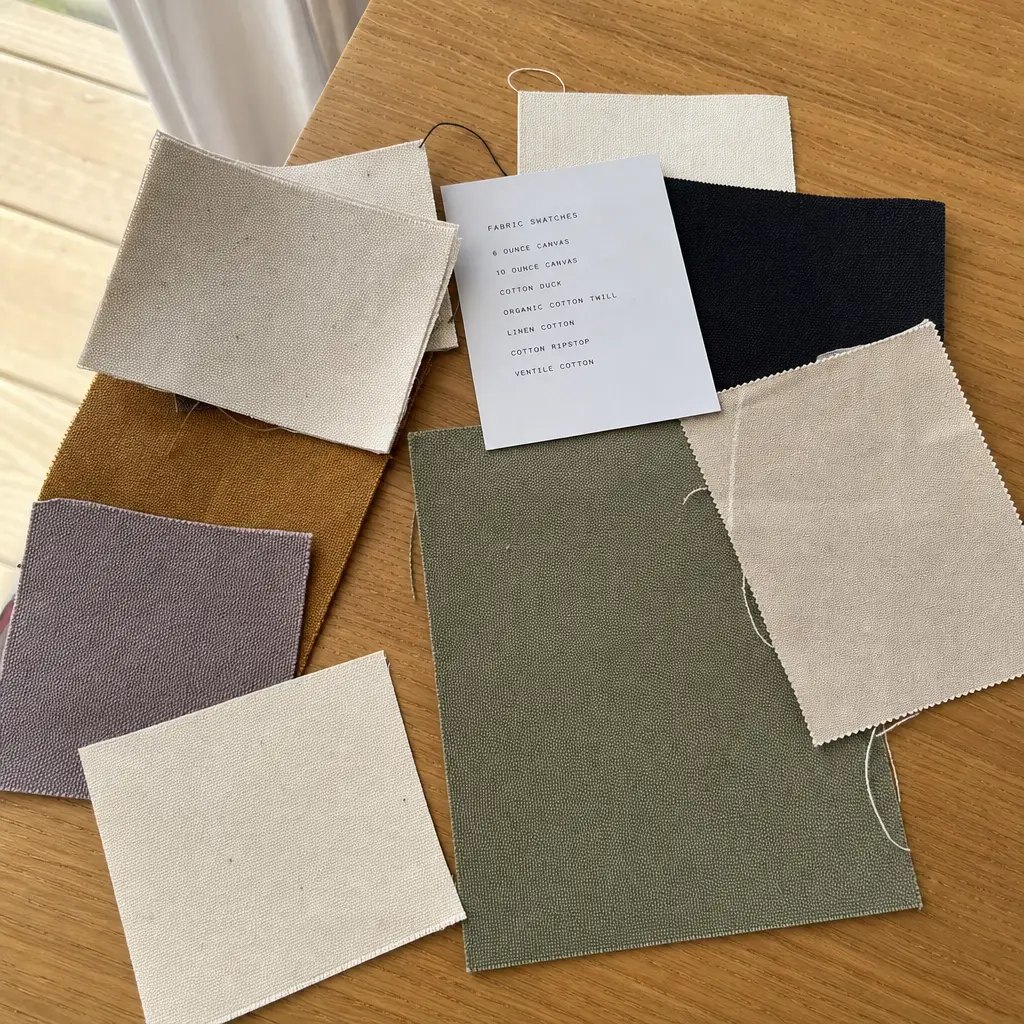
- Can you provide a fabric swatch, bulk fabric reference, and any available shrinkage or colorfastness information, especially if dyed or washed canvas is requested?
- Which zipper size, zipper type, tape material, slider material, slider finish, puller style, end-stop method, and zipper tape color are included?
- What internal clearance do you recommend for our actual A4 or US letter document stack, including catalog inserts and any thicker cards?
- What lining material, pocket depth, seam allowance, edge finishing, thread type, stitch density, and reinforcement points are included in the quoted construction?
- Which branding method do you recommend for our artwork on natural canvas, and what minimum line thickness or text height should we avoid for clean production?
- What file format, logo size, color reference, placement measurement, and artwork tolerance do you need before making the printed pre-production sample?
Quality-control points to confirm
- Finished external length and width should normally be controlled within about ±5 mm for soft document portfolios unless padding, gussets, or stiffeners require a different written tolerance.
- Internal usable space must be checked with the actual paper size and agreed document stack thickness, not only by measuring the outside of the portfolio.
- Logo placement should be measured from fixed edges or seams; a practical tolerance is often ±3-5 mm depending on logo size, print method, and panel shape.
- Canvas weight should be verified against the approved standard or supplier specification; bulk fabric should not be substituted with a visibly lighter handfeel after sample approval.
- Zipper must open and close smoothly across the full path without skipped coil, broken teeth, loose end stops, twisted tape, sharp puller edges, or fabric caught in the seam.
- Zipper corners and ends should be reinforced and cleanly stitched because these points receive repeated stress when portfolios are filled and opened daily.
- Print should show correct artwork, readable small details, acceptable ink coverage on textured canvas, no obvious smearing, no unacceptable dry-rub transfer, and no peeling after normal handling.
- Canvas surface should be free from oil stains, mildew odor, large dark marks, broken yarns, severe shade mismatch, and visible defects inside the logo area.
- Natural slubs, neps, and minor texture variation should be accepted only when defined in advance and when they do not weaken the fabric or interrupt logo readability.
- Seams should be secure with consistent stitch density, no open seams, no skipped stitching at corners, no loose pocket edges, and no excessive thread tails on visible areas.