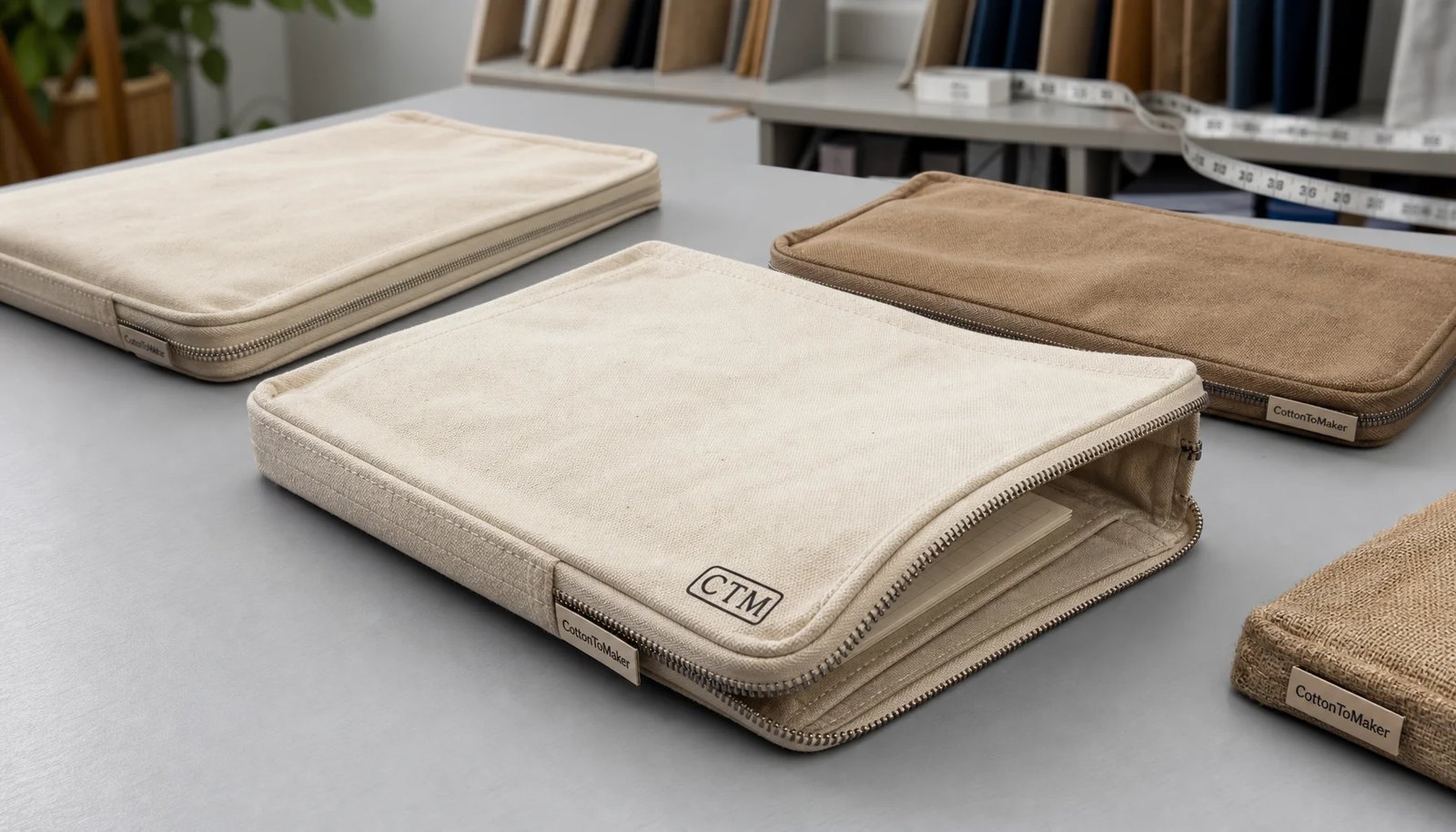
Start With The Use Case, Not The Fabric Name
For trade show exhibitors, a canvas zipper portfolio is usually doing two jobs at once. It is a branded giveaway or staff kit, and it is also a working folder for brochures, contracts, badge cards, pens, tablets, or price sheets. The material choice should come from that use case. A portfolio that only carries a thin brochure can use lighter canvas with a lining. A portfolio that needs to survive three show days, hotel transfers, and follow-up meetings needs stronger fabric, better zipper tape, and reinforced corners.
The common RFQ mistake is writing only “canvas zipper portfolio with logo.” That leaves the supplier to choose the cheapest canvas that can technically be sewn into the shape. Quotes will look competitive, but samples may feel soft, collapse when empty, or show zipper waves along the edge. A better RFQ gives the factory a target structure: finished size, document capacity, outer canvas weight, lining, zipper type, reinforcement, print area, packing method, and inspection expectations.
- For A4 documents, allow internal usable space larger than 210 x 297 mm plus seam allowance and pocket opening tolerance.
- For US Letter, confirm 8.5 x 11 inch paper fit separately; A4 and Letter are close but not interchangeable for tight pockets.
- For tablet use, provide the actual device size with case thickness instead of only screen size.
- For exhibitor staff kits, define expected contents by weight so corner reinforcement and zipper strength are not guessed.
Canvas Weight And Handfeel
Canvas weight is the first cost and quality driver. For zipper portfolios, 10 oz canvas, roughly 300-340 GSM, is workable for large promotional orders when the lining or inner board gives enough structure. It prints well for simple logos and keeps freight weight reasonable. The tradeoff is handfeel: if the portfolio is large and not reinforced, it can feel more like a soft pouch than a business organizer.
A 12 oz canvas, usually around 380-420 GSM, is the practical middle range for most trade show buyers. It has enough body to hold a rectangular shape, accepts screen printing cleanly, and does not make sewing corners too bulky. For premium merchandise, 14-16 oz canvas can look substantial, but the buyer must review zipper curves, corner thickness, and carton weight. Heavy fabric is not automatically better if the finished portfolio becomes stiff, expensive to sew, or hard to close when filled.
- Use 10 oz canvas for budget event giveaways with lighter contents and lining support.
- Use 12 oz canvas for balanced cost, printability, and structure.
- Use 14-16 oz canvas for premium gifts after approving a real sample with the final zipper and binding.
- Request both oz and GSM because suppliers in different regions may quote fabric weight differently.
Natural, Dyed, Washed, Or Coated Canvas
Natural cotton canvas is popular because it gives a clear sustainability and craft signal without needing complicated finishing. It is also more forgiving for one-color screen print. However, natural canvas has visible seed flecks and shade variation. If the buyer wants a clean corporate white or precise brand background, bleached or dyed canvas should be discussed early, because it changes MOQ, lead time, and color approval work.
Washed canvas gives a softer handfeel but can shrink and distort panels if the construction is not planned for it. Coated or laminated canvas can add water resistance and stiffness, but it changes the print method and may create odor or crease marks after packing. For a trade show portfolio, the safest route is often unwashed 12 oz canvas with lining and reinforcement. Move to washed, dyed, or coated fabric only when the brand requirement justifies the extra sampling and tolerance control.
- Natural canvas: good for simple logos, lower dye risk, visible cotton flecks.
- Bleached canvas: cleaner look, higher risk of stains showing during sewing and packing.
- Dyed canvas: stronger brand color, higher MOQ and shade lot control needed.
- Washed canvas: softer feel, but sample must confirm shrinkage, zipper shape, and size tolerance.
- Coated canvas: more structure or water resistance, but print adhesion and folding marks need testing.
Lining, Pockets, And Internal Structure
The inside of the portfolio often decides whether the product is useful or just attractive. A 210D polyester lining is enough for many event folders and keeps cost controlled. For heavier use, 300D polyester or cotton lining feels more substantial. Non-woven lining can reduce cost, but it is less durable around pocket openings and may not match the buyer’s expected business gift quality.
Pocket layout should be specified by usable dimensions, not by a rough sketch alone. A brochure pocket that measures correctly on the pattern may lose space after seam allowance and binding. Pen loops need enough diameter for common promotional pens. Card pockets must hold business cards without becoming too tight after stitching. If the buyer wants a tablet pocket, the factory needs device size, case thickness, elastic position, and whether padding is required.
- State internal pocket opening width and depth after sewing.
- Use real brochures, catalogues, cards, and pens during sample approval.
- Add reinforcement at pocket stress points when staff will use the portfolio daily during a show.
- Avoid too many decorative pockets if the order is cost-sensitive; each pocket adds cutting, sewing, and inspection time.
Zipper Choice And Corner Construction
For canvas zipper portfolios, a No. 5 nylon coil zipper is usually the most stable choice. It bends around corners better than many metal zippers, weighs less, and is less likely to scratch printed surfaces during packing. Metal zippers can look more premium, but they add cost and stiffness. If the portfolio has a full zip-around opening, the zipper must be tested at the corner curve, not only on a straight sample strip.
The slider and puller deserve more attention than buyers usually give them. Many failures happen because the slider is weak, the puller is too small for daily use, or the zipper tape is sewn too close to thick canvas layers. Corner reinforcement, binding tape, and bar tacks help prevent the product from twisting or tearing when filled. The approved sample should be opened and closed repeatedly with documents inside, because an empty sample can hide zipper tension problems.
- Specify No. 5 nylon coil zipper for most standard orders.
- Define zipper tape color, slider finish, and puller shape in the RFQ.
- Review zipper smoothness at corners after the portfolio is filled.
- Use binding and bar tacks at stress points instead of relying only on the main seam.
Print Method And Logo Placement
Screen printing is the normal choice for solid trade show logos on canvas zipper portfolios. It gives good coverage, controlled cost, and reliable repeatability for one to three colors. The artwork should include Pantone references, print size, position from the finished edges, and whether the logo must avoid seams, pockets, folds, and zipper pressure points. A large front logo can look clean on a flat sample but crack or distort if it crosses a fold line.
Heat transfer is useful for gradients or multi-color sponsor artwork, but the film can look shiny on coarse natural canvas. Embroidery gives a premium feel but can pucker lighter canvas and may not suit small text. Woven labels or side labels are often better for subtle branding because they avoid ink coverage issues and remain consistent across fabric lots. The buyer should approve print on the actual bulk fabric, not on a smoother substitute swatch.
- Use screen print for bold, solid logos and event marks.
- Use heat transfer only after approving film feel, edge clarity, and wash or rub performance.
- Use embroidery on heavier canvas with backing and stitch density control.
- Use woven labels for small brand marks, retail styling, or multi-color logos with fine detail.
- Keep important artwork away from zipper edges, rounded corners, and heavy fold zones.
MOQ And Cost Drivers
MOQ is not only about the factory’s sewing line. It is also about fabric purchasing, dyeing, zipper tape, lining color, labels, packaging, and print setup. A supplier may accept a lower MOQ for a natural canvas portfolio using stock zipper tape and standard lining. The same design in dyed canvas with custom zipper puller and printed lining may trigger several separate supplier MOQs before production can start.
To compare quotes properly, separate the base product from optional upgrades. One supplier may quote a low unit price using 10 oz canvas, non-woven lining, and a basic zipper. Another may quote 12 oz canvas, 210D lining, reinforced corners, and better packing. Without a shared specification sheet, the cheaper quote may simply be a thinner product. For distributor and importer RFQs, it is useful to request a base option plus upgrade lines so the buyer can decide where the money improves actual performance.
- Main cost drivers: canvas weight, dyeing, lining grade, zipper quality, pocket count, reinforcement, print area, and packing.
- Hidden MOQ drivers: custom lining color, custom zipper tape, branded puller, woven label, retail insert card, and individual carton.
- Cost-saving route: keep one body fabric and one zipper color, then vary logo printing by sponsor or region.
- Premium route: upgrade zipper, lining, reinforcement, and label before adding complicated outer shapes.
Sample Approval With Acceptance Criteria
A trade show order should not move to bulk production on photos only. The buyer needs a physical sample or at least a pre-production sample using the confirmed fabric, zipper, lining, print, and pocket layout. The sample should be tested as the final product will be used: loaded with documents, zipped around corners, carried in a tote or carton, and placed flat on a meeting table. This reveals twisting, zipper resistance, print cracking, and pocket fit problems early.
Approval comments should be measurable. Instead of writing “make it stronger,” specify reinforcement at corners, a heavier lining, or a revised zipper sewing distance. Instead of “logo too low,” provide the exact distance from the bottom edge or zipper edge. Good sample feedback reduces argument later because the factory can convert comments into pattern, material, or process changes.
- Measure finished width and height against the approved spec and tolerance.
- Test zipper opening and closing at least 20 cycles on the sample with contents inside.
- Rub the printed logo with a dry white cloth and inspect obvious transfer.
- Insert the actual brochure, price sheet, business card, pen, and tablet if required.
- Photograph approved front, back, inside, zipper corner, label, and carton packing for production reference.
Packing And Shipping For Event Deadlines
Packing affects both appearance and landed cost. Canvas portfolios should usually ship flat or lightly nested, with the printed face protected from zipper pressure and carton abrasion. Tight folding can leave creases across the logo, especially on coated canvas or heavy ink coverage. For natural cotton canvas, moisture control matters because long sea freight and humid warehouse storage can cause odor or mildew risk if cartons are packed with excess humidity.
For trade show delivery, carton planning should be done before the final quote is accepted. The buyer needs units per carton, carton dimensions, gross weight, and pallet quantity to estimate freight and venue handling. Air shipping a bulky portfolio order can become expensive quickly, so a slightly thinner product or smarter carton count may matter more than a small unit price difference. If the goods ship to a 3PL for kitting, carton marks and inner packing sequence should match the kitting workflow.
- Request flat packing whenever possible to protect the front print and portfolio shape.
- Use separators or paper where zipper pullers may press into printed panels.
- Confirm export carton strength and moisture protection for sea freight.
- Get carton size and gross weight before comparing landed cost.
- For direct-to-venue shipments, confirm carton labels, delivery window, and receiving requirements early.
Lead Time Risk And Quote Data
Canvas zipper portfolios have more moving parts than a simple tote bag, so lead time should be planned from material approval, not only from deposit date. Fabric booking, zipper sourcing, lining purchase, print screens, sample revisions, cutting, sewing, trimming, inspection, and packing all sit on the schedule. Dyed canvas, custom zipper tape, molded pullers, and printed lining add time because they depend on outside material suppliers.
A useful quote should give the buyer enough data to compare production risk, not just unit price. For each supplier, collect fabric weight, lining spec, zipper spec, print method, MOQ, sample fee, sample lead time, bulk lead time, carton details, payment terms, and inspection options. When two quotes are close, the better supplier is often the one that gives clearer construction details and flags risk before production, because that reduces last-minute show delivery problems.
- Build schedule from artwork approval, material confirmation, sample approval, production start, inspection, and shipment booking.
- Leave buffer for one sample revision if the product includes custom pockets or heavy branding.
- Treat vague lead time wording carefully; define what event starts the clock.
- Compare landed cost using carton volume and gross weight, not unit price alone.
- Keep a fallback plan for air freight only after seeing packed carton volume.
Specification comparison for buyers
| Spec decision | Recommended option | When it fits | Buyer risk to check |
|---|---|---|---|
| Outer canvas weight | 12 oz cotton canvas, about 380-420 GSM, pre-shrunk if full-panel printing is required | Most trade show portfolios where the buyer wants a firm handfeel, good print surface, and reasonable freight weight | Too light will wrinkle and feel promotional; too heavy can increase sewing difficulty, carton weight, and zipper waviness |
| Budget fabric option | 10 oz cotton canvas, about 300-340 GSM, with non-woven or 210D lining for structure | High-volume giveaways, distributor programs, or one-event campaigns with tighter unit cost targets | Portfolio may collapse when empty unless reinforcement board or lining is specified clearly |
| Premium fabric option | 14-16 oz canvas, about 450-540 GSM, washed or enzyme-washed only after testing shrinkage | Retail-quality exhibitor gifts, VIP meeting kits, or brand merchandise sold after the show | Heavy fabric may blunt corners, distort zipper curves, and require higher needle size and slower sewing |
| Lining and inner pockets | 210D polyester lining for standard use; 300D or cotton lining for better feel; add card, pen, tablet, and document pockets by measured size | Buyers who need the portfolio to carry contracts, brochures, badge cards, or tablets during booth meetings | Unclear pocket dimensions cause samples that cannot hold A4, Letter, or tablet sizes; lining color may show through natural canvas |
| Zipper specification | No. 5 nylon coil zipper for smooth opening; No. 5 metal zipper only for premium styling after abrasion review | Nylon coil suits most trade show orders because it is lighter, flexible, and less likely to scratch print areas | Cheap sliders fail first; request zipper pull test, slider finish, puller shape, and whether zipper tape color matches canvas or contrast trim |
| Print method | Screen print for solid logos; heat transfer for gradients; embroidery or woven label for a premium low-color mark | Screen print is usually best for single-color CTM-style front branding and distributor logos | Large ink coverage on unwashed canvas can crack at folds; transfer film can look plastic on coarse canvas unless sampled |
| Closure and reinforcement | Full zip-around closure with reinforced corners, binding tape, and bar tacks at stress points | Trade show staff who carry documents, sample sheets, small catalogues, chargers, and pens all day | Corners are the common failure point; weak binding or no reinforcement makes the product look twisted after packing |
| MOQ logic | Use one body fabric, one lining color, and one zipper color for lower MOQ; separate MOQ applies to dyed canvas, custom lining, molded puller, or woven labels | Importers consolidating several sponsor logos or regional show orders under one base item | Quote may hide separate MOQs for zipper tape, dyed fabric, printed lining, or custom packaging |
| Packing format | Individual polybag or paper band plus flat export carton with moisture control; avoid tight folding across printed panels | Orders shipped to show venues, 3PLs, distributor warehouses, or kitting centers | Creases, trapped humidity, and carton compression can damage canvas appearance before the event starts |
Buyer checklist before sampling
- Confirm final portfolio size by the document standard: A4, Letter, legal pad, tablet, or catalogue bundle thickness.
- Specify outer canvas weight in oz and GSM, not only the word canvas.
- Define whether the fabric should be natural, bleached, dyed, washed, or laminated.
- State lining material, lining color, pocket layout, and pocket usable dimensions.
- Choose zipper type, zipper size, tape color, slider finish, puller style, and opening direction.
- Provide artwork size, print colors, Pantone references, placement from edges, and whether the logo crosses seams or folds.
- Set sample acceptance criteria for fabric handfeel, zipper smoothness, print rub resistance, seam straightness, and inside pocket fit.
- Request carton dimensions, carton weight, units per carton, packing method, and whether the portfolio ships flat or lightly folded.
- Build the schedule around artwork approval, material booking, pre-production sample, bulk production, final inspection, and vessel or air cutoff.
- Separate required items from optional upgrades so suppliers can quote a base version and premium alternatives clearly.
Factory quote questions to send
- What is the exact outer fabric weight in oz and GSM, and is the canvas greige, bleached, dyed, washed, or pre-shrunk?
- Can the quoted canvas pass a basic rub test after printing, especially on darker ink over natural cotton canvas?
- What lining material and GSM are included in the quoted price, and can the lining color be changed without increasing MOQ?
- Which zipper brand or zipper grade is quoted, what is the zipper size, and what pull strength can the slider and tape meet?
- Are reinforcement board, binding tape, corner stitching, and bar tacks included, or are they quoted as upgrades?
- What is the MOQ for the base portfolio, and what separate MOQs apply to dyed canvas, custom zipper tape, woven labels, molded pullers, or retail packaging?
- How many sample rounds are included before bulk production, and what is the sample lead time after artwork and material confirmation?
- What are the carton dimensions, gross weight, and units per carton for sea freight and air freight planning?
- What inspection standard does the factory use for AQL, and which defects are considered major for zipper, print, stains, and size variance?
- What production lead time starts after deposit, artwork approval, or pre-production sample approval?
Quality-control points to confirm
- Finished size tolerance should normally stay within plus or minus 5 mm for width and height on standard portfolios, unless the design includes heavy padding or washed canvas.
- Zipper must open and close smoothly for the full length without skipped teeth, slider snagging, or fabric caught near corners.
- Print placement should stay within plus or minus 3 mm from approved sample position for front logos and within plus or minus 5 mm for larger panels.
- Screen print should pass dry rub testing with no obvious color transfer and should not crack when the portfolio is flexed at normal use points.
- Seams, binding, and corner reinforcement should be straight, secure, and free from loose thread clusters on visible front and inside panels.
- Inner pockets must fit the intended documents or devices using real samples, not only paper measurements.
- Canvas surface should be free from oil marks, heavy slubs in logo areas, mildew odor, and inconsistent dye lots across the same order.
- Cartons should be dry, export grade, correctly marked, and packed to prevent zipper pressure marks on printed front panels.